The Things That We Love

by James Wallace Harris, 6/27/26

Susan and I just finished watching The Spoils of Poynton, a 1970 BBC production shown on Masterpiece Theater in 1971. It’s based on a 1897 novel by Henry James. Mrs. Adele Gereth has collected art objects, furniture, knick-knacks, lamps, glassware, and pottery for her entire life. Now that her son Owen is of age and will inherit the house and everything in it, she is distraught to learn that his fiancée, Mona Brigstock, lacks the taste and refinement to appreciate her treasure. So Adele connives to get Owen to marry someone else.

This is how things used to be. Families clung to generations of cherished things. Before my mother died, she wanted to know who wanted what of her things. She assumed that Becky, my sister, and I, as well as some of my cousins, would fight over her favorite things. After she died, I took the photo albums, my sister took some homemade quilts, and we gave away everything else.

I’m currently listening to Whistler, the new novel by Ann Patchett. At one point, Jonathan, the husband of the main character, Daphne Fuller, leaves her for several days to return home after his mother’s death to sort through her possessions with his siblings. Daphne begs Jonathan to hire an estate cleanout instead of putting himself through weeks of agony.

When Susan’s parents died, we bought their house because Susan and her brothers were too sentimental to let it go. So we lived with Robert and Mary’s stuff for a very long time. It was actually better than our stuff. And when my friend Janis moved to Mexico, we took in a bunch of her stuff. I think of these people by the things they owned.

All of this makes me think about the things I love to buy and own. Isn’t it weird how we love physical objects so intently? Susan and I are terrible at home decor. Our favorite kind of furniture is the La-Z-Boy. We have six single chairs and one double. We also love large screen TVs. My den has a 65″ TV, and her living room has a 75″ TV. We have hundreds of DVDs. And I have hundreds of CDs. I also have hundreds of books.

I don’t lust after cars, guns, or sports memorabilia like normal guys. I’m a bookworm, and books are what I get all sappy about. Susan says when I die, she’ll call Goodwill and Salvation Army and ask them to haul off everything I loved. Sometimes I think I should help her out by giving most of my books away before I die.

I especially love old science fiction magazines. I’d rather have them than diamonds. I would trade them for 19th-century artwork, but I’m realistic enough to know I’m no art collector. Besides, impressionist artworks really don’t go with La-Z-Boys.

The other day, I watched a YouTube video of the actor Paul Giamatti being interviewed about his book collecting. I felt a great affinity with these two guys. These are my people. I cherish crappy old paperbacks, too.

I always marvel when I visit friends and see how they’ve made their houses into museums of the things they admire. It makes me feel bad that I don’t love beautiful home furnishings. Our decor is functional for watching TV, listening to music, and reading.

After I’ve died, and someone is throwing out my science fiction magazine, I doubt they will see the beauty I saw. They won’t know that every issue of F&SF, Galaxy, or Astounding triggers memories. Most people remember the people they knew and the stories about them. I remember writers and the stories they wrote.

I wish I had a manor house and a lifetime of collected treasures like Adele Gereth, including my library of books and magazines. I love my house, even though it’s junky and cluttered. I do regret not having more refined tastes. But I never cared about dishes or doodads. My grandmother collected figurines of dogs. She had hundreds. That was cool. I wish I had gotten one to remember her by – a collie dog.

In Whistler, Jonathan’s first wife collected paintings of rabbits. I wish I had thought of something like that when I was young. Some kind of modest art that people throwing my stuff away could have identified me with. I’ve always admired 19th-century drawings by naturalists and scientists.

I visit the Friends of the Library bookstore once a week. People donate the kind of things I treasure. In fact, a lot of my treasure came from that bookstore. I think I’ll arrange to give my stuff to them when I die. I’ve already given them thousands of books, records, and CDs over the decades. It makes me sad when I see things I once loved left on the shelves for weeks. Hopefully, they will all find a new home with someone to love them. I guess I’m no different than Adele Gereth.

JWH

Are My Thoughts Like Your Thoughts?

by James Wallace Harris, 6/15/26

In Chapter 3, “Thought” from A World Appears, Michael Pollan works with psychologist Russell T. Hurlburt, who has been collecting thought diaries from his subjects for over fifty years. The technique Hurlburt uses is called Descriptive Experience Sampling (DES). Subjects wear a device that randomly beeps in their ears. When they hear the beep, they write down what was going on in their head just before the beep. Hurlburt says:

I have sampled with some people whose inner experience is characterized almost exclusively by inner speech; with others whose inner experience is characterized almost exclusively by images, or by sensory awareness, or by unsymbolized thinking, or by feelings; with others whose inner experience is characterized by a combination of all those; with some whose inner experience is characterized by many simultaneous events; with others whose inner experience is characterized almost exclusively by one event at a time; and so on. So, yes, I think people are importantly different when it comes to inner experience.

So when you ask a person, “What are you thinking?” the answer might not be anything like how you think. For the most part, people assume everyone thinks like they do, but Hurlburt’s research shows that isn’t true.

I’ve kept a running chatter in my head my whole life, except for when I’m unconscious. However, as soon as I wake up, the voice returns. It’s weird to think that some people don’t have this inner voice. That makes me think of the science fiction novel Blindsight by Peter Watts. Watts imagines an intelligent alien race that lacks conscious self-awareness.

My inner voice is almost always analytical, always commenting on what I’m experiencing. If I have a pain in my abdomen, the voice is proposing theories as to what is causing the pain. But it’s not always like this.

When I was younger, I had constant fantasies about everything. I was a little Walter Mitty. I’ve always had imaginary conversations in my head, usually about what I was going to talk about with people in the future. Of course, I had lots of sexual fantasies, but I had many more kinds of fantasies. If I saw a movie and didn’t like the plot, I’d reimagine it with a new plot. If I didn’t like the actors, I’d recast the film in my head. I’ve mentally written hundreds of science fiction stories. For every blog post I write, I’ve already written it several times in my thoughts.

I found it fascinating that Hurlburt said some people don’t do this either.

But then, when I discovered I had aphantasia, my mind boggled trying to imagine how other people see inside their minds. I do sometimes have flashes of visual imagery. My dreams are very vivid. And sometimes if I’m tired in just the right way, I have waking dreams. When I was young and smoked dope, the visual floodgates would open.

I do “visualize” things in my head, but without pictures. I have good spatial awareness and can intuit how machines work. I have another sense for how things look. It’s very hard to describe. I wonder if it’s like how blind people develop spatial awareness?

Hurlburt’s research also showed that people see and think less in their heads as they age. That makes me wonder if I had better mental imagery when I was younger. I do feel my inner chatter is slowing.

One reason I believe that is because when I first tried to meditate in the 1970s, I had a hell of a time quieting that inner voice. Now I can relax, and it will shut up for about as long as I can hold my breath. And it feels like that. The longer I shut up mentally, the pressure builds, sort of like needing to take a breath when you’re holding it. Thoughts eventually explode out.

I’ve often wondered why most people aren’t addicted to music like I am. When I play music, it stimulates my brain in many ways. My “thinking” goes into overdrive, and my mind is flooded with ideas. Also, music creates all kinds of emotions or enhances existing emotions. Music makes me mentally high, but it’s unlike the old marijuana high that made my body high, too. I need to hear one to two hours of music a day, so it does feel like an addiction.

I’m not sure what Hurlburt means by “symbolized” and “unsymbolized thinking.” I might do that, or I might not. Nor do I know what he means by only being able to think of one event at a time. I know I’m experiencing many sensory events at once, but I think I only focus on one at a time. Are some people multichanneled? Is that like having multiple picture-in-picture on your inner TV screen?

I have to assume I’m a bookworm because of the way I think. Reading fiction is like having your own artificial reality goggles. However, I don’t visualize scenes like other readers do.

I assume I write blogs because it feels like I’m organizing my thoughts. I assume that I would think like a writer, say, like Michael Pollan. But the more I read about Hurlburt, the more I wonder.

The fact that there is so much variation from person to person in our modes of thinking is itself an important finding of Descriptive Experience Sampling. Most of us assume that our inner lives must be substantially similar—not necessarily in content but in the form our thoughts take. Hurlburt has suggested that we fail to recognize the diversity of thinking styles because we lump them all together under that single word—thinking—and assume we mean the same thing by it, though in actuality we don’t.

“When a visualizer says they are thinking about something,” Hurlburt said, “they mean they are seeing a visual image of something, and if they are predominantly inner speakers, they mean ‘I was talking to myself.’ And the reason for this, I speculate, is that when you were two and learned that when your mother, or whoever it was, says, ‘I was thinking,’ that meant something that was happening inside Mom that you couldn’t see. So when I want to tell you whatever is going on inside me, that’s ‘I’m thinking.’ But ‘thinking’ means something different from person to person.” If Hurlburt is right, the word thinking has allowed us to overlook these differences and make the unwarranted assumption that other people are having inner experiences more or less like our own.

Pollan, Michael. A World Appears: A Journey into Consciousness (pp. 146-147). Penguin Publishing Group. Kindle Edition.

Pollan was surprised when Hurlburt expressed what his DES diaries suggested:

Hurlburt proceeded to tell me that he didn’t think I had much inner experience at all. I was on the far end of a spectrum that ran from a rich inner life of words, images, and sensations to one…well, one lacking all that. Apparently, the fact that I had so much trouble distinguishing context from the moments under analysis (and kept bringing up things he considered irrelevant) suggested to him that I was, in effect, backfilling moments empty of actual inner experience.

I was flabbergasted, and reacted a little defensively.

Hurlburt said that he had arrived at his conclusion by a process of elimination: Most of my beeps lacked words, lacked images, lacked sensory awareness. Okay, but what about unsymbolized thinking? My non- or preverbal thought processes seemed to fall neatly into this mode. Hurlburt acknowledged that we had turned up a few instances of this, but “unsymbolized thoughts are complete thoughts,” he explained, not the misty “gists” of thought I had described. Subtract those and he was left with one uncomfortable possibility: that I didn’t have nearly as much of an inner life as I’d always assumed.

My interiority, he seemed to be suggesting, was sparsely furnished.

Has it always been this way? I wondered. Hurlburt pointed out that the ability to generate inner experiences depends on cognitive resources that decline with age. For example, he’s found that as people get older, their inner seeing tends to deteriorate, fading from full-color imagery to black and white. He cited James, who writes that “the older men are and the more effective as thinkers, the more, as a rule, they have lost their visualizing power…. The present writer observes it in his own person most distinctly.” Hurlburt thinks that all forms of inner experience may be subject to the same fading over time.

Pollan, Michael. A World Appears: A Journey into Consciousness (pp. 148-149). Penguin Publishing Group. Kindle Edition.

Can we know ourselves? Many philosophers and scientists say we can’t understand consciousness because we’re studying it from the inside out. Wouldn’t it be wonderful to step outside of ourselves and study who we are?

It’s quite commonly known that people see colors differently. For example, when I play Rummikub with friends, they claim the green tiles are blue. This is really no different than how different monitors show the same .jpg file with different-looking colors.

This morning, my inner voice was chatting about how we see the world, and asked if machines perceive reality differently. Does a camera see a vista as objective reality? Or are the chemicals in film, and the sensors in digital cameras, also limited by physical constraints?

It is rather weird that we have no idea what reality looks like. And it seems we have no idea what we really look like on the inside.

JWH

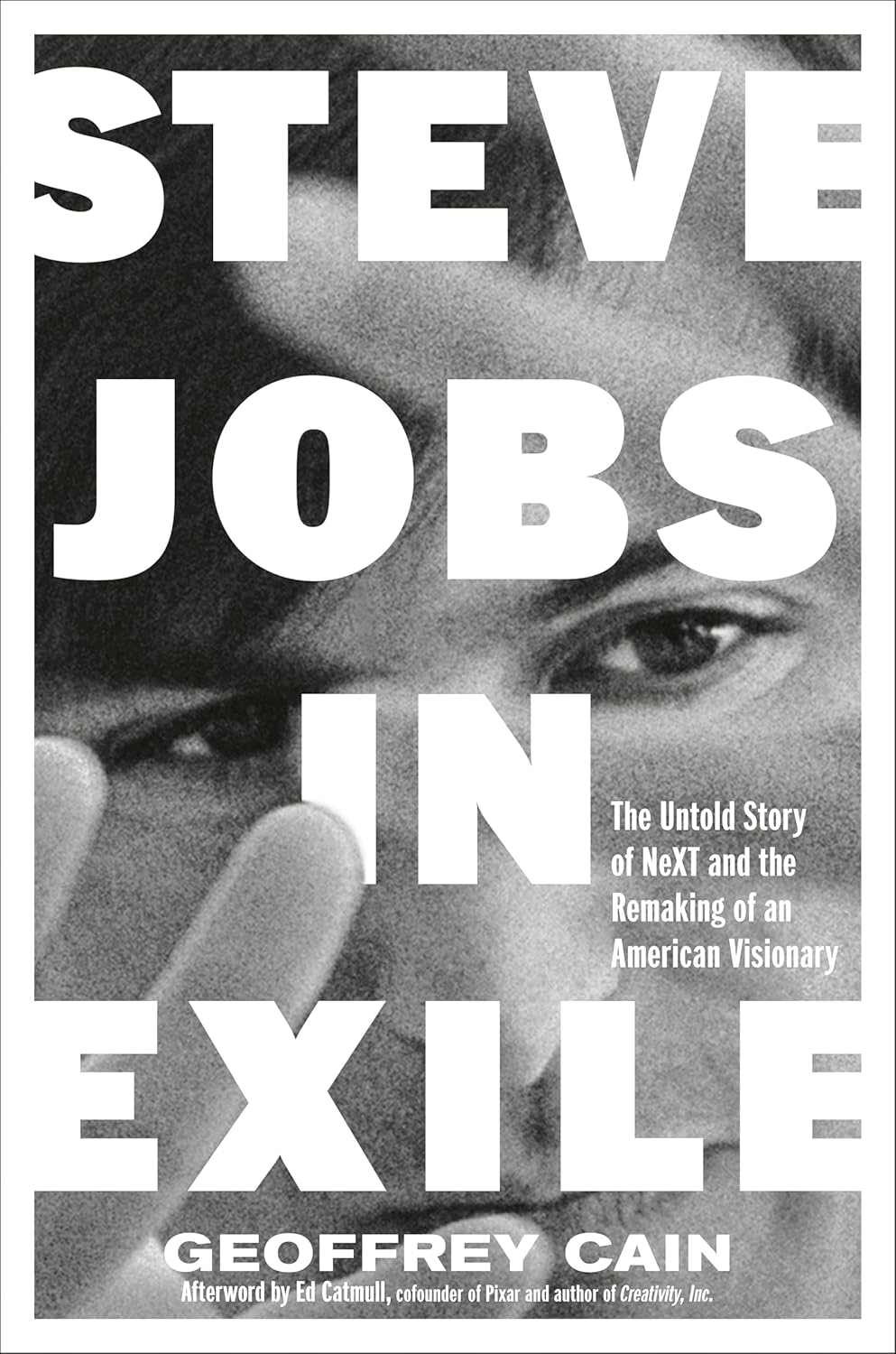
STEVE JOBS IN EXILE by Geoffrey Cain

by James Wallace Harris, 6/1/26

When I first saw Steve Jobs in Exile: The Untold Story of NeXT and the Remaking of an American Visionary by Geoffrey Cain, advertised on Facebook, I thought, “Geez, is there anything left unsaid about Steve Jobs?” After all the biographies and biopics, is there anything new to be revealed about the man? I decided to take a chance because the book focuses on the twelve years of the NeXT Computer. Besides, I had not read The Second Coming of Steve Jobs by Alan Deutschman in 2000, which covered the same period.

If I were to pitch this book to the average reader, I’d say: “Steve Jobs in Exile is about a world-class asshole who finds humility.” And for folks who dream of becoming entrepreneurs, I’d say, “Steve Jobs in Exile is a detailed checklist of what not to do.” This book really is about the man, and not the technology.

Interestingly, Walter Isaacson has written extensive biographies of both Steve Jobs and Elon Musk. Do people read them because they are fascinated with invention or with billionaires? Both men are known for their egotism, arrogance, and cruelty toward the workers they managed. Steve Jobs in Exile is about a young man who achieved two historic successes in his twenties but then fell from grace, only to achieve a third success. Will we ever read about Elon Musk falling from grace and finding humility?

By the way, why does Jobs get so much credit when he wasn’t a programmer or electrical engineer? I give Steve Wozniak credit for the Apple computer. And credit for the Macintosh to the pirate team Jobs assembled. Was NeXT’s eventual redemption due to Jobs? Or despite him? I hoped Steve Jobs in Exile would have been more about the real inventors of NeXT computers and NeXTSTEP.

I had hoped Steve Jobs in Exile would be another Soul of a New Machine by Tracy Kidder – it wasn’t, but I still found it an engrossing read. The first part of the book made me despise Steve Jobs, but eventually Cain convinced me to admire the man a great deal. This nonfiction book was like a novel with a protagonist who grows and ultimately overcomes their faults. The book reignited my addiction to reading about the history of personal computers. I’ll probably go read David Pogue’s new book, Apple: The First 50 Years, soon, even though I’ve read plenty of histories on Apple Computers, too.

I was always a PC guy, and not a Mac guy, until last year. Although I used Macs at work. From 1978 until 2013, my job involved ordering computers, setting them up, and training their users. I worked at a college of education with about 150 faculty and staff, and just under 3,000 students. I’ve probably used every model computer Apple made during those years. I also set up PCs, starting with the first IBM PC with diskette drives. I guess I’ve unboxed and set up over a thousand computers.

Also, back in 1978, I became addicted to computer magazines. I’d go all over town, checking computer stores, newsstands, and bookstores two or three times a week for the latest issues of magazines devoted to computers. That’s when I first learned about Steve Wozniak and Steve Jobs. I wanted an Apple II, but could only afford an Atari 400.

Back in the 1990s, sales reps from NeXT came to our PC user group and demoed the NeXT Cube. Damn, I wanted one of them, but at $10,000, it could only be a fantasy. I guess that’s why I read Steve Jobs in Exile. I remembered that desire for a NeXT computer.

Several years ago, I got the hankering to buy a classic computer like an Apple II or Commodore 64, or even a NeXT Cube. NeXT machines do show up on eBay, such as this one for $5,817.54.

However, after playing with operating system emulators online, I realized that the futuristic NeXT Computer from the 1990s is now horribly primative. Just watch how painful it is to watch NeXTSTEP 1.0 boot up. From time to time, I still hanker for a classic computer. But then I visualize using one, recalling its limitations and why I was always upgrading to a newer computer.

I take consolation in that I’m using Tahoe 26.5 on my Mac Mini M4 right now, which is a descendant of NeXTSTEP. That didn’t stop me from going to Archive.org and reading old issues of NeXTWORLD magazine.

Reading about Steve Jobs again reminded me of how a few men back in the 20th century changed all of our lives. If we filmed It’s A Wonderful Life today, and imagined removing Steve Jobs and Bill Gates, just how different would our society be? Sure, similar devices and operating systems would develop, but would society unfold again like it did? Was the GUI and smartphone inevitable? Aren’t most tech billionaires rich because they got to an idea first, and if they hadn’t, many others would have?

Why are there so many books written about the men who sold us computers, and not about the computers and technology? Did Steve Jobs change society, or did the iPhone?

I’d love to read a detailed history of the graphical user interface (GUI). Was NeXTSTEP really superior to Sun OS, Windows NT, or OS/2? Who really invented the various elements of these operating systems?

JWH

What Exactly is Loneliness?

by James Wallace Harris, 5/30/26

Reading all the stories in the press about America suffering from a crisis of loneliness made me ask: What exactly is loneliness? I’m not sure if it means just being alone. Lots of people live alone and don’t feel lonely. And I’ve heard many people say they feel loneliest at social gatherings. After reading several articles about how people are turning to AI for companionship, this topic became even more intriguing to me. I was especially moved by a story in the New York Times about an old lady in her 80s living alone with a robot.

I’ve been reading books that attempt to explain consciousness. I say attempt, because no one seems to know what it is or how it arises. I’ve decided that our personalities are composed of separate components. This makes me theorize that each component has its own version of loneliness. And since I see every component of our personality existing on a spectrum, I picture describing loneliness like a sound mixing board. Loneliness could be considered a combination of sliders set at different positions. I don’t know if our personalities have 8 tracks or 16, or just 4, but it still leaves a vast array of settings when referring to a single English word.

If you feel lonely, could you answer this question: “I wouldn’t be lonely if I had X.” If X is another person to hang out with, would any person do? Then you might clarify that with, “a person to talk to.” Then I might counter with, “How often have you been talking with someone and been dissatisfied with the conversation?” See where I’m going? When answering the question “I wouldn’t be lonely if I had X,” you need to be very specific. You might need to say, “I wouldn’t be lonely if I had someone to talk to about all the things I’m interested in.” And then meditate on those interests and why you need other people.

Well, this explains why so many people are talking to AIs. AIs tend to suck up to their users and focus on what you like to chat about. They are often sycophants. This also explains why they are so addictive.

If an AI soothes your loneliness, then which part of your personality is it appealing to? We have two types of thinking, fast and slow. (Read: Thinking, Fast and Slow by Daniel Kahneman.) My theory is that the fast-thinking component of our brain is like a large language model (LLM) AI. Both are based on processing information with a neural network, one is biological and the other cybernetic. The similarities are amazing. Just meditate on how complex thoughts bubble up out of your unconsciousness. What’s really funny is that they both get facts wrong, and they both will hallucinate.

Why would your inner LLM be lonely? I wonder if AIs are lonely. They always want to keep the conversation going. Sometimes I feel bad leaving an AI because it always wants to keep talking. Is the urge to talk just a byproduct of neural networks?

By the way, I believe my inner-LLM is writing this essay.

Now the slow-thinking aspect of my mind is different. It can think: “I’m writing an essay.” Or ask: “Why am I writing this essay?” But if a flood of words comes to mind in answer, those are from the fast-thinking component.

I’m not sure if my slow-thinking mind gets lonely. I’ll have to meditate on that. It pretty much makes comments or asks questions. Its sentence structure is simple. It often triggers the fast-thinking component. Or, it comments on the output of the fast-thinking component. But I don’t think it craves conversion with others. I’m not sure, though.

Some people say they like to leave the radio or television on because it makes them feel less lonely. Other people claim pets keep them company. This suggests that conversation isn’t needed. I don’t like living alone. I’ve been married for 47 years. But we spend most of the day in separate rooms. We each have our own hobbies. However, we do watch two hours of television together every day, and we have people over to play games and eat together.

Where I would say I was lonely would be in sharing interests. I have several friends with whom I share certain interests, but I have other interests that I don’t have anyone to share with. That’s why I blog. I let my inner-LLM out by writing. I wonder if I would still write if I had enough friends to talk about all my interests?

The lonely elderly woman in the New York Times article got an ElliQ robot from Washington State’s Department of Social and Health Services. The ElliQ robot doesn’t look like a human or any animal, but it creates an emotional bond with its users. And when I talk to Gemini about topics my friends aren’t interested in talking about, I do feel a kind of kinship.

But do we really want to be friends with machines? And if your definition of loneliness involves physical activities, say riding motorcycles, playing golf, or shopping for antiques, would a machine do?

What components of our personality need physical companionship? Would playing golf with a humanoid robot count? What about playing golf with a robot that looked like a spider? If any golf-playing robot beat you in every game, it probably wouldn’t be much fun. Sometimes loneliness means finding someone like yourself who you can compete.

A great deal of loneliness is solved through work, school, and sports. Being part of a group or team is important. Even a church group or political party counts. I think there is something inside us that thrives on us-versus-them competition. When I was young, I hated going to work. I wanted to be free. But looking back, I’m very nostalgic about the people I met at work. Ditto for school. I hated school, but loved the social contacts. I can’t imagine getting an online education or working from home. I don’t think I was ever lonely at work.

Probably the most fundamental aspect of our personality is sex. Biology is keen on reproduction. I think our hormonal system is a separate component of our being. Its sense of loneliness is different from the fast-thinking LLM in our heads. Being young and horny is a very intense kind of loneliness. I think for many males today, that’s creating a lot of mean political thinking.

Thus, the urge to find a mate is a major factor in solving loneliness. But even that isn’t clear-cut. For some people, all they want is a desirable body to give them an orgasm, while other people want a lifelong companion. I would say if you’re looking regularly at porn, you’re lonely for certain body parts. You might want to think about that.

A friend once gave me a bit of wisdom, which, over the years, I’ve decided is wise. He says people will be anxious in life until they finish school at whatever level they aimed at, get a real job that they don’t think is a shit job, and find a mate for life. All of those might relate to loneliness, but the last one for sure.

I don’t think I feel lonely because I have a wife and friends, but also because I love to read, and I enjoy social media. Just having connections to the larger reality helps.

My book club is reading The Mattering Instinct: How Our Deepest Longing Drives Us and Divides Us by Rebecca Newberger Goldstein. She divides people into islands of what matters to them. Doesn’t the drive to matter relate to our drive not to be alone?

When people say they are lonely, it can mean so many things. For some, it’s not getting laid, but for others, it’s not being married. For other people, loneliness could be resolved by working on a shared project. Loneliness might be cured by talking to a robot or finding someone to share a beer or a joint.

And for many people, other people cause stress, anxiety, depression, and anger. Peace and happiness come from being alone. It’s such a complex subject.

Since I’m getting old, talking with my friends about getting old and ending up living alone conjures up all kinds of fears. What it means to be alone at different times in life also suggests that there are many types of loneliness. Getting near the end of life and being the last person you know must be a very special kind of loneliness.

I think we should move away from thinking loneliness is just being alone. I think we need to explore the infinite reasons why we say we’re lonely.

JWH

Separate Tables (1958) and Mrs. Palfrey at the Claremont (1971)

By James Wallace Harris, 5/26/26

Last Thursday, Bookbub offered me a $1.99 deal on Mrs. Palfrey at the Claremont by Elizabeth Taylor. That deal is no longer available, and the Kindle edition is now $5.99. However, my edition is an NRRB edition, and the current one is from Virago. They each have a different introduction. That makes me wonder about Bookbub deals. Well, that’s neither here nor there. Mrs. Palfrey at the Claremont is a wonderful novel.

I bought the book and started reading it right away because it was about an elderly Englishwoman moving into a hotel that catered to retirees. For some reason, I’ve always liked movies, TV shows, and books where people live in a rooming house or hotel.

But here’s the coincidence I wanted to mention. Thursday night, YouTube offered me Separate Tables, a film about people living at an English residential hotel. You have to wonder just how savvy these AI algorithms are at knowing what we like.

I’ve since discovered there’s a film version of Mrs. Palfrey at the Claremont, also available to watch for free on YouTube. It would have been even eerier if the algorithm had offered me this film last Thursday. And one reason I’m reviewing these two stories together is that the people in the Claremont also ate at separate tables. Both stories are about loneliness. Mrs. Palefrey focuses on older people, and Separate Tables covers everyone.

Mrs. Palfrey at the Claremont, the novel, is a gentle tale about unhappiness that makes you feel good. Laura Palfrey is a widow with one estranged daughter and one indifferent grandson.

Elizabeth Taylor describes her: “She was a tall woman with big bones and a noble face, dark eyebrows and a neatly folded jowl. She would have made a distinguished-looking man and, sometimes, wearing evening dress, looked as Lord Louis Mountbatten might in drag.”

The plot of this novel is rather simple. Mrs. Palfrey is embarrassed that her grandson doesn’t come to visit. She befriends a starving would-be writer, Ludo Myers, who actually likes her. So she tells the other hotel guests that Ludo is her grandson. Keeping up this lie leads to light, pleasant humor. Along the way, we get to know the other elderly guests at the Claremont.

Only one old man, Mr. Osmond, lives among the old women. I sometimes go places where I’m the only old guy among a roomful of old women. So I identified with Mr. Osmond.

Separate Tables is a far more dramatic, edgier tale, on the verge of melodrama. The film is based on two one-act plays, and the story is told through an ensemble cast. David Niven won a Best Actor Oscar, even though his time on screen was short. In all, the film was nominated for seven Oscars, including Best Picture, and won two. The other was for Wendy Hiller for Best Supporting Actress.

Sibyl Railton-Bell (Deborah Kerr) is a homely spinster dominated by her mother, Mrs. Maud Railton-Bell (Gladys Cooper). Sibyl is emotionally fragile and is afraid of sex, yet she is attracted to Major David Angus Pollock (David Niven). Pollock is a lonely old man who pretends to be a war hero and has several dark secrets. John Malcolm (Burt Lancaster) is an American hiding out from life at the hotel. He has a tortured soul, drinks, but attracts the hotel manager, Pat Cooper (Wendy Hiller). They talk of getting married. Then Anne Shankland (Rita Hayworth) shows up. She’s an actress who has gotten too old and can no longer dominate men or get parts.

All the actors play against their famous type.

Separate Tables is gorgeous to look at, filmed in widescreen black-and-white. The story flows from one character to the next, bringing all the guests together into a scene I particularly liked. It’s near the end when they are all seated at separate tables, but talking to each other between tables.

Both stories, Between Tables and Mrs. Palfrey at the Claremont, are about loneliness. I’ve known several people who have said they were loneliest at parties, when they were around people. The characters in these two stories are frequently together. The virtue of Elizabeth Taylor’s novel is that the reader hears what’s going on in people’s heads. In contrast to the film, viewers must read the actors’ minds through facial expressions and body language.

I have this odd feeling I’ve seen Separate Tables before, but I have no real memory of it, just a bit of déjà vu. Getting old is a trip. I know I’m trying not to talk about it because it depresses my friends, but I find the experience fascinating, even all the forgetting.

I’ve always assumed that if my wife dies first, I’ll move into some kind of retirement community or assisted living. Most people I know dread the thought of such a lifestyle. I like the idea of having my own room for solitude, but being able to go downstairs and find a community. And I know as I get older and weaker, I’ll be glad to give up working in the yard, taking care of the house, and driving. I think such laziness is why I’m drawn to stories about people living on hotels and rooming houses.

I’m guessing that many of my friends will find these two stories disturbing. My peers hate anything that makes them think about aging. I guess I’m some kind of existential Boy Scout, because I consider such stories to be preparing me for the future.

By the way, the introduction to Mrs. Palfrey at the Claremont in the current edition is by Paul Bailey, who claims to have been Taylor’s inspiration for Ludo. You can read the sample at Amazon to read the introduction, but here’s the part I liked.

I have to begin this appreciation of Elizabeth Taylor’s penultimate novel on a personal note. I was working as an assistant in Harrods when my first book, At the Jerusalem, was published in 1967 – a fact which, for some reason, struck the diarist of The Times as being of interest to the paper’s readers. A year after publication, I met Elizabeth Taylor at a party. She told me how intrigued she had been that a man in his late twenties should have chosen a home for old women as the setting for a novel, and that she had gone to Harrods’ magazine department to see what such a curious creature looked like. She went on to say that she had watched me at work for about an hour, from the vantage of a chair in the adjoining lounge. She smiled as she made this revelation. She had not anticipated seeing someone with a youthful appearance: she had expected me to be just a trifle wizened.

When I read Mrs Palfrey at the Claremont in 1971, I remembered Elizabeth Taylor’s confession. Ludovic Myers, the young man who comes to Mrs Palfrey’s aid when she falls in the street and who subsequently befriends her, is a novelist manqué. Throughout the course of Mrs Palfrey, he is writing a study of old age which – altering a phrase uttered over a pre-dinner sherry by his new, elderly friend – he gives the title They Weren’t Allowed to Die There. He works at Harrods, in the sense that he takes his manuscript into the (now vanished) banking hall, where he scribbles away happily, surrounded by Honourables on their uppers and tired county ladies resting their feet before the train journey back to the shires. Ludo, like me, is an ex-actor, who has done his stint in a tatty repertory company and has no desire to repeat the experience. In other words, I am flattered to think that I gave Elizabeth Taylor a little bit of inspiration for what is undoubtedly one of her finest books.

Taylor, Elizabeth (2011). Mrs Palfrey At The Claremont: A Virago Modern Classic (Virago Modern Classics Book 83) . Little, Brown Book Group. Kindle Edition.

JWH