
by James Wallace Harris, 8/28/26
Today I read in the New York Times, “The Most Important Longevity Term You’ve Probably Never Heard Of” by Dana G. Smith. Doctors are looking for a way to measure how well we’re aging and call it “intrinsic capacity.” They haven’t worked out the details yet, but they want to track five subdomains:
- cognition
- locomotion (strength and mobility)
- sensory capacity (vision and hearing)
- psychological well-being
- vitality (overall energy levels and resilience to physical stressors)
Naturally, young people should pass with flying colors. It’s only when we get older that these functions start to diminish, so it’s important to track our overall potential for aging. They haven’t worked out a scoring system yet, but they want a quantitative indicator that patients and doctors can use.
At 74, I believe I’m losing on cognition, doing better on locomotion, and that vision and hearing are about the same; I’m on an even keel psychologically, but I’m slowly running out of energy.
In other words, I wouldn’t make a 100 on any Intrinsic Capacity score.
Even before I read this article today, I’ve been thinking about how I can measure my cognitive decline. Let’s be honest here: at some point, everyone’s Intrinsic Capacity score will reach zero.
Let’s assume our healthcare system adopts this idea and tests everyone’s Intrinsic Capacity at age 60. It can’t be relative because people are so different. It should be a personal baseline to work from for the rest of our lives.
If at 60 my score was 100, at 74, I imagine it’s about 75 right now, because I feel I have about 25 percent less capacity now than I did then.
Is it possible to improve one’s score? I think so. For example, in the past, my spinal stenosis was so bad I had to give up walking for exercise. But recently, and I guess because of regular physical therapy exercises, I’m back to walking one mile each day.
This is why tracking an Intrinsic Capacity score is such a good idea. It should push older folks to try harder to stay healthy.
My main worry is memory. I don’t have dementia, but I have a whole lot of getting-old forgetting. So I’ve decided to come up with my own method of tracking my memory’s health.
Remember that movie Still Alice from back in 2014? At one point, she was given a memory test, and her doctor told her several words to remember. I didn’t do well taking that test along with her.
A while back on Jeopardy, one of the contestants mentioned that they used a free software program called Anki to help them study trivia. I decided this week to use Anki as the cognitive test portion of my Intrinsic Capacity test.
(AnkiMobile for iOS is $24.99. It’s possible to bypass that cost by using the web version from your phone, but I like supporting the Anki developers. And Anki is far cheaper than many iOS flashcard apps that charge a monthly fee.)
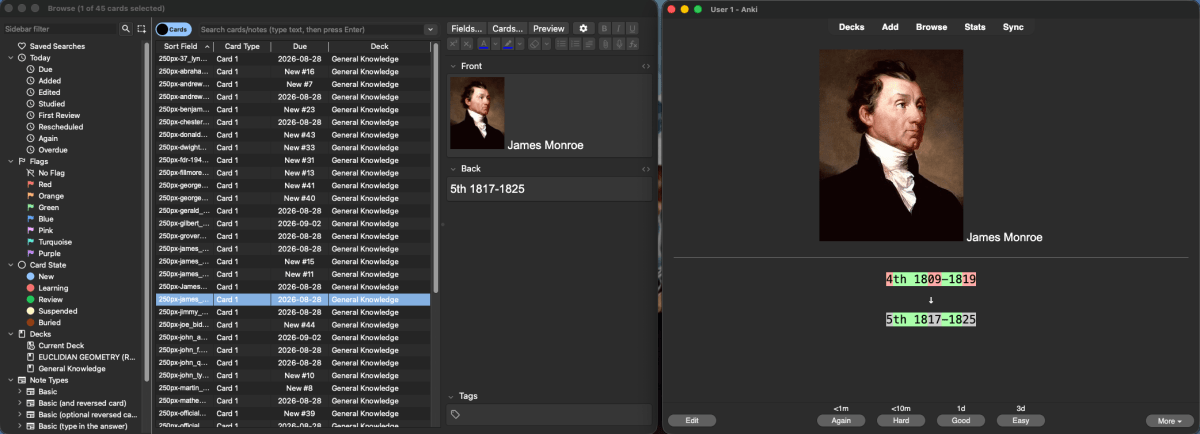
Using Wikipedia, I made Anki flashcards for all the U.S. Presidents. On the front of the cards, I show their name and picture. On the back, I list their order (1st, 2nd, 3rd, …) and the years they were in office. I remember back when Bush the son was president; my niece could rattle off all the presidents in order.
Even after a few days of practicing an hour each day, I can remember a little over half of the content. Where I’m struggling is remembering the years they were in office. When I first started this project, I included the years each president was born and died, but I quickly realized that recalling all those numbers was too much.
I’m studying in two ways. Before I practice with Anki each day, I write out all the details on a legal pad as practice. I’ve read that writing things down is a good way to remember.
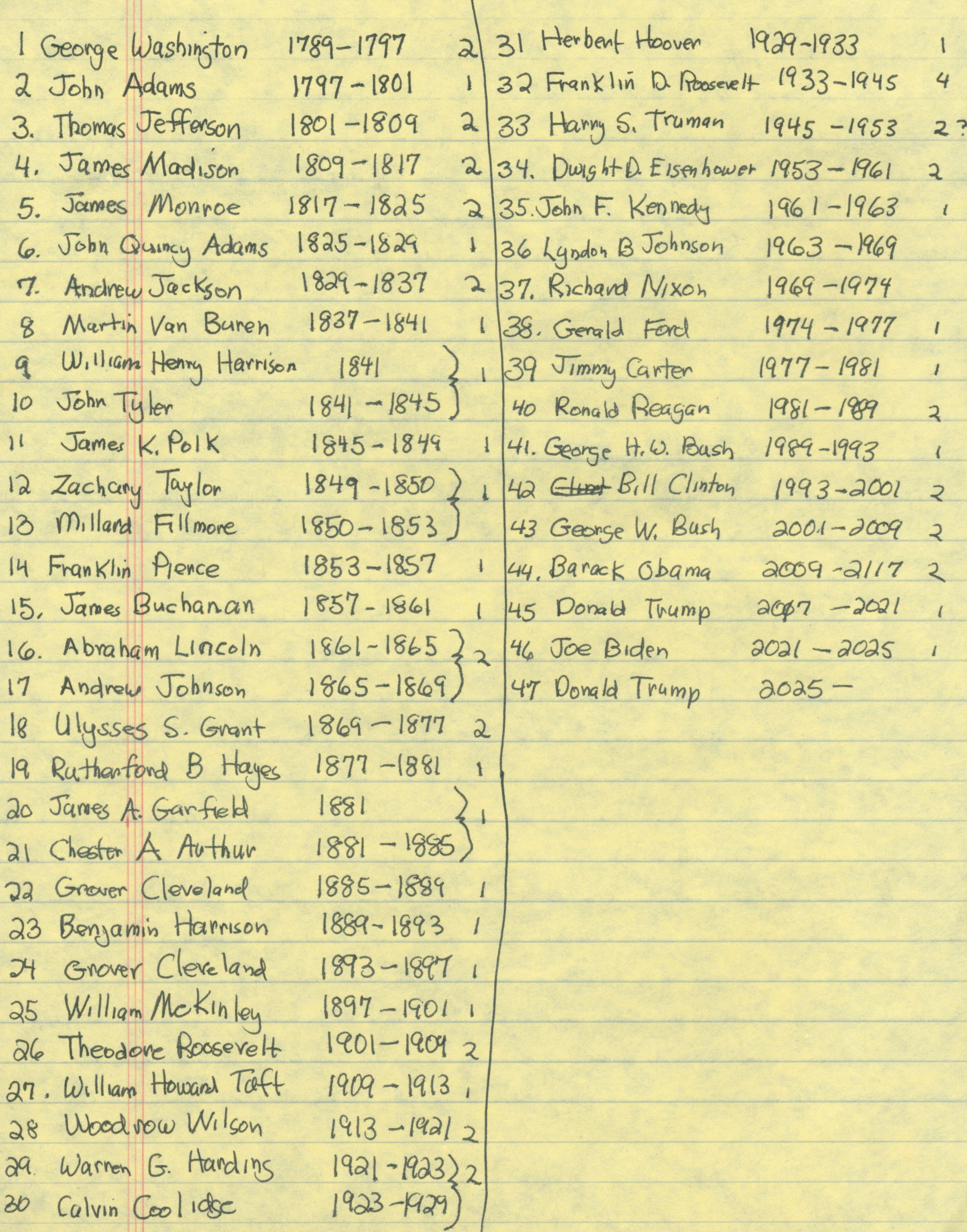
Then, while testing myself with Anki, I use this as a cheat sheet when I don’t know the answer. Anki uses spaced repetition to enhance the learning process. When I see the answer and know how well I remembered it, I hit one of four buttons: Again, Hard, Good, or Easy. That determines how quickly Anki will ask me this question again.
I don’t think just doing the flashcards is enough. That’s why I rewrite the above sheet each day. Mentally, I do all kinds of tricks to help me remember too. Like I say to myself, “Lincoln is a sweet 16.” Or FDR was the 32nd and ran in 32. Or Kennedy was the 35th, and Reagan was the 40th, and I calculate others from there. I’m pretty solid from Teddy to Donald.
I’m also experimenting with reading aloud. I might even set up a voice-transcribing program and dictate the list from memory. I figure reading and writing, listening and dictating, might all reinforce memory.
I think I’ll be able to memorize this list in a few days. (I’ll update this post when I do.)
But how long will I be able to remember this list? Can I maintain this memory if I run through the flashcards once a day? Should I test myself by skipping a week or a month?
This will be my baseline. If I can’t remember it in the future, even after daily practice, I’ll know my Intrinsic Capacity is shrinking. This will be a test for long-term retention.
However, I’m guessing I’ll need to memorize new lists from scratch every now and then to test if I can retain new information. That might also be fun. I can pick subjects that help me when watching Jeopardy. Like books of the Bible, plays by Shakespeare, teams at the Super Bowl, or Best Picture Oscar winners.
I should try to make this more quantitative. I wish I had started this when I was young, so I’d have some data to track and graph. I don’t remember it being easier to memorize things when I was a kid. I made Cs and Bs in school, but I never studied much. However, I did pay attention in class. Whenever I did try to study something hard, I struggled.
I do remember a Shakespeare class I had in college. For each play, we had a 10-question pop quiz. On the first play, I got like 6 out of 10. I read the play, but I tend to read fast. So I went to the library and got the next play on LPs. I read and listened. I got 10 out of 10. The professor always threw in one question that required very close reading. Like what was embroidered on So-in-So’s handkerchief. I got that one. (If I remember right from almost 50 years ago, it was a strawberry. Was it, Desdemona?) After that, I always read along with records, and I got 10 out of 10 each time.
I’ve also bought Beginning Algebra by K. Elayn Martin-Gay to see if I can still learn something hard. I’m doubtful about that. But we’ll see.
JWH


Loving these endeavors, James. I’m 60, recently retired, and am learning German via Duolingo – trying to keep challenging my brain too..