In the 21st century, we often talk about how technology has taken over our lives, referring to the Internet, smartphones, and AI. But we forget the major technological revolution that television brought to Baby Boomers. Thinking about it, I realized that television shows have brought me far more pleasure than all the features of the internet.
I love Amazon, YouTube, AppleNews+, Facebook, Wikipedia, ABEbooks, and all the other websites I visit, but they have never made the emotional impact that sitcoms, dramas, and miniseries have made since 1955.
It would be far harder for me to decide between TV shows, books, and music. In fact, I don’t know if I could decide between those three. I do know that if I had to pick between movies on TV and movies at the theater, I’d choose movies on TV.
Watching TV has brought me so much pleasure that it’s impossible to imagine my life without it. This might sound odd, but the tightest bond I’ve had with my wife, Susan, is watching television together for 50 years. This is even truer since I set up a Jellyfin server and put many of our favorite TV shows on it. Every night we watch two hours of old TV together.
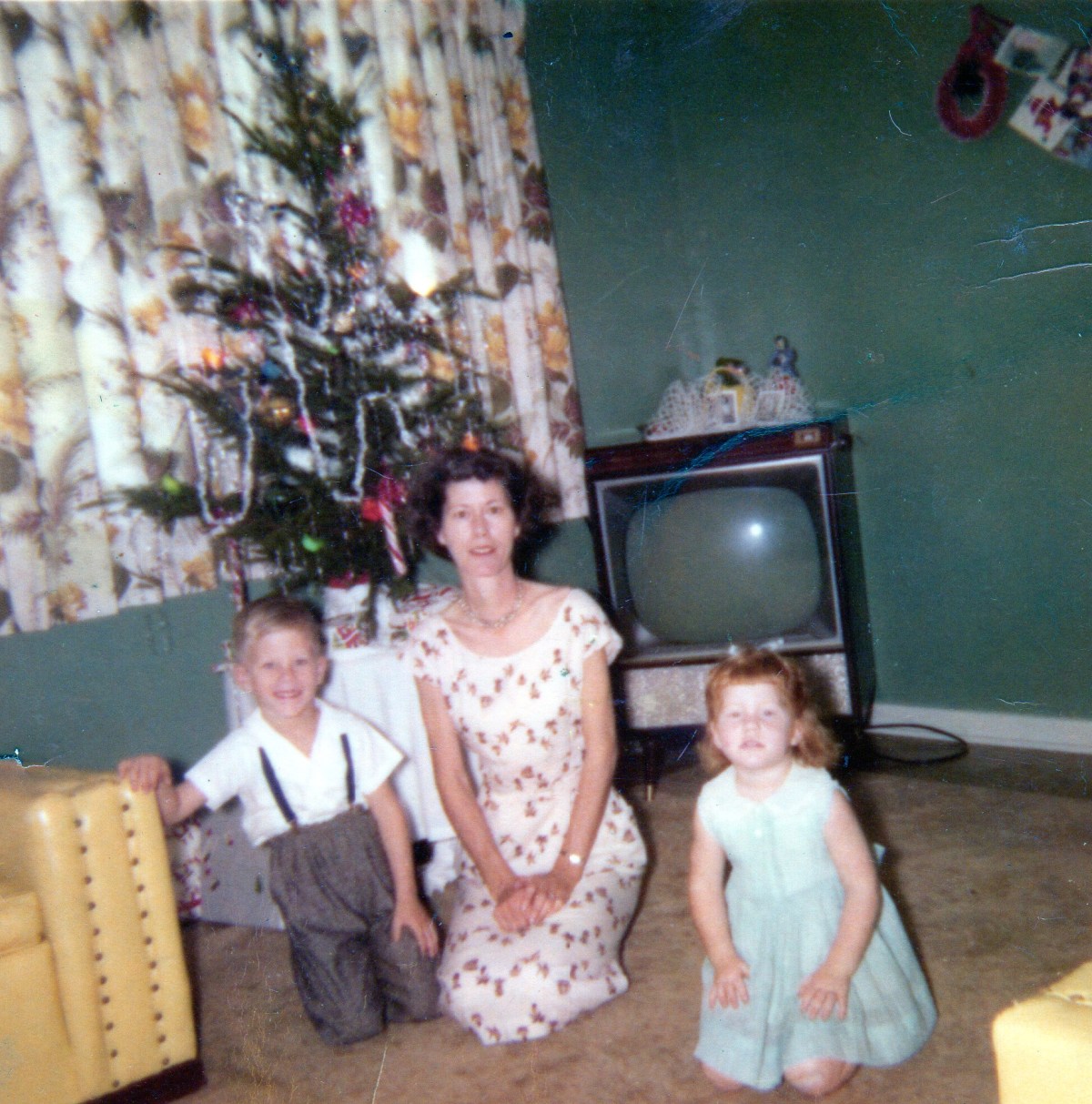
Even though the internet is famous for social media, that feels like a solitary pursuit. I have many internet friends I’ve never met, and I value that, but it’s just not the same as sitting in a room with someone else, even if we’re only staring at a screen together. Most of my childhood memories involve watching television, especially with my sister, Becky, but also with my mother and father.
Of course, that’s kind of sad too. People worry about kids spending too much time with screens, but I grew up with TV screens in the 1950s and 1960s. It’s a shame I didn’t spend more time getting to know my parents, especially my dad, who was mostly a mystery to me.
Reading science fiction and listening to music are the only other forms of entertainment that might equal the pleasure of watching TV. I’ve always tried to make science fiction and music more social by seeking out friends who enjoyed them too. But I’ve never had as many people to share science fiction and music with as I’ve had with television shows.
Starting in the 1st grade, I could always talk with people about television shows, from The Mickey Mouse Club to Star Trek. I didn’t meet someone to talk science fiction with until the 10th grade. A while after that, I loved getting together with friends to smoke pot and listen to music, but that only lasted a few years. Talking about television shows has always been the most useful way to have something to talk about. If you meet someone who likes the same show as you, it often means there’s a reason to be friends.
And even when I lived by myself, television was always a better companion than social media. The Tonight Show and The Dick Cavett Show were often great company on lonely nights before I got married.
But I wonder about young people today. Do they feel the same about television, or do they prefer social media? They seem to get a lot of YouTube and internet influencers.
I’ve always found immense pleasure in reading. And that’s truly a solitary pursuit. Science fiction got its start with the pulp magazine era. Before TV became big in the 1950s, millions of people read pulp magazines. Short stories were incredibly popular. When I was growing up and talked with old guys who grew up with the pulps and radio, I got the feeling they preferred them over television. But didn’t television unite the Baby Boomer generation?
When the power goes out, my wife and I get very restless. We miss TV and the internet. But we miss TV most.
I think I could walk away from the Internet. It’s nice being connected to the world. It’s nice having friends on five continents. I’d hate to have to go back to shopping in physical buildings. I couldn’t find the rare books I wanted without ABE. And I couldn’t keep up with relatives and old friends like I can with Facebook. Plus, I’d feel immense anxiety when I leave the house without my smartphone.
What Susan and I really like is watching complete TV series on DVDs. Of course, I rip them to my Jellyfin server, but there’s something special about watching a TV show from pilot to finale. We’re currently going through the 264 episodes of Frasier, one episode an evening.
However, when you think about it, isn’t it kind of pathetic that we’ve bonded so tightly with something so artificial as a television show, spending so many thousands of hours glued to a TV screen? I suppose we could have grown up differently, but Baby Boomers grew up with television.
TV was the technology that shaped us. TV was our screen of choice.
148,000 MLGW customers lost power on August 22nd during a severe storm. We only lost electricity for a couple of hours; however, several of our neighbors went five days without power. Over the last twenty years, we have lost power many times for 1-4 days. I wrote about some of those times: “Thrown Off the Grid Kicking and Streaming” in 2017, “Blogging by Candlelight and Paper” in 2011, “Living Like Jane Austen” in 2008.
Every time this happens, I research buying a whole-house generator. And every time, I decide they’re not worth the expense. Over the years, some people I know have bought them, but their reviews have been mixed.
This time, I meditated on what it means to go without power. Am I just being whimpy? Essentially, what hurts the most is having our routines disrupted. The August heat and January cold are unpleasant, but not immediately life-threatening. What pains us is not having TV and computers. That’s pitiful, don’t you think?
My two main worries are freezing pipes and spoiled food. This house survived an ice storm without power for two weeks, so the pipes are probably okay if we keep the water dripping. And we’ve had to throw out a couple hundred dollars of food twice. But is it worth spending $10,000 to save what’s in the refrigerator? According to this video, that’s what it would take to get the icebox going for a week. (Although I could probably do it cheaper because our fridge is smaller and cheaper DIY solutions.)
It does seem unwise to spend thousands to save hundreds. I’ve been watching dozens of YouTube videos about backup power, and there’s an interesting socio-economic divide between the various filmmakers. Many are made by guys who obviously have a lot of money, while the rest are made by do-it-yourself scroungers. I’m not like the guys with expensive homes or the guys who can make $2000 power stations with $200 worth of mail-ordered parts.
The video that impressed me the most was this guy who combined a smaller power station with portable solar panels.
Yet, this is still somewhat complicated. This guy has a house wired to handle this approach. I’d have to get a very long extension cord to run from the solar panels to the Bluetti through an open window, or just carry the Bluetti outside whenever I needed to recharge it. Also, notice this guy is one of those with money. I think prepping is a big hobby for some rich dudes.
That Bluetti with two portable solar panels is $1699 on Amazon. As the video showed, it’s a very versatile setup. It can be used for a variety of devices. And it beats the solutions offered by the guy in the first video. However, do I want to spend $1700 to save maybe $200 in groceries?
I think Susan would prefer to use the Bluetti to keep the TV going. But we learned something from the last two ice storms. In the first ice storm, we learned we wanted our phones the most. After that storm, we went to AT&T and signed up for unlimited data and the ability to have internet hotspots. We also bought a smaller Jackery power station for $200 that can recharge our phones several times.
During the next ice storm, we bundled up in several layers of clothes, got in our La-Z-Boys, covered ourselves with blankets and cats, and streamed movies and TV shows on our phones. It worked great.
We did get tired of eating cold food. We even ate out of the icebox for a couple of days. The cheese and yogurt seemed fine. We ultimately had to throw out a bunch of frozen dinners and veggies, but it was probably less than $100 to replace.
During this recent power failure, we offered to let our neighbor stay with us, but she preferred to stay in her house. We kept her frozen food for her. She didn’t complain much about five days of no air conditioning. She just visited friends and stores with power.
I think the real reason I spend so much time thinking about devising emergency power solutions is that it’s an interesting technical challenge. But do I really want to spend $10,000-$20,000 to solve an interesting problem? Isn’t it just more tech toys that I love?
We have several LED lanterns and a Jackery for the iPhones, and that seems to do well enough. What bothers us is not eating our regular meals or following our daily routines. Susan and I are creatures of habit, and we hate being thrown out of our ruts.
It’s revealing that losing the internet is the most disturbing aspect of power failures. What does that say about us? Our iPhones are little internet lifeboats, and that keeps us somewhat content. But what we want is our big-screen TVs. Isn’t that sad? Probably going without them for several days is character-building.
Still, plunking down the bucks for a Generac so we’re never inconvenienced still tempts me. What I really want is what Base Power offers in Texas. Base Power offers to rent whole-house battery backup. Rent is $19-29 a month, and installation is around a $1000. If everyone’s power company offered that deal, no one would buy whole-house generators or whole-house batteries. Letting the power company deal with everything is the way to go. I think I’ll wait.
Going without electricity is so damn revealing about our personalities that I shouldn’t try to always avoid it.
Today I read in the New York Times, “The Most Important Longevity Term You’ve Probably Never Heard Of” by Dana G. Smith. Doctors are looking for a way to measure how well we’re aging and call it “intrinsic capacity.” They haven’t worked out the details yet, but they want to track five subdomains:
cognition
locomotion (strength and mobility)
sensory capacity (vision and hearing)
psychological well-being
vitality (overall energy levels and resilience to physical stressors)
Naturally, young people should pass with flying colors. It’s only when we get older that these functions start to diminish, so it’s important to track our overall potential for aging. They haven’t worked out a scoring system yet, but they want a quantitative indicator that patients and doctors can use.
At 74, I believe I’m losing on cognition, doing better on locomotion, and that vision and hearing are about the same; I’m on an even keel psychologically, but I’m slowly running out of energy.
In other words, I wouldn’t make a 100 on any Intrinsic Capacity score.
Even before I read this article today, I’ve been thinking about how I can measure my cognitive decline. Let’s be honest here: at some point, everyone’s Intrinsic Capacity score will reach zero.
Let’s assume our healthcare system adopts this idea and tests everyone’s Intrinsic Capacity at age 60. It can’t be relative because people are so different. It should be a personal baseline to work from for the rest of our lives.
If at 60 my score was 100, at 74, I imagine it’s about 75 right now, because I feel I have about 25 percent less capacity now than I did then.
Is it possible to improve one’s score? I think so. For example, in the past, my spinal stenosis was so bad I had to give up walking for exercise. But recently, and I guess because of regular physical therapy exercises, I’m back to walking one mile each day.
This is why tracking an Intrinsic Capacity score is such a good idea. It should push older folks to try harder to stay healthy.
My main worry is memory. I don’t have dementia, but I have a whole lot of getting-old forgetting. So I’ve decided to come up with my own method of tracking my memory’s health.
Remember that movie Still Alice from back in 2014? At one point, she was given a memory test, and her doctor told her several words to remember. I didn’t do well taking that test along with her.
A while back on Jeopardy, one of the contestants mentioned that they used a free software program called Anki to help them study trivia. I decided this week to use Anki as the cognitive test portion of my Intrinsic Capacity test.
(AnkiMobile for iOS is $24.99. It’s possible to bypass that cost by using the web version from your phone, but I like supporting the Anki developers. And Anki is far cheaper than many iOS flashcard apps that charge a monthly fee.)
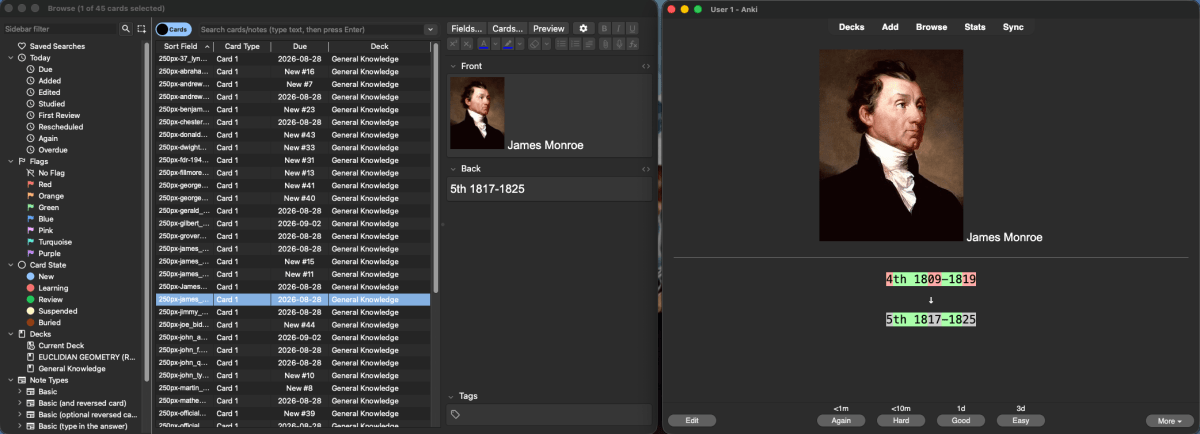
Using Wikipedia, I made Anki flashcards for all the U.S. Presidents. On the front of the cards, I show their name and picture. On the back, I list their order (1st, 2nd, 3rd, …) and the years they were in office. I remember back when Bush the son was president; my niece could rattle off all the presidents in order.
Even after a few days of practicing an hour each day, I can remember a little over half of the content. Where I’m struggling is remembering the years they were in office. When I first started this project, I included the years each president was born and died, but I quickly realized that recalling all those numbers was too much.
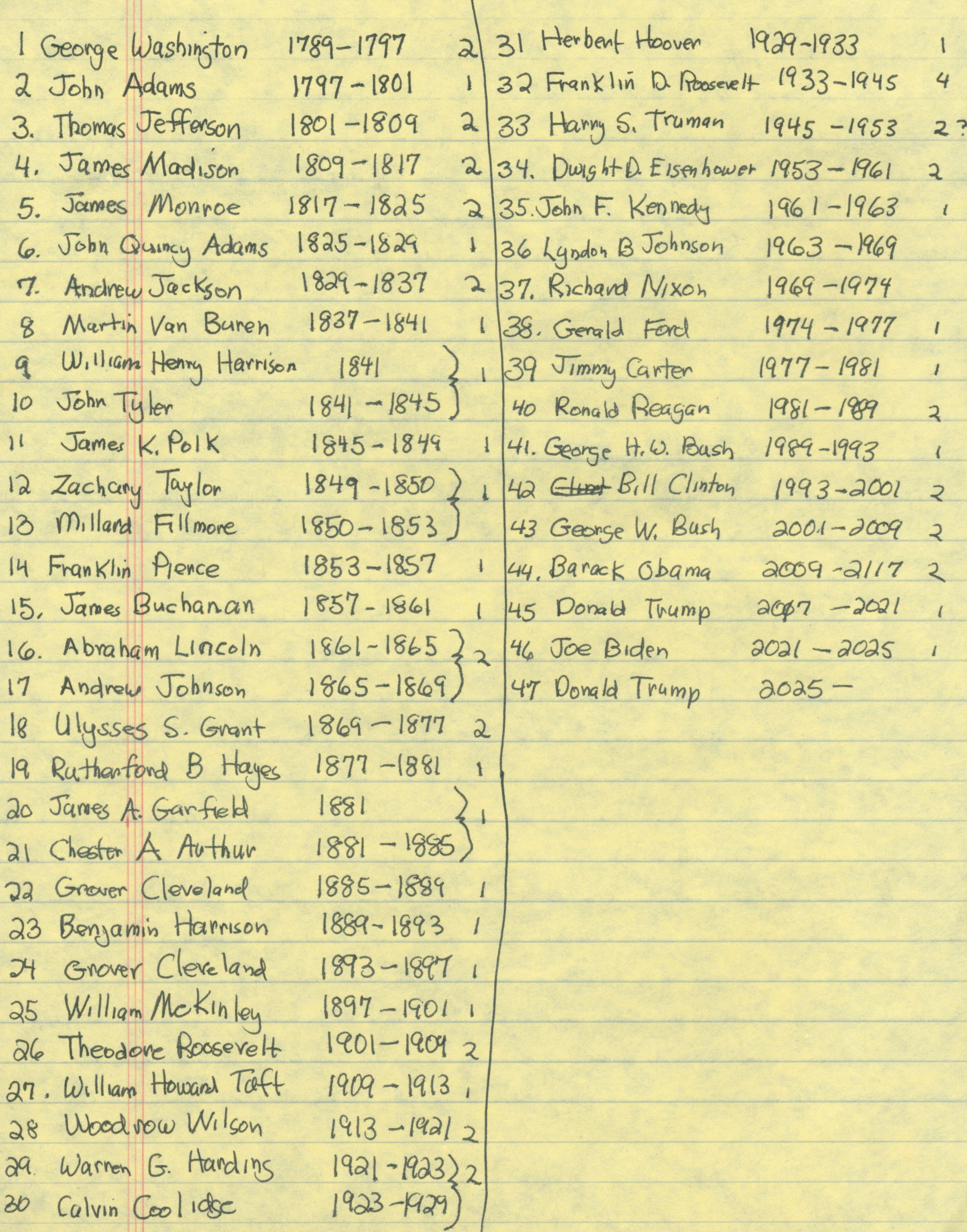
I’m studying in two ways. Before I practice with Anki each day, I write out all the details on a legal pad as practice. I’ve read that writing things down is a good way to remember.
Then, while testing myself with Anki, I use this as a cheat sheet when I don’t know the answer. Anki uses spaced repetition to enhance the learning process. When I see the answer and know how well I remembered it, I hit one of four buttons: Again, Hard, Good, or Easy. That determines how quickly Anki will ask me this question again.
I don’t think just doing the flashcards is enough. That’s why I rewrite the above sheet each day. Mentally, I do all kinds of tricks to help me remember too. Like I say to myself, “Lincoln is a sweet 16.” Or FDR was the 32nd and ran in 32. Or Kennedy was the 35th, and Reagan was the 40th, and I calculate others from there. I’m pretty solid from Teddy to Donald.
I’m also experimenting with reading aloud. I might even set up a voice-transcribing program and dictate the list from memory. I figure reading and writing, listening and dictating, might all reinforce memory.
I think I’ll be able to memorize this list in a few days. (I’ll update this post when I do.)
But how long will I be able to remember this list? Can I maintain this memory if I run through the flashcards once a day? Should I test myself by skipping a week or a month?
This will be my baseline. If I can’t remember it in the future, even after daily practice, I’ll know my Intrinsic Capacity is shrinking. This will be a test for long-term retention.
However, I’m guessing I’ll need to memorize new lists from scratch every now and then to test if I can retain new information. That might also be fun. I can pick subjects that help me when watching Jeopardy. Like books of the Bible, plays by Shakespeare, teams at the Super Bowl, or Best Picture Oscar winners.
I should try to make this more quantitative. I wish I had started this when I was young, so I’d have some data to track and graph. I don’t remember it being easier to memorize things when I was a kid. I made Cs and Bs in school, but I never studied much. However, I did pay attention in class. Whenever I did try to study something hard, I struggled.
I do remember a Shakespeare class I had in college. For each play, we had a 10-question pop quiz. On the first play, I got like 6 out of 10. I read the play, but I tend to read fast. So I went to the library and got the next play on LPs. I read and listened. I got 10 out of 10. The professor always threw in one question that required very close reading. Like what was embroidered on So-in-So’s handkerchief. I got that one. (If I remember right from almost 50 years ago, it was a strawberry. Was it, Desdemona?) After that, I always read along with records, and I got 10 out of 10 each time.
I’ve also bought Beginning Algebra by K. Elayn Martin-Gay to see if I can still learn something hard. I’m doubtful about that. But we’ll see.
I read a couple dozen great nonfiction books each year. While I’m reading those books, I feel like I’m learning a tremendous amount of new information. But just a few days after I finish each one, all that information slips away. That pisses me off.
I enjoy learning, but I’m not very big on doing. For example, I’m studying J. D. Salinger at the moment. I’m reading biographies, watching documentaries, and reading his fiction. Eventually, I’ll summarize everything in a blog. But that’s not applying the information. Unless I were an English professor submitting articles to academic journals, I don’t have any reason to apply that information.
I’m also studying the programming language Python so I can create animations that will illustrate Euclid’s Elements. However, I’m putting so little time into learning Python that I’m not getting the kind of practice that will help me remember it.
I feel I’ve accomplished a fair amount by installing Python, Visual Studio Code, Homebrew, UV, and Manim, and getting them working together in a virtual environment that doesn’t conflict with my Mac’s version of Python. I can even get Gemini AI to write programs that produce Manim animations.
However, I didn’t write the code; Gemini did. I’d like to know how to do it myself, so I started working my way through Python Crash Course, 3rd edition, by Eric Matthes. I’ll also need to learn Manim.
Here’s where the video about the secrets of studying Math comes in. Reading the books and documentation won’t cut it. I need to spend months practicing what I learn to get up to speed before I can even begin programming my own animations.
At 74, I only have so much physical and intellectual energy to expend each day. To learn enough Python to use the Manim library could take months. I would probably have to jettison all my other interests.
And that points to a failing personality trait that I’ve dealt with my whole life. I can never fully commit to anything and stick with it. I have too many interests I chase after.
I can study the common way people study math in that video, but not the way smart students study. That’s how I got through school and college. I studied enough to pass tests. I never pursued the kind of regular practice that video promotes. I was able to be a programmer at work because I did it all day long. But I’ve never been able to pick a hobby that I’ll work at all day long.
I’m at a crossroads. At 74, I need to decide if I’m capable of changing. Or just accept that I’m a bookworm and not a student. I hate to give up, but there’s a certain reality to aging.
It’s easy to read books and watch TV. I can do that all day long. I’m well trained for it. I’ve put in my 10,000 hours.
However, I can imagine being on my deathbed and regretting that I didn’t stick with any of the hobbies I fantasize about pursuing.
If I worked hard, spending four hours a day studying Python and Manim, I’d get my 10,000 hours in about 6.8 years. But here’s where my Hamlet complex cuts in. Is Python/Manim the single project I want to pursue over all my other interests?
Some of you might say I’d have plenty of time to pursue other interests if I apply myself to my main interest for four hours a day. But working at anything for four hours would drain me. I’m not even sure I could apply myself for four hours. I think there’s a reason why most old people aren’t that productive.
But there’s something else to consider. I’ve already put in my ten thousand hours writing blogs. I could work harder at that. I could specialize in analyzing short stories, something I’ve been doing for a while now. I could practice to get much better at that. Or even writing short stories.
Maybe Python and Manim are the diversion?
But after watching that video, I realize I need to work on applying myself to something, rather than just being an information consumer.
What is nostalgia? Most people think of it as a mental perception, an outlook, but what if it’s just another emotion caused by a chemical reaction in the brain? What if it’s like fear or sexual desire, caused by triggers in our environment? When we were still hunters and gatherers, wouldn’t you think that all emotions evolved from traits that supported survival? Fear of tigers and snakes made fear a very good thing. Horniness promoted reproduction.
However, other emotions, like anxiety, sadness, and depression, don’t feel positive, nor would I think they’d promote survival. Have we always had such emotions? Did cavemen sit around the fire complaining they were depressed and didn’t feel like hunting mammoths today? Did they long for old campgrounds or prey they hadn’t seen in a long time?
If nostalgia is an emotion like anxiety, what triggers it? Nostalgia used to be considered an ailment, but today we think of it as an indulgence. Nostalgia has been in the news lately because Gen Z has become nostalgic for the 1990s, and especially for a time before smartphones and social media. Lots of writers and pundits are trying to read the tea leaves of current nostalgia trends.
I have always suffered from nostalgia, even when I was a kid. Nostalgia has always been both painful and euphoric to me. Often specific thoughts and sights trigger it. Does that mean nostalgia is an emotion similar to sexual desire? Then does it have a useful purpose?
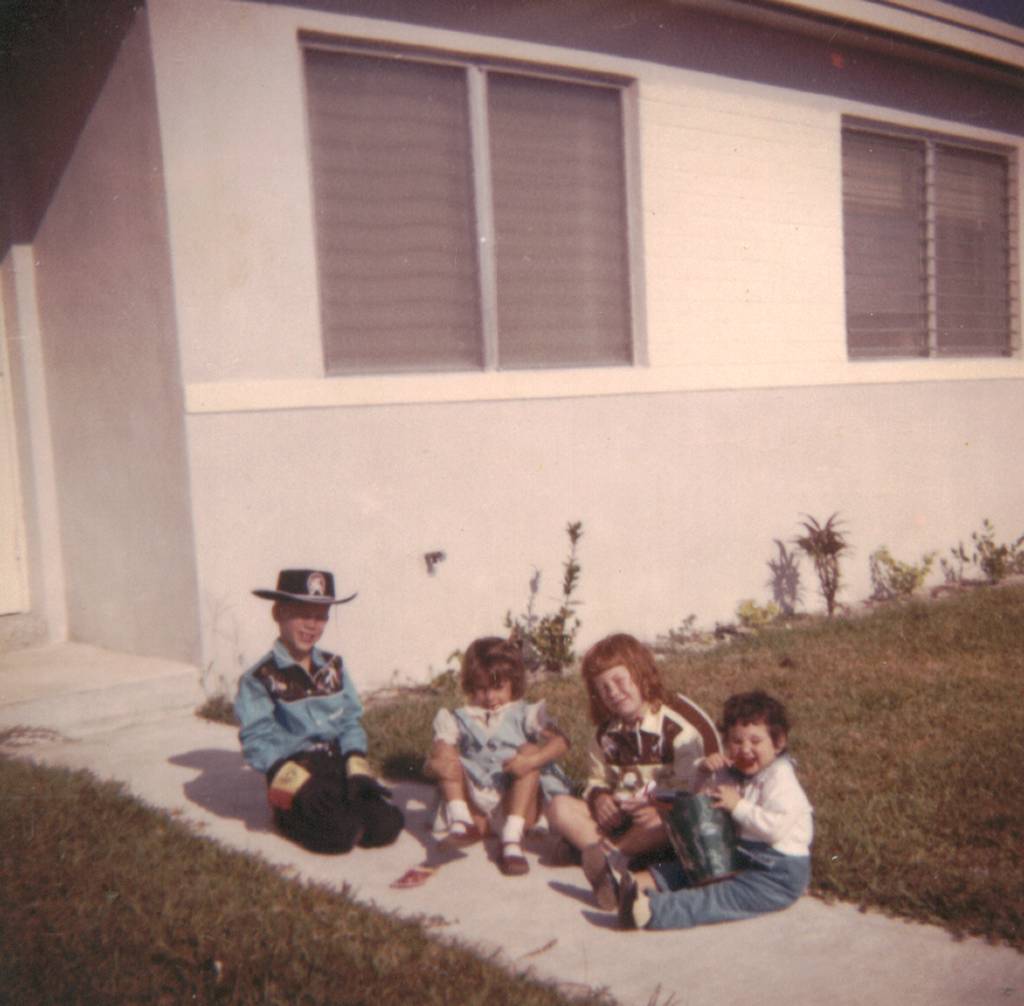
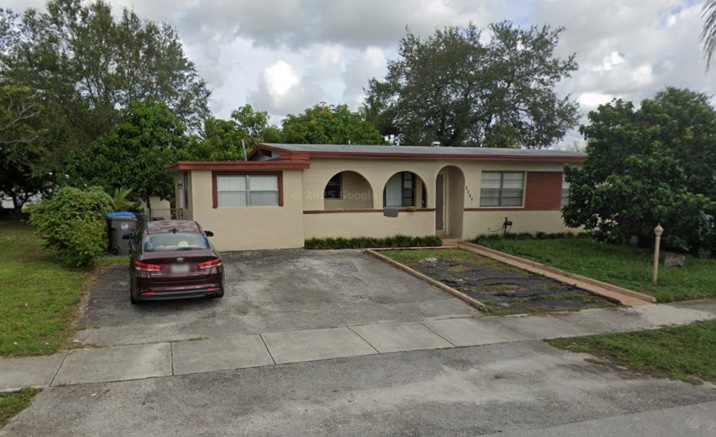
Early this morning, my sister sent me a link to Google Maps showing the house her son is buying for her. She said it reminded her of the house we lived in back in the late 1950s, in the Lake Forest subdivision, near Hollywood, Florida. She asked me if I could find the address of our old home. I got on Google Maps and found that house.
That Lake Forest house is a powerful trigger of nostalgia for me. It has haunted my dreams since 1963. It’s the El Dorado of my childhood that I keep searching for in my subconscious.
I never felt nostalgia before I lived there. I’ve never analyzed why before. I have looked it up on Google Maps several times over the years, and it’s always triggered a tremendous rush of nostalgia.
My family first moved to that house in 1958 when I was in the 2nd grade. We’d just moved back to Florida after living in South Carolina for a few months. This might have been the first house my parents owned.
This was an interesting stage in my life. At 7, I evidently was old enough to remember more, so this period is an archaeological strata near the lowest part of my mind. I had memories of places before this, but they are vague and rare.
We only lived at the Lake Forest house for about a year, and then moved to New Jersey and Mississippi for my 3rd grade, and then returned to Lake Forest for my 4th grade. During the 5th grade, we moved to Homestead AFB in 1961, and then returned to Lake Forest in early November, 1963. We moved away from that house the day after John F. Kennedy was shot in Dallas. That was 11/23/63, and I was in the 7th grade.
I spent less than 3 years total at the Lake Forest house, probably closer to 2 years. Yet, it’s burned into my memory. From 1963 until sometime in the 1980s, I often dreamed about the Lake Forest house. The dreams were always about desperately trying to find my way home. In the 1980s, I actually got to see the Lake Forest house again with my sister and her husband. That was an intense experience. It felt so tiny that I thought I could walk like a giant up and down the block in five steps.
Those searching for my way home dreams stopped. Visiting Lake Forest cured them. At least until I got into my sixties, when I started having a generalized version of those dreams, which I wrote about as “Can’t Find My Way Home Dreams.”
When I looked up the house on Google Maps this morning, that old intense feeling returned. I get this specific, overwhelming ache whenever I think about the places I used to live. And it depresses me in a unique way when I discover that any house I once lived in has been torn down, such as the one on West Trade Avenue in Coconut Grove.
There have been times in my life when I fantasized about returning to one of my favorite houses, buying it, and retreating there to live like a monk until I died. What’s that about? What would a psychiatrist make of that?
My father was in the Air Force, and we moved many times when I was young. I think I went to 3 first-grade schools, 3 seventh-grade schools, 1 school for 6th, 9th, and 12th, and 2 for the rest. Maybe all that moving around as a kid did a number on my psyche. Why do I want to go back to those places? I don’t mean now, but in time. Is nostalgia about finishing unfinished business?
I’ve known people who are seldom, if ever, nostalgic. My friend Laurie will call me sexist for saying this, but I feel women are less nostalgic than men. I know a lot of men who are nostalgic for the things they owned, wanted to own, in adolescence, or for the people and activities they pursued in their teenage years. Is nostalgia simply a longing for happier times? Just look at the old guys who buy old toys. I’d like a 1967 GTO.
Then how come I’m nostalgic for all the less-than-great times? For example, what was so great about the Lake Forest house? Do I want to be a kid again? Do I miss my little friends Michael Kevin Ralph, and Patty Paqquete?
I don’t know what happened to them.
They say when you die you are reunited with everyone you once knew. That’s probably a trick of the mind during the dying process. If it is, does that mean it’s the most powerful desire we have in life? To meet everyone again?
I have moved around so much that there are hordes of people I once knew. And I have run into a few of them over the years. What’s weird is such reunions are often disappointing. We discover we have so little to say to each other. We really can’t go home again. Then why do we try?
If I could travel back in time to visit earlier versions of me, I’m not sure if we would have much fun together. Is the Jimmy that was blown away by hearing Bob Dylan’s “Like a Rolling Stone” on a clock radio in 1965 anything like the Jim that thrilled to listen to “Like a Rolling Stone” on SACD in 2010? Or the old Jim listening to it now?
I must admit that Spotify is a goddman humongous nostalgia machine. Six feet to my right are bookcases with old science fiction magazines. They aren’t the same magazines I owned as a kid, but they are the same issues.
Sometimes I think nostalgia is feeling loss for parts of ourselves that have disappeared along the way.
What’s funny is I don’t think I’m as nostalgic in my 70s as I was in my 60s. Maybe, after decades of trying to return home, I’ve accepted I can’t.
I know I hate to travel in my old age, but that might be normal. Before I was 40, 18 months was the longest I lived anywhere. Then as I got older, that period began to lengthen. I’ve lived in this house for 20 years, and the previous house for 7 years.
I want to die in this house.
I still get deep emotional pangs when I think about certain houses, especially the Lake Forest house. Do I grieve for past versions of myself? Did Thomas Wolfe write You Can’t Go Home Again because many people feel that way? Maybe I need to reread that novel. It might be more meaningful now that I’m older. When I first read it, it was assigned in college.
It’s rather ironic that I’ve spent so much time reading science fiction, thinking about the future, and now I spend most of my time living in the past by reading old books, listening to old music, and watching old TV shows and old movies. At night, I dream about people I used to know and places where I used to work. And if I have insomnia, I lie awake thinking about the past. But is that nostalgia? I’m not so sure. I’m probably just consuming pop culture that I’m conditioned to enjoy most.
When I was younger, I’d lie awake thinking about the future, making plans. I used to worry about the future, but I don’t worry much about it anymore.
This morning I listened to an article from The Atlantic about how young people are nostalgic for the years before smartphones and social media, even if they never lived in those times. They hunger for a simpler time.
I wonder if my nostalgia for old homes is something like what they are feeling?
During my younger days, I used to love fantasizing about where I’d go if I had a time machine. Would I return to 1958 if I could? Notice the windows on the right in the picture at the top. They’re open. We had no air conditioning back then. The high today is expected to be 100F. I know this makes me a pussy, but I’d never travel further back in time before central air.
And unlike the current generation, I don’t think I’d like to travel to a time before smartphones. My memory is going, and I depend on them to recall words that won’t come to mind. As my mind becomes more crippled, smartphones are proven to be excellent crutches.
Besides, the old music I love sounds better on modern stereos. And the old movies and TV shows look way better on my 65-inch high-definition TV than they did on the old 19″ CRT. And I doubt the two heart procedures I’ve had were available in 1958.
If I’m realistic, I know any wanting-to-go-home-again nostalgia I feel is just chemical processes in my brain I can’t control. It’s about as useful as feeling horny when you’re an old fat bald guy with ED at 74. That’s just damn annoying. I guess when we’re old, we want to return to many places we used to go, and for some, it just takes a long time to realize we can’t.


 Auxiliary Memory