by James Wallace Harris, 8/31/26
148,000 MLGW customers lost power on August 22nd during a severe storm. We only lost electricity for a couple of hours; however, several of our neighbors went five days without power. Over the last twenty years, we have lost power many times for 1-4 days. I wrote about some of those times: “Thrown Off the Grid Kicking and Streaming” in 2017, “Blogging by Candlelight and Paper” in 2011, “Living Like Jane Austen” in 2008.
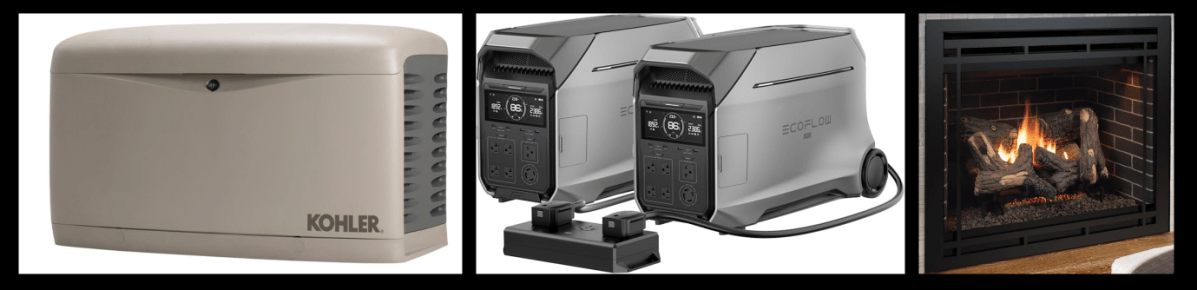
Every time this happens, I research buying a whole-house generator. And every time, I decide they’re not worth the expense. Over the years, some people I know have bought them, but their reviews have been mixed.
This time, I meditated on what it means to go without power. Am I just being whimpy? Essentially, what hurts the most is having our routines disrupted. The August heat and January cold are unpleasant, but not immediately life-threatening. What pains us is not having TV and computers. That’s pitiful, don’t you think?
My two main worries are freezing pipes and spoiled food. This house survived an ice storm without power for two weeks, so the pipes are probably okay if we keep the water dripping. And we’ve had to throw out a couple hundred dollars of food twice. But is it worth spending $10,000 to save what’s in the refrigerator? According to this video, that’s what it would take to get the icebox going for a week. (Although I could probably do it cheaper because our fridge is smaller and cheaper DIY solutions.)
It does seem unwise to spend thousands to save hundreds. I’ve been watching dozens of YouTube videos about backup power, and there’s an interesting socio-economic divide between the various filmmakers. Many are made by guys who obviously have a lot of money, while the rest are made by do-it-yourself scroungers. I’m not like the guys with expensive homes or the guys who can make $2000 power stations with $200 worth of mail-ordered parts.
The video that impressed me the most was this guy who combined a smaller power station with portable solar panels.
Yet, this is still somewhat complicated. This guy has a house wired to handle this approach. I’d have to get a very long extension cord to run from the solar panels to the Bluetti through an open window, or just carry the Bluetti outside whenever I needed to recharge it. Also, notice this guy is one of those with money. I think prepping is a big hobby for some rich dudes.
That Bluetti with two portable solar panels is $1699 on Amazon. As the video showed, it’s a very versatile setup. It can be used for a variety of devices. And it beats the solutions offered by the guy in the first video. However, do I want to spend $1700 to save maybe $200 in groceries?
I think Susan would prefer to use the Bluetti to keep the TV going. But we learned something from the last two ice storms. In the first ice storm, we learned we wanted our phones the most. After that storm, we went to AT&T and signed up for unlimited data and the ability to have internet hotspots. We also bought a smaller Jackery power station for $200 that can recharge our phones several times.
During the next ice storm, we bundled up in several layers of clothes, got in our La-Z-Boys, covered ourselves with blankets and cats, and streamed movies and TV shows on our phones. It worked great.
We did get tired of eating cold food. We even ate out of the icebox for a couple of days. The cheese and yogurt seemed fine. We ultimately had to throw out a bunch of frozen dinners and veggies, but it was probably less than $100 to replace.
During this recent power failure, we offered to let our neighbor stay with us, but she preferred to stay in her house. We kept her frozen food for her. She didn’t complain much about five days of no air conditioning. She just visited friends and stores with power.
I think the real reason I spend so much time thinking about devising emergency power solutions is that it’s an interesting technical challenge. But do I really want to spend $10,000-$20,000 to solve an interesting problem? Isn’t it just more tech toys that I love?
We have several LED lanterns and a Jackery for the iPhones, and that seems to do well enough. What bothers us is not eating our regular meals or following our daily routines. Susan and I are creatures of habit, and we hate being thrown out of our ruts.
It’s revealing that losing the internet is the most disturbing aspect of power failures. What does that say about us? Our iPhones are little internet lifeboats, and that keeps us somewhat content. But what we want is our big-screen TVs. Isn’t that sad? Probably going without them for several days is character-building.
Still, plunking down the bucks for a Generac so we’re never inconvenienced still tempts me. What I really want is what Base Power offers in Texas. Base Power offers to rent whole-house battery backup. Rent is $19-29 a month, and installation is around a $1000. If everyone’s power company offered that deal, no one would buy whole-house generators or whole-house batteries. Letting the power company deal with everything is the way to go. I think I’ll wait.
Going without electricity is so damn revealing about our personalities that I shouldn’t try to always avoid it.
JWH