
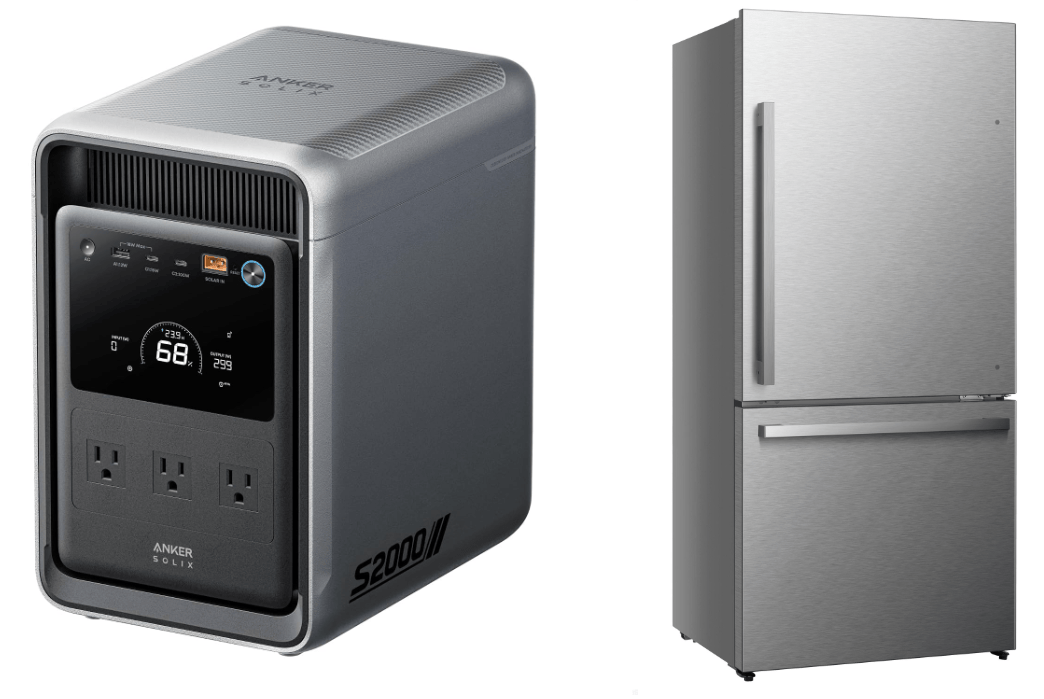
How Long Can My Anker SOLIX S2000 Portable Power Station Run My Refrigerator?

by James Wallace Harris, 10/15/26

For some reason, I’m morphing into a prepper. Is it my age? Or am I experiencing what Bob Dylan wrote about in “Talkin’ World War III Blues,” where everyone is worried about the end of the world?

Well, now time passed and now it seems
Everybody’s having them dreams
Everybody sees themselves
Walkin’ around with no one else

Are these strange political, climatological, and technological times unnerving people? Why is everyone buying a gun? For some reason, I don’t worry about crime, but grid failure. I probably should worry about AI. Getting old is making me frail – is that the cause?

Back in August, a storm knocked 148,000 homes off the grid. We only lost power for a couple of hours, but my neighbor lost power for five days. She stored her refrigerated food in our refrigerator. Again, I agonized over buying a whole-house generator but decided against it. Air-cooled generators aren’t designed to run 24/7 for days, and I’m not ready to step up to water-cooled generators.

However, I just couldn’t let the idea go. After watching a zillion YouTube videos, I bought an Anker SOLIX S2000 power station backup and ZOUPW 450W Portable solar panels. I knew even this was impractical. I spent $1200 to protect $200 to $300 worth of food. I’d need to experience five or six multi-day power outages to recoup my investment.

To be honest, I bought the S2000 and ZOUPW because I love gadgets and electronic devices. I felt challenged to find a solution that would keep my refrigerator running indefinitely during a power outage.

The Anker SOLIX S2000 is advertized to keep an average American fridge running for 35 hours. I figured since I had a smaller 17.2-cubic-foot icebox, I’d get even more hours.

In my first test, I got 29 hours. Not bad, but a little disappointing. My fridge uses about 70 watts on average, but had a few surges past 200.

I knew when I bought the solar panels that my yard gets very little direct sunlight because of all the trees. Still, I tried. The day was also overcast. But our most common outages are ice storms, when trees are bare.

The portable solar panel generated 7-10 watts. That’s the reality of solar energy. I’ll test them again on a sunny day. Even with the trees, I get some sunny patches. In winter, I hope I’ll get much more direct sunlight.

If I could get 250-300 watts for six hours, I could keep my S2000 going for days.

Yet, I must question my obsession. For seventy years, I never worried about power failures. Never felt the need to prep. So why now? Back in my fifties, Susan and I endured 13 days without power in July and August. It was miserable. Never spent a moment thinking about it happening again. I’ve also lived through several ice storms without power.

I never thought about prepping until I heard about whole-house natural gas generators. I never wanted to mess with a gasoline generator. And then it got worse when I heard about solar power stations. I guess I’m seduced by tech.

But once I got into the idea of making my own electricity, it became a fun problem to ponder. However, I do need to think about the reality of what I’m trying to do.

I don’t mind bundling up and living with the cold. I do hate enduring the heat. My friend Laurie just got back from a month in Costa Rica. She had no air conditioning. Europe went through a heat wave this summer, and most people didn’t have air conditioning. I’m just being a wimp if I can’t go without air conditioning for a few days or weeks. I grew up in Miami without air conditioning.

Two or three ice storms ago, we realized that our phones, tablets, and laptops were our top priority. I bought a small Jackery that solved that problem. We also have a gas water heater, so we could take hot showers.

Recalling the last ice storm, I missed hot food the most. Yet, I didn’t starve. I had stocked up on lots of ready-to-eat snacks.

Because I own a solar power station with solar panels, what else could I use it for? I checked with an AI, and the most efficient way to heat a meal with electricity is with a microwave. Gemini says the S2000 could produce 35 hot meals. That’s not bad.

Gemini also said I could run my 5G internet router and smart TV for 15 to 24 hours. At the next power outage, I’ll ask Susan: Want the refrigerator or TV?

This got me thinking. I was considering spending $15,000 on a whole-house generator. I could buy ten S2000 power stations for less than half that. (Currently $649 each.) With even five S2000s, I could solve many of my power problems for several days.

See how this is more of a complicated puzzle to me than an actual survival problem? I’m not a real prepper who worries about civilization collapsing. I assume if civilization falls apart, it’s time to die.

Pondering all the possibilities regarding keeping my gadgets powered reveals something philosophical about modern life. It’s really about fighting boredom and being thrown out of our comfortable ruts. It’s amazing how many electrical appliances and gadgets we’ve integrated into our lives.

What if something severe happened to the nation? Say the power grid went down, telecommunications/computer networks collapsed, and food and water must be rationed by the government. Citizens in many nations endure that now.

Imagine having to build outhouses in our backyards and create our own toilet paper. What if our only light was daylight? If things got that bad, there would be no pharmacies. We’d spend most of our time waiting in line for food and water. What would we do with ourselves without the internet and television?

We depend on civilization. Then why are we so self-destructive and constantly undermining civilization? The money we spend on defense and war could build a rock-solid infrastructure. Just the money we spent on the current war in Iran could have transformed our power grid.

I’m currently reading The End of Everything by M. John Harrison. The novel is a finalist for this year’s Booker Prize. Weird invaders from another dimension have caused civilization to collapse. I just finished reading “If We Make It Through This Alive” by A. T. Greenblatt, a short story in which civilization has fallen apart for unspecified reasons. Like the Bob Dylan song above, when everyone worried about the bomb, everyone now sees endless possibilities for apocalypses.

Is prepping a new fad? Or the conscious reaction to unconscious fears?

JWH
Prepping for Power Outages?

by James Wallace Harris, 4/28/26

Over the last decade, we’ve had three power outages during ice storms that lasted 3-5 days. Back in the 1990s, this house experienced a 10-day power outage during an ice storm. And in our previous house, we lived through a 13-day power outage during July and August.

We have survived all those outages with only inconvenience and discomfort. And I’ve never had any kind of emergency generator during my 74 years. It’s kind of wimpy to think about spending $15,000-20,000 dollars on the chance the power will go out for a few days. However, the older Susan and I get, the more we dislike discomfort and inconvenience.

We were lucky; the power stayed on during Winter 2025, but we were snowed in for over a week. Susan and I are afraid of falling, so we don’t go out when the ground is covered with snow and ice. News videos showing what people in Nashville, Tennessee, and Oxford, Mississippi, experienced frightened us. The destructive power of nature becomes so much scarier when you’re old.

My real fear is the pipes freezing. During these ice storms, many of our friends have had pipes burst. Now that’s more than inconvenient. The house’s temperature dropped into the forties during the last ice-storm outage. It was unpleasant, but we survived easily by wearing layers and sitting in our La-Z-Boys under several blankets. I’m considering buying some winter camping equipment.

One of the biggest problems during power outages is boredom. We solved that by getting unlimited phone plans and buying a Jackery to recharge our phones. I listened to music and audiobooks, doom scrolled Facebook and YouTube, and watched movies.

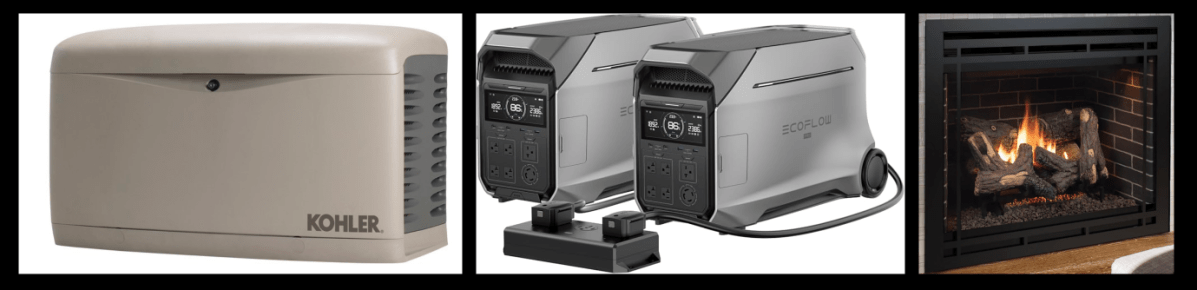
For years, I’ve been thinking about buying a whole-house generator that runs off natural gas. But I’ve always hesitated. I kept thinking whole-house battery backup might become practical.

I looked at two years of electric bills, talked to an AI that gave me some rough figures to consider.

If I’m lucky, I might get a whole-house generator installed for $15,000 to $20,000. I’d need a new electrical panel, but I’ve been thinking about that anyway. However, I’ve read that generators need an oil change after the first 25 hours and after running continuously for 50-100 hours. That would be a problem if the ground is covered in ice. Also, I know one family that spent $17,000 on a whole-house generator, and it failed the first time they needed it.

All that makes me leery of whole-house generators. Although they can last 20-30 years. (I don’t think I can, though.) That makes them a good investment.

I also researched getting something like a Tesla Powerwall. After much discussion with the AI, it was decided I’d need 40-50 kWh of battery backup to last a week-long power outage. With all the installation, the AI estimated $30,000 to $40,000. That’s way more than I’m willing to spend.

However, if the United States renovated its grid system, and I added both solar arrays and battery backups, this would be the best long-term solution.

Then I mentioned to the AI that my biggest worry was freezing pipes. That’s when it recommended a direct-vent insert for our fireplace. It should keep the house warm enough to keep the pipes from freezing, and it would work without electricity.

The AI also recommended a portable power station that could run just the blower to my natural gas heating system.

Those were two good ideas I’m considering. Battery technology is improving dramatically every year, and the prices are coming down. It might be cheaper to buy several portable units that I could roll around as needed. And I can research getting portable solar panels to put out in the yard to recharge them.

Portable power stations could run fans in the summer when the power is out. But I don’t know if they are powerful enough to use for cooking. Our water heater runs on natural gas, and it stays on when the power is out. But our stove and oven are electric. I’ve looked into Mr. Buddy heaters that use propane canisters. But propane sounds scary to use inside the house.

Let me know what solutions y’all have found.

JWH

DAC Compare: Fiio K13 R2R vs. Geshelli J2 vs. AudioLab 6000A

by James Wallace Harris, 12/20/25

On the surface, this essay might appear to be about audio equipment, but it’s really about wants and desires, perception and marketing, the limits of our senses.

A DAC is a Digital-to-Analog converter. Most people own several, even though they might be unfamiliar with the acronym. They are critical to audiophiles because they determine how well digital files are recreated as analog sound in your amplifier and speakers.

For most music listeners, the DAC is built into their computers, smartphones, amplifiers, or CD players. Some audiophiles will spend hundreds or thousands of dollars on an external DAC, hoping to hear details in their music that are not produced by integrated DACs.

I’m not really an audiophile. Maybe I’m a half-ass audiophile. I do want to hear music in all its richness, but I just don’t want to spend the kind of bucks that audiophiles are willing to part with.

Some audiophiles are purists and shun digital recordings. They want vinyl records that were produced with analog equipment and to play their LPs on analog amplifiers. This route requires no DAC. I’ve spent a modest amount of money pursuing the analog sound, and it’s always been elusive. Watching YouTube videos from analog purists makes me think I’d find sonic greatness if I’d only shell out a few thousand dollars more.

On the other hand, other audiophiles who embrace digital technology claim that if you spend enough money, you will hear more details from every note and instrument, from a larger three-dimensional soundstage, and experience greater sonic textures and thrills.

For over a decade, I’ve been chasing three mirages. The first is analog sound, the second is high-resolution music, and the third is better DACs. I gave up on vinyl because it was never apparent that analog sounded superior to digital, even after much testing. I gave up on high-resolution music because it only sounded slightly better than CD quality, and only if I concentrated mightily hard. However, I’m still a sucker for DAC hucksters.

Since Covid, I’ve been hearing reviews of R2R DACs, and I’ve been hankering to own one. Unfortunately, R2R DACs were more expensive than the more common Delta-sigma DACs. Then Fiio came out with the K11 R2R headphone amp/DAC for $159. I thought I’d buy one and see if there really was a difference. Before I could pull the trigger, Fiio came out with the K13 R2R headphone amp/DAC for $320 that claimed to be even better. So I bought one for my birthday.

A couple of years ago, I purchased the Geshelli Labs J2 DAC with upgraded Sparkos SS3602  op-amps and AK4499 DAC because the Cheap Audioman had convinced me it was the best Delta-sigma DAC for under a $1000. (It was just over $500 with the upgrades, so I thought, what a bargain.)

I already owned an AudioLab 6000A because of Darko Audio. It has an ES9018K2M DAC. It sounded great to me, but watching audio equipment reviews online leaves a never-ending desire to explore those greater musical dimensions they claim they can hear.

When I got the Geshelli Labs J2, I thought I heard more detail. After a year, I became tired of having to get up to turn on the J2 before turning on my AudioLab 6000A with a remote. I removed the J2 and used the DAC in the AudioLab 6000A. I wasn’t really sure I could hear a difference anymore. I never could decide if the external J2 sounded better than the internal DAC of the 6000A.

But I kept listening to reviews. Many of my favorite reviewers went through countless DACs, apparently searching for audiophile nirvana. Some claimed that DACs costing $5000 or $10,000 would get me there.

Reviewers consistently claimed R2R DACs had the smooth sound of analog music, projecting larger soundstages. I felt the soundstage for the AudioLab 6000A was as large as my den, but then what did I know? Maybe it wasn’t.

I wasn’t willing to risk my retirement savings on a $5,000 DAC. Some reviewers were honest enough to admit that those expensive DACs didn’t reveal their riches unless your amplifier and speakers also cost at least $5,000.

I decided I just had to hear an R2R DAC to see if I could actually hear a difference, so I bought the Fiio K13 R2R.

To be honest, I was disappointed with what I heard using it as a K13 R2R headphone amp. The music sounded far more exciting through my Sennheiser 560S headphones and Fiio K5 Pro headphone amplifier. The music presented by the K13 was very nice, but it was missing all those exciting details I heard from the ESS Sabre DAC of the K5 Pro.

I’m not unhappy with the K13. Its smooth sound, especially on female vocals, is quite pleasant. However, for headphone listening, I especially enjoy the details.

I then hooked up the K13 and J2 to the AudioLab 6000A’s analog inputs. I also compared the sound from the AudioLab 6000 CD transport using its internal DAC. The R2R DAC did sound smooth and pleasant. And I’ve been enjoying it for days. It’s just fine, but I don’t think I’m an R2R person after all.

Here’s the thing: there are differences between the three DACs, but do they really matter? My bedroom stereo, using a Bluesound Powernode 2i and Klipsch RP-5000F speakers, sounds the richest, most detailed, and dimensional of all my systems. However, I think that’s due to the room. My main stereo is in the den. It doesn’t have a back wall, because it opens into a dining area and kitchen. One wall is floor-to-ceiling glass, and the other two walls have wrap-around windows near the ceiling.

I’m sure the rooms make a bigger difference than the DACs. And I imagine the Polk Reference Series R-500 speakers sound different from the Klipsch.

For years, my only source of music was a clock radio. It had only one speaker. It was no larger than three inches in diameter. I loved that radio, and the music I first heard on it from 1962 to 1968 has stuck with me my whole life.

The most excitement I got from listening to music this year wasn’t from the equipment, but from consciously trying new music I hadn’t heard before that was created in the last ten years. Spotify estimated my age from the music I played to be 28.

I do know the DAC in my $89 Wiim Mini sounds bad. But it seems any DAC costing over $200, despite its technology, sounds pretty damn good. Maybe if I spent more than $2000, I would hear a difference, but would it be a night-and-day difference? I don’t know. Unless I win a mega lottery, I ain’t going to find out.

In my testing, playing a CD through the AudioLab 6000A sounded the best by far. But I’m not ready to go back to CDs.

I think watching audiophile reviewers on YouTube is making me dissatisfied with my equipment. I have to wonder if the differences they hear are really psychological or physiological?

I’ve found that what makes the biggest difference is volume. Listening at 85 decibels makes my stereo systems sound great. At 85 decibels, I hear more details with a larger soundstage by using any of my DACs.

After that, convenience matters. Audiophiles claim that separate components sound better than all-in-one units. Calling up albums on my phone via Spotify is just too damn convenient. Powering on with a remote is too damn convenient. I wish I could power up my integrated amplifiers with my iPhone and ditch the remote.

My advice. Spend a middling amount on an integrated system and play it loud.

JWH

Three Friends Start Over at 67

by James Wallace Harris, Friday, October 5, 2018

Have you dreamed of starting over – maybe in another career, city, country or even continent? Do you crave new surroundings, conversations, activities, friendships, romances, routines, or even commitments? Do you hunger for something new, something different, something even exotic? Or do you just want the freedom to be yourself, to make all your own choices, to schedule every moment doing exactly what you want?

Three of my friends amazed me recently by rebooting their lives at age 67. Janis after years of planning moved to Guanajuato Mexico, Linda after a lifetime of dedication to husbands and children moved to Denver, and Peggy who thought for a decade she’d be the happiest living on a lake near her brother finally found she was right. Seeing these three women start over by themselves in a new place amazed and inspired me. I’ve been living in the same city for 48 years, married for 40, worked at the same university for 36 years, lived in the same house for 12. (Janis, Linda, and Peggy must think I’m boring!)

I’ve often wondered if I shouldn’t do something different with my life before I die. Up until I got married at 26, I had never lived in one place longer than 18 months, with the average closer to 12. Marriage, work, and getting older settled me down. In my late forties, I started having a heart arrhythmia which eventually gave me a touch of agoraphobia. My ticker was eventually surgically fixed, but I’ve kept the slight agoraphobia. Then my wife Susan started working out of town, and for eleven years I lived mostly alone (she came home Saturday afternoon to Sunday afternoon 2-3 times a month). For the last five years since retiring, I’ve been holed up in the house spending my days pursuing hobbies, and evening socializing with friends. But most of the time I was alone and I got to like that.

Janis, Linda, and Peggy were three women I’ve gotten to know in recent decades. I’ve often listened to them talk about their hopes for happiness. All three have gone through many changes, each different, but including buying and selling houses, retiring, losing or leaving husbands, dealing with children and grandchildren, traveling as much as possible, but ultimately, each thinking about where they could go to be exactly the person they wanted to be.

I am reminded of what I’ve read about women finding themselves in their post-menopausal years when they realize that men and children have dominated their lives, and it was time to put themselves first. I believe Janis learned that in her twenties after a brief marriage, but Peggy and Linda were devoted wives and mothers most of their lives. My wife Susan found a lot of independence when her career blossomed in her fifties and she moved out of town to follow it. And I also discovered being alone strengthened my soul. However, Peggy, Susan and I never learned to live completely alone, like Janis always has and how Linda is experimenting.

JanisThen there is moving to a new location. Janis living in Mexico blows me away. She is a life-long tourist. Her true love is travel. She was a flight attendant for Eastern before it failed, then became a lawyer, and briefly returned to work as a flight attendant in 2001 but that was nipped in the bud by 9/11. She’s been studying Spanish since I’ve known her and finished a B.A. in the language last year. She moved to Guanajuato to immerse herself in conversation and culture. The idea of living in alone another country astounds me. I’m much too chicken to ever do that.

Linda decided she wanted a life where she could make all her own choices and moved to Denver. She’s also a frequent traveler and wanted to live somewhere where people were progressive and liberal. That’s been my dream too, but I’m even too chicken to move to another town in this country.

LindaLinda wrote to me, “First, we’re all so different and so I don’t think what any of us have done would work for you. We’re very different people. What Janis and Peggy have done sound great—but wouldn’t be something I would want to do. I hadn’t really thought about it but 2 of my 5 or 6 best friends have done exactly what Janis and Peggy and I have done—Decided they didn’t like where they were and picked up and moved across the country. I think where we find ourselves when we retire just isn’t necessarily where we want to be and we’re more likely to be financially able to do what we want to do. For me, Denver is so comfortable. The people I’m meeting are well-educated, well-read, welcoming and just nice!  I’ve never had so many people go out of their way to get to know me. And the opportunities for learning and for meeting like-minded people seem way more than I’ve ever noticed in other cities. Maybe it’s just because my head is in a different place. Anyway—this was a great move for me and I am completely content with my decision!”

Peggy recently moved to Denver to be near her daughter and grandson but found that Denver was not a good fit for her. Ultimately, she decided to move back south to fulfill a longtime dream of living on a lake. She has been talking about living on a lake ever since her husband died when she was in her fifties. It’s just taken her this long to get free of the distractions of children, jobs, and boyfriends.

PeggyPeggy wrote to me, “After 27 years of marriage, I have spent the time since my husband’s death in 2006 trying to find my new place in the universe.  I have read many times that life is a journey and not a destination.  I’ve learned through my own experiences, both good and bad, that there is probably not just one place for me. So, I believe that if I am not happy in a place or relationship, it is reasonable to move on to another.  However, each time I move on I hope for a longer stay where I can find happiness and someone to share it.  To have the courage to do this, I remind myself that the final destination is Death and that we are not promised tomorrow. Jim thinks I’m brave, I think I’m just following the life I was destined to lead. So, I expect to continue my journey wherever it takes me (maybe with someone special) until I reach that final destination.”
Maybe I’m awed by my brave lady friends because of my agoraphobia, but I don’t think most people make such big moves late in life, especially by themselves. However, I can think of several women bloggers who have. Are women more willing to start over later in life? Maybe I don’t travel because I’m too content where I am, even though I know there might be better places to live elsewhere.

I assumed I would grow old and decay in place in my current house. Before Janis moved to Mexico, she had said life here was getting stale. That got me to thinking. Was I not making enough effort to get more out of life? Am I going stale? For years Janis was my TV buddy and we watched television together several nights a week. We have many overlapping interests, but we’re also very different. I’m sure our TV life was part of the staleness. However, Janis also said without the challenge of being a lawyer or going back to college, just being retired can be boring. I’ve often wondered if my life shouldn’t have more varied stimulation than books, music, movies, and television, but they give me such great pleasure that so I don’t feel retirement is boring. Susan has always resented that I didn’t love to travel and even asked me to try Zoloft hoping it would make me less anxious about taking trips. Maybe I don’t travel because I like what I’m doing more.

I told my oldest friend Connell about writing this essay and he immediately replied I was deluding myself if I thought I could travel. He knows me extremely well. Yet, I still felt guilty for not trying harder to see more of this world. My goal for retirement was to teach myself to write. I could live anywhere as long as it had few distractions.

Before I retired at age 62, I saved for years so I could reach my dream destination of free time. Maybe it’s my tiny touch of agoraphobia because I’ve always wanted to stay home and worked at my hobbies. Yet, is my reclusiveness hurting me? Should I push myself to be braver before I get too old? Or am I already too old? I’ve had more physical problems than Janis, Linda, and Peggy — or is that just a rationalization. Stephen Hawking traveled often despite his severe handicaps.

These women wowed me. They decided what they wanted and made it happen. They had to take risks and sell houses, leave family and friends, and essentially start over, almost from scratch. I wonder if there’s any place on Earth I’d give up everything to go live?

Being married is security. Owning a house is security. Having old friends is a security. Having a familiar infrastructure of shopping, doctors, support services, entertainment is security. Because Susan moved away to work for eleven years, I feel I could move away to do something on my own for a while too. One place I thought about is New York City, on the Upper East side near Central Park. I want to live somewhere where I won’t need a car, in a rented apartment building several floors up, but near lots of cultural events that were within walking distance or a quick rideshare. Or cities would work too. I’d still need a place to hold up in that comforts my agoraphobia but makes it easy to take excursions two or three times a week. (Ha-ha, I don’t expect to transform that much.)

Linda wrote to me, “But I do think you might regret not living in New York at some point. Why don’t you find a place to rent for 3 months and just get the experience of living somewhere else without a long-term commitment? I’m pretty sure I’ve suggested this before. I think you would really enjoy it and it would be an adventure. Without moving everything you own.” I’ve already been thinking about that and I’m encouraged by her advice, but I just don’t know if I have the balls to do that. I am going to do some extensive research and planning. That helps me overcome my anxieties.

I wish I was a brave traveler like Janis. I feel guilty for not ever traveling outside this country. I have lived in far more places in the U.S. than Janis, but that was all before I got married. I’m even chickenshit with my foreign travel fantasies because I’ve only ever been tempted by London, Paris, and Tokyo. I’m just too conditioned by always traveling in books, not reality. Janis sends me photos, videos, and stories that make me feel there’s more to this reality than the United States.

I’m most impressed with Janis’ travel bravery, but I’m the most envious of Linda’s location and activities. She immediately volunteered to work for the Democratic party, joined a thriving Unitarian church, and found many fascinating people who are pursuing a variety of creative activities to befriend. And she lives in an apartment several floors up overlooking beautiful scenery, another fantasy of mine. Linda shows me I don’t have to live in the conservative heartland. I could go and live somewhere that isn’t so politically depressing.

Peggy’s new life is the most opposite of my psychology. She’s out in nature every day, doing lots of physical and social activities. Peggy likes being with groups, which I don’t. But this represents bravery on her part because after her husband died, she spent years barely getting out. In a way, Peggy has returned to her high school age, hanging out with people who love social activities, sports, dating, eating out, and doing things in gangs. Susan is like that and wishes I was too. I’ve never been that way though. I love people but prefer them one at a time. However, Peggy shows me I should make more of an effort to get out into nature and to socialize more. This week she’s at Cruizin’ the Coast which attracts folks in antique cars. That’s something I would love to see.

These women are making me rethink my own life choices. I assumed I made my choice when I retired, but now I’m thinking I still have time to make other choices. I worry that I’ve let security and anxiety keep me from doing more – but can a leopard change its spots?

I turn 67 next month.

JWH


Living Life As It Happens Versus Making Dreams Comes True

Do you measure happiness by the number of dreams you’ve made come true, or by accepting life as it comes to you?  It’s very hard to control reality.  If your whim is to go to the movies, that’s not to hard to make real.  But if your whim is to travel to Europe, that requires a lot of effort to make into a reality.  If your dream is to become a Nobel Prize winning scientist, then you’re moving into the world of chance, no matter how hard you work.

life2

Recently, my wife and I were talking about our regrets, and things we wished we had done when we were young.  We are both lazy, and neither one of us have strong motivational drives.  I said it’s a shame we didn’t do more when we were young, but maybe we did the things we really wanted to do, like watch TV, go to the movies, play with our cats, hang out with friends and family, read books, and so on – just ordinary everyday things.

Our friend Olivia has been on hundreds of vacations, while Susan and I have probably been on less than 50 each in our whole life.  If you measure success in life by where you’ve been, then we have little.  We know many people with beautifully decorated homes that we envy, but our house has the couch potato décor of two TV watching experts.  We’ve met rich and successful people, and by those yardsticks we come up short too.  But have they read the thousands of books I have?  I’m a bookworm, so I live to read.

If success in life is measured by making fantasies come true, we haven’t done very well.  The trouble is I have at least a dozen good fantasies a day – that’s about a quarter million daydreams in my lifetime.  Which ones should I have made come true?  You see, I think our society is too bamboozled by desires.

Because of television we see how millions of other people live and we think we should have their lives too.  If we see someone go to Colorado for a ski trip we feel bad if we can’t too.  If we know someone with a Porsche we feel bad we don’t have an high performance sports car too.  Susan’s brother and wife are going on their second trip to Europe, and Susan probably feels bad we’ve never had our first. 

Me, I feel I go to Europe all the time.  The two books I’m currently listening to are from Russia and England.  The last movie I watched from Netflix was French.  I regularly read The Guardian.  I watch a lot of TV from England, read a lot of books by European authors, and regularly read histories about Europe.  I love European painters, and have seen many of their great work here in traveling exhibits.  I’m studying classical music, most of which has European origins.  In high school I studied German, and in college Spanish.  And I can’t count how many documentaries I’ve seen on European history, art and science.  I once started an internet business with a guy from Paris.  It’s not like I don’t know about the place, I’ve just never been there.  I’m fascinated by Western civilization, but have little desire to see the relics, and if I did, the main reason would be to see the paintings.  Most of what I actually like about Europe is in books and music, which transcends space and time.

One of the things I realized from my discussion with Susan was that I live in my head, and I think most people don’t.  To Susan and most of my friends, the real world is where they can see, hear, touch, smell and taste external to their bodies.  Success is measured by experience or accumulation. 

I live in a different world.  I think life is philosophical, and you live it as it happens.  Success is measured by how well you digest it.  It’s not what you see, but how you see  it.  It’s not what you earn, but how you earn it.  It’s not who you know, but how you know each other.

What’s funny, is by my method of measuring, or theirs, no matter how much external or internal success you find, it’s never enough.  If you don’t die with regrets, then you never looked very far.

JWH – 4/19/14