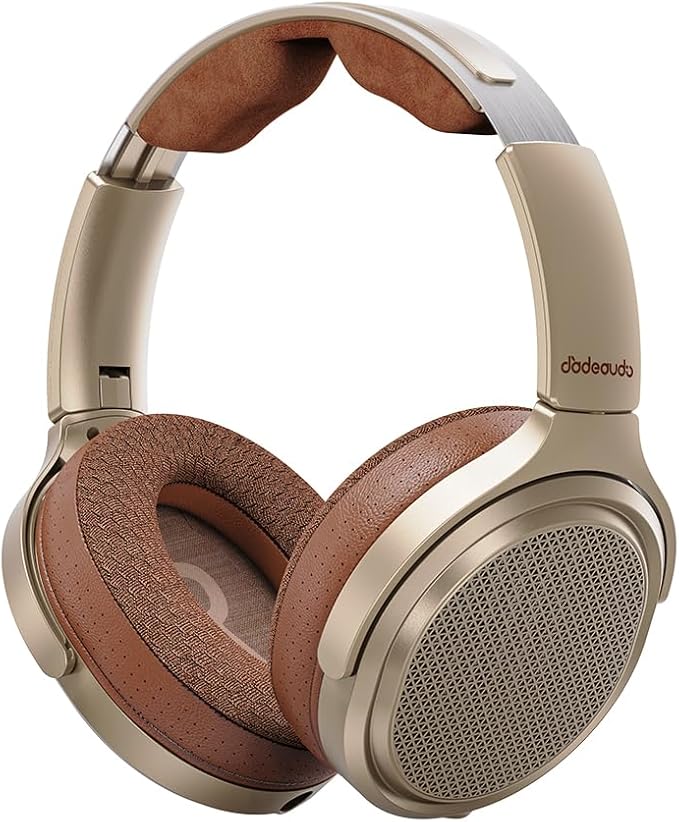
FiiO JT7 $119 Planar Magnetic Headphones

by James Wallace Harris, 4/21/26

I’m a sucker for audiophile reviews that claim a new product sounds great for the money. My current headphones are Sennheiser HD 560 S, which sound wonderful, and I was completely happy playing through a FiiO K5Pro headphone amplifier. But then I saw several reviews praising the FiiO K13 R2R Desktop DAC & Headphone Amp. I’ve always wanted to try an R2R DAC, so I bought it. (See my review.)

The Fiio K13 R2R was very good, but it didn’t produce that night-and-day difference I was expecting. After years of seeing reviews of planar magnetic headphones, I’ve wanted to try them too, hoping the technology would take my music to a new level. That’s why I ordered the FiiO JT7 headphones. Plus, they offered two sets of cables, one of which worked with balanced circuits. In other words, the JT7 had two tech upgrades to try.

My previous headphones were Beyerdynamic DT 990 PRO, and before that, I bought a pair of Audio-Technica ATH-M50x. Astute observers will notice that all of this equipment originally cost between $100-$200. I’m not sure if that isn’t the limiting factor determining the sound quality.

Between four headphones and two headphone amplifiers, I got a range of treble and bass responses, sound staging, and musical details. But nothing was ever night-and-day. I can say R2R sounds smoother than the ESS Delta-sigma DAC, but the Delta-sigma DAC had more detail. I can say my open-back headphones have a larger soundstage than closed-back headphones.

After switching between the four headphones and two headphone amps, the biggest factor in determining what I liked was power. The DT990s have 250 Ohm impedance. The Sennheisers have 120 Ohms. The ATH-M50x are 36 Ohms. And the JT7 is just 18 Ohms, but with a relatively low sensitivity of 92 dB/mW.

Comparing these four headphones is very difficult because once I got them to the same volume, which is very subjective, they were hard to tell apart. Like I said, soundstage and instrument placement varied, but mainly between the open-back and closed-back headphones. The overall tone varied between the K5Pro and K13. That was because of the ESS and R2R DACs.

I don’t know if I can ever find a true night-and-day difference in my audio equipment unless I spend a great deal more money. But the headphones don’t sound significantly different through my Bluesound Node 2i or AudioLab 6000A amplifiers, both of which cost over a $1000.

I’ve listened to “True Love” by Anna Ash so many times that I’m not sure which headphones actually delivered better sound quality. There are so many variables. I prefer the Sennheiser and FiiO JT7 the most, I believe. And I like the FiiO best for how they feel on my head and the way they look.

I will never buy $1000 headphones. I might buy $500 headphones if they did produce that El Dorado of night-and-day improvement in sound quality. However, I’m not sure that exists. I’m starting to wonder if audiophile reviewers have superior hearing to mine. I’m 74.

I’m not sure if technology or cost makes a difference anymore. I think I like the Class A-B AudioLab 6000A better than the Class D Bluesound Node 2i, but I’m not sure. It could be that they sound different because of the rooms they are in. I do know that equipment that costs under $100 doesn’t sound as good. The DAC in the Wiim Mini ($89) is terrible.

To me, everything I currently use sounds fantastic once the volume gets around 85 decibels.

I need to stop watching YouTube audio reviews. And I need to stop thinking that new equipment will blow me away.

I’m quite happy with the FiiO JT7 headphones. I just can’t tell you if they will sound better or worse than what you already own. My wife likes them, because when I use headphones, I’m not playing my stereo at 85 decibels while she’s trying to watch TV in another room.

JWH

DAC Compare: Fiio K13 R2R vs. Geshelli J2 vs. AudioLab 6000A

by James Wallace Harris, 12/20/25

On the surface, this essay might appear to be about audio equipment, but it’s really about wants and desires, perception and marketing, the limits of our senses.

A DAC is a Digital-to-Analog converter. Most people own several, even though they might be unfamiliar with the acronym. They are critical to audiophiles because they determine how well digital files are recreated as analog sound in your amplifier and speakers.

For most music listeners, the DAC is built into their computers, smartphones, amplifiers, or CD players. Some audiophiles will spend hundreds or thousands of dollars on an external DAC, hoping to hear details in their music that are not produced by integrated DACs.

I’m not really an audiophile. Maybe I’m a half-ass audiophile. I do want to hear music in all its richness, but I just don’t want to spend the kind of bucks that audiophiles are willing to part with.

Some audiophiles are purists and shun digital recordings. They want vinyl records that were produced with analog equipment and to play their LPs on analog amplifiers. This route requires no DAC. I’ve spent a modest amount of money pursuing the analog sound, and it’s always been elusive. Watching YouTube videos from analog purists makes me think I’d find sonic greatness if I’d only shell out a few thousand dollars more.

On the other hand, other audiophiles who embrace digital technology claim that if you spend enough money, you will hear more details from every note and instrument, from a larger three-dimensional soundstage, and experience greater sonic textures and thrills.

For over a decade, I’ve been chasing three mirages. The first is analog sound, the second is high-resolution music, and the third is better DACs. I gave up on vinyl because it was never apparent that analog sounded superior to digital, even after much testing. I gave up on high-resolution music because it only sounded slightly better than CD quality, and only if I concentrated mightily hard. However, I’m still a sucker for DAC hucksters.

Since Covid, I’ve been hearing reviews of R2R DACs, and I’ve been hankering to own one. Unfortunately, R2R DACs were more expensive than the more common Delta-sigma DACs. Then Fiio came out with the K11 R2R headphone amp/DAC for $159. I thought I’d buy one and see if there really was a difference. Before I could pull the trigger, Fiio came out with the K13 R2R headphone amp/DAC for $320 that claimed to be even better. So I bought one for my birthday.

A couple of years ago, I purchased the Geshelli Labs J2 DAC with upgraded Sparkos SS3602  op-amps and AK4499 DAC because the Cheap Audioman had convinced me it was the best Delta-sigma DAC for under a $1000. (It was just over $500 with the upgrades, so I thought, what a bargain.)

I already owned an AudioLab 6000A because of Darko Audio. It has an ES9018K2M DAC. It sounded great to me, but watching audio equipment reviews online leaves a never-ending desire to explore those greater musical dimensions they claim they can hear.

When I got the Geshelli Labs J2, I thought I heard more detail. After a year, I became tired of having to get up to turn on the J2 before turning on my AudioLab 6000A with a remote. I removed the J2 and used the DAC in the AudioLab 6000A. I wasn’t really sure I could hear a difference anymore. I never could decide if the external J2 sounded better than the internal DAC of the 6000A.

But I kept listening to reviews. Many of my favorite reviewers went through countless DACs, apparently searching for audiophile nirvana. Some claimed that DACs costing $5000 or $10,000 would get me there.

Reviewers consistently claimed R2R DACs had the smooth sound of analog music, projecting larger soundstages. I felt the soundstage for the AudioLab 6000A was as large as my den, but then what did I know? Maybe it wasn’t.

I wasn’t willing to risk my retirement savings on a $5,000 DAC. Some reviewers were honest enough to admit that those expensive DACs didn’t reveal their riches unless your amplifier and speakers also cost at least $5,000.

I decided I just had to hear an R2R DAC to see if I could actually hear a difference, so I bought the Fiio K13 R2R.

To be honest, I was disappointed with what I heard using it as a K13 R2R headphone amp. The music sounded far more exciting through my Sennheiser 560S headphones and Fiio K5 Pro headphone amplifier. The music presented by the K13 was very nice, but it was missing all those exciting details I heard from the ESS Sabre DAC of the K5 Pro.

I’m not unhappy with the K13. Its smooth sound, especially on female vocals, is quite pleasant. However, for headphone listening, I especially enjoy the details.

I then hooked up the K13 and J2 to the AudioLab 6000A’s analog inputs. I also compared the sound from the AudioLab 6000 CD transport using its internal DAC. The R2R DAC did sound smooth and pleasant. And I’ve been enjoying it for days. It’s just fine, but I don’t think I’m an R2R person after all.

Here’s the thing: there are differences between the three DACs, but do they really matter? My bedroom stereo, using a Bluesound Powernode 2i and Klipsch RP-5000F speakers, sounds the richest, most detailed, and dimensional of all my systems. However, I think that’s due to the room. My main stereo is in the den. It doesn’t have a back wall, because it opens into a dining area and kitchen. One wall is floor-to-ceiling glass, and the other two walls have wrap-around windows near the ceiling.

I’m sure the rooms make a bigger difference than the DACs. And I imagine the Polk Reference Series R-500 speakers sound different from the Klipsch.

For years, my only source of music was a clock radio. It had only one speaker. It was no larger than three inches in diameter. I loved that radio, and the music I first heard on it from 1962 to 1968 has stuck with me my whole life.

The most excitement I got from listening to music this year wasn’t from the equipment, but from consciously trying new music I hadn’t heard before that was created in the last ten years. Spotify estimated my age from the music I played to be 28.

I do know the DAC in my $89 Wiim Mini sounds bad. But it seems any DAC costing over $200, despite its technology, sounds pretty damn good. Maybe if I spent more than $2000, I would hear a difference, but would it be a night-and-day difference? I don’t know. Unless I win a mega lottery, I ain’t going to find out.

In my testing, playing a CD through the AudioLab 6000A sounded the best by far. But I’m not ready to go back to CDs.

I think watching audiophile reviewers on YouTube is making me dissatisfied with my equipment. I have to wonder if the differences they hear are really psychological or physiological?

I’ve found that what makes the biggest difference is volume. Listening at 85 decibels makes my stereo systems sound great. At 85 decibels, I hear more details with a larger soundstage by using any of my DACs.

After that, convenience matters. Audiophiles claim that separate components sound better than all-in-one units. Calling up albums on my phone via Spotify is just too damn convenient. Powering on with a remote is too damn convenient. I wish I could power up my integrated amplifiers with my iPhone and ditch the remote.

My advice. Spend a middling amount on an integrated system and play it loud.

JWH