I’ve Got a Noir a Day Habit

by James Wallace Harris, 7/9/26

I went for years not being able to sit through a movie or television show by myself. My mind would just feel restless after ten minutes, and I couldn’t continue. I guess I felt guilty, thinking I should be doing something more productive with my time. But being retired, I have all my time free, so why did it make me feel uneasy about frittering away a bit of it?

Then I discovered my mind would latch onto certain old movies, and I learned to relax and go with the flow. Oddly, these were mostly film noir movies. I’ve never been big on mystery or crime fiction. I just never cared whodunit. Evidently, there are aspects to film noir that calm my restless mind.

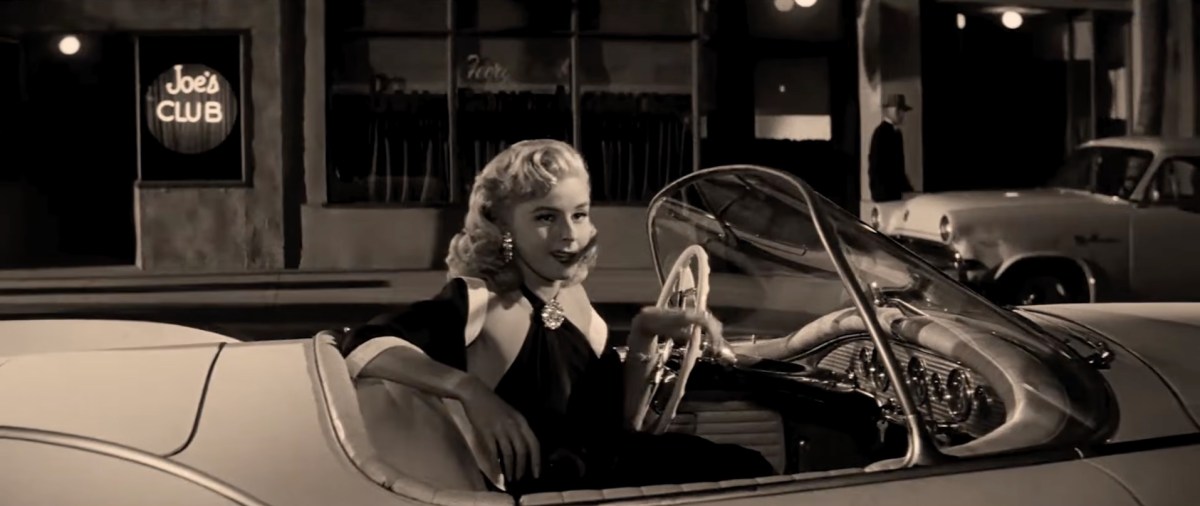
Today’s film was Flaxy Martin (1949), starring Virginia Mayo, Zachery Scott, and Dorothy Malone. I was inspired to select this movie because of The Stiletto Gumshoe’s essay, “Meeting Flaxy For The First Time.” I had no memory of seeing Flaxy Martin before, but as I watched, I realized I had.

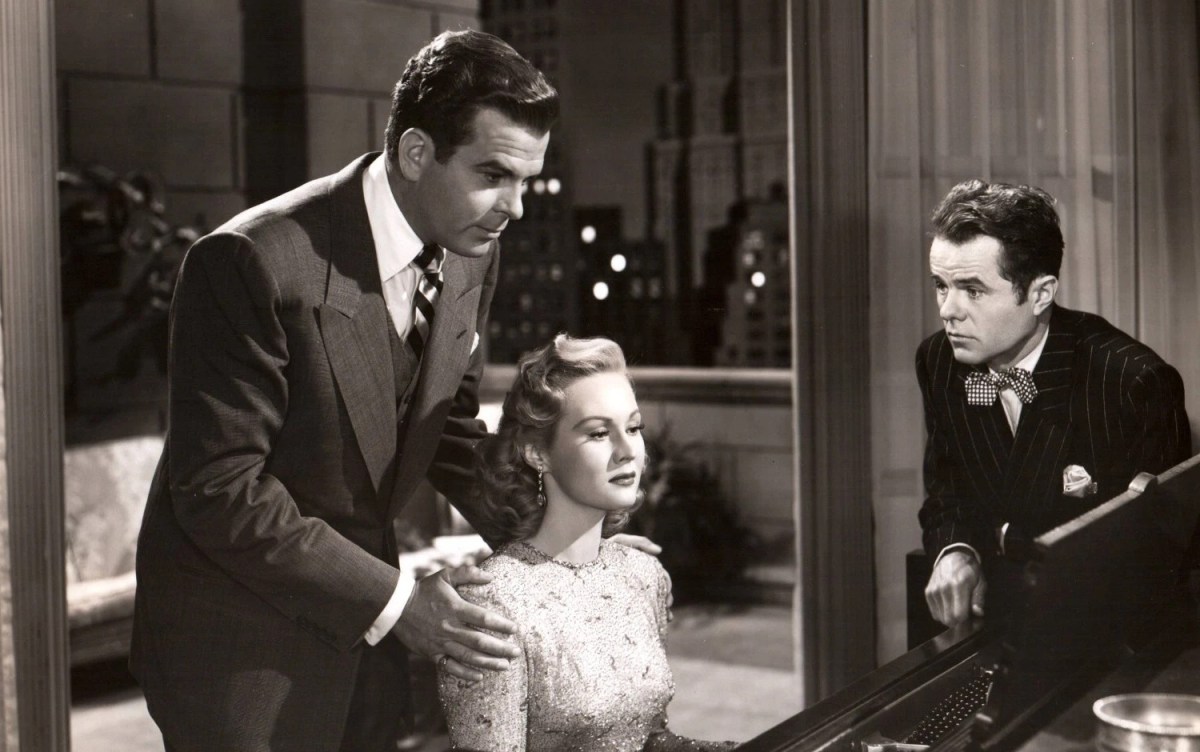
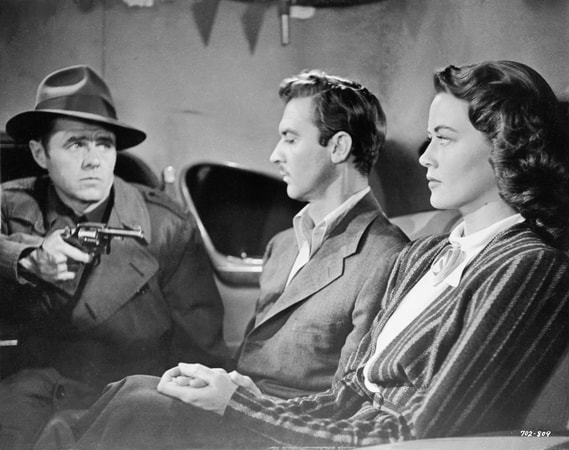
I instantly picked Flaxy Martin for today’s dose of noir because of this photo. I’m a big fan of Elisha Cook, Jr. He’s most famous for playing the gunsel, Wilmer, in The Maltese Falcon. But Cook shows up in countless old movies and old television shows. He plays a very similar character in both Flaxy Martin and The Maltese Falcon – a bantam rooster with a rod.

I’ve never thought of myself as a fan of Virginia Mayo, but I might need to rethink that. Flaxy is a femme fatale and quite evil, and I love a good evil woman character. My friend Mike and I have been keeping a list of evil women in movies since we saw Gene Tierney in Leave Her to Heaven (1945). Flaxy is not up to the evil of Ellen Berent Harland, but she’s dangerous enough. I see that Mayo was also in two other 1949 films admire, Colorado Territory and White Heat.

I wish Flaxy Martin had been the main character in Flaxy Martin; unfortunately, she’s not. She’s AWOL for most of the middle of the film. The movie is really about Walter Colby (Zachery Scott), a lawyer for crime boss Hap Richie (Douglas Kennedy). Quite a lot happens to Walter in the flick, which is why the story moves so fast.

At the beginning of the film, Walter is in love with Flaxy, not knowing that Flaxy is two-timing him with Hap. Of course, Flaxy plays both ends against the middle, and neither the audience nor Walter nor Hap knows where she stands until the end of the film. For each man, Flaxy acts as a spy on the other, but lets the audience ponder whether she’s a double agent for which one.

Flaxy Martin lacks the style of true noir, so it’s really just a good, fast-action B-movie thriller. There are noirish scenes. The movie would have been hardcore noir if the story had been told entirely from Flaxy’s perspective. We see Flaxy set up Walter, and then for the middle of the film, he goes off and falls for Dorothy Malone. The film moves fast, with several twists, but the subplot with Malone feels tacked on. That middle part does give Elisha Cook, Jr. a lot more to do, and I appreciated that.

It’s just a shame that Flaxy wasn’t the main character. Femme fatales seldom get to be the main character. It would have been great to see Flaxy manipulate all the men all the time, for the entire show.

I don’t think the production code would have allowed this, but I would have loved to see Flaxy manipulate all the men and get away with it.

The weird thing about being retired is having all this time to fill. I’m never bored, but neither am I fulfilled. I’m well occupied by a series of entertaining diversions. Watching a film noir each day is becoming as regular as lunch. I assume I’ll burn out on them one day. I wish I knew why my brain likes them now.

Eddie Muller will convince you to watch Flaxy Martin.

JWH

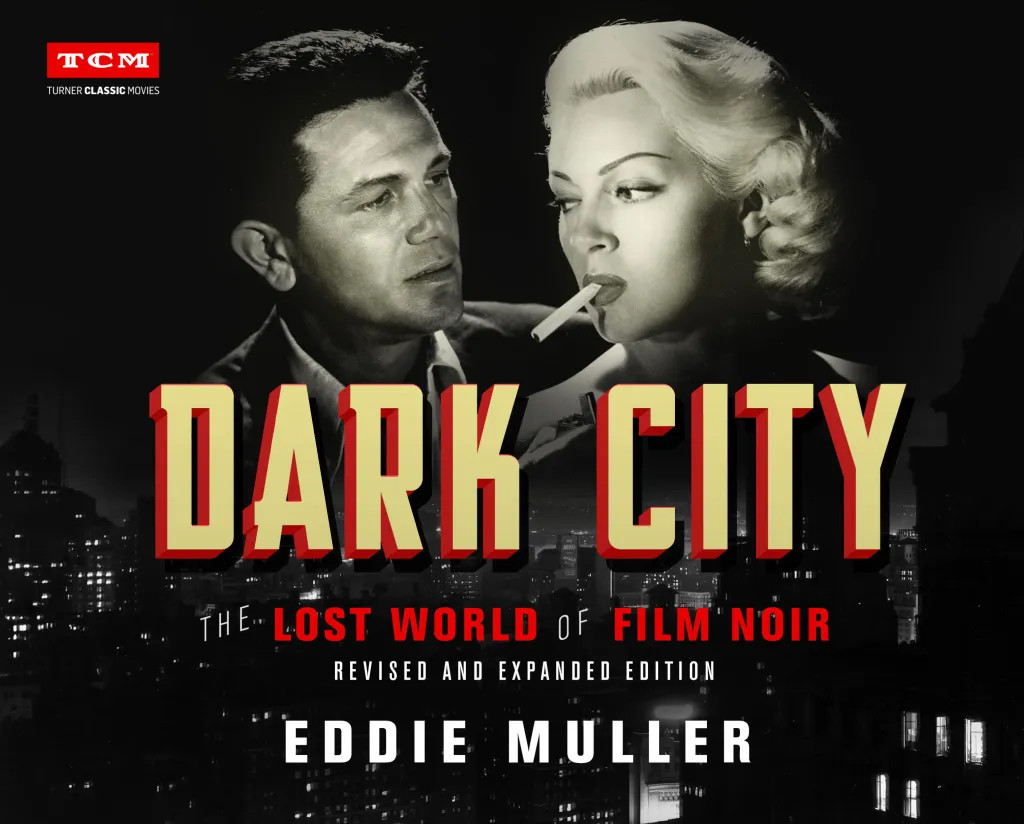
DARK CITY: THE LOST WORLD OF FILM NOIR by Eddie Muller

by James Wallace Harris, 7/8/26

Anyone who frequents Noir Alley on Saturday nights on TCM should find Dark City: The Lost World of Film Noir by Eddie Muller to be Noir Metropolis. However, a tip about where to place your bet.

I bought the hardback edition because I knew I’d want to linger over the beautiful photos. Noir is very visual. And the book is laid out in landscape to showcase those photos. But when I went to read the book, I discovered that reading a landscape volume was a pain in the ass while sitting in my La-Z-Boy. The tiny type was also a hindrance.

Luckily, the audiobook of Dark City went on sale, and I snagged a copy. Listening to the book is like listening to 12 hours and 19 minutes of Eddie Muller on Noir Alley. Muller is one of the audiobook’s narrators. The book is written in the same style he uses to narrate his introductions on TCM. Muller’s nonfiction prose is like reading Raymond Chandler novels.

I’m glad I got the hardback with pictures, but I wish I had the Kindle edition too, so I could enjoy reading and studying Dark City with my eyes. I have to read Dark City at my desk using a book holder. That’s only comfortable for short periods.

However, I never need to read for long. That’s because when Muller describes a movie, I often jump up to go watch it. I haven’t gotten far in the hardback, but I have with the audiobook. And it might not be a book I can ever finish reading. It makes me want to watch too many noir films.

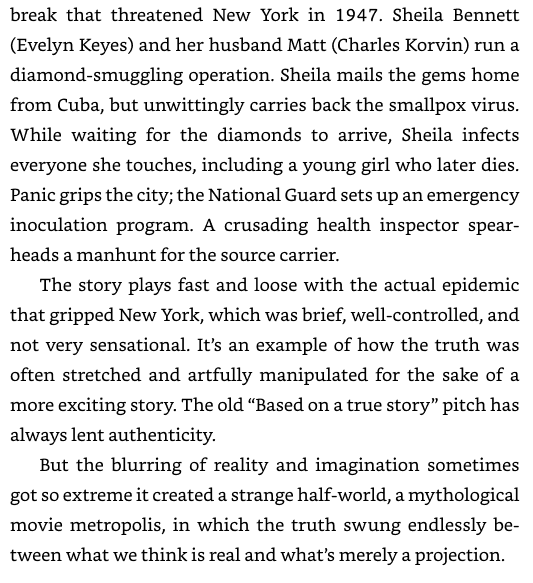
For example, I read this and immediately wanted to watch it.

After you watch the show, read about the 1947 smallpox outbreak on Wikipedia. While watching the movie, I thought some of the events were too fantastic to believe, but they happened.

Luckily, I found The Killer That Stalked New York (Frightened City) on YouTube right away.

A word of warning. A large percentage of the films Muller mentions are on YouTube. But I’m not sure if everyone can see them for free. I subscribed to the light version of YouTube Premium, which gets rid of commercials, for $8.99 a month. That fee might get me extra movies. Just check. Often, when using the JustWatch app on your phone to see where a movie is playing, it will say it’s not available to stream. Then check YouTube. It often has movies that aren’t streaming anywhere else.

Here’s Muller’s old introduction to the film on Noir Alley.

Muller tends to call every black-and-white movie from the 1940s and 1950s film noir if it involves crime. The Killer That Stalked New York lacks the visual and narrative style of The Maltese Falcon or Double Indemnity. Nor does it have the gonzo edginess of Gun Crazy or Kiss Me Deadly. It’s just a gripping story.

And that’s my problem with film noir. Hundreds of films get the film noir tag, but is that fair? I’ve looked for all kinds of rubrics to categorize a film as noir, and nothing works consistently.

One thing I have noticed is that some of my friends who claim to hate old movies will watch and praise a classic noir film. I’m wondering if most old films just seem hokey to them, and noirs are old movies with a story they can handle. Maybe crime stories just seem more realistic. And is this related to why every TV show on BritBox seems to be a police procedural? Are crime stories some kind of lingua fraca among moviegoers? Or do tales about criminals just have wide appeal?

If you’re not familiar with film noir, look at this list on Rotten Tomatoes. If you watch a few of them and like them, you might want to get Muller’s book to look for all the forgotten films. I’m addicted to them.

JWH

Finding Old Movies on YouTube When You Don’t Have TCM

by James Wallace Harris, 6/2/26

Turner Classic Movies (TCM) is the gold standard for old movie lovers. Unfortunately, in the era of cord-cutting, fewer people have access to this wonderful resource. TCM is available via several live-streaming services, including YouTube TV, Hulu + Live TV, DirecTV Stream, and Sling TV. However, they are becoming as expensive as cable TV.

Luckily, my wife is willing to pay for YouTube TV, so I don’t have to worry. However, I have friends who love old movies and don’t have TCM. I invite them over to watch movies with me, but it’s not the same.

The mood to sit in a dark room lit only by the flicker of a black-and-white movie can strike at any time. When I say old, I mean films produced before Beatlemania.

To show how old I am, I’d call The Graduate (1967) a new movie. I define old movies as those I first saw on television growing up. And new movies are those that came out after I started going to the movies on my own in 1962, when I was ten. I’d tend to call films like The Matrix (1999) recent films.

There are plenty of streaming services that show new and recent movies. It’s hard to find old movies if you don’t have TCM.

YouTube is a great resource for old movies. If you don’t subscribe to YouTube Premium Lite ($8.99) or YouTube Premium ($15.99), you’ll have to watch ads or rent the films individually. See YouTube Premium. Lite just removes most commercials, and full Premium adds YouTube Music. Watch this video for a full explanation. I’m subscribed to Lite because I have a Spotify subscription.

Go to YouTube’s Movies and TV page to view their catalog newer movies.

However, many old films are uploaded by regular users. These you have to find yourself, but they are a great source of old movies that aren’t shown on TCM. TCM’s library is great on MGM and Warner Brothers films, but is less good for many studios. For example, YouTube has lots of films from 20th Century Fox and Screen Gems that you don’t see on TCM.

Whenever you’re searching JustWatch and it lists no streaming sources for the film or TV show you’re looking for, check on YouTube.

In recent years, I’ve craved widescreen black-and-white films from the 1950s, and I’ve struck gold on YouTube in finding them.

I should warn y’all that watching old movies on YouTube can be tricky. In the early years of YouTube, old movies were uploaded in low resolution. But over time, they are reloaded in higher resolutions. If you find a movie that’s not in 1080p or 720p, be sure to use the search function to locate other copies.

Also, some uploaders trim off the opening credits. I hate that. I assume they are trying to avoid copyright strikes. Others like to overlay their channel IDs onto the film. I really hate that! My TV can upscale a 360p or 480p copy to make it watchable, but I generally check for 720p or 1080p copies first.

I’m also annoyed by colorized prints. Generally, I won’t watch them. However, I am intrigued by David Adiss’s effort to convert The Hound of the Baskervilles (1939) from 4:3 to 16:9 aspect ratio with AI, and colorize it with AI.

Another problem is that films are uploaded without titles or alternate titles. I guess this is a shade area of the law. Check IMDb.org.

On the other hand, I’ve found stunning prints of old movies on YouTube. My soul finds great beauty in black-and-white cinematography.

It’s possible to watch old movies on your phone or tablet on YouTube, but I strongly recommend adding the YouTube app to your smart TV interface, or your Roku, Fire TV Stick, or Apple TV box.

I also recommend having a Google account. This should be automatic if you’re using a smart TV with Google TV or Android TV.

If you’re logged into YouTube, you can save old films to Watch Later. Also, Google remembers what you like and suggests additional old movies to your feed. I now have a nice library of old movies waiting to be seen.

Below are movies I’ve watched on YouTube with IMDB ratings. If you like a film, click on “Watch on YouTube.” It will take you to YouTube, and you can add it to your Watch Later list.

No Down Payment (1957) – 7.1

The Tattered Dress (1957) – 6.5

Oliver Twist (1948) – 7.8

The Admirable Crichton (1957) – 7.1

Separate Tables (1958) – 7.3

Two of a Kind (1951) – 6.6

Rawhide (1951) – 7.1

The Big Combo (1955) – 7.3

Garden of Evil (1954) 6.6 4K

House of Strangers (1949) – 7.3

Vicki (1953) – 6.5

Mrs. Palfrey at the Claremont (2005) – 7.6

These are just the ones I’ve seen recently. You’ll note the many film noir flicks. Once I started watching them, YouTube kept offering me more. As the algorithm learns your tastes in films, the better the system gets. Be patient.

JWH

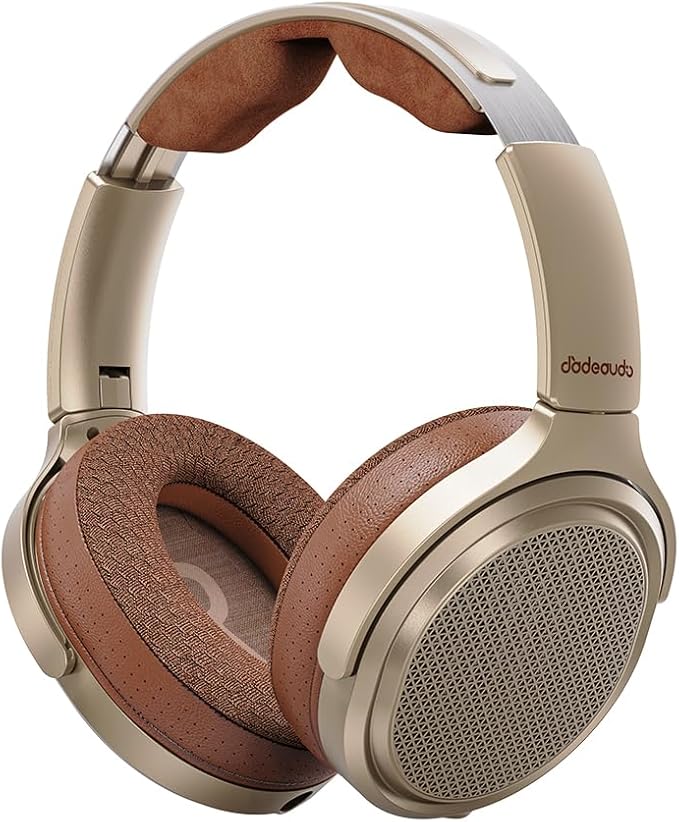
FiiO JT7 $119 Planar Magnetic Headphones

by James Wallace Harris, 4/21/26

I’m a sucker for audiophile reviews that claim a new product sounds great for the money. My current headphones are Sennheiser HD 560 S, which sound wonderful, and I was completely happy playing through a FiiO K5Pro headphone amplifier. But then I saw several reviews praising the FiiO K13 R2R Desktop DAC & Headphone Amp. I’ve always wanted to try an R2R DAC, so I bought it. (See my review.)

The Fiio K13 R2R was very good, but it didn’t produce that night-and-day difference I was expecting. After years of seeing reviews of planar magnetic headphones, I’ve wanted to try them too, hoping the technology would take my music to a new level. That’s why I ordered the FiiO JT7 headphones. Plus, they offered two sets of cables, one of which worked with balanced circuits. In other words, the JT7 had two tech upgrades to try.

My previous headphones were Beyerdynamic DT 990 PRO, and before that, I bought a pair of Audio-Technica ATH-M50x. Astute observers will notice that all of this equipment originally cost between $100-$200. I’m not sure if that isn’t the limiting factor determining the sound quality.

Between four headphones and two headphone amplifiers, I got a range of treble and bass responses, sound staging, and musical details. But nothing was ever night-and-day. I can say R2R sounds smoother than the ESS Delta-sigma DAC, but the Delta-sigma DAC had more detail. I can say my open-back headphones have a larger soundstage than closed-back headphones.

After switching between the four headphones and two headphone amps, the biggest factor in determining what I liked was power. The DT990s have 250 Ohm impedance. The Sennheisers have 120 Ohms. The ATH-M50x are 36 Ohms. And the JT7 is just 18 Ohms, but with a relatively low sensitivity of 92 dB/mW.

Comparing these four headphones is very difficult because once I got them to the same volume, which is very subjective, they were hard to tell apart. Like I said, soundstage and instrument placement varied, but mainly between the open-back and closed-back headphones. The overall tone varied between the K5Pro and K13. That was because of the ESS and R2R DACs.

I don’t know if I can ever find a true night-and-day difference in my audio equipment unless I spend a great deal more money. But the headphones don’t sound significantly different through my Bluesound Node 2i or AudioLab 6000A amplifiers, both of which cost over a $1000.

I’ve listened to “True Love” by Anna Ash so many times that I’m not sure which headphones actually delivered better sound quality. There are so many variables. I prefer the Sennheiser and FiiO JT7 the most, I believe. And I like the FiiO best for how they feel on my head and the way they look.

I will never buy $1000 headphones. I might buy $500 headphones if they did produce that El Dorado of night-and-day improvement in sound quality. However, I’m not sure that exists. I’m starting to wonder if audiophile reviewers have superior hearing to mine. I’m 74.

I’m not sure if technology or cost makes a difference anymore. I think I like the Class A-B AudioLab 6000A better than the Class D Bluesound Node 2i, but I’m not sure. It could be that they sound different because of the rooms they are in. I do know that equipment that costs under $100 doesn’t sound as good. The DAC in the Wiim Mini ($89) is terrible.

To me, everything I currently use sounds fantastic once the volume gets around 85 decibels.

I need to stop watching YouTube audio reviews. And I need to stop thinking that new equipment will blow me away.

I’m quite happy with the FiiO JT7 headphones. I just can’t tell you if they will sound better or worse than what you already own. My wife likes them, because when I use headphones, I’m not playing my stereo at 85 decibels while she’s trying to watch TV in another room.

JWH

Why Did Kristin Diable’s “My River” Sound So Great On My Cheap Headphones at 5:55am This Morning?

by James Wallace Harris 1/29/26

I’ve come up with 5 reasons why I’m hearing more details in my music listening. And none of them is because I’ve bought better equipment. Some of those reasons might sound a bit woo-woo, but who knows.

I woke up early yesterday morning with the urge to hear music. I wasn’t ready to get up. The only headphones on my bedstand were a cheap pair of Bluetooth headphones I use for audiobooks. I put them on and loaded my standard Spotify playlist.

“My River” by Kristin Diable came on. It sounded amazing. For weeks, my den and bedroom stereos have sounded much better than ever. What’s going on? I’m talking a dramatic night-and-day difference on these headphones. Were my ears improving?

1 -Physiological?

Weeks ago, I stopped taking a drug I’d had been taking for years. When I asked my doctor about my chronic stuffy nose, she mentioned that sinus congestion was a side effect of that drug. Slowly, over recent weeks, I feel myself breathing more through my nose. Could this also have affected my hearing?

The only problem with this theory is that I don’t remember hearing music like this before I took the drug. Nor do I remember a decline in hearing after I started taking the drug.

2 – Time of Day?

As I lay there in the dark listening to music, all the instruments were clear and distinct. I heard little guitar riffs and drum fills I’d never noticed before. Could I have been dreaming? Diable’s voice was so multi-textured.

I do love listening to music on headphones while I sleep because sometimes I achieve a state of consciousness between sleep and awake, and I feel like I’m floating inside the music. But I was awake this morning.

I think I always hear music better late at night or early in the morning when I’m using headphones. Yesterday morning was special. It felt like a peak event. This morning, I played music again at the same time, and the music was equally vivid.

However, this doesn’t explain why music sounds better at other times during the day. Not quite as impressive as the headphones this morning, but I’ve been noticing a definite improvement in staging and fidelity.

3 – Focus?

The other day, I read an excerpt from Michael Pollan’s new book titled “How to Have a Don’t-Know Mind.” It was from the last chapter of A World Appears: A Journey Into Consciousness, due out next month. That chapter was about staying at a Zen Buddhist retreat, where he learned that shutting off his mind led to greater powers of awareness. He spent days in a “cave” with few distractions, forcing him to slow his racing thoughts.

Was listening to music in the dark before it was time to get up, a time when my mind was inactive, letting me hear more?

Audiophiles claim to hear greater details in music than average listeners. Is that just the ability to focus? I remember back in the 1960s, and how smoking pot made music sound great. I quit getting high over fifty years ago, but I remember that I decided then that pot didn’t enhance music, but altered time and concentration. I’ve always tried to pay close attention while listening. I don’t like using music as background noise.

4 – Sense of Time

I remember getting a friend high, one who was an avid music listener, and he exclaimed that he heard things in his favorite songs he never heard before. We theorized that it might be because pot distorted our sense of time. When time slows down, we hear more.

That altered sense of time could explain why music sounds better when I’m sleeping or just waking up. But it doesn’t explain why my daytime listening also improved. Not as much, but noticeable. Maybe during the day, I’m relaxing more, focusing on the music more, slowing time down.

Maybe I should train my mind to meditate on music and shut out everything else.

5 – Technology

I was awake when Kristin Diable’s voice sounded so rich and alluring. I wasn’t in a dream state, where music sounds unbelievable. Audiophiles talk about headphones and speakers needing a burn-in period. I’ve listened to hundreds of hours of audiobooks with the Earfun headphones, but only a few hours of music. Could they have reached a burn-in stage for music?

And I haven’t listened to these headphones since Spotify switched to CD-quality streaming. That could be another factor.

But then why were the Klipsch and Polk speakers also sounding much better, too?

Conclusion

Later in the day, the music still sounded good on those headphones, but not as impressive as when I was in bed before sunrise. I tried those headphones again this morning at the same time, and wow, oh, wow.

The first song I heard was “Merry Christmas Mr. Lawrence” by Ryuichi Sakamoto. It’s a piano piece, and I thought I could discern the separate notes in chords. Every instrument sounded so distinct. I could place each spatially, and I was aware of the duration of notes. It had to be an altered sense of time.

Then I listened to “Me & Magdalena” by The Monkees. Before now, I thought only Mike sang it, but this time I could hear both Mike and Micky.

And I’m sure some people have always been able to hear such details. Even though I’ve been crazy about music since 1962, and have spent many tens of thousands of hours listening to it, I’m probably still learn how to listen. Still learning to distinguish the components that make up a gestalt.

Before I publish this, I’ve thought of one more reason. I’m getting old and retreating from the world. Music has become a refuge. I get more pleasure from listening to music than doing anything else. I wonder if the Williamson effect is taking hold of me. I had a friend named Williamson who, before he died, lost interest in his many passions, one by one. The last time I talked to him, he said listening to Duane Allman and Benny Goodman were the only things he cared about. I’ve wondered if he got down to just one before he died. Or even none.

My list of favorite things is dwindling. It’s still in the dozens, though, so I have a ways to go.

JWH