by James Wallace Harris, 6/13/26
Would anyone still be reading John Galsworthy if British television didn’t keep producing new versions of The Forsyte Saga? Galsworthy did win the Nobel Prize for Literature in 1932, the year before he died, but that recognition seldom guarantees an enduring audience.
I must admit I wouldn’t be reading Galsworthy books today if I hadn’t been a fan of all three miniseries based on The Forsyte Saga. Technically, The Forsyte Saga is the title Galsworthy gave to the first trilogy of novels based on the Forsyte family. All nine novels are called The Forsyte Chronicles.
I know it sounds obsessive that I’m reading the books after watching 42 episodes of the three miniseries. However, the novels color in the main characters with greater detail. They also flesh out all the minor characters we see standing around the main characters on the screen.
The literary world has forgotten Galsworthy as a Victorian materialist who didn’t make the evolutionary step to modernism. Virginia Woolf was particularly hard on Galsworthy for failing to portray the inner lives of his characters. We don’t get deep, long stream-of-consciousness narratives, but I do feel Galsworthy describes the inner world of his characters, sometimes explicitly but often implied through dialogue and action.
Soames Foryste, who readers will hate as much as Irene Forsyte hates him, does get our sympathy. Soames is so well developed over six novels that he feels like one of the historical figures Lytton Strachey wrote about in Eminent Victorians.
Personally, I don’t know why Anthony Trollope and John Galsworthy aren’t as popular with readers as Jane Austen and Charles Dickens. They fill in a gap in English history for readers who study history through novels. Galsworthy is well-suited for those who love Downton Abbey, which explains why British television has produced it three times.
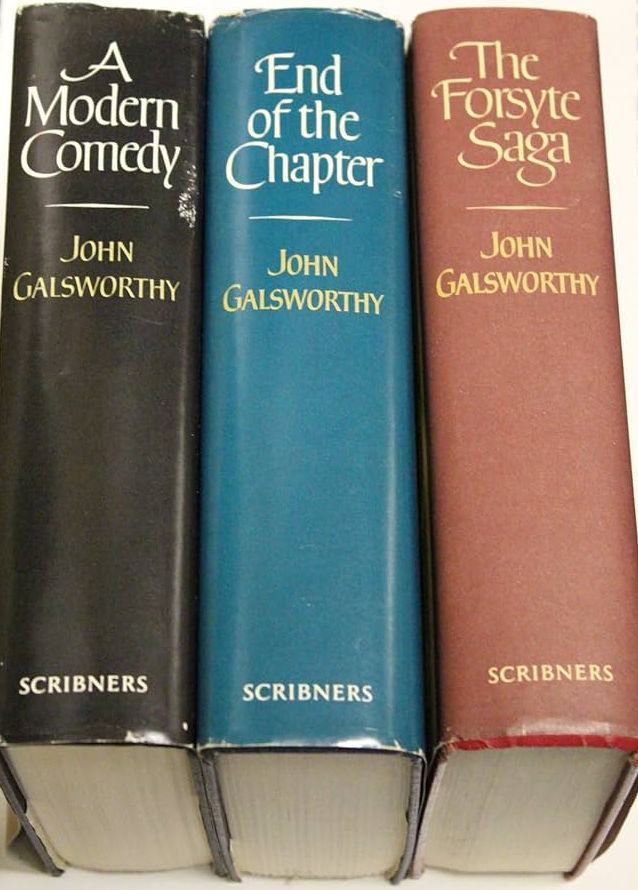
Amazon has the Forsyte Collection for 99 cents, which claims to contain everything in 3,355 pages. There are several audiobook editions, but I’m listening to the Naxos editions. Naxos packages the entire story of nine novels using their trilogy names: The Forsyte Saga, A Modern Comedy, and End of the Chapter.
Only the first six novels actually focus on the Forsytes; the last three deal with a distant cousin.
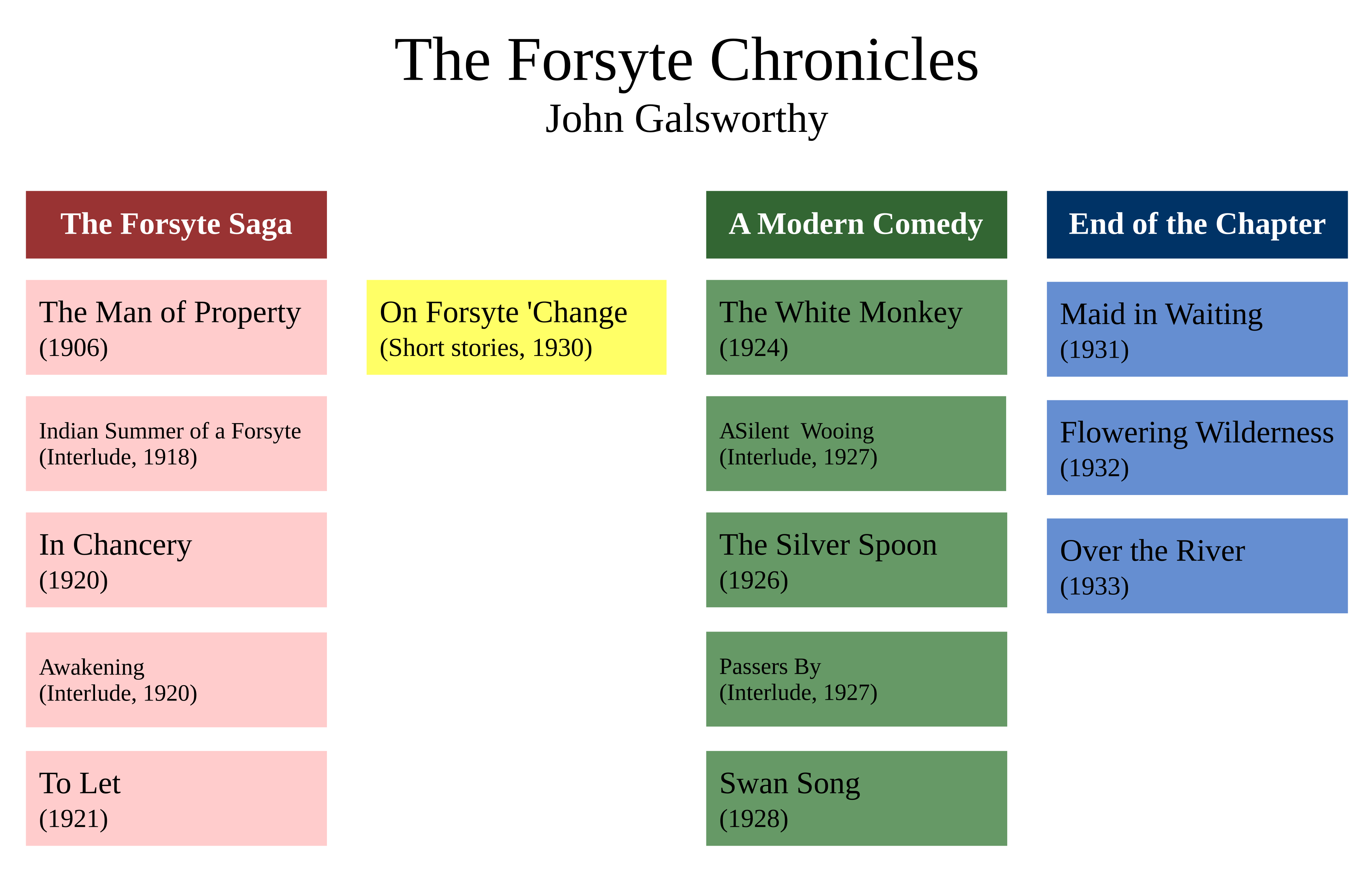
The Forsytes Saga (1967) miniseries has 26 parts, and covers the first six novels and interludes (short stories):
- The Man of Property
- In Chancery
- To Let
- The White Monkey
- The Silver Spoon
- Swan Song
The Forsyte Saga (2002) miniseries has 10 parts, and only covers the first three novels and interludes (short stories):
- The Man of Property
- In Chancery
- To Let
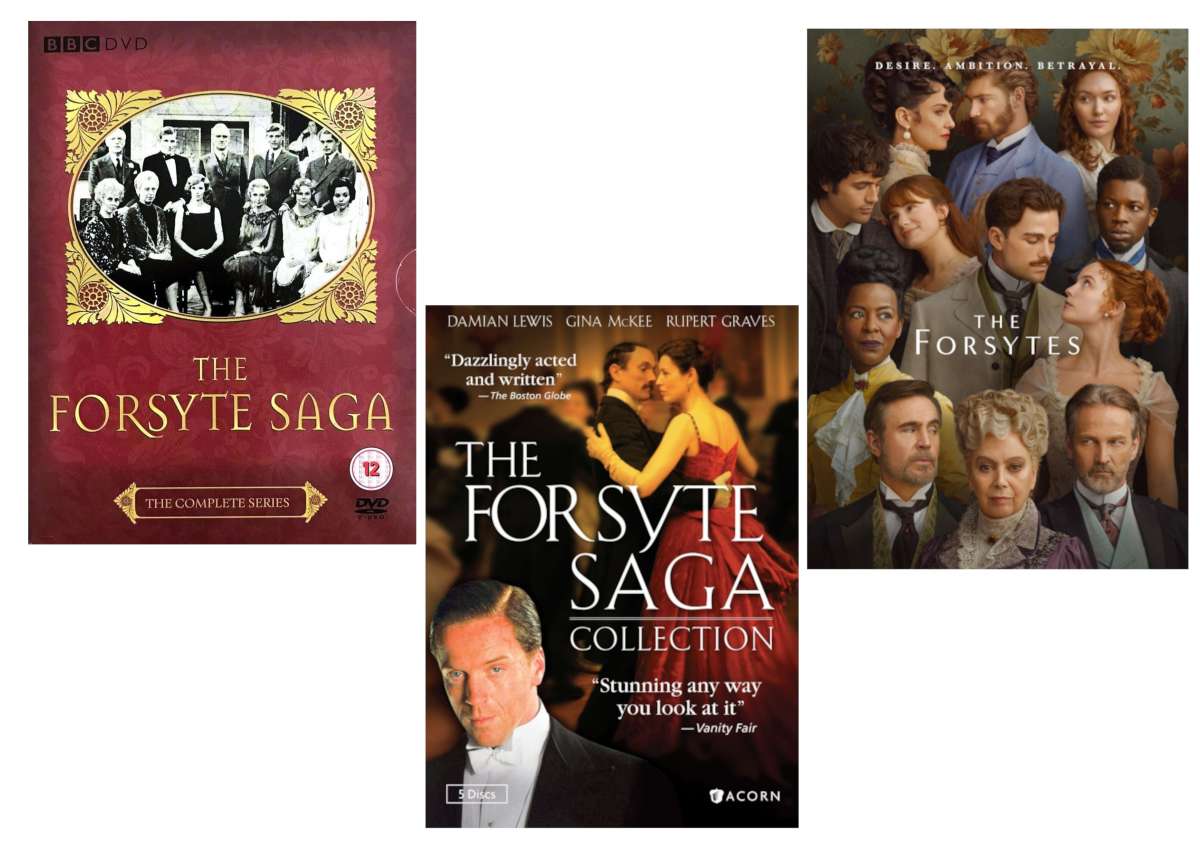
The latest television version, The Forsytes (2025), had only six episodes in its first season and covered only part of The Man of Property. It had been renewed for seasons 2 and 3. For some reason, it changes the story from the books and the two other television series. I don’t recommend starting with this series, even though it has the most elaborate production.
I recommend watching the 1967 series, which is in black-and-white. The only place I could find it was on YouTube. Among the stars were two of my favorites, Kenneth More and Susan Hampshire.
As far as I can remember, only Soames, Irene, and Winifred appear in all six of the first novels that focus on the Forsyte family from the 1880s until 1926. It involves at least ten love stories and eight marriages. It begins in Victorian times, spans the Edwardian, through World War I, and into the Jazz Age.
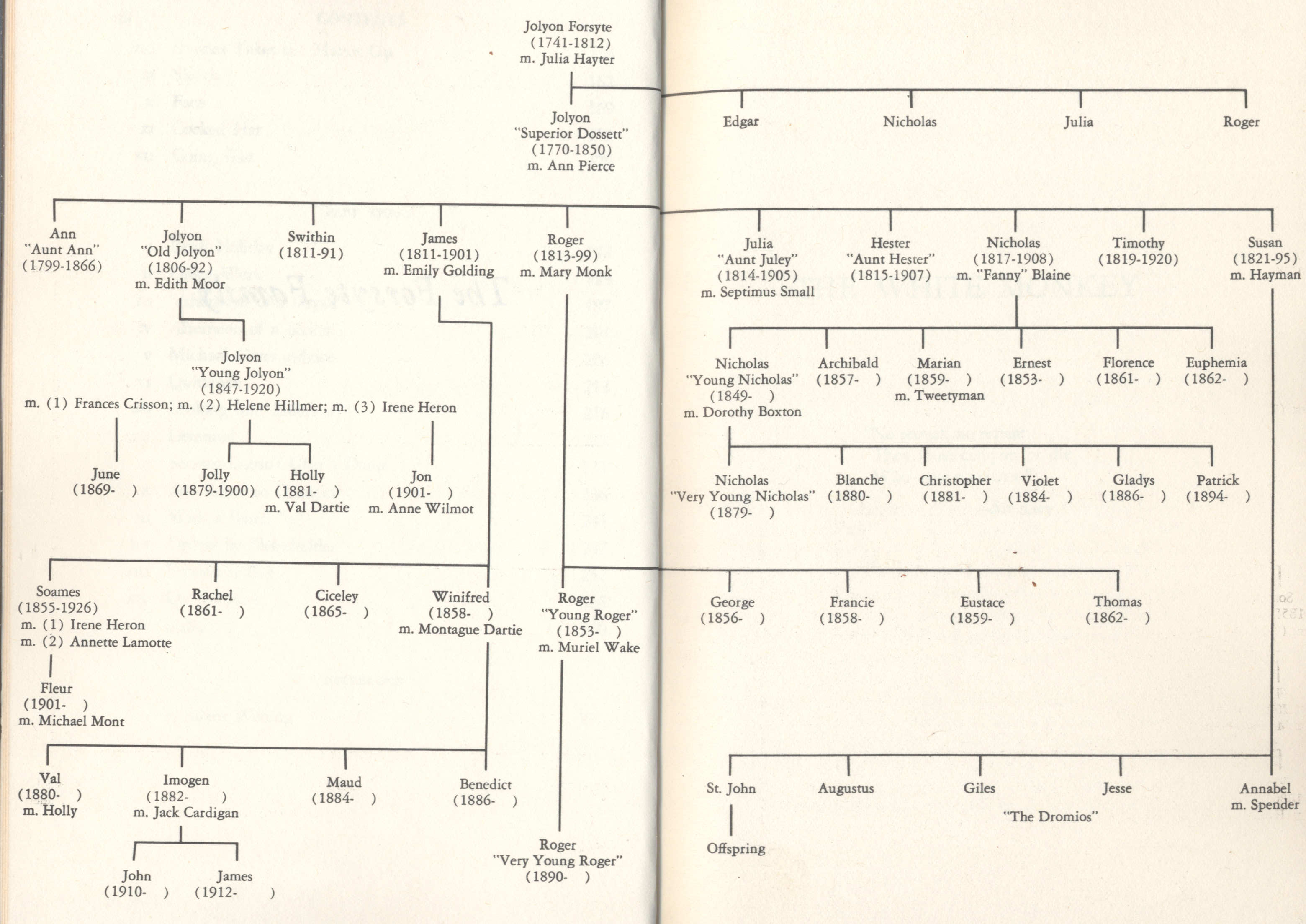
The 26 episodes of The Forsyte Saga reminded me a great deal of the 26 episodes of The Pallisers, which is based on six novels by Anthony Trollope. It made me wonder if Galsworthy was a fan of Trollope. But it also reminded me of the 12-volume novel series, Dance to the Music of Time by Anthony Powell, and the four-part TV series of the same name. These English writers like to span generations, combining character drama and British history.
Although there are plenty of reasons to hate Soames Forsyte, I found him a fascinating character. I was very sympathetic to Irene Forsyte, but I also wanted to condemn her. I both liked and disliked Jon and Fleur. In the 1967 version, Fleur was played by Susan Hampshire. It’s hard to judge the faults of a character played by such a beautiful actress.
I’ve already seen the 2002 version twice, and I’m looking forward to watching it again. According to WatchNow, it’s available on Netflix and PBS. Damian Lewis portrays Soames wonderfully. The character is so unlikable, yet over time, you develop great sympathy for the poor man.
Unfortunately, I haven’t taken to the new 2025 version, although I will give it another viewing. The actors all look too young and beautiful. The costumes, sets, and production are luscious. Visually, it reminds me of HBO’s The Gilded Age. The latest big historical dramas all seem to be revising the past, so everyone is young and beautiful. I really appreciated all the genuinely old-looking characters in the 1967 version.
The miniseries focuses on romantic relationships. The novels also explore many other kinds of relationships. Soames and his father. Soames and his uncles and aunts. Soames with his brothers and sisters. Soames is the patron of Philip the artist. But they are also romantic rivals for Irene. In the second trilogy, A Modern Comedy, the novels focus on Soames’ relationship with his daughter Fleur. In the second trilogy, we see Soames in several business and political relationships. And we see Soames’ relationship to art – he’s a collector of paintings.
And this is just the connections of Soames. There is an intense relationship between Old Jolyon, Young Jolyon, and his son Jolly. We encounter even more relationships with their wives and lovers. Young Jolyon is Soames’s first cousin, and the two families have several overlapping relationships.
The story focuses on marriage from Victorian times through the Jazz Age. To the first and second generations of Forystes, marriage was about improving the Forsyte holdings. Soames twice marries poor, beautiful women who come to despise him. Intense love fails other couples. In the first six novels, I can only recall one marriage where love succeeds.
I’ve read enough about Galsworthy to know that the complicated Forsytes were somewhat inspired by his own family. And Galsworthy stole his wife, Ada, from his cousin, and they lived unmarried for several years, hiding the scandal from his father. After his father died, his cousin divorced Ada, and Galsworthy married her. This is paralleled with Jolyon and Soames.
In other words, there is great depth in these novels that makes The Forsytes worth reproducing for television. And it should encourage fans to read the novels.
JWH

