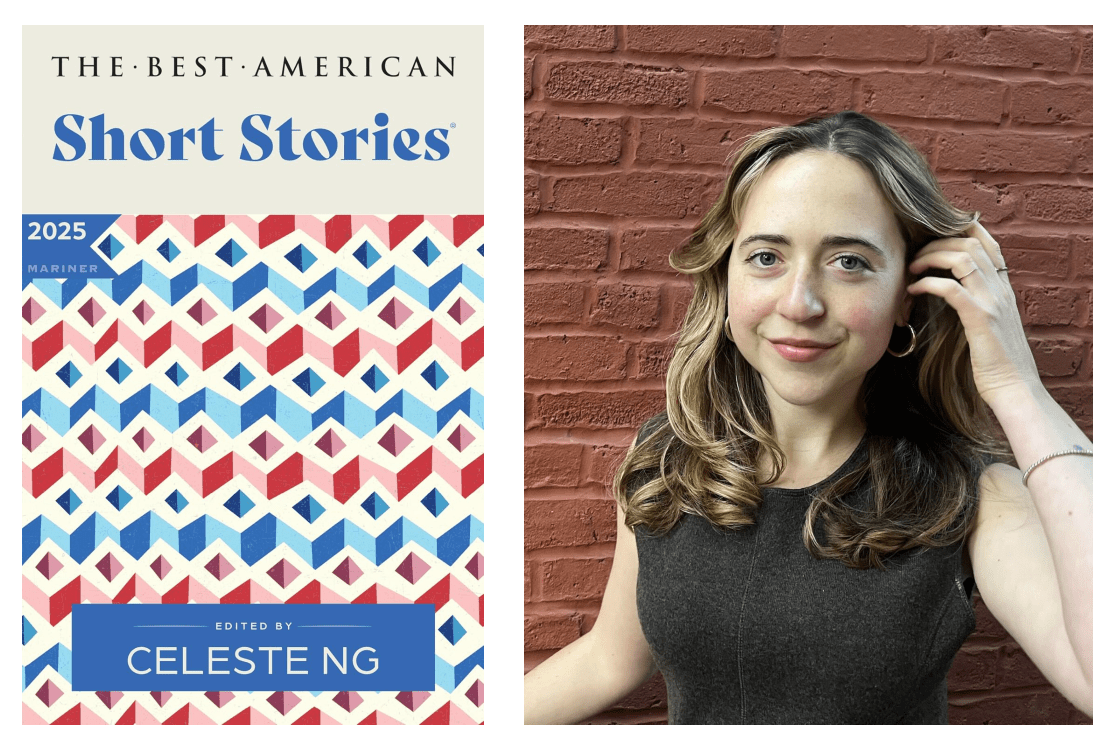
“Unfathomably Deep” by Sophie Madeline Dess

by James Wallace Harris, 8/12/26

“Unfathomably Deep” by Sophie Madeline Dess is available to read online. Or buy a copy of The Best American Short Stories 2025.

One of the essential challenges of being a professional writer is developing ideas. Ideas come to a writer all day long. I get two or three every time I take a shower, and a few more when I read the morning news. You have to pick one and work at it like painting in oil or sculpting in marble. Developing an idea means making hundreds, if not thousands, of decisions. That kind of art takes days, weeks, months, even years.

During my time taking fiction writing courses towards an MFA, I wrote over thirty stories. They encouraged us to write new ones every week. And that is a certain kind of learning experience. However, I thought my program should require workshops in which you rewrote a story every week for a semester. Because that’s how good stories evolve.

Back in the pulp magazine era, professional writers often prided themselves on being able to churn out a first draft that an editor would buy. To make a living, you had to regularly sell stories. If you read these stories today, they aren’t very good. Often I think that if they had only rewritten this story two or three times, it could have been a classic.

“Unfathomably Deep” feels like it has been rewritten many times, lacquered with many layers of varnish.

Going through the contributors section of The Best American Short Stories, you often see comments about how long the writer worked on a story, sometimes even putting it away for a time to rework it later. That’s because literary stories have so many layers.

Because these discussions of stories are not reviews, I’m going to reveal things that many readers will consider spoilers. Read the story. The link is above.

At the simplest level, “Unfathomably Deep” is about a young delusional woman named Izzie who falls in love with a handsome doctor, feels spurned, and kills him. The backstory reveals the death of her sister Danielle. To confuse matters, the doctor’s name is Daniel. And it’s not until you are into the story that you realize that Izzie isn’t talking to the reader.

The idea for “Unfathomable Deep” was just a passing bit of info. Sophie Madeline Dess said this in her contributor note:

A friend of mine is getting his MD, and from him I learned of the existence of the Gynecological Teaching Assistant—a person trained to use her own body as a teaching tool to instruct medical students on administering breast and pelvic exams. I was immediately obsessed by the thought of this job. To bring “performance” into the exam room; to be probed and prodded, to pretend. The job struck me as perfect for a voice that had been floating around in my head, the voice of Izzie in “Unfathomably Deep.” Izzie’s passion, grief, and spunk all took shape as I imagined her as a GTA, lying on an exam table, surrounded by handsome, untalented medical students. Eventually that career choice became secondary to the main thrust of the story, which is to do with allegiance, violence, and fate. It is a story born of the question: What forces and passions possess us in the wake of grief?

Dess was given an idea accidentally. A million writers would have written a million different stories with that idea. Ideas count for nothing. Dess had a character she had been developing in her mind. Character is the foundation of literary fiction, not the idea or plot. How many data points would you need to define your own character? Writers have to think up those details for the characters they create.

Yet, a good idea and character aren’t enough. You need a conflict. Readers keep reading to see how a character solves a problem. And you need to start everything with a hook. The first sentence of “Unfathomably Deep” is:

“Three men were supposed to spread me open, check me out.”

That’s a shocker. I imagined open-heart surgery because I’ve seen so many medical shows where the doctors use a rib spreader. But Dess quickly diverted me away from that image. “As the men locked me in my stirrups, they told me their names, which now I’ve forgotten, but I do remember that one was blond, the other blonder.” Okay, she’s in for a pelvic exam. That’s a different image of spreading altogether.

See how Dess’s imagination is controlling what we imagine? Movies are a series of photographs. At 24 frames per second, we see an illusion of reality. Writers have to create the illusion of reality with words. The old saying that a picture is worth a thousand words doesn’t apply to fiction. It doesn’t take 24,000 words a second. Fiction is an accumulation of significant details. Each sentence should add details to the story. (Read “About 5,750 Words” by Samuel R. Delany.)

This paragraph should clarify the setting and situation in the reader’s mind:

It was my job to intervene. Formally speaking, I was a GTA: a Gynecological Teaching Assistant. Really just a body lender for medical students. Their one task was to perform a partial gynecological exam on a pretend patient — me — who had pretend gynecological problems, which were the result of a pretend sex life, which was the result of a pretend desirability. I had a script and everything.

Personally, I would have begun the story with that paragraph. I think it’s a much better hook. However, some literary writers like to play around with the reader’s head.

Sophie Madeline Dess is attempting far more than I imagined on the initial reading. Like reality, fiction can connect to many realms, or levels. At first, “Unfathomably Deep” feels like a simple comedy about a woman paid to be a gynecological patient falling in love with the student doctor.

But I didn’t tell you about the epitaph at the beginning of the story:

I know indeed what evil I intend to do,
But stronger than all my afterthoughts is my fury,
Fury that brings upon mortals the greatest evils.

— Euripides’s Medea, 431 B.C.E.

Now I need to use a reference from a movie that many people consider offensive. It’s when Robert Downey Jr.’s character tells Ben Stiller’s character in Tropic Thunder to not go full retard. He explains that you can create award-winning roles about cognitively damaged people if you don’t play them as too damaged. That’s an apt analogy for going too literary. James Joyce was fine with many readers with A Portrait of the Artist as a Young Man, but lost a lot of them with Ulysses. But he lost most of his readers with Finnegans Wake by going full Joycean. There are only so many layers of allusion that some readers can handle.

My friend Linda said she didn’t like “Unfathomably Deep” because it was too strange. I wondered if Dess had gone full-Joycean for her. I still enjoyed the story, but I’m not sure how many times I’m willing to reread it to get all the allusions and foreshadowing.

Karen Carlson said at A Just Recompense, “I had to read the story several times to feel like I knew what was happening in various places, and I think I’ll be milking subtext and metaphor for the next thirty reads at least.” And at Jake Weber’s Workshop Heretic, she said in the comments that this was her favorite story in the anthology. Karen’s post went down the Medea rabbit hole. I recommend you read it.

I ignored the Medea angle while reading the story. That means I missed a lot of what Dess intended. I loved Joyce’s Portrait, but never could finish Ulysses after several tries. Dess is somewhere between the two with literary allusions. Karen said she’s currently obsessed with Greek literature.

Jake went down the Freudian rabbit hole. And I recommend you read his piece too. I wondered about Freud while reading the story and considered researching that angle. Weber is careful to point out that Freud is considered useless for modern psychoanalysis, but is still popular for literary analysis.

“Unfathomably Deep” is a smorgasbord of stories. I latched onto Izzie falling in love at first sight. Yesterday, by coincidence, my friend Anne texted me about how gorgeous her doctor was. She was quite taken. And I’ve remembered other times when women friends told me they were knocked out by male beauty. For men, beautiful women are everywhere. It comes in all varieties. But with women, Mr. Beautiful is as rare as black swans. I was hoping the story would explore the differences between women and men and their view of beauty, but it doesn’t.

Izzie stalks Daniel. The second time Izzie gets to work with Daniel, he completely lets her down. Then she stalks his neighborhood. But why. Well, she kills him. This falls in with the Medea thread. Izzie wraps her legs around Daniel’s head while holding him underwater, fondling his face and hair. Some readers discuss this story’s humor. And I could picture this story made into a movie, and even imagine the scene of Izzie drowning Daniel being funny.

But when you reread the story, with all the Medea and Freudian layers, you realize Izzie is quite cognitively damaged. You have to ask what Robert Downey Jr. asked so crudely. Does Dess go too far with Izzie? That’s hard to answer.

I suppose there’s an audience for humor about insanity, like some readers who seek out stories of body horror. Dess’ humor isn’t like Heller’s in Catch-22. It’s somewhat like J. D. Salinger’s if you ignore all the Medea stuff. And I’m leaving out whole gobs of the story, especially the weird humor about Danielle.

There’s a subplot that satirizes concepts regarding female bodies. I believe hordes of readers could read “Unfathomably Deep” without ever connecting with what Karen, Jake, and I saw in the story.

JWH
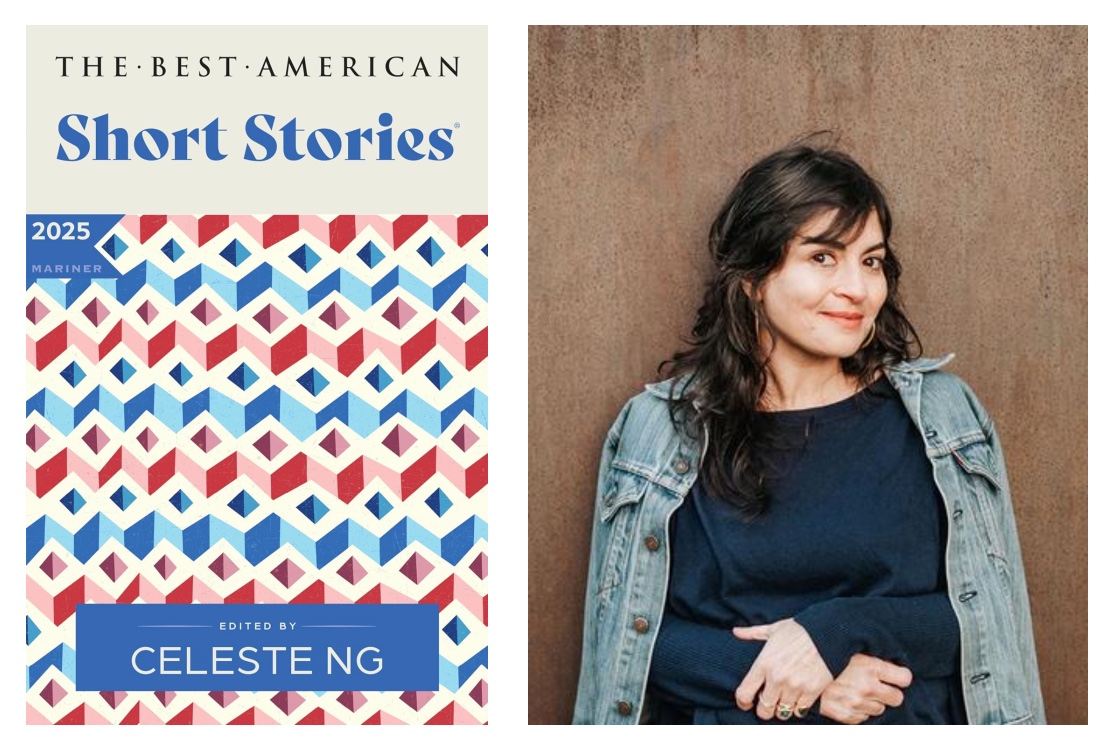
“Abject Naturalism” by Sarah Braunstein

by James Wallace Harris, 8/11/26

We humans have several cognitive tools for understanding reality. The early ones were myth, folklore, and religion. The only ones that can consistently describe reality are math and science. But a popular one today is fiction. I don’t just mean short stories and novels. But also television shows, movies, comics, video games, manga, poetry, lyrics, etc. I think reading and analyzing literary stories are a unique kind of microscope for studying reality.

The thing about fiction is everyone interprets it differently. I like that. It helps to consume other interpretations. Luckily, I have Karen Carlson at A Just Recompense and Jake Weber at Workshop Heretic to follow behind in reading The Best American Short Stories volumes.

For most of my life, I’ve read science fiction. I review it on Classics of Science Fiction. Science fiction is mostly genre fiction. Genre fiction is like modern art; it doesn’t try to portray reality, but create an artificial reality. Genre fiction is admired for creating something beautiful that doesn’t exist in reality. Literary fiction is beautiful for describing reality.

When I was growing up, science fiction fans would call literary fiction mundane fiction. “Abject Naturalism” by Sarah Braunstein describes a very mundane situation. Now that I’m older, stories about interstellar travel bore me, and I’m more fascinated by the mundane.

You can read or listen to “Abject Naturalism” at The New Yorker if you have a subscription. If you have a Spotify account, you can listen to the story read by the author. And, of course, you can read it in The Best American Short Stories 2025.

Toni is the mother of 10-year-0ld Amalie. My guess is Toni is around 44 because she gives two backstories ten years apart. The first jump is twenty years earlier, when Toni first met Amalie’s father in graduate school. The second jump is ten years back, when she briefly reunited with Amalie’s father and got pregnant with Amalie.

Jake Weber at Workshop Heretic did an extensive analysis of the title: “Abject Naturalism.” I recommend reading it because I don’t want to repeat his work. Weber says:

This emphasis on the “physiological” nature meant naturalism was more likely than realism to focus on humanity’s grosser functions, its various excretions and weird growths. It’s borderline scatalogical, but not like a gross-out comedy; more like a gross-out horror. In this sense, naturalism matches the meaning of the term “the abject” from theorist Julia Kristeva. I’ve delved more deeply into the meaning of “the abject” in this analysis of its use in female horror stories, but here, I’ll define the abject briefly as whatever reminds us of our status as animals, as blood-and-meat carrying bodies that die and decay. Women are particularly depicted as abject because, among other things, their monthly bloody cycles and their fertile bodies remind us of our “naturalism.” If we think of naturalism in this way, and this meaning of abject, the title becomes something like “Abject Abject.” A double dose of abjection. Weber gives plenty of evidence to support this with quotes from the story.

Weber cites plenty of points in the story to support this view. Especially connecting it with Toni’s desire to write literary horror stories when she was in writing school. By the end of “Abject Naturalism,” Toni feels positive about writing again, and we have to wonder if “Abject Naturalism” is something she would have written?

But that is not how I focused on “Abject Naturalism.” For me, it was about two things: freedom from fear and writing. Karen Carlson at A Just Recompense was closer to my view when reviewing “Abject Naturalism.” I completely agree with this.

I once took a class with a professor who insisted that every poem Robert Frost wrote, no matter what it was about, was really about writing poetry. Two roads in the wood? Poetry. Woods on a snowy evening? Poetry. Walls, birches, death, gold, choosing a star? All about writing poems. I got the sense, after I’d read this story a couple of times and looked up the title, that this story is all about writing a story.

I believe all literary fiction is about writing, but it seems more obvious when the protagonist is a writer, or in Toni’s case, a failed writer. It’s even more revealing when we get a title like “Abject Naturalism.” To me, literary fiction is always a kind of metafiction. While consuming a literary story, I always ask myself, “Why did the writer write this story, how did they write it, is any of it autobiographical, and what is the writer really telling us?”

I couldn’t find much about Sarah Braunstein, but this paragraph from her contributor’s page is very revealing.

Some years ago, my elementary-aged child went for a jog in the neighborhood, promising to stay alert and to avoid strangers. He returned with a telescope a stranger had been throwing away. The man, he said, had told him he could buy a new part for it on the web. My son and I ordered some plastic mirror thing for $3 on eBay, but we could never get it to fit, and the telescope now sits in the basement wrapped in cobwebs. From the day he came home with it, the telescope radiated with meaning. It felt like the set-up of a short story on my front stoop, the kid and the object. The telescope lets the child see the cosmos, a world beyond the household, beyond what the mother knows. I imagined a mother who would feel threatened by this, who would wonder about the man . . . who might even go to his door to complain. She would be lonely, half-aware of her motivations. When she knocked on his door and I saw the entryway to Marco’s living room, his reading glasses, I realized this might be a story about real estate, or friendship, or love . . . the narrative opened up to me, a Venn diagram of these elements. I began to imagine a daughter who is prickly and tart, always one step ahead of her mother. She has a band on her wrist that counts steps, another device Toni did not give her, and downloads apps without permission on Toni’s phone. Poor Toni! It began to make me laugh, the Sisyphean task of controlling a young adolescent with a burning mind. Well, what about her own burning mind? Toni as a former creative person came into focus then. I wanted to write about so many things, to say something about grief, creativity, doubt, fear . . . finding my way to the end of this story was a challenge. At one point Toni says she stopped writing because she never could figure out how to end things. “Abject Naturalism” sat in a file for a long time until I could understand what its ending needed to do.

So she had a kid about Amalie’s age, but how old is she? In 2010, the National Book Foundation recognized her as “5 Under 35.” I guessed that Toni was around 44, so Braunstein could be of a similar age. From what little I did find about her, I could imagine Braunstein following Toni’s path, as well as the path Toni didn’t take, the one Amalie’s father took. Braunstein attended the Iowa Writers’ Workshop, the Mecca for MFA students. And “Abject Naturalism” was published in both The New Yorker and The Best American Short Stories 2025. Braunstein has two novels and a collection available at Amazon, and she teaches creative writing at Colby College in Maine. Doesn’t that sound like Amalie’s father?

Literary fiction gives writers a chance to work things out. I’m currently rereading J. D. Salinger, and I consider his stories metaphorical roman à clef. I want to believe literary writers are telling us something about their lives, even when the plot and characters don’t match their own.

“Abject Naturalism” really begins when Amalie, at ten, claims she’s old enough to go jogging by herself. This terrifies Toni. Amalie wants her freedom. Toni realizes she must give her freedom, but knows that she, herself, is not free. Toni resents that Amalie’s father chose to become a successful writer rather than being a parent, but was that freedom?

Now, I identify with Toni in two ways. First, I’m also an MFA dropout who eventually gave up the dream of becoming a writer. Even though we never had children, the thought of letting a kid go out of the house on their own terrifies me.

Which is odd, because in 1957, when I was just 5, I walked to my first day of 1st grade by myself. My parents asked me if I knew where the school was. I said yes, but I didn’t really. I just went outside and followed all the other kids in the neighborhood, heading somewhere. By the time I was 6 and 7, I was roaming the neighborhood for blocks. When we moved to New Jersey in 1959, and I was 8, I roamed across farms and woods. One day, I led my 6-year-old sister into the woods to see how far we could go and ended up in town. By chance, my father was driving home from work and saw us.

My father was surprised to see us. He asked us how we got into town. But when we explained, he didn’t yell at us. He just drove us home. I’ve always wondered what I would have done if he hadn’t spotted us. Probably returned the same way we came. I was good at not getting lost.

The first half of “Abject Naturalism” dramatises Toni’s fears of letting Amalie roam free. If I had had kids, I don’t know if I could let them out of my sight. In today’s New York Times, I read “Should Letting Children Play Alone Outside Be a Crime?” By today’s standards, my parents would have seen jail time.

To make matters worse, Amalie comes back from her jog lugging a broken telescope. She tells Toni a man gave it to her. Toni freaks out at the thought of Amalie talking to strangers.

The next day, when Amalie is in school, Toni goes down the street and confronts the man, Marcos. He’s described as an old guy in his mid-to-late sixties. Toni calmly tells him that he shouldn’t talk to children because it conditions them to feel safe talking to strangers. Marcos explains he hadn’t really struck up a conversation. He said Amalie was looking at the telescope he put out on the street in the trash. He merely told Amalie she could have it, and that it was missing a part that could be bought cheaply on eBay.

This calms Toni some, but she still worries.

Then the story takes a different turn. Toni keeps returning to visit Marcos. In a way, she slowly gives herself freedom too. The hard part of the story for me was believing a woman in her forties would be romantically attracted to a guy in his sixties. Toni does worry about losing her low-rent apartment in a gentrified neighborhood. Does she want Marcos for his house? She imagines her and Amalie moving into it. But she also believes Marcos loves her, but she’s too embarrassed to say that to her friends.

Toni is constantly running a script in her head about her fears. When Amalie demands some very limited freedom, Toni starts allowing herself a small bit of freedom.

The ending of the story is happy, and even kind of sappy. Toni even fantasizes about writing again. She pictures herself setting up a writing location in Marcos’ house.

There is actually too much to analyze in “Abject Naturalism.” In the beginning of the story, we’re given Toni’s backstory with Amalie’s father. This is one kind of love story. But we see another kind of love story at the end, with Marcos. Unfortunately, we are only told what Amalie’s father and Marcos might be thinking.

It would have been a whole other level of naturalism/realism if we had their points of view. Some writers do attempt such multiplex perspectives.

There was something else I wanted to analyze. Like many MFA-type literary stories, there are lots of flashbacks. This means we’re often told information rather than experiencing it dramatically.

I just reread “A Perfect Day for Banafish” by J. D. Salinger. It was an exquisite example of showing rather than telling. It was so concise. So immediate. Reality glittered. I’m sad that we don’t see this style of writing much anymore. Most of my bookworm friends that I try to get to read The Best American Short Stories tell me they don’t like that kind of writing. I will admit that “Abject Naturalism” conforms to a modern MFA-style of writing that feels like a genre of its own.

Like I said, everyone reads a short story differently; just read the comments here. Some of them said they normally get tired of this kind of story, but this one is a good one of that type.

If you read this story, let me know what you thought about it.

JWH

The Forsytes on TV

by James Wallace Harris, 6/13/26

Would anyone still be reading John Galsworthy if British television didn’t keep producing new versions of The Forsyte Saga? Galsworthy did win the Nobel Prize for Literature in 1932, the year before he died, but that recognition seldom guarantees an enduring audience.

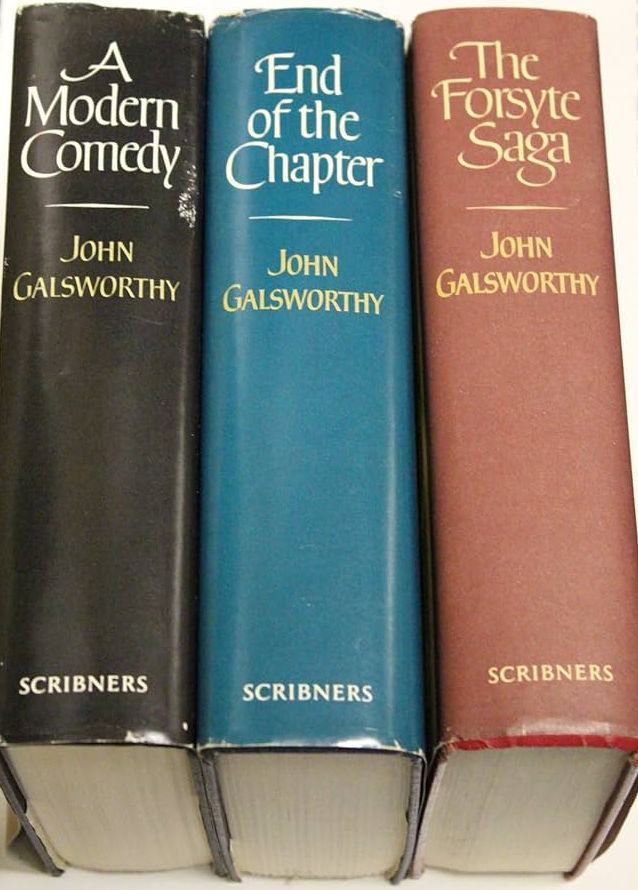
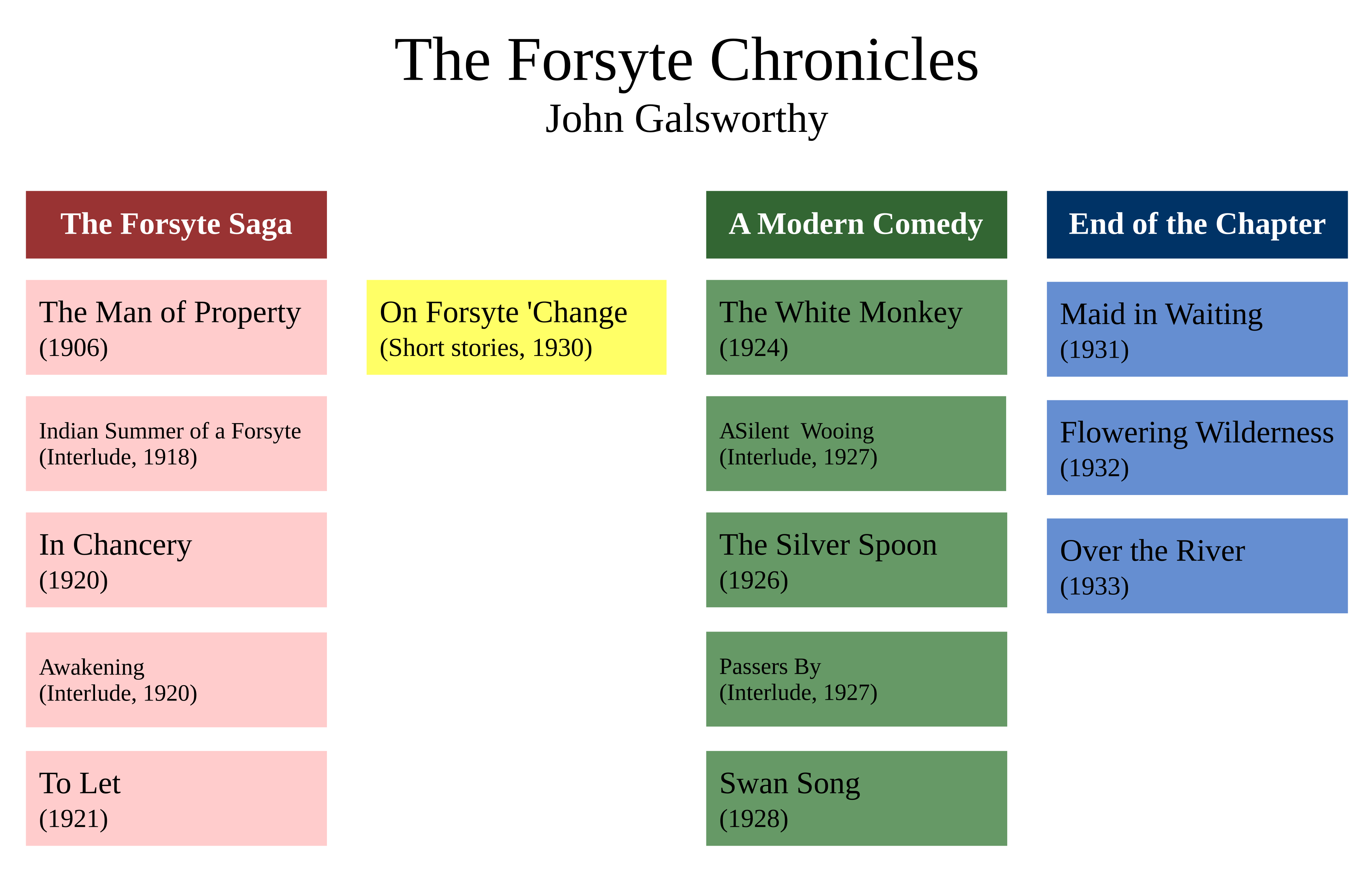
I must admit I wouldn’t be reading Galsworthy books today if I hadn’t been a fan of all three miniseries based on The Forsyte Saga. Technically, The Forsyte Saga is the title Galsworthy gave to the first trilogy of novels based on the Forsyte family. All nine novels are called The Forsyte Chronicles.

I know it sounds obsessive that I’m reading the books after watching 42 episodes of the three miniseries. However, the novels color in the main characters with greater detail. They also flesh out all the minor characters we see standing around the main characters on the screen.

The literary world has forgotten Galsworthy as a Victorian materialist who didn’t make the evolutionary step to modernism. Virginia Woolf was particularly hard on Galsworthy for failing to portray the inner lives of his characters. We don’t get deep, long stream-of-consciousness narratives, but I do feel Galsworthy describes the inner world of his characters, sometimes explicitly but often implied through dialogue and action.

Soames Foryste, who readers will hate as much as Irene Forsyte hates him, does get our sympathy. Soames is so well developed over six novels that he feels like one of the historical figures Lytton Strachey wrote about in Eminent Victorians.

Personally, I don’t know why Anthony Trollope and John Galsworthy aren’t as popular with readers as Jane Austen and Charles Dickens. They fill in a gap in English history for readers who study history through novels. Galsworthy is well-suited for those who love Downton Abbey, which explains why British television has produced it three times.

Amazon has the Forsyte Collection for 99 cents, which claims to contain everything in 3,355 pages. There are several audiobook editions, but I’m listening to the Naxos editions. Naxos packages the entire story of nine novels using their trilogy names: The Forsyte Saga, A Modern Comedy, and End of the Chapter.

Only the first six novels actually focus on the Forsytes; the last three deal with a distant cousin.

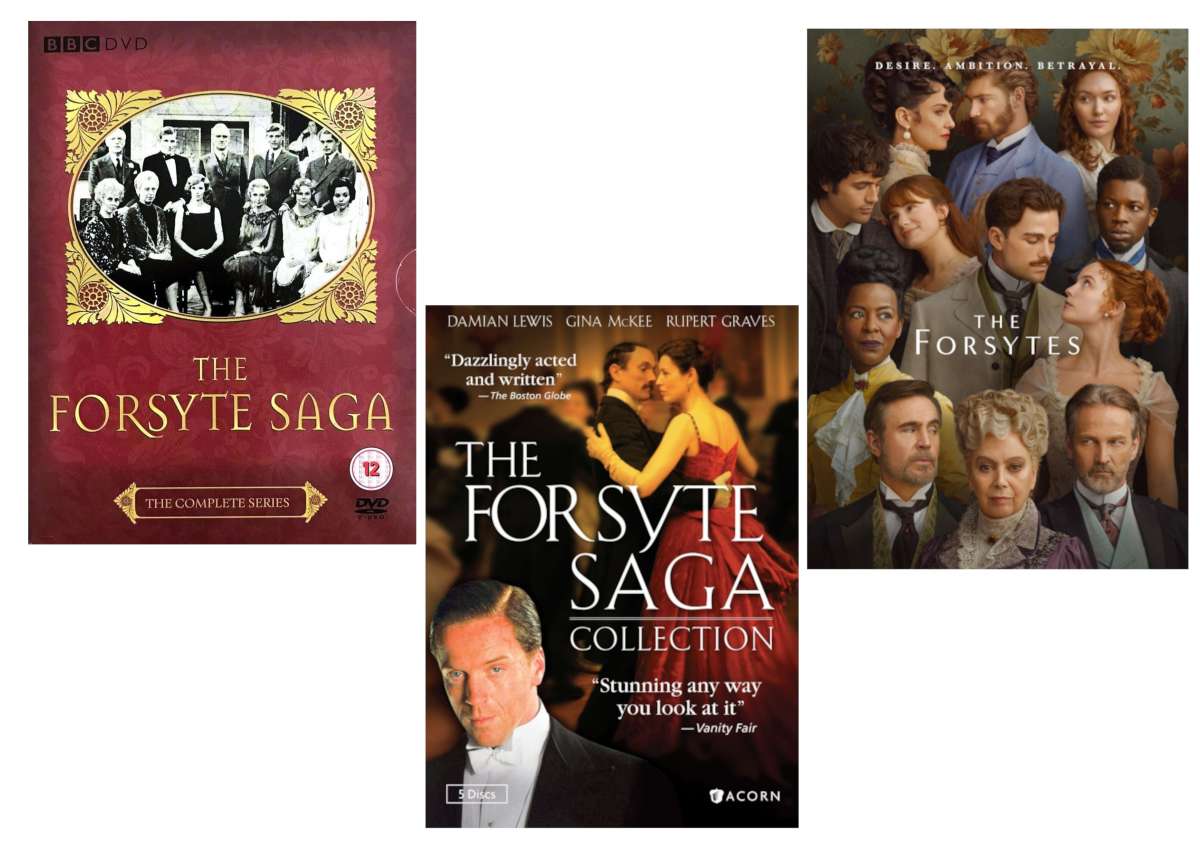
The Forsytes Saga (1967) miniseries has 26 parts, and covers the first six novels and interludes (short stories):

  • The Man of Property
  • In Chancery
  • To Let
  • The White Monkey
  • The Silver Spoon
  • Swan Song

The Forsyte Saga (2002) miniseries has 10 parts, and only covers the first three novels and interludes (short stories):

  • The Man of Property
  • In Chancery
  • To Let

The latest television version, The Forsytes (2025), had only six episodes in its first season and covered only part of The Man of Property. It had been renewed for seasons 2 and 3. For some reason, it changes the story from the books and the two other television series. I don’t recommend starting with this series, even though it has the most elaborate production.

I recommend watching the 1967 series, which is in black-and-white. The only place I could find it was on YouTube. Among the stars were two of my favorites, Kenneth More and Susan Hampshire.

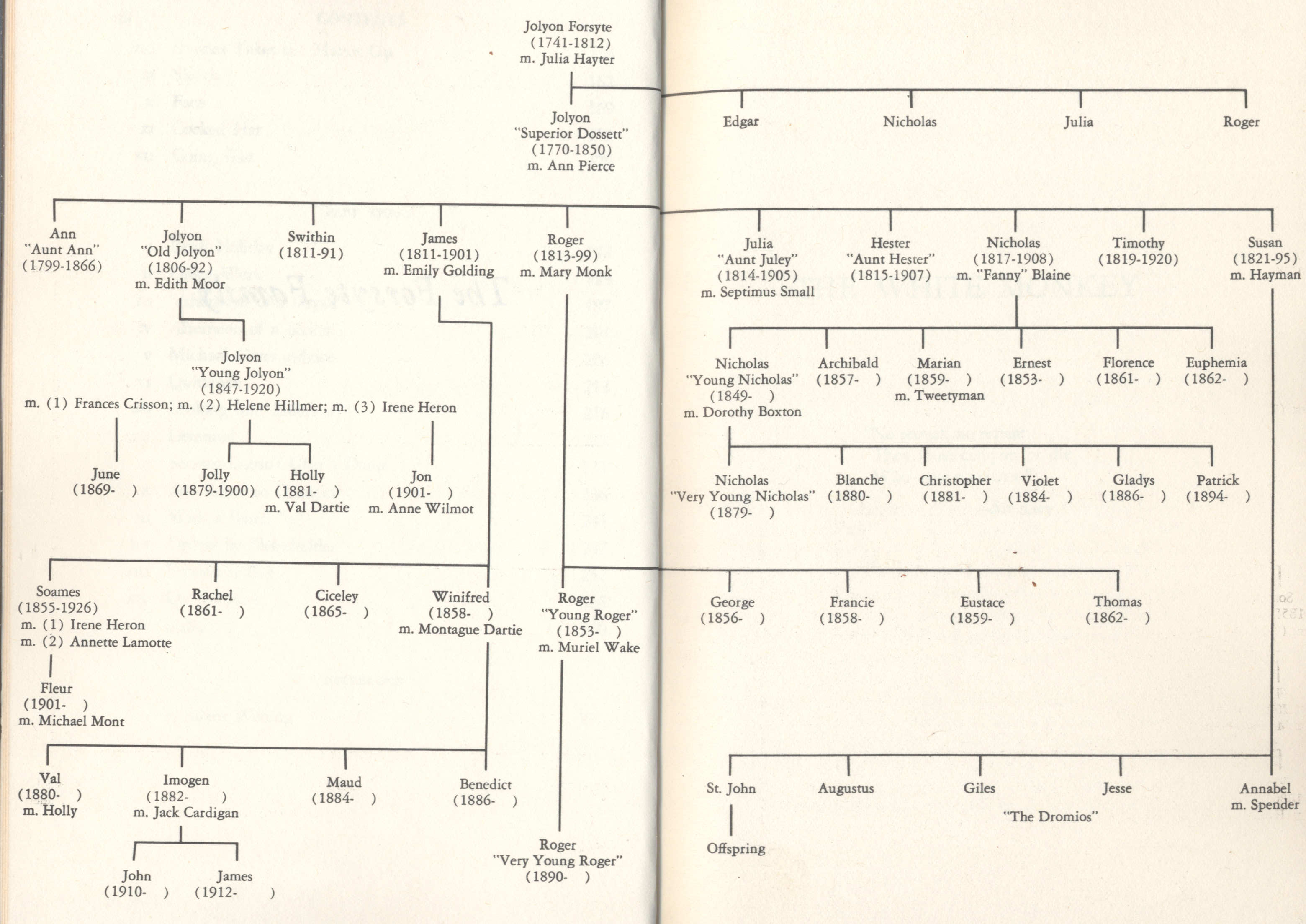
As far as I can remember, only Soames, Irene, and Winifred appear in all six of the first novels that focus on the Forsyte family from the 1880s until 1926. It involves at least ten love stories and eight marriages. It begins in Victorian times, spans the Edwardian, through World War I, and into the Jazz Age.

The 26 episodes of The Forsyte Saga reminded me a great deal of the 26 episodes of The Pallisers, which is based on six novels by Anthony Trollope. It made me wonder if Galsworthy was a fan of Trollope. But it also reminded me of the 12-volume novel series, Dance to the Music of Time by Anthony Powell, and the four-part TV series of the same name. These English writers like to span generations, combining character drama and British history.

Although there are plenty of reasons to hate Soames Forsyte, I found him a fascinating character. I was very sympathetic to Irene Forsyte, but I also wanted to condemn her. I both liked and disliked Jon and Fleur. In the 1967 version, Fleur was played by Susan Hampshire. It’s hard to judge the faults of a character played by such a beautiful actress.

I’ve already seen the 2002 version twice, and I’m looking forward to watching it again. According to WatchNow, it’s available on Netflix and PBS. Damian Lewis portrays Soames wonderfully. The character is so unlikable, yet over time, you develop great sympathy for the poor man.

Unfortunately, I haven’t taken to the new 2025 version, although I will give it another viewing. The actors all look too young and beautiful. The costumes, sets, and production are luscious. Visually, it reminds me of HBO’s The Gilded Age. The latest big historical dramas all seem to be revising the past, so everyone is young and beautiful. I really appreciated all the genuinely old-looking characters in the 1967 version.

The miniseries focuses on romantic relationships. The novels also explore many other kinds of relationships. Soames and his father. Soames and his uncles and aunts. Soames with his brothers and sisters. Soames is the patron of Philip the artist. But they are also romantic rivals for Irene. In the second trilogy, A Modern Comedy, the novels focus on Soames’ relationship with his daughter Fleur. In the second trilogy, we see Soames in several business and political relationships. And we see Soames’ relationship to art – he’s a collector of paintings.

And this is just the connections of Soames. There is an intense relationship between Old Jolyon, Young Jolyon, and his son Jolly. We encounter even more relationships with their wives and lovers. Young Jolyon is Soames’s first cousin, and the two families have several overlapping relationships.

The story focuses on marriage from Victorian times through the Jazz Age. To the first and second generations of Forystes, marriage was about improving the Forsyte holdings. Soames twice marries poor, beautiful women who come to despise him. Intense love fails other couples. In the first six novels, I can only recall one marriage where love succeeds.

I’ve read enough about Galsworthy to know that the complicated Forsytes were somewhat inspired by his own family. And Galsworthy stole his wife, Ada, from his cousin, and they lived unmarried for several years, hiding the scandal from his father. After his father died, his cousin divorced Ada, and Galsworthy married her. This is paralleled with Jolyon and Soames.

In other words, there is great depth in these novels that makes The Forsytes worth reproducing for television. And it should encourage fans to read the novels.

JWH

Audible Has Granted Some of My 2018 Wishes

by James Wallace Harris, 4/13/26

When I joined Audible back in 2002, I wanted to reread (by listening) my favorite science fiction books I had read growing up. Audible did a fantastic job producing hundreds of science fiction novels first published in the 1950s, 1960s, and 1970s. However, there were quite a few I kept waiting to hear. In 2018, I published a list of 67 science fiction books I hoped Audible would produce. I came across that list today. I thought I’d reprint it, annotating which wishes were granted.

Unfortunately, Audible has quietly dropped many old science fiction books from its catalog. On a discussion board today, one member described a visit to Barnes & Noble, where he looked to see how many old science fiction titles that Baby Boomers grew up reading were available for new readers to buy. I’m not sure he would find any of these books in B&N’s science fiction section. I do give Audible credit for keeping a great many mid-20th-century SF in print. Luckily, I bought hundreds of old science fiction books on Audible, and they’re still in my library, even if they are no longer for sale.

Here’s my wishlist from 2018. I link to Wikipedia for those titles that are now available at Audible. (It was the best way I could make them stand out.)

Per the comment below, I’ve looked for these books on YouTube, and marked those titles.)

  1. A Voyage to Arcturus (1920) by David Lindsay (YouTube)
  2. The World of Null-A (1948) by A. E. Van Vogt (YouTube)
  3. The Voyage of the Space Beagle (1950) by A. E. Van Vogt (YouTube)
  4. The Legion of Time (1952) by Jack Williamson
  5. The Long Loud Silence (1952) by Wilson Tucker
  6. Marooned on Mars (1952) by Lester del Rey
  7. Bring the Jubilee (1953) by Ward Moore
  8. Children of the Atom (1953) Wilma H. Shiras
  9. A Mirror for Observers (1954) by Edgar Pangborn
  10. Mission of Gravity (1954) by Hal Clement
  11. Cities in Flight (1955) by James Blish
  12. Citizen in Space (1955) by Robert Sheckley
  13. Rocket to Limbo (1957) by Alan E. Nourse (YouTube)
  14. Wasp (1957) by Eric Frank Russell
  15. The Enemy Stars (1958) Poul Anderson
  16. The Lincoln Hunters (1958) by Wilson Tucker
  17. The Fourth “R” (1959) by George O. Smith (YouTube)
  18. The High Crusade (1960) by Poul Anderson (YouTube)
  19. Hothouse (1962) by Brian W. Aldiss
  20. Second Ending (1962) by James White
  21. Davy (1964) by Edgar Pangborn
  22. Simulacron-3 (1964) by Daniel Galouye
  23. Earthblood (1966) by Keith Laumer and Rosel George Brown
  24. Empire Star (1966)
  25. The Witches of Karres (1966) by James H. Schmitz
  26. Lords of the Starship (1967) by Mark S. Geston
  27. Camp Concentration (1968) by Thomas Disch
  28. Of Men and Monsters (1968) by William Tenn (YouTube)
  29. Omnivore (1968) by Piers Anthony
  30. Past Master (1968) by R. A. Lafferty
  31. Space Chanty (1968) by R. A. Lafferty
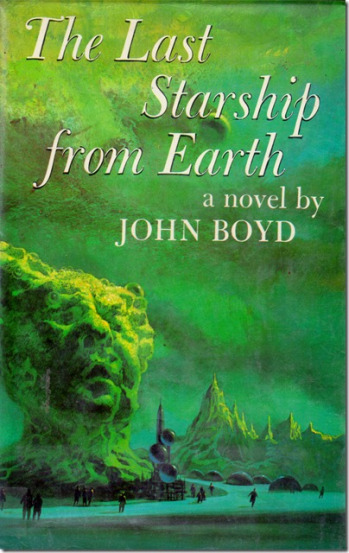
  32. The Last Starship from Earth (1968) by John Boyd
  33. The Still, Small Voice of Trumpets (1968) by Lloyd Biggle, Jr.
  34. Behold the Man (1969) by Michael Moorcock
  35. Bug Jack Barron (1969) by Norman Spinrad
  36. Macroscope (1969) by Piers Anthony
  37. And Chaos Died (1970) by Joanna Russ
  38. The Year of the Quiet Sun (1970) by Wilson Tucker
  39. The Doors of His Face, The Lamps of His Mouth (1971) by Roger Zelazny
  40. The Fifth Head of Cerberus (1972) by Gene Wolfe (YouTube)
  41. The Listeners (1972) by James Gunn
  42. The Continuous Katherine Mortenhoe (The Unsleeping Eye) (1973) by D. G. Compton
  43. The Centauri Device (1974) by M. John Harrison
  44. Orbitsville (1975) by Bob Shaw
  45. The Female Man (1975) by Joanna Russ
  46. The Shockwave Rider (1975) by John Brunner
  47. Trouble on Triton (1976) by Samuel R. Delany
  48. On Wings of a Song (1979) by Thomas M. Disch
  49. Ridley Walker (1980) by Russell Hoban (YouTube)
  50. No Enemy But Time (1982) by Michael Bishop
  51. Native Tongue (1984) by Suzette Haden Elgin
  52. Ancient of Days (1985) by Michael Bishop
  53. The Falling Woman (1986) by Pat Murphy
  54. Mindplayers (1988) by Pat Cadigan
  55. Her Smoke Rose Up Forever (1990) by James Tiptree, Jr.
  56. A Woman of the Iron People (1991) by Eleanor Arnason
  57. Sarah Canary (1991) – Karen Joy Fowler
  58. Synners (1991) by Pat Cadigan
  59. China Mountain Zhang (1992) by Maureen F. McHugh
  60. Ammonite (1993) by Nicola Griffith
  61. Galatea 2.2 (1995) by Richard Powers
  62. Ingathering: The Complete People Stories of Zenna Henderson (1995)
  63. Holy Fire (1996) by Bruce Sterling
  64. The Book of the Long Sun (1993-96) by Gene Wolfe
  65. Aye, and Gomorrah (2003) by Samuel R. Delany
  66. Store of the Worlds (2012) by Robert Sheckley
  67. The Future is Female (2018) edited by Lisa Yaszek

JWH

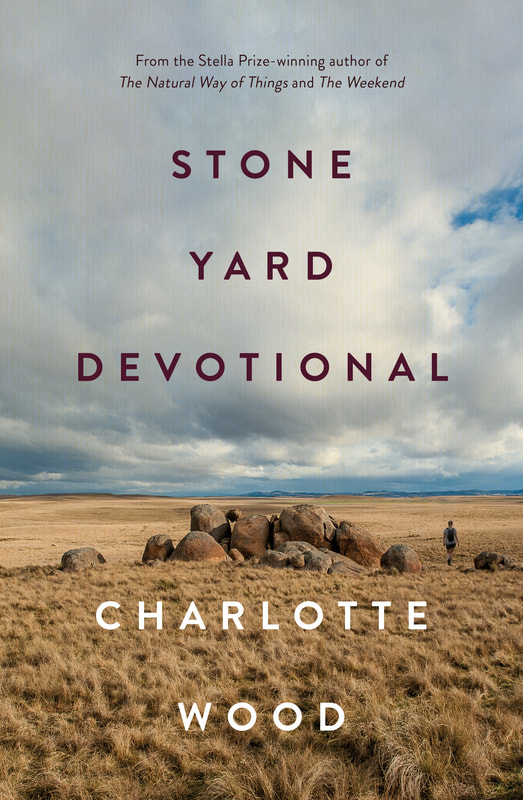
STONE YARD DEVOTIONAL by Charlotte Wood

by James Wallace Harris, 4/12/25

Stone Yard Devotional is about how reality puts the peddle to the metal when life gets all too real. Stone Yard Devotional reads like a memoir, a diary, but it’s classified as a novel. The book was nominated for several awards.

The entire time I was listening to this book I wondered if Charlotte Wood was the unnamed narrator, however after reading “‘The shock was so deep’: Novelist Charlotte Wood on the experience that changed everything” in the Syndney Herald, I realized the novel was only inspired by her own life. Wood and her two sisters were being treated for breast cancer, while she was contemplating mortality and drafting this book.

I have no memory of how I discovered Stone Yard Devotional by Charlotte Wood. The cover and title intrigued me for sure. Maybe it was because it was shortlisted for the 2024 Booker Prize. The audiobook was part of my Spotify subscription, so I gave it a try, and I’m glad I did. It’s not the kind of book I normally read, but it’s wonderful to read if you’re getting old.

The story begins with the Covid pandemic. The narrator separates from her husband, ghosts her friends, and hides out in a guest house of a religious order, even though she is nonreligious. She wants to be alone. But after her initial stay, she returns to the order to live with the nuns. I was never sure if she joined the order or not. I have often thought the monastic life has certain appeals.

The story is about the narrator’s observations while living a contemplative life. These include the death of her mother, the remembrance of childhood, studying the nuns, working in the garden and kitchen, and the guilt of living with a woman she and her classmates horribly bullied as a child. The narrative is simple, like meditation.

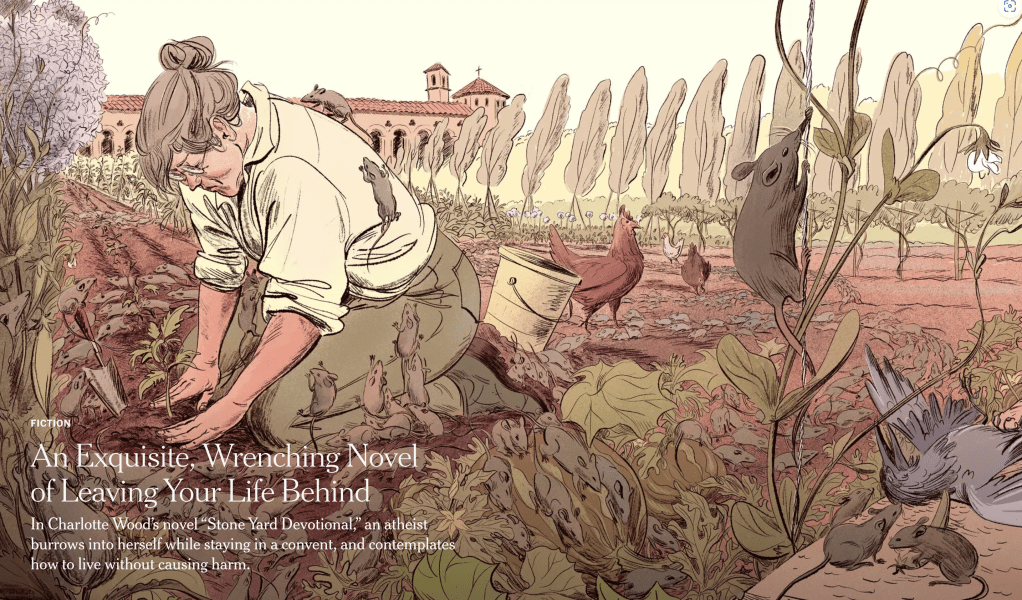
The setting is Australia, which is exotic to me. As a kid I wanted to live in Australia. Over the course of the novel, there is a plague of mice that invade the convent. The mice are so numerous that they cover the roads in gray fur. At first, I thought Wood added this element to give her tale some excitement, but I researched and found that her part of Australia they did have a mice plague of Biblical proportions in 2021.

That made life in the convent extremely inconvenient. The mice ate electrical insulation, throwing daily living in the convent back to the 19th century. The illustration for the book’s review at The New York Times might have been another reason I read this book.

Much of what the unnamed narrator contemplates throughout the novel is what everyone thinks about as they get older. The fear of declining health and death, the regrets, the desires for wanting to have done things different, the desires to connect with others while also wanting to pull away, the changes we see in ourselves and others, the appeal of nature and living simple. Wood’s story explores all of that and more, triggering the reader to think about their lives.

Charlotte Wood was born in 1965, so she’s fourteen years younger than me. However, her battle with cancer has likely aged her perception on life. At 73, I’ve been thinking about the things in this novel for years. But I don’t know if everyone who collects social security meditates on these issues. Stone Yard Devotional is a great title for this novel. Even though the narrator said she was an atheist at the beginning of this story, getting old and dealing with people who die, pushes you to be spiritual even without a belief in God.

JWH