
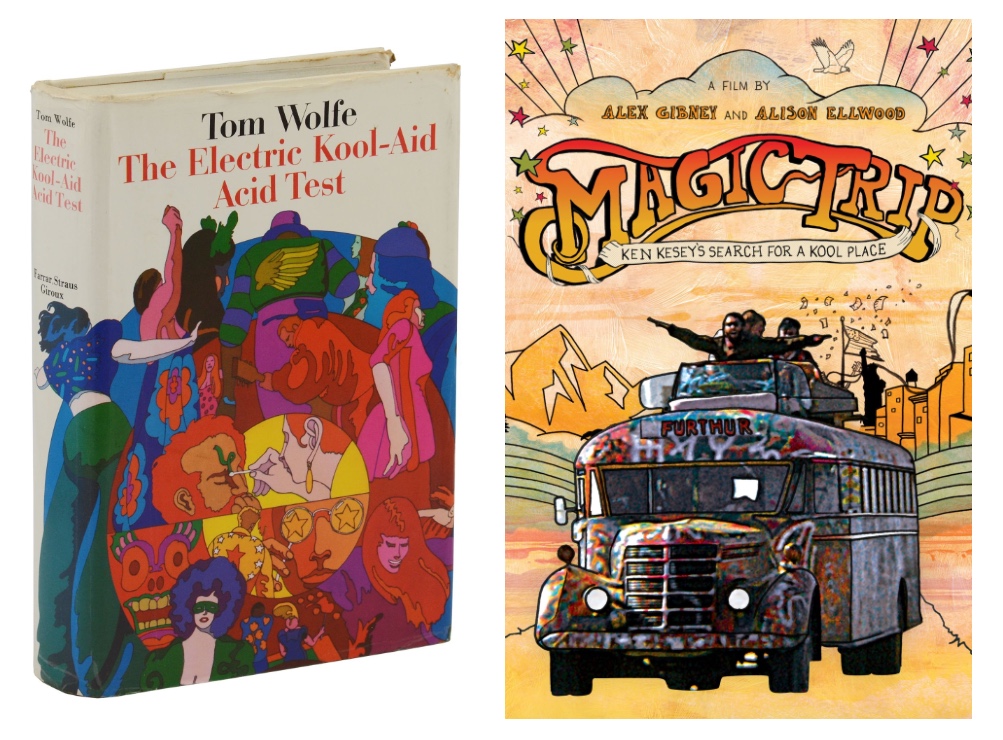
by James Wallace Harris, 9/23/26
I discovered Tom Wolfe’s The Electric Kool-Aid Acid Test in 1968. I found it on the 7-day bookshelf of the Coconut Grove Library, in Miami, Florida. Being just sixteen and in the 11th grade, the crazy antics of Ken Kesey and the Merry Pranksters enchanted the juvenile male in me. Wolfe’s jazzy prose inspired my impressionable pseudo-intellect. Boy, I wanted to run off to San Francisco. At that age, I was just as goofy and naive as the Pranksters (although they were about ten years older than me).
For some reason, I was drawn to Neal Cassady. This was before I had read On the Road or One Flew Over the Cuckoo’s Nest. Up until then, I had mostly read science fiction, and a smattering of popular science books. It pleased me that Kesey and crew read Stranger in a Strange Land. At that time, Heinlein was my guru.
And this was before I had smoked grass or dropped acid. I worked as a bagboy at the Kwik Chek in the Coconut Grove. My biggest problem as a horny teenager was being afraid of girls. The wild sex life of the Pranksters made me wish I could be like them.
Cassaday spoke like an over-revved engine. The man never stopped twitching and rapping. Cassaday’s thing was flipping a small sledgehammer. I imitated him by walking around my house flipping a large can of pork and beans. My father asked, “What the hell are you doing?” It made me feel self-conscious, but I kept flipping those pork and beans.
My prank at the time was joining the Columbia and Capitol record clubs to acquire albums as fast as possible. I’d get 12 albums for free, promising to buy eight more for full price. Because I was working, I could pay for my commitment quickly. I’d then quit and rejoin to get another 12 albums. That quickly let me build a library of all the back albums of my favorite groups. Bob Dylan, The Byrds, Jefferson Airplane, Buffalo Springfield, and all the new groups coming out of San Francisco. I identified with those people.
I knew nothing about Haight-Asbury, the Summer of Love, Acid Tests, or even Monterey Pop. News of the hippie world was sparse where I lived. I remember watching a segment on The Today Show about the light show behind The Jefferson Airplane, and reading about the group in Life Magazine. Besides astronauts, these rock musicians seem like the coolest people on the planet.
What Tom Wolfe described was as far out as fantasy or science fiction. All I knew about LSD was from Popular Science and CBS News reports about Timothy Leary. The Kwik Check was near the park in Coconut Grove, and all the kids who wanted to be hippies showed up there on the weekends. I looked up to these older kids, believing they had special knowledge.
When I read The Electric Kool-Aid Acid Test in 1968, I didn’t know about the spiritual side of psychedelic drugs. But I’d soon find out when I read Leary’s The Politics of Ecstasy. But that was months later. In the 1960s, drugs seemed about ecstasy, while in the 1970s, they were about exploring spiritual horizons.
Crazy fun is what I saw in my first reading of The Electric Kool-Aid Acid Test. I pictured The Merry Pranksters like a trippier version of The Monkees. But I imagined them looking like the kids in the news stories about Haight-Asbury.
A few years ago, when I first rented Magic Trip, I was shocked by how Ken Kesey and The Merry Pranksters dressed. They didn’t have long hair or weird clothes. They wore the kind of shirts I wore in 1965. In fact, they reminded me of what the Beach Boys looked like before The Beatles.
The Merry Pranksters’ antics were less sophisticated than any episode of The Monkees. I couldn’t believe how silly and uncool they were. Magic Trip uses the 16mm film Kesey and the Pranksters took on their 1964 trip in Furthur. Probably the same film Tom Wolfe viewed to write his book.
And the Acid Tests were childish. No wonder Leary and Albert were anxious to get rid of these guys. And I can’t blame Kerouac for getting drunk and looking so goddamn morose when he had to endure an evening with the Pranksters. I have to admit, after watching Magic Trip, even my young 15-year-old self would have thought the Pranksters completely uncool. I don’t know how Larry McMurtry was so patient with them.
This week I reread The Electric Kool-Aid Acid Test and rewatched Magic Bus. I supplemented those two with videos I found on YouTube. With this reading, I was impressed with Wolfe’s reporting and writing.
I love books about generational cohorts that create artistic/literary movements like The Beats, The Lost Generation, The Transcendentalists, or the German Romantics. Ken Kesey and the Pranksters inspired that kind of a movement, although theirs was less defined by specific artistic works.
They could even be the headwaters of the 1960s drug counterculture. Many writers have suggested Ken Kesey and the Pranksters were the children of the Beats and parents of the Hippies. However, Kerouac, Ginsberg, Burroughs, and Cassady were the tip of the iceberg of Beat-like people emerging all across America in the 1950s. And Kesey and the Pranksters were another visual tip of a new wave of rebellion. Actually, I think it was all one wave.
I was surprised to see so many references to Ken Kesey and the Pranksters in the YouTube videos about The Grateful Dead. I just ordered The Last Great Dream: How Bohemians Became Hippies and Created the Sixties by Dennis McNally. I hope his book explores those theories and provides a history of what happened next. Did this movement end when Jerry Garcia died?
I was intrigued by this video from The Shakedown Archives. (That channel focuses on the Grateful Dead’s history.)
This video accuses Tom Wolfe of spending too little time with Ken Kesey and the Merry Pranksters. That because he only did acid once and didn’t like it, he couldn’t have fathomed what it meant to be on the bus. In another video, Kesey said The Electric Kool-Aid Acid Test was a good book, an accurate book, but it just didn’t understand everything about him.
I’m fascinated by how history is reported. Is it ever 100% accurate and complete? I often ask people who lived in the 1960s to name books they feel captured those times. No one book stands out. I wasn’t in San Francisco in 1965 but for some reason I feel this book might be the best for what it covers. I compare its quality to The Soul of a New Machine by Tracy Kidder, a book I might use for the 1970s.
One reason I back Wolfe on this is that he doesn’t editorialize about his subject. He doesn’t judge. He observes. He got to interview many of the principal players and see all the films. Just because he did all this work in three weeks doesn’t mean he couldn’t grok it. Ken Kesey and the Merry Pranksters could never edit their own film.
But there’s one other clue. Throughout the story, Kesey and the Pranksters judged people by whether they were on or off the bus, and then by the acid tests. Tom Wolfe graded them in one place. He compared them to Hermann Hesse’s book, Journey to the East. I read that back in the 1970s. I completely understood what Wolfe was saying, but to be sure, I reread the book this week.
Hesse’s book is about H. H., who remembers being on a pilgrimage with a special group of spiritual people. He was on the bus. Somehow he got lost from the group. He was off the bus. Eventually, H. H. finds Leo, the leader of their group. H. H. wants to write the history of their group, but can’t. He’s even been given access to the group’s vast library of mystical documents. Leo even tries to show him that the documents are worthless by burning some of them. It’s not until H. H. sees two figurines that represent him and Leo that he understands. He sees the light from each figure merge.
Tom Wolfe put Ken Kesey and the Merry Pranksters on this higher plane. He knew that just seeing them wasn’t enough. On the outside, they looked goofy and stupid. Maybe he was saying that unless people merged together with some inner light, it was impossible to understand. Wolfe knew he was never on the bus, in real life or spiritually, but he guessed what it meant.
I remember back in the 1970s belonging to a group of people who did various drugs. We all moved to the same street. We pursued many wild, creative projects, which we were very good at. We dressed in silly clothes and played silly games. Years later, I was in a second group. They were about mysticism, meditation, and spirituality. More like what Ram Das taught. In both cases, it’s about being in the group, exploring the edge of consciousness. In each case, we had our own version of being on the bus.
In another YouTube video, one I can no longer find, the narrator felt that being on the bus meant you were moving and part of a group. That Jack Kerouac’s failure was that he had stopped moving and became solitary. He said these artistic/literary movements ended when individuals branched off to be by themselves. I liked that idea. They also said being a Deadhead was all about being part of a group.
When I was a kid reading The Electric Kool-Aid Acid Test, I think that’s what I wanted. To be part of a group. I wanted to find my own kind. I did that several times over my life. I don’t have that now. It’s sad.
JWH

