by James Wallace Harris, 9/14/26
I love YouTube. If I’m not careful, I’ll watch it for four or five hours a day. And I’m not saying YouTube is all bad; it’s just so damn addictive. But YouTube also has tons of crapola content to avoid. If I mined more gold and less pyrite, I might feel better about being such an avid fanboy.
Is avoiding bad content my problem, my self-control, or can we blame content creators or even YouTube? Too many people see YouTube as a gold rush, especially after AI. They have no scruples seeking views and will do anything to capture our attention.
Either I figure out how to watch the best content and ignore the bad, or I’ve got to go cold turkey. Yet, what determines if a video is worth my precious time? Is it up to me, or could YouTube become its own Maxwell Perkins? What makes newspapers and magazines great aren’t just the writers, but the editors.
There are two approaches. First, identify the best and ignore the rest. Or I could keep pulling weeds until YouTube is a beautiful lawn for my mind.
Identifying the Best
- Subscribe to channels produced by the best magazines. The Economist, The Wall Street Journal, The Atlantic, etc. This works for the pro content, but not the amateur.
- Subscribe to channels with trustworthy human hosts. YouTube is fantastic because it allows anyone to create content. It’s open to amateurs. But somebody has to hold the hook.
- Limit which topics to follow. My mind wanders, and YouTube leads it all over the universe.
- Find the hosts that I’m convinced know what they are talking about.
- Stick to sites that don’t waste my time.
Identifying the Worst
- If it’s AI-generated, I pull the plug.
- If they bury the lead. This drives me insane. I always back out when I realize this is happening.
- They spend 30 minutes covering five minutes of information.
- If they use AI photos or videos, or stock photos or videos that don’t match the narration. Or they use stock photos with watermarks.
- If the human host is not qualified.
- If the human host depends on AI slop.
- If the thumbnail is deceptive.
- If the title is deceptive.
- If the channel is designed solely to sell something.
- If the host is obviously an influencer.
- If the reviews are paid for.
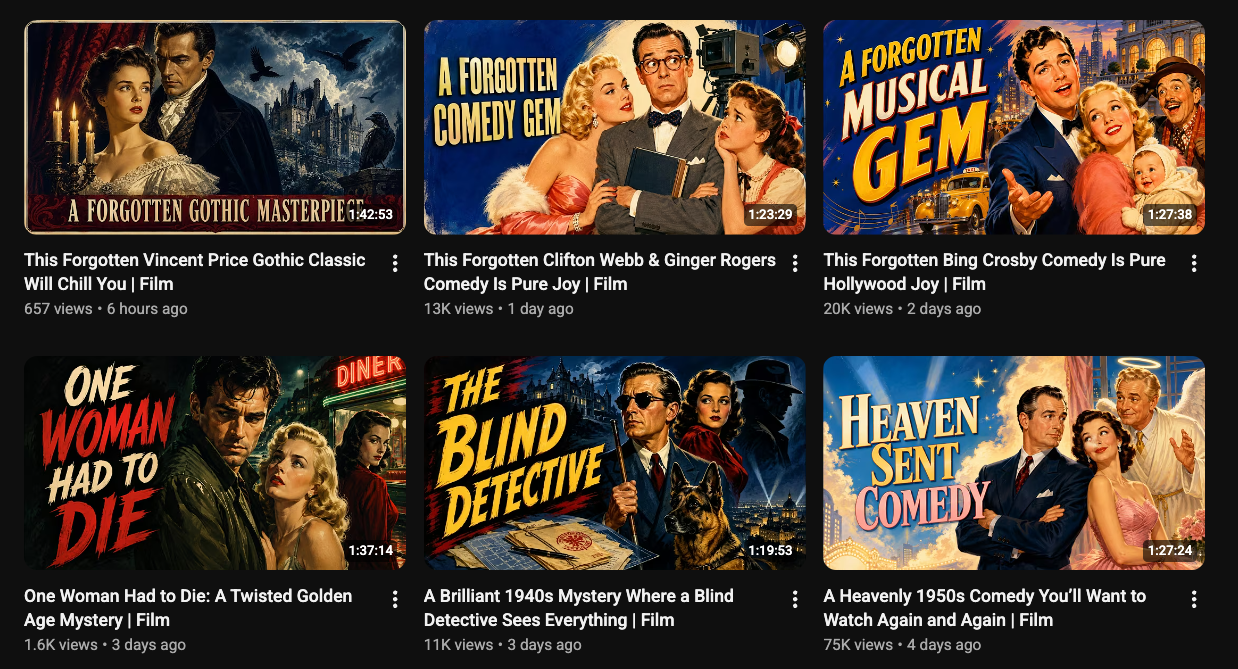
- When AI is used instead of real photos. For example, all these images have famous actors in them, but you can’t recognize any of them.
Luckily, I pay for YouTube Premium Lite, so I don’t have to watch commercials. However, if I didn’t pay that toll, I’d probably never watch YouTube because of the insane bombardment of ads.
I Wish YouTube Would …
- Have something like a “get the hook” button. Meaning, never show me this channel again.
- And if I’ve used the hook, let YouTube’s AI deep-six anything like that again.
- Switch/setting that filters out pure AI content.
- Strict rule requiring all AI-generated video to be clearly watermarked.
- A method that allows viewers to report misinformation.
- Hire human editors who reject shitty content. Basically, YouTube is one vast slushpile that everyone is reading. Hire some editors who can tell content providers they suck and should try harder.
- Go ahead and use AI to recognize the content I value and reject what it knows I will hate. Potentially, this could make YouTube irresistible.
A Few Examples I Admire
Just Josh is an A+ site for laptop reviews. I post this video because Just Josh has problems with YouTube too. Much of what makes content bad for viewers also makes YouTube bad for creators.
Listen to how he’s going to combat AI. It’s a case of fighting fire with fire. I like that. AI search engines and AI YouTube slop are killing his channel. His approach is to use AI to make his channel even more useful to humans.
I admire CBS Sunday Morning, but I seldom watch broadcast TV. Using YouTube to catch the best of broadcast TV makes watching YouTube more valuable. It’s funny to contrast the professionals at CBS with amateur YouTube content creators reporting on the same information.
My opinions sync well with the science fiction book reviews by Bookpilled. YouTube channels don’t have to be by world-class experts. Just people you trust.
Useful Charts has a highly unique focus. Matt Baker explains history using charts. It’s very effective.
Usagi Electric focuses on rebuilding old computers. This is rather esoteric. But that’s a significant virtue of YouTube: finding the esoteric topics you’re interested in.
Python Programmer promotes learning. I have no idea what his credentials or educational background involve, but I’ve come to trust him. YouTube allows anyone to teach. It would be great if the system had a way to validate what’s being taught for accuracy, but I don’t see how that’s possible. We all have to decide for ourselves. There are too many channels where I’m wary of the host.
AstroBackyard is a channel devoted to astrophotography. This is a hobby I wish I had, but I don’t for many reasons. I live vicariously through his videos. There are many YouTube creators who I wish I could be like.
Pop Goes the 60s is a great example of an amateur expert. His videos are well done, well researched, and worth their length.
Pete Beard has cornered the market on videos about old book and magazine illustrators. His little videos are beautiful and instructive. It’s an extremely narrow focus, but he does it so well.
I could list dozens of more channels I follow. I don’t want to point to channels that annoy me. I don’t really want to pick on people. Some creators are well-intentioned but lack ability. Others use every trick in the book to get views because they dream of giving up their day jobs and becoming rich. This type has exploded since ChatGPT.
And don’t get me wrong, some people can wring some amazing content out of AI. But so much of it is horrible. On the other hand, what will happen when AI gets so good that anyone – and I mean anyone, even a five-year-old kid asks an AI to create a 30-minute professional quality video for YouTube that will get a million hits, and the AI does it?
One reason I want to reject AI content is not that I’m prejudiced against AI, but because I enjoy seeing what humans can do. YouTube is a wonderful venue for that, but it needs some kind of control. I wonder if a voting system like the one on IMDb.com? I find that any movie or TV show that gets a 7.0 or higher rating is something I’m likely to enjoy. But there is a technical issue. I watch YouTube on my television. How would I enter the rating?
I don’t know if YouTube has any incentive to help its viewers find better content. It’s already the most popular streaming service.
If I can’t learn to discipline my YouTube addiction, I will have to give it up. Yesterday I didn’t watch any YouTube, and I got so much more done. Today, I watched a little and still got a lot done. That’s a good sign.
JWH
 Auxiliary Memory