

by James Wallace Harris, 6/3/26
When I was little, I pondered two philosophical questions that would make my head ache. The first was, “Why am I here?” The second, “Why isn’t there ‘nothing’ instead of something?” I don’t think the second question can ever be answered. Although I concluded as a kid that “nothing” can’t exist. If it could, we wouldn’t exist.
A World Appears: A Journey into Consciousness by Michael Pollan is resonating with me more than anything else I’ve read that tries to answer the first question. I’m reading the hardback while also listening to the audiobook. This forces me to go slow. But I’ve also decided to start over and take notes chapter by chapter.
This is my fourth attempt to take notes. I tried underlining in the Kindle edition. I tried using Obsidian. And I tried putting my notes into HTML. I want to be able to cut and paste text and to hyperlink to sources on the web. Using Obsidian or writing HTML code in a text editor was hindering me. So I decided to try collecting my notes in WordPress.
I find reading the Wikipedia entries for all the terms and people Pollan mentions helps me understand what I’m reading. I also feel I’ll eventually need to read the books mentioned, too.
Introduction: The Wager (pp. xiii-xxxv)
With Koch at his side, Crick set out to explain how it is that a particular piece of brain tissue generates the feeling of being alive—the sense of a self in possession of subjective experience.
Pollan, Michael. A World Appears: A Journey into Consciousness (p. xiv). Penguin Publishing Group. Kindle Edition.
The hard problem of consciousness
First, there were what he called the “easy problems” of consciousness, which included figuring out the workings of mental operations like learning, memory, discrimination, and perception. Not all that easy, but at least we had a proven scientific method for approaching such behavioral and cognitive functions in terms of specific measures of brain activity. And then there was what he memorably called the “hard problem” of consciousness: the puzzle of why any of these mental operations are accompanied by any conscious experience whatsoever. “Why doesn’t all this information-processing go on ‘in the dark,’ free of any inner feel?” he asked in a subsequent paper.
Pollan, Michael. A World Appears: A Journey into Consciousness (p. xv). Penguin Publishing Group. Kindle Edition.
The wager:
When the scientist and the philosopher met in Bremen in 1998, drinking together late into the night, Chalmers expressed doubt that the search for neural correlates would succeed in the foreseeable future, much less solve the hard problem even if it did. Koch, with the brashness of a young man backed by one of the most brilliant scientists of his time, proposed a wager: Within twenty-five years, we would find the physical footprint of consciousness in the brain, which he predicted would comprise a small set of specialized neurons responsible for subjective experience. The loser would deliver to the winner a case of fine wine.
Pollan, Michael. A World Appears: A Journey into Consciousness (p. xvi). Penguin Publishing Group. Kindle Edition.
Galileo’s Error by Philip Goth (Amz)
Ever since Galileo’s time, and at his urging, science has cordoned off the mind—or the soul, as it was then known—leaving it to the exclusive jurisdiction of the priests and poets. This was both a political move and a practical one—political because it would (Galileo hoped) avoid bringing the hammer of the Church down on the scientific enterprise, and practical because (as Galileo foresaw) more progress could be made in the investigation of nature by focusing on objective qualities that could be measured rather than on subjective qualities that could not. With a few notable exceptions along the way (I’m thinking of Sigmund Freud and American philosopher-psychologist William James), this approach toward the science of the mind endured well into the twentieth century. Take, for example, behaviorism, the school of thought that dominated psychology for most of the twentieth century; it refused to deal with interiority or, really, anything but measurable outward behaviors. In light of this history, Christof Koch and David Chalmers stand out as pioneers.
Pollan, Michael. A World Appears: A Journey into Consciousness (pp. xvi-xvii). Penguin Publishing Group. Kindle Edition.
The fact that consciousness can be altered by chemicals does not necessarily prove that consciousness is, at its core, a material phenomenon, but it would seem to lend at least some credence to the idea.
Pollan, Michael. A World Appears: A Journey into Consciousness (p. xx). Penguin Publishing Group. Kindle Edition.
Who won the wager?
Chalmers won the bet, by the way. During a ceremony I attended at a consciousness conference in New York City in June 2023, Koch graciously conceded and presented Chalmers with a case of Madeira.
Pollan, Michael. A World Appears: A Journey into Consciousness (p. xx). Penguin Publishing Group. Kindle Edition.
Integrated Information Theory (IIT) – Giulo Tononi
According to IIT, every such moment of consciousness shares the same five specific qualities: It is “intrinsic” (that is, it has an internal perspective); it is “composed” of many distinct phenomenal parts (think of the way the experience combines elements of perception, memory, feeling, imagination, etc.); it is “integrated,” or unified (these elements are joined together in a single experience at a time); it is “definitive” (it is this and not that, in other words); and it is “bounded” (it has an edge beyond which the conscious perception doesn’t go).
Pollan, Michael. A World Appears: A Journey into Consciousness (p. xxii). Penguin Publishing Group. Kindle Edition.
I don’t pretend to understand all the complexities of IIT, and the math can get pretty abstruse, but it seems to me that the straightforward question posed to Koch in Zurich hasn’t been completely answered: Why should neurons organized and exchanging information in any particular way necessarily feel like something? Koch and Tononi, who teamed up to refine IIT, have offered in reply an application of sheer intellectual brute force: Information integrated in the prescribed manner doesn’t just generate consciousness or correlate with it—no, integrated information is consciousness, full stop. The two are identical. The theory is controversial, to say the least, and no one has yet figured out a way to prove or disprove it.
Pollan, Michael. A World Appears: A Journey into Consciousness (pp. xxii-xxiii). Penguin Publishing Group. Kindle Edition.
Global Workplace Theory (GWT, GNWT)
This theory contends that the brain consists of a great many modules, or networks, that spend most of their time processing information unconsciously—information from the sense organs, from the body, from memory, from emotions, and so on. After all, the overwhelming majority of the work done by our brains takes place completely beneath our notice. So how and why does some of this material bubble up into our conscious awareness?
Pollan, Michael. A World Appears: A Journey into Consciousness (p. xxiii). Penguin Publishing Group. Kindle Edition.
Chalmers believes that neither IIT nor GWT solves the hard question of consciousness.
Now this is very mind-blowing:
When I asked Koch what the world would look like absent all consciousness, he didn’t hesitate: “Particles and waves, that’s all. Dust! Just dust!” Discrete objects, time, even space—all are constructs, or figments, of consciousness, and all would melt away as soon as it did.
Pollan, Michael. A World Appears: A Journey into Consciousness (p. xxvi). Penguin Publishing Group. Kindle Edition.
It’s entirely possible to go through life without worrying about the “problem” of consciousness—what it is and how it came to be. In fact, it takes a certain kind of mind for “the problem” to arise—one that is self-conscious, or aware that it is aware, and marvels at this mystery (which is, when you stop to think about it, astounding). It is astounding that in a universe we often assume to be dead and purposeless, there evolved beings who can experience this reality and have feelings and thoughts not only about the appearing world but about the fact that they have feelings and thoughts at all! And it is still more astounding that these beings have minds capable of imagining counterfactuals, such as the possibility of a world without consciousness.
Pollan, Michael. A World Appears: A Journey into Consciousness (p. xxix). Penguin Publishing Group. Kindle Edition.
Chapters in A World Appears:
- Sentience
- Feeling
- Thought
- Self
- Coda – The Cave
This, then, is the wager of A World Appears: that by the end of this journey, you will be more conscious than you were before it. Conscious of what? Of the rhythms and workings of your own mind; of the sentience that is all around us in nature; and of the improbable fact—the miracle!—that in this universe of rock and fire and ice and infinite space, we are somehow not only here but aware.
Pollan, Michael. A World Appears: A Journey into Consciousness (pp. xxxiv-xxxvi). Penguin Publishing Group. Kindle Edition.
JWH


I’m going to have to read this slowly later on and the links. I have always found this subject very interesting. Two quick points… perhaps we underestimate the importance of language and consciousness, even the grunts and groans and whistles and shrieks in the animal world. I believe they have levels of consciousness…. Think monkeys and whales.
Also, I just re-ordered a book that I read way back called “The Minds I” by Dennett and Hofstadter. I think you might like it. I found it on Amazon in large paperback format.
As a total non-expert, I believe consciousness and self-awareness is simply the workings of neurons or synapses in the brain. I think the real world would be out there whether we were here or not.
Sometimes I think scientists and philosophers search for consciousness being permanent and something out of this worldly realm thing, goes back to man’s search through religion for the same thing. At all breaks down to fear of nonexistence.
Mary, I’m currently reading
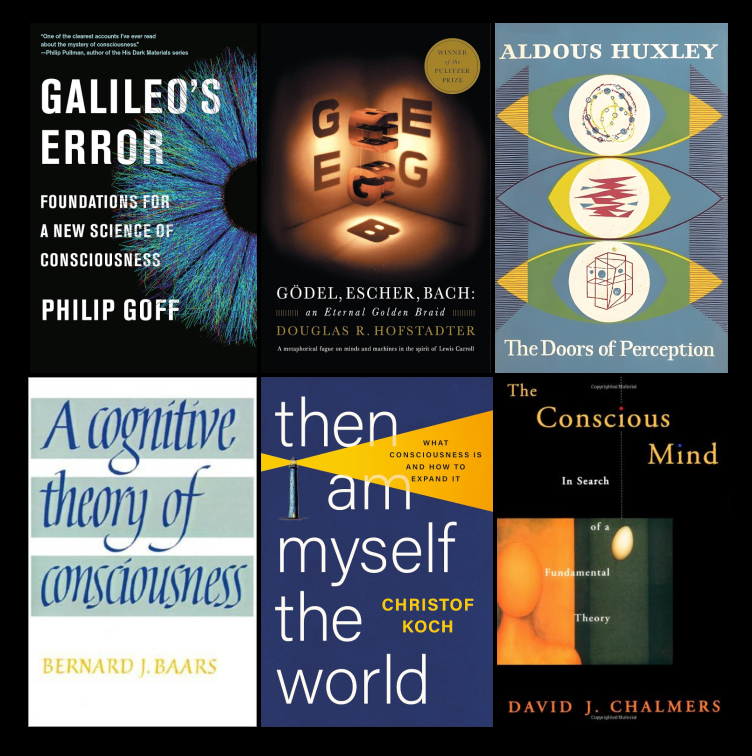
by Doughlas Hofstadter. And I have three books by Dennett that I’m trying to get around to reading. There are so many great books on consciousness to read.
I agree, I think reality exists without us, and our consciousness evolved along with brain evolution. In the next chapter, Pollan explores research into the origins and evolution of consciousness. He makes a great case that its evolution began as early as single cell organisms or even bacteria and viruses.
Pollan discusses how some scientists still old out for metaphysical explanation of our minds, but most feel we’re just one end of spectrum that’s evolved with biology.
I think one reason to study consciousness is to free ourselves of myths.