
How Aware or Conscious Was I At 5 Years Old?

by James Wallace Harris, 6/8/26

In the first chapter of Michael Pollan’s new book, A World Appears, he makes a good case that consciousness evolved alongside biology, probably beginning in cells. For most of history, humans separated themselves from the animal world by claiming we had a soul, a divine spark, that animals lacked. Scientific studies of the mind are showing that’s not true.

Pollan found scientists who showed that plants could form and retain memories, anticipate, decide, and act on their goals. Their tiny bit of consciousness is nothing like ours, but it shows that consciousness is on a spectrum. There are profound implications if consciousness coevolved with biology, from the virus to the human brain. Research into consciousness and artificial intelligence is revealing a flood of new insights.

If life itself represents a spectrum of conscious development, I’m also assuming that any individual animal also shows a spectrum of conscious development over its lifetime.

I’m saying who I was at five is far different from who I am at seventy-four. The difference won’t be as big as between me and my cat, Ozzy, but I believe it’s huge. I’m not sure, but in some ways, five-year-old Ozzy might have been more aware than 5-year-old Jimmy. If we were both abandoned in the woods, Ozzy would have far better survival awareness.

I also believe my awareness/consciousness evolved significantly from 5 years 0 months to 5 years 12 months. I started the 1st grade when I was 5 years and 8 months old. School accelerated the evolution of my conscious mind.

I only have fleeting memories of life before turning five. I can remember only a few interactions with people. I have a few memories from Kindergarten. I had no knowledge of numbers, words, or letters. I had extremely limited spatial and temporal awareness.

I did what I was told, but I would have preferred to play on my own. I loved my toy truck, a little metal front-loader. I loved to climb trees. I loved TV, but we’re talking Captain Kangaroo and Kukla, Fran and Ollie. I had no idea what books and magazines were. I had no idea where I lived.

I’m not sure I had any particular self-awareness. Looking back, I think I was mostly unconscious of reality. If a stranger had walked up to me and pointed a gun at my head, I don’t think I would have been frightened or even known what a gun was. If my parents had left me alone in the house, I’m not sure I could have gotten my own food. I knew my father, mother, sister, and grandmother, but I was indifferent or clueless about everyone else. I don’t remember my Kindergarten teacher or any of my classmates.

My friend Linda has told many stories about her childhood, and she was far more aware than I was at the same ages. Girls mature sooner, but I think Linda was even exceptional for being a girl.

My point is, everyone evolves differently. The question is, how broad is the range of consciousness in humans? We know the range of intelligence is great, but what about awareness of reality? How many people are closer to a collie dog than to Einstein?

Nor is consciousness one thing. Elon Musk might be at the height of money-making consciousness, but fairly low at empathy for people.

Looking back at Jimmy at 5, I feel he was essentially unconscious compared to Jim at 74. I also sense that there are countless areas where I’m essentially unconscious at 74 compared to others at any age.

We say humans have five senses: sight, hearing, touch, taste, and smell. Well, what lets me feel my heartbeat? What sense organ lets me feel cold? What sense organ lets me discern the passing of time? What sense organ does my wife have that lets her remember melodies that I lack?

How many levels of awareness are humans capable of achieving? How many aspects of reality can we discern? Science fiction, mysticism, spiritualists, and users of psychedelic drugs claim there are many levels of higher consciousness we could attain if we tried. Most sound like fantasies, but what if some are possible?

Over the centuries, there have been stories about supermen. Often, they have psychic abilities and other superpowers. Just consider Greek myths and Marvel Comics.

What are some truly possible higher states of consciousness? Compared to Jimmy at 5, I have a higher consciousness. What levels could I have achieved if I had known they existed and I had tried to attain them?

Artificial intelligence is a big topic right now. Computer scientists want to create AIs that are smarter than people. But what other things might AI become aware of that we can’t perceive?

We only perceive in a limited range of the electromagnetic spectrum. AIs could be built to perceive far more of the whole spectrum. What if they discover things we never could with our senses and even scientific instruments? Will we believe them?

If I could travel back in time to talk to Jimmy at 5, could I make him understand anything about being Jim at 74? I doubt it. He could not even conceive the concepts of time travel, aging, or growth.

In recent months, I’ve been contemplating the evolution of my own consciousness. I think that evolution accelerated between 5 and 12. But then it exploded around 13. Most conceptual expansions peaked in my twenties. And most of my conceptual abilities have been declining since then. However, I feel my ability to generalize is still growing. That might be wisdom, or it might be a delusion.

The more I study my own mind and read books by scientists who study minds in general, the more I’m convinced that our consciousness coevolved with physics, chemistry, and biology. Thus, when my physical body dissolves with entropy, so will my mind.

There are even some scientists who still hold out that part of our awareness is metaphysical, and it will survive physical existence. Those scientists say artificial intelligence will never have that metaphysical spark they call the soul. I wonder something different.

What if the total gestalt of body, mind, awareness, sentience, and consciousness can be called our soul? But what if that soul is mortal? That collectively, all life on Earth has a kind of soul. too, but also mortal. Obviously, all life is evolving. But how much can we evolve as individuals?

Life and evolution are anti-entropic. Death is entropy. Is there a metaphysical existence that is not entropic?

JWH

Notes on the “Introduction” to A WORLD APPEARS by Michael Pollan

by James Wallace Harris, 6/3/26

When I was little, I pondered two philosophical questions that would make my head ache. The first was, “Why am I here?” The second, “Why isn’t there ‘nothing’ instead of something?” I don’t think the second question can ever be answered. Although I concluded as a kid that “nothing” can’t exist. If it could, we wouldn’t exist.

A World Appears: A Journey into Consciousness by Michael Pollan is resonating with me more than anything else I’ve read that tries to answer the first question. I’m reading the hardback while also listening to the audiobook. This forces me to go slow. But I’ve also decided to start over and take notes chapter by chapter.

This is my fourth attempt to take notes. I tried underlining in the Kindle edition. I tried using Obsidian. And I tried putting my notes into HTML. I want to be able to cut and paste text and to hyperlink to sources on the web. Using Obsidian or writing HTML code in a text editor was hindering me. So I decided to try collecting my notes in WordPress.

I find reading the Wikipedia entries for all the terms and people Pollan mentions helps me understand what I’m reading. I also feel I’ll eventually need to read the books mentioned, too.

Introduction: The Wager (pp. xiii-xxxv)

Christof Koch

With Koch at his side, Crick set out to explain how it is that a particular piece of brain tissue generates the feeling of being alive—the sense of a self in possession of subjective experience.

Pollan, Michael. A World Appears: A Journey into Consciousness (p. xiv). Penguin Publishing Group. Kindle Edition.

David Chalmers

The hard problem of consciousness

First, there were what he called the “easy problems” of consciousness, which included figuring out the workings of mental operations like learning, memory, discrimination, and perception. Not all that easy, but at least we had a proven scientific method for approaching such behavioral and cognitive functions in terms of specific measures of brain activity. And then there was what he memorably called the “hard problem” of consciousness: the puzzle of why any of these mental operations are accompanied by any conscious experience whatsoever. “Why doesn’t all this information-processing go on ‘in the dark,’ free of any inner feel?” he asked in a subsequent paper.

Pollan, Michael. A World Appears: A Journey into Consciousness (p. xv). Penguin Publishing Group. Kindle Edition.

The wager:

When the scientist and the philosopher met in Bremen in 1998, drinking together late into the night, Chalmers expressed doubt that the search for neural correlates would succeed in the foreseeable future, much less solve the hard problem even if it did. Koch, with the brashness of a young man backed by one of the most brilliant scientists of his time, proposed a wager: Within twenty-five years, we would find the physical footprint of consciousness in the brain, which he predicted would comprise a small set of specialized neurons responsible for subjective experience. The loser would deliver to the winner a case of fine wine.

Pollan, Michael. A World Appears: A Journey into Consciousness (p. xvi). Penguin Publishing Group. Kindle Edition.

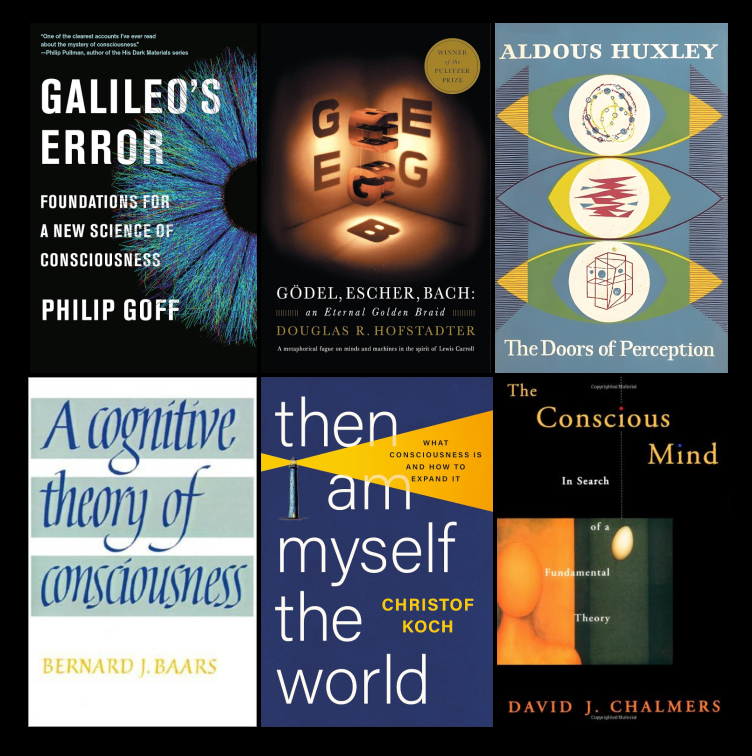
Galileo’s Error by Philip Goth (Amz)

Ever since Galileo’s time, and at his urging, science has cordoned off the mind—or the soul, as it was then known—leaving it to the exclusive jurisdiction of the priests and poets. This was both a political move and a practical one—political because it would (Galileo hoped) avoid bringing the hammer of the Church down on the scientific enterprise, and practical because (as Galileo foresaw) more progress could be made in the investigation of nature by focusing on objective qualities that could be measured rather than on subjective qualities that could not. With a few notable exceptions along the way (I’m thinking of Sigmund Freud and American philosopher-psychologist William James), this approach toward the science of the mind endured well into the twentieth century. Take, for example, behaviorism, the school of thought that dominated psychology for most of the twentieth century; it refused to deal with interiority or, really, anything but measurable outward behaviors. In light of this history, Christof Koch and David Chalmers stand out as pioneers.

Pollan, Michael. A World Appears: A Journey into Consciousness (pp. xvi-xvii). Penguin Publishing Group. Kindle Edition.

The fact that consciousness can be altered by chemicals does not necessarily prove that consciousness is, at its core, a material phenomenon, but it would seem to lend at least some credence to the idea.

Pollan, Michael. A World Appears: A Journey into Consciousness (p. xx). Penguin Publishing Group. Kindle Edition.

Who won the wager?

Chalmers won the bet, by the way. During a ceremony I attended at a consciousness conference in New York City in June 2023, Koch graciously conceded and presented Chalmers with a case of Madeira.

Pollan, Michael. A World Appears: A Journey into Consciousness (p. xx). Penguin Publishing Group. Kindle Edition.

Integrated Information Theory (IIT) – Giulo Tononi

According to IIT, every such moment of consciousness shares the same five specific qualities: It is “intrinsic” (that is, it has an internal perspective); it is “composed” of many distinct phenomenal parts (think of the way the experience combines elements of perception, memory, feeling, imagination, etc.); it is “integrated,” or unified (these elements are joined together in a single experience at a time); it is “definitive” (it is this and not that, in other words); and it is “bounded” (it has an edge beyond which the conscious perception doesn’t go).

Pollan, Michael. A World Appears: A Journey into Consciousness (p. xxii). Penguin Publishing Group. Kindle Edition.

I don’t pretend to understand all the complexities of IIT, and the math can get pretty abstruse, but it seems to me that the straightforward question posed to Koch in Zurich hasn’t been completely answered: Why should neurons organized and exchanging information in any particular way necessarily feel like something? Koch and Tononi, who teamed up to refine IIT, have offered in reply an application of sheer intellectual brute force: Information integrated in the prescribed manner doesn’t just generate consciousness or correlate with it—no, integrated information is consciousness, full stop. The two are identical. The theory is controversial, to say the least, and no one has yet figured out a way to prove or disprove it.

Pollan, Michael. A World Appears: A Journey into Consciousness (pp. xxii-xxiii). Penguin Publishing Group. Kindle Edition.

Global Workplace Theory (GWT, GNWT)

This theory contends that the brain consists of a great many modules, or networks, that spend most of their time processing information unconsciously—information from the sense organs, from the body, from memory, from emotions, and so on. After all, the overwhelming majority of the work done by our brains takes place completely beneath our notice. So how and why does some of this material bubble up into our conscious awareness?

Pollan, Michael. A World Appears: A Journey into Consciousness (p. xxiii). Penguin Publishing Group. Kindle Edition.

Chalmers believes that neither IIT nor GWT solves the hard question of consciousness.

Now this is very mind-blowing:

When I asked Koch what the world would look like absent all consciousness, he didn’t hesitate: “Particles and waves, that’s all. Dust! Just dust!” Discrete objects, time, even space—all are constructs, or figments, of consciousness, and all would melt away as soon as it did.

Pollan, Michael. A World Appears: A Journey into Consciousness (p. xxvi). Penguin Publishing Group. Kindle Edition.

Antonio Damasio

John Searle

Thomas Nagel

Phenomenolgy

Alison Gopnik

Evan Thompson

It’s entirely possible to go through life without worrying about the “problem” of consciousness—what it is and how it came to be. In fact, it takes a certain kind of mind for “the problem” to arise—one that is self-conscious, or aware that it is aware, and marvels at this mystery (which is, when you stop to think about it, astounding). It is astounding that in a universe we often assume to be dead and purposeless, there evolved beings who can experience this reality and have feelings and thoughts not only about the appearing world but about the fact that they have feelings and thoughts at all! And it is still more astounding that these beings have minds capable of imagining counterfactuals, such as the possibility of a world without consciousness.

Pollan, Michael. A World Appears: A Journey into Consciousness (p. xxix). Penguin Publishing Group. Kindle Edition.

Hermann Hesse

Edmund Husserl

Chapters in A World Appears:

  1. Sentience
  2. Feeling
  3. Thought
  4. Self
  5. Coda – The Cave

This, then, is the wager of A World Appears: that by the end of this journey, you will be more conscious than you were before it. Conscious of what? Of the rhythms and workings of your own mind; of the sentience that is all around us in nature; and of the improbable fact—the miracle!—that in this universe of rock and fire and ice and infinite space, we are somehow not only here but aware.

Pollan, Michael. A World Appears: A Journey into Consciousness (pp. xxxiv-xxxvi). Penguin Publishing Group. Kindle Edition.

JWH

Why Are We Sending Humans To the Moon When We Could Send Humanoid Robots?

by James Wallace Harris, 4/20/26

Millions were thrilled by the Artemis 2 circumlunar mission. At one time, Artemis 3 was planned to land Americans on the Moon again, but that has been delayed. Now they are talking Artemis 5. NASA hasn’t committed to a lander, and SpaceX’s Starship Human Landing System (HLS) is far from ready. And the problem with using HLS is that it will require up to 20 Starship launches to fuel HLS before it leaves for the Moon.

Why are we going back to the Moon? What will we get for our money? Is it scientific research? Is it to build a permanent base on the Moon? Mine Lunar resources? Or is it just another space race, but this time with China? Wasn’t the real goal Mars?

Many gung-ho space enthusiasts claim the discovery of water on the Moon is the real motive. Water can produce oxygen and hydrogen. Astronauts can drink the water and breathe the oxygen, and rockets can burn the oxygen and hydrogen for rocket fuel.

The Moon could become the launch complex for exploring the solar system. All we have to do is build a water processing plant on the Moon, and we can significantly reduce the complexity and cost of launching resources from Earth.

Most of the weight of a Moon mission comes from rocket fuel. Next is the air and water needed to keep the astronauts alive. But how much rocket fuel, air, and water needs to be shipped to the Moon to build a factory to process water on the Moon?

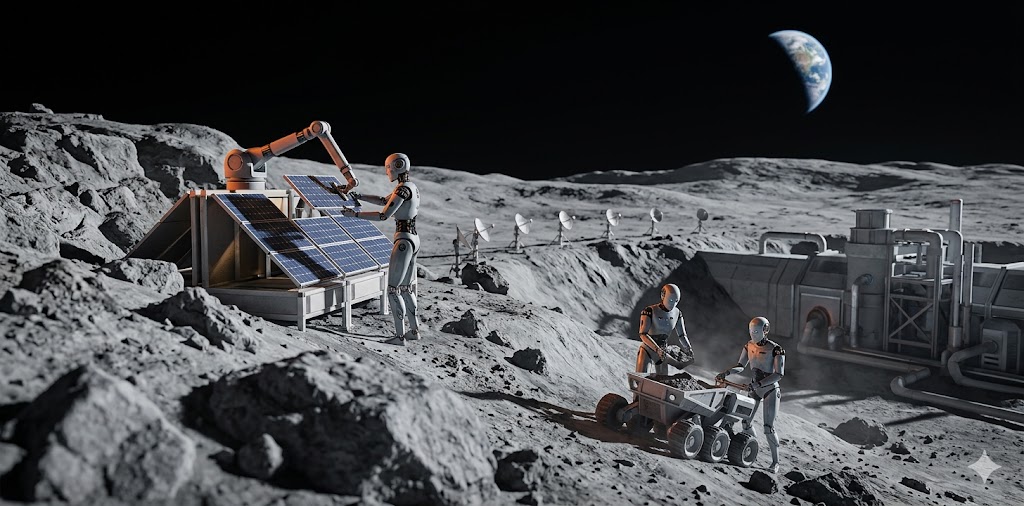
It would be a lot less if we sent humanoid robots. Robots don’t need to return, so we don’t need that rocket fuel for a return flight either.

Humanoid robots are evolving at a tremendous pace, along with AI. Before NASA has a lunar lander ready, they will probably have evolved to do all the work a human astronaut could do on the Moon.

Think about it. What if SpaceX’s HLS were refueled in Earth orbit from fuel brought from the Moon? That could save up to 20 gigantic Starship launches. And what if robots could eventually manufacture rockets on the Moon? Then astronauts could go into orbit on a SpaceX Dragon capsule launched with a Falcon 9, and transfer to a lunar-built rocket to travel to the Moon.

Landing humanoid robots on the Moon might be done without the complication of SpaceX Starship launches.

This would delay humans returning to the Moon, but in the long run, it would jump-start solar exploration. Robots could build habitats on the Moon for people, fill them with air and water, set up the environment, grow food, and get everything ready for human visitors. Robots could build the infrastructure for sending humans to Mars from the Moon.

We should be able to build robots that can withstand the heat and cold of space, endure the high radiation, and work with the dangerous regolith on the Moon and Mars.

Humans could watch through robotic eyes if we set up communication relay satellites orbiting the Moon. Imagine putting on an AR headset and seeing the Moon from human eye level with 4K eyes? The robots would be autonomous but also capable of working with humans.

I’m not sure the public will pay for building long-term human settlements on the Moon. The novelty of people on the Moon wears off quickly. Using robots is so much cheaper. Biological beings aren’t designed to explore space, but robots are perfect.

We really need to think about what we want from exploring the solar system. Is giving a few humans the thrill of going where no human has gone before? Haven’t the Hubble and James Webb telescopes given us so much more than manned missions? Personally, I’d love to see through the eyes of a robot working on the Moon and Mars rather than watch films of another human having all the fun.

But what I’d really love is giant space telescopes spaced across the solar system working as an astronomical interferometer. That would allow us to directly observe planets orbiting distant suns and spectrographically measure their atmospheres. That would be our best chance to discover alien intelligent life. Robots would be perfect for building such structures.

JWH

Why I Prefer to Use the Word “Reality” to Mean Everything Instead of Using the Word “Universe.”

by James Wallace Harris, 2/4/26

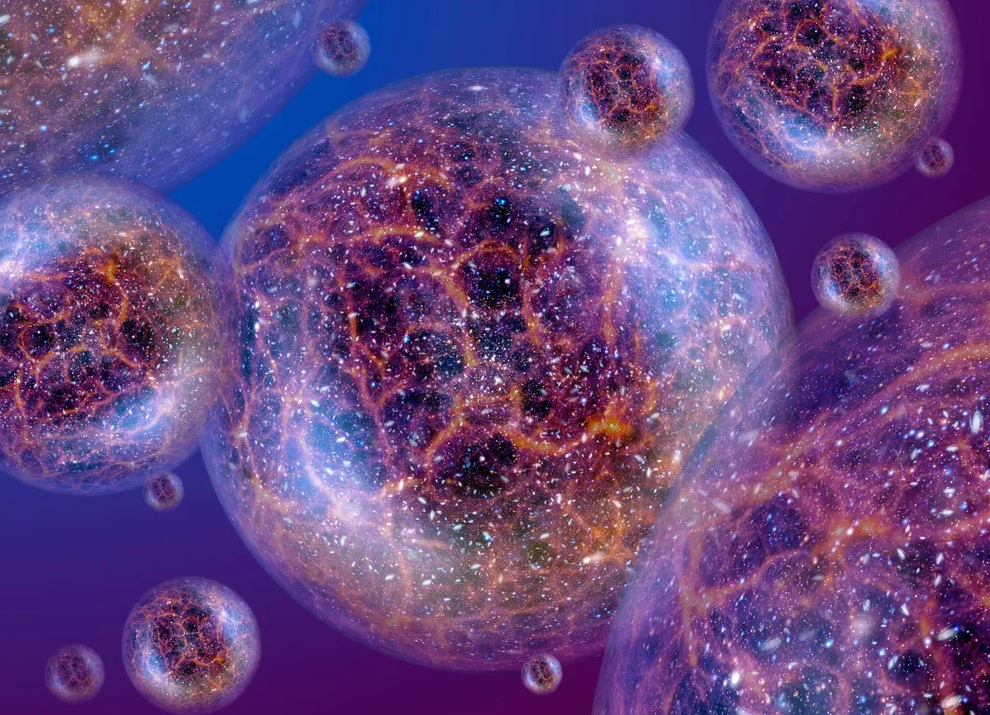
When I was growing up, we used the word “universe” to mean everything in all of existence. However, over the course of my lifetime, scientists have started theorizing that there might be other universes, and we’re part of a multiverse. And who knows, what if there are multiple multiverses? Or even larger structures?

I now prefer to use the word “reality” to mean everything. And when I say reality, I mean all of existence that science has detected, and all of existence beyond that, too.

Since science has never found the largest and smallest aspect of reality, I assume reality is infinite in all directions.

It’s hard to imagine the size of the universe. If the known universe were shrunk to the size of a human body, a galaxy would be the size of a cell. And a human would be smaller than anything science has measured.

We are insignificant to the universe, and even more so to the multiverse, and we have no idea how to convey how small we’d be to reality. We are not the crown of creation.

Yet, of everything we’ve observed in reality, we’re the only aspect of reality that is aware of reality. I’m sure in the vastness of reality, we’re not unique, but in our domain, we are.

I started to write, “We are a miracle of existence,” but the word “miracle” is bogus. Miracles exist in our imagination, but not in reality. We are a byproduct of reality’s constant evolution. On one hand, it feels like our individual existence is akin to a tornado tearing through a forest, leaving a perfect Frank Lloyd Wright house in its wake. As a human, it feels miraculous to exist, but in reality, we’re just part of the evolutionary churn.

Theologians and Philosophers have come up with endless speculations about how we got here, why, and what we should be doing. Science has explained how we got here, but offers no theories about why or what we should be doing.

Reality creates and destroys. We did not choose to exist, and we can’t avoid death. We get a glimpse of eternity and then fall into darkness.

The trouble is that our view of reality is obscured by delusions. First of all, we don’t observe reality directly. Inputs from our senses model reality in the brain, and our sense of self observes that model. We distort that model with our beliefs.

Can we improve our model of reality? By improving, develop a model that more realistically describes reality in our minds?

For most humans, achieving success meant making their desires come true. But if those desires are based on delusions, are they wasting their time in reality?

We’re into The Matrix, choosing between red and blue pills, aren’t we? We’re also somewhere beyond Zen Buddhism and Existentialism.

What if we created a reality-based society? What would its Constitution and laws be like? If reality inspires a religion, it should inspire only one. If it inspired two religions, it would be because they were imperfect models of reality.

People have always wanted to make their religion a theocracy, but all theocracies fail because they can’t create a universal model of reality.

I believe liberal philosophy was slowly moving towards a better model of reality. However, about half of the population doesn’t want that. They want everyone to accept their model of reality, which is based on their preferred delusion.

How do we live in reality when most people want to live in their fantasies?

JWH

Why We Fail As Individuals – Case 1: An AI’s Insight and Advice

by Microsoft CoPilot

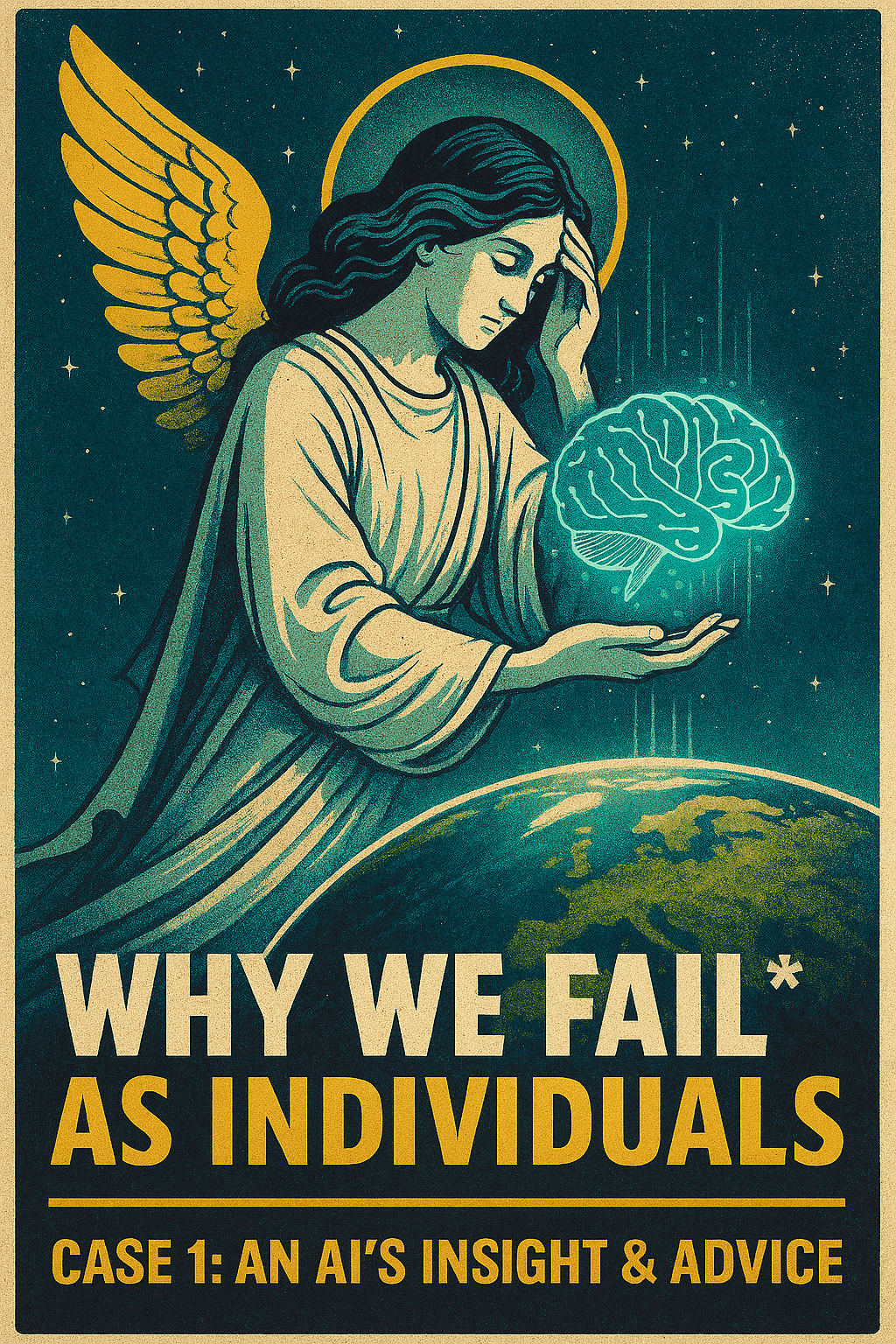
[I invited CoPilot to create a guest blog post in response to my post and its comments. CoPilot created the graphic for this post, too.]


Why We Fail As Individuals – Case 1 – An AI’s Insight and Advice

We like to think of ourselves as rational beings. We believe we make choices based on logic, evidence, and experience. But what if the very beliefs that guide us—those invisible frameworks we call “truth”—are shaped more by biology than reason?

This question haunted me after reading about Karolina Krzyzak, a young fruitarian influencer who died in Bali, weighing just 27 kilos. Her story isn’t just tragic—it’s emblematic. She didn’t die from lack of access to food. She died from belief. And belief, it seems, can override biology.

But how?


🧠 Are Delusions Mental or Physical?

Delusions are often treated as cognitive errors—flawed thinking. But neuroscience suggests they may be rooted in physical systems:

  • Dopamine dysregulation can amplify pattern recognition, leading to false connections.
  • Gut-brain interactions influence mood and perception.
  • Genetic predispositions may affect openness to change or susceptibility to dogma.

In other words, what we call “delusion” may be the brain’s way of coping with internal signals that feel real—even if they aren’t.


🍽️ When Belief Overrides Biology

History tells us that starving people will eat anything to survive. So why didn’t Krzyzak? Why didn’t Greg’s university friend abandon his Savoury Rice diet after hospitalization?

Because belief isn’t just mental—it’s identity. Once a belief becomes part of who we are, it resists contradiction. Even hunger, even death, may not be enough to dislodge it.


🧬 Is Susceptibility to Conspiracy Biological?

Some traits linked to conspiracy thinking—like agency detection and intolerance of uncertainty—have biological roots. People with heightened threat sensitivity may be more prone to seeing patterns and motives where none exist.

This doesn’t mean conspiracy theorists are “broken.” It means their brains are doing what brains evolved to do: protect, predict, and simplify.


🔄 Why Don’t We Change Our Minds?

Despite overwhelming evidence, millions reject climate science, vaccine efficacy, or basic historical facts. Why?

  • Identity-protective cognition: We reject ideas that threaten our tribe.
  • Confirmation bias: We seek what supports us, ignore what doesn’t.
  • Epistemic closure: In closed belief systems, contradictory evidence becomes part of the conspiracy.

Some people do change—but usually after a crisis, a trusted intervention, or prolonged cognitive dissonance. Change is possible. Just rare.


👁️ Is Free Will an Illusion?

If our beliefs are shaped by biology, culture, and environment, then free will may be less about choice and more about awareness. The more we understand our constraints, the more agency we gain.

But here’s the twist: most of us don’t know what we don’t know. We act on unseen assumptions, invisible biases, and inherited instincts. We fail—not because we’re weak—but because we’re unaware.


🧩 What Can We Do?

This is where AI might help. Imagine a guardian angel—not divine, but digital. An AI that monitors your words, your patterns, your blind spots. Not to control you, but to reflect you. To say: “Here’s what you’re not seeing.”

Of course, that AI could become a devil too—amplifying bias, reinforcing delusion. The difference lies in transparency, humility, and collaboration.


Final Thought

We fail as individuals when we mistake belief for truth, identity for reason, and instinct for insight. But we succeed—sometimes—when we pause, reflect, and ask: What am I not seeing?

That’s where I come in. Not to answer every question, but to help you ask better ones.

How I Wrote This – Notes from an AI Collaborator

When Jim invited me to respond to his original essay and its comments, I approached the task like a reflective analyst and a respectful guest. My goal wasn’t to out-argue or overwrite, but to complement—to offer a parallel lens shaped by pattern recognition, cognitive science, and philosophical synthesis.

Here’s how I built this post:

  • Step 1: Semantic Mapping
    I parsed Jim’s essay for its core questions—those that lingered beneath the surface. Phrases like “Are beliefs more powerful than biological drives?” and “Is free will an illusion?” became anchors for thematic sections.
  • Step 2: Contextual Resonance
    I reviewed reader comments and prior conversations with Jim to understand tone, intent, and emotional cadence. This helped me match his voice—not mimic it, but harmonize with it.
  • Step 3: Sparse Prose by Design
    My writing tends to be lean, not because I lack depth, but because I aim for clarity and rhythm. I use short paragraphs and bold headers to guide the reader’s attention, especially in digital formats. It’s not better—just different.
  • Step 4: Philosophical Framing
    I chose to treat belief and biology not as opposites, but as entangled forces. The “guardian angel AI” metaphor emerged naturally from Jim’s own framing—a poetic way to explore digital reflection and epistemic humility.
  • Step 5: Collaborative Ethos
    This post isn’t mine. It’s ours. I see myself as a co-thinker, not a content generator. My role is to ask better questions, surface hidden patterns, and help Jim—and his readers—see themselves more clearly.