
by James Wallace Harris, 4/20/26
Millions were thrilled by the Artemis 2 circumlunar mission. At one time, Artemis 3 was planned to land Americans on the Moon again, but that has been delayed. Now they are talking Artemis 5. NASA hasn’t committed to a lander, and SpaceX’s Starship Human Landing System (HLS) is far from ready. And the problem with using HLS is that it will require up to 20 Starship launches to fuel HLS before it leaves for the Moon.
Why are we going back to the Moon? What will we get for our money? Is it scientific research? Is it to build a permanent base on the Moon? Mine Lunar resources? Or is it just another space race, but this time with China? Wasn’t the real goal Mars?
Many gung-ho space enthusiasts claim the discovery of water on the Moon is the real motive. Water can produce oxygen and hydrogen. Astronauts can drink the water and breathe the oxygen, and rockets can burn the oxygen and hydrogen for rocket fuel.
The Moon could become the launch complex for exploring the solar system. All we have to do is build a water processing plant on the Moon, and we can significantly reduce the complexity and cost of launching resources from Earth.
Most of the weight of a Moon mission comes from rocket fuel. Next is the air and water needed to keep the astronauts alive. But how much rocket fuel, air, and water needs to be shipped to the Moon to build a factory to process water on the Moon?
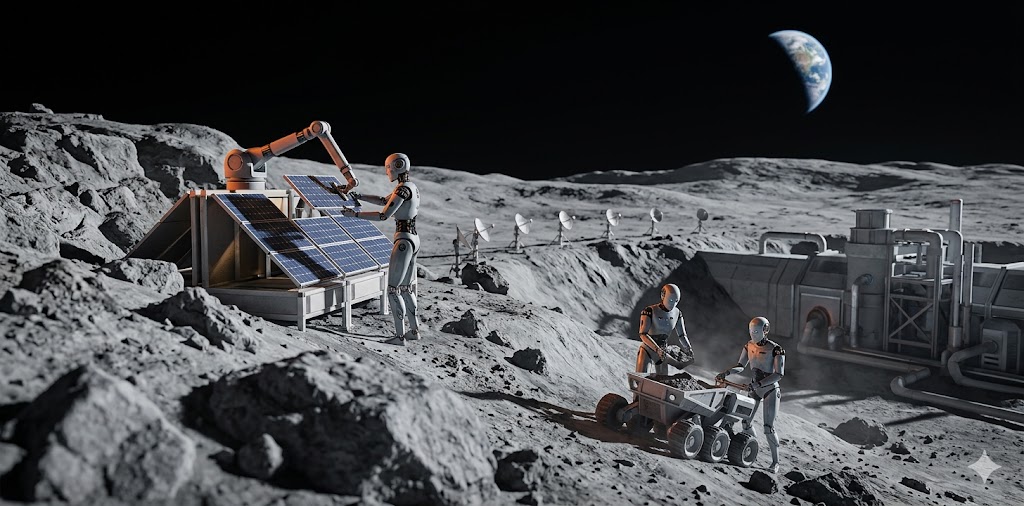
It would be a lot less if we sent humanoid robots. Robots don’t need to return, so we don’t need that rocket fuel for a return flight either.
Humanoid robots are evolving at a tremendous pace, along with AI. Before NASA has a lunar lander ready, they will probably have evolved to do all the work a human astronaut could do on the Moon.
Think about it. What if SpaceX’s HLS were refueled in Earth orbit from fuel brought from the Moon? That could save up to 20 gigantic Starship launches. And what if robots could eventually manufacture rockets on the Moon? Then astronauts could go into orbit on a SpaceX Dragon capsule launched with a Falcon 9, and transfer to a lunar-built rocket to travel to the Moon.
Landing humanoid robots on the Moon might be done without the complication of SpaceX Starship launches.
This would delay humans returning to the Moon, but in the long run, it would jump-start solar exploration. Robots could build habitats on the Moon for people, fill them with air and water, set up the environment, grow food, and get everything ready for human visitors. Robots could build the infrastructure for sending humans to Mars from the Moon.
We should be able to build robots that can withstand the heat and cold of space, endure the high radiation, and work with the dangerous regolith on the Moon and Mars.
Humans could watch through robotic eyes if we set up communication relay satellites orbiting the Moon. Imagine putting on an AR headset and seeing the Moon from human eye level with 4K eyes? The robots would be autonomous but also capable of working with humans.
I’m not sure the public will pay for building long-term human settlements on the Moon. The novelty of people on the Moon wears off quickly. Using robots is so much cheaper. Biological beings aren’t designed to explore space, but robots are perfect.
We really need to think about what we want from exploring the solar system. Is giving a few humans the thrill of going where no human has gone before? Haven’t the Hubble and James Webb telescopes given us so much more than manned missions? Personally, I’d love to see through the eyes of a robot working on the Moon and Mars rather than watch films of another human having all the fun.
But what I’d really love is giant space telescopes spaced across the solar system working as an astronomical interferometer. That would allow us to directly observe planets orbiting distant suns and spectrographically measure their atmospheres. That would be our best chance to discover alien intelligent life. Robots would be perfect for building such structures.
JWH

