I’ve Got a Noir a Day Habit

by James Wallace Harris, 7/9/26

I went for years not being able to sit through a movie or television show by myself. My mind would just feel restless after ten minutes, and I couldn’t continue. I guess I felt guilty, thinking I should be doing something more productive with my time. But being retired, I have all my time free, so why did it make me feel uneasy about frittering away a bit of it?

Then I discovered my mind would latch onto certain old movies, and I learned to relax and go with the flow. Oddly, these were mostly film noir movies. I’ve never been big on mystery or crime fiction. I just never cared whodunit. Evidently, there are aspects to film noir that calm my restless mind.

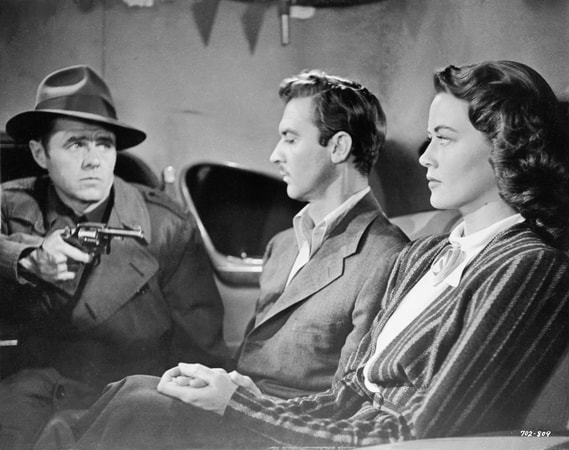
Today’s film was Flaxy Martin (1949), starring Virginia Mayo, Zachery Scott, and Dorothy Malone. I was inspired to select this movie because of The Stiletto Gumshoe’s essay, “Meeting Flaxy For The First Time.” I had no memory of seeing Flaxy Martin before, but as I watched, I realized I had.

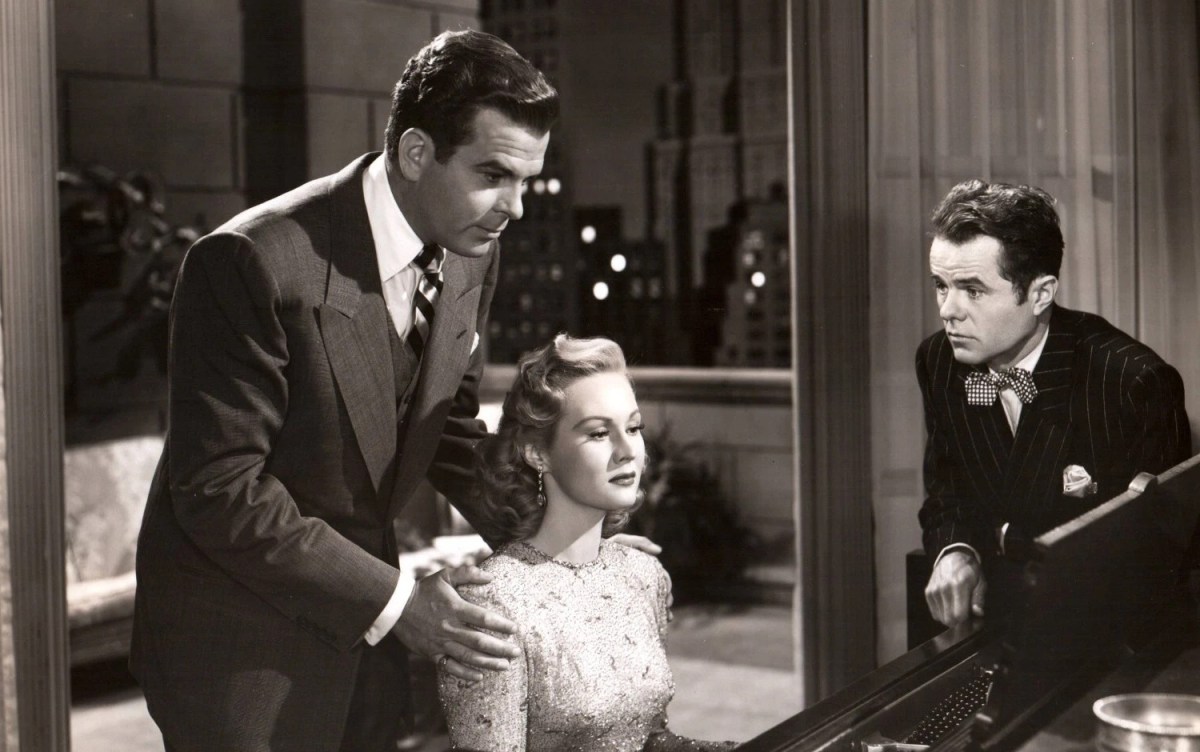
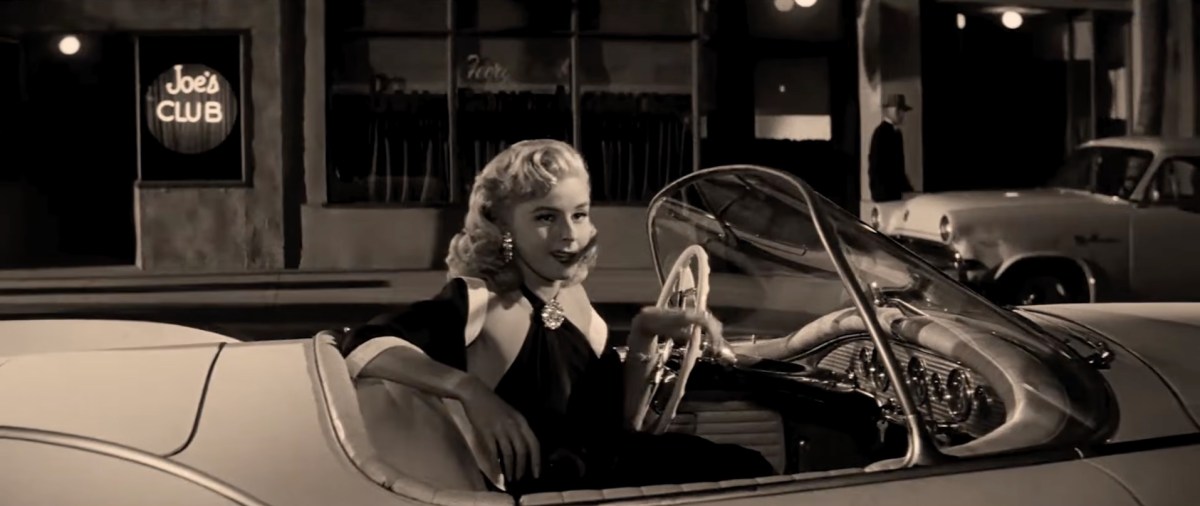
I instantly picked Flaxy Martin for today’s dose of noir because of this photo. I’m a big fan of Elisha Cook, Jr. He’s most famous for playing the gunsel, Wilmer, in The Maltese Falcon. But Cook shows up in countless old movies and old television shows. He plays a very similar character in both Flaxy Martin and The Maltese Falcon – a bantam rooster with a rod.

I’ve never thought of myself as a fan of Virginia Mayo, but I might need to rethink that. Flaxy is a femme fatale and quite evil, and I love a good evil woman character. My friend Mike and I have been keeping a list of evil women in movies since we saw Gene Tierney in Leave Her to Heaven (1945). Flaxy is not up to the evil of Ellen Berent Harland, but she’s dangerous enough. I see that Mayo was also in two other 1949 films admire, Colorado Territory and White Heat.

I wish Flaxy Martin had been the main character in Flaxy Martin; unfortunately, she’s not. She’s AWOL for most of the middle of the film. The movie is really about Walter Colby (Zachery Scott), a lawyer for crime boss Hap Richie (Douglas Kennedy). Quite a lot happens to Walter in the flick, which is why the story moves so fast.

At the beginning of the film, Walter is in love with Flaxy, not knowing that Flaxy is two-timing him with Hap. Of course, Flaxy plays both ends against the middle, and neither the audience nor Walter nor Hap knows where she stands until the end of the film. For each man, Flaxy acts as a spy on the other, but lets the audience ponder whether she’s a double agent for which one.

Flaxy Martin lacks the style of true noir, so it’s really just a good, fast-action B-movie thriller. There are noirish scenes. The movie would have been hardcore noir if the story had been told entirely from Flaxy’s perspective. We see Flaxy set up Walter, and then for the middle of the film, he goes off and falls for Dorothy Malone. The film moves fast, with several twists, but the subplot with Malone feels tacked on. That middle part does give Elisha Cook, Jr. a lot more to do, and I appreciated that.

It’s just a shame that Flaxy wasn’t the main character. Femme fatales seldom get to be the main character. It would have been great to see Flaxy manipulate all the men all the time, for the entire show.

I don’t think the production code would have allowed this, but I would have loved to see Flaxy manipulate all the men and get away with it.

The weird thing about being retired is having all this time to fill. I’m never bored, but neither am I fulfilled. I’m well occupied by a series of entertaining diversions. Watching a film noir each day is becoming as regular as lunch. I assume I’ll burn out on them one day. I wish I knew why my brain likes them now.

Eddie Muller will convince you to watch Flaxy Martin.

JWH

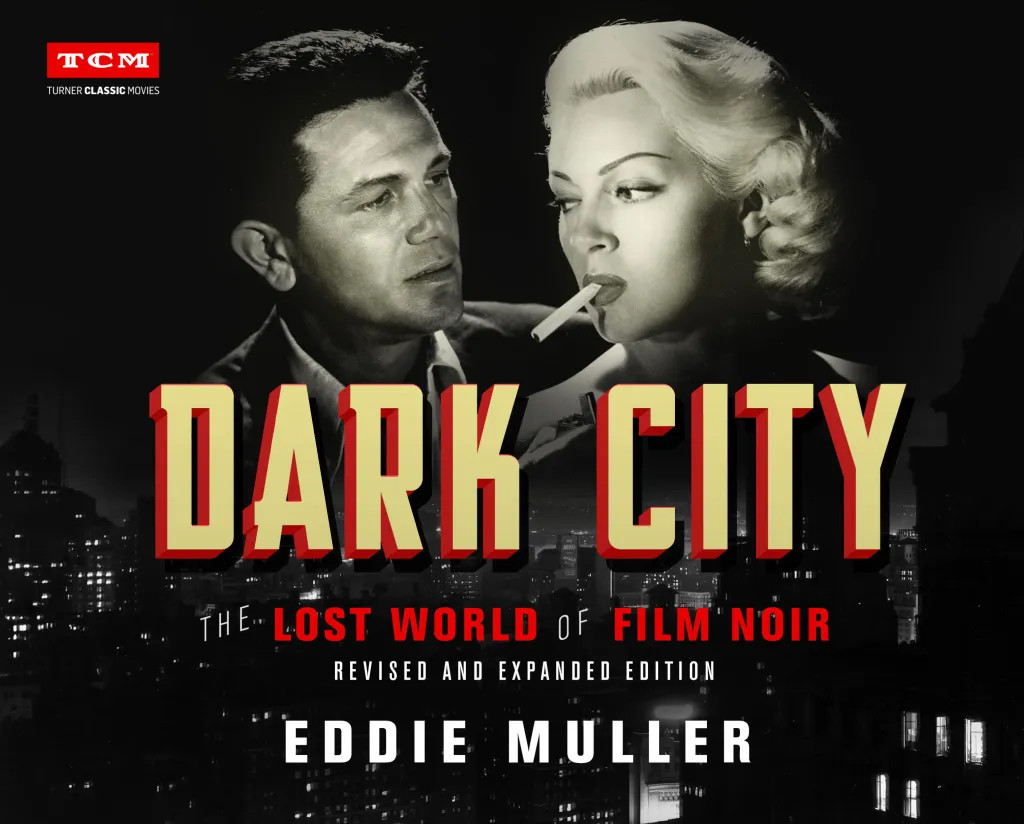
DARK CITY: THE LOST WORLD OF FILM NOIR by Eddie Muller

by James Wallace Harris, 7/8/26

Anyone who frequents Noir Alley on Saturday nights on TCM should find Dark City: The Lost World of Film Noir by Eddie Muller to be Noir Metropolis. However, a tip about where to place your bet.

I bought the hardback edition because I knew I’d want to linger over the beautiful photos. Noir is very visual. And the book is laid out in landscape to showcase those photos. But when I went to read the book, I discovered that reading a landscape volume was a pain in the ass while sitting in my La-Z-Boy. The tiny type was also a hindrance.

Luckily, the audiobook of Dark City went on sale, and I snagged a copy. Listening to the book is like listening to 12 hours and 19 minutes of Eddie Muller on Noir Alley. Muller is one of the audiobook’s narrators. The book is written in the same style he uses to narrate his introductions on TCM. Muller’s nonfiction prose is like reading Raymond Chandler novels.

I’m glad I got the hardback with pictures, but I wish I had the Kindle edition too, so I could enjoy reading and studying Dark City with my eyes. I have to read Dark City at my desk using a book holder. That’s only comfortable for short periods.

However, I never need to read for long. That’s because when Muller describes a movie, I often jump up to go watch it. I haven’t gotten far in the hardback, but I have with the audiobook. And it might not be a book I can ever finish reading. It makes me want to watch too many noir films.

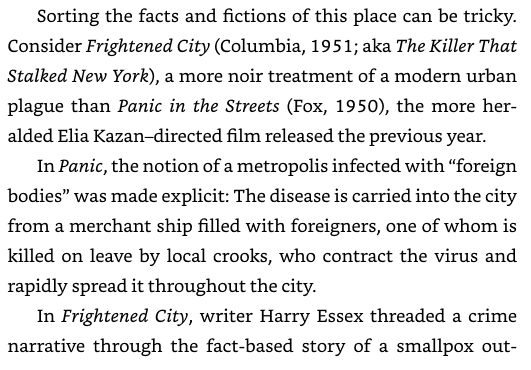
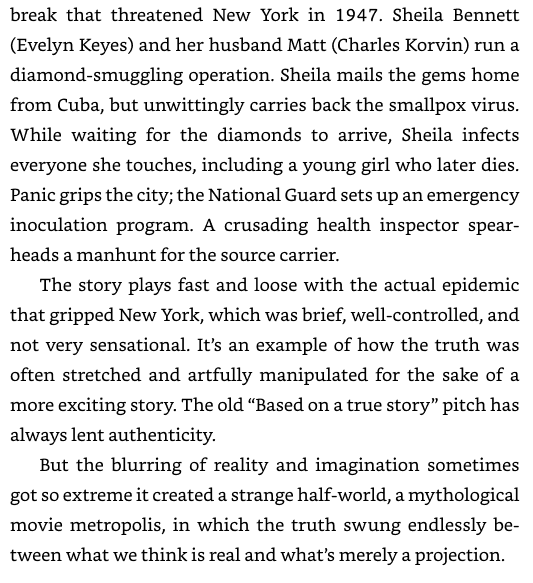
For example, I read this and immediately wanted to watch it.

After you watch the show, read about the 1947 smallpox outbreak on Wikipedia. While watching the movie, I thought some of the events were too fantastic to believe, but they happened.

Luckily, I found The Killer That Stalked New York (Frightened City) on YouTube right away.

A word of warning. A large percentage of the films Muller mentions are on YouTube. But I’m not sure if everyone can see them for free. I subscribed to the light version of YouTube Premium, which gets rid of commercials, for $8.99 a month. That fee might get me extra movies. Just check. Often, when using the JustWatch app on your phone to see where a movie is playing, it will say it’s not available to stream. Then check YouTube. It often has movies that aren’t streaming anywhere else.

Here’s Muller’s old introduction to the film on Noir Alley.

Muller tends to call every black-and-white movie from the 1940s and 1950s film noir if it involves crime. The Killer That Stalked New York lacks the visual and narrative style of The Maltese Falcon or Double Indemnity. Nor does it have the gonzo edginess of Gun Crazy or Kiss Me Deadly. It’s just a gripping story.

And that’s my problem with film noir. Hundreds of films get the film noir tag, but is that fair? I’ve looked for all kinds of rubrics to categorize a film as noir, and nothing works consistently.

One thing I have noticed is that some of my friends who claim to hate old movies will watch and praise a classic noir film. I’m wondering if most old films just seem hokey to them, and noirs are old movies with a story they can handle. Maybe crime stories just seem more realistic. And is this related to why every TV show on BritBox seems to be a police procedural? Are crime stories some kind of lingua fraca among moviegoers? Or do tales about criminals just have wide appeal?

If you’re not familiar with film noir, look at this list on Rotten Tomatoes. If you watch a few of them and like them, you might want to get Muller’s book to look for all the forgotten films. I’m addicted to them.

JWH

Finding Old Movies on YouTube When You Don’t Have TCM

by James Wallace Harris, 6/2/26

Turner Classic Movies (TCM) is the gold standard for old movie lovers. Unfortunately, in the era of cord-cutting, fewer people have access to this wonderful resource. TCM is available via several live-streaming services, including YouTube TV, Hulu + Live TV, DirecTV Stream, and Sling TV. However, they are becoming as expensive as cable TV.

Luckily, my wife is willing to pay for YouTube TV, so I don’t have to worry. However, I have friends who love old movies and don’t have TCM. I invite them over to watch movies with me, but it’s not the same.

The mood to sit in a dark room lit only by the flicker of a black-and-white movie can strike at any time. When I say old, I mean films produced before Beatlemania.

To show how old I am, I’d call The Graduate (1967) a new movie. I define old movies as those I first saw on television growing up. And new movies are those that came out after I started going to the movies on my own in 1962, when I was ten. I’d tend to call films like The Matrix (1999) recent films.

There are plenty of streaming services that show new and recent movies. It’s hard to find old movies if you don’t have TCM.

YouTube is a great resource for old movies. If you don’t subscribe to YouTube Premium Lite ($8.99) or YouTube Premium ($15.99), you’ll have to watch ads or rent the films individually. See YouTube Premium. Lite just removes most commercials, and full Premium adds YouTube Music. Watch this video for a full explanation. I’m subscribed to Lite because I have a Spotify subscription.

Go to YouTube’s Movies and TV page to view their catalog newer movies.

However, many old films are uploaded by regular users. These you have to find yourself, but they are a great source of old movies that aren’t shown on TCM. TCM’s library is great on MGM and Warner Brothers films, but is less good for many studios. For example, YouTube has lots of films from 20th Century Fox and Screen Gems that you don’t see on TCM.

Whenever you’re searching JustWatch and it lists no streaming sources for the film or TV show you’re looking for, check on YouTube.

In recent years, I’ve craved widescreen black-and-white films from the 1950s, and I’ve struck gold on YouTube in finding them.

I should warn y’all that watching old movies on YouTube can be tricky. In the early years of YouTube, old movies were uploaded in low resolution. But over time, they are reloaded in higher resolutions. If you find a movie that’s not in 1080p or 720p, be sure to use the search function to locate other copies.

Also, some uploaders trim off the opening credits. I hate that. I assume they are trying to avoid copyright strikes. Others like to overlay their channel IDs onto the film. I really hate that! My TV can upscale a 360p or 480p copy to make it watchable, but I generally check for 720p or 1080p copies first.

I’m also annoyed by colorized prints. Generally, I won’t watch them. However, I am intrigued by David Adiss’s effort to convert The Hound of the Baskervilles (1939) from 4:3 to 16:9 aspect ratio with AI, and colorize it with AI.

Another problem is that films are uploaded without titles or alternate titles. I guess this is a shade area of the law. Check IMDb.org.

On the other hand, I’ve found stunning prints of old movies on YouTube. My soul finds great beauty in black-and-white cinematography.

It’s possible to watch old movies on your phone or tablet on YouTube, but I strongly recommend adding the YouTube app to your smart TV interface, or your Roku, Fire TV Stick, or Apple TV box.

I also recommend having a Google account. This should be automatic if you’re using a smart TV with Google TV or Android TV.

If you’re logged into YouTube, you can save old films to Watch Later. Also, Google remembers what you like and suggests additional old movies to your feed. I now have a nice library of old movies waiting to be seen.

Below are movies I’ve watched on YouTube with IMDB ratings. If you like a film, click on “Watch on YouTube.” It will take you to YouTube, and you can add it to your Watch Later list.

No Down Payment (1957) – 7.1

The Tattered Dress (1957) – 6.5

Oliver Twist (1948) – 7.8

The Admirable Crichton (1957) – 7.1

Separate Tables (1958) – 7.3

Two of a Kind (1951) – 6.6

Rawhide (1951) – 7.1

The Big Combo (1955) – 7.3

Garden of Evil (1954) 6.6 4K

House of Strangers (1949) – 7.3

Vicki (1953) – 6.5

Mrs. Palfrey at the Claremont (2005) – 7.6

These are just the ones I’ve seen recently. You’ll note the many film noir flicks. Once I started watching them, YouTube kept offering me more. As the algorithm learns your tastes in films, the better the system gets. Be patient.

JWH

DVDs vs. Streaming vs. Plex/Jellyfin

by James Wallace Harris, 1/24/26

I don’t know if you are old enough to remember videotapes, but they were a marvel for the time. Before that, the only way to see a particular movie or TV show was to wait for it to be broadcast. Sometimes, you’d wait years to catch one specific film or rerun of a TV show. After VHS tapes, you could go to the video store and buy or rent whatever you wanted to see.

Eventually, DVDs and Blu-ray discs replaced VHS tapes. Progress was always toward building personal libraries of favorite films and TV shows with higher quality playback resolution.

Then came Netflix DVD rentals. That allowed access to any film or TV show within a day or two. That was so damn convenient that owning DVDs became less popular. After that came Netflix streaming, which made access to favorite shows instant. Who needed to own anything?

Nothing stays the same. If Netflix had never gotten any competitors, I think I would have been content forever. It was like Spotify, one monthly payment for everything.

Now our favorite movies and TV shows are spread over many streaming services, but some shows are nowhere to be streamed. In some cases, I can rent what I want to see individually from Amazon, but with other shows, I have to buy them on DVD or Blu-ray. And for a few shows, they aren’t available for sale or rent.

Over the past thirty years, Susan and I have amassed quite a library of movies and television shows on DVD/BD. But for years, they have been sitting on an out-of-the-way bookshelf. Several years ago, I gave several bags of DVDs to the Friends of the Library when Marie Kondo became popular. However, I kept a couple of hundred that still sparked joy when I held them.

Last fall, I got disgusted with streaming services. We were subscribed to several. They kept raising their prices. And what I wanted to see kept jumping from one service to another. And HBO jettisoned many of its classic shows.

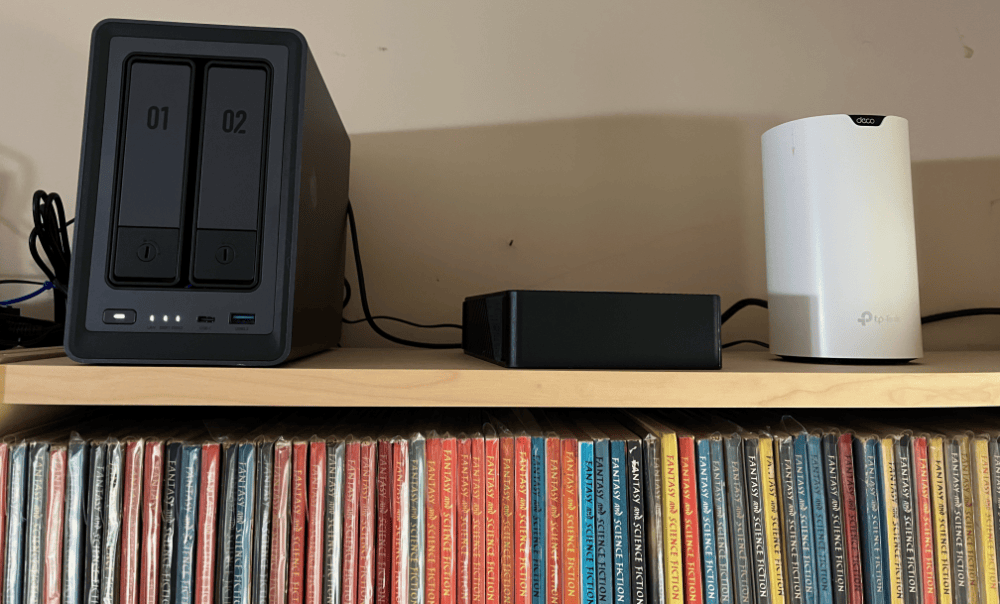
I bought a NAS, set up Jellyfin, and started ripping our library to MP4 and MKV. I’ve been working for weeks, and I’m only halfway through our discs.

It’s a lot of work ripping discs. And it’s frustrating because sometimes neither MakeMKV nor WinX DVD Ripper can read an old disc. I own the complete series of The Twilight Zone on Blu-ray, but MakeMKV couldn’t read one disc, and one episode from another. Nor could either program rip my copy of the theatrical release of Blade Runner from a DVD set that had four different versions of the movie. I also failed to copy one episode of MASH out of 251. That’s annoying.

Setting up Jellyfin on a NAS was not easy. A NAS with RAID drives and two external drives for backups was expensive. It’s quite a commitment to set up your own streaming service on Plex or Jellyfin.

I’m not sure it is worth it. Once the content is ripped, watching movies and TV shows on Jellyfin is much more convenient than watching them on disc. And Susan and I have started using our video library again. That does feel good.

Once ripping is done, Jellyfin is very nice. But to be perfectly honest, watching the same shows on Netflix, HBO, Apple, Hulu, Paramount+, etc. is a bit more convenient, and the picture quality is a touch better. Jellyfin is still plenty good enough.

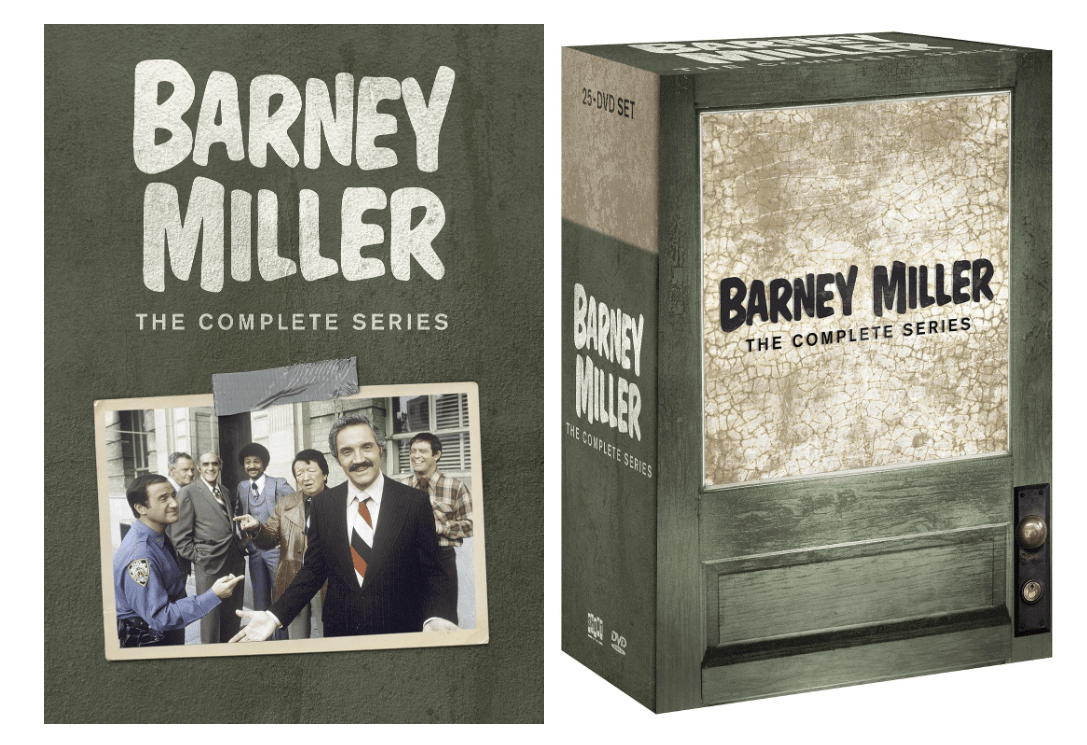
Personally, I’d be happy to cancel all our streaming services and just watch what we own, but Susan wants to keep all her favorite streaming services. Susan loves watching all her favorite TV shows over and over again while she cross-stitches. There are about a dozen of them spread over five streaming services. I’ve bought the complete series of several of them on DVD and ripped them to my Jellyfin server.

I will subscribe to a streaming service to see a new TV series. For example, I’m subscribing to Paramount+, so my friends and I can watch Landman season 2. Before that, I subscribed to MGM+ so Annie and I could watch Earth Abides. And I resubscribed to Apple+ so Susan and I could watch Pluibus. And before that, I subscribed to Britbox to watch The House of Eliot.

Right now, Susan and I are watching The Fugitive and Mr. Novak at night on Jellyfin. Neither is available to stream. In other words, to watch shows unavailable on regular streaming, we have to buy the discs and use Jellyfin.

I roughly estimate that Jellyfin costs me $25 a month, assuming my NAS setup lasts at least five years, and includes the cost of buying DVDs occasionally. We currently spend $50-60 a month on streaming services.

Unless we cancel half of our subscriptions, Jellyfin isn’t saving us any money. It does make our 30-year investment in DVDs pay dividends again. However, many of the movies and TV shows in our library are available on streaming services. It’s hard to make a case for Jellyfin. Life would be simpler without ripping discs, maintaining a NAS server, backing up, etc. Also, our house would be less cluttered without all these discs.

Going the Plex/Jellyfin route only makes sense if you only watch what you own. And that tends to be old favorites. If you love seeing the latest films and shows, Jellyfin isn’t practical.

Knowing what I know now, I would have given all my old discs to the Friends of the Library and my DVD and Blu-ray players to Goodwill. The Fugitive and Mr. Novak have their nostalgic appeal for 1963, but there are many other worthy new shows to watch in 2026.

JWH

Watching Old Movies vs. Old Television Shows in Old Age

by James Wallace Harris, 9/20/25

For years, my wife and I have been watching old TV shows at night. We just finished fifteen seasons of ER. It’s our ritual to watch a couple of hours of TV together. However, I asked Susan if we could watch movies for a few months, and she agreed. Susan prefers TV shows.

I’ve always been a big fan of Turner Classic Movies (TCM). I’ve loved old movies since I was a kid, when I would stay up watching movies all night in the summertime. Stations back then would play old movies overnight. That was in the 1960s, and they would show films from the 1930s, 1940s, and 1950s. The kind that TCM shows today.

Since I retired, I discovered I can’t watch TV by myself. My mind gets restless. But if I have someone to watch with me, my mind can relax. I can’t explain that. I’ve been craving old movies due to that affliction, so I’m thankful that Susan has agreed to watch old movies with me.

Sadly, watching TCM films hasn’t been as fun as I hoped. Has something happened to me? Last night we watched The Lady Eve (1941) with Barbara Stanwyck and Henry Fonda – classic screwball comedy. When I was young, I would have rated this film A+. Now, it was just a C. Susan gave it the same grade. Our friends Mike and Betsy had seen this flick a few days ago, and they were also disappointed. The TCM host gushed about The Lady Eve, and IMDB gives it a 7.7 out of 10 score. That doesn’t sound high, but it is. Anything over a 7 is generally something good.

Mike and Betsy felt the film jumped the shark when the Stanwyck character passes herself off as a different woman to Fonda’s character, and he believed her. That didn’t bother Susan and me.

I enjoyed all the innuendos and double entendres. The movie is a goofy take on sex and love. And I’m a sucker for good character actors, and this film had many of my favorites (Charles Coburn, Eugene Pallette, William Demarest, and Eric Blore).

I remember being completely enchanted by The Lady Eve thirty years ago, so why did I have to force myself to watch it last night? I think the answer is binge-watching television. We’ve been altered by streaming TV.

We just finished watching 331 episodes of ER. Every episode was more entertaining to me than The Lady Eve, even the ones I found somewhat disappointing. Susan and I generally watched two episodes a night, but sometimes we’d sneak another one or two episodes in during the day. We were addicted. I always craved 8:00 pm because I wanted to see another two episodes.

Old movies, or even new movies, just don’t have the addictive quality of a great television show. That’s why Susan prefers TV. And maybe I do too. I think preference began when we could binge-watch an entire TV show from pilot to finale.

I’ve always thought movies were artistically superior to television shows. And maybe they often are. But I don’t get attached to the characters like I do with Mrs. Maisel, Perry Mason, or Beaver Cleaver.

Great movies often have more to say. Great films used to have better acting and higher-quality production. That’s not always true anymore.

Ace in the Hole (1951) had impressive character development. It had a tight plot. The cinematography was excellent. The ending was very satisfying. And it had a lot of delicious moral ambiguity. It’s an A+ picture. It even makes a good episode of Perry Mason look mediocre. Why then is watching Perry, Della, and Paul more addictive? And why was the newer HBO Perry Mason even more intensely addictive? The answer, I believe, is the newer Perry Mason, which combined a TV characterization with movie-level production values.

What if the characters Barbara Stanwyck and Henry Fonda in The Lady Eve came back every week? Is that why we loved The Thin Man and Tarzan movies so much? Are movies less satisfying than television because the story ends? And is that why so many films today at the theaters are franchises?

JWH