For some reason, I’m morphing into a prepper. Is it my age? Or am I experiencing what Bob Dylan wrote about in “Talkin’ World War III Blues,” where everyone is worried about the end of the world?
Well, now time passed and now it seems Everybody’s having them dreams Everybody sees themselves Walkin’ around with no one else
Are these strange political, climatological, and technological times unnerving people? Why is everyone buying a gun? For some reason, I don’t worry about crime, but grid failure. I probably should worry about AI. Getting old is making me frail – is that the cause?
Back in August, a storm knocked 148,000 homes off the grid. We only lost power for a couple of hours, but my neighbor lost power for five days. She stored her refrigerated food in our refrigerator. Again, I agonized over buying a whole-house generator but decided against it. Air-cooled generators aren’t designed to run 24/7 for days, and I’m not ready to step up to water-cooled generators.
However, I just couldn’t let the idea go. After watching a zillion YouTube videos, I bought an Anker SOLIX S2000 power station backup and ZOUPW 450W Portable solar panels. I knew even this was impractical. I spent $1200 to protect $200 to $300 worth of food. I’d need to experience five or six multi-day power outages to recoup my investment.
To be honest, I bought the S2000 and ZOUPW because I love gadgets and electronic devices. I felt challenged to find a solution that would keep my refrigerator running indefinitely during a power outage.
The Anker SOLIX S2000 is advertized to keep an average American fridge running for 35 hours. I figured since I had a smaller 17.2-cubic-foot icebox, I’d get even more hours.
In my first test, I got 29 hours. Not bad, but a little disappointing. My fridge uses about 70 watts on average, but had a few surges past 200.
I knew when I bought the solar panels that my yard gets very little direct sunlight because of all the trees. Still, I tried. The day was also overcast. But our most common outages are ice storms, when trees are bare.
The portable solar panel generated 7-10 watts. That’s the reality of solar energy. I’ll test them again on a sunny day. Even with the trees, I get some sunny patches. In winter, I hope I’ll get much more direct sunlight.
If I could get 250-300 watts for six hours, I could keep my S2000 going for days.
Yet, I must question my obsession. For seventy years, I never worried about power failures. Never felt the need to prep. So why now? Back in my fifties, Susan and I endured 13 days without power in July and August. It was miserable. Never spent a moment thinking about it happening again. I’ve also lived through several ice storms without power.
I never thought about prepping until I heard about whole-house natural gas generators. I never wanted to mess with a gasoline generator. And then it got worse when I heard about solar power stations. I guess I’m seduced by tech.
But once I got into the idea of making my own electricity, it became a fun problem to ponder. However, I do need to think about the reality of what I’m trying to do.
I don’t mind bundling up and living with the cold. I do hate enduring the heat. My friend Laurie just got back from a month in Costa Rica. She had no air conditioning. Europe went through a heat wave this summer, and most people didn’t have air conditioning. I’m just being a wimp if I can’t go without air conditioning for a few days or weeks. I grew up in Miami without air conditioning.
Two or three ice storms ago, we realized that our phones, tablets, and laptops were our top priority. I bought a small Jackery that solved that problem. We also have a gas water heater, so we could take hot showers.
Recalling the last ice storm, I missed hot food the most. Yet, I didn’t starve. I had stocked up on lots of ready-to-eat snacks.
Because I own a solar power station with solar panels, what else could I use it for? I checked with an AI, and the most efficient way to heat a meal with electricity is with a microwave. Gemini says the S2000 could produce 35 hot meals. That’s not bad.
Gemini also said I could run my 5G internet router and smart TV for 15 to 24 hours. At the next power outage, I’ll ask Susan: Want the refrigerator or TV?
This got me thinking. I was considering spending $15,000 on a whole-house generator. I could buy ten S2000 power stations for less than half that. (Currently $649 each.) With even five S2000s, I could solve many of my power problems for several days.
See how this is more of a complicated puzzle to me than an actual survival problem? I’m not a real prepper who worries about civilization collapsing. I assume if civilization falls apart, it’s time to die.
Pondering all the possibilities regarding keeping my gadgets powered reveals something philosophical about modern life. It’s really about fighting boredom and being thrown out of our comfortable ruts. It’s amazing how many electrical appliances and gadgets we’ve integrated into our lives.
What if something severe happened to the nation? Say the power grid went down, telecommunications/computer networks collapsed, and food and water must be rationed by the government. Citizens in many nations endure that now.
Imagine having to build outhouses in our backyards and create our own toilet paper. What if our only light was daylight? If things got that bad, there would be no pharmacies. We’d spend most of our time waiting in line for food and water. What would we do with ourselves without the internet and television?
We depend on civilization. Then why are we so self-destructive and constantly undermining civilization? The money we spend on defense and war could build a rock-solid infrastructure. Just the money we spent on the current war in Iran could have transformed our power grid.
I’m currently reading The End of Everything by M. John Harrison. The novel is a finalist for this year’s Booker Prize. Weird invaders from another dimension have caused civilization to collapse. I just finished reading “If We Make It Through This Alive” by A. T. Greenblatt, a short story in which civilization has fallen apart for unspecified reasons. Like the Bob Dylan song above, when everyone worried about the bomb, everyone now sees endless possibilities for apocalypses.
Is prepping a new fad? Or the conscious reaction to unconscious fears?
148,000 MLGW customers lost power on August 22nd during a severe storm. We only lost electricity for a couple of hours; however, several of our neighbors went five days without power. Over the last twenty years, we have lost power many times for 1-4 days. I wrote about some of those times: “Thrown Off the Grid Kicking and Streaming” in 2017, “Blogging by Candlelight and Paper” in 2011, “Living Like Jane Austen” in 2008.
Every time this happens, I research buying a whole-house generator. And every time, I decide they’re not worth the expense. Over the years, some people I know have bought them, but their reviews have been mixed.
This time, I meditated on what it means to go without power. Am I just being whimpy? Essentially, what hurts the most is having our routines disrupted. The August heat and January cold are unpleasant, but not immediately life-threatening. What pains us is not having TV and computers. That’s pitiful, don’t you think?
My two main worries are freezing pipes and spoiled food. This house survived an ice storm without power for two weeks, so the pipes are probably okay if we keep the water dripping. And we’ve had to throw out a couple hundred dollars of food twice. But is it worth spending $10,000 to save what’s in the refrigerator? According to this video, that’s what it would take to get the icebox going for a week. (Although I could probably do it cheaper because our fridge is smaller and cheaper DIY solutions.)
It does seem unwise to spend thousands to save hundreds. I’ve been watching dozens of YouTube videos about backup power, and there’s an interesting socio-economic divide between the various filmmakers. Many are made by guys who obviously have a lot of money, while the rest are made by do-it-yourself scroungers. I’m not like the guys with expensive homes or the guys who can make $2000 power stations with $200 worth of mail-ordered parts.
The video that impressed me the most was this guy who combined a smaller power station with portable solar panels.
Yet, this is still somewhat complicated. This guy has a house wired to handle this approach. I’d have to get a very long extension cord to run from the solar panels to the Bluetti through an open window, or just carry the Bluetti outside whenever I needed to recharge it. Also, notice this guy is one of those with money. I think prepping is a big hobby for some rich dudes.
That Bluetti with two portable solar panels is $1699 on Amazon. As the video showed, it’s a very versatile setup. It can be used for a variety of devices. And it beats the solutions offered by the guy in the first video. However, do I want to spend $1700 to save maybe $200 in groceries?
I think Susan would prefer to use the Bluetti to keep the TV going. But we learned something from the last two ice storms. In the first ice storm, we learned we wanted our phones the most. After that storm, we went to AT&T and signed up for unlimited data and the ability to have internet hotspots. We also bought a smaller Jackery power station for $200 that can recharge our phones several times.
During the next ice storm, we bundled up in several layers of clothes, got in our La-Z-Boys, covered ourselves with blankets and cats, and streamed movies and TV shows on our phones. It worked great.
We did get tired of eating cold food. We even ate out of the icebox for a couple of days. The cheese and yogurt seemed fine. We ultimately had to throw out a bunch of frozen dinners and veggies, but it was probably less than $100 to replace.
During this recent power failure, we offered to let our neighbor stay with us, but she preferred to stay in her house. We kept her frozen food for her. She didn’t complain much about five days of no air conditioning. She just visited friends and stores with power.
I think the real reason I spend so much time thinking about devising emergency power solutions is that it’s an interesting technical challenge. But do I really want to spend $10,000-$20,000 to solve an interesting problem? Isn’t it just more tech toys that I love?
We have several LED lanterns and a Jackery for the iPhones, and that seems to do well enough. What bothers us is not eating our regular meals or following our daily routines. Susan and I are creatures of habit, and we hate being thrown out of our ruts.
It’s revealing that losing the internet is the most disturbing aspect of power failures. What does that say about us? Our iPhones are little internet lifeboats, and that keeps us somewhat content. But what we want is our big-screen TVs. Isn’t that sad? Probably going without them for several days is character-building.
Still, plunking down the bucks for a Generac so we’re never inconvenienced still tempts me. What I really want is what Base Power offers in Texas. Base Power offers to rent whole-house battery backup. Rent is $19-29 a month, and installation is around a $1000. If everyone’s power company offered that deal, no one would buy whole-house generators or whole-house batteries. Letting the power company deal with everything is the way to go. I think I’ll wait.
Going without electricity is so damn revealing about our personalities that I shouldn’t try to always avoid it.
The average human lives around 40 million minutes, but it’s doubtful they can recall more than a few thousand. Some people try to record as much of their life as possible – they call it lifelogging. Some lifeloggers wear cameras on their chest that snap a pic every 15 minutes.
That would mean over 2,666,666 photos for the average American lifespan. That’s way more than I’d want to manage. Even if I took one photograph a day, I wouldn’t want to maintain 28,835 pictures and the memories that went with each.
Forgetting is one of the key aspects of our personalities. Strangely enough, one of the limitations of artificial intelligence is memory. Both biological and silicon minds function with finite memory. Remembering and forgetting shape who we are, whether biological beings or AI. Just because technology allows us to store more memories doesn’t mean it’s practical to integrate them into our consciousness.
If I took one photograph a week and wrote an essay about it, would it be worth trying to remember 4,120 people, places, and events? I’ve written almost 3,000 essays for my blogs, but I barely remember a tiny fraction of them. What if we tried to remember one special moment from every month we live? Would 949 be too many?
We’re getting close, at least for me. Admittedly, at 74, my ability to recall is fading. I couldn’t limit myself to a single significant moment for each of my 74 years, because some years, I’d want to remember several. This suggests my mind can handle between 300 and 600.
Even ordinary people take thousands of photos and videos with their smartphones. I have around 9,000 digital photographs, nineteen family photo albums, two boxes of loose photos, and a hallway of relatives captured in time. That’s too many.
I realize now that no one is interested in my collection of photos. The photos I save are just for me. I’ve been studying the Photos app on my Apple devices and Google Photos to decide which to make my standard. Learning how each works is helping me decide how to manage my digital memories.
Our smartphones have made us cyborgs. They extend our brains in so many ways that most of us freak out if we lose them.
Having an instant camera at our fingertips is reshaping our lives and society. Even though my iPhone has room for tens of thousands of photographs, there’s no practical way for me to psychologically manage all those visual memories.
Scientists tell us that when we dream at night, our brains decide what to remember and what to forget. Since my iPhone can’t dream, I’ll have to take over that function consciously. Photos, the app on my iPhone, will be where I do this dreaming. I’m training myself to be ruthless in my deleting because what I keep is how I’m consciously defining myself.
When my mother died, I discovered several boxes and albums of old photos. The same thing happened when my wife’s mother died. I have photos from several generations of our four parents. I also have a lifetime of photos that Susan and I took. And as my aunts and uncles have died, my cousins have sent us many photos they thought belonged with our branch of the family.
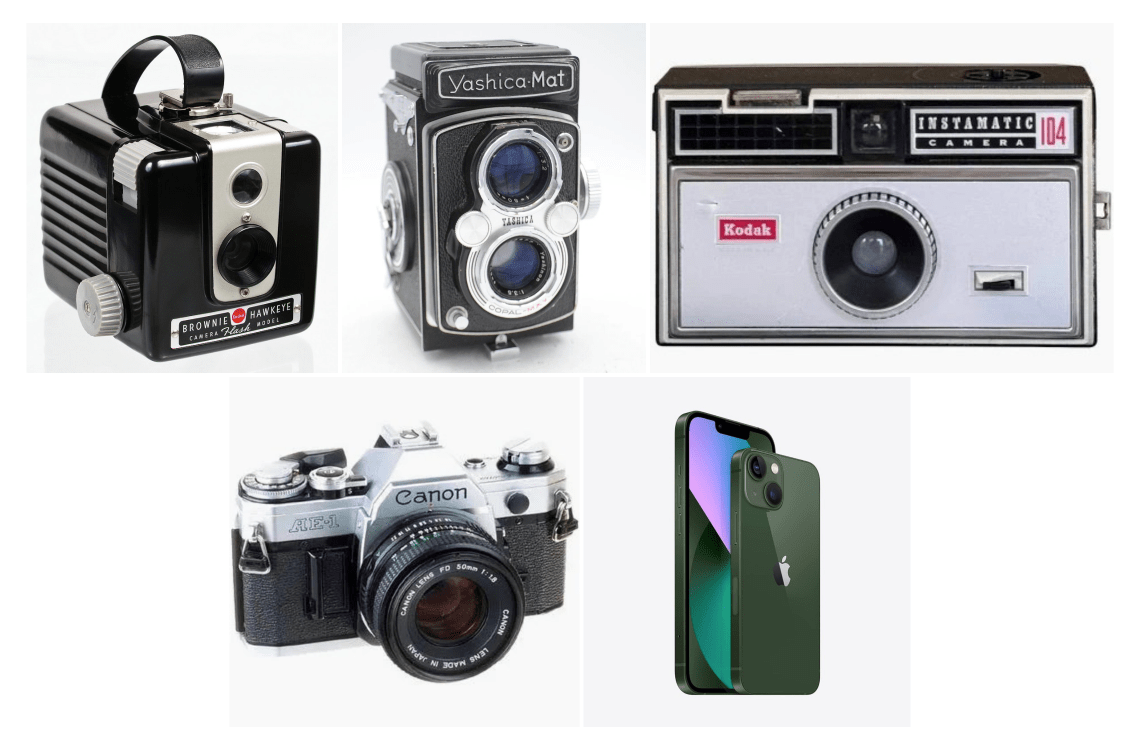
Here’s the thing. My parents only owned one camera, a Kodak Brownie. I don’t think they used more than 5-6 rolls of film over their lifetime. Each roll took 12 photos. I say that because it appears my father took fewer than 60 pictures. I assume Dad took them because he is in none of them.
I’m not sure my grandparents or their parents on either side owned cameras. I say that because there are so few photographs of them when they were young, and the ones I have seem to have been taken by professional photographers. I’m also guessing the pictures I have of their older years were taken by their children.
My parents apparently kept a roll of film in the Brownie for years at a time, taking a couple of pictures at birthday parties and Christmas. Most of the photos I have from the two generations before my parents seemed professionally shot, with a smattering of snapshots given to them by relatives.
At sixteen, I bought a Yashica twin-lens reflex because my buddies were into photography. I took two rolls of film on one family vacation, expanding the family collection by 24 images! Most of the photos my mother had were from school photos, and snaps my aunts and uncles had sent her.
I remembered my Mom and Dad on my blog with the photos I have. There weren’t that many. What does it mean to have so many pictures to remember our lives?
Things changed for us baby boomers. In the early years of our marriage, Susan and I took several dozen photos with Instamatic cameras. Then Susan bought a Canon AE1 in the 1980s and took hundreds. Since buying iPhones, we’ve taken thousands. Our closet, where we stash old stuff, contains hundreds of paper prints, but our phones and hard drives contain thousands of images.
And you want to know something sad? No one wants them. Susan and I don’t have children, but I’ve asked our nephews and nieces if they wanted them, and none of them did. Susan doesn’t really care to look at them anymore, either. We scanned the paper prints, put them on DVDs, and gave them to our siblings one Christmas, but they’ve never been mentioned since.
I’ve become the memory keeper, the archivist of the forgotten. What’s weird is that some of my friends tell me they hate to look at old photos, that it makes them sad and depressed. One of my friends says she’s thrown all her old photos away. Yet, other friends are sentimental like me, regularly posting old photos on Facebook.
Last week, a friend brought the vacation photos she took in France to show after our Mahjong game. Before she came, she asked me how many I’d want to see. Over her 19-day trip, she took 3,730 photos. I told her 300. For her own digital album to remember the trip, she chose 500.
That inspired this essay and my research. And it’s the numbers that make me philosophical. I accept my limitations and work to maximize what I can do with what I can handle.
My friend uses Photos on her Mac. I asked her how many photos her Mac and iPhone were currently managing. She said 28,500. (She’s a big-time traveler.) Well, that was far more capability than I needed for my 9,000, so I settled on Apple Photos, too. I also considered Google Photos, because I also use a lot of their products. But I settled on Photos because I use an iPhone. If I had been an Android user, I would have picked Google Photos.
I started playing with Photos on my Mac Mini and learned that my photo library would appear on all my Apple devices and iCloud. That’s very useful. I also learned that any photograph deleted from any device would be removed from all devices. That can be dangerous, but useful too.
But the more I used Photos on my Mac Mini, iPhone, and iPad, the more I realized that I didn’t want all my photos in Photos. I like using my iPhone as an external memory, and it’s not practical to find a single photo out of 9,000.
How we use photo managers like Photos can shape how we think about the past. Smartphones are changing humanity in ways we’ve yet to realize.
Over the years, I’ve developed a folder structure on my hard drive for filing photos. I’ve decided to leave my entire photo library there and make Apple Photos just for the photos I want to quickly access on my iPhone. I want Apple Photos to represent how I want to remember the past. Like a dreaming brain, I have to constantly delete.
We showed my friends photos from France on our 75″ TV using a laptop and an HDMI cable. This got me thinking about organizing my photos and viewing them on the TV. The impact of photos varies from the small iPhone screen, to the 10″ iPad screen, to the 27″ screen for my Mac Mini. The emotional impact is greatest on the 75″ TV screen. When the new Apple TV comes out, I’m going to buy one just to conveniently view my memories on the large screen.
In idle moments, often during insomnia, I’ll take out my iPhone and view photos. Sometimes, like Anne and Mike, my photos make me sad. Other times, they trigger intense, powerful emotions, which I relish like a vampire feeding on someone’s lifeblood. Mostly, these images of the past make me philosophical. They bring back memories that my mind is forgetting. I hate that I forget. But I do that more and more.
When you think about it, staring at a screen for hours on end seems weird. We exist in an immense three-dimensional reality, yet we prefer to focus on a small two-dimensional artificial reality. Why?
There are possible explanations. We don’t view reality directly, but rather perceive what we think is reality through a recreation within our minds. And our minds love making up stories to explain everything, and usually, they have little to do with reality. At night, our unconscious minds generate dreams that feel like another reality.
Is it any wonder we’re so addicted to fiction on a screen? Make-believe is so much easier than the complexity of reality.
Before screens, there were books, plays, storytellers, tall tales, and gossip. Humans interact with reality with words and language, but those tools are so imprecise that they encourage us to make stuff up that’s not there.
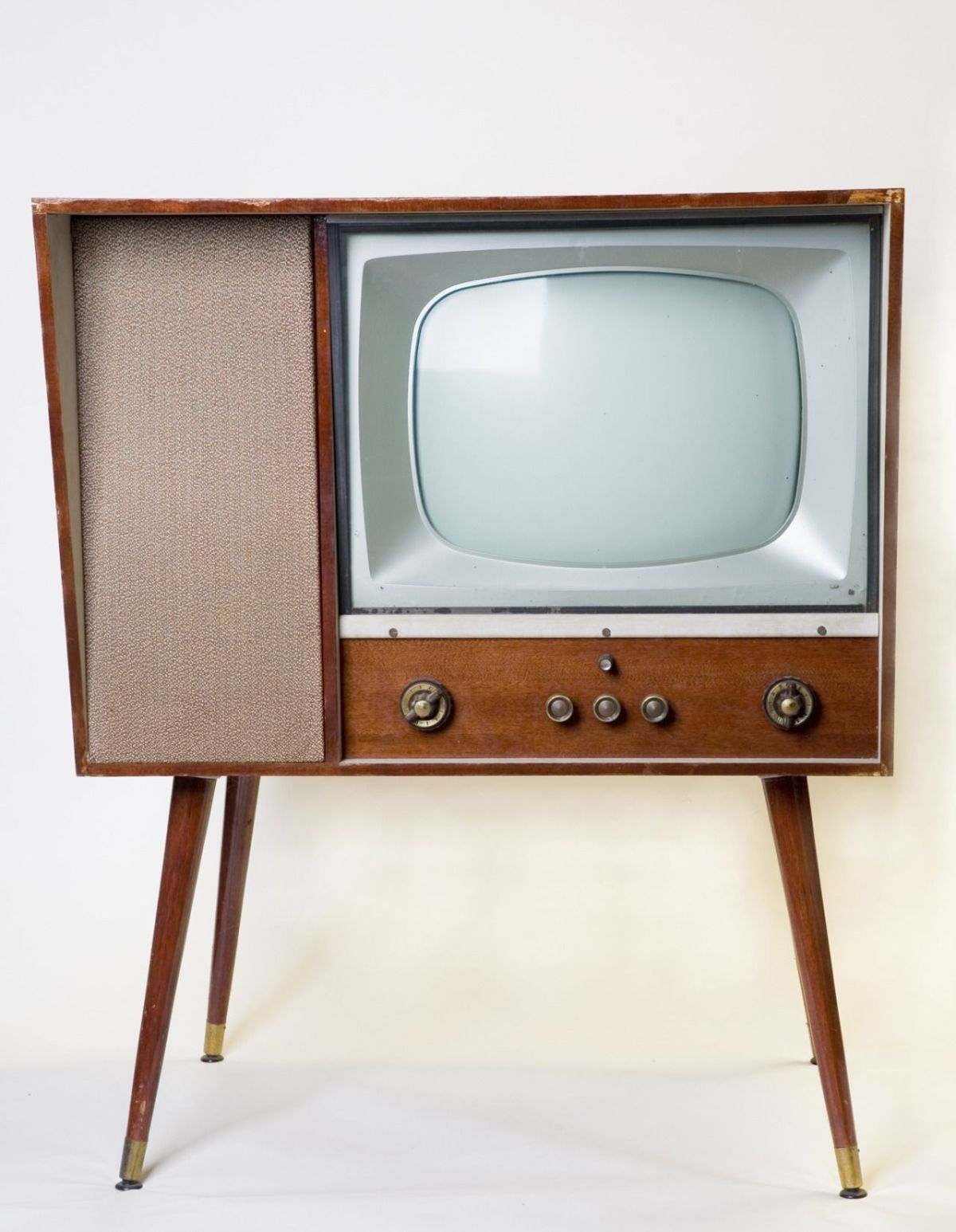
So, back in 1957, when I was five, could I have rejected television? Could my little mind have said, “This is fake, I’m going out to ride my bike?”
I wish I had, but I didn’t. Guessing that I watch four hours of television a day on average, that means since January 1, 1957, I’ve spent 100,884 hours in front of the boob tube. They claim it takes 10,000 hours of practice to become great at doing anything. I could have become an expert at ten endeavors if I had said “No” to television.
A more important question is: Can I say “No” to television in 2026?
Why spend the last years of my existence glued to a television or computer screen?
Reality feels the most real when I’m outside working in the yard. I can feel the heat of a nearby star, the changing atmospheric conditions, and watch the plants, trees, birds, bugs, and animals coexist in an ecology. At night, I can see the moon, planets, stars, and even galaxies. Nature should be the most stimulating part of my existence. But it’s not.
My mind prefers to dwell on music, books, magazines, TV shows, movies, the internet, and YouTube. Why is watching old episodes of Mr. Novak from 1963 more rewarding than raking leaves or watching birds at their feeder?
I think it’s because I didn’t say “No” to television in 1957. Like people embracing religion for a lifetime at an early age, I worshipped at the television set. I wasn’t smart enough to make a choice.
Years before 1957, I remember my mother putting my sister and me in front of the TV to watch Kukla, Fran and Ollie or Romper Room as she got dressed in the morning. And after them, it was Captain Kangaroo. But I’m not blaming my mother. TV was irresistible. When my parents weren’t around, I’d turn it on. I have distinct memories of doing that by myself at age five. I remember watching Gunsmoke by myself in 1957.
I suppose if my parents had coached me in learning little activities, I might have become used to actively doing things rather than sitting in front of the TV. To be fair, in 1957, I have memories of playing with toy trucks in the scrubery, riding my bike, playing with friends, walking to school, and spending weeks pretending to be a pirate while sailing in an old wooden crate.
However, all those activities lacked much conscious effort. Becoming good at anything requires a conscious effort. I’m not sure kids do that on their own. I never had a mentor to get me started.
Watching television or doomscrolling is deliciously an unconscious effort.
I could never have said “No” to television in 1957 on my own. That would have only happened if I had the guidance of a wiser person. And they would have had to show me a better alternative.
I’ve contemplated giving up television for all my adult life. Intellectually, I know there are better ways to spend my time in reality. But I got conditioned to television at a young age, and I’ve never been able to reprogram myself.
I really should try. I only have a few more years in this reality.
If you don’t want your kids addicted to screens their entire lives, I recommend mentoring them in other activities.
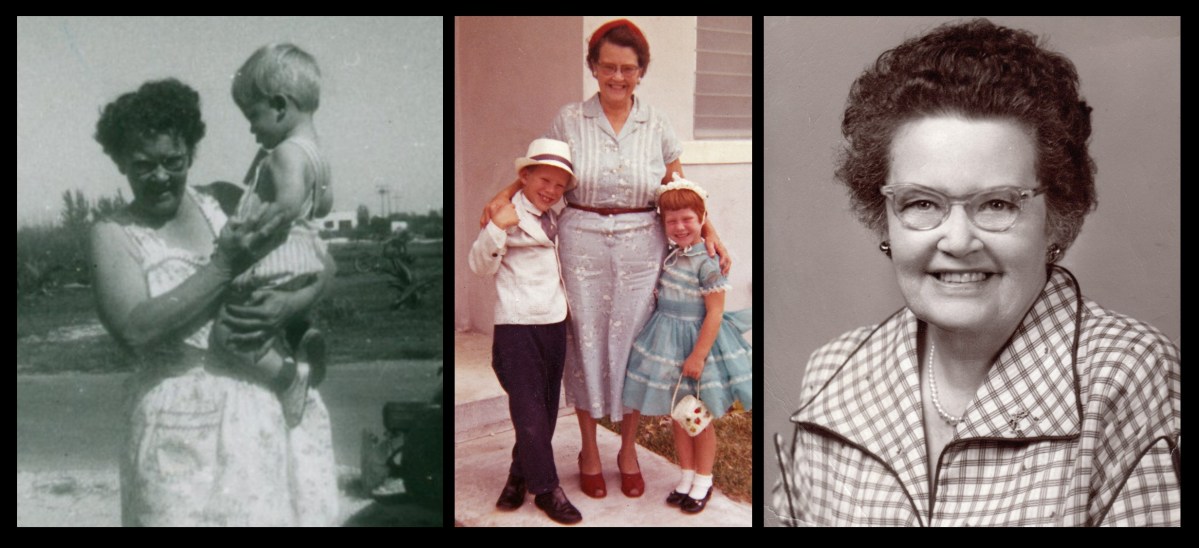
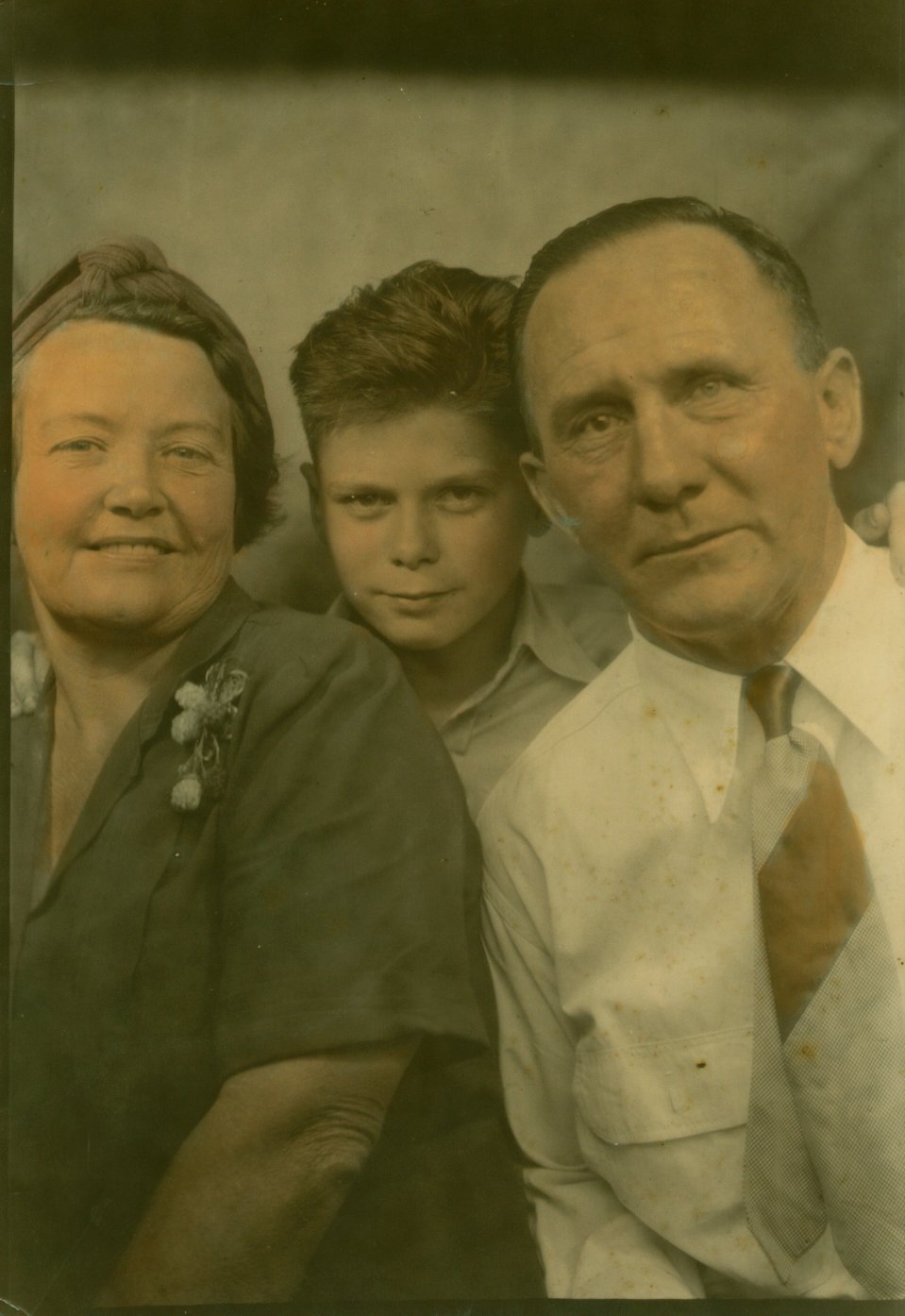
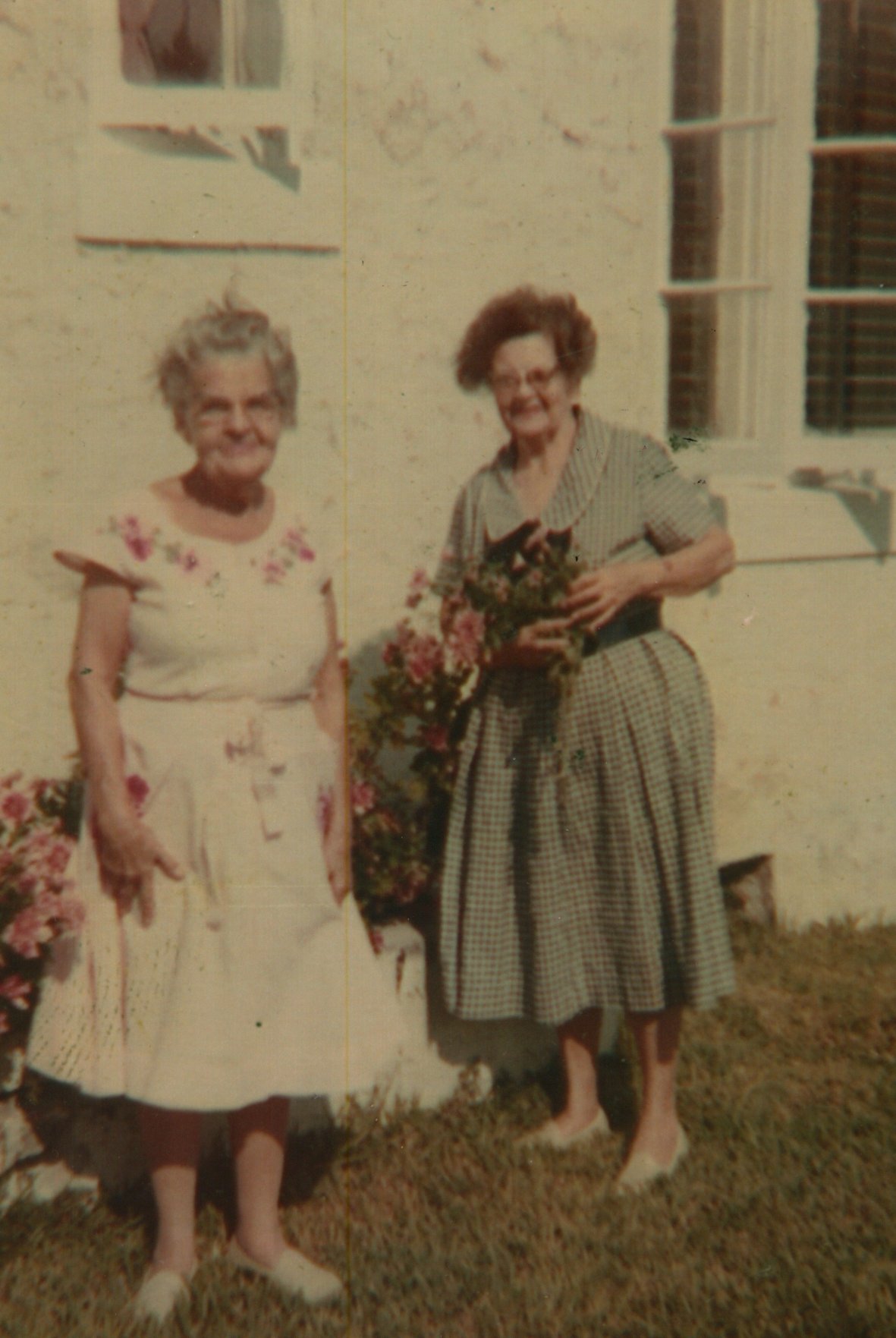
This essay is about memory and history. What can I remember? What can I document with photographs or research with Ancestry.com? What can I find on the internet? I want to know as much as possible about Helen Harris. I plan to update this page as I find more information. The photo on the left at the top of the page is me with my grandmother around 1953. I was her first grandchild. The next photograph is of my grandmother with me and my sister in 1959. The last picture is just the best portrait I have of her. I believe it was taken in the 1960s.
Helen Harris was my grandmother, my father’s mother. I’m learning to use Ancestry.com by researching her records. This essay aims to show how genealogy research works and to push my memory to remember everything I can about my paternal grandmother. I’m also using clues I found on Ancestry.com to research on Google. Here is the current state of my family tree.
I’m going to start with my grandmother’s birth and work forward in time.
1900 United States Federal Census (June 20, 1900)
I cannot find a birth certificate for my grandmother. I discovered on Google that Indiana didn’t require birth certificates until 1907 (but some counties had them as early as 1882). I’m not exactly sure where my grandmother was born. The first official document that lists my grandmother is the 1900 United States Federal Census.
Helen is listed as a granddaughter living with John I. Martin and Mary A. Martin, her maternal grandparents. My grandmother’s mother is listed as Margarete Delany and her father James Delany lived with them. Delaney was spelled without the e. Spellings, especially first and last names were often inconsistent in historical documents.
They lived on 484 Third Street, Hoopeston, Grant Township, Vermilion County, Illinois. The census was taken on June 20, 1900. My grandmother’s grandfather was born in Ireland in 1848. His wife came from Ireland in 1857. I don’t know if they were married in Ireland or America. That puts me five generations from being an immigrant on that side of the family?
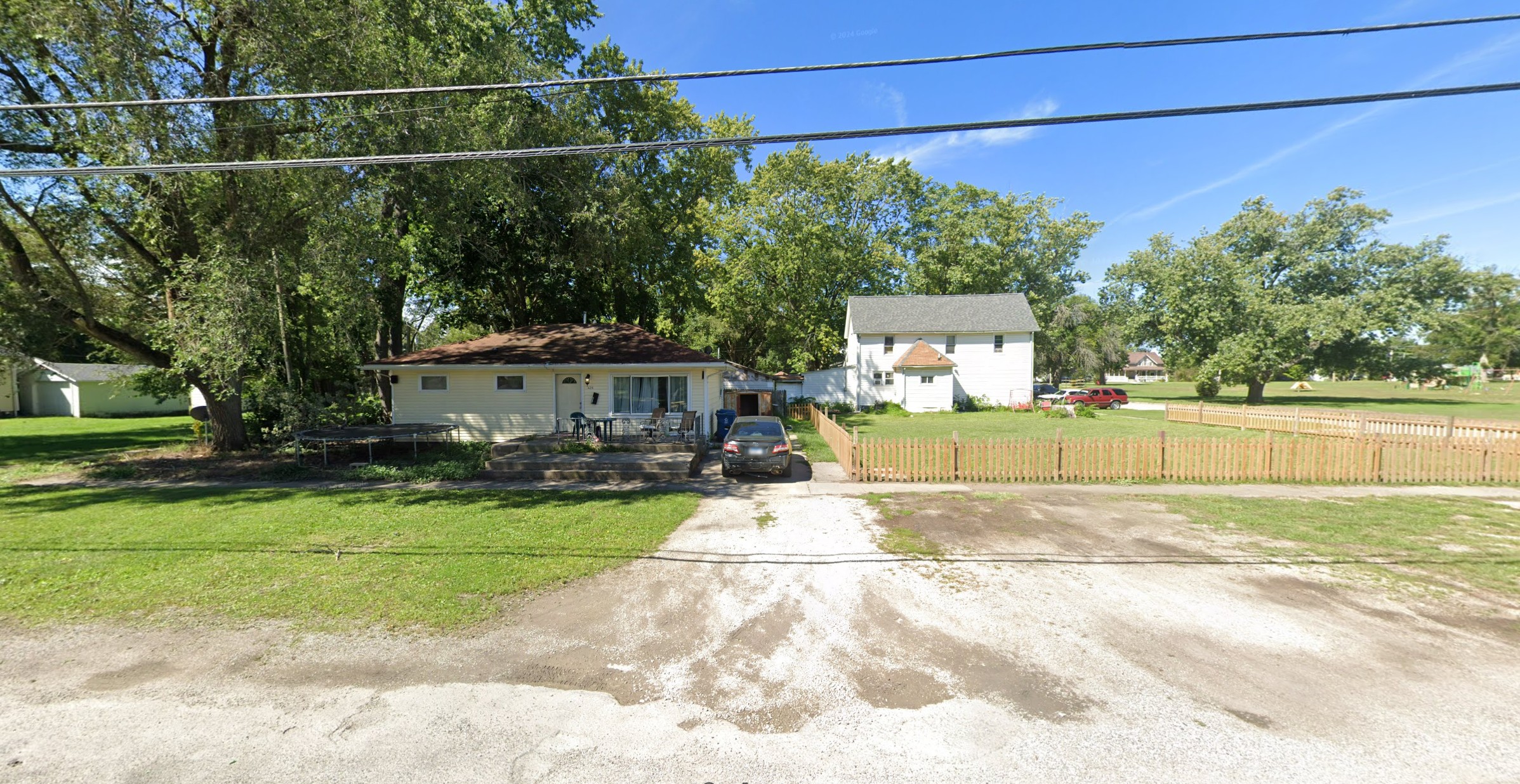
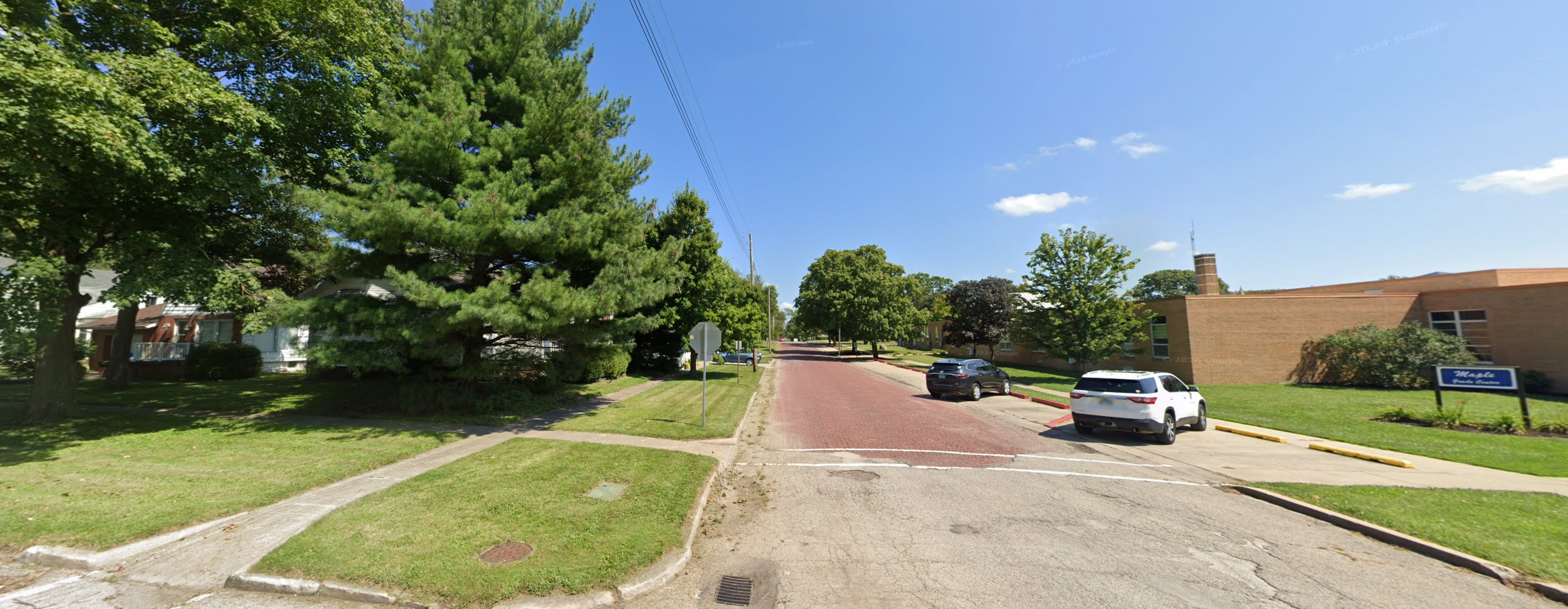
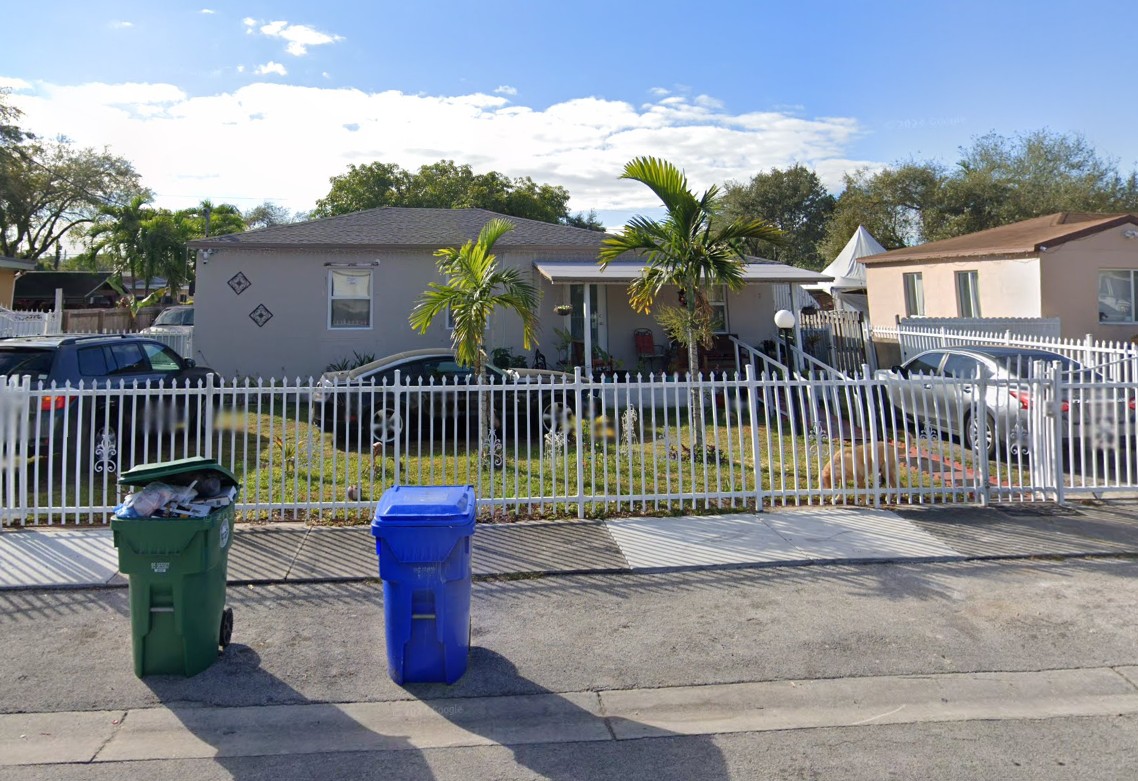
Third St. Hoopeston is now divided between north and south. There’s no telling where 484 would have been. This photo shows a 2024 view of 452 and 498 of N. Third. The house in the back looks old. Maybe 498 could have once been 484?
This is about where 484 S. Third Street should be.
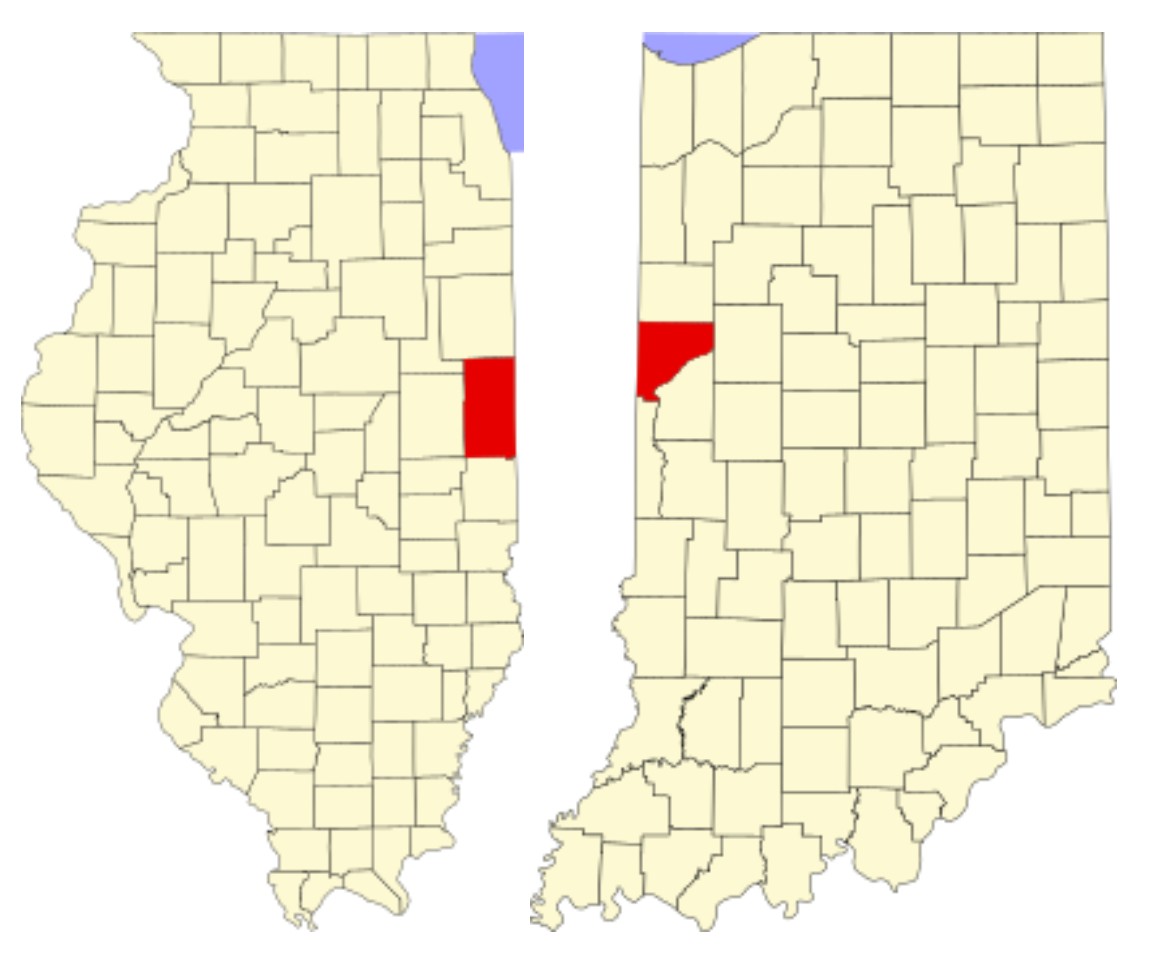
This brings up the question: Why was my grandmother living in Illinois at one year and seven months when she was born in Indiana? Vermilion County is right on the border with Warren County, Indiana. Evidently, it’s close enough for dating. I wish I knew where my grandmother was born.
1910 United States Census (April 10, 1910)
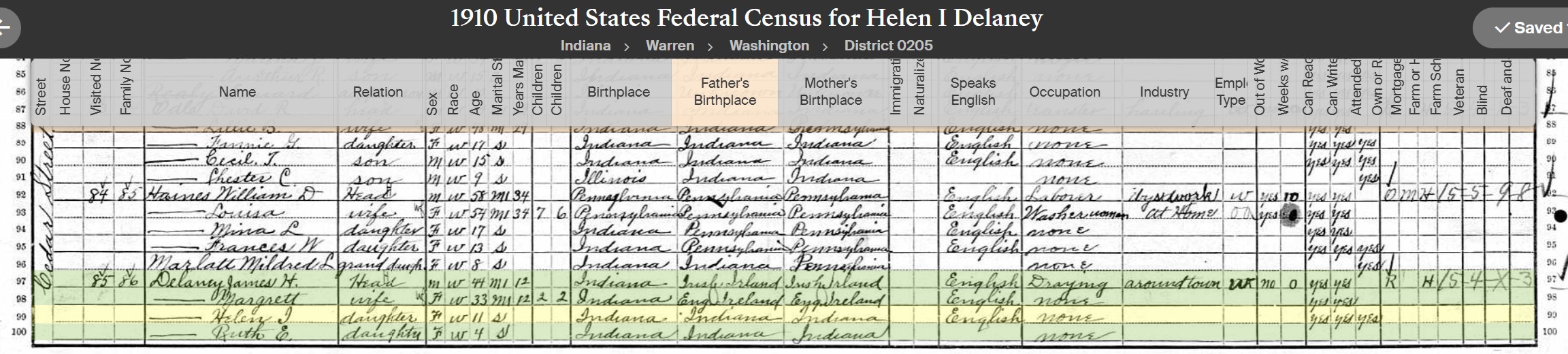
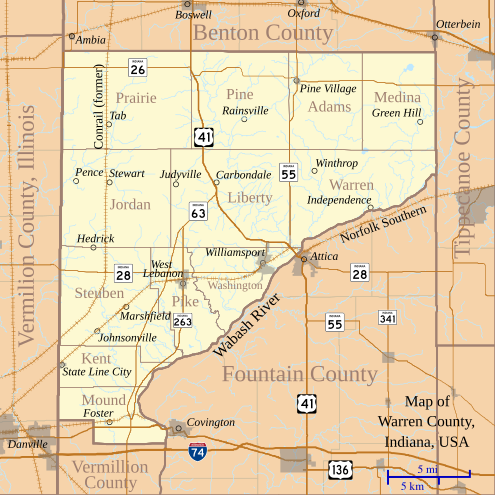
Helen Harris was 11 and living on Cedar Street, Williamsport, Washington Township, Warren County, Indiana. Her father was listed as James H. Delaney (44) and her mother Margrett Delaney (33). My grandmother now had a 4-year-old sister Ruth. That validates real life because my grandmother had a sister Ruth. The names have different spellings. This map shows how close they were to Vermilion County, Illinois, and the location of Williamsport. In 1910, the town’s population was only around 1,200.
I was always told she was born in Indiana, but I can’t validate that in any way. Was Williamsport her birthplace and family home? Later records claim she was born Helen Imojean Delaney on November 28, 1898, to James Henry Delaney (1863-1947) and C. Margaret Martin (1877-1968). I might find out more when I research Margeret Martin.
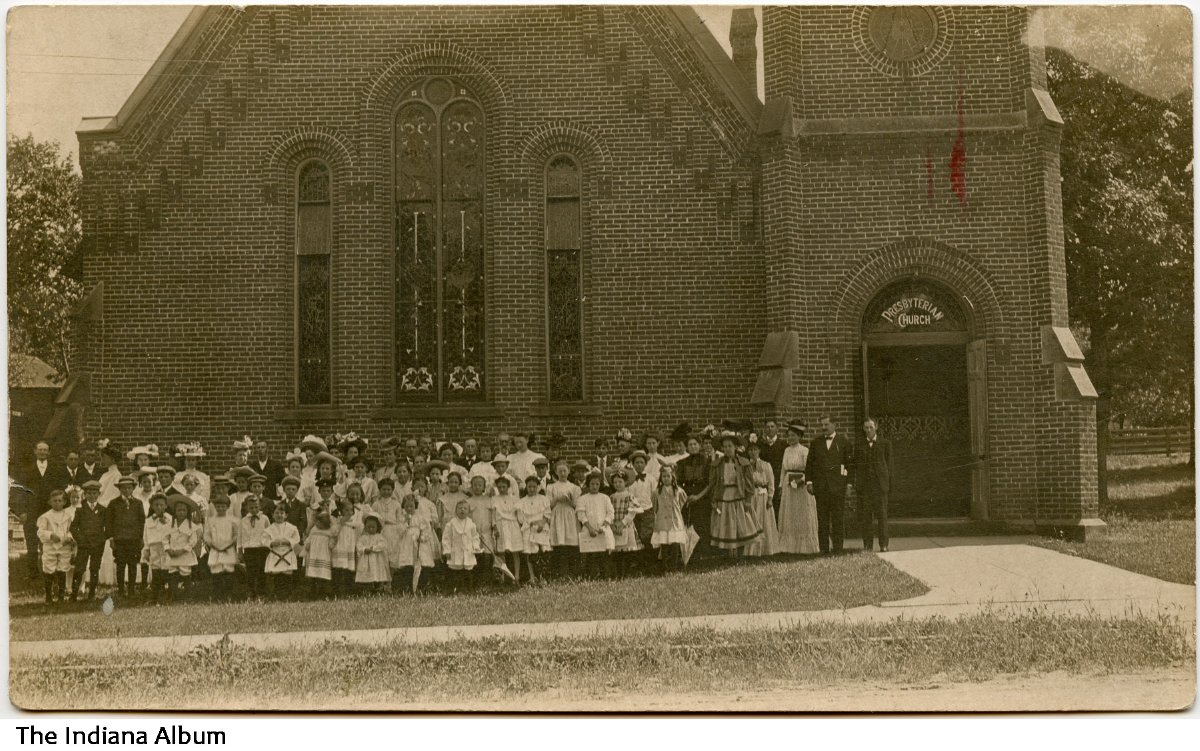
Here is a photograph from Williamsport in 1910. My grandmother would have been eleven. I wonder if she is in this group of people? How far can I go with this research? Just how many pieces of evidence of our lives do we leave behind? I wonder if I drove to Williamsport if I could find more clues?
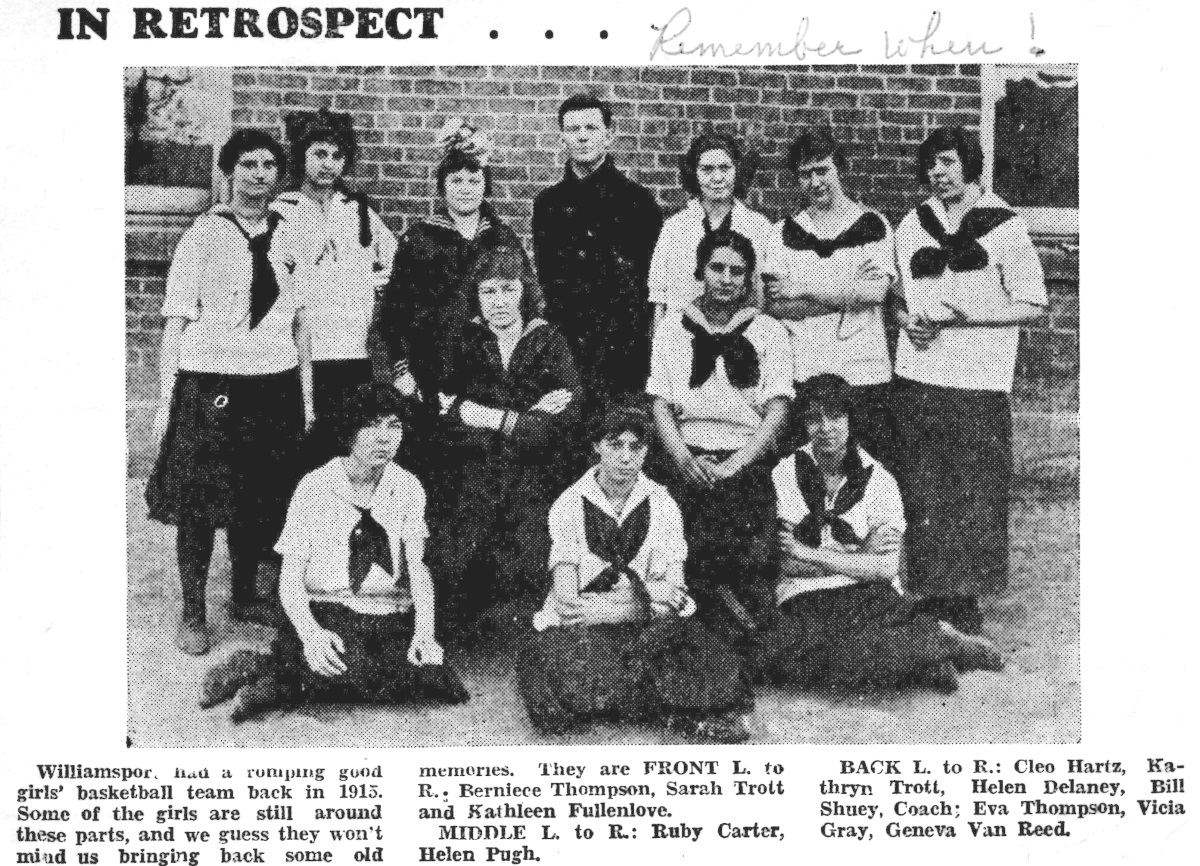
My next bit of evidence comes from 1915. I don’t know where this clipping came from. It appears to be a look at the past. My grandmother is about 16. She’s third from left in the back, wearing the weird hat. It’s the earliest photograph I have of her. (Strangely, I also have an old newspaper photograph of my mother on a basketball team.)
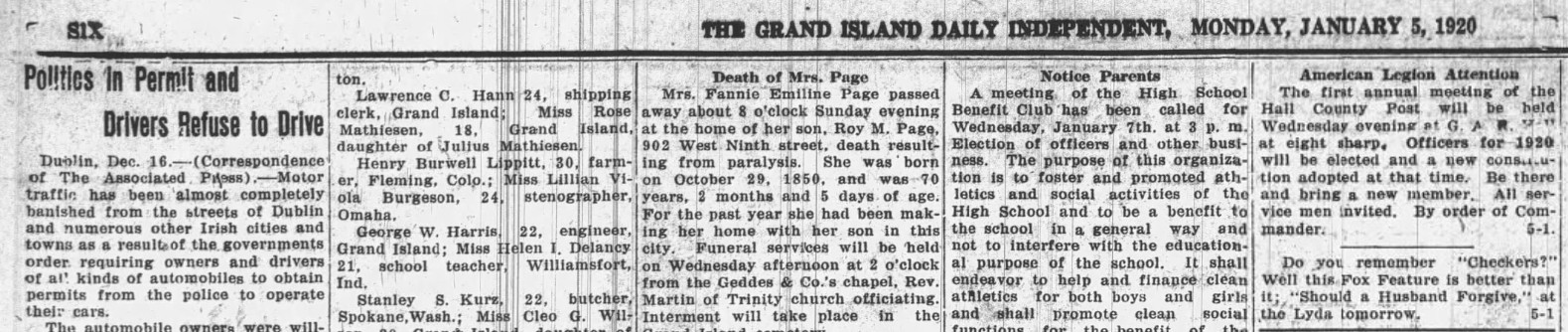
The next record I can find about my grandmother is a marriage notice in The Grand Island Daily Independent for Monday, January 5, 1920. Helen Delaney married George W. Harris, 22, an engineer. She is listed as 21 and a school teacher.
I wonder what they mean by an engineer? Was he a college graduate? After he moved to Florida, my grandfather worked as a border agent. Supposedly, his picture was once in Life Magazine arresting illegal aliens coming in by boat. My grandmother once told me she had been a schoolteacher in a one-room schoolhouse. So that fits. My father, George Delaney Harris, their first child was born on October 12, 1920.
How did she meet a man from Nebraska? This is the earliest photo I have of my paternal grandfather, George W. Harris. He is on the far right. Those are his parents and brothers, my great-great-grandparents. He looks older than 22 there, so I’m guessing it was after 1920.
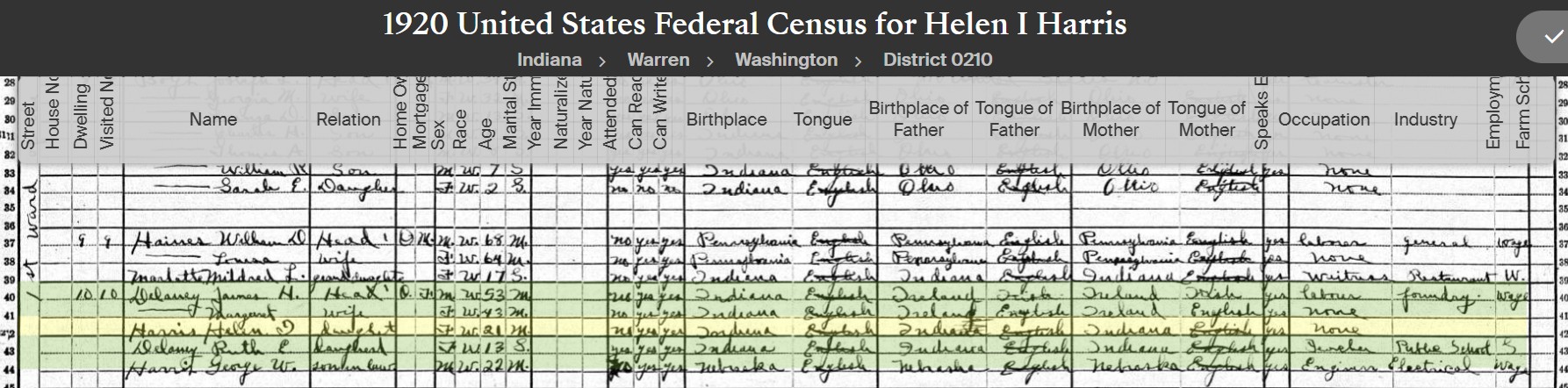
1920 United States Federal Census (June 2, 1920)
My grandmother and grandfather are living with her parents in Williamsport, Indiana. Was the Nebraska newspaper notice of their marriage just a notice, and they weren’t living in Nebraska? Or had they gone there to marry, and then returned to Indiana to live? My grandmother is unemployed, but my grandfather is now an electrical engineer.
Sometime during the 1920s, they move to Florida. I have no proof of when or where. The next record to validate their existence does put them in Florida. I’d love to know the story behind the move.
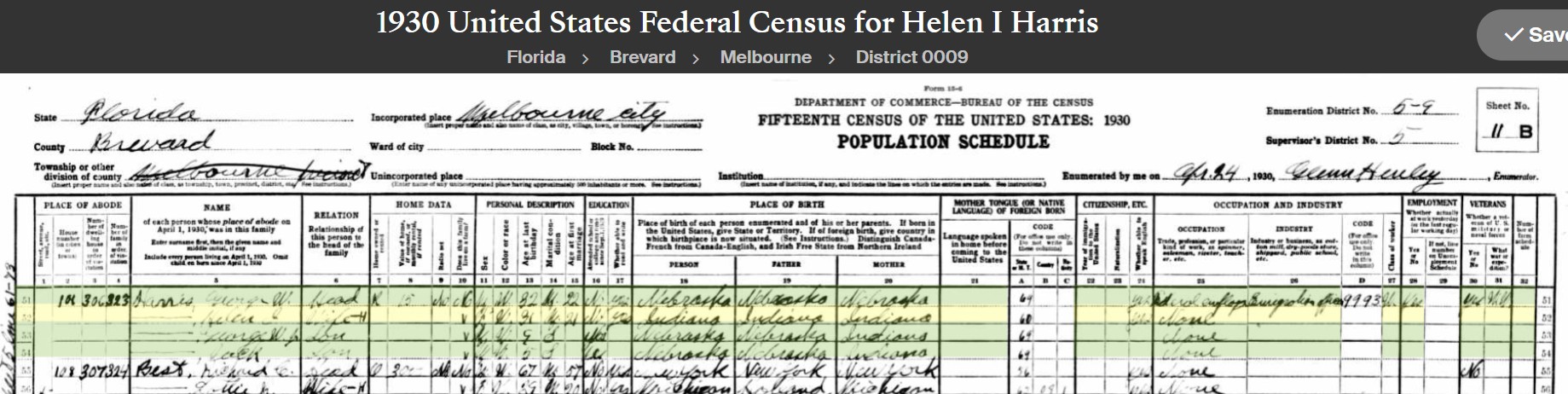
1930 United States Federal Census (April 4, 1930)
I never heard anyone in the family saying they lived in Melbourne, Florida in Brevard County. The census document says they live at 101 “Wolfe” Street. But I’m not sure of the handwriting. Can’t find a Wolfe street. My grandfather’s occupation is now listed as a federal employee and an emigration officer. That fits with family stories. My grandmother is still unemployed, but now has a second son, my uncle Jack.
1935 Florida Dade County Census
They rented a house at 193 NW 54th St. My grandfather was a federal inspector. All three sons are now here, including my Uncle Bob. My dad was 14.
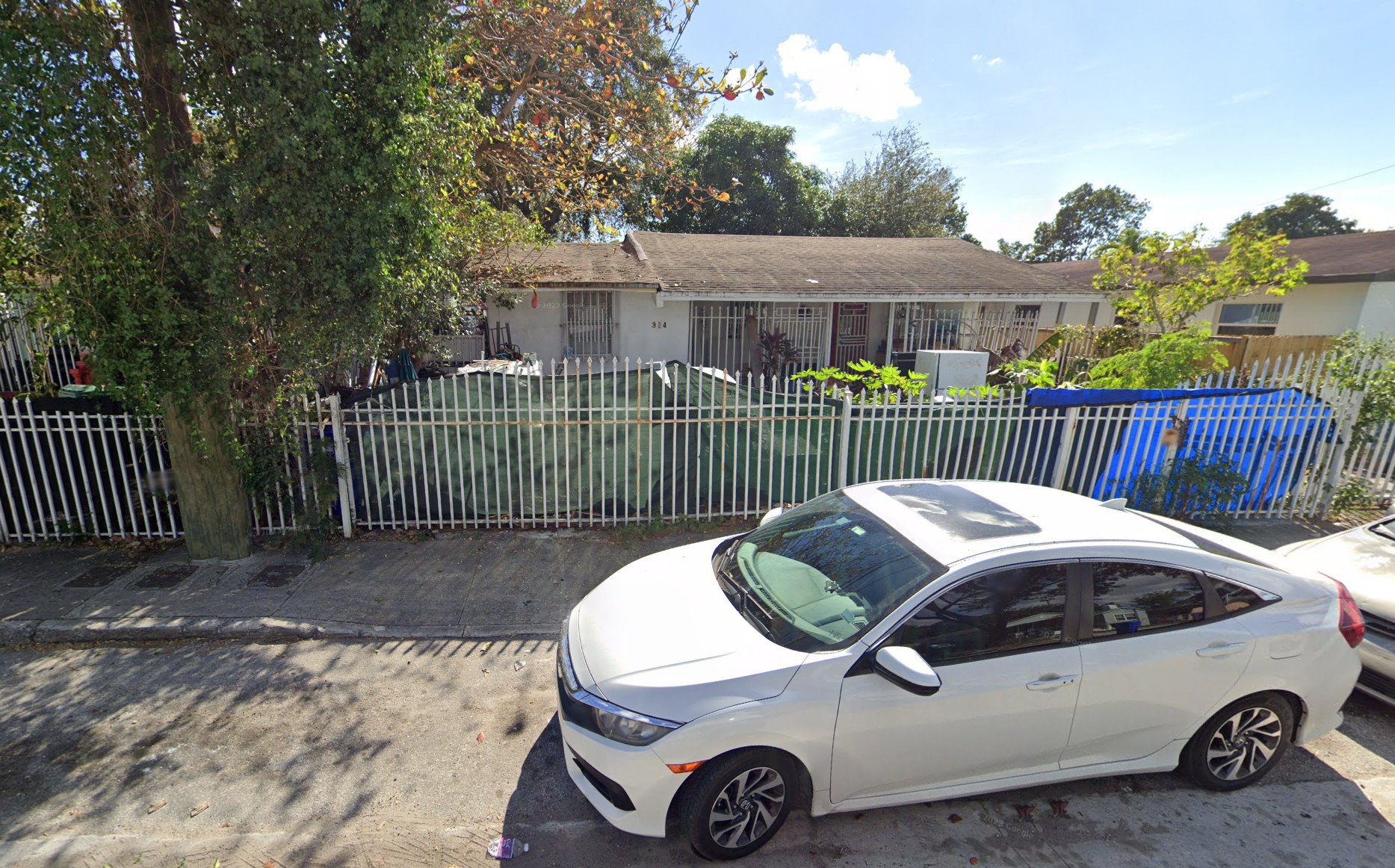
1936 City Directory
My grandmother is listed as living at 324 NW 53rd Street in Miami. Here is a current Google Maps Streetview photo. This
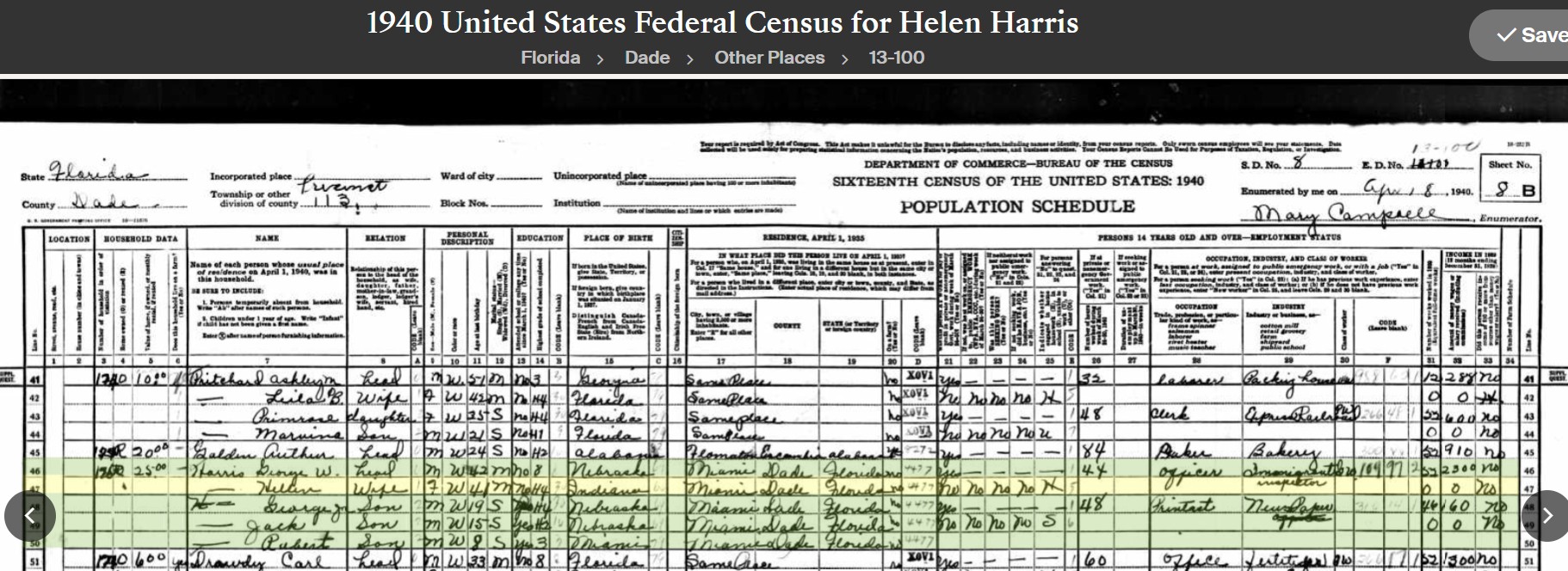
1940 United States Federal Census (April 8, 1940)
They are now living in Dade County, where Miami is located. However, I can not make out the township. I would love to know their address. I remember visiting my grandmother in a little house in the early 1950s. My grandfather had died in 1947.
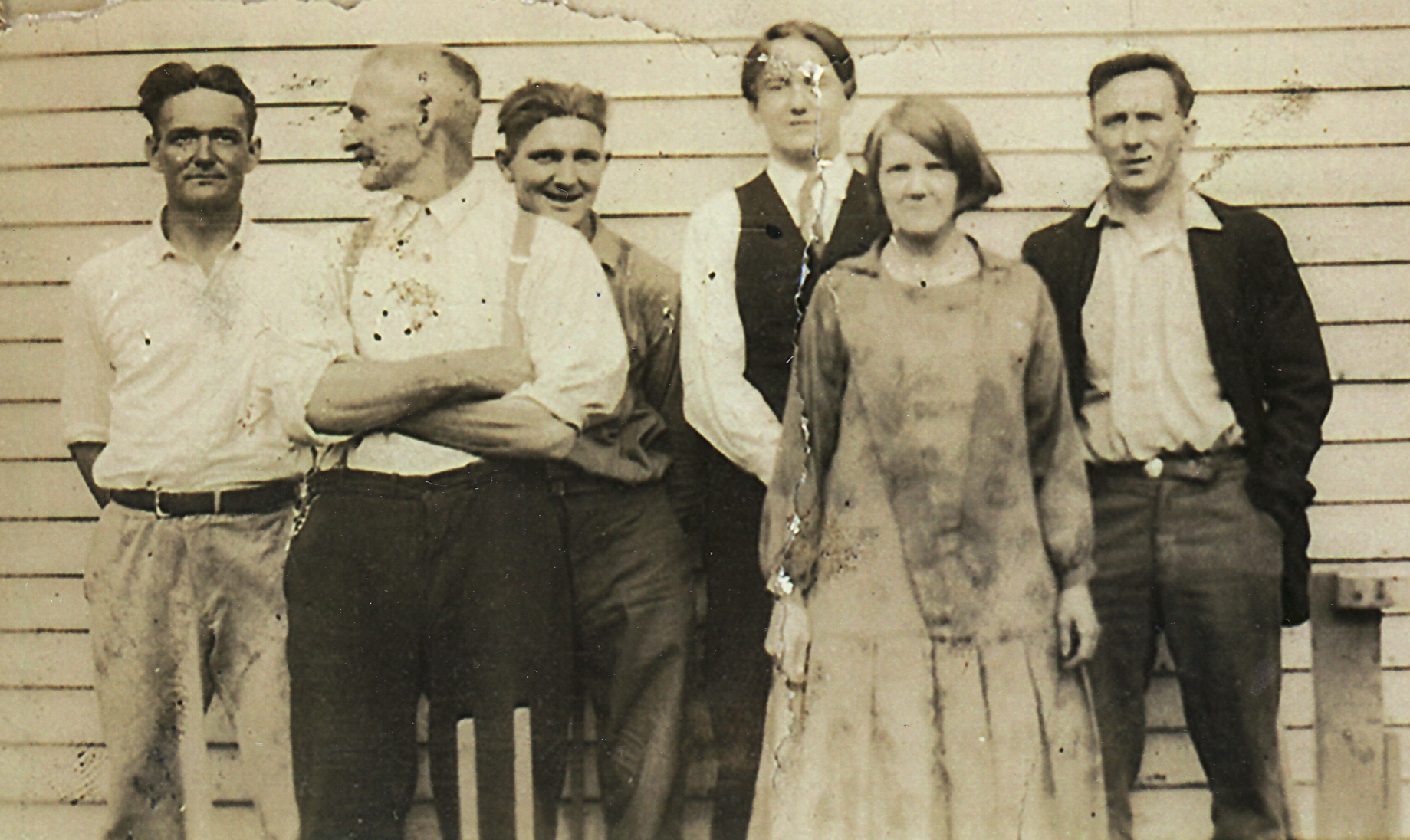
My grandfather is now an Immigration Inspector, and my father, 19, works for a newspaper. I have a clipping from a Miami newspaper, describing my father studying advertising layout in high school. I won’t include it here, just evidence for my grandmother. Uncle Jack is 15 and Uncle Bob is 8. I have one photo from around this time. My Uncle Bob is in the middle, and he looks like a teen, so I’m guessing it’s around 1945?
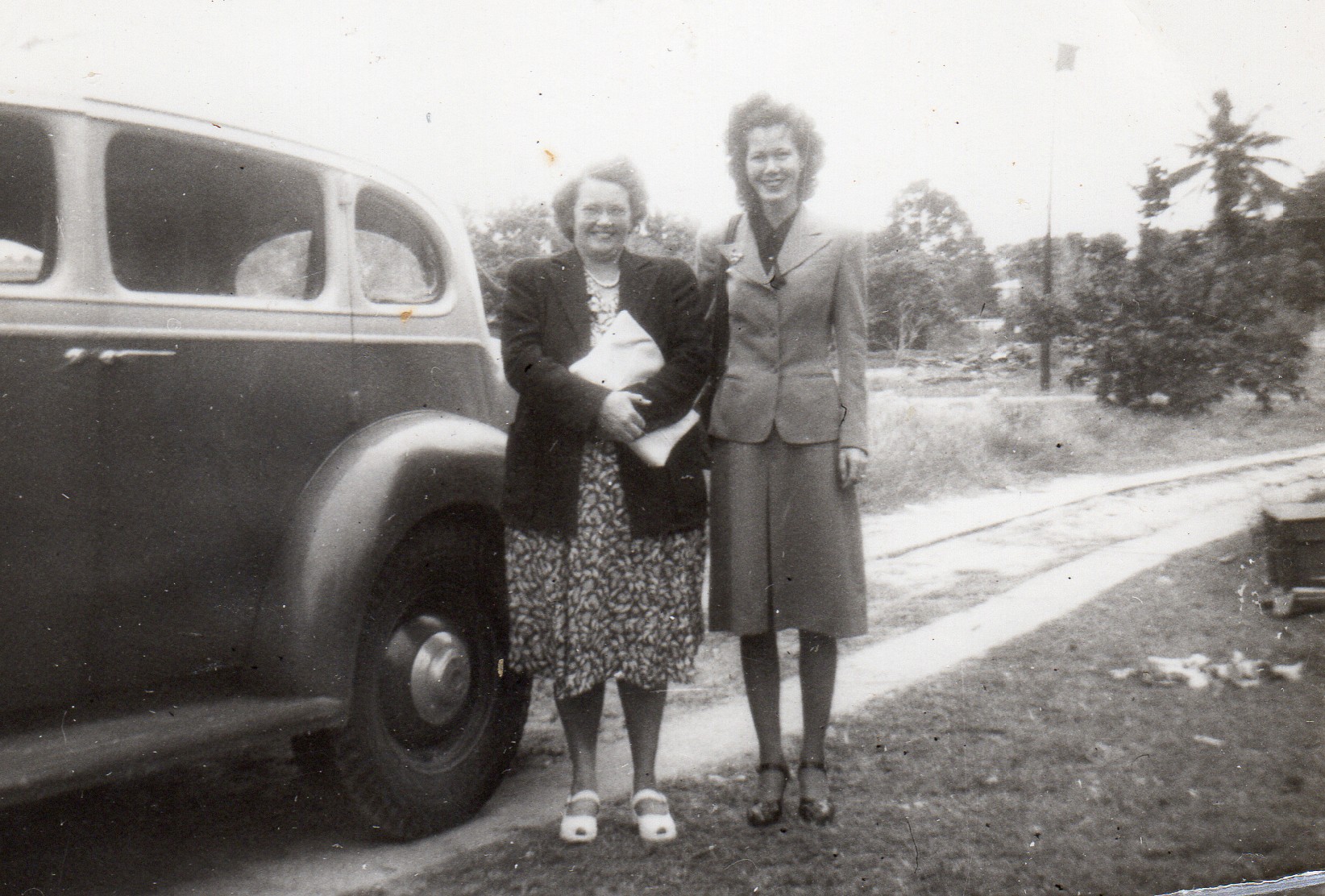
Here’s a picture of my grandmother with my mother. My mother and father got married in 1945. I assume this photo was taken before I was born in 1951.
1953 City Directory
My grandmother is listed as living at 1131 NW 55th Terrace in Miami. I would have turned two that year. I remember visiting her in the mid-1950s, in a small house. This could have been it. Evidently, she was living alone by then. Here’s what it looks like from Google Maps Streetview. My memory is of a house on a corner surrounded by lots of trees looking like the two below.
I can’t find any more resources on Ancestry.com for my grandmother. She’s not in the 1950 United States Federal Census, and Ancestry.com doesn’t seem to have access to censuses from 1960 forward. Nor can I find any more city directories. I wonder if my grandmother didn’t fill out a 1950 census. She was a widow by then, and I assume her three boys had moved out.
My Memories
I mainly grew up around Miami Florida. That’s where my father’s side of the family had been living since the 1920s, or so I thought. However, my father and his father were from Nebraska, and his mother and family were from Indiana. I never knew how my father’s parents met. That’s the kind of mystery you wish pursuing genealogy would answer but doesn’t. My grandfather died before I was born, so I have no memory of him, and very few stories.
My earliest memory of my grandmother, Helen Harris, is visiting her in a tiny house in an old section of Miami. Back in the 1950s, Miami seemed mostly new housing divisions, but sometimes we’d visit older sections that were probably built in the 1920s or 1930s. I’d love to know where that house was located. This was probably mid 1950s.
My next memory of my grandmother was visiting her at an old apartment on 8th Avenue, which I believe is Flagler, and is now considered part of Little Havana. She was the manager, and this was in the late 1950s or early 1960s. The place was old. I loved roaming the old interior halls, with the ancient musky-smelling rugs, and talking to the old people living there.
Around 1959 my mother was diagnosed with TB and was sent to stay at a sanatorium in Valley Forge, Pennsylvania. My father was in the Air Force and stationed in Canada. So my grandmother moved into our house in Hollywood, Florida to care for Becky and me for about six months. I have several memories from this time. (The center picture at the top of the page is from this time.)
After that, she moved to an apartment complex on Bayshore Avenue, right on Biscayne Bay. She stayed there, I believe until she died in 1981. But I’m not positive. My father died in 1970 and my mother, sister, and I moved to Memphis, Tennessee. I only saw my grandmother a couple more times after that when I would visit Miami to see a friend. The last time was in 1978 when I got married and took my wife Susan to meet her.
Most of the other memories I have of Helen Harris were when she came to family Thanksgiving and Christmas dinners. I did stay with her several times at the apartments on Flagler and Bayshore Drive.
I do have some specific memories. When my grandmother kept Becky and me in 1959, I was seven, and sometimes still wet the bed. She knew I admired her large leather-bound zip-up 3-ring notebook which she used to organize all her bills and paperwork. She told me when she came that if I didn’t wet the bed while she was there she’d give me her notebook when she left. I got that notebook. My parents should have tried bribing me earlier.
One of the most exciting memories I have of my grandmother is when I stayed with her at the apartments she was managing. I had seen the 1958 movie, A Night to Remember about the Titanic, and told her about it. She introduced me to an old lady living at the apartments who had been on the Titanic as a child. Years later, I wondered if I could track down who that lady was. I don’t remember her name.
I can’t remember too many details about my grandmother’s personality. She was jolly and I loved her. She collected glass figurines of dogs, so my sister and I always gave her a little dog figurine for her birthday or Christmas. I remember seeing her several times reading a book about the medicinal value of honey. She also talked about Edgar Cayce, the psychic. I can’t remember anything else she liked. I don’t recall her watching TV, playing music, or reading novels.
In 1965, I stayed with her at the Bayshore Drive apartments. I remember helping her clean out an apartment. I found an old tackle box which she let me keep. She didn’t see that it had a switchblade knife in it. I loved that knife and took it to school with me. I never told any grownups about it. I use the tackle to fish off the sea wall. While I was staying with her I would gather coconuts and unhusk them. I sold a dozen coconuts to a vegetable stand in Homestead for 50 cents each.
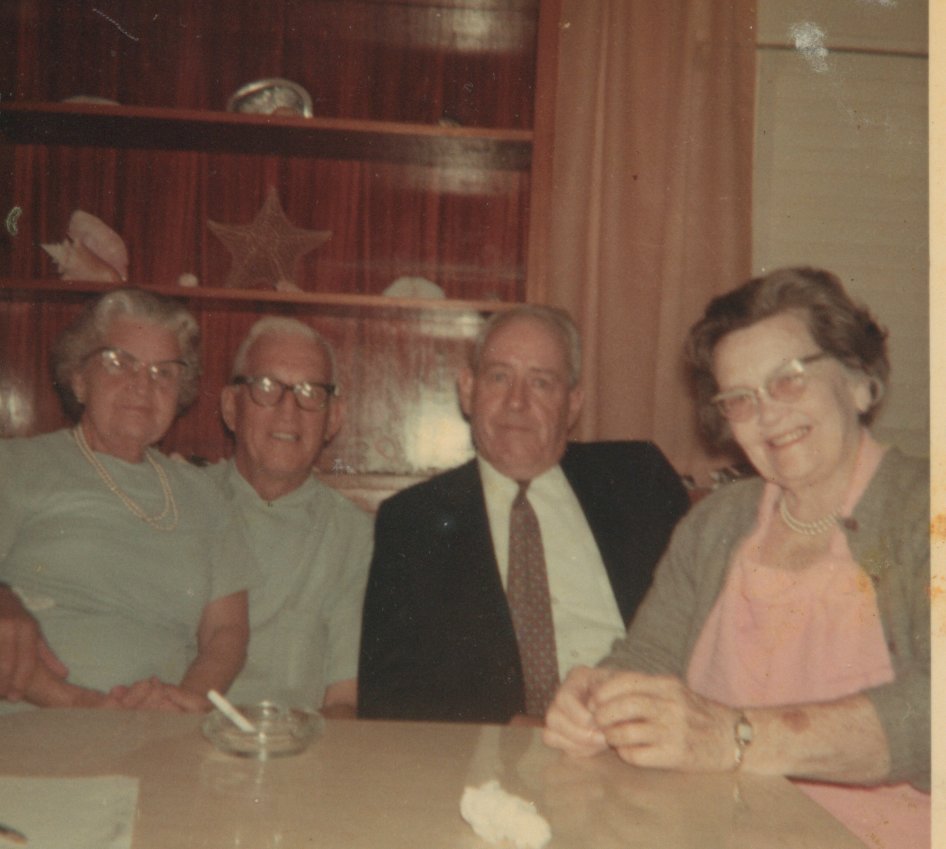
I remember she had friends named John and Alice. I believe we rented their house for a couple months in 1958 before we moved into our house in Hollywood, Florida. I think this might be Alice and John on the left, but I’m not sure. The other man was named Ollie. But that’s all I know.
The next photo might be the last photo I have of my grandmother. I believe it’s with her sister Ruth but it might be Alice. It was taken at the Bayshore Drive apartments, I believe in the 1970s. The last time I visited my grandmother was in 1978. I had just married Susan and we had gone down to Miami so I could introduce her to my grandmother.
Helen Harris died in 1981. I regret not calling or writing her more. If I had known I would one day be writing this essay I would have asked her a lot more questions. And I would have saved more documentation.
The faithful believe they will be reunited in heaven with their loved ones. That would be nice, but I’m not a believer. We’re often told that those who pass will live as long as someone remembers them. Helen Harris might be down to three people who remember her, maybe four. If by chance you do, leave a comment. I might have hordes of unknown relatives that remember her.
One last memory. Once my grandmother told me about her high school class. It was small. I want to say thirty people. She said they had agreed to a tontine, and the last person living would get some object I’ve now forgotten. Over the years, I wonder who won the tontine. I wonder if genealogy research could lead me to her graduation class.
We leave behind very little which proves that we were once here. Eventually, it all fades away.