

by James Wallace Harris
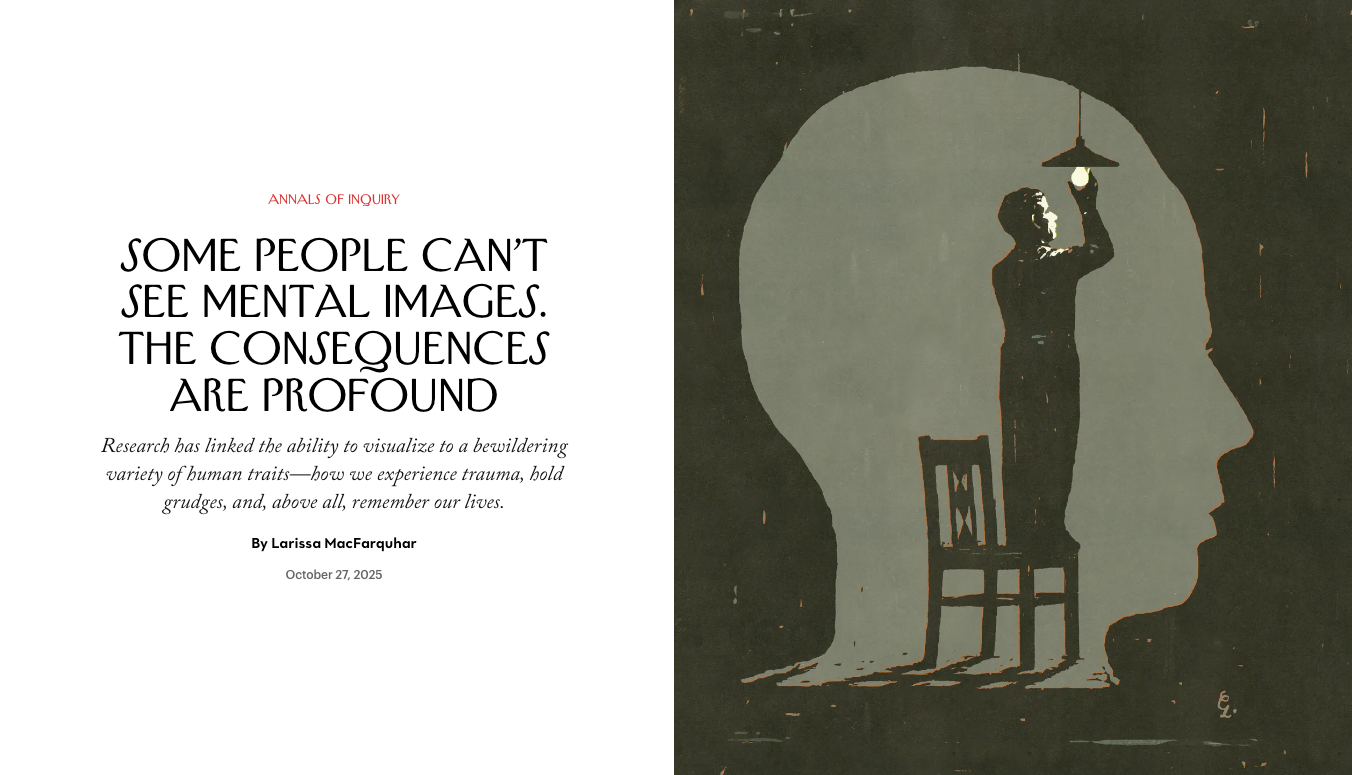
If you don’t know what aphantasia or hyperphantasia then you should read “Some People Can’t See Mental Images. The Consequences Are Profound.” by Larissa MacFarquhar in The New Yorker. Unfortunately, it’s behind a paywall, so I’m going to reiterate the high points to encourage you to find a copy. I highly recommend subscribing to the magazine or Apple News+.
The article is about a condition called aphantasia, one that I have. I wrote about that when I first discovered it in 2016. This new article by MacFarquhar describes the condition and its discovery in much greater depth than I have previously read. It also describes the opposite of this condition, hyperphantasia.
If you don’t know what aphantasia and hyperphantasia are, then you need to read this article if you have a certain kind of mindset such as artist or scientist, have trouble remembering the past, have difficulty recognizing faces, feel disconnected from your self, think you might be autistic, and many other personality traits that make you wonder if you’re different.
Aphantasia is the inability to remember mental images. Most people can close their eyes and recall a scene from their life. The face of a loved one, their desktop at work, the home they lived in as a child. About 2-3 percent of people can’t. But it turns out there all many degrees of not being able to see mental images, including some people who are overwhelmed with mental imagery. That condition is called hyperphantasia.
This article taught me a great deal about this condition I didn’t know. From my previous readings, I simplistically thought aphantasia meant one thing, but it’s not. For many people with the condition, they can’t remember their own past. I can. In fact, I’m obsessed with my past. I was particularly impressed what aphantasia did to artists and scientists.
I’m not like the extreme members of The Aphantasia Network or the people interviewed in the book Aphantasia: Experiences, Perceptions, and Insights by Alan Kendle. That’s comforting, but I still miss mental memories. Yet, I’m lucky. Some people have aphantasia so severe they can’t remember anything about their past, and they feel like living corpses.
For most of my life, I assumed everyone perceived reality pretty much the same if all their sense organs were healthy. Of course, I knew some people had better sight or hearing than others, but I assumed what we perceive was the same reality. That’s because I naively thought we observed reality directly.
I now know we don’t. Our senses are used to construct a model of reality inside our heads. And we all model reality differently. This is called our Umwelt. I highly recommend reading An Immense World by Ed Yong if you want to learn more about that.
MacFarquhar’s article explores how the ability to recall mental images affects our personality, memory, sense of self, and our Umwelt. When I first learned that I lacked the common ability to consciously recall mental images, I felt deprived. Some call it mental blindness. MacFarquhar suggests I would be a different person if I had what I missed. More than that, aphantasia affects people in various ways, and I could have been very different in other ways.
MacFarquhar begins her article by profiling Nick Wakins. He thought he was normal, but couldn’t understand why other people could remember their past and he couldn’t. He abstractly knew about his earlier life from what people told him and photographs. He started researching his condition and discovered that some 19th century scientists had discovered people like him. Then in the 1970s, psychologists again explored visual memory, but it didn’t go far.
In 2010 Adam Zeman and colleagues published research in Neuropsychologie about “blind imagination.” The journalist Carl Zimmer wrote an article for Discover magazine. That caused dozens of people recognizing the condition in themselves to contact Zeman. Zeman coined the term aphantasia with the help of a friend, and published “Lives without imagery–Cogential aphantasia” in Cortex in 2015.
That inspired an article in The New York Times and Zeman got around seventeen thousand emails. It was around this time that I heard about it and wrote my blog piece.
Zeman was now hearing about many related conditions that people claiming to have aphantasia experience. Since 2015 a tremendous wealth of research has gone into this topic, information I didn’t know about. Larissa MacFarquhar does a fantastic job of catching me up.
This article is as exciting as anything Oliver Sacks wrote about. He also had aphantasia. And it’s more than just visual memories. It also relates to being remember sound, smells, tastes, and touches.
We all peceive the world tremendously different.
Nick Wakins thought he was absolutely normal until he uncovered this research. Nick has a PhD. He didn’t know what he was missing until he researched how other people peceived. We seldom compare notes like that.
Melinda Utal had an extreme case of no past memory that is very sad:
One of Kendle’s interviewees was Melinda Utal, a hypnotherapist and a freelance writer from California. She had trouble recognizing people, including people she knew pretty well, so she tended to avoid social situations where she might hurt someone’s feelings. When she first discovered that she was aphantasic, she called her father, who was in the early stages of Alzheimer’s disease and living in a nursing home in Oregon. He had been a musician in big bands—he had toured with Bob Hope and played with Les Brown and his Band of Renown. She asked him whether he could imagine a scene in his head, and he said, Of course. I can imagine going into a concert hall. I see the wood on the walls, I see the seats, I know I’m going to sit at the back, because that’s where you get the best sound. I can see the orchestra playing a symphony, I can hear all the different instruments, and I can stop it and go backward to wherever I want it to start up and hear it again. She explained to her father what aphantasia was, how she couldn’t see images in her mind, or hear music, either. On the phone, her father started to cry. He said, But, Melinda, that’s what makes us human.
Melinda had an extremely bad memory for her life, even for an aphantasic. She once had herself checked for dementia, but the doctor found nothing wrong. She had become aware when she was in second grade that she had a bad memory, after a friend pointed it out. In an effort to hold on to her memories, she started keeping a journal in elementary school, recording what she did almost every single day, and continued this practice for decades. When, in her sixties, she got divorced and moved into an apartment by herself, she thought it would be a good time to look through her journals and revisit her younger days. She opened one and began to sob because, to her horror, the words she had written meant nothing to her. The journals were useless. She read about things she had done and it was as though they had happened to someone else.
MacFarquhar profiles many people for her long article, but I was particularly taken by two artists she interviewed. Sheri Paisley had aphantasia:
Among the e-mails that Zeman received, there were, to his surprise, several from aphantasic professional artists. One of these was Sheri Paisley (at the time, Sheri Bakes), a painter in her forties who lived in Vancouver. When Sheri was young, she’d had imagery so vivid that she sometimes had difficulty distinguishing it from what was real. She painted intricate likenesses of people and animals; portraiture attracted her because she was interested in psychology. Then, when she was twenty-nine, she had a stroke, and lost her imagery altogether.
To her, the loss of imagery was a catastrophe. She felt as though her mind were a library that had burned down. She no longer saw herself as a person. Gradually, as she recovered from her stroke, she made her way back to painting, working very slowly. She switched from acrylic paints to oils because acrylics dried too fast. She found that her art had drastically changed. She no longer wanted to paint figuratively; she painted abstractions that looked like galaxies seen through a space telescope. She lost interest in psychology—she wanted to connect to the foundations of the universe.
On the other hand, Clare Dudeney had hyperphantasia.
In talking to a friend of hers, an aphantasic painter who was one of Zeman’s research subjects, Clare had realized that she was the opposite—hyperphantasic. Her imagery was extraordinarily vivid. There was always so much going on inside her head, her mind skittering and careening about, that it was difficult to focus on what or who was actually in front of her. There were so many pictures and flashes of memory, and glimpses of things she thought were memory but wasn’t sure, and scenarios real and imaginary, and schemes and speculations and notions and plans, a relentless flood of images and ideas continuously coursing through her mind. It was hard to get to sleep.
At one point, in an effort to slow the flood, she tried meditation. She went on a ten-day silent retreat, but she disliked it so much—too many rules, getting up far too early—that she rebelled. While sitting in a room with no pictures or stimulation of any kind, supposedly meditating, she decided to watch the first Harry Potter movie in her head. She wasn’t able to recall all two hours of it, but watching what she remembered lasted for forty-five minutes. Then she did the same with the other seven films.
An interesting aspect of new research is showing that some people have aphantasia since birth, but others acquire it later in life, often due to a physical injury. Other reseach suggests that visual memory is better in children and women, and that many children might have hyperphantasia. I believe I did see mental images when I was young. And other studies suggest that taking drugs brings back the ability to create mental imagery. I can testify to that. I used to get great flashes of imagery when I got high. Other studies show that people repress the ability to create mental imagery because of psychological trauma. All of this makes me wonder if I could retrain myself to create mental pictures in my head.
It is quite common for people with aphantasia to dream with vivid imagery, although others claim their dreams are thin and dark. As I’ve gotten older, my dreams have become dark and shadowy. However, the other night I had a dream that was intensely vivid, bright, and colorful. I was even aware in the dream to a slight degree. I said to myself that I was in a dream and I couldn’t believe it was so damn real. It felt so real that I was afraid I couldn’t get back to my old life. I was on a street looking at buildings I didn’t know, and was worried that if I became stuck in the dream I wouldn’t know where to go. I was quite relieved to wake up.
Scientists who are very good at thinking abstractly often forget how to create mental imagery. And some even theorize that spending so much time reading and staring at words have ruined our capacity to create mental pictures.
At first I envied people with hyperphantasia until I read this:
Hyperphantasia often seemed to function as an emotional amplifier in mental illness—heightening hypomania, worsening depression, causing intrusive traumatic imagery in P.T.S.D. to be more realistic and disturbing. Reshanne Reeder, a neuroscientist at the University of Liverpool, began interviewing hyperphantasics in 2021 and found that many of them had a fantasy world that they could enter at will. But they were also prone to what she called maladaptive daydreaming. They might become so absorbed while on a walk that they would wander, not noticing their surroundings, and get lost. It was difficult for them to control their imaginations: once they pictured something, it was hard to get rid of it. It was so easy for hyperphantasics to imagine scenes as lifelike as reality that they could later become unsure what had actually happened and what had not.
I believe I’ve copied as much of this article as I ethically should.
I’m using this blog to encourage you to go read the article. I’m also encourage people to subscribe to magazines. If you want good information it costs. We need to get away from always assume information should be free. Free information on the web is corrupting our society. Subscribing to magazines supports the spread of better information.
My new effort at home schooling myself is to read one great article a day from magazines with solid editors. I look for articles that expand my mental map of the world. This one certainly has.
JWH
 Auxiliary Memory