STONE YARD DEVOTIONAL by Charlotte Wood

by James Wallace Harris, 4/12/25

Stone Yard Devotional is about how reality puts the peddle to the metal when life gets all too real. Stone Yard Devotional reads like a memoir, a diary, but it’s classified as a novel. The book was nominated for several awards.

The entire time I was listening to this book I wondered if Charlotte Wood was the unnamed narrator, however after reading “‘The shock was so deep’: Novelist Charlotte Wood on the experience that changed everything” in the Syndney Herald, I realized the novel was only inspired by her own life. Wood and her two sisters were being treated for breast cancer, while she was contemplating mortality and drafting this book.

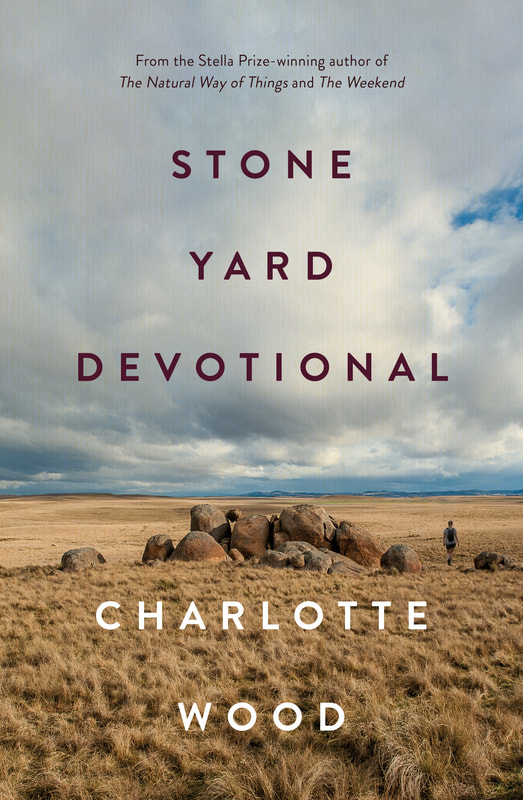
I have no memory of how I discovered Stone Yard Devotional by Charlotte Wood. The cover and title intrigued me for sure. Maybe it was because it was shortlisted for the 2024 Booker Prize. The audiobook was part of my Spotify subscription, so I gave it a try, and I’m glad I did. It’s not the kind of book I normally read, but it’s wonderful to read if you’re getting old.

The story begins with the Covid pandemic. The narrator separates from her husband, ghosts her friends, and hides out in a guest house of a religious order, even though she is nonreligious. She wants to be alone. But after her initial stay, she returns to the order to live with the nuns. I was never sure if she joined the order or not. I have often thought the monastic life has certain appeals.

The story is about the narrator’s observations while living a contemplative life. These include the death of her mother, the remembrance of childhood, studying the nuns, working in the garden and kitchen, and the guilt of living with a woman she and her classmates horribly bullied as a child. The narrative is simple, like meditation.

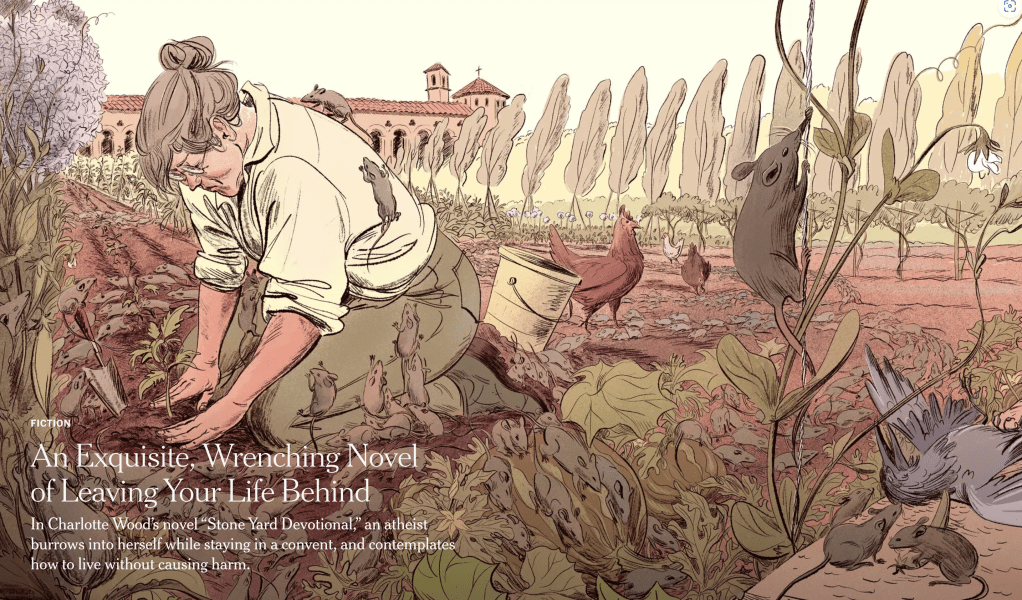
The setting is Australia, which is exotic to me. As a kid I wanted to live in Australia. Over the course of the novel, there is a plague of mice that invade the convent. The mice are so numerous that they cover the roads in gray fur. At first, I thought Wood added this element to give her tale some excitement, but I researched and found that her part of Australia they did have a mice plague of Biblical proportions in 2021.

That made life in the convent extremely inconvenient. The mice ate electrical insulation, throwing daily living in the convent back to the 19th century. The illustration for the book’s review at The New York Times might have been another reason I read this book.

Much of what the unnamed narrator contemplates throughout the novel is what everyone thinks about as they get older. The fear of declining health and death, the regrets, the desires for wanting to have done things different, the desires to connect with others while also wanting to pull away, the changes we see in ourselves and others, the appeal of nature and living simple. Wood’s story explores all of that and more, triggering the reader to think about their lives.

Charlotte Wood was born in 1965, so she’s fourteen years younger than me. However, her battle with cancer has likely aged her perception on life. At 73, I’ve been thinking about the things in this novel for years. But I don’t know if everyone who collects social security meditates on these issues. Stone Yard Devotional is a great title for this novel. Even though the narrator said she was an atheist at the beginning of this story, getting old and dealing with people who die, pushes you to be spiritual even without a belief in God.

JWH

The Limits of Memory

by James Wallace Harris, 3/3/25

It annoys me more and more that I can’t recall names and nouns. I don’t worry yet that it’s dementia because most of my friends have the same problem. But I’ve been thinking about my ability to remember and realized that I’ve never been good at remembering things.

I know I have aphantasia, which means I can’t visualize mental images in my head. I wonder if there’s a connection between not visualizing images and poor memory? People with astounding memory often use mental images as mnemonics.

The ability to remember is on a spectrum. On one end of this range, are rare individuals with photographic memories, while at the other end, are a tiny group with no short-term memories.

My new theory. One possible reason I have poor memory is my education. More precisely, how my personality approached learning as a kid. I considered K-12 a thirteen-year prison sentence. I paid just enough attention to pass tests. I mostly got Cs and Bs, with a rare A and D. I remembered things just long enough to pass a test.

I was never motivated to remember for the long haul.

I do like to learn. I’ve read thousands of books. Of course, most of them have been science fiction, but I also love nonfiction. However, information leaves me as fast as I consume it.

I’m starting to wonder if I would have a better memory if I had developed a different approach to school and learning. Primary and secondary education aim to give kids a well-rounded education. And in college, over half the courses are required.

The idea is we should learn as much as possible about the world. Is that a valid approach? After school and college, we specialize in whatever our work requires, and become selective about what we study for fun. Those subjects are what we remember best.

Reality is too big to know everything. What we need to learn is how to coexist with reality. We need the knowledge to fit in and survive. Would knowing more about fewer subjects help? Or would memorizing the deep dynamics of how things work better yet?

I do believe the more we know, the wiser we are. But there are limits to what we can understand and memorize.

I’m currently reading Nexus by Yuval Noah Harari. In chapter 2, Harari shows how fiction drives our societies, not truth. We live by stories we want to believe. It’s much easier to vaguely understand fiction than to learn the details of reality. For example, more people accept The Bible than biology. That suggests a natural tendency to minimize how much we know.

That would be okay if the Earth were sparsely populated. But we live in dense, complex societies racing at the speed of computer networks and artificial intelligence. Living by fiction is fine if the year is 500 BCE, but we live in 2025. CE.

Let me give one example of what I mean by learning less to know more. I’ve been reading American history books to understand how our society got to now. That gives me a certain level of wisdom about our problems. However, I’m also reading about French history, especially the French Revolution and 19th century history. Seeing the parallels ups my level of understanding. But do I need to read the history of every country now and then? What I see is common dynamics. Reading more histories will give me more examples of the same dynamics.

The same is true of religion. I like studying the history of the Bible. I’ve also studied Buddhism and Hinduism. As I do, I see common dynamics at work. Harari’s new book Nexus points out the common dynamics of society and history.

The educational philosophy I experienced growing up pushed me to memorize a million details. What I needed to understand and remember is the fewer dynamics of reality.

People like to live by fiction because it’s easier. Politics is currently overwhelmed by fiction. Read Nexus to understand why I say that. The question we have to answer is if we can reject fiction.

Real information is seeing patterns in reality. Wisdom is seeing patterns in the patterns. The only real cognitive tool we’ve ever developed to understand reality is science. However, it’s statistical, and hard to learn and understand. We live in a time of simplex thinking. People see or are told about one pattern and they accept that as a complete explanation of reality. All too often, that pattern is based on a cherished story.

We can’t live by memes alone. Nor can we live by infinite piles of memorized details. The only way to understand is to observe consistent patterns. But it has to be more than two or three. That can lead to delusions. Even anecdotal evidence of ten occurrences could still deceive. How can this lead to learning more from less? It’s a paradox.

Last year, I read a three-volume world history. It provided hundreds of examples of strong man rule over thousands. of years. But how many kids, or citizens can we get to read a three-volume world history? Would a listing of these leaders, including the wars they started, and the numbers of people who died because of their leadership be just as effective? Would all the common traits they shared help too? Such as wanting to acquire more territory, or appeals to nationalism?

Could we create a better educational system with infographics and statistics? I don’t know. I do know I tried to process too much information. I also know that I only vaguely remember things. Memory has limits. As does wisdom.

JWH

MY BRILLIANT FRIEND by Elena Ferrante

by James Wallace Harris, 10/19/24

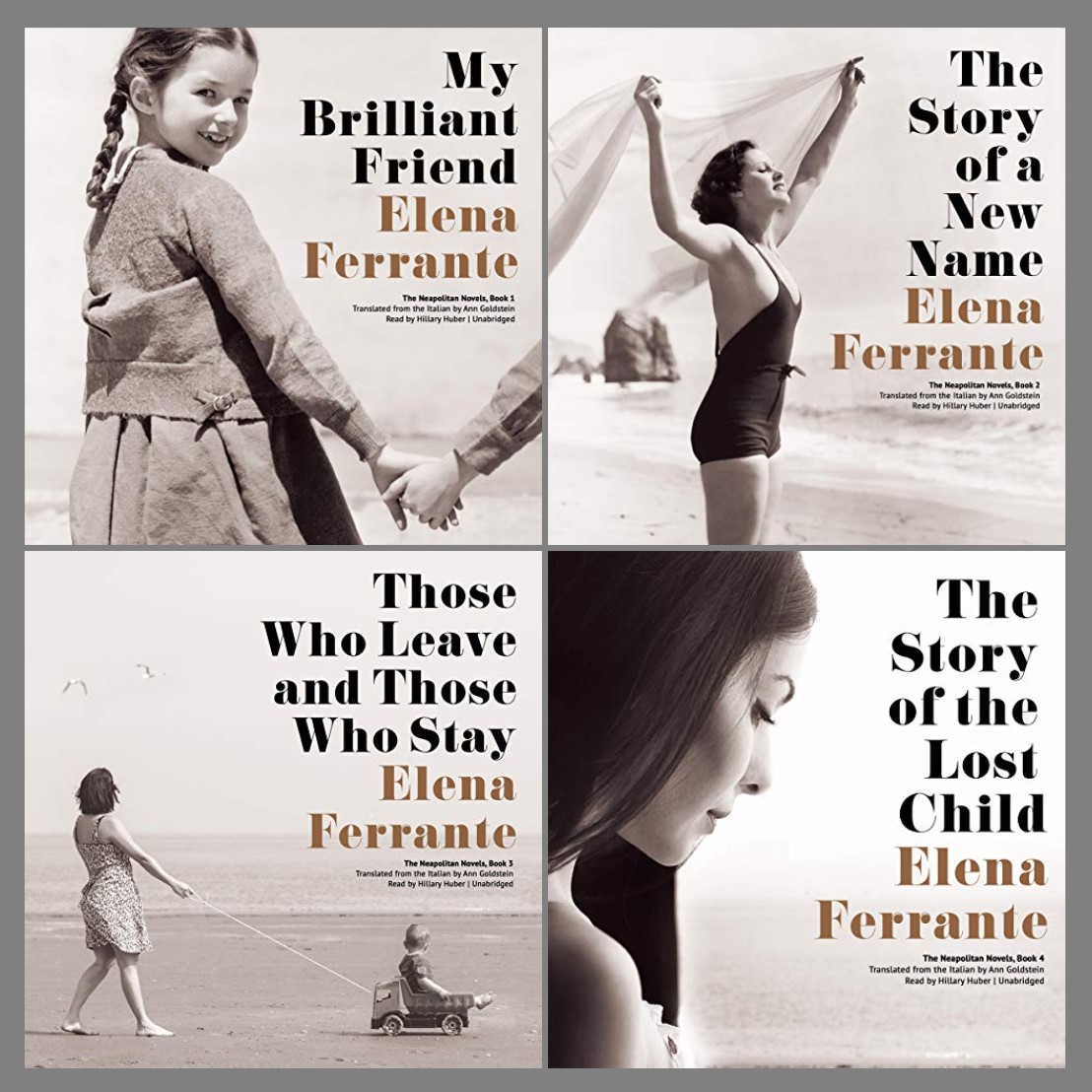
Technically, My Brilliant Friend by Elena Ferrante is the first novel in a four-volume sequence that is collectively referred to as the Neapolitan Novels. Now that I’ve read all four books, I dislike that tagline for the whole story. The four books are really one whole novel, and even though Naples, Italy is very important to the story, it doesn’t properly describe the complete novel. Each volume picks up exactly where the last one stops. If they were published in one volume with no subdivisions, you wouldn’t notice any transitions.

For this review, I’m going to refer to the whole as My Brilliant Friend, and when needed, I’ll point to the individual titles as part of the story. The structure below uses the dates for the English translation. The books were originally published in Italian one year earlier.

  1. My Brilliant Friend (2012)
    • Prologue: Eliminating All the Traces
    • Childhood: The Story of Don Achille
    • Adolescence: The Story of the Shoes
  2. The Story of a New Name (2013)
  3. Those Who Leave and Those Who Stay (2014)
    • Middle Time
  4. The Story of the Lost Child (2015)
    • Maturity
    • Old Age: The Story of Bad Blood
    • Epilogue: Restitution

Circular Plot and Recursion

The complete story begins where it ends. And throughout this long story, it constantly refers to itself. It’s so recursive that it feels like two mirrors aimed at each other. It’s also cyclical because it’s about daughters and their mothers, who eventually become mothers of daughters. In so many ways, this story mirrors its parts.

The novel is about two women, Elena Greco and Raffaella Cerullo, who call each other Lenù and Lila. The story feels like an autobiography, and we have to remember that the author’s name is Elena too. Elena Ferrante hides behind a pseudonym, but this novel feels very autobiographical. Lenù and Lila react and respond to each other so intensely that it’s hard to tell who originates what traits. I even imagined that Elena Greco is writing about two versions of her own identity, the one who writes books, and her ordinary self. And it’s interesting that Ferrante hides behind her pseudonym, claiming she wants to remain anonymous while Lila also wants to remain anonymous throughout the story. So many reflections.

Literary Novels

I’ve always thought the greatest of literary novels feel biographical or autobiographical. They don’t need to be about real people, but they do need to feel like they are, and this novel offers two realistic portraits. Another trait of great literary novel is setting. We often think of London when we think of Dickens, or Russia when we think of Tolstoy, or Ireland when we think of Joyce. Ferrante has made her book about Naples and Italy.

If you’ve only read the first volume, My Brilliant Friend, you should tell yourself that you never finished the novel. The Neapolitan Novels boxed set runs 1,965 pages. On audio the four books run 78 hours and 52 minutes. To give perspective, War and Peace by Leo Tolstoy averages about 60 hours in the various audio editions. Different translations of The Bible run 82-102 hours. The seven volumes of Proust’s Remembrance of Things Past runs 154 hours and 14 minutes. In other words, the whole My Brilliant Friend is a literary heavyweight.

Most novels that come out in a series are never artistically heavier than a single volume. That’s why when I finished reading the single volume entitled My Brilliant Friend, I couldn’t understand why the writers polled by The New York Times considered it the top book of the 21st century so far. It was good, but not that good. That’s because it’s only one-fourth of a whole. Now that I’ve read all four volumes, I can easily see why it was voted the top novel of this century.

Will it Become a Classic?

Whenever I read a highly respective modern novel I’ve wondered if it will someday be considered a classic. I’ve never felt sure about any modern novel to predict one before. However, for the whole of My Brilliant Friend I felt like it was at least an equal to Anna Karenina by Leo Tolstoy. That novel only runs 36-40 hours in audio, so it’s about half the size of the full version of My Brillian Friend. The Ferrante novel is far more ambitious, at least in being a biography of two women, so maybe it needs twice the space that Tolstoy used to tell us about Anna Karenina. However, Anna is never developed in such detail like Lenù and Lila.

We follow Lenù and Lila from being little girls to old women, and that makes a huge difference in storytelling ambition. This novel is primarily about friendship, even though it says almost as much about kinship. Men do not come across well in this story. This novel is feminist at a visceral level. I’d also say this book is an anti-chemistry book in the sexual sense. Time and time again, hormones overwhelm Lenù and Lila into making bad life-changing decisions. The great loves of their lives are the same evil Mr. Right. Nino Sarratore is no Mr. Darcy. Ferrante makes Nino one of the detestable bad guys of literary history. I can’t believe that Lenù and Lila didn’t immediately recognize that he was a clone of his father, Donato, the slimy seducer they knew from childhood.

The Prose

It’s hard to judge the writing of a translated novel. I do know that Ann Goldstein’s translation of Ferrante’s Italian prose is clear and precise, and the writing comes across as vivid and impactful, but the style is plain and unadorned. It lacks the colorful authorial voice of two recent novels where the prose enchanted me, A Gentleman in Moscow by Amor Towles and Lessons in Chemistry by Bonnie Garmus. Nor does it have any the wonderful authorial commentary like old literary writers Dickens or Tolstoy since Ferrante’s story is told in the first person.

A lot of modern bestsellers have the highly refined writing style taught by MFA programs. Readability and clarity are valued over wordy digressions and colorations. This is one reason why I have a hard time predicting if a novel will become a classic a century from now. The classics we’ve crowned from the 19th century all have distinctive writer’s voices. Ferrante’s voice comes across through the characterizations of Lenù and Lila, and it’s confusing to distinguish Elena the author’s voice from Elena the character.

Final Judgment

I liked this story tremendously. It may have ruined me for reading lesser novels, especially for reading science fiction, which seldom achieves any kind of deep character development. The whole story of My Brilliant Friend reminds me of two other multi-novel sequences about characters as they age.

The first is A Dance to the Music of Time, a twelve-volume series by Anthony Powell which he wrote from 1951 to 1975 using his own life and friends for inspiration. I reviewed them here, here, and here.

And the other are books by Elizabeth Strout. Collectively, they follow the growth of two women too, Lucy Barton and Olive Kitteridge. I’ve reviewed them here.

This first reading of the entire My Brilliant Friend story will not be enough to truly appreciate this novel. Even though it’s told in a straightforward manner, it is quite complex in what it has to say. I listened to the books this time. Next time I’ll read them with my eyes. Luckily, I have a one-volume Kindle edition that includes all four books.

Ferrante made me think about my life as a whole. She also makes me think about aging. And she has quite a lot to say about the relationship between men and women. Her novel might be the perfect illustration as to why we don’t have free will. Whether or not it becomes a classic in future centuries, it is worth reading and contemplating now. It gives us lot to meditate on.

JWH

So Many Books, Too Little Time

My motto should be:  “ Quot Libros, Quam Breve Tempus” or so many books, so little time.

My patron saint is Henry Bemis.

henry-bemis

In case you don’t know Henry Bemis, he was played by Burgess Meredith in a very famous episode of Twilight Zone, “Time Enough at Last” about a super-bookworm, Henry Bemis.  Henry was a bank clerk who never could find enough time to read, until the world came to an end.

I never can find enough time to read either.  It’s a life of quiet desperation for words.   I have more unread books on my shelves than I will be able to read if I lived to be 100.  I also have a book buying addiction – I buy 7-10 books for every one I read.  I’ve always rationalized I will read them someday, but at 60, I know that’s not true.

I had an epiphany the other day.  I was flipping through some free books I had picked up and it dawned on me that I will never run out of something to read, even if I didn’t own a single book.  I have access to so many free or cheap books, that owning books doesn’t matter anymore.  I even pictured myself finishing a book and just leaving it where someone else could find it, and then stumbling onto my next read.  There’s a service for leaving books for other people to find called Book Crossing.

There’s also a movement called Little Free Libraries, where people build tiny waterproof libraries to give away books.  They put them in public places, or in front of their homes, with a sign “Take a book, leave a book.”  I wonder if I built a little free library box for my yard, would there always be a book in it I’d want to read when I finished my current book?

little-free-library-3

Where I work we’ve had a free book table for years.  I always find something to read there.  Today I snagged The Victorians by A. N. Wilson, and Us and Them: Understanding Your Tribal Mind by David Berreby.  Yesterday my friend Ted handed me Fooled by Randomness by Nassim Nicholas Taleb.  Before that I brought home The Closing of the Western Mind by Charles Freeman.  Don’t be too impressed, I doubt I’ll actually read them, but like Henry Bemis I dream of the day when I could.  Ted is giving away hundreds of books.  Over the years so have I.

I’ve also rediscovered libraries, and my main library now has a used bookstore as part of the library.  So there’s a library book sale every day except Sunday.  It’s classic section always has at least one book I’ve always wanted to read.  Last Saturday I came home with five such books, for about $9.

And even if I couldn’t find a free book, there’s never been a time I’ve walked into a bookstore and not found a book I wanted to read.

This makes me wonder why I hoard books.  Generally I don’t read books off my bookshelves because I’m always hearing about a new book I want to read.  Serendipity always selects my next read, so why should I bother gathering books to somehow plan my future reading?

Well, it’s an addiction.  Not a bad one.  I don’t have to steal to keep up my habit.  The worse aspect about it is my house fills up with books and I have to decide which ones to give away.  That’s what I’m doing this week.  So far I’ve brought five cloth bags of books to the free book table at work.  The fall classes start this week and they will disappear quickly.

Another source of books is friends.  I know enough bookworms telling me about great books that I could mooch off of them for the rest of my life.

There’s also an Internet service called BookMooch.  You list books you want to give away by mail and people contact you.  You earn points towards mooching books off of other members.  I have access to so many free books that this service wouldn’t help me, but people living where books were hard to find should love it.

And just remember the new world of ebooks.  Feedbooks and Manybooks fills my Kindle and iPad with classics and public domain books.  And Books on the Knob daily reports all the great free ebooks that are available.   My library provides me with free ebooks to check out, and Amazon Prime lends me free books too.

I could reduce my bookshelves down to one volume, a Kindle, and never have to worry about finding something to read again.

I don’t think I’ll give away all my books.  I have too many I keep for sentimental reasons, but I do think I might try overcoming my book buying addition.  There’s no reason to hoard books.  Well, I can think of one reason.  If the world came to an end like in the Twilight Zone show, it would be great to have a stockpile of books to read if I was a sole survivor.

JWH – 8/21/12

Has Reading With My Ears Ruined My Desire To Read With My Eyes?

I have hundreds of unread books sitting on my shelves wagging their tales anxious to be read, but of the 28 books I “read” so far this year, only one was read with my eyes.  And that one, Marsbound by Joe Haldeman, was read as a magazine serial.  Had it been available on audio at the time, like it is now, I wouldn’t have read any printed books this year.  Of the 39 books I read last year, only two were printed.  Before I discovered audio books on digital players through Audible.com in 2002, I read on average 6-12 books a year.  After digital audio, I’m reading 35-55 books each year.

I read more audio books now because, one, I can multitask reading with walking, driving, doing the dishes, eating alone, and other quiet mindless activities.  Second, I listen to more books than I read because I’m enjoying them more.  When I was kid I was a real bookworm, often reading a book a day for weeks at a time.  I discovered a lot of fun books back then, but I have since reread some of those books on audio and discovered I missed a lot from reading too fast and poorly.  Third, audio books got me out of my science fiction rut and into a wider range of literature because listening gives me the patience to read books with my ears that I would never take the time to read with my eyes.  Fourth, and this is the most important, I think I experience books better through audio because I’ve discovered I’m not a very good reader, and the quality of audio book narrators have constantly improved in recent years and I flat out prefer listening to a great reader than doing a botched up job myself.

Now, the the question is:  Has reading with my ears destroyed my desire to read with my eyes?  When the seventh Harry Potter book came out last year I raced through it like everyone else, so I know I can still enjoy eyeball reading, but the whole time I wished I had waited for the audio edition to arrive from Amazon. 

To force myself to read a book with my eyes, I bought Incandescence, a new novel by Greg Egan.  I was in the mood for some cutting edge science fiction and it wasn’t available on audio.  And, I am enjoying reading it.  I read slower than I used to – that’s something listening has taught me.  But as I go through the sentences I can’t help but think this book would sparkle far greater if I was hearing it read by a fine reader.

So, have audio books become a crutch?  Or have I just discovered a better way of experiencing books and have become addicted?  If EMP killed off all the iPods in the world I think I’d want to try and recreate audio books in the old fashion way.  I’d want someone to read to me, or I’d want to learn how to read aloud and try to dramatically present stories like the narrators I love so much to hear.

Yet, if this return-to-the-19th-century catastrophe happened I might end up reading more books because all the computers and televisions would be out of commission too.  I started reading like crazy in junior high school when I outgrew Gilligan’s Island and I wanted to break away from my family unit.  I had lots of time and even though I had plenty to do, I preferred the laziness of reading.

In our society, literacy is a virtue, but being a kid gorging himself on science fiction does not confer a lot of social status.  It was plain old escapism.  If iPods and Audible had been invented in 1965 I would have grown up listening to books, and I would have listened to better books than I had been reading.

I’m currently listening to The House of Mirth by Edith Wharton.  That’s one book I would never read with my eyes, but if I had read it and The Age of Innocence at 13, I would have had a much better understanding of those scary junior high girls.  I think I’m a much better person at 56 for reading Wharton.  That wouldn’t have happened if it hadn’t been for audio books, and I was an English major during my college years.  I had a hard time reading classic novels – I kept hoping they’d assign fun modern novels, but they didn’t.  If I had gotten to hear the classics back then I would have been a much better literature student.  I know this is true because when I took three Shakespeare classes I listened to the plays on LPs and aced my exams, plus I admired the writing so much more.

Now, don’t get me wrong.  I’m not suggesting you should give up reading with your eyes.  I think many people are better than I am at reading.  I just discovered late in life, at around 50, that I was a lousy-ass reader.  When I do read now, I do try harder try to hear what I’m seeing.  That requires reading slower and thinking about the dramatic quality of the sentences in front of me.  I wish I could read like Jeff Woodman or Jim Dale, but I don’t.

Last night I pulled down several novels that I’ve been meaning to read and read a few pages from each.  I admired the writing but I realized I would never read them.  Middlemarch, Vanity Fair and Call It Sleep are just too dense for me to read with my eyes.  I brought them to work today and put them on our book give-away table.  They disappeared in a few minutes and I hope they have found good homes.

Audio books have greatly enriched my life.  I truly don’t think they have ruined my urge to read with my eyes, because that urge was already fading.  Without audio books I’d probably continue reading 6-12 books a year for the rest of my life.  Before I turned fifty I was thinking I might only read another 200 books before I died, and wondered why I owned 1,200 and was buying more all the time.  I’ve already listened to more than that planned 200, so audio books have already expanded my reading lifetime. 

My desire to “read” books is greater than any other time in my life, but strangely I’m going to stop buying books, ones printed on paper, that is, because they will sit on my shelves, unread, and I’m feeling way too guilty to add any more lonely unread pages.

Jim