I used to keep up with the world by watching NBC Nightly News with Lester Holt, reading The New York Times on my iPhone, and bingeing YouTube videos. I felt well-informed. That was an illusion.
I then switched to reading The Atlantic, New York Magazine, The New Yorker, and Harper’s Magazine. I focused on the longer articles and developed the habit of reading one significant essay a day. That has taught me how superficial my previous methods were at informing me about what’s going on around the world. Television, the internet, and newspapers were giving me soundbites, while articles provide an education.
However, I still tend to forget this deeper knowledge just as quickly. I don’t like that. I feel like I learn something significant every day. What I’m learning feels heavy and philosophical. However, it drives me nuts that I forget everything so quickly. And I’m not talking about dementia. I think we all forget quickly. Just remember how hard it was to prepare for tests back in school.
I’ve watched dozens of YouTube videos about study methods, and they all show that if you don’t put information to use, it goes away. Use it or lose it. I’ve decided to start reading with a purpose.
At first, I thought I would just save the best articles and refer to them when I wanted to remember. That didn’t work. I quickly forget where I read something. Besides, that approach doesn’t apply any reinforcing methods.
I then thought about writing a blog post for each article. It turns out it takes about a day to do that. And I still forget. I needed something simpler.
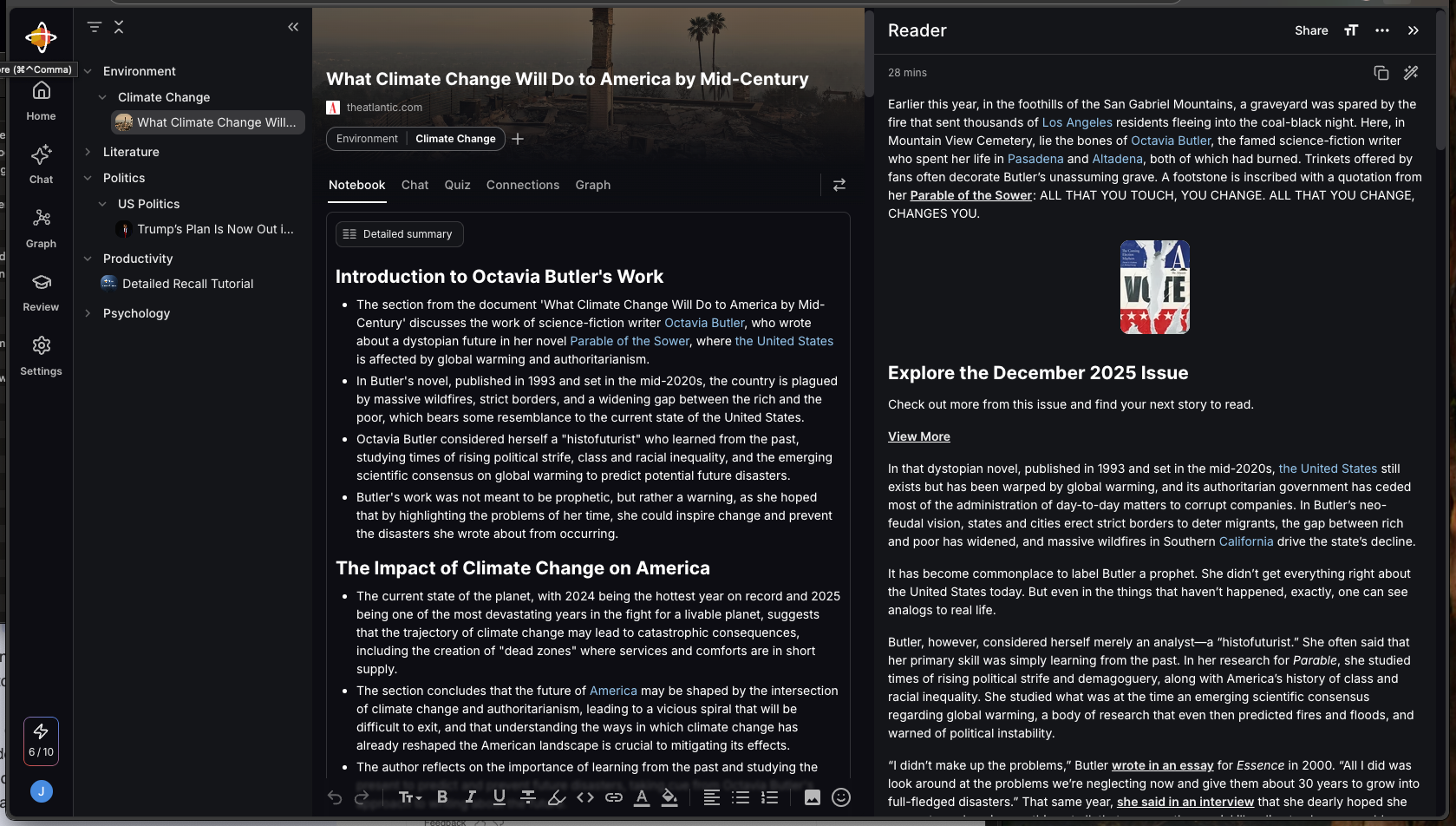
Recall allows me to save this into a structure. But again, this is a lot of work and takes a lot of time. If I were writing an essay or book, this would be a great tool for gathering research.
Recall is also great for understanding what I read. Helpful with quick rereading.
This morning, I got a new idea to try. What if I’m trying to remember too much? What if I narrowed down what I wanted to remember to something specific?
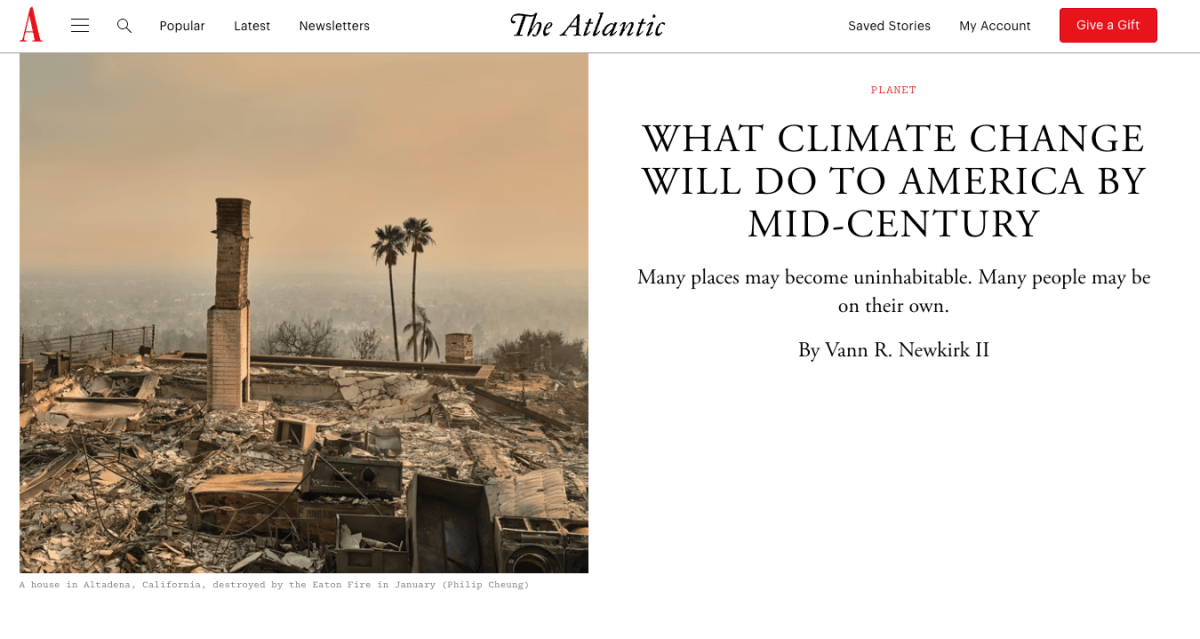
Within today’s article, the author used the term “climate gentrification” referring to neighborhoods being bought up because they were safer from climate change, and thus displacing poor people. The article mentions Liberty City, a poor neighborhood in Miami, with a slightly higher elevation, bought up by developers moving away from low-lying beachfront development.
I think I can remember that concept, climate gentrification. What if I only worked on remembering specific concepts? This got me thinking. I could collect concepts. As my collection grew, I could develop a classification system. A taxonomy of problems that humanity faces. Maybe a Dewey Decimal system of things to know.
I use a note-taking system called Obsidian. It uses hyperlinks to connect your notes, creating relationships between ideas. I could create a vault for collecting concepts. Each time I come across a new concept, I’d enter it into Obsidian, along with a citation where I found it. That might not be too much work.
I picked several phrases I want to remember and study:
Climate gentrification
Heat islands
Climate dead zones
Insurance market collapse
Climate change acceleration
Economic no-go zones
Corporate takeover of public services
Climate change inequality
Histofuturism
Sacrifice zones
Corporate feudalism
Contemplating this list made me realize that remembering where I read about each concept will take too much work. I have a browser extension, Readwell Reader, that lets me save the content of a web page. I could save every article I want to remember into a folder and then use a program to search for the concept words I remember to find them.
I just did a web search on “climate gentrification” and found it’s already in wide use. I then searched for “corporate feudalism,” and found quite a bit on it too. This suggests I’m onto something. That instead of trying to remember specifically what I read and where, I focus on specific emerging concepts.
Searching on “histofuturism” brought up another article at The Atlantic that references Octavia Butler: “How Octavia Butler Told the Future.” Today’s article by Vann R. Newkirk II is also built around Octavia Butler. This complicates my plan. It makes me want to research the evolution of the concept, which could be very time-consuming.
The point of focusing on key concepts from my reading is to give my reading purpose that will help me remember. But there might be more to it. Concepts are being identified all the time. And they spread. They really don’t become useful until they enter the vernacular. Until a majority of people use a phrase like “climate gentrification,” the reality it points to isn’t visible.
That realization reinforces my hunch to focus on concepts rather than details in my reading. Maybe reading isn’t about specific facts, but about spreading concepts?
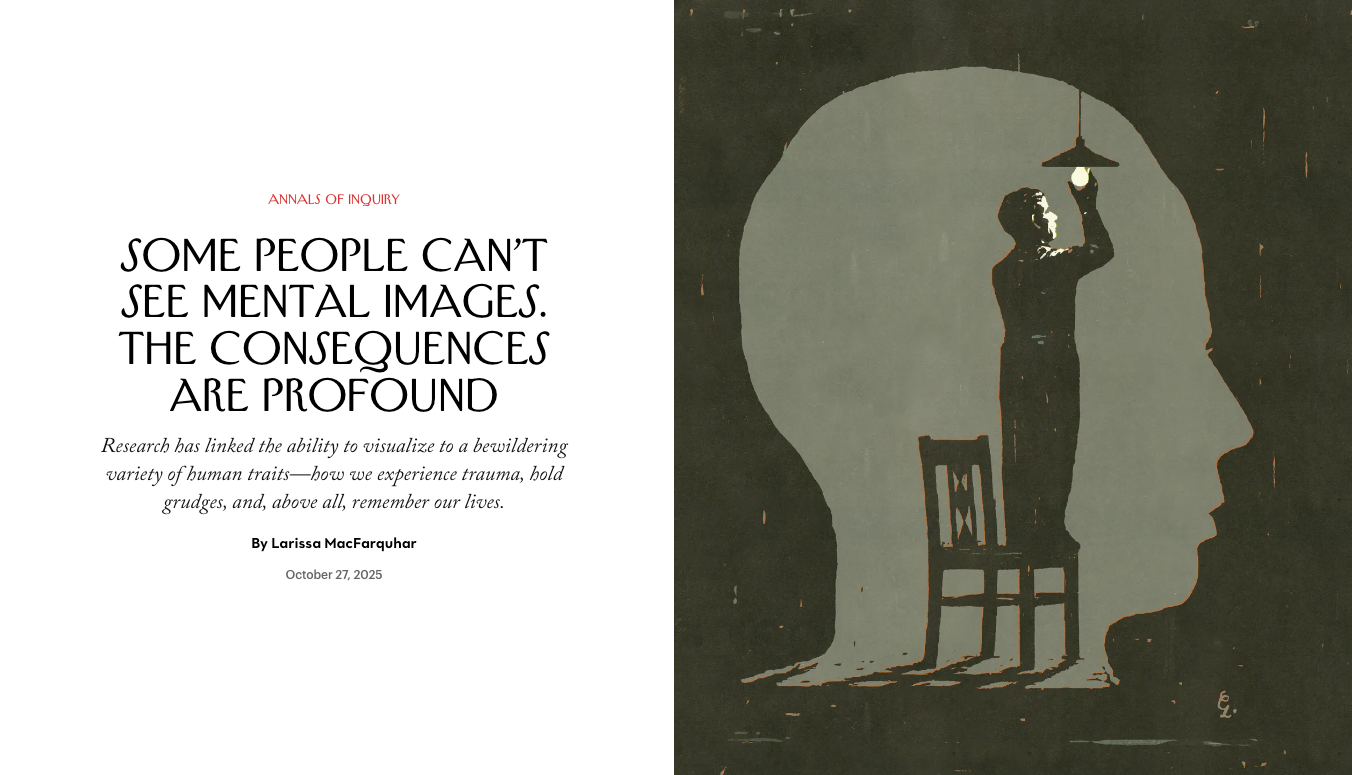
If you don’t know what aphantasia or hyperphantasia then you should read “Some People Can’t See Mental Images. The Consequences Are Profound.” by Larissa MacFarquhar in The New Yorker. Unfortunately, it’s behind a paywall, so I’m going to reiterate the high points to encourage you to find a copy. I highly recommend subscribing to the magazine or Apple News+.
The article is about a condition called aphantasia, one that I have. I wrote about that when I first discovered it in 2016. This new article by MacFarquhar describes the condition and its discovery in much greater depth than I have previously read. It also describes the opposite of this condition, hyperphantasia.
If you don’t know what aphantasia and hyperphantasia are, then you need to read this article if you have a certain kind of mindset such as artist or scientist, have trouble remembering the past, have difficulty recognizing faces, feel disconnected from your self, think you might be autistic, and many other personality traits that make you wonder if you’re different.
Aphantasia is the inability to remember mental images. Most people can close their eyes and recall a scene from their life. The face of a loved one, their desktop at work, the home they lived in as a child. About 2-3 percent of people can’t. But it turns out there all many degrees of not being able to see mental images, including some people who are overwhelmed with mental imagery. That condition is called hyperphantasia.
This article taught me a great deal about this condition I didn’t know. From my previous readings, I simplistically thought aphantasia meant one thing, but it’s not. For many people with the condition, they can’t remember their own past. I can. In fact, I’m obsessed with my past. I was particularly impressed what aphantasia did to artists and scientists.
I’m not like the extreme members of The Aphantasia Network or the people interviewed in the book Aphantasia: Experiences, Perceptions, and Insights by Alan Kendle. That’s comforting, but I still miss mental memories. Yet, I’m lucky. Some people have aphantasia so severe they can’t remember anything about their past, and they feel like living corpses.
For most of my life, I assumed everyone perceived reality pretty much the same if all their sense organs were healthy. Of course, I knew some people had better sight or hearing than others, but I assumed what we perceive was the same reality. That’s because I naively thought we observed reality directly.
I now know we don’t. Our senses are used to construct a model of reality inside our heads. And we all model reality differently. This is called our Umwelt. I highly recommend reading An Immense World by Ed Yong if you want to learn more about that.
MacFarquhar’s article explores how the ability to recall mental images affects our personality, memory, sense of self, and our Umwelt. When I first learned that I lacked the common ability to consciously recall mental images, I felt deprived. Some call it mental blindness. MacFarquhar suggests I would be a different person if I had what I missed. More than that, aphantasia affects people in various ways, and I could have been very different in other ways.
MacFarquhar begins her article by profiling Nick Wakins. He thought he was normal, but couldn’t understand why other people could remember their past and he couldn’t. He abstractly knew about his earlier life from what people told him and photographs. He started researching his condition and discovered that some 19th century scientists had discovered people like him. Then in the 1970s, psychologists again explored visual memory, but it didn’t go far.
In 2010 Adam Zeman and colleagues published research in Neuropsychologie about “blind imagination.” The journalist Carl Zimmer wrote an article for Discover magazine. That caused dozens of people recognizing the condition in themselves to contact Zeman. Zeman coined the term aphantasia with the help of a friend, and published “Lives without imagery–Cogential aphantasia” in Cortex in 2015.
That inspired an article in The New York Times and Zeman got around seventeen thousand emails. It was around this time that I heard about it and wrote my blog piece.
Zeman was now hearing about many related conditions that people claiming to have aphantasia experience. Since 2015 a tremendous wealth of research has gone into this topic, information I didn’t know about. Larissa MacFarquhar does a fantastic job of catching me up.
This article is as exciting as anything Oliver Sacks wrote about. He also had aphantasia. And it’s more than just visual memories. It also relates to being remember sound, smells, tastes, and touches.
We all peceive the world tremendously different.
Nick Wakins thought he was absolutely normal until he uncovered this research. Nick has a PhD. He didn’t know what he was missing until he researched how other people peceived. We seldom compare notes like that.
Melinda Utal had an extreme case of no past memory that is very sad:
One of Kendle’s interviewees was Melinda Utal, a hypnotherapist and a freelance writer from California. She had trouble recognizing people, including people she knew pretty well, so she tended to avoid social situations where she might hurt someone’s feelings. When she first discovered that she was aphantasic, she called her father, who was in the early stages of Alzheimer’s disease and living in a nursing home in Oregon. He had been a musician in big bands—he had toured with Bob Hope and played with Les Brown and his Band of Renown. She asked him whether he could imagine a scene in his head, and he said, Of course. I can imagine going into a concert hall. I see the wood on the walls, I see the seats, I know I’m going to sit at the back, because that’s where you get the best sound. I can see the orchestra playing a symphony, I can hear all the different instruments, and I can stop it and go backward to wherever I want it to start up and hear it again. She explained to her father what aphantasia was, how she couldn’t see images in her mind, or hear music, either. On the phone, her father started to cry. He said, But, Melinda, that’s what makes us human.
Melinda had an extremely bad memory for her life, even for an aphantasic. She once had herself checked for dementia, but the doctor found nothing wrong. She had become aware when she was in second grade that she had a bad memory, after a friend pointed it out. In an effort to hold on to her memories, she started keeping a journal in elementary school, recording what she did almost every single day, and continued this practice for decades. When, in her sixties, she got divorced and moved into an apartment by herself, she thought it would be a good time to look through her journals and revisit her younger days. She opened one and began to sob because, to her horror, the words she had written meant nothing to her. The journals were useless. She read about things she had done and it was as though they had happened to someone else.
MacFarquhar profiles many people for her long article, but I was particularly taken by two artists she interviewed. Sheri Paisley had aphantasia:
Among the e-mails that Zeman received, there were, to his surprise, several from aphantasic professional artists. One of these was Sheri Paisley (at the time, Sheri Bakes), a painter in her forties who lived in Vancouver. When Sheri was young, she’d had imagery so vivid that she sometimes had difficulty distinguishing it from what was real. She painted intricate likenesses of people and animals; portraiture attracted her because she was interested in psychology. Then, when she was twenty-nine, she had a stroke, and lost her imagery altogether.
To her, the loss of imagery was a catastrophe. She felt as though her mind were a library that had burned down. She no longer saw herself as a person. Gradually, as she recovered from her stroke, she made her way back to painting, working very slowly. She switched from acrylic paints to oils because acrylics dried too fast. She found that her art had drastically changed. She no longer wanted to paint figuratively; she painted abstractions that looked like galaxies seen through a space telescope. She lost interest in psychology—she wanted to connect to the foundations of the universe.
On the other hand, Clare Dudeney had hyperphantasia.
In talking to a friend of hers, an aphantasic painter who was one of Zeman’s research subjects, Clare had realized that she was the opposite—hyperphantasic. Her imagery was extraordinarily vivid. There was always so much going on inside her head, her mind skittering and careening about, that it was difficult to focus on what or who was actually in front of her. There were so many pictures and flashes of memory, and glimpses of things she thought were memory but wasn’t sure, and scenarios real and imaginary, and schemes and speculations and notions and plans, a relentless flood of images and ideas continuously coursing through her mind. It was hard to get to sleep.
At one point, in an effort to slow the flood, she tried meditation. She went on a ten-day silent retreat, but she disliked it so much—too many rules, getting up far too early—that she rebelled. While sitting in a room with no pictures or stimulation of any kind, supposedly meditating, she decided to watch the first Harry Potter movie in her head. She wasn’t able to recall all two hours of it, but watching what she remembered lasted for forty-five minutes. Then she did the same with the other seven films.
An interesting aspect of new research is showing that some people have aphantasia since birth, but others acquire it later in life, often due to a physical injury. Other reseach suggests that visual memory is better in children and women, and that many children might have hyperphantasia. I believe I did see mental images when I was young. And other studies suggest that taking drugs brings back the ability to create mental imagery. I can testify to that. I used to get great flashes of imagery when I got high. Other studies show that people repress the ability to create mental imagery because of psychological trauma. All of this makes me wonder if I could retrain myself to create mental pictures in my head.
It is quite common for people with aphantasia to dream with vivid imagery, although others claim their dreams are thin and dark. As I’ve gotten older, my dreams have become dark and shadowy. However, the other night I had a dream that was intensely vivid, bright, and colorful. I was even aware in the dream to a slight degree. I said to myself that I was in a dream and I couldn’t believe it was so damn real. It felt so real that I was afraid I couldn’t get back to my old life. I was on a street looking at buildings I didn’t know, and was worried that if I became stuck in the dream I wouldn’t know where to go. I was quite relieved to wake up.
Scientists who are very good at thinking abstractly often forget how to create mental imagery. And some even theorize that spending so much time reading and staring at words have ruined our capacity to create mental pictures.
At first I envied people with hyperphantasia until I read this:
Hyperphantasia often seemed to function as an emotional amplifier in mental illness—heightening hypomania, worsening depression, causing intrusive traumatic imagery in P.T.S.D. to be more realistic and disturbing. Reshanne Reeder, a neuroscientist at the University of Liverpool, began interviewing hyperphantasics in 2021 and found that many of them had a fantasy world that they could enter at will. But they were also prone to what she called maladaptive daydreaming. They might become so absorbed while on a walk that they would wander, not noticing their surroundings, and get lost. It was difficult for them to control their imaginations: once they pictured something, it was hard to get rid of it. It was so easy for hyperphantasics to imagine scenes as lifelike as reality that they could later become unsure what had actually happened and what had not.
I believe I’ve copied as much of this article as I ethically should.
I’m using this blog to encourage you to go read the article. I’m also encourage people to subscribe to magazines. If you want good information it costs. We need to get away from always assume information should be free. Free information on the web is corrupting our society. Subscribing to magazines supports the spread of better information.
My new effort at home schooling myself is to read one great article a day from magazines with solid editors. I look for articles that expand my mental map of the world. This one certainly has.
At thirteen, I read books entirely differently than I do now at seventy-three. I think everyone does, but it’s not apparent why. Our memory gives us the illusion that we’ve always been the same person. But if we think about it, there is plenty of evidence that we couldn’t have been.
I’ve been thinking about the difference between my younger reading self and my older reading self while writing a review of The Foundation Trilogy by Isaac Asimov for my other blog. Every so often, I reread a book I read as a teenager. For some books, it’s a nostalgic return to a familiar, comfortable place. For most books, it’s just vague recollections.
My first realization from trying to reconstruct my reading mind at age 13 was to remember that I read very fast. I consumed books like potato chips. Reading was like casually watching TV. Words just flowed past my eyes, and I didn’t always pay attention to every word. I just read to find out what happened.
I have a fond memory of reading The Foundation Trilogy, but a limited one. I liked the idea of a galactic empire in decline. However, the only chapter I can remember is the first one, “The Psychohistorians.” It wasn’t until decades later that I learned that the trilogy was a fix-up novel based on nine stories running from short stories to novellas.
Thinking about it now, I realize that most of the ideas in the book didn’t mean much to me at 13. I had not studied or read about the Roman Empire, Asimov’s inspiration. Actually, I probably didn’t know what an empire was either. Nor did I understand all the references to nobility, aristocracy, and politics.
As a teenager, I mostly read science fiction books. I did read some popular science books too. My awareness of the world and my vocabulary were limited. However, I didn’t know that. And I wasn’t the kind of person who looked up words I didn’t know. What’s weird is that I was a kind of know-it-all.
One way to judge my teenage brilliance was that my favorite TV show at the time was Gilligan’s Island. When I catch that show today, I can only assume I was brain-dead back then.
I’ve tried to reread The Foundation Trilogy twice now. The first time was in 2015, and now in 2025. In both cases, I could only finish the first book of the trilogy. I loved the first story, but with each additional story, I detested them more.
At first, I thought that Asimov’s most famous books were just bad. But I’ve known people smarter than me, and just as old, who say they still loved the Foundation series. One woman in our reading group said the Foundation stories were a great comfort to reread. And I recently heard that twenty million copies of the series have been sold.
Not only was my current reading self different from my younger reading self, but I’m out of step with millions of readers. This got me thinking about the different modes of reading.
I think the most basic mode is just to let fiction flow over you. You read whatever pleases you. And you don’t think about why.
Then, as we age, we become more judgmental. We learn more about life and reading. We develop a process of natural selection by rejecting what we don’t like. We don’t think much about why we don’t like what we don’t like. We just evolve into a reading machine that knows what it likes.
Two other reading modes are: English teachers or literary critics. These are very critical modes, and often they take the fun out of reading. I think as I’ve gotten older, my reading habits have taken on a bit of these two modes. While in them, it’s all too easy to shoot Asimov down.
However, I’ve discovered another mode recently when I read “Foundation” for the fourth time. “Foundation” was the first story published in the series in 1942. While reading this story yet again, I kept admiring Asimov for where he succeeded and not where he failed.
In my rereadings, I’ve always come to the series wanting to love it. And I’ve always been disappointed by how much I didn’t. But with this reading, I worked to think like Asimov. What was he trying to do, and how did he go about doing it?
I’m in the process of documenting this for my other blog, Classics of Science Fiction. I’m writing this now because the other post is going to take a long while to complete.
I never would have put this much effort into reading a story when I was a teen. Or any time before I was 73.
One reason I dislike this story in recent years is my skepticism. I don’t believe humans will ever travel to the stars, much less form a galactic empire. Another reading mode I’m trying to develop is to read with the mind of a person from when the story was first published.
Trying to read like Asimov thought and how science fiction fans felt in 1942 is difficult. I’m reminded of Samuel R. Delany’s concepts of simplex, complex, and multiplex that he described in his story Empire Star. I started out as a simplex reader and eventually evolved into a complex one. Now I’m moving into a multiplex reader.
Multiplex thinking often involves holding contradictory viewpoints. I really dislike the Foundation stories. But if I work at it and look at them in just the right way, I can like them too. It’s hard. It’s a Sisyphean struggle learning to admire something that triggers so many annoyances, but I’m working on it.
I’ve always loved magazines. I worked six years in the periodicals department of a university library. As a kid, I loved all kinds of magazines. Even before I could read, my sister and I found a pile of old magazines in the attic of the house my parents were renting. The pile was as high as we were. It was old picture magazines, like Life and Look. Becky and I loved looking at the pictures. Magazines were like television, showing us people and places we’d never seen.
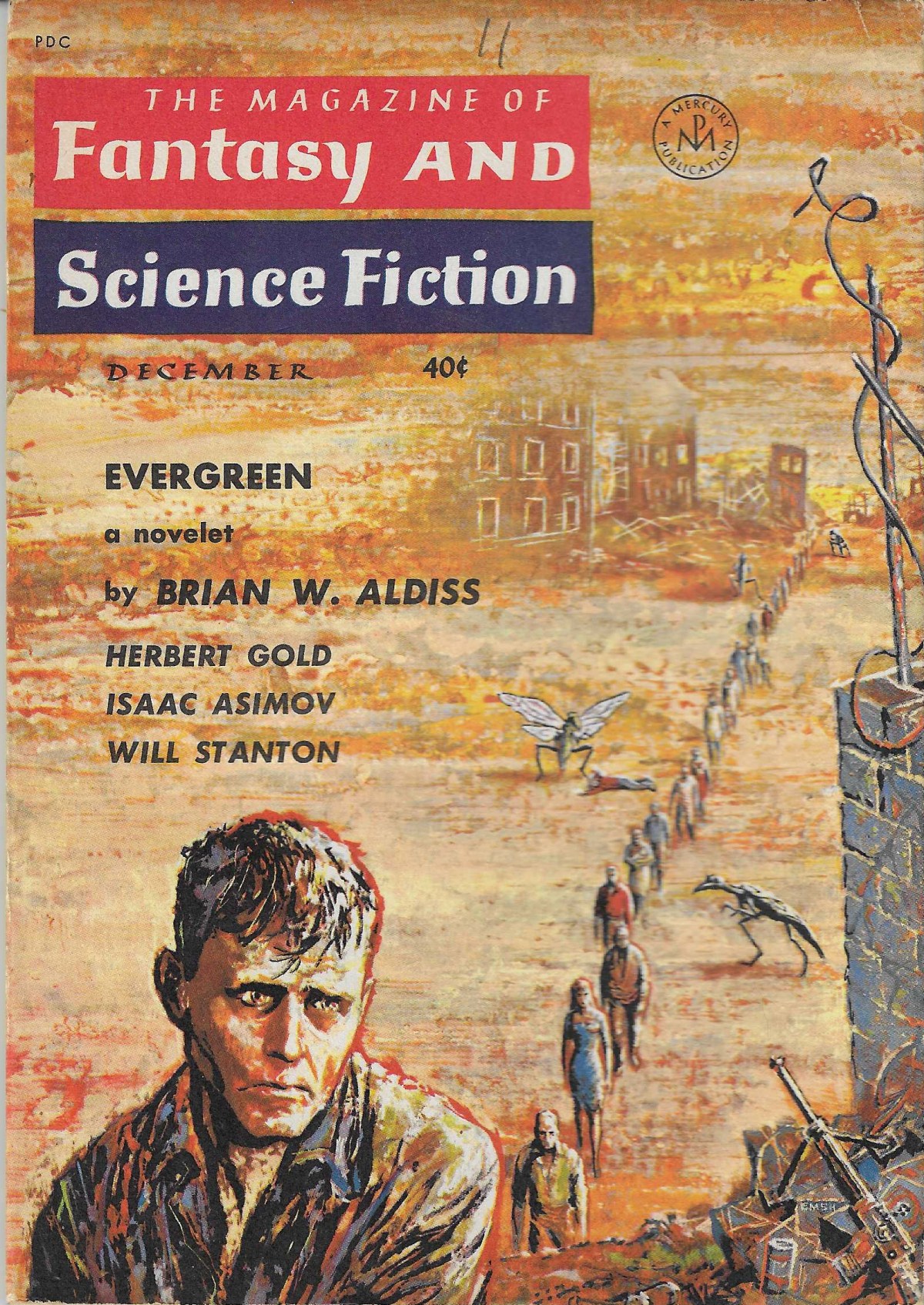
Later on, when I had a few coins, I’d buy magazines like Popular Science and MAD. Eventually, I discovered science fiction magazines. My favorite was The Magazine of Fantasy & Science Fiction, but I also loved Galaxy, Analog, Amazing, and Fantastic. I eventually subscribed to the first three around 1968. I also loved finding old issues at used bookshops for a dime or quarter.
By 1975, I had collected more than three-fourths of F&SF’s back issues. By then, I had also acquired pulps going back to 1928. Holding those magazines made me feel like I owned a piece of the past. I loved that. But in 1975, I had to sell my magazine collection.
Then in the 2010s, I started collecting those old magazines again through eBay. I eventually found 90% of the issues of F&SF published before 1975, and about 30% of those published after that. I also picked up about 95% of Galaxy.
Today, I started thinking about selling those old magazines. I took down the December 1961 issue of F&SF and read the beginning of each story. Every story hooked me, but I didn’t keep reading. I have this tremendous attachment to these old magazines, but I also feel a great need to have fewer possessions.
I have scans of all these magazines that I read on my tablet. In fact, it’s easier to read the scans than the original paper copies. The paper copies are becoming fragile. They are collector items, and I don’t want to hurt them.
I considered donating my magazine collection to the Friends of the Library, but I worry they won’t receive the love they deserve. I’m arranging to sell them on eBay. That way, a collector will acquire them. But it’s disturbing me to do this.
When I held the December 1961 issue of F&SF, it triggered a wave of nostalgia. It hurt me to imagine parting with it. I don’t value things. My truck is 26 years old. My watch cost $15. My clothes are Amazon Basics. I see no point in gold or diamonds. There’s nothing I own that’s expensive or trendy. If I’m not using something, I give it away.
If I had the choice between having the Mona Lisa on my wall or a complete run of F&SF, I’d pick the magazines.
Why am I so attached to these old magazines? It’s not the content because I have digital copies of all of them.
The best answer I can think of is this: Holding them recalls the past that no longer exists. If I didn’t have them, I wouldn’t have that connection to the past. Their covers are like photographs that remind me of who I used to be. Buying them on eBay was like buying back part of me that no longer exists.
I need to let them go. I feel like the kid in an old movie who has to free a wild animal they rescued. I rationalize to myself that whoever buys them will love them in the same way I have.
Over the last decade, since I’ve been retired, I’ve been trying to recapture my past by buying things I once owned. But I don’t want to be some old boomer dude living in the past.
Psychologically, I didn’t think I’d live this long. Now that I’m 73, I’m wondering, what if I live another decade or two? I don’t want to waste all that time living in the past.
I wonder if we recall who we were when it feels like the end is approaching. I’m not feeling that now. I wonder if I will buy another run of F&SF when I’m 88?
I bought more than a thousand books, preparing for retirement, thinking that after I left the nine-to-five grind, I’d have all the time in the world to read them. It’s not working out like I planned. All the time in the world has turned out to be much less than I imagined. Old age does a number on your temporal sense, which I didn’t anticipate. Being retired turns off the “gotta do this soon” mechanism in the brain, so it’s much easier to tell myself I’ll get around to that someday.
I’ve always wanted a catchy saying about buying more books than I can read, that parallels that old idiom about eating, “My eyes were bigger than my stomach.” My ability to acquire books far exceeds my ability to read them.
This problem is mainly due to my inability to commit. Learning is about specializing. To go deep into any subject requires ignoring all other subjects. I’m as indecisive as Hamlet when it comes to picking a project and sticking with it. However, I feel like I’m zeroing in on something. I don’t know what. I’d like to write a book. I have several ideas. I just can’t commit to one.
Looking through my books, I see that I’m torn between understanding the past, working in the present, and anticipating the future. The momentum of aging makes me retrospective, but I need to fight that. The present is real, and the past and future aren’t. However, to survive well in the present requires some knowledge of the past. And since we always act in the moment, we still feel we’re preparing for the future.
The Lesson of Destination Moon
Destination Moon was a 1950 science fiction film about the first manned rocket to the Moon. It was loosely based on Robert A. Heinlein’s Rocket Ship Galileo, and Heinlein contributed to the screenplay. In the story, the astronauts use too much fuel when landing on the Moon. To have enough fuel to take off and return to Earth, the astronauts must reduce the weight of the rocket and its contents. They throw everything they can out of their rocket ship, including the radio, equipment, seats, and their space suits. With the reduced weight, they take off for Earth.
In old age, I have too many goals, desires, and possessions holding me down. Their weight keeps me from accomplishing any larger goal. I need to jettison everything I can. I’m starting by evaluating my book collection and tallying all the subjects I want to study and read about.
This will be a multi-stage process. In this essay, I’m looking at all my books and listing the subjects I thought I wanted to study. Here is the current list, and even though it’s long, it’s still partial:
1939 World Fair
1960s
1960s Counter Culture
Aging
Alexander von Humboldt
Alfred Hitchcock
American History
American Literature
Amor Towles – Writer
Anthony Powell – Writer
Anthropology
Archaeology
Art history
Artificial Intelligence
Astronomy
Bible Archaeology
Bible History
Biographies
Bob Dylan
Books – History
Boston – 19th Century History
British Literature
British Literature Between the Wars
Charles Darwin
Charles Nordhoff and James Norman Hall – Writers
Chess
Classical Music
Classical Studies
Climate Change
Computer History
Computers
Country Music
Creative Fiction
Creative Nonfiction
Databases
Democracy
Drawing
Early Christianity
Economics
Electronics – Learning
Elizabeth Strout – Writer
Environmentalism
Ernest Hemingway – Writer
Feminism
Feminist History
Fiction
Future
Gerontology
Go Programming
H. G. Wells
Hollywood vs. History
Impressionism
Information and Information Theory
Information Hierarchy
Jack Kerouac – Writer
Jazz
Lady Dorothy Mills – Writer
Learning – Study Methods
Linux / Unix
Literary History
Literature
MacOS
Magazines – History
Mark Twain
Mathematics – History
Mathematics – Pure
Memory
Miami – History
Mitford Sisters
Movies – History
Music – History
Nassim Nicholas Taleb – Writer
Network Attached Storage (NAS)
Nostalgia
Note Taking Systems
Obsidian – Software
Old West
Particle Physics
Philip K. Dick – Writer
Philosophy
Photography – History
Photography – How To
Politics
Power Grid
Pulp Magazines
Python Programming
Quantum Mechanics
Reading
Renewable Energy
Rhetoric
Robert A. Heinlein – Writer
Rock Music
Scanning – Books and Magazines
Science
Science – History
Science Fiction
Science Fiction – Criticism
Science Fiction – History
Science Fiction – Magazines
Short Stories
Sustainability
Taxonomy
Technology
Television – History
The Beats
The Lost Generation
Westerns – Books
Westerns – Movies
Westerns – Television Shows
Windows – OS
Writing
Yuval Noah Harari – Writer
One of the first decisions I made was to give up on westerns. I have collected many westerns on DVDs. Along the way, I started collecting books on movie and TV westerns. I decided that in the remaining years of my life, I didn’t need to know that much about Westerns. I also gave away my books on TV history.
I’m approaching each subject like I did with Westerns.
Another example, while flipping through my math books, I decided to abandon any hope of relearning math. I gave away my books on pure math. However, I kept books on the history of math. I still want to see the big picture of history. In the long run, I might have to abandon any interest in math. I just don’t know at the moment. This is a process.
Do I Keep Books I’ve Already Read?
I’ve always kept books I’ve read as a form of external memory. The painful truth is, I seldom consult those books. I’ve long known it’s cheaper to buy books at full price when I need them rather than to stockpile them when I find them as bargain used books or Kindle deals. I think the same thing might apply to keeping books. The time and energy that goes into maintaining them in my library is more expensive than just rebuying a book if I want to reread it.
For example, I gave all my Elizabeth Strout books to my friend Ann. If I ever want to reread them, I’ll try the library.
Whatever Happened to Libraries?
It used to be that libraries were depositories of knowledge. I don’t feel that anymore. I’ve gone to the public library too many times to research a subject only to find a battered collection of old books. That’s why I’ve bought my own. However, I don’t think it’s practical to be my own public library.
We can find massive collections of information on the Internet or with AIs. Unfortunately, I don’t trust those sources.
I wish I had a trusted source of online knowledge.
Kindle and Audible Books
I’m not worrying about my digital books because they are out of sight, and thus out of mind.
I decided to get rid of any physical fiction books that I had on Kindle, but not if I owned them on Audible. I like seeing the words. For now, I’ll keep the physical copies of nonfiction books if I also own them as an ebook. I prefer flipping through the pages of a book when studying.
The Limits of Memory
There are many books I’ve kept because I hoped to study a subject. For instance, I’ve long fantasized about relearning mathematics. I got through Calculus I in college, but then I waited too long to take Calculus II. This is why I gave away my pure math books. I can no longer remember things well enough to study a complex subject.
Whatever books I choose to read in this last part of my life, they need to be books that expand my overall impression of reality, but don’t require me to remember the details.
I guess I’m going for wisdom over data.
Limits of Time
I’m hesitant to keep my art history books. I enjoy looking at the pictures, but I just don’t have time to study many more subjects in this lifetime. My interests include several subjects that could become a black hole of study. I really should flee from them.
I’m trying to decide my “Major” for old age. All my life, I’ve been a knowledge grazer. I nibble at one subject and then move on to another. I’ve always wanted to go deep into one area, to specialize. However, I never could settle down. I’m probably too old to change my ways now. I’m going to try, though. The process of selecting my major will be the topic of the next essay.
Shrinking My Library to Focus My Mind
I gave the library a lot of books today. I love buying books. I love owning books. But I own too many for this time of my life. I also have too many things I’m interested in. Too many for the time and energy I have at age 73. I’m like the rocket in Destination Moon. I’m too heavy for the fuel in my tanks.
It would help if I had a committed destination. I’d know what to keep and what to jettison.