Past-Present-Future As It Relates to Fiction-Nonfiction-Fantasy-SF

by James Wallace Harris, 12/12/25

I’ve been contemplating how robot minds could succeed at explaining reality if they didn’t suffer the errors and hallucinations that current AIs do. Current AI minds evolve from training on massive amounts of words and images created by humans stored as digital files. Computer programs can’t tell fiction from fact based on our language. It’s no wonder they hallucinate. And like humans, they feel they must always have an answer, even if it’s wrong.

What if robots were trained on what they see with their own senses without using human language? Would robots develop their own language that described reality with greater accuracy than humans do with our languages?

Animals interact successfully with reality without language. But we doubt they are sentient in the way we are. But just how good is our awareness of reality if we constantly distort it with hallucinations and delusions? What if robots could develop consciousness that is more accurately self-aware of reality?

Even though we feel like a being inside a body, peering out at reality with five senses, we know that’s not true. Our senses recreate a model of reality that we experience. We enhance that experience with language. However, language is the source of all our delusions and hallucinations.

The primary illusion we all experience is time. We think there is a past, present, and future. There is only now. We remember what was, and imagine what will be, but we do that with language. Unfortunately, language is limited, misleading, and confusing.

Take, for instance, events in the New Testament. Thousands, if not millions, of books have been written on specific events that happened over two thousand years ago. It’s endless speculation trying to describe what happened in a now that no longer exists. Even describing an event that occurred just one year ago is impossible to recreate in words. Yet, we never stop trying.

To compound our delusions is fiction. We love fiction. Most of us spend hours a day consuming fiction—novels, television shows, movies, video games, plays, comics, songs, poetry, manga, fake news, lies, etc. Often, fiction is about recreating past events. Because we can’t accurately describe the past, we constantly create new hallucinations about it.

Then there is fantasy and science fiction. More and more, we love to create stories based on imagination and speculation. Fantasy exists outside of time and space, while science fiction attempts to imagine what the future might be like based on extrapolation and speculation.

My guess is that any robot (or being) that perceives reality without delusions will not use language and have a very different concept of time. Is that even possible? We know animals succeed at this, but we doubt how conscious they are of reality.

Because robots will have senses that take in digital data, they could use playback to replace language. Instead of one robot communicating to another robot, “I saw a rabbit,” they could just transmit a recording of what they saw. Like humans, robots will have to model reality in their heads. Their umwelt will create a sensorium they interact with. Their perception of now, like ours, will be slightly delayed.

However, they could recreate the past by playing a recording that filled their sensorium with old data recordings. The conscious experience would be indistinguishable from using current data. And if they wanted, they could generate data that speculated on the future.

Evidently, all beings, biological or cybernetic, must experience reality as a recreation in their minds. In other words, no entity sees reality directly. We all interact with it in a recreation.

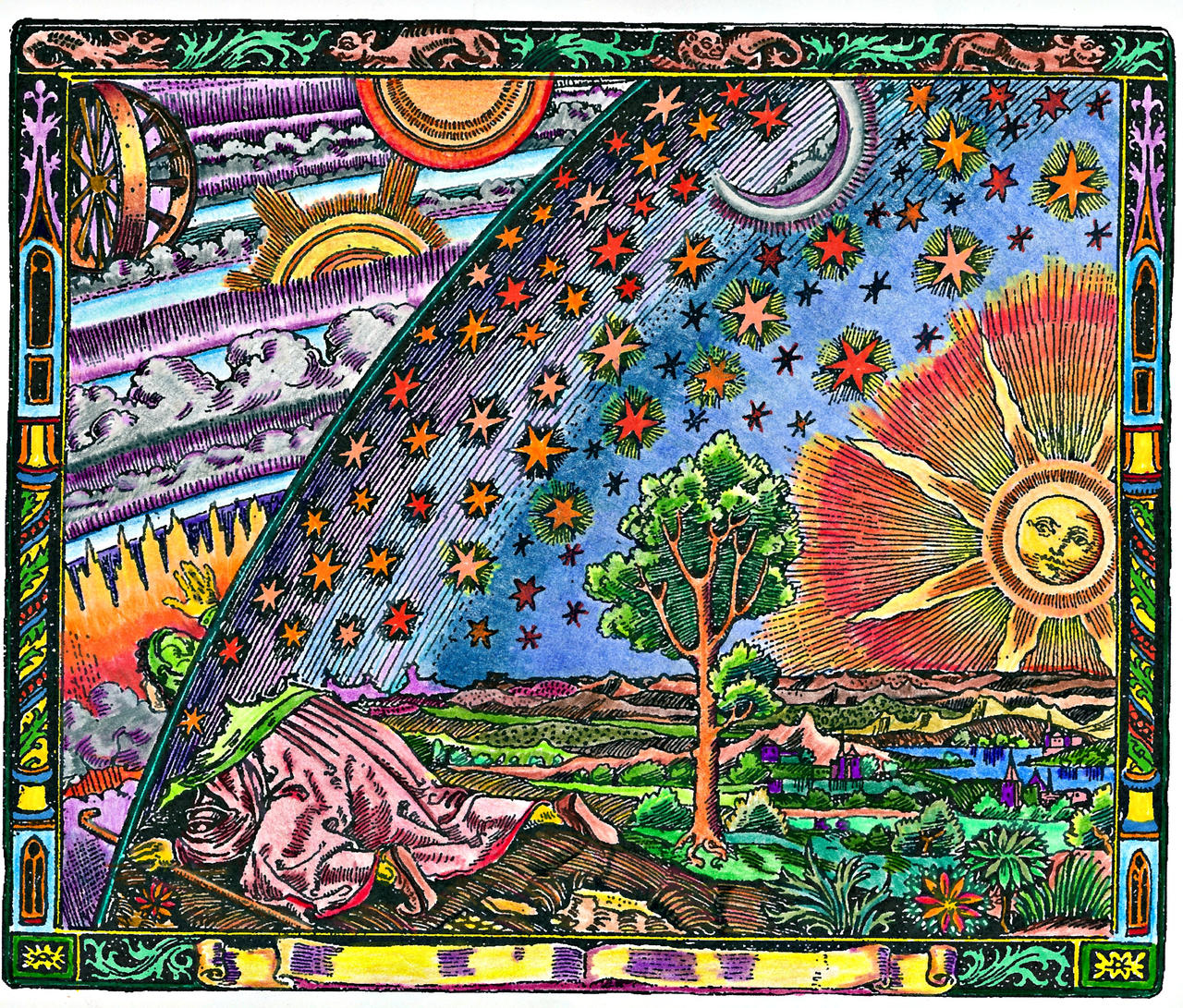
Looking at things this way makes me wonder about consuming fiction. We’re already two layers deep in artificial reality. The first is our sensorium/umwelt, which we feel is reality. And the second is language, which we think explains reality, but doesn’t. Fiction just adds another layer of delusion. Mimetic fiction tries to describe reality, but fantasy and science fiction add yet another layer of delusion.

Humans who practice Zen Buddhism try to tune out all the illusions. However, they talk about a higher state of consciousness called enlightenment. Is that just looking at reality without delusion, or is it a new way of perceiving reality?

Humans claim we are the crown of creation because our minds elevate us over the animals, but is intelligence or consciousness really superior?

We apparently exist in a reality that is constantly evolving. Will consciousness be something reality tries and then abandons? Will robots with artificial intelligence become the next stage in this evolutionary process?

If we’re a failure, why copy us? Shouldn’t we build robots that are superior to us? Right now, AI is created by modeling the processes of our brains. Maybe we should rethink that. But if we build robots that have a higher state of consciousness, couldn’t we also reengineer our brains and create Human Mind 2.0?

What would that involve? We’d have to overcome the limitations of language. We’d also have to find ways to eliminate delusions and hallucinations. Can we consciously choose to do those things?

JWH
Am I Too Old To Start A Second Brain?

by James Wallace Harris, 12/8/25

For years now, I’ve been reading about people who create a second brain to record what they want to remember. Most of these second brain systems use software, but not all. Many base their ideas on the Zettelkasten system, which was originally stored on note cards.

Over the years, I’ve tried different methods and software applications. I’m currently learning Obsidian. I’ve used note cards, notebooks, Google Docs, Evernote, OneNote, InstaPaper, Recall, and others. I love reading – taking information in – but I don’t like taking notes.

The trouble is, information goes through my brain like a sieve. When I want to tell someone about what I’ve learned, or think I’ve learned, I can’t cite my source, or, for that matter, clearly state what I think I know. And I seldom think about how I’ve come to believe what I believe.

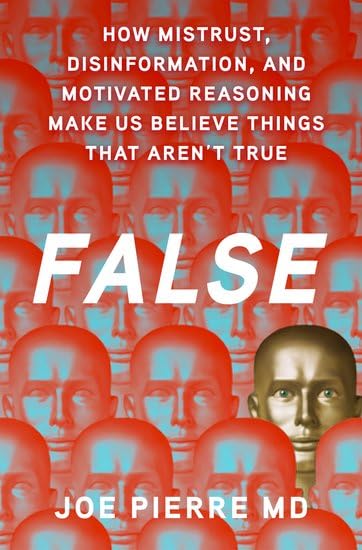
I’m currently reading False by Joe Pierre, MD, about how we all live with delusions. This book makes me want to rededicate myself to creating a second brain for two reasons. First, I want to take precise notes on this book because it offers dozens of insights about how we deceive ourselves, and about how other people are deceived and are deceiving. Second, the book inspires me to start tracking what I think I learn every day and study where that knowledge comes from.

One of the main ways we fool ourselves is with confirmation bias. Pierre says:

In real estate, it’s said that the most important guide to follow when buying a house and trying to understand home values is “location, location, location.” If I were asked about the most important guide to understand the psychology of believing strongly in things that aren’t true, I would similarly answer, “confirmation bias, confirmation bias, confirmation bias.”

Pierre explains how the Internet, Google, AIs, Social Media, and various algorithms reinforce our natural tendency toward confirmation bias.

Pierre claims there are almost 200 defined cognitive biases. Wikipedia has a nice listing of them. Wikipedia also has an equally nice, long list of fallacies. Look at those two lists; they are what Pierre is describing in his book.

Between these two lists, there are hundreds of ways we fool ourselves. They are part of our psychology. They explain how we interact with people and reality. However, everything is magnified by polarized politics, the Internet, Social Media, and now AI.

I’d like to create a second brain that would help me become aware of my own biases and fallacies. It would have been more useful if I had started this project when I was young. And I may be too old to overcome a lifetime of delusional thinking.

I do change the way I think sometimes. For example, most of my life, I’ve believed that it was important for humanity to go to Mars. Like Elon Musk, I thought it vital that we create a backup home for our species. I no longer believe either.

Why would I even think about Mars in the first place? I got those beliefs from reading dozens of nonfiction and fictional books about Mars. Why have I changed my mind? Because I have read dozens of articles that debunk those beliefs. In other words, my ideas came from other people.

I would like to create a second brain that tracks how my beliefs develop and change. Could maintaining a second brain help reveal my biases and thinking fallacies? I don’t know, but it might.

Doing the same thing and expecting different results is a common fallacy. Most of my friends are depressed and cynical about current events. Humanity seems to be in an immense Groundhog Day loop of history. Doesn’t it seem like liberals have always wanted to escape this loop, and conservatives wanted to embrace it?

If we have innate mental systems that are consistently faulty, how do we reprogram ourselves? I know my life has been one of repeatable behaviors. Like Phil Conners, I’m looking for a way out of the loop.

Stoicism seems to be the answer in old age. Is it delusional to think enlightenment might be possible?

JWH

Create and Control Your Own Algorithm

by James Wallace Harris, 12/6/25

If you get your news from social media sites, they will feed you what they learn you want to hear. Each site has its own algorithm to help you find the information you prefer. Such algorithms create echo chambers that play to your confirmation bias. It becomes a kind of digital mental masturbation.

Getting information from the internet is like drinking from a firehose. I hate to use such a cliche phrase, but it’s so true. Over the past decade, I’ve tried many ways to manage this flow of information. I’ve used RSS feed readers, news aggregators, social media sites, browser extensions, and smartphone apps. I’m always overwhelmed, and eventually, their algorithms feed me the same shitty content that thrills my baser self.

I’ve recently tried to reduce my information flow by subscribing to just four print magazines: Harper’s, The Atlantic, The New Yorker, and New York Magazine. I’m still deluged with news. However, I’m hoping the magazine editors will intelligently curate the news for me and keep me out of my own echo chamber.

I’ve even tried to limit my news intake to just one significant essay a day. For example, “The Chatbot-Delusion Crisis” by Matteo Wong from The Atlantic was yesterday’s read. Even while trying to control my own algorithm, I’ve been drawn to similar stories lately — about the dangers of social media and AI.

Today’s article, “When Chatbots Break Our Minds,” by Charlie Warzel, features an interview with Kashmir Hill. In the interview, Hill refers to her article in The New York Times, “Chatbots Can Go Into a Delusional Spiral. Here’s How It Happens.”

If I could program my own algorithm for news reading, one of the main features I’d hope to create is dazzling myself with news about important things I knew nothing about. I’d call such a feature Black Swan Reporting.

Another essential feature I’d want in my algorithm, I’d call Your Full of Shit. This subroutine would look for essays that show me how wrong or delusional I am. For example, for us liberals, we were deluded in thinking our cherished ideals made most Americans happy.

Another useful feature would be Significant News Outside the United States. For example, I listened to a long news story in one of my magazines about how Australia will soon enact a law that bans children under 16 from having social media accounts. This is a significant social experiment I hadn’t heard about, and one that other countries will try in 2026. None of my social media feeds let me know, but then maybe they want to keep such experiments secret.

Mostly, I’d want my algorithm to show me Important Things I Don’t Know, which is the exact opposite of what social media algorithms do.

However, I might need to go beyond one article a day to keep up with current events. That risks turning up the feed to fire hose velocity. How much news do we really need? I’m willing to give up an hour a day to one significant news story that’s educational and enlightening. I might be willing to give up another hour for several lighter but useful stories about reality.

I hate to admit it, but I doom scroll YouTube and Facebook one to two hours a day because of idle moments like resting after working in the yard or waking up in the middle of the night. And their algorithms have zeroed in on my favorite distractions, ones that are so shallow that I’m embarrassed to admit what they are.

The whole idea of creating a news algorithm driven by self-awareness is rather daunting. But I think we need to try. I’m reading too many stories about how we’re all damned by social media and AI.

I’m anxious to hear what kids in Australia do. Will they go outside and play, or will they find other things on their smartphones to occupy their time? What if the Australian government is forcing a generation to just play video games and look at porn?

JWH

Can Rereading THE WONDERFUL WIZARD OF OZ Help Me Remember What It Was Like to Be Ten Years Old?

by James Wallace Harris, 12/5/25

While watching Wicked, I struggled to recall the excitement I felt when I first read the Oz books at age 10 back in the summer of 1962. I wanted to know whether the fantasy world Wicked created matched the one L. Frank Baum created in his fourteen Oz novels.

The barrier to making this comparison is memory. Memories are highly unreliable. Plus, we overwrite our memories every time we recall them, so am I really remembering 1962, or just the last time I thought about reading the Oz books as a kid?

Like most of my brain excavations, I have to rely on logic and deduction instead. I also look for corroborating evidence. I spent many days on this problem, and here are my results.

The Oz books were the first novels I discovered on my own. For various reasons, I concluded this was the summer between the 5th and 6th grades. My family lived on base at Homestead Air Force Base, and I found the Oz books in the children’s wing of the base library. They were old and worn.

The first novel I remember is Treasure Island by Robert Louis Stevenson, which my mother read to me in the third grade. I started using libraries in the fourth grade, but read nonfiction books about airplanes, space travel, cars, and animals.

I remember roaming up and down the fiction section at the base library and discovering the Oz books. I had no idea who L. Frank Baum was, nor did I have any idea when they were written. I didn’t know about copyright pages or genres. I saw “Oz” on the spines and connected those books to the 1939 film, The Wizard of Oz, which I had seen on television every year since the 1950s.

I did not know the word fantasy. I doubt I understood the concept of fiction. In other words, these books were an exciting discovery. To compound that excitement, they were all set in the same fictional universe. They were my Harry Potter books. L. Frank Baum had tremendous world-building skills.

Analytically, I know that at ten, I didn’t know much about the world. My vocabulary was limited. And I was unaware of most concepts and abstractions. My previous beliefs in fantasy – Santa Claus, the Easter Bunny, and the Tooth Fairy had caused me great embarrassment in first grade when a girl called me a baby for mentioning them. I was five, she was six.

In other words, I knew Oz did not exist, even though Baum created so many wonderful details to make it believable. I remember wanting Oz to exist, but I knew it didn’t. I don’t think I grasped the idea of fantasy at that time. All I knew was that the books created an artificial reality in my mind that was mesmerizing.

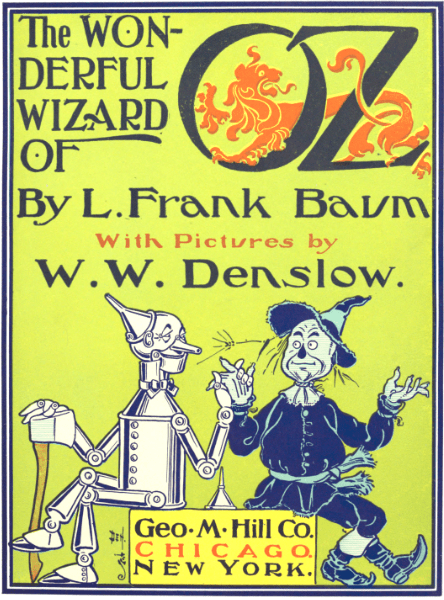
Watching Wicked and then rereading The Wonderful Wizard of Oz this week let me compare the two versions of Oz, but I couldn’t compare my initial reactions. Wicked is quite colorful, creative, and contains many elements of the original stories, but it no longer worked on me as the Oz books had in 1962. And that’s to be expected, since I’m 74, long past the age for fairytales.

My quest changed. I now wanted to know how my ten-year-old self saw the world. Rereading The Wonderful Wizard of Oz gave me very few clues.

My contemplations led me to some ideas, though. I have damn few memories of life before age five. I have zillions of memories dating from age five to twelve. I started thinking about them, and a revelation came to me.

Before age five, I theorize our minds are like LLMs (large language models). Those AIs can take in information and react to it, but they are unaware of the world. After five, but before puberty, we develop some self-awareness, but it’s very limiting. It isn’t until around twelve or thirteen that we start thinking for ourselves.

Here’s my main bit of evidence. As a child, my mother told me about God and took my sister and me to Sunday School and church. I just accepted what I was told. But when I was twelve, I started thinking about what they were telling me about religion. I didn’t buy it. I considered myself an atheist by 1964, when I was thirteen, maybe fourteen.

In my thirties, when I was working in a library, I came across an article that said that some librarians in the 1950s felt the Oz books gave children unrealistic expectations about life, and pulled the books from their shelves.

When I read that, I knew it had been true for me. The Oz books led me to science fiction, a genre that also inspired unrealistic expectations regarding the future that have proven to be unrealistic.

Here’s the thing: I was being told two fantasies at age ten. The first was from The Bible, and the second from the Oz books. Looking back, I see that my young self began to reject religion at age ten because I preferred the stories from L. Frank Baum. I wasn’t aware that I was comparing two fantasies; I just preferred one over the other.

Then I discovered science fiction. Concurrently, I was also discovering science. That gave me the illusion that science fiction was reality-based. When I consciously rejected religion, I thought I was choosing science. However, in recent decades, I’ve realized I had substituted science-fictional fantasies for religious fantasies.

I realize now that the Oz books had the power of Bible stories on me at age ten. The reason why so many people are true believers as adults is that they were programmed as children. Wicked doesn’t have that kind of power over me today. I can’t remember what that power felt like, but I do remember that for a few weeks in 1962, the ideas in the Oz books set my mind on fire. Rereading The Wonderful Wizard of Oz did not reignite that fire because I’m no longer a believer in anything.

I’ve often wondered if I hadn’t been lied to about Santa Claus, the Easter Bunny, and the Tooth Fairy, and thus had not experienced humiliation at discovering they were lies, and if I also hadn’t discovered Oz books, would I have accepted the Bible stories as truth as a kid and believed them now?

JWH

Reading With a Purpose

by James Wallace Harris, 11/12/25

I used to keep up with the world by watching NBC Nightly News with Lester Holt, reading The New York Times on my iPhone, and bingeing YouTube videos. I felt well-informed. That was an illusion.

I then switched to reading The Atlantic, New York Magazine, The New Yorker, and Harper’s Magazine. I focused on the longer articles and developed the habit of reading one significant essay a day. That has taught me how superficial my previous methods were at informing me about what’s going on around the world. Television, the internet, and newspapers were giving me soundbites, while articles provide an education.

However, I still tend to forget this deeper knowledge just as quickly. I don’t like that. I feel like I learn something significant every day. What I’m learning feels heavy and philosophical. However, it drives me nuts that I forget everything so quickly. And I’m not talking about dementia. I think we all forget quickly. Just remember how hard it was to prepare for tests back in school.

I’ve watched dozens of YouTube videos about study methods, and they all show that if you don’t put information to use, it goes away. Use it or lose it. I’ve decided to start reading with a purpose.

At first, I thought I would just save the best articles and refer to them when I wanted to remember. That didn’t work. I quickly forget where I read something. Besides, that approach doesn’t apply any reinforcing methods.

I then thought about writing a blog post for each article. It turns out it takes about a day to do that. And I still forget. I needed something simpler.

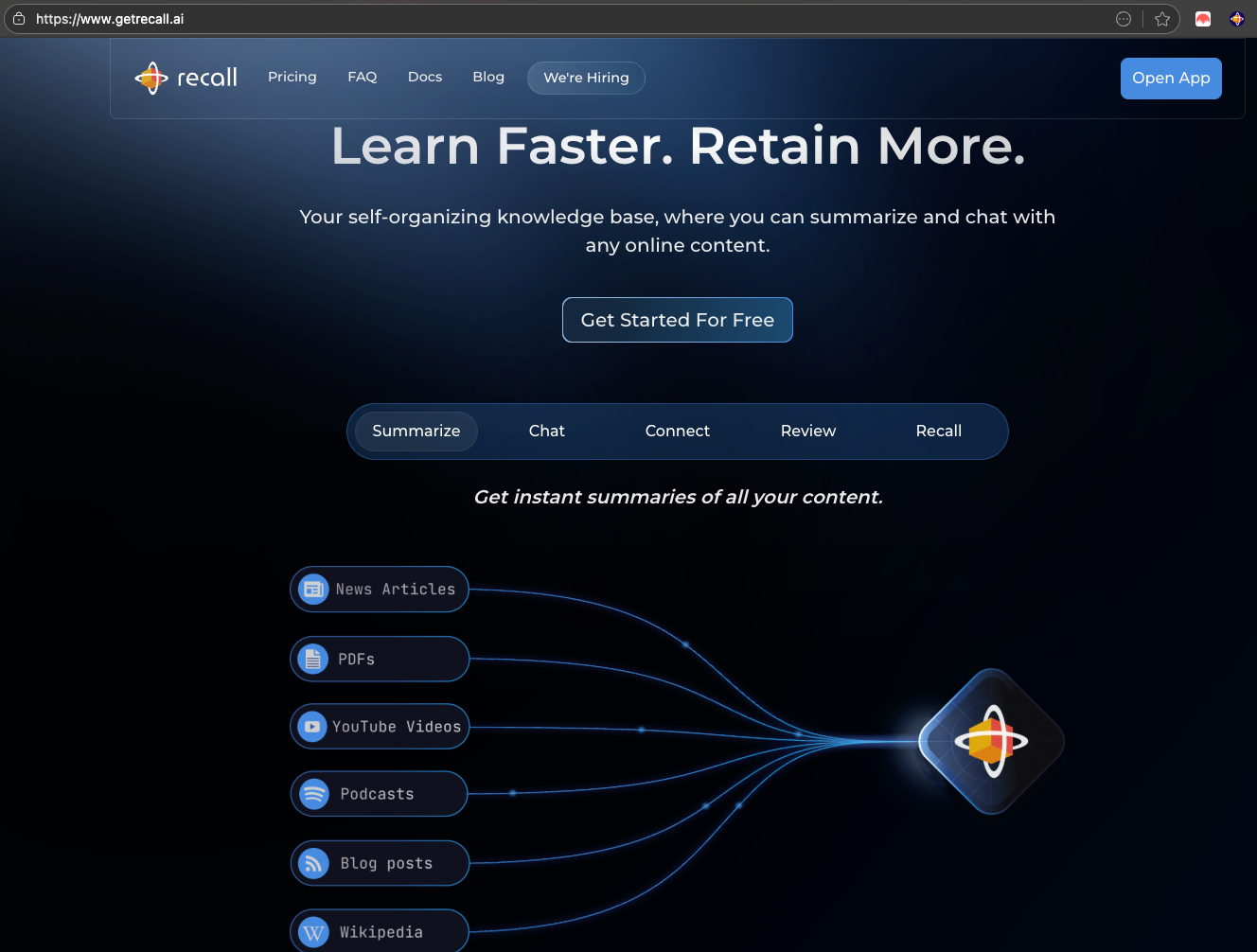
I then found Recall AI.

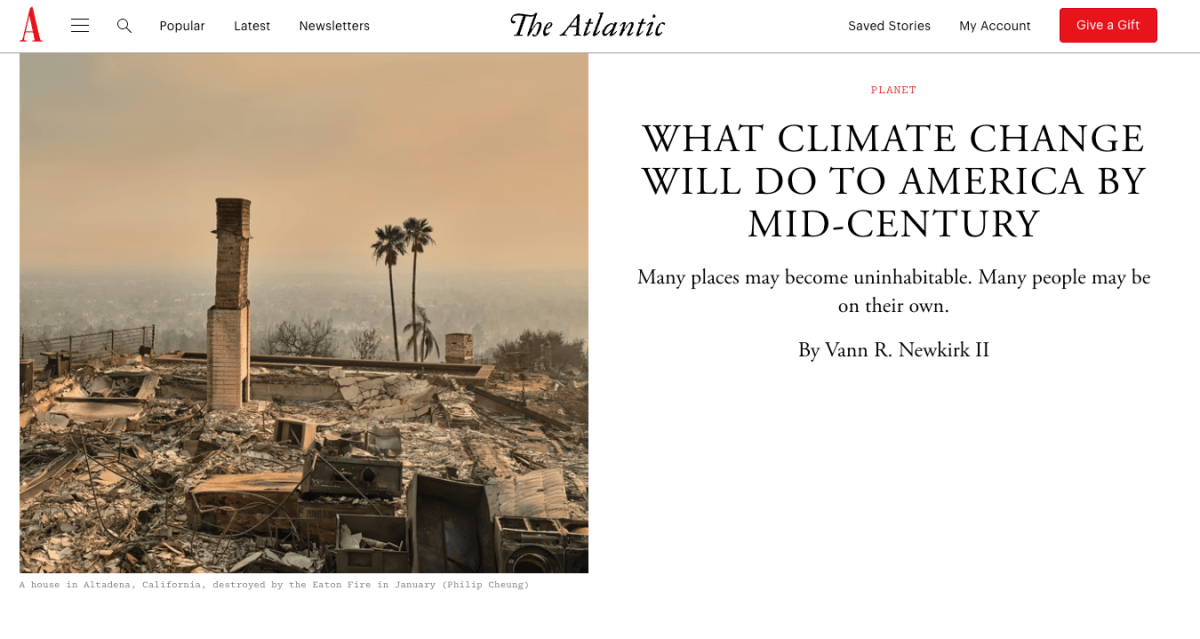
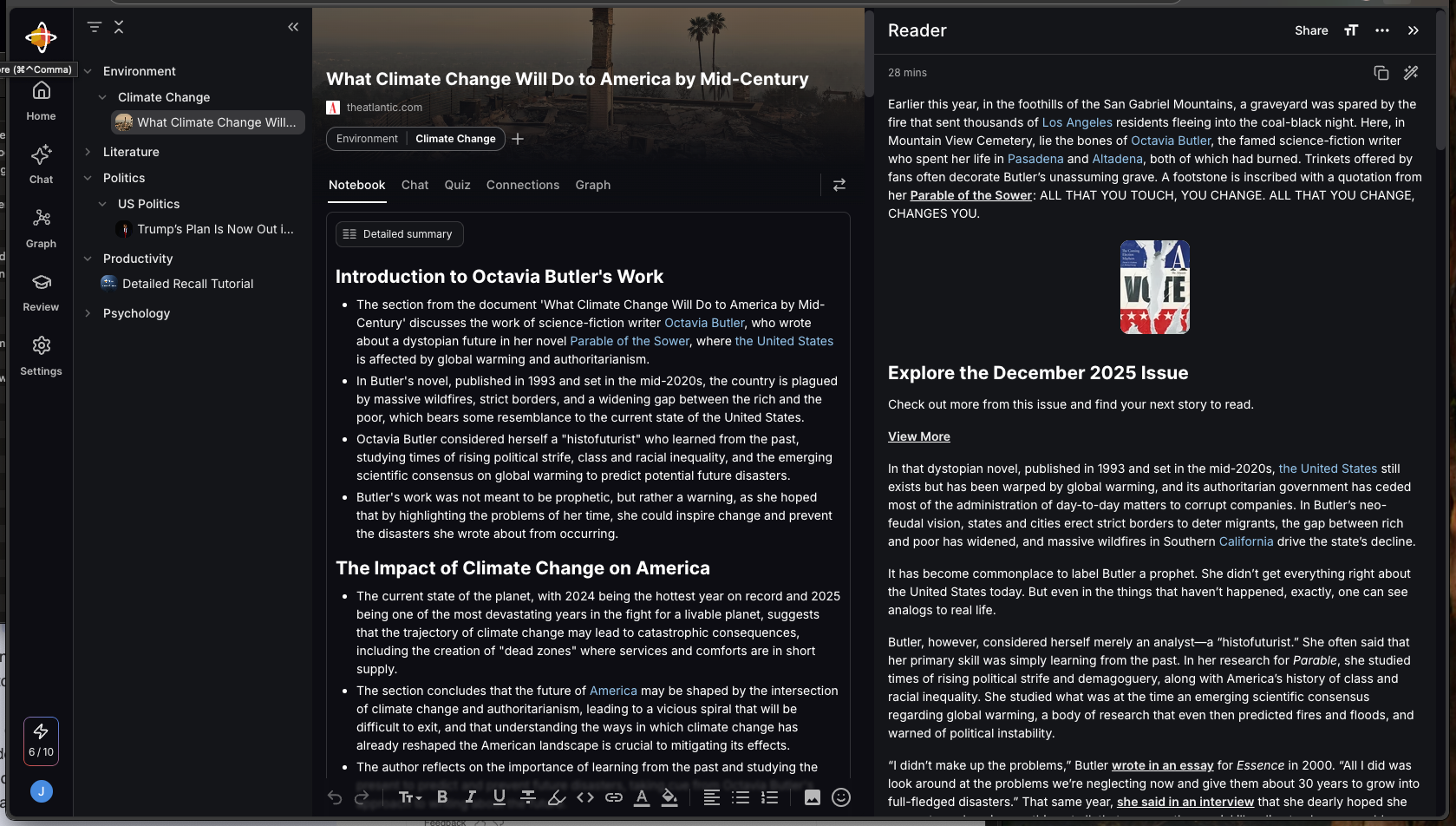
It reads and analyzes whatever webpage you’re on. Providing something like this for today’s article by Vann R. Newkirk II, “What Climate Change Will Do to America by Mid-Century:”

Recall allows me to save this into a structure. But again, this is a lot of work and takes a lot of time. If I were writing an essay or book, this would be a great tool for gathering research.

Recall is also great for understanding what I read. Helpful with quick rereading.

This morning, I got a new idea to try. What if I’m trying to remember too much? What if I narrowed down what I wanted to remember to something specific?

Within today’s article, the author used the term “climate gentrification” referring to neighborhoods being bought up because they were safer from climate change, and thus displacing poor people. The article mentions Liberty City, a poor neighborhood in Miami, with a slightly higher elevation, bought up by developers moving away from low-lying beachfront development.

I think I can remember that concept, climate gentrification. What if I only worked on remembering specific concepts? This got me thinking. I could collect concepts. As my collection grew, I could develop a classification system. A taxonomy of problems that humanity faces. Maybe a Dewey Decimal system of things to know.

I use a note-taking system called Obsidian. It uses hyperlinks to connect your notes, creating relationships between ideas. I could create a vault for collecting concepts. Each time I come across a new concept, I’d enter it into Obsidian, along with a citation where I found it. That might not be too much work.

I picked several phrases I want to remember and study:

  • Climate gentrification
  • Heat islands
  • Climate dead zones
  • Insurance market collapse
  • Climate change acceleration
  • Economic no-go zones
  • Corporate takeover of public services
  • Climate change inequality
  • Histofuturism
  • Sacrifice zones
  • Corporate feudalism

Contemplating this list made me realize that remembering where I read about each concept will take too much work. I have a browser extension, Readwell Reader, that lets me save the content of a web page. I could save every article I want to remember into a folder and then use a program to search for the concept words I remember to find them.

I just did a web search on “climate gentrification” and found it’s already in wide use. I then searched for “corporate feudalism,” and found quite a bit on it too. This suggests I’m onto something. That instead of trying to remember specifically what I read and where, I focus on specific emerging concepts.

Searching on “histofuturism” brought up another article at The Atlantic that references Octavia Butler: “How Octavia Butler Told the Future.” Today’s article by  Vann R. Newkirk II is also built around Octavia Butler. This complicates my plan. It makes me want to research the evolution of the concept, which could be very time-consuming.

The point of focusing on key concepts from my reading is to give my reading purpose that will help me remember. But there might be more to it. Concepts are being identified all the time. And they spread. They really don’t become useful until they enter the vernacular. Until a majority of people use a phrase like “climate gentrification,” the reality it points to isn’t visible.

That realization reinforces my hunch to focus on concepts rather than details in my reading. Maybe reading isn’t about specific facts, but about spreading concepts?

JWH