Past-Present-Future As It Relates to Fiction-Nonfiction-Fantasy-SF

by James Wallace Harris, 12/12/25

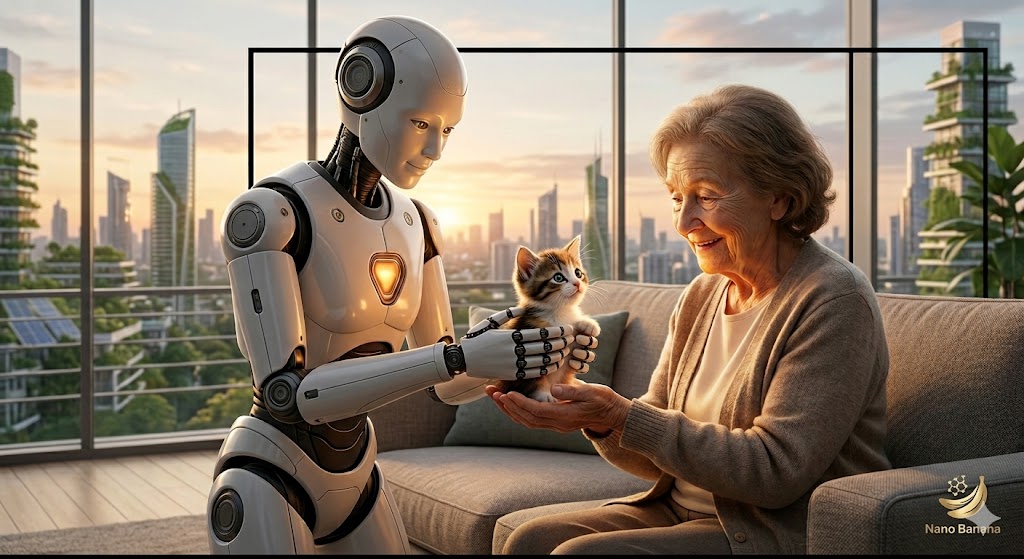
I’ve been contemplating how robot minds could succeed at explaining reality if they didn’t suffer the errors and hallucinations that current AIs do. Current AI minds evolve from training on massive amounts of words and images created by humans stored as digital files. Computer programs can’t tell fiction from fact based on our language. It’s no wonder they hallucinate. And like humans, they feel they must always have an answer, even if it’s wrong.

What if robots were trained on what they see with their own senses without using human language? Would robots develop their own language that described reality with greater accuracy than humans do with our languages?

Animals interact successfully with reality without language. But we doubt they are sentient in the way we are. But just how good is our awareness of reality if we constantly distort it with hallucinations and delusions? What if robots could develop consciousness that is more accurately self-aware of reality?

Even though we feel like a being inside a body, peering out at reality with five senses, we know that’s not true. Our senses recreate a model of reality that we experience. We enhance that experience with language. However, language is the source of all our delusions and hallucinations.

The primary illusion we all experience is time. We think there is a past, present, and future. There is only now. We remember what was, and imagine what will be, but we do that with language. Unfortunately, language is limited, misleading, and confusing.

Take, for instance, events in the New Testament. Thousands, if not millions, of books have been written on specific events that happened over two thousand years ago. It’s endless speculation trying to describe what happened in a now that no longer exists. Even describing an event that occurred just one year ago is impossible to recreate in words. Yet, we never stop trying.

To compound our delusions is fiction. We love fiction. Most of us spend hours a day consuming fiction—novels, television shows, movies, video games, plays, comics, songs, poetry, manga, fake news, lies, etc. Often, fiction is about recreating past events. Because we can’t accurately describe the past, we constantly create new hallucinations about it.

Then there is fantasy and science fiction. More and more, we love to create stories based on imagination and speculation. Fantasy exists outside of time and space, while science fiction attempts to imagine what the future might be like based on extrapolation and speculation.

My guess is that any robot (or being) that perceives reality without delusions will not use language and have a very different concept of time. Is that even possible? We know animals succeed at this, but we doubt how conscious they are of reality.

Because robots will have senses that take in digital data, they could use playback to replace language. Instead of one robot communicating to another robot, “I saw a rabbit,” they could just transmit a recording of what they saw. Like humans, robots will have to model reality in their heads. Their umwelt will create a sensorium they interact with. Their perception of now, like ours, will be slightly delayed.

However, they could recreate the past by playing a recording that filled their sensorium with old data recordings. The conscious experience would be indistinguishable from using current data. And if they wanted, they could generate data that speculated on the future.

Evidently, all beings, biological or cybernetic, must experience reality as a recreation in their minds. In other words, no entity sees reality directly. We all interact with it in a recreation.

Looking at things this way makes me wonder about consuming fiction. We’re already two layers deep in artificial reality. The first is our sensorium/umwelt, which we feel is reality. And the second is language, which we think explains reality, but doesn’t. Fiction just adds another layer of delusion. Mimetic fiction tries to describe reality, but fantasy and science fiction add yet another layer of delusion.

Humans who practice Zen Buddhism try to tune out all the illusions. However, they talk about a higher state of consciousness called enlightenment. Is that just looking at reality without delusion, or is it a new way of perceiving reality?

Humans claim we are the crown of creation because our minds elevate us over the animals, but is intelligence or consciousness really superior?

We apparently exist in a reality that is constantly evolving. Will consciousness be something reality tries and then abandons? Will robots with artificial intelligence become the next stage in this evolutionary process?

If we’re a failure, why copy us? Shouldn’t we build robots that are superior to us? Right now, AI is created by modeling the processes of our brains. Maybe we should rethink that. But if we build robots that have a higher state of consciousness, couldn’t we also reengineer our brains and create Human Mind 2.0?

What would that involve? We’d have to overcome the limitations of language. We’d also have to find ways to eliminate delusions and hallucinations. Can we consciously choose to do those things?

JWH

Create and Control Your Own Algorithm

by James Wallace Harris, 12/6/25

If you get your news from social media sites, they will feed you what they learn you want to hear. Each site has its own algorithm to help you find the information you prefer. Such algorithms create echo chambers that play to your confirmation bias. It becomes a kind of digital mental masturbation.

Getting information from the internet is like drinking from a firehose. I hate to use such a cliche phrase, but it’s so true. Over the past decade, I’ve tried many ways to manage this flow of information. I’ve used RSS feed readers, news aggregators, social media sites, browser extensions, and smartphone apps. I’m always overwhelmed, and eventually, their algorithms feed me the same shitty content that thrills my baser self.

I’ve recently tried to reduce my information flow by subscribing to just four print magazines: Harper’s, The Atlantic, The New Yorker, and New York Magazine. I’m still deluged with news. However, I’m hoping the magazine editors will intelligently curate the news for me and keep me out of my own echo chamber.

I’ve even tried to limit my news intake to just one significant essay a day. For example, “The Chatbot-Delusion Crisis” by Matteo Wong from The Atlantic was yesterday’s read. Even while trying to control my own algorithm, I’ve been drawn to similar stories lately — about the dangers of social media and AI.

Today’s article, “When Chatbots Break Our Minds,” by Charlie Warzel, features an interview with Kashmir Hill. In the interview, Hill refers to her article in The New York Times, “Chatbots Can Go Into a Delusional Spiral. Here’s How It Happens.”

If I could program my own algorithm for news reading, one of the main features I’d hope to create is dazzling myself with news about important things I knew nothing about. I’d call such a feature Black Swan Reporting.

Another essential feature I’d want in my algorithm, I’d call Your Full of Shit. This subroutine would look for essays that show me how wrong or delusional I am. For example, for us liberals, we were deluded in thinking our cherished ideals made most Americans happy.

Another useful feature would be Significant News Outside the United States. For example, I listened to a long news story in one of my magazines about how Australia will soon enact a law that bans children under 16 from having social media accounts. This is a significant social experiment I hadn’t heard about, and one that other countries will try in 2026. None of my social media feeds let me know, but then maybe they want to keep such experiments secret.

Mostly, I’d want my algorithm to show me Important Things I Don’t Know, which is the exact opposite of what social media algorithms do.

However, I might need to go beyond one article a day to keep up with current events. That risks turning up the feed to fire hose velocity. How much news do we really need? I’m willing to give up an hour a day to one significant news story that’s educational and enlightening. I might be willing to give up another hour for several lighter but useful stories about reality.

I hate to admit it, but I doom scroll YouTube and Facebook one to two hours a day because of idle moments like resting after working in the yard or waking up in the middle of the night. And their algorithms have zeroed in on my favorite distractions, ones that are so shallow that I’m embarrassed to admit what they are.

The whole idea of creating a news algorithm driven by self-awareness is rather daunting. But I think we need to try. I’m reading too many stories about how we’re all damned by social media and AI.

I’m anxious to hear what kids in Australia do. Will they go outside and play, or will they find other things on their smartphones to occupy their time? What if the Australian government is forcing a generation to just play video games and look at porn?

JWH

Are Podcasts Wasting Our Time?

by James Wallace Harris, 11/16/25

While listening to the Radio Atlantic podcast, “What If AI Is a Bubble?,” a conversation between host Hanna Rosin and guest Charlie Warzel, I kept thinking I had heard this information before. I checked and found that I had read “Here’s How the AI Crash Happens” by Matteo Wong and Charlie Warzel, which Rosin had mentioned in her introduction.

Over the past year, I’ve been paying attention to how podcasts differ from long-form journalism. I’ve become disappointed with talking heads. I know podcasts are popular now, and I can understand their appeal. But I no longer have the patience for long chats, especially ones that spend too much time not covering the topic. All too often, podcasts take up excessive time for the amount of real information they cover.

What I’ve noticed is that the information density between podcasts and long-form journalism is very different. Here’s a quote, five paragraphs from the podcast:

WarzelThere’s a recent McKinsey report that’s been sort of passed around in these spheres where people are talking about this that said 80 percent of the companies they surveyed that were using AI discovered that the technology had no real—they said “significant”—impact on their bottom line, right?

So there’s this notion that these tools are not yet, at least as they exist now, as transformative as people are saying—and especially as transformative for productivity and efficiency and the stuff that leads to higher revenues. But there’s also these other reasons.

The AI boom, in a lot of ways, is a data-center boom. For this technology to grow, for it to get more powerful, for it to serve people better, it needs to have these data centers, which help the large language models process faster, which help them train better. And these data centers are these big warehouses that have to be built, right? There’s tons of square footage. They take a lot of electricity to run.

But one of the problems is with this is it’s incredibly money-intensive to build these, right? They’re spending tons of money to build out these data centers. So there’s this notion that there’s never enough, right? We’re going to need to keep building data centers. We’re going to need to increase the amount of power, right? And so what you have, basically, is this really interesting infrastructure problem, on top of what we’re thinking of as a technological problem.

And that’s a bit of the reason why people are concerned about the bubble, because it’s not just like we need a bunch of smart people in a room to push the boundaries of this technology, or we need to put a lot of money into software development. This is almost like reverse terraforming the Earth. We need to blanket the Earth in these data centers in order to make this go.

Contrast that with the opening five paragraphs of the article:

The AI boom is visible from orbit. Satellite photos of New Carlisle, Indiana, show greenish splotches of farmland transformed into unmistakable industrial parks in less than a year’s time. There are seven rectangular data centers there, with 23 more on the way.

Inside each of these buildings, endless rows of fridge-size containers of computer chips wheeze and grunt as they perform mathematical operations at an unfathomable scale. The buildings belong to Amazon and are being used by Anthropic, a leading AI firm, to train and run its models. According to one estimate, this data-center campus, far from complete, already demands more than 500 megawatts of electricity to power these calculations—as much as hundreds of thousands of American homes. When all the data centers in New Carlisle are built, they will demand more power than two Atlantas.

The amount of energy and money being poured into AI is breathtaking. Global spending on the technology is projected to hit $375 billion by the end of the year and half a trillion dollars in 2026. Three-quarters of gains in the S&P 500 since the launch of ChatGPT came from AI-related stocks; the value of every publicly traded company has, in a sense, been buoyed by an AI-driven bull market. To cement the point, Nvidia, a maker of the advanced computer chips underlying the AI boom, yesterday became the first company in history to be worth $5 trillion.

Here’s another way of thinking about the transformation under way: Multiplying Ford’s current market cap 94 times over wouldn’t quite get you to Nvidia’s. Yet 20 years ago, Ford was worth nearly triple what Nvidia was. Much like how Saudi Arabia is a petrostate, the U.S. is a burgeoning AI state—and, in particular, an Nvidia-state. The number keeps going up, which has a buoying effect on markets that is, in the short term, good. But every good earnings report further entrenches Nvidia as a precariously placed, load-bearing piece of the global economy.

America appears to be, at the moment, in a sort of benevolent hostage situation. AI-related spending now contributes more to the nation’s GDP growth than all consumer spending combined, and by another calculation, those AI expenditures accounted for 92 percent of GDP growth during the first half of 2025. Since the launch of ChatGPT, in late 2022, the tech industry has gone from making up 22 percent of the value in the S&P 500 to roughly one-third. Just yesterday, Meta, Microsoft, and Alphabet all reported substantial quarterly-revenue growth, and Reuters reported that OpenAI is planning to go public perhaps as soon as next year at a value of up to $1 trillion—which would be one of the largest IPOs in history. (An OpenAI spokesperson told Reuters, “An IPO is not our focus, so we could not possibly have set a date”; OpenAI and The Atlantic have a corporate partnership.)

Admittedly, the paragraphs in the article are somewhat longer, but judge them on the amount of facts each presents.

Some people might say podcasts are more convenient. But I listened to the article. I’ve been subscribing to Apple News+ for a while now. I really didn’t use it daily until I discovered the audio feature. And it didn’t become significant until I began hearing major articles from The New Yorker, The Atlantic, and New York Magazine.

Whenever I listened to a podcast, including podcasts from those magazines, I was generally disappointed with their impact. Conversational speech just can’t compete with the rich informational density of a well-written essay. And once I got used to long-form journalism, the information I got from the internet and television seemed so damn insubstantial.

These magazines have spoiled me. I’m even disappointed with their short-form content. Over my lifetime, I’ve watched magazines fill their pages with shorter and shorter content. Interesting tidbits came to magazines long before the internet appealed to our ever-shortening attention spans.

As an experiment, I ask you to start paying attention to the length of the content you consume. Analyze the information density of what you read, either with your eyes or ears. Pay attention to the words that have the greatest impact. Notice what percentage of a piece is opinion and what percentage is reported facts. How are the facts presented? Is a source given? And when you look back, either from a day or a week, how much do you remember?

What do you think when you read or hear:

According to one estimate, this data-center campus, far from complete, already demands more than 500 megawatts of electricity to power these calculations—as much as hundreds of thousands of American homes. When all the data centers in New Carlisle are built, they will demand more power than two Atlantas.

Don’t you want to know more? Where did those facts come from? Are they accurate? Another measure of content is whether it makes you want to know more. The article above drove my curiosity to insane levels. That’s when I found this YouTube video. Seeing is believing. But judging videos is another issue, but that’s for another time.

JWH

Knowing When To Give Up Dreams

by James Wallace Harris, 1/25/25

I love computers and digital devices but I have too many of them. For some reason getting old is making me anxious about owning stuff. Like the instinct that makes birds fly south for the winter, aging has triggered an instinct to simplify my life. I’m still young enough to want all the junk I have, but I’m going through an in-between aging stage, where I want to keep stuff and get rid of it at the same time. That anxiety is gnawing at me more and more.

I will give an analogy that young people might not understand. On the Ed Sullivan Show in the 1960s, Ed would have these guys who could spin plates on the top of sticks. They could keep a row of plates spinning on sticks by running between them and jiggling each stick. Being young means you have the energy and dexterity to quickly run between lots of spinning plates, but when you get older, you slow down and can only keep a few spinning.

Being 73 isn’t that old, but it’s old enough to start feeling I need to spin fewer plates. Deciding what activities I love that I need to quit is stressful. At 73, I’m already old enough to let a bunch of spinning plates fall. That’s depressing, but I don’t have the energy to keep up. I’m starting to lose the energy to even care, which is scarier. I need to decide which activities I love the most that I can manage, and psychically let go of the other ones.

I realize I’ve already been doing this for years, but I’ve been letting activities go that didn’t matter much. What hurts is realizing which activities and ambitions I still hope to pursue that I need to stop thinking about.

When I retired in 2013, I thought I’d do many things with programming and computers. I thought about getting an M.S. in Computer Science even though I would never work as a programmer again. But none of that happened. I thought I would at least learn to program Python for fun. That didn’t happen. I had many ideas for programs I wanted to write but never did. I see that I only programmed when people were paying me.

For years, I’ve kept buying computers and piddling around with them. My most productive activity was scanning old pulp magazines and science fiction fanzines to put on the Internet Archive, but I’ve stopped because of diminishing energy. However, I’ve kept all these computers, scanners, and other devices for all my dream projects that need to be thinned out.

I don’t know if my Hamlet nature keeps me from committing to one computer operating system, or if I’m a child in a toyshop who screams he wants everything. However, mining three computer systems with three different operating systems has become a pain in my psyche.

Reality tells me to give up several dreams and the equipment that went with them. Why keep a Midi keyboard after I discovered I have no musical talent? Well, I kept it thinking someday I’d see how much I could do with Garage Band on the Mac with minimal talent. I’m sure that’s a delusion.

I need to jettison everything I plan to use that is obvious that I will never use. I’ve had this insight many times before but never could pull the trigger. The present reality is my energy reserves are getting so low that too much of them are being wasted on keeping impractical hopes alive. I must commit to the operating systems and computer equipment that will do the most for my aging future self.

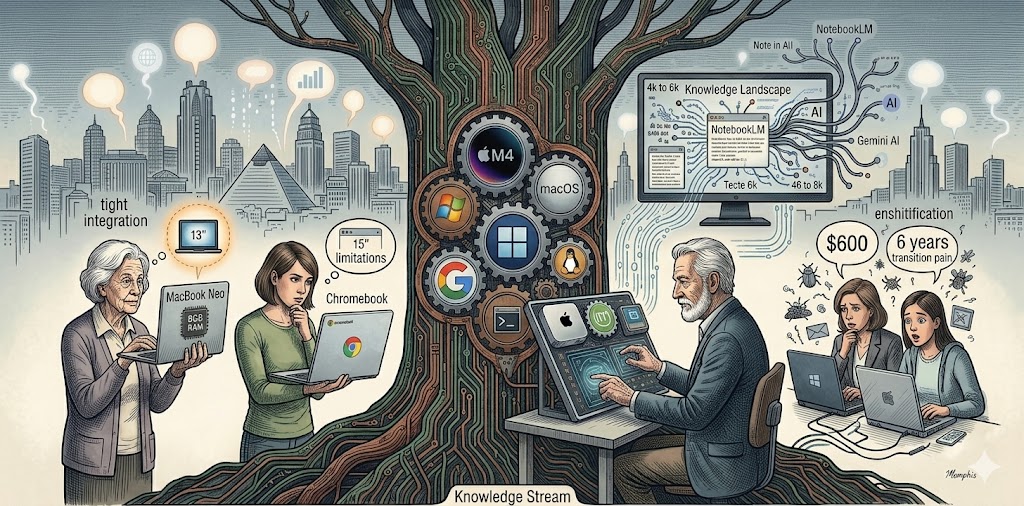
If Microsoft wasn’t so heavy-handed in constantly adding features and monitoring my computer, I would make everything Windows. But there isn’t a Windows phone. If I didn’t dislike MacOS so much, I could settle on buying everything from Apple, because I love my iPhone and iPad. I do love Mac hardware, I just don’t like MacOS. And if I had my druthers, I’d go Linux and use all FOSS programs because I admire the concept of open source.

The idealistic computer geek in me wants to choose Linux. And I could realistically pick Linux if I knew I’d never wanted to scan magazines again. Picking Linux also means giving up Microsoft Office. Picking Linux also means living as a computer user minority.

I love my Mac Mini M4 machine because it’s quiet. I love my Mac Air M1 laptop because the hardware is deluxe. And I can use MacOS just fine. I just prefer how Windows, or even Linux works better. However, Linux and Macs aren’t compatible with all my hardware and software.

The most universally useful computer I have is my Windows machine. My favorite phone is my iPhone. My favorite tablet is my iPad Mini. I like Android because it allows for microSD cards and is more open, but it’s nowhere near as easy to use as iOS. I wish iOS devices allowed microSD cards. Buying extra storage for iPhones and iPads is so damn expensive.

I wish I had 2TB of storage on every device I owned to fully replicate my Dropbox filesystem to every device. Dropbox is fantastic as long as I have the space to replicate everything. Selective sync could work, but it seems to have disappeared as a feature on my Mac and Linux machines. I could get an iPad Pro with 2TB of memory, but it’s $2000, and even then I’m unsure if it would sync my Dropbox drive. Maybe I should give up needing 2 terabytes of old files.

I would simplify my life by keeping my Windows computer, Mac Air M1, iPhone, and iPad Mini. But wouldn’t it be more logical to keep my Mac Mini M4 and be compatible with my other Apple devices I don’t want to give up? As Mr. Spock would say, “That is the logical solution.” But damn, I don’t know if I could walk away from Windows.

I could test the logical solution by packing away my Windows and Linux machines for several months to see how I feel.

And maybe that’s an approach I could try with other things I own. Just pack them away, and see how long I can live without them. If I can, then get rid of them.

I wrote this essay to think things through. I realize now, that I’ve written myself into a decision. I’ll let you know if I can overcome my Hamlet complex and commit.

I have decided to pack two computer systems away. I just don’t know which two.

JWH

Switched From PC To Mac After Buying a Mac Mini M4

by James Wallace Harris, 12/12/24

I’ve wanted to own a Mac since 1984, but they were always too expensive. When Apple announced the Mac Mini M4 had 16GB of memory as the base memory for $599, I preordered one from Amazon. They had it for $579.

I love Windows. But my Intel NUC has been annoying the crap out of me with its fan noise. I even went into the BIOS and set the processor to its lowest performance level so it should overheat less, but the fan still whined, but not as much. And it got less hot to touch. I don’t know why, but even when I didn’t use it background processes were always running something. I checked for viruses and malware but didn’t find any. I opened the NUC and vacuumed the dust, making sure that wasn’t a problem. I don’t know why, but that fan whine just got to me.

I never hear the Mac Mini M4. Nor does it get warm. I added a 4TB external hard drive to handle my 2TB Dropbox drive and a folder of Plex movies and TV shows. The heavy-duty OWC enclosure with metal fins gets warm sometimes, but it’s quiet.

I love the quietness of the Mac Mini, but I’m worried about the OWC external drive. The light comes on when I’m not using the machine, and it’s sometimes warm when I haven’t used the Mac for hours. I’m worried that something is running in the background that I might not like.

Modern computers run dozens of processes in the background, and this is starting to annoy me. I was hoping the Mac ran fewer. It’s a major reason why I considered switching to Linux. I never know if those processes are essential, corporate spying, or malware activity.

The trick to switching to the Mac was finding software that served the same functions as all my Windows programs. Office 365 runs on both platforms. No problem there. I use Microsoft Edge browser on Windows, Linux, iOS, Android, and Mac. Obsidian runs on PC, Mac, and Linux.

I was quite happy with Office 365 on the Mac. It even installs Microsoft Defender, which includes more than just anti-virus tools. However, I’ve taken all the Microsoft programs off the Mac Mini because Activity Monitor shows that Microsoft runs too many processes.

I’m testing to see if I want to standardize on pure Apple apps or pure Open Source programs. I mention this because switching to the Mac is like switching to Linux. You can try to make everything work like it did on Windows, or you can go native.

My first big hurdle was Adobe Photoshop Elements 2021. My copy came with a Mac version but wouldn’t load on the Mac Mini. I thought I’d switch to Gimp because it runs on PC, Mac, and Linux. But I just don’t like Gimp. I solved the problem by using the online app, Photopea. It works great on all three platforms. Photopea works like Photoshop Elements and Photoshop, so no learning curve.

Ripping disks with MKV works even better on the Mac. Plex works fine from the Mac. I took down the Intel NUC I used as a Plex server. Since I have so much space on the Mac Mini’s external drive, and because it is quiet and power-efficient enough to run all the time, I made it my Plex server. Even my favorite CBR reader, YACReader ran on the Mac (as well as Windows and Linux).

The Mac doesn’t work with my Plustek OptiBook flatbed scanner or my favorite program for scanning and mass manipulating images, IrfanView. I just can’t find a driver for the Plustek for either the Mac or Linux and no other program I’ve ever used even comes close to the utility of IrFanView.

Also, I can’t find a screenshot program that functions as well as Windows Snipping Tool, or ShareX.

I own a copy of Abbyy Fine Reader for Windows 15, but they’ve moved to a subscription program. I don’t know if I’m ready to subscribe to the Mac version, especially since I can’t use my scanner. I used to scan old science fiction magazines and fanzines to convert to CBR files and needed the Plustek, IrfanView, Abbyy Fine Reader, and Scan Tailor for the job. That task might have to stay on my Windows machine. But it might just retire from that hobby.

I’m not keen on how Mac OS does many things, but that might be because I’m used to doing it differently on Windows for decades. I’m adapting. I can go days without turning on my Windows machine.

One thing that has made migration easier is I keep all my files on Dropbox. I’ve always been annoyed when using one machine and remembering a file I created is stored locally on another machine. It’s so much easier to keep things on Dropbox and I can access the files from Windows, Linux, Mac OS, iOS, and Android.

There’s a lot I have left to learn about using a Mac, but it doesn’t seem to be too much trouble to do the Mac way of doing things. I am disappointed my PlusTek scanner doesn’t work.

I’ve wanted to switch to Linux for years, but never could because it didn’t have the programs I use to scan magazines or drivers for my scanner. So the Mac and Linux are equal in that.

Now that I’ve been using the Mac Mini M4 for a couple weeks, I love the hardware, but I still don’t like Apple’s operating system. It works, but it’s not what I’ve been using for decades. Using MacOS reveals just how much I love Windows 11. I wish Windows 11 ran on the Mac Mini M4.

I don’t like having an external SSD. The OWC housing and 4TB Crucial SSD work fine, but there’s something else on the desk. That bugs me. Knowing what I know now, I wouldn’t try switching to a Mac. I’m going to stick with it, at least for several months.

I write this in case you’re seduced by the Mac Mini M4 mania and haven’t bought one yet.

I love the high-tech of the M4 chip. I love having such a powerful machine. However, all I really needed was a new mini PC that was quiet.

JWH