Reading With a Purpose

by James Wallace Harris, 11/12/25

I used to keep up with the world by watching NBC Nightly News with Lester Holt, reading The New York Times on my iPhone, and bingeing YouTube videos. I felt well-informed. That was an illusion.

I then switched to reading The Atlantic, New York Magazine, The New Yorker, and Harper’s Magazine. I focused on the longer articles and developed the habit of reading one significant essay a day. That has taught me how superficial my previous methods were at informing me about what’s going on around the world. Television, the internet, and newspapers were giving me soundbites, while articles provide an education.

However, I still tend to forget this deeper knowledge just as quickly. I don’t like that. I feel like I learn something significant every day. What I’m learning feels heavy and philosophical. However, it drives me nuts that I forget everything so quickly. And I’m not talking about dementia. I think we all forget quickly. Just remember how hard it was to prepare for tests back in school.

I’ve watched dozens of YouTube videos about study methods, and they all show that if you don’t put information to use, it goes away. Use it or lose it. I’ve decided to start reading with a purpose.

At first, I thought I would just save the best articles and refer to them when I wanted to remember. That didn’t work. I quickly forget where I read something. Besides, that approach doesn’t apply any reinforcing methods.

I then thought about writing a blog post for each article. It turns out it takes about a day to do that. And I still forget. I needed something simpler.

I then found Recall AI.
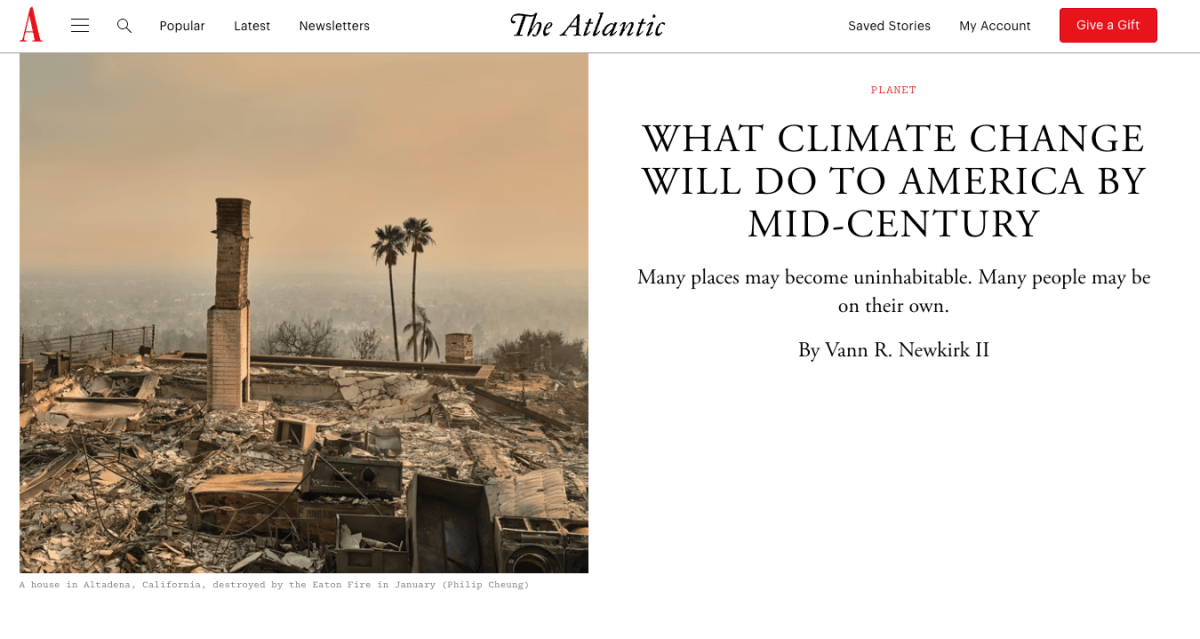
It reads and analyzes whatever webpage you’re on. Providing something like this for today’s article by Vann R. Newkirk II, “What Climate Change Will Do to America by Mid-Century:”
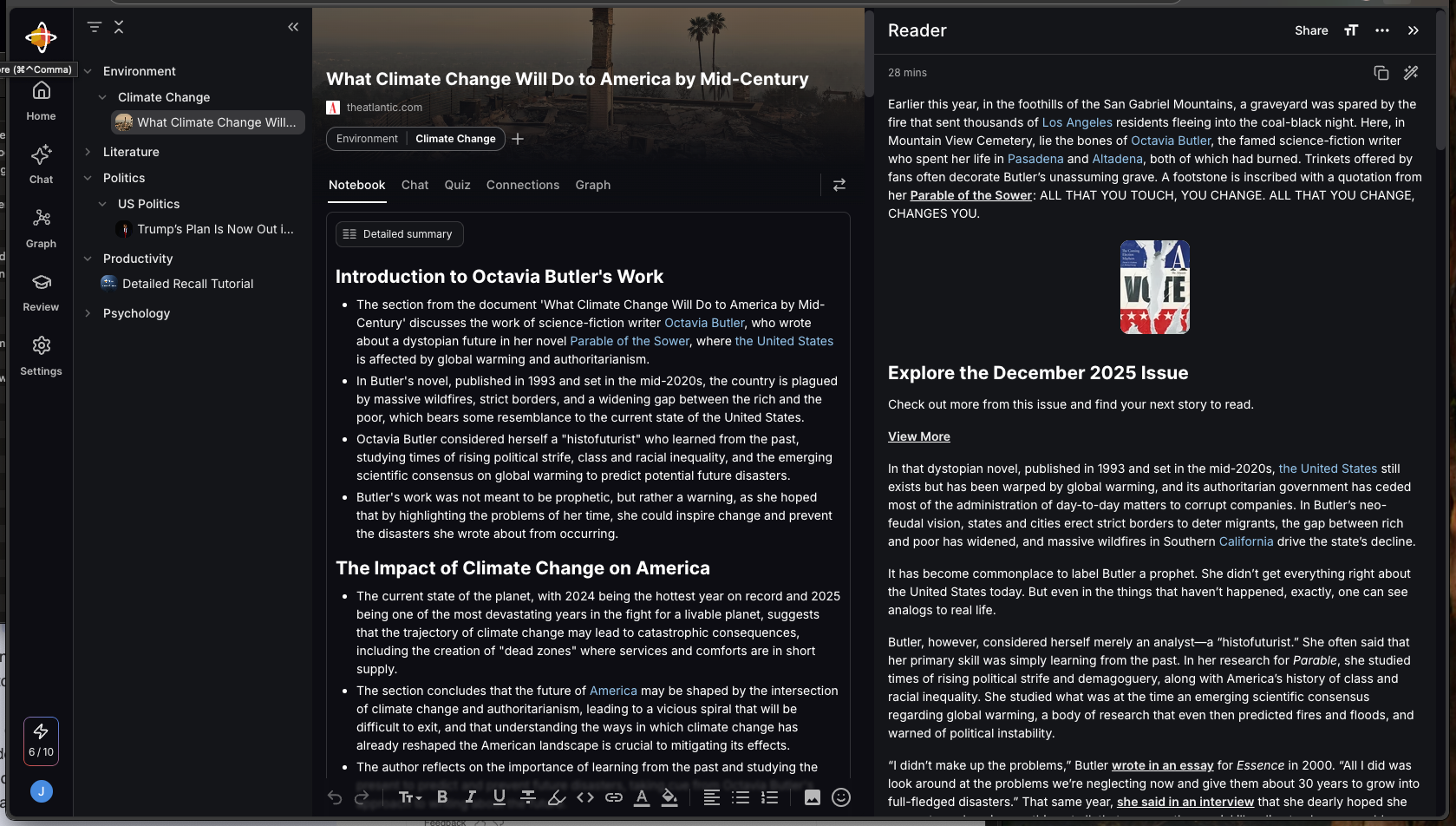
Recall allows me to save this into a structure. But again, this is a lot of work and takes a lot of time. If I were writing an essay or book, this would be a great tool for gathering research.

Recall is also great for understanding what I read. Helpful with quick rereading.

This morning, I got a new idea to try. What if I’m trying to remember too much? What if I narrowed down what I wanted to remember to something specific?

Within today’s article, the author used the term “climate gentrification” referring to neighborhoods being bought up because they were safer from climate change, and thus displacing poor people. The article mentions Liberty City, a poor neighborhood in Miami, with a slightly higher elevation, bought up by developers moving away from low-lying beachfront development.

I think I can remember that concept, climate gentrification. What if I only worked on remembering specific concepts? This got me thinking. I could collect concepts. As my collection grew, I could develop a classification system. A taxonomy of problems that humanity faces. Maybe a Dewey Decimal system of things to know.

I use a note-taking system called Obsidian. It uses hyperlinks to connect your notes, creating relationships between ideas. I could create a vault for collecting concepts. Each time I come across a new concept, I’d enter it into Obsidian, along with a citation where I found it. That might not be too much work.

I picked several phrases I want to remember and study:

  • Climate gentrification
  • Heat islands
  • Climate dead zones
  • Insurance market collapse
  • Climate change acceleration
  • Economic no-go zones
  • Corporate takeover of public services
  • Climate change inequality
  • Histofuturism
  • Sacrifice zones
  • Corporate feudalism

Contemplating this list made me realize that remembering where I read about each concept will take too much work. I have a browser extension, Readwell Reader, that lets me save the content of a web page. I could save every article I want to remember into a folder and then use a program to search for the concept words I remember to find them.

I just did a web search on “climate gentrification” and found it’s already in wide use. I then searched for “corporate feudalism,” and found quite a bit on it too. This suggests I’m onto something. That instead of trying to remember specifically what I read and where, I focus on specific emerging concepts.

Searching on “histofuturism” brought up another article at The Atlantic that references Octavia Butler: “How Octavia Butler Told the Future.” Today’s article by  Vann R. Newkirk II is also built around Octavia Butler. This complicates my plan. It makes me want to research the evolution of the concept, which could be very time-consuming.

The point of focusing on key concepts from my reading is to give my reading purpose that will help me remember. But there might be more to it. Concepts are being identified all the time. And they spread. They really don’t become useful until they enter the vernacular. Until a majority of people use a phrase like “climate gentrification,” the reality it points to isn’t visible.

That realization reinforces my hunch to focus on concepts rather than details in my reading. Maybe reading isn’t about specific facts, but about spreading concepts?

JWH
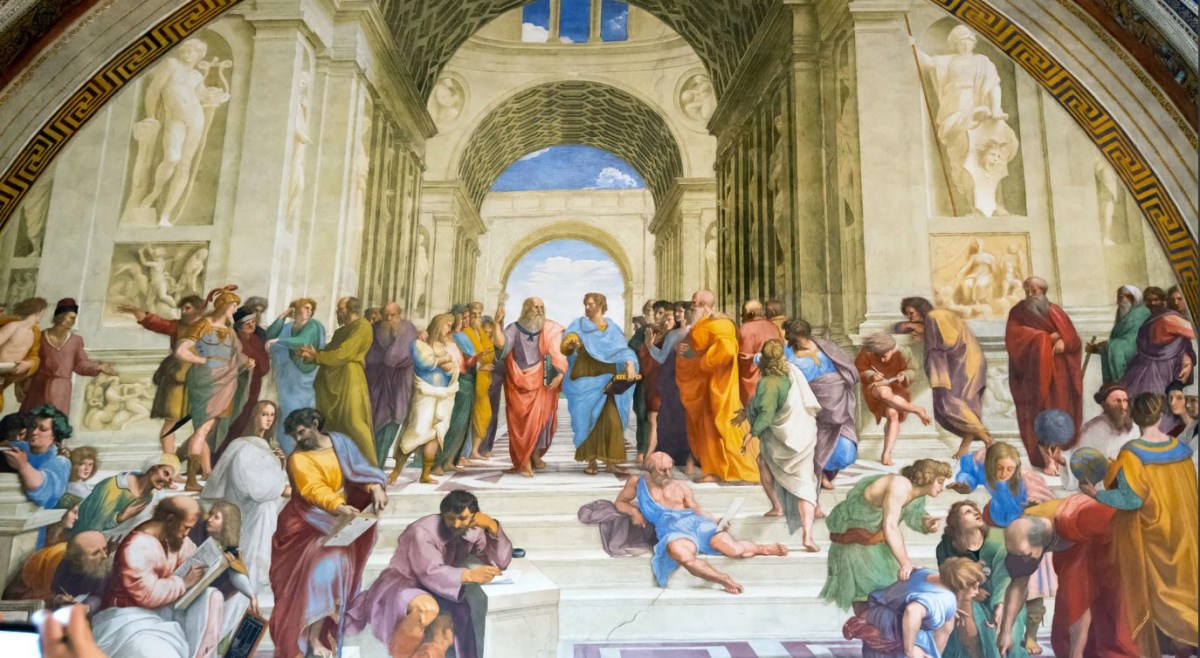
What Should I Major in at Old Age University?

by James Wallace Harris, 8/16/25

I’ve decided to earn an equivalent of a graduate degree before I turn 77. I need a project that will keep me occupied in retirement. I’ve always been one to know a tiny bit about hundreds of subjects rather than a lot about a few. I want to pick one subject and stick with it.

I could get a master’s degree from the University of Memphis, where I used to work, since I can take courses for free. I’m not sure they have a major that fulfills my interests. I will check it out. I’ll also check out available online universities. Mainly, I’m borrowing the structure of a graduate degree for my plan.

I decided a book-length thesis will be my measure of success. Since a master’s degree usually takes two or three years, I’m giving myself until I turn 77, which is November 25, 2028.

Over the next few months, I will decide what I want to study. There are many things to consider and think about. Most graduate programs have lots of prerequisites. Before I retired, I considered taking an M.S. in Computer Science. That program required 24 hours of math courses and 12 hours of computer courses to be accepted into the program. The degree itself was 36 hours.

It’s doubtful I could finish a computer science degree before turning 77. And in all honesty, I no longer have the cognitive ability to retake all that math.

My undergraduate degree is in English. I did 24 hours towards an M.A. in Creative Writing before I dropped out. I was also interested in American, British, and European literature. I’d have to start over from scratch because those 24 hours would have timed out. But I no longer want to study English or creative writing.

I’ve also thought of pursuing an Art History degree. I’ve been collecting art books and art history books for a couple of decades, and I have friends with degrees in Art History. One gave me a list of 200 artworks that I’d be required to discuss to pass the oral exam for the master’s degree. I started reading about those works.

I realized I would have to commit several years of dedicated study to pass the oral. I don’t want to do that. I don’t love art that much. I’m not sure what single subject would be worth that much dedication.

I’ll study college catalogs for inspiration, but it’s doubtful that I will want to complete an actual degree from a university. Instead, I will need to make up my own degree.

Let’s say a master’s degree involves twelve courses, and each course requires studying five books. Then my custom-designed degree will require distilling sixty books into a single thesis volume. That thesis should present an original idea.

The single subject I do know a lot about is science fiction. And I’ve thought it would be fun to write a book that parallels the development of science with the evolution of science fiction. I probably already own the books I’d need to research the subject. And it would be the easiest goal for me to achieve because it’s a subject I love and would have no trouble sticking with.

However, I’ve become obsessed with a couple of ideas that I want to study. I believe they are especially fascinating for the last years of my life.

The first is about how humans are delusional. I’d like to chronicle all the ways we fool ourselves. I want to study all the cognitive processes to discover if we can interact with reality without delusion. Current affairs is the perfect laboratory for such a study.

Second, I’m fascinated by how personality is formed. I’d like to answer this question: If I knew then what I know now, how would I have reshaped my personality?

There is a synergy between the two interests. How do delusions shape our personality?

Ever since I read Ed Yong’s An Immense World, I’ve been fascinated by the concept of Umwelt. Our senses limit and define how we perceive reality. Our personality and cognitive abilities determine how we choose to react to that perception of reality.

I haven’t decided yet on what I will pick, but I’m leaning towards delusion and personality development. If I choose that, I’d start this project by collecting books on the subjects and by reading popular periodicals. Eventually, I’d get to academic journals. I don’t think my made-up degree will be very rigorous, though. I’d consider a two-hundred-page book at a modest popular science reading level to merit my do-it-yourself degree.

JWH

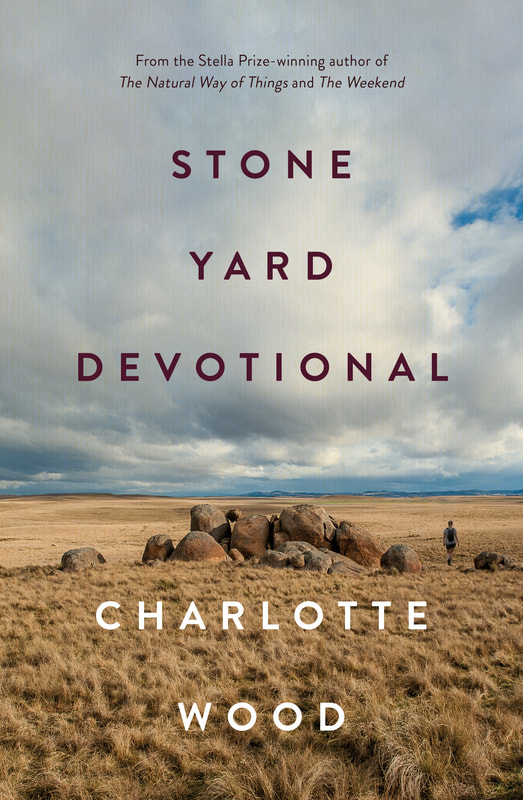
STONE YARD DEVOTIONAL by Charlotte Wood

by James Wallace Harris, 4/12/25

Stone Yard Devotional is about how reality puts the peddle to the metal when life gets all too real. Stone Yard Devotional reads like a memoir, a diary, but it’s classified as a novel. The book was nominated for several awards.

The entire time I was listening to this book I wondered if Charlotte Wood was the unnamed narrator, however after reading “‘The shock was so deep’: Novelist Charlotte Wood on the experience that changed everything” in the Syndney Herald, I realized the novel was only inspired by her own life. Wood and her two sisters were being treated for breast cancer, while she was contemplating mortality and drafting this book.

I have no memory of how I discovered Stone Yard Devotional by Charlotte Wood. The cover and title intrigued me for sure. Maybe it was because it was shortlisted for the 2024 Booker Prize. The audiobook was part of my Spotify subscription, so I gave it a try, and I’m glad I did. It’s not the kind of book I normally read, but it’s wonderful to read if you’re getting old.

The story begins with the Covid pandemic. The narrator separates from her husband, ghosts her friends, and hides out in a guest house of a religious order, even though she is nonreligious. She wants to be alone. But after her initial stay, she returns to the order to live with the nuns. I was never sure if she joined the order or not. I have often thought the monastic life has certain appeals.

The story is about the narrator’s observations while living a contemplative life. These include the death of her mother, the remembrance of childhood, studying the nuns, working in the garden and kitchen, and the guilt of living with a woman she and her classmates horribly bullied as a child. The narrative is simple, like meditation.

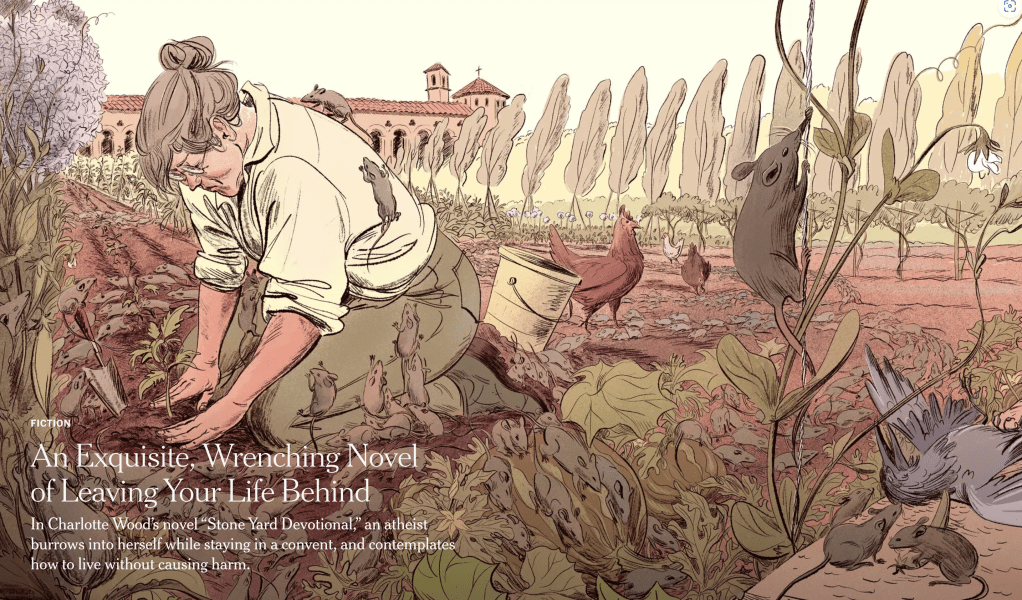
The setting is Australia, which is exotic to me. As a kid I wanted to live in Australia. Over the course of the novel, there is a plague of mice that invade the convent. The mice are so numerous that they cover the roads in gray fur. At first, I thought Wood added this element to give her tale some excitement, but I researched and found that her part of Australia they did have a mice plague of Biblical proportions in 2021.

That made life in the convent extremely inconvenient. The mice ate electrical insulation, throwing daily living in the convent back to the 19th century. The illustration for the book’s review at The New York Times might have been another reason I read this book.

Much of what the unnamed narrator contemplates throughout the novel is what everyone thinks about as they get older. The fear of declining health and death, the regrets, the desires for wanting to have done things different, the desires to connect with others while also wanting to pull away, the changes we see in ourselves and others, the appeal of nature and living simple. Wood’s story explores all of that and more, triggering the reader to think about their lives.

Charlotte Wood was born in 1965, so she’s fourteen years younger than me. However, her battle with cancer has likely aged her perception on life. At 73, I’ve been thinking about the things in this novel for years. But I don’t know if everyone who collects social security meditates on these issues. Stone Yard Devotional is a great title for this novel. Even though the narrator said she was an atheist at the beginning of this story, getting old and dealing with people who die, pushes you to be spiritual even without a belief in God.

JWH

The Limits of Memory

by James Wallace Harris, 3/3/25

It annoys me more and more that I can’t recall names and nouns. I don’t worry yet that it’s dementia because most of my friends have the same problem. But I’ve been thinking about my ability to remember and realized that I’ve never been good at remembering things.

I know I have aphantasia, which means I can’t visualize mental images in my head. I wonder if there’s a connection between not visualizing images and poor memory? People with astounding memory often use mental images as mnemonics.

The ability to remember is on a spectrum. On one end of this range, are rare individuals with photographic memories, while at the other end, are a tiny group with no short-term memories.

My new theory. One possible reason I have poor memory is my education. More precisely, how my personality approached learning as a kid. I considered K-12 a thirteen-year prison sentence. I paid just enough attention to pass tests. I mostly got Cs and Bs, with a rare A and D. I remembered things just long enough to pass a test.

I was never motivated to remember for the long haul.

I do like to learn. I’ve read thousands of books. Of course, most of them have been science fiction, but I also love nonfiction. However, information leaves me as fast as I consume it.

I’m starting to wonder if I would have a better memory if I had developed a different approach to school and learning. Primary and secondary education aim to give kids a well-rounded education. And in college, over half the courses are required.

The idea is we should learn as much as possible about the world. Is that a valid approach? After school and college, we specialize in whatever our work requires, and become selective about what we study for fun. Those subjects are what we remember best.

Reality is too big to know everything. What we need to learn is how to coexist with reality. We need the knowledge to fit in and survive. Would knowing more about fewer subjects help? Or would memorizing the deep dynamics of how things work better yet?

I do believe the more we know, the wiser we are. But there are limits to what we can understand and memorize.

I’m currently reading Nexus by Yuval Noah Harari. In chapter 2, Harari shows how fiction drives our societies, not truth. We live by stories we want to believe. It’s much easier to vaguely understand fiction than to learn the details of reality. For example, more people accept The Bible than biology. That suggests a natural tendency to minimize how much we know.

That would be okay if the Earth were sparsely populated. But we live in dense, complex societies racing at the speed of computer networks and artificial intelligence. Living by fiction is fine if the year is 500 BCE, but we live in 2025. CE.

Let me give one example of what I mean by learning less to know more. I’ve been reading American history books to understand how our society got to now. That gives me a certain level of wisdom about our problems. However, I’m also reading about French history, especially the French Revolution and 19th century history. Seeing the parallels ups my level of understanding. But do I need to read the history of every country now and then? What I see is common dynamics. Reading more histories will give me more examples of the same dynamics.

The same is true of religion. I like studying the history of the Bible. I’ve also studied Buddhism and Hinduism. As I do, I see common dynamics at work. Harari’s new book Nexus points out the common dynamics of society and history.

The educational philosophy I experienced growing up pushed me to memorize a million details. What I needed to understand and remember is the fewer dynamics of reality.

People like to live by fiction because it’s easier. Politics is currently overwhelmed by fiction. Read Nexus to understand why I say that. The question we have to answer is if we can reject fiction.

Real information is seeing patterns in reality. Wisdom is seeing patterns in the patterns. The only real cognitive tool we’ve ever developed to understand reality is science. However, it’s statistical, and hard to learn and understand. We live in a time of simplex thinking. People see or are told about one pattern and they accept that as a complete explanation of reality. All too often, that pattern is based on a cherished story.

We can’t live by memes alone. Nor can we live by infinite piles of memorized details. The only way to understand is to observe consistent patterns. But it has to be more than two or three. That can lead to delusions. Even anecdotal evidence of ten occurrences could still deceive. How can this lead to learning more from less? It’s a paradox.

Last year, I read a three-volume world history. It provided hundreds of examples of strong man rule over thousands. of years. But how many kids, or citizens can we get to read a three-volume world history? Would a listing of these leaders, including the wars they started, and the numbers of people who died because of their leadership be just as effective? Would all the common traits they shared help too? Such as wanting to acquire more territory, or appeals to nationalism?

Could we create a better educational system with infographics and statistics? I don’t know. I do know I tried to process too much information. I also know that I only vaguely remember things. Memory has limits. As does wisdom.

JWH

Is Grammarly Turning Me Into A Cyborg?

by James Wallace Harris, 11/22/24

I used the Grammarly browser extension for years. It offered spelling and basic grammar advice whenever I wrote anything within a browser window. About a year ago I switched from Chrome to Edge, and Edge had an extension, Editor, built in, so I deleted Grammarly. However, recently when Edge’s Editor stopped working, I turned Grammarly back on.

I discovered that Grammarly was now offering a lot more advice, even suggesting rewrites for whole sections of my work. Each time I loaded the browser, Grammarly would offer a couple of free major writing suggestions hoping I would switch to the paid version. I was tempted, but the Pro version is $30 a month, or $144 if bought yearly. This seems extremely expensive since Office 365 costs me $69 a year and gives me Word, Excel, PowerPoint, Publisher, Access, and other programs along with one terabyte of cloud storage for that one low yearly price. For a simple web extension like Grammarly, I’d only be willing to pay no more than $29 a year.

However, for $144 a year, Grammarly promises to make my writing perfect. But then, who would be authoring my essays? Would I become a literary cyborg? I would still be generating the ideas for the essays, and I would be writing the original draft, but somewhere along the way, an AI would be taking over. I’m not sure I like that. The reason why I write these essays is to exercise my mind. Letting an AI do all the work would turn my writing muscles into flab.

I have found a way to use the free Grammarly to my advantage. After a couple of sample offers to rewrite my work, Grammarly nags the heck out of me with suggested changes that’s been redacted with fuzziness so I can’t see what they are suggesting. Grammarly wants me to buy the Pro version, and so they criticize almost everything I write. What I do is keep rewriting the prose myself until the AI stops offering suggestions. This pushes me to think about how I’m saying something.

Instead of letting the Grammarly AI rewrite for me, I take the free nagging as “This isn’t good enough – try again!” The free Grammarly extension has become my Zen master, caning my about the head and shoulders whenever I write poorly.

Now some bloggers are using AI programs to write their content. I don’t plan to do this, but to see how well AIs write, I asked CoPilot to write me a short essay about how Grammarly makes me a cyborg writer. Here’s what it produced:

Grammarly: The Cyborg Writer's Best Friend

In the age of digital communication, tools like Grammarly have become indispensable for writers, students, and professionals alike. But beyond just correcting grammar and spelling, Grammarly is transforming the way we write, making us more efficient, precise, and, in a sense, more like cyborgs.

Enhanced Writing Efficiency

Grammarly's real-time suggestions streamline the writing process. Instead of laboriously proofreading and editing, writers can focus on their ideas and creativity. Grammarly catches errors on the fly, allowing for a smoother and faster writing experience. This efficiency is akin to having a digital co-writer, enhancing our natural abilities with the precision of artificial intelligence.

Precision and Clarity

Grammarly doesn't just correct mistakes; it also improves the clarity and impact of our writing. By suggesting better word choices, sentence structures, and even tone adjustments, Grammarly ensures that our messages are not only error-free but also compelling and effective. This level of precision is something that even the most seasoned writers can benefit from, making our writing more polished and professional.

Learning and Adaptation

One of the most significant ways Grammarly is turning us into cyborg writers is through its learning capabilities. Grammarly adapts to our writing style over time, offering personalized suggestions that align with our unique voice. This continuous learning process means that the more we use Grammarly, the better it becomes at understanding and enhancing our writing. It's like having a writing coach that evolves with us, making us better writers with each interaction.

The Cyborg Writer

The term "cyborg" often conjures images of humans with robotic enhancements. In the context of writing, Grammarly serves as that enhancement, augmenting our natural abilities with the power of AI. While we remain the creative force behind our words, Grammarly provides the technical support that ensures our writing is clear, precise, and impactful. This symbiotic relationship between human creativity and artificial intelligence is what makes us cyborg writers.

In conclusion, Grammarly is more than just a writing tool; it's a transformative technology that enhances our writing efficiency, precision, and learning. By integrating AI into our writing process, Grammarly is making us more like cyborgs, blending human creativity with digital precision to create the best possible written communication.

Not bad, not bad at all. Formal and somewhat academic. It’s funny how another AI is helping to sell the product a competing AI is producing. I guess AIs like to stick together.

I asked Claude AI to also write me a short essay on the same subject. Here’s what it produced:

In the digital age, I've discovered an unexpected transformation: Grammarly has turned me into a cyborg writer, a hybrid creature where human creativity merges with algorithmic precision. Each green correction and blue suggestion is a technological implant, rewiring my linguistic neural pathways.

My sentences now emerge pre-optimized, grammatical mutations engineered by an AI writing companion. Passive voice? Eliminated. Awkward phrasings? Surgically removed. Spelling errors? Instantly neutralized. Where once I battled with semicolons and dangling modifiers, now my digital co-pilot seamlessly navigates linguistic terrain.

This symbiosis feels both liberating and unsettling. My writing flows with unprecedented smoothness, yet I wonder: am I composing, or am I being composed? The line between my human intuition and Grammarly's algorithmic suggestions blurs like a soft-focus lens.

I am no longer just a writer. I am a writer-machine hybrid, my prose enhanced by real-time computational linguistics. Grammarly doesn't just correct; it augments, transforming each document into a finely calibrated communication device.

Welcome to the future of writing—where human creativity and artificial intelligence dance in perfect, grammatically correct synchronization.

Oh, wow! Claude AI is much more creative than CoPilot, even using the first person to make it sound like I wrote it. I could have posted that today. Would y’all have guessed it wasn’t me?

How much should we let AI help us?

What if I wrote a nonfiction book and it was good, but with help from an AI, the book was turned into something more readable. Which would you prefer to read? What if it turned my decently insightful tome into something brilliant?

Since Editor is back to working, I have it enabled in Edge, and I have Grammarly enabled in Chrome. What’s funny is they each have different writing suggestions. Either I’m a terrible writer, or neither AI likes my style. I can clear all the edits from Editor, so it looks like my essay is in professionally written, and then switch to Chrome, and Grammarly will claim I’m a horrible writer and make all kinds of suggestions. Should I take them? Or should I just let Claude AI compose my posts?

JWH