
by James Wallace Harris, 12/39/25
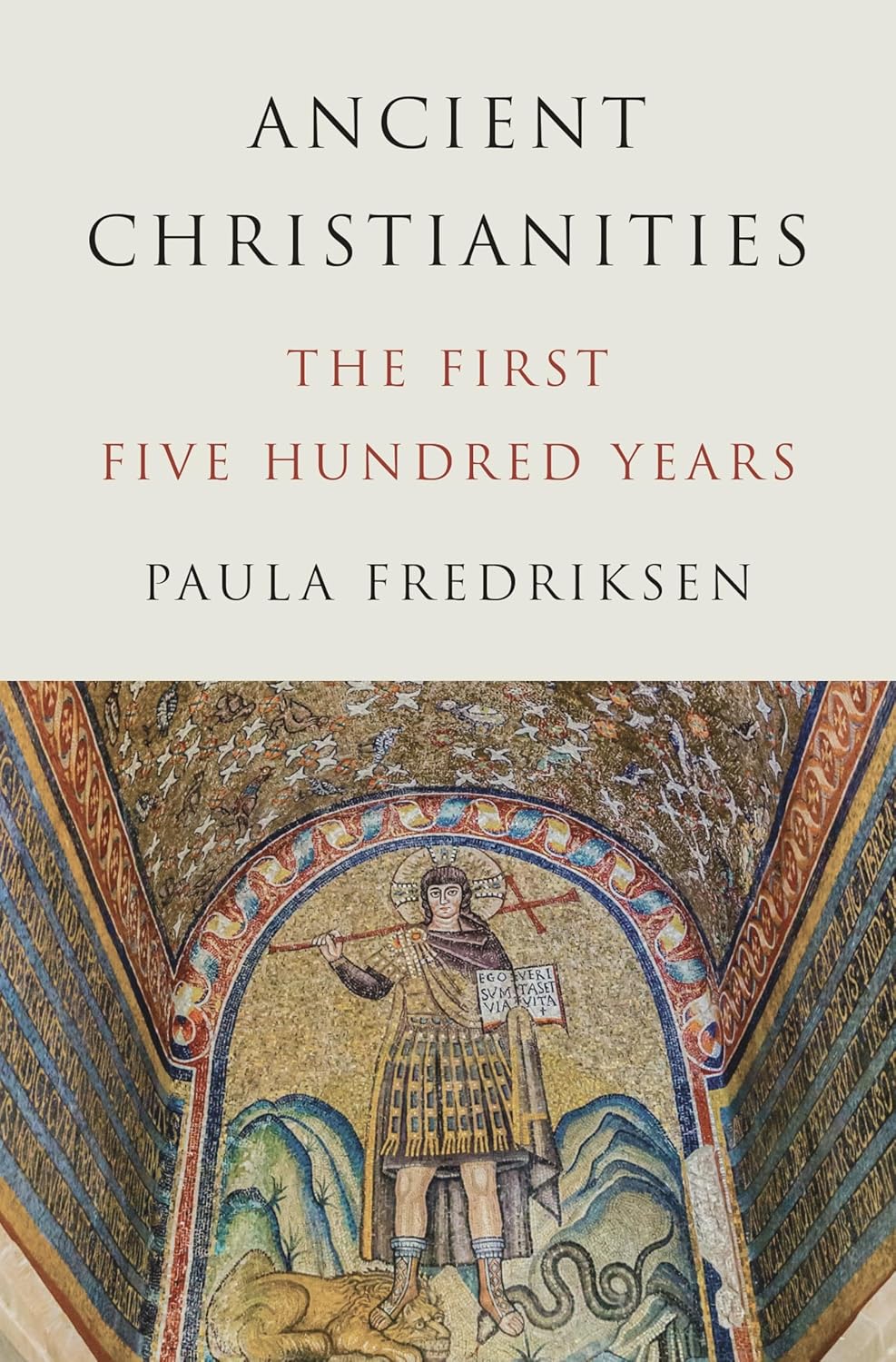
Ancient Christianities by Paula Fredriksen is a scholarly work that chronicles the evolution of Christian theology over its first half millennium. I would say this book is not for the faithful, but for readers who enjoy studying history. Paula Fredriksen is an American historian and scholar of early Christianity. She held the position of William Goodwin Aurelio Professor of Scripture at Boston University from 1990 to 2010. If you are considering reading Ancient Christianities, I highly recommend following the link to her name. Fredriksen has published several books on Jesus, Paul, early Christianity, and St. Augustine that I want to read.
I will not review Ancient Christianities; for that, I recommend reading Joseph Foltz’s review in Ancient Jew Review (May 14, 2025). Instead, I’m going to describe why I read this book.
I believe we are all brainwashed as children by our parents, family, teachers, peers, and churches. We can’t recall how we acquired our foundational beliefs because they were imprinted at a time when we understood little about reality. These beliefs are recorded so deeply in our minds that we seldom examine them. The amount of work it takes to explore this area of our personality is too great for most people.
There is a fascinating parallel between dredging up personal memories from our early minds and studying the history of the early formation of Christian theology. It’s impossible to know anything for sure about either. However, working with memory and history can be enlightening.
I gave up religion back in the mid-1960s, but I’ve never been able to erase everything that going to church as a child put in my head. However, I’ve always felt kindly towards the person we call Jesus. I assumed he discovered a new way of seeing the world that was more compassionate than was common over two thousand years ago.
Over the years, I’ve read many books by historians trying to discover who Jesus was and what he taught. I’ve concluded it is impossible to know what Jesus believed or preached, and Ancient Christianities only confirms this conclusion.
If you study all the various sects of Christianity and all its theologians, you will not find one common denominator. Whatever Jesus believed, it’s been obscured by thousands of new opinions. Some scholars claim that Jesus might not have existed at all, but was created to promote specific concepts. But we can’t even identify the first creator of Jesus, because the idea of Jesus has been recreated countless times over the last two thousand years.
Because Jesus didn’t write down his philosophy, we can’t say for sure what it was. The earliest writings about Jesus come from Paul, but we can’t trust them because Paul didn’t know Jesus. Paul wrote letters about Jesus twenty years after Jesus died. He says very little about Jesus the man. But that’s like you writing about someone you heard about who died in 2005.
The authors of Matthew, Mark, and Luke wrote decades later and told different stories about Jesus that don’t always match up. That’s like writing about someone you heard about who died in 1980.
The author of the Gospel of John wrote even later and went full gonzo on the story of Jesus.
Paul Fredriksen recounts how many other men wrote stories about Jesus in the following four hundred years. Everyone made something new up. And some of their ideas involve concepts as far out as those imagined by science fiction writers.
Ancient Christianities is about endlessly reinventing Jesus over five hundred years. Those ideas are so ancient, so deep in our collective unconsciousness, that they are like ideas that we acquired when we were four, and dwell in the darkness of our unconscious minds.
Every theologian and every historian has their own theory about Jesus’ identity. All we can do is pick the one we like the best, but we can never know.
I’ve always wanted to believe Jesus was the guy who came up with the ideas in the Sermon on the Mount. I’m not so sure anymore. I’m currently leaning towards the idea that Jesus was a radical who wanted to overthrow the system. It’s not hard to picture him talking like the hotheads on the internet with big ideas. And that the Sermon on the Mount came from a later storyteller.
There’s a wonderful book, The Five Gospels: The Search for the Authentic Words of Jesus. It’s based on the Jesus Seminar, where, over a decade, theologians and historians debated which passages in red in the New Testament were said by the historical Jesus. The Five Gospels is based on voting, and the results are color-coded. Even among experts, there is no complete agreement. We tend to advocate for what we want to believe. Confirmation bias is powerful.
Books like Ancient Christianities help us understand how commonly believed concepts evolved from specific people. (By the way, it’s all men.)
If you read enough history books about religion, you realize there is no divinity anywhere to be found. It’s all concepts created by men. Like the famous story by Carl Sagan, it’s turtles all the way down.
JWH

 Auxiliary Memory