Am I Too Old To Start A Second Brain?

by James Wallace Harris, 12/8/25

For years now, I’ve been reading about people who create a second brain to record what they want to remember. Most of these second brain systems use software, but not all. Many base their ideas on the Zettelkasten system, which was originally stored on note cards.

Over the years, I’ve tried different methods and software applications. I’m currently learning Obsidian. I’ve used note cards, notebooks, Google Docs, Evernote, OneNote, InstaPaper, Recall, and others. I love reading – taking information in – but I don’t like taking notes.

The trouble is, information goes through my brain like a sieve. When I want to tell someone about what I’ve learned, or think I’ve learned, I can’t cite my source, or, for that matter, clearly state what I think I know. And I seldom think about how I’ve come to believe what I believe.

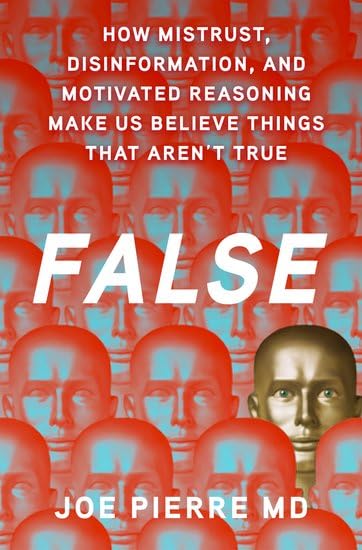
I’m currently reading False by Joe Pierre, MD, about how we all live with delusions. This book makes me want to rededicate myself to creating a second brain for two reasons. First, I want to take precise notes on this book because it offers dozens of insights about how we deceive ourselves, and about how other people are deceived and are deceiving. Second, the book inspires me to start tracking what I think I learn every day and study where that knowledge comes from.

One of the main ways we fool ourselves is with confirmation bias. Pierre says:

In real estate, it’s said that the most important guide to follow when buying a house and trying to understand home values is “location, location, location.” If I were asked about the most important guide to understand the psychology of believing strongly in things that aren’t true, I would similarly answer, “confirmation bias, confirmation bias, confirmation bias.”

Pierre explains how the Internet, Google, AIs, Social Media, and various algorithms reinforce our natural tendency toward confirmation bias.

Pierre claims there are almost 200 defined cognitive biases. Wikipedia has a nice listing of them. Wikipedia also has an equally nice, long list of fallacies. Look at those two lists; they are what Pierre is describing in his book.

Between these two lists, there are hundreds of ways we fool ourselves. They are part of our psychology. They explain how we interact with people and reality. However, everything is magnified by polarized politics, the Internet, Social Media, and now AI.

I’d like to create a second brain that would help me become aware of my own biases and fallacies. It would have been more useful if I had started this project when I was young. And I may be too old to overcome a lifetime of delusional thinking.

I do change the way I think sometimes. For example, most of my life, I’ve believed that it was important for humanity to go to Mars. Like Elon Musk, I thought it vital that we create a backup home for our species. I no longer believe either.

Why would I even think about Mars in the first place? I got those beliefs from reading dozens of nonfiction and fictional books about Mars. Why have I changed my mind? Because I have read dozens of articles that debunk those beliefs. In other words, my ideas came from other people.

I would like to create a second brain that tracks how my beliefs develop and change. Could maintaining a second brain help reveal my biases and thinking fallacies? I don’t know, but it might.

Doing the same thing and expecting different results is a common fallacy. Most of my friends are depressed and cynical about current events. Humanity seems to be in an immense Groundhog Day loop of history. Doesn’t it seem like liberals have always wanted to escape this loop, and conservatives wanted to embrace it?

If we have innate mental systems that are consistently faulty, how do we reprogram ourselves? I know my life has been one of repeatable behaviors. Like Phil Conners, I’m looking for a way out of the loop.

Stoicism seems to be the answer in old age. Is it delusional to think enlightenment might be possible?
JWH
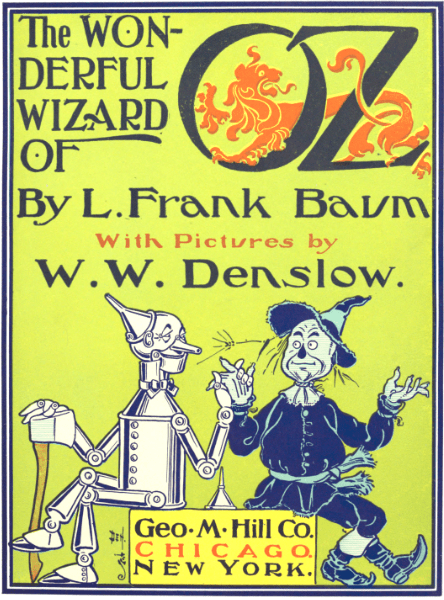
Can Rereading THE WONDERFUL WIZARD OF OZ Help Me Remember What It Was Like to Be Ten Years Old?

by James Wallace Harris, 12/5/25

While watching Wicked, I struggled to recall the excitement I felt when I first read the Oz books at age 10 back in the summer of 1962. I wanted to know whether the fantasy world Wicked created matched the one L. Frank Baum created in his fourteen Oz novels.

The barrier to making this comparison is memory. Memories are highly unreliable. Plus, we overwrite our memories every time we recall them, so am I really remembering 1962, or just the last time I thought about reading the Oz books as a kid?

Like most of my brain excavations, I have to rely on logic and deduction instead. I also look for corroborating evidence. I spent many days on this problem, and here are my results.

The Oz books were the first novels I discovered on my own. For various reasons, I concluded this was the summer between the 5th and 6th grades. My family lived on base at Homestead Air Force Base, and I found the Oz books in the children’s wing of the base library. They were old and worn.

The first novel I remember is Treasure Island by Robert Louis Stevenson, which my mother read to me in the third grade. I started using libraries in the fourth grade, but read nonfiction books about airplanes, space travel, cars, and animals.

I remember roaming up and down the fiction section at the base library and discovering the Oz books. I had no idea who L. Frank Baum was, nor did I have any idea when they were written. I didn’t know about copyright pages or genres. I saw “Oz” on the spines and connected those books to the 1939 film, The Wizard of Oz, which I had seen on television every year since the 1950s.

I did not know the word fantasy. I doubt I understood the concept of fiction. In other words, these books were an exciting discovery. To compound that excitement, they were all set in the same fictional universe. They were my Harry Potter books. L. Frank Baum had tremendous world-building skills.

Analytically, I know that at ten, I didn’t know much about the world. My vocabulary was limited. And I was unaware of most concepts and abstractions. My previous beliefs in fantasy – Santa Claus, the Easter Bunny, and the Tooth Fairy had caused me great embarrassment in first grade when a girl called me a baby for mentioning them. I was five, she was six.

In other words, I knew Oz did not exist, even though Baum created so many wonderful details to make it believable. I remember wanting Oz to exist, but I knew it didn’t. I don’t think I grasped the idea of fantasy at that time. All I knew was that the books created an artificial reality in my mind that was mesmerizing.

Watching Wicked and then rereading The Wonderful Wizard of Oz this week let me compare the two versions of Oz, but I couldn’t compare my initial reactions. Wicked is quite colorful, creative, and contains many elements of the original stories, but it no longer worked on me as the Oz books had in 1962. And that’s to be expected, since I’m 74, long past the age for fairytales.

My quest changed. I now wanted to know how my ten-year-old self saw the world. Rereading The Wonderful Wizard of Oz gave me very few clues.

My contemplations led me to some ideas, though. I have damn few memories of life before age five. I have zillions of memories dating from age five to twelve. I started thinking about them, and a revelation came to me.

Before age five, I theorize our minds are like LLMs (large language models). Those AIs can take in information and react to it, but they are unaware of the world. After five, but before puberty, we develop some self-awareness, but it’s very limiting. It isn’t until around twelve or thirteen that we start thinking for ourselves.

Here’s my main bit of evidence. As a child, my mother told me about God and took my sister and me to Sunday School and church. I just accepted what I was told. But when I was twelve, I started thinking about what they were telling me about religion. I didn’t buy it. I considered myself an atheist by 1964, when I was thirteen, maybe fourteen.

In my thirties, when I was working in a library, I came across an article that said that some librarians in the 1950s felt the Oz books gave children unrealistic expectations about life, and pulled the books from their shelves.

When I read that, I knew it had been true for me. The Oz books led me to science fiction, a genre that also inspired unrealistic expectations regarding the future that have proven to be unrealistic.

Here’s the thing: I was being told two fantasies at age ten. The first was from The Bible, and the second from the Oz books. Looking back, I see that my young self began to reject religion at age ten because I preferred the stories from L. Frank Baum. I wasn’t aware that I was comparing two fantasies; I just preferred one over the other.

Then I discovered science fiction. Concurrently, I was also discovering science. That gave me the illusion that science fiction was reality-based. When I consciously rejected religion, I thought I was choosing science. However, in recent decades, I’ve realized I had substituted science-fictional fantasies for religious fantasies.

I realize now that the Oz books had the power of Bible stories on me at age ten. The reason why so many people are true believers as adults is that they were programmed as children. Wicked doesn’t have that kind of power over me today. I can’t remember what that power felt like, but I do remember that for a few weeks in 1962, the ideas in the Oz books set my mind on fire. Rereading The Wonderful Wizard of Oz did not reignite that fire because I’m no longer a believer in anything.

I’ve often wondered if I hadn’t been lied to about Santa Claus, the Easter Bunny, and the Tooth Fairy, and thus had not experienced humiliation at discovering they were lies, and if I also hadn’t discovered Oz books, would I have accepted the Bible stories as truth as a kid and believed them now?

JWH

Reading With a Purpose

by James Wallace Harris, 11/12/25

I used to keep up with the world by watching NBC Nightly News with Lester Holt, reading The New York Times on my iPhone, and bingeing YouTube videos. I felt well-informed. That was an illusion.

I then switched to reading The Atlantic, New York Magazine, The New Yorker, and Harper’s Magazine. I focused on the longer articles and developed the habit of reading one significant essay a day. That has taught me how superficial my previous methods were at informing me about what’s going on around the world. Television, the internet, and newspapers were giving me soundbites, while articles provide an education.

However, I still tend to forget this deeper knowledge just as quickly. I don’t like that. I feel like I learn something significant every day. What I’m learning feels heavy and philosophical. However, it drives me nuts that I forget everything so quickly. And I’m not talking about dementia. I think we all forget quickly. Just remember how hard it was to prepare for tests back in school.

I’ve watched dozens of YouTube videos about study methods, and they all show that if you don’t put information to use, it goes away. Use it or lose it. I’ve decided to start reading with a purpose.

At first, I thought I would just save the best articles and refer to them when I wanted to remember. That didn’t work. I quickly forget where I read something. Besides, that approach doesn’t apply any reinforcing methods.

I then thought about writing a blog post for each article. It turns out it takes about a day to do that. And I still forget. I needed something simpler.

I then found Recall AI.

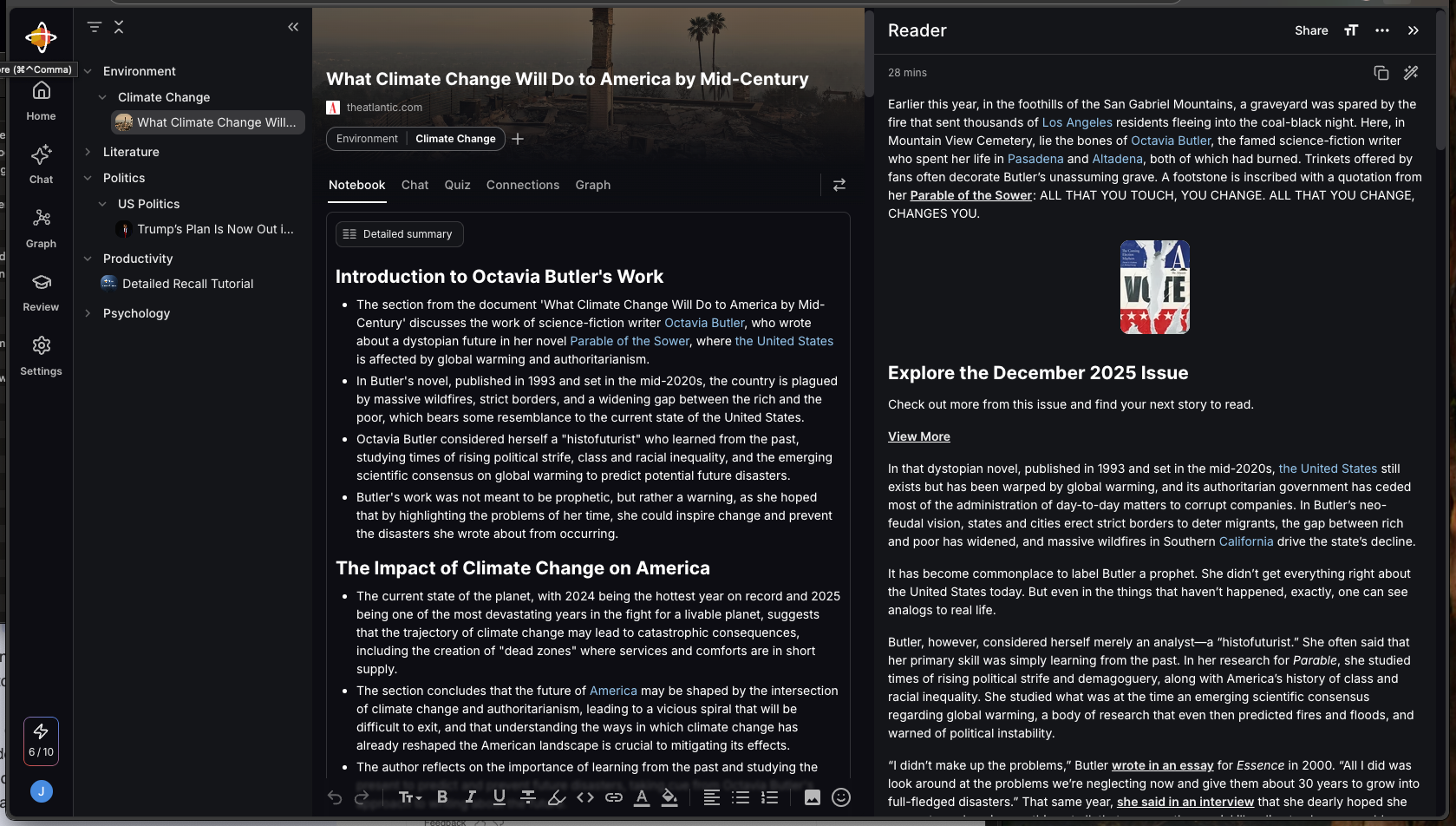
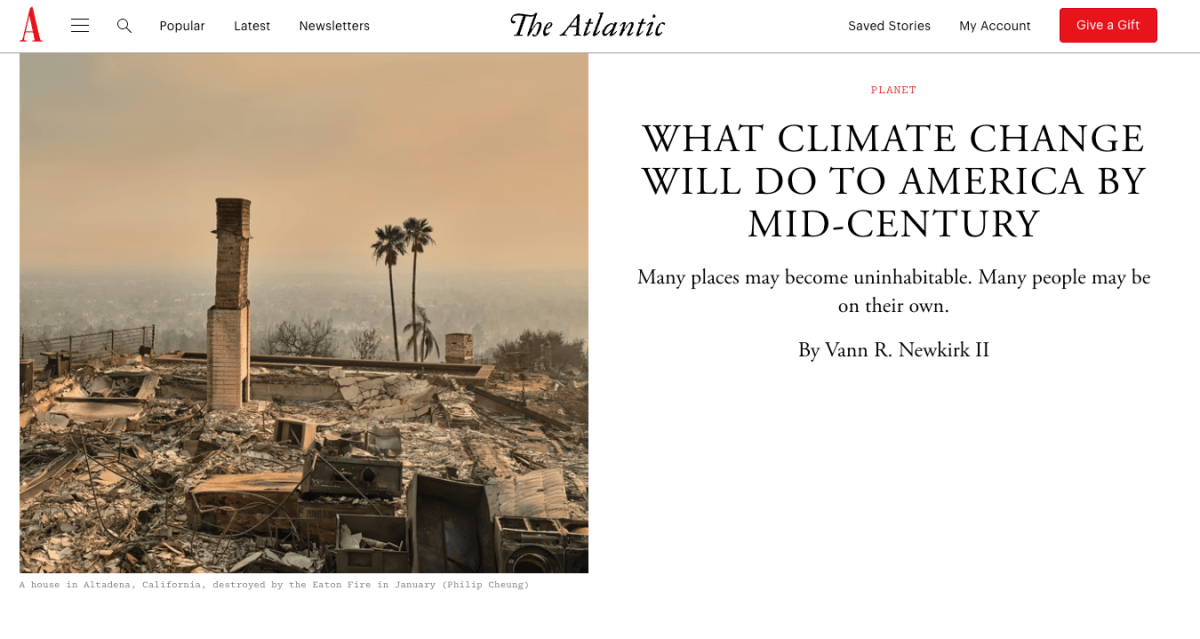
It reads and analyzes whatever webpage you’re on. Providing something like this for today’s article by Vann R. Newkirk II, “What Climate Change Will Do to America by Mid-Century:”

Recall allows me to save this into a structure. But again, this is a lot of work and takes a lot of time. If I were writing an essay or book, this would be a great tool for gathering research.

Recall is also great for understanding what I read. Helpful with quick rereading.

This morning, I got a new idea to try. What if I’m trying to remember too much? What if I narrowed down what I wanted to remember to something specific?

Within today’s article, the author used the term “climate gentrification” referring to neighborhoods being bought up because they were safer from climate change, and thus displacing poor people. The article mentions Liberty City, a poor neighborhood in Miami, with a slightly higher elevation, bought up by developers moving away from low-lying beachfront development.

I think I can remember that concept, climate gentrification. What if I only worked on remembering specific concepts? This got me thinking. I could collect concepts. As my collection grew, I could develop a classification system. A taxonomy of problems that humanity faces. Maybe a Dewey Decimal system of things to know.

I use a note-taking system called Obsidian. It uses hyperlinks to connect your notes, creating relationships between ideas. I could create a vault for collecting concepts. Each time I come across a new concept, I’d enter it into Obsidian, along with a citation where I found it. That might not be too much work.

I picked several phrases I want to remember and study:

  • Climate gentrification
  • Heat islands
  • Climate dead zones
  • Insurance market collapse
  • Climate change acceleration
  • Economic no-go zones
  • Corporate takeover of public services
  • Climate change inequality
  • Histofuturism
  • Sacrifice zones
  • Corporate feudalism

Contemplating this list made me realize that remembering where I read about each concept will take too much work. I have a browser extension, Readwell Reader, that lets me save the content of a web page. I could save every article I want to remember into a folder and then use a program to search for the concept words I remember to find them.

I just did a web search on “climate gentrification” and found it’s already in wide use. I then searched for “corporate feudalism,” and found quite a bit on it too. This suggests I’m onto something. That instead of trying to remember specifically what I read and where, I focus on specific emerging concepts.

Searching on “histofuturism” brought up another article at The Atlantic that references Octavia Butler: “How Octavia Butler Told the Future.” Today’s article by  Vann R. Newkirk II is also built around Octavia Butler. This complicates my plan. It makes me want to research the evolution of the concept, which could be very time-consuming.

The point of focusing on key concepts from my reading is to give my reading purpose that will help me remember. But there might be more to it. Concepts are being identified all the time. And they spread. They really don’t become useful until they enter the vernacular. Until a majority of people use a phrase like “climate gentrification,” the reality it points to isn’t visible.

That realization reinforces my hunch to focus on concepts rather than details in my reading. Maybe reading isn’t about specific facts, but about spreading concepts?

JWH

Reading at 13 vs. 73

By James Wallace Harris, 10/19/25

At thirteen, I read books entirely differently than I do now at seventy-three. I think everyone does, but it’s not apparent why. Our memory gives us the illusion that we’ve always been the same person. But if we think about it, there is plenty of evidence that we couldn’t have been.

I’ve been thinking about the difference between my younger reading self and my older reading self while writing a review of The Foundation Trilogy by Isaac Asimov for my other blog. Every so often, I reread a book I read as a teenager. For some books, it’s a nostalgic return to a familiar, comfortable place. For most books, it’s just vague recollections.

My first realization from trying to reconstruct my reading mind at age 13 was to remember that I read very fast. I consumed books like potato chips. Reading was like casually watching TV. Words just flowed past my eyes, and I didn’t always pay attention to every word. I just read to find out what happened.

I have a fond memory of reading The Foundation Trilogy, but a limited one. I liked the idea of a galactic empire in decline. However, the only chapter I can remember is the first one, “The Psychohistorians.” It wasn’t until decades later that I learned that the trilogy was a fix-up novel based on nine stories running from short stories to novellas.

Thinking about it now, I realize that most of the ideas in the book didn’t mean much to me at 13. I had not studied or read about the Roman Empire, Asimov’s inspiration. Actually, I probably didn’t know what an empire was either. Nor did I understand all the references to nobility, aristocracy, and politics.

As a teenager, I mostly read science fiction books. I did read some popular science books too. My awareness of the world and my vocabulary were limited. However, I didn’t know that. And I wasn’t the kind of person who looked up words I didn’t know. What’s weird is that I was a kind of know-it-all.

One way to judge my teenage brilliance was that my favorite TV show at the time was Gilligan’s Island. When I catch that show today, I can only assume I was brain-dead back then.

I’ve tried to reread The Foundation Trilogy twice now. The first time was in 2015, and now in 2025. In both cases, I could only finish the first book of the trilogy. I loved the first story, but with each additional story, I detested them more.

At first, I thought that Asimov’s most famous books were just bad. But I’ve known people smarter than me, and just as old, who say they still loved the Foundation series. One woman in our reading group said the Foundation stories were a great comfort to reread. And I recently heard that twenty million copies of the series have been sold.

Not only was my current reading self different from my younger reading self, but I’m out of step with millions of readers. This got me thinking about the different modes of reading.

I think the most basic mode is just to let fiction flow over you. You read whatever pleases you. And you don’t think about why.

Then, as we age, we become more judgmental. We learn more about life and reading. We develop a process of natural selection by rejecting what we don’t like. We don’t think much about why we don’t like what we don’t like. We just evolve into a reading machine that knows what it likes.

Two other reading modes are: English teachers or literary critics. These are very critical modes, and often they take the fun out of reading. I think as I’ve gotten older, my reading habits have taken on a bit of these two modes. While in them, it’s all too easy to shoot Asimov down.

However, I’ve discovered another mode recently when I read “Foundation” for the fourth time. “Foundation” was the first story published in the series in 1942. While reading this story yet again, I kept admiring Asimov for where he succeeded and not where he failed.

In my rereadings, I’ve always come to the series wanting to love it. And I’ve always been disappointed by how much I didn’t. But with this reading, I worked to think like Asimov. What was he trying to do, and how did he go about doing it?

I’m in the process of documenting this for my other blog, Classics of Science Fiction. I’m writing this now because the other post is going to take a long while to complete.

I never would have put this much effort into reading a story when I was a teen. Or any time before I was 73.

One reason I dislike this story in recent years is my skepticism. I don’t believe humans will ever travel to the stars, much less form a galactic empire. Another reading mode I’m trying to develop is to read with the mind of a person from when the story was first published.

Trying to read like Asimov thought and how science fiction fans felt in 1942 is difficult. I’m reminded of Samuel R. Delany’s concepts of simplex, complex, and multiplex that he described in his story Empire Star. I started out as a simplex reader and eventually evolved into a complex one. Now I’m moving into a multiplex reader.

Multiplex thinking often involves holding contradictory viewpoints. I really dislike the Foundation stories. But if I work at it and look at them in just the right way, I can like them too. It’s hard. It’s a Sisyphean struggle learning to admire something that triggers so many annoyances, but I’m working on it.

JWH

Avoiding Mirages in Reality Created By Words

by James Wallace Harris, 10/12/25

Humanity is plagued by delusions generated by words. We struggle to distinguish between words that point to aspects of reality and words that point to fictional mirages. In other words, we can’t differentiate between what is real and shit we make up.

I’m partial to an unverified quote attributed to James Michener, “The trick to life is to make it to 65 without being either a drunk or insane.” Sanity is notoriously hard to define. Many of us can stay sober until 65, but do any of us stay sane till then? Don’t we all end up seeing things that aren’t there? Don’t we all embrace cherished delusions to cope with life?

Of course, you will disagree with me. We all know what we believe is real.

Language allows us to be self-aware and manipulate reality, but don’t many of our words point to theoretical concepts that don’t actually exist in reality?

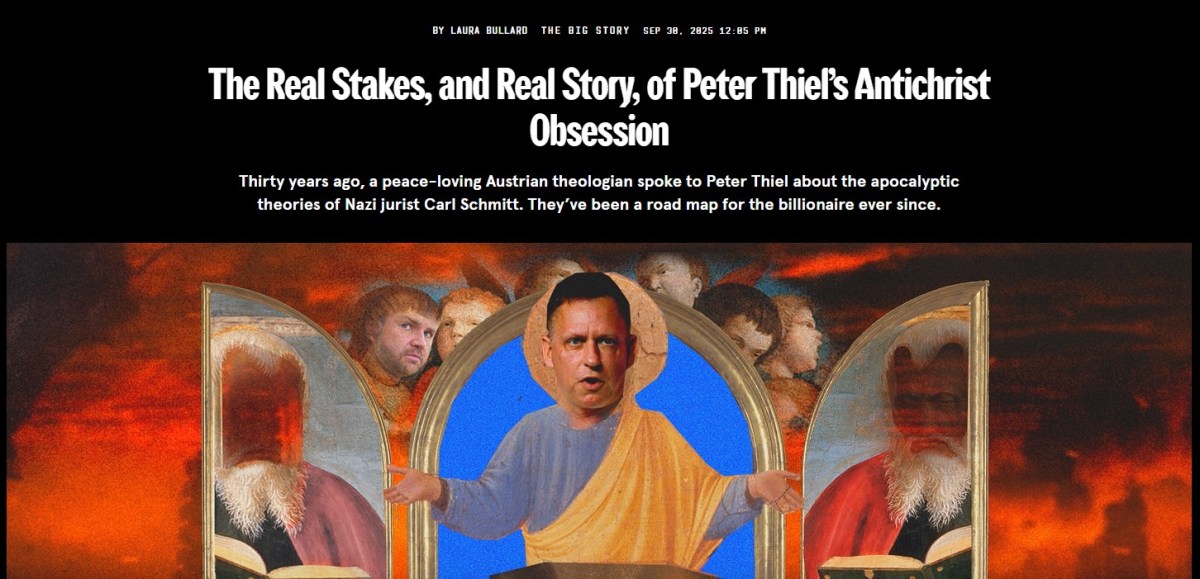
I recently read “The Real Stakes, and Real Story, of Peter Thiel’s Antichrist Obsession” in Wired Magazine. [Nearly everything I read is behind a paywall. I use Apple News+ to access hundreds of magazines and newspapers that exist behind a paywall. Wired shows the entire article for a few seconds. If you immediately right-click and select Print, a copy of this article can be read in your printer preview window. If you don’t catch it the first time, refresh the page. Or read other articles about this.]

Recently, Peter Thiel gave a four-part lecture on the Antichrist and the Apocalypse. In her Wired article, Laura Bullard attempts to decipher what Thiel is preaching.

By Thiel’s telling, the modern world is scared, way too scared, of its own technology. Our “listless” and “zombie” age, he said, is marked by a growing hostility to innovation, plummeting fertility rates, too much yoga, and a culture mired in the “endless Groundhog Day of the worldwide web.” But in its neurotic desperation to avoid technological Armageddon—the real threats of nuclear war, environmental catastrophe, runaway Al—modern civilization has become susceptible to something even more dangerous: the Antichrist.


According to some Christian traditions, the Antichrist is a figure that will unify humanity under one rule before delivering us to the apocalypse. For Thiel, its evil is pretty much synonymous with any attempt to unite the world. “How might such an Antichrist rise to power?” Thiel asked. “By playing on our fears of technology and seducing us into decadence with the Antichrist’s slogan: peace and safety.” In other words: It would yoke together a terrified species by promising to rescue it from the apocalypse.


By way of illustration, Thiel suggested that the Antichrist might appear in the form of someone like the philosopher Nick Bostrom—an Al doomer who wrote a paper in 2019 proposing to erect an emergency system of global governance, predictive policing, and restrictions on technology. But it wasn’t just Bostrom. Thiel saw potential Antichrists in a whole Zeitgeist of people and institutions “focused single- mindedly on saving us from progress, at any cost.”

So humanity is doubly screwed: It has to avoid both technological calamity and the reign of the Antichrist. But the latter was far more terrifying for the billionaire at the podium. For reasons grounded in Girardian theory, Thiel believed that such a regime could only—after decades of sickly, pent-up energy—set off an all-out explosion of vicious, civilization-ending violence. And he wasn’t sure whether any katechons could hold it off.

Thiel draws theology from the Bible, philosophy from studying with René Girard, and apparently combines them with ideas from Carl Schmitt, a political theorist from Nazi Germany, to create a rather bizarre warning about our future.

Because Thiel is a billionaire, he’s able to spread his beliefs widely. And because our society is overpopulated with people searching for meaning, we have a problem.

I’ve been collecting news stories and sorting them into two categories. The first deals with delusions that affect individuals. The second collects reports showing how we’re failing as a species. I could have filed this Wired article under both.

Whether as individuals or as a species, we act on false assumptions about reality. We often assume things to exist that don’t. Such as the Antichrist, or for that matter, The Christ. There may or may not have been a historical person we call Jesus. That may or may not have been his name. The concept of Christ was created over several generations of his followers. It has no real existence in reality. And neither does the Biblical Apocalypse or Antichrist. Those concepts have been redefined repeatedly over twenty centuries.

Among the thousands of Christian denominations that have existed over the past two millennia, there is no consensus on what Jesus preached or what is meant by the term Christ. In other words, there is no common denominator between Christians. This is because their beliefs are imaginary concepts that each individual redefines for their own use in words.

Religious beliefs are fine as long as they remain private to an individual, but when they are used to shape reality, they become dangerous. I often read about people who want to use their beliefs to make others conform to their illusions. That disturbs me.

But I’m only now realizing why. It represents a failure of language. Language is useful as long as words point to aspects of reality. The closer words stay to nouns and verbs that have a one-to-one relationship with things or actions within reality, the safer we are. It’s the words we fight over their definitions. That’s when things get dangerous.

Peter Thiel’s bizarre philosophy becomes dangerous when he can get others to accept his definitions. As I read news stories, I see this validated time and again. How many Russians and Ukrainians would be alive today who died because of Putin’s mirage of words? Look at any war, political conflict, or personal argument, and you can often trace it back to the ideas of one person.

Even my words here will incite some people.

As my last years fade away, I struggle to comprehend the years living in this reality. I’m starting to see that most of the confusion comes from interpreting words. The more I approach my experiences with the Zen-like acceptance of what is, the calmer things get. Eastern religions took a different approach to reality. In the West, we work to shape reality to our desires. Eastern philosophers teach that we should accept reality as it is. There are also dangers to that approach.

The reality is that humans create climate change. Many people can’t accept that reality. They use language that creates a mirage that many want to believe. That is one form of action. It’s a way of manipulating the perception of reality. That will actually work for those people, for a short while.

The weakness of our species is that we manipulate the perception of reality instead of actually making real changes in reality.

That’s how I now judge the news. A plane crash is a real event, not a mirage. But how often are men seeking power describing something real?

JWH