12 Reasons Why I’ve Stopped Watching the NBC Nightly News

by James Wallace Harris, 7/29/25

I developed the habit of watching the CBS Evening News with Walter Cronkite when JFK was assassinated in 1963. I had just turned thirteen. Cronkite had been the first to switch to a half-hour evening news format that September. I only had a vague sense of what the news was before that. I stuck with CBS until the 1980s, into the Dan Rather years. For some reason, my wife and I then switched to ABC for a couple of decades before finally switching to NBC. When Lester Holt retired, I decided to stop getting my news from television.

Since then, I’ve been thinking about what it means to follow the news. Does it require a daily habit of studying current affairs? Should we consider the news to be any reporting of significant events that have recently happened? How much information can be crammed into twenty-two minutes of television? Who decides what is worth knowing? Recently, NBC chose to make the deaths of two celebrities the lead story two nights running. Were the careers of Ozzy Osbourne and Hulk Hogan the most important information I needed to know on those two days? Think about it. Of all these events happening around the world on those two days, were their deaths the most essential for me to learn about?

Reason 1

I’m not picking on NBC. All the broadcast networks and the cable news networks decided what their audiences want to watch based on ratings. It’s not that Ozzy and Hulk’s deaths are more newsworthy than famine in Gaza, but NBC knows its audience is tired of hearing about starving Palestinians, and more people would watch their show if it opened with Osbourne and Hogan.

Decision 1: I need to decide what’s newsworthy.

Reason 2

Is twenty-two minutes enough time to learn about the critical world events that happened in the last twenty-four hours? Just how much time should I devote to being well-informed? If it is as little as twenty-two minutes, then television is the wrong medium. Reading just the headings of all the news stories from a quality newspaper app on my phone serves me far better.

Television news spends most of its time on visual news. Often, NBC repeats exciting film clips several times. That’s not an efficient use of time. Airplane crashes and flooding rivers grab our attention, but is it really news we need?

Decision 2: I need to decide how much time I want to spend on the news. Additionally, I need to decide on the best medium that maximizes that time.

Reason 3

Too much of television news is taken up by reporters and anchors. Often, reporters take more time asking a question than the time given to the eyewitness’s reply. I’m not interested in reporters or anchors.

Decision 3: I need to look for news sources where the journalist is in the background. That excludes television and most podcasts. Generally, good print reporting only includes the reporter’s byline.

Reason 4

Television news offers low-quality information. A major article in The Atlantic might have taken months to research and write. Such articles are information-dense. TV news is written and edited quickly. There’s not much time for fact gathering or checking. It’s often based on eye-witnesses who mainly add emotional impact rather than inform. Television news relies on soundbites, which are mostly opinions. Experts interviewed on TV news are often selected by convenience rather than their authority.

There have been over 22,500 days since I started watching nightly news programs on TV. There is an incredible sameness to the kind of content TV news presents. I should have abandoned it long ago, but it gave the illusion I was being informed, and it was convenient.

Decision 4: Pick another medium for consuming news.

Reason 5

Television news is narrow in scope. It focuses on catastrophes, tragedies, and political conflict. Over a lifetime of seeing thousands of news reports on wildfires, they all look and feel the same. That’s also true for wars, airplane crashes, riots, elections, famines, hurricanes, floods, and tornadoes. Television news mainly focuses on the types of stories we’ve seen repeated throughout our lives.

Television makes it seem like there is nothing new under the sun. I’ve learned from reading quality magazine articles and newspaper journalism that that old bit of wisdom is completely untrue. Magazine and newspaper articles constantly amaze me with news that surprises me because it’s about people, places, concepts, ideas, and events I’ve never heard of before.

Decision 5: Find more news sources that teach me about reality, inspire my curiosity, and better inform.

Reason 6

TV news is seldom memorable. If John F. Kennedy’s assassination was only reported once on the CBS Evening News on November 22, 1963, I doubt I would even remember the event. I remember it because of constant coverage over several days, including all the documentaries, movies, and books that have been produced since that day. I remember Project Mercury, Gemini, and Apollo missions because of the around-the-clock television coverage, as well as the documentaries, movies, and books that have been produced since those events. That’s why I don’t remember all the space missions since. They didn’t get such coverage.

A thirty-second spot on the nightly news, or even a big event stretched to four minutes of reporting, just isn’t remembered. I don’t need to waste time on ephemeral news stories. I’ve discovered it’s far better to spend thirty minutes on one topic than two minutes on fifteen topics.

Decision 6: Focus on one news topic for most of my daily time spent on the news. Then quickly go over the headlines.

Reason 7

Television news isn’t educational because it focuses on the same topics. Shouldn’t news enlighten us about reality? Shouldn’t we always expand our awareness of what’s going on in the world?

How can short videos and soundbites be truly informative? I want news that adds to my personal growth. News that adds wisdom, not ephemeral data.

Decision 7: Make lists of what I want to learn about and then find news reports that bring me up to date on those topics.

Reason 8

Television news is biased. Knowing the truth is impossible. Content produced for money-making ratings or to promote a political agenda will always be questionable. I even suspect the kind of long-form journalism that goes out of its way to appear unbiased. I expect all writing to have some bias. It’s my job to spot it.

Decision 8: Start analyzing prose for bias. Think about word choices in each sentence. Always wonder if information is left out.

Reason 9

Real knowledge is statistical. Science is our only cognitive tool that consistently explains reality. News is too close to word-of-mouth. We need news to be closer to peer-reviewed science journals. That’s probably impossible, but we need to think about it. Ground News attempts to apply statistics to the news by comparing political bias and the amount of coverage a story receives. Can’t we find other statistical methods to measure the news?

Decision: Don’t trust any news unless it comes from multiple sources.

Reason 10

Replying on a single network for news is dangerous.

Decision 10: Seek out different gatekeepers. Every group or organization has an agenda. Learn what that agenda is before interpreting what they are saying.

I’ve discovered that reading/listening to one well-reported article a day is much more informative and educational than a package of video clips and soundbites. I’ve been achieving this with Apple News+, which offers content from over 400 magazines and newspapers. Each morning, I listen to a single long-form article from magazines such as The Atlantic, New York Magazine, The New Yorker, and New Scientist, while I do my physical therapy and morning walk.

Reason 11

Television news can be misleading. It’s not as dangerous as AI-generated fake news on YouTube, but television news is easily corrupted by money, marketing, and politics.

Decision 11: Always consider the source of the news. I need to decide which news sources I will trust.

Reason 12

Most television news gives the United States’ perspective of world events.

Decision 12: Find news sources from around the world.

Conclusion

This is just the beginning of changing a lifelong habit of watching the nightly news on television. I should have made these changes long ago. We all get into ruts that are hard to escape. I believe getting old is making me regret not trying other approaches to understanding reality. However, all the political turmoil since 2016 is making me question everything I know. Human-created and computer-created fake news is disturbing. In recent years, I’ve decided that all of us suffer from multiple delusions.

You shouldn’t ask yourself if you’re delusional, but how delusional. Anyone who feels they know the truth is crazy. We can only guess what might be true by using statistics. Television has always depended on the false assumption that seeing is believing. I have doubts about believing anything.

Television, politics, artificial intelligence, and the Internet have corrupted our perception of reality. I want to rethink everything. I’m starting with my old habit of watching the nightly news.

JWH

Has Retirement Made Me Lazy, Or is the Laziness a Byproduct of Aging?

James Wallace Harris, 6/22/25

Before I retired in 2013, I assumed I’d have all the time in the world to do everything I ever wanted once my 9-to-5 burden was lifted. However, I have done less and less each year. I’m still disciplined about doing my chores and meeting my responsibilities, but the discipline needed to pursue my hobbies and pastimes is dwindling away.

I’m not depressed, I eat right and exercise regularly, and I have a positive outlook. I just don’t spend my free time on hobbies like I once did. Instead, I churn through the YouTube videos or play on my iPhone during idle moments. I hear that’s also a problem for kids, so maybe it’s not aging, but it feels age-related.

Why do I think that? Well, for one, it seems like people slow down when they get older. Here’s what happens. I’ll be working on an objective I consider fun. For example, I got a new Ugreen NAS and was setting it up to use Jellyfin as a media server. The task is tedious because it’s new and has a steep learning curve. I work at it for a bit, feel tired, and decide to put it away for the day. When I was younger, I could work on a tedious problem for hours. Now I can’t.

Do I quit quickly because my older mind can’t handle the task? Or has all that web surfing, channel hopping, and doom scrolling weakened my discipline? I became addicted to audiobooks in 2002 and have read less since, is another example.

This is a kind of chicken-and-egg problem. Has technology weakened my mind? Or was my mind slowing down, and technology is a useful adaptation? I have read more books since the advent of Audible.com.

Here’s another bit of evidence. When I worked full-time, I did far more after work than I do with unlimited free time in retirement. I didn’t have an iPhone back then. Why didn’t I put the same number of work hours into my hobbies after I retired? Did being free of work responsibilities ruin my discipline?

I shouldn’t agonize over this problem if doing less is part of aging. However, does retiring make us age faster? Is technology making us lazier? I have no answer.

I could test things by limiting my screen time. My emotional reaction to that idea is about what a thirteen-year-old feels when a parent tells them they need to cut back on their screen time.

I’m constantly thinking about aging. Philosophically, it’s an interesting concept. Comparing it to the old nature vs. nurture debate, I would consider aging a problem of decay vs. mind. We know we will all end up as worm food. The challenge is to be the most interesting and creative worm food before we’re eaten. The insidiousness of aging is accepting that it’s time to be eaten.

JWH

I Can’t Believe the Most Essential Aspect of Sexual Reproduction and Gender Has Gone Unnoticed Until Now

by James Wallace Harris, 4/29/25

I suppose because humans have always reproduced like bunnies, we’ve always ignored an essential aspect of sexual reproduction and gender. Statistically, we need every female to have more than two children. Because some women can’t have children, and because some girls die before reaching reproductive age, to keep the population steady during current conditions requires 2,100 babies to be born to every 1,000 women. That number varies depending on the state of medicine and the number of catastrophes.

In 2024, 1,626 babies were born to every 1,000 women in the United States. That’s not enough. If we continued at that rate, we’d eventually become extinct. In many other countries, that number is much smaller than 1,626.

Why aren’t these statistics common knowledge? Why didn’t we learn them when our parents (or peers) taught us about sex? It’s a heavy responsibility to know that we should all have children. My wife and I didn’t have children. Most of my friends didn’t have children. Why did we all start doing our own thing and forget this essential aspect of life?

It’s unfair that the burden of maintaining the species falls on women. To maintain the current population, every woman needs to have two children, and one in ten needs to have three. That’s assuming all women can have children. The practical need is for all women to have three children. Few women want that today.

Males don’t escape responsibility either. The species could get by with fewer males for making babies, but we need males to support the raising of children. I suppose a feminist utopia could get by with an exceedingly small number of males, or even none if women perfected cloning, but the statistics of maintaining the species are the same even if males weren’t needed.

However, we have evolved into a society/culture that doesn’t want enough children. What does that mean? Should we make people have more babies?

I wrote about this yesterday. However, the impact of these numbers didn’t hit me until 3:11 am last night.

For humanity to survive, we must deal with climate change, environmental sustainability, capitalism, inequality in all forms, artificial intelligence, and reproductive stability.

Theoretically, we could solve all these problems, but I doubt we will. The obvious solution is that civilization will collapse, and we’ll fall back into previous kinds of social organizations. It’s a fascinating challenge to imagine a society that can solve all these problems. However, can you imagine any future where all fertile women must have three children, and all men must become dedicated fathers? I can’t.

The human race needs to act radically differently. Is that possible?

JWH

STONE YARD DEVOTIONAL by Charlotte Wood

by James Wallace Harris, 4/12/25

Stone Yard Devotional is about how reality puts the peddle to the metal when life gets all too real. Stone Yard Devotional reads like a memoir, a diary, but it’s classified as a novel. The book was nominated for several awards.

The entire time I was listening to this book I wondered if Charlotte Wood was the unnamed narrator, however after reading “‘The shock was so deep’: Novelist Charlotte Wood on the experience that changed everything” in the Syndney Herald, I realized the novel was only inspired by her own life. Wood and her two sisters were being treated for breast cancer, while she was contemplating mortality and drafting this book.

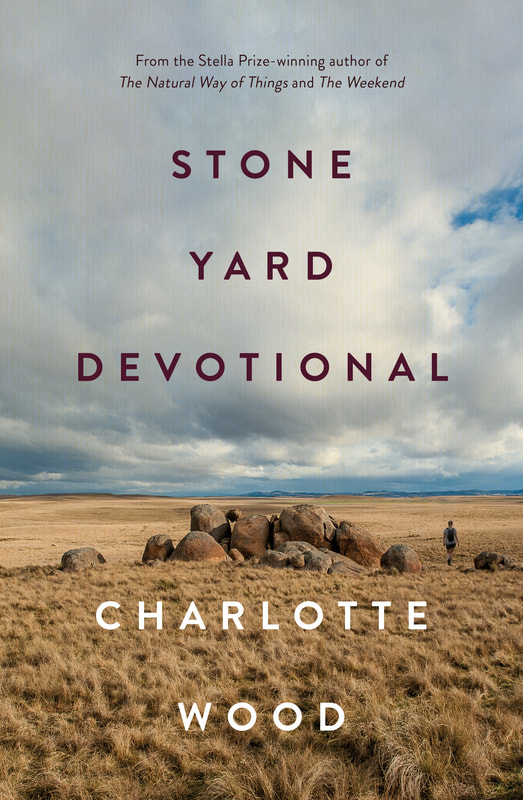
I have no memory of how I discovered Stone Yard Devotional by Charlotte Wood. The cover and title intrigued me for sure. Maybe it was because it was shortlisted for the 2024 Booker Prize. The audiobook was part of my Spotify subscription, so I gave it a try, and I’m glad I did. It’s not the kind of book I normally read, but it’s wonderful to read if you’re getting old.

The story begins with the Covid pandemic. The narrator separates from her husband, ghosts her friends, and hides out in a guest house of a religious order, even though she is nonreligious. She wants to be alone. But after her initial stay, she returns to the order to live with the nuns. I was never sure if she joined the order or not. I have often thought the monastic life has certain appeals.

The story is about the narrator’s observations while living a contemplative life. These include the death of her mother, the remembrance of childhood, studying the nuns, working in the garden and kitchen, and the guilt of living with a woman she and her classmates horribly bullied as a child. The narrative is simple, like meditation.

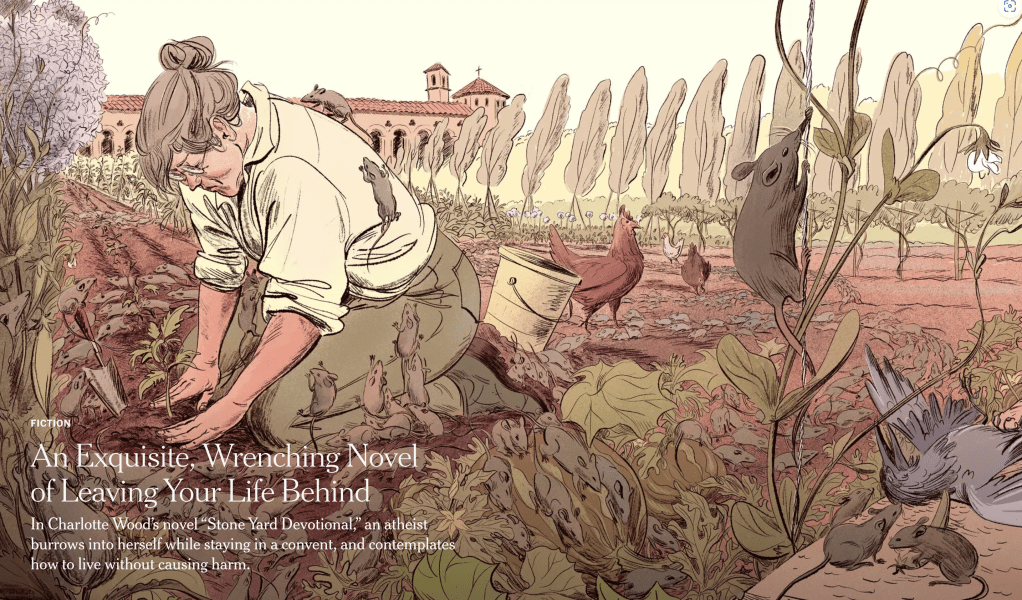
The setting is Australia, which is exotic to me. As a kid I wanted to live in Australia. Over the course of the novel, there is a plague of mice that invade the convent. The mice are so numerous that they cover the roads in gray fur. At first, I thought Wood added this element to give her tale some excitement, but I researched and found that her part of Australia they did have a mice plague of Biblical proportions in 2021.

That made life in the convent extremely inconvenient. The mice ate electrical insulation, throwing daily living in the convent back to the 19th century. The illustration for the book’s review at The New York Times might have been another reason I read this book.

Much of what the unnamed narrator contemplates throughout the novel is what everyone thinks about as they get older. The fear of declining health and death, the regrets, the desires for wanting to have done things different, the desires to connect with others while also wanting to pull away, the changes we see in ourselves and others, the appeal of nature and living simple. Wood’s story explores all of that and more, triggering the reader to think about their lives.

Charlotte Wood was born in 1965, so she’s fourteen years younger than me. However, her battle with cancer has likely aged her perception on life. At 73, I’ve been thinking about the things in this novel for years. But I don’t know if everyone who collects social security meditates on these issues. Stone Yard Devotional is a great title for this novel. Even though the narrator said she was an atheist at the beginning of this story, getting old and dealing with people who die, pushes you to be spiritual even without a belief in God.

JWH

Old Man vs. Front Lawn (Round 2)

by James Wallace Harris, 10/25/24

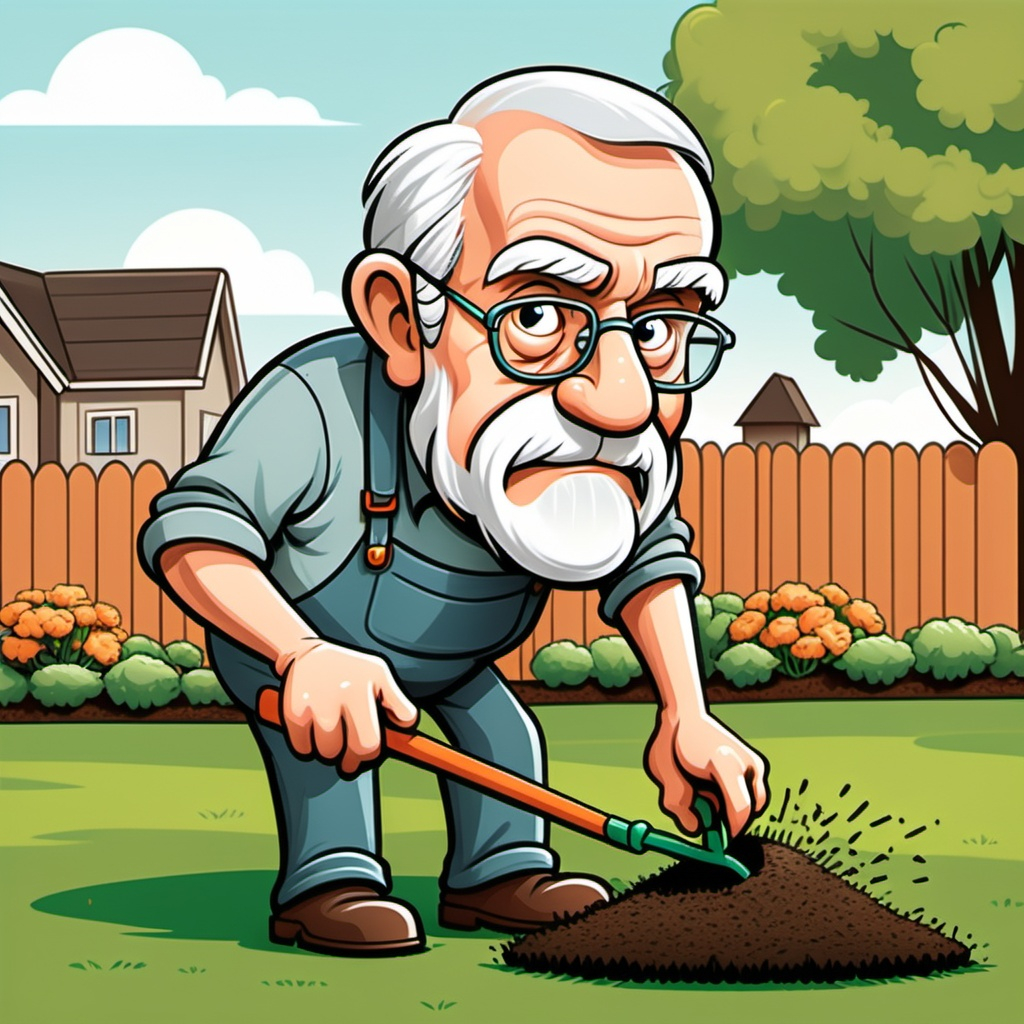
Like I said in the first round, I don’t care about having a perfect lawn. I’m using converting my front lawn from mostly dirt to mostly anything green as a physical challenge to improve my health and stamina. Because I suffer from spinal stenosis, sciatica, neuropathy in my legs, and muscle spasms in my lower back, I can’t do much physically. However, I’m testing the theory that if I slowly do a little more, I can eventually do a lot more. It’s also a way of psyching myself out. I want to believe that I’m not too old to keep doing certain things.

This effort has worked out some. I started out wearing myself out in ten or fifteen minutes. But now, I can work up to an hour on some days. But on most days, I usually spend just twenty minutes twice a day watering the new grass. I also bought the book Back Mechanic whose author, Stuart McGill proposes that back pain is often due to weak muscles and that strengthening them will eliminate back pain. I’m hoping yard work will strengthen my core muscles.

In round two I’ve learned several new things about yardwork and about my health. Having a new challenge is good for me mentally. I dislike doing yardwork, but my body doesn’t like being sedentary. I also dislike being outdoors but being outside in my front yard is teaching me about nature, getting me to learn new skills, encouraging me to talk to my neighbors and introducing me to all the walkers, runners, roller skaters, and dog owners in the neighborhood.

Initially, I thought growing new grass would only entail spreading seeds, fertilizing, and watering twice a day for a few weeks until the grass grew in. It hasn’t been that easy.

My ground is very compact and hard. The seeds only spouted in random places. Then fall began, and leaves started covering the new grass, killing it. Damn.

I called my yard guy to come remove the leaves early. That was Monday. It’s now Friday, and the leaves are back. I’m going to need to have the leaves removed every three or four days. I can’t afford that. I bought a Worx corded leaf blower and a 100 ft. extension cord.

This morning, I tried blowing the leaves myself and made a major discovery. Besides blowing the leaves, the leaf blower blows away all the loose dirt. No wonder my ground is so hard and compact. The grass seeds struggled to pierce the smooth hard soil with their tiny roots, so I need lots of loose dirt. That means no more leaf blowing. (I did learn the leaf blower is great at cleaning off walkways, driveways, and patios, so I’ll keep it. I also imagine, if I had a thick lawn, the blower would only blow leaves.)

I need to rake the leaves manually or consider mulching them with a mower. I also need to buy several loads to topsoil and spread it over my front yard. What have I gotten myself into?

And where there aren’t bald hard dirt spots, there’s thick weeds, old crabgrass, and patches of my new grass. I’ve discovered I need to dethatch my lawn. Before I started this project, I didn’t even know that was a thing.

I bought the corded Worx leaf blower because it was cheaper and blew stronger than a battery-powered leaf blower. But I quickly learned that working with a cord is a pain. For some reason, most of the lawn geek YouTubers use corded dethatching machines. I need to research if a battery-operated dethatching machine works as well as a corded one. I’d probably only use it once or twice a year, that is if all that leaf raking doesn’t kill me first (and I give up on this project). (I also bought a 16-gauge extension cord, and it gets warm. I bet need to buy a more expensive 12-gauge cord.)

This isn’t all I’ve learned in Round 2. I’ve now bought enough garden tools and machines that I need to buy a toolshed. Maintaining a yard requires a great deal of work and a lot of equipment. I’m back to fantasizing about living in an apartment again. But then I wouldn’t have this useful purpose that helps me mentally and physically. (That’s me trying to psyche myself up.)

I’m considering trying a third seeding. My neighbor who had a groundskeeping company in his younger days, recommended I try winter rye. Can rye and tall fescue coexist? This project also involves learning a lot of new things about how nature works.

Do I have enough time before the first freeze to get some grass seeds to germinate and grow a few inches? To do it properly, I’d need run the dethatch machine with both the dethatch and scarifier blades over the lawn. Spread the seeds. Then put down some garden soil, peatmoss, or compost lightly over the seeds. And keep watering twice a day. Also do some more fertilizing. I don’t know if I have the energy for all that right now.

This is never ending. Being a lazy couch potato was so much easier.

Maybe I should put all this off until spring and see how much grass I grow from my first two seedings. It’s coming up good in some places.

I could stick to watering and raking for the rest of the year – that should be plenty of exercise and outdoor activity. Raking should loosen up the soil some, but mulching might add to the soil. I got to research that to see which is best. I can’t stop thinking about all the options. I need to AI program to help me.

I hadn’t realized how much I was killing my grass by leaving the leaves on it until Thanksgiving, and then again to Christmas.

I’ve taken a beating in round two. I’m tired, but not hurting too bad. I’m trying to figure how much should I push myself in round three. Should I just continue with what I’ve started, or push myself to a new effort level before winter comes in?

I do know that all this yardwork is draining away all my energy for doing hobbies inside the house. I wanted to believe that exercising would give me more energy, but so far that hasn’t work out.

JWH