Science v. Greed

by James Wallace Harris, 9/9/25

What if the greatest threat to truth isn’t ignorance—but desire? In a world overflowing with information, we rely on cognitive tools like religion, politics, philosophy, and science to make sense of reality. But as greed hijacks our narratives and undermines our trust in evidence, science—the one tool built to transcend bias—is under siege.” – Microsoft CoPilot

This essay describes how I evaluate my daily news feeds. We all rationalize what we want with cognitive tools humans have evolved to explain reality. Two tools dominate many news reports covering current events: science and greed.

If an electron had consciousness, imagine it attempting to explain its existence and describe its position in reality. We are no more significant than an electron, yet we explain our existence with an array of cognitive tools that justify our lives. Cognitive tools are linguistic systems that explain reality to ourselves and others.

Of all the changes our society is undergoing in 2025, the one I fear the most is the attack on science. Science is the only cognitive tool we’ve developed that consistently explains reality across minds and cultures. Unfortunately, reality is complex and science is statistical. Most individuals can’t comprehend complexity. This is especially true when math is required.

Most individuals choose a cognitive tool on faith. They will never understand what they believe or how they believe it. Even believers in science accept it mostly through faith. That’s a shame, faith is a terrible cognitive tool. It is the root of all delusion.

I know early Christian theologians made a virtue out of faith, but consider the logic behind it. They were asking their followers to believe something they couldn’t prove. Because I’m not a scientist, I can only accept scientific claims about reality on faith in science. I don’t like that, but I have to be honest with myself.

However, science’s peer-reviewed research can be studied. Scientific results evolve with constant retesting, which can also be studied. Scientific knowledge is applied in technology, which is further validation.

Faith is a cognitive tool, but a dangerous one. It promotes belief over evidence.

Throughout our evolution, we’ve developed several cognitive tools to explain reality. Religion is the people’s favorite. Unfortunately, religion doesn’t describe reality; it only claims to. To support its views on reality, religions spawned morality to impose order on individuals. Religions are fantasies we create to rationalize our fears and wants. Religion is a cognitive tool we use to impose an explanation on reality, one imagined by one person, and spread to others.

Politics is another cognitive tool we use to impose order onto reality. Politics began with the strength of one individual, which spread to groups. Eventually, weaker individuals gained power by using religion. Finally, collectives gained power through consensus. Politics often combines tools such as science, religion, art, philosophy, ethics, and others to create an ordered system within reality.

The next significant cognitive tool to emerge was philosophy. Philosophy gave us mathematics, ethics, logic, and rhetoric. We learned a great deal from philosophy, but ultimately, it can lead to endless speculation. Philosophy often became another tool for rationalization for what we wanted to believe.

Science is a collective effort that works to eliminate bias. Science studies patterns and consistency that can be measured by all observers. The results of science are not absolutes, only our current best working hypothesis. Science has proved to be the supreme cognitive tool because it works so consistently. Technology is applied science. We only have to consider the success of technology as the best proof that science is an effective cognitive tool.

Many humans can’t handle science. They are willing to accept science if it agrees with their wants. But they reject science when it gets in the way of their desires. Greed is steamrolling science today because some individuals have wants that are more powerful than scientific explanations.

I wanted to link to an article in Bloomberg, “Why Iowa Chooses Not to Clean Up Its Polluted Water,” but it’s behind a paywall. Bloomberg subscribers can read it, but that costs $39.99 a month. Apple News+ subscribers can read it for $12.99 a month. It was the perfect article to illustrate my essay. It described how all the cognitive tools I covered are used to rationalize polluting water in Iowa.

[I’ve since found a free video version of this article on YouTube.]

I’ll use a general example in case you don’t want to watch the video. Take climate change. Science has been consistent in predicting what will happen if we increase the concentration of CO2 in the atmosphere.

There are trillions of dollars worth of fossil fuels waiting to be extracted. The people who own the rights to those fossil fuels don’t want to lose that wealth. Science suggests we should switch to energy sources that don’t produce CO2. This would destroy the wealth connected to fossil fuels.

That’s why the fossil fuel industry attacked science. And they’ve made it political, philosophical, and even religious. They use every cognitive tool before science to attack science. They even attack science with pseudoscience.

Ever since the fossil fuel industry has succeeded with its attacks on science, every group that wants something that science denies has borrowed those tactics.

Climate change is a complex subject to understand. That complexity allows individuals to confuse people with doubt. I can simplify it in my mind. CO2 can be considered a thermostat. Raising the concentration will increase the average temperature of the planet; lowering the concentration will lower the temperature. But leaving trillions of dollars in the ground is something many people can’t accept.

The primary foe of science is greed, but other sources of human desire have embraced the same thinking. Especially, religion. Faith has always been the tool of religion to counter rationality.

Belief rules in this new age. Decades ago, I thought science would help us create a more rational political system. Maybe even inspire the creation of a science-based religion. But that hasn’t happened. We’re rejecting science. We’re returning to cognitive tools that don’t jive with an objective reality. We want to live by subjective experience.

That’s scary. Especially to me, since I want to live in a society where reality makes sense. Reality created through subjectivity is madness, a chaos.

We don’t have to see into the future to know what will happen. We only have to look at history, another cognitive tool for explaining reality. History has always been susceptible to corruption. But if you study enough histories, you’ll see consistencies.

With every news article you read or watch on television, consider how the individuals involved are interpreting reality and which cognitive tools they are using. Notice how often the story involves science versus greed.

Greed usually wins.

JWH
The Limits of Learning

by James Wallace Harris, 8/18/25

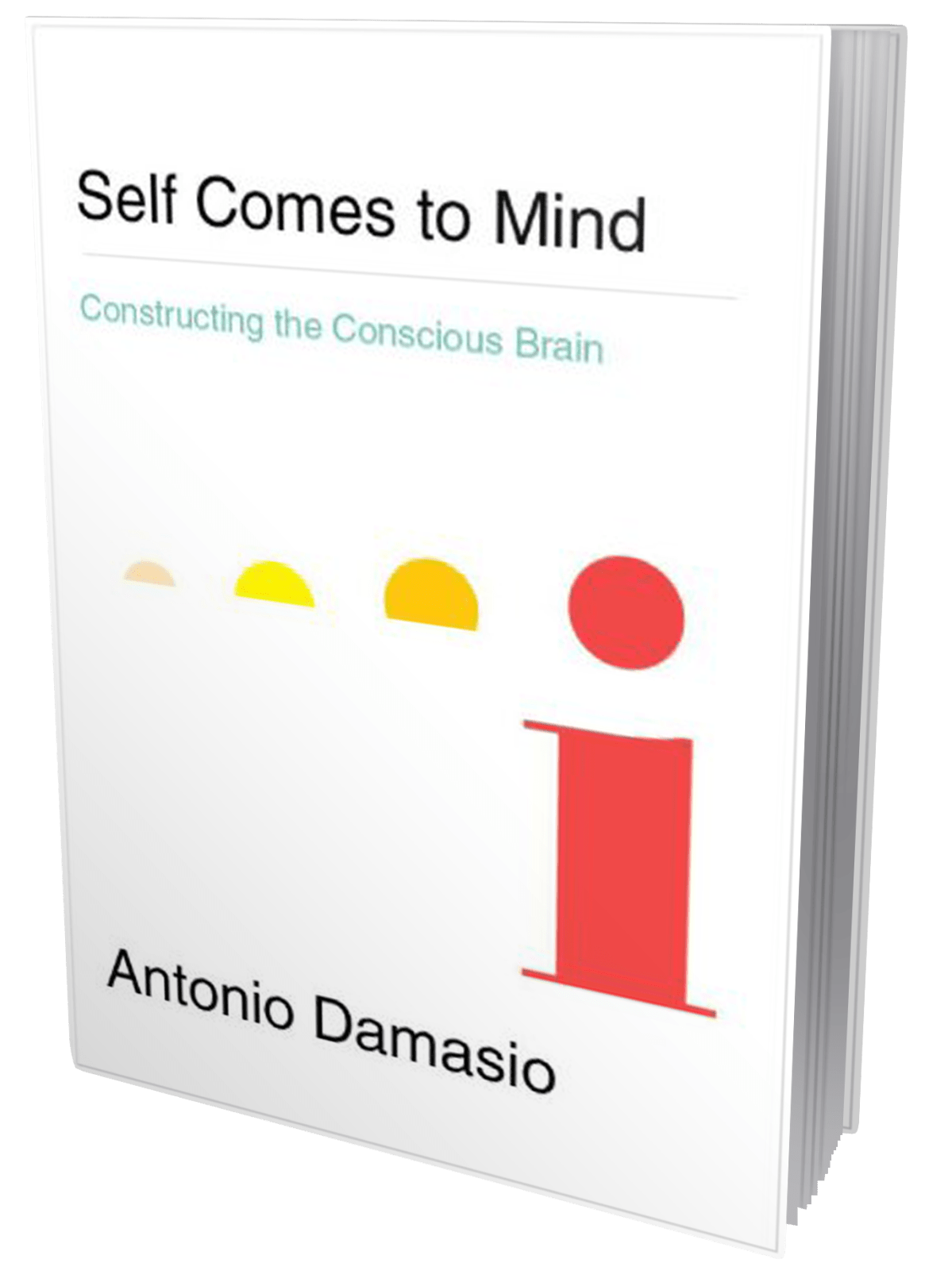
I began work on the project I described in my last post (“What Should I Major in at Old Age University“) by looking through the books in my bookcases for titles that fit the project. The first one I found was Self Comes to Mind by Antonio Damasio. After reading a few pages, I wanted to hear it. I bought the audiobook. After listening to fifteen pages, I knew this book was one I wanted to study thoroughly. I purchased the Kindle edition so I could highlight the passages I wanted to remember.

I was particularly taken with this paragraph:

We all have free access to consciousness, bubbling so easily and abundantly in our minds that without hesitation or apprehension we let it be turned off every night when we go to sleep and allow it to return every morning when the alarm clock rings, at least 365 times a year, not counting naps. And yet few things about our beings are as remarkable, foundational, and seemingly mysterious as consciousness. Without consciousness—that is, a mind endowed with subjectivity—you would have no way of knowing that you exist, let alone know who you are and what you think. Had subjectivity not begun, even if very modestly at first, in living creatures far simpler than we are, memory and reasoning are not likely to have expanded in the prodigious way they did, and the evolutionary road for language and the elaborate human version of consciousness we now possess would not have been paved. Creativity would not have flourished. There would have been no song, no painting, and no literature. Love would never have been love, just sex. Friendship would have been mere cooperative convenience. Pain would never have become suffering—not a bad thing, come to think of it—but an equivocal advantage given that pleasure would not have become bliss either. Had subjectivity not made its radical appearance, there would have been no knowing and no one to take notice, and consequently there would have been no history of what creatures did through the ages, no culture at all.

Damasio, Antonio. Self Comes to Mind: Constructing the Conscious Brain. Knopf Doubleday Publishing Group. Kindle Edition.

I want to know everything Damasio is telling us. I want to remember it. I was never a good student, never good at remembering information for tests, and at age 73, my memory is like a sieve. There are both comprehensive barriers that I can’t overcome, and limitations to the knowledge I can digest and maintain.

To maximize my reading concentration, I concurrently listen to an audiobook edition while following along with the printed page with my eyes. Although Damasio’s prose set my mind on fire, I can’t paraphrase what I just read. I can vaguely say that he describes what he thinks the mind is and makes a case that feelings are an important aspect of understanding the mind. I remember that because I wondered if AIs can ever become conscious without feelings. Feelings must be tied to biology.

If I’m ever going to learn and remember what I read, I need to go beyond the momentary exposure to ideas I get through simple reading. It seems comic, or should I say tragic, or maybe ironic, or even pointless, that I’m finally getting down to developing study habits at 73.

The only way to prove you know something is to teach it. Teaching a topic requires comprehension. I feel that when reading, I do comprehend, but that’s probably a delusion. One way to explain something is to give an analogy that makes the idea understandable. Another method is to create an infographic, chart, or diagram.

Yesterday, when I set my goal to understand how my personality developed and to explain why people are delusional, I didn’t say I wanted to teach what I learned. I did write that my final proof of accomplishment is writing a thesis on what I learned. That is a kind of teaching. It makes allowances for my quick-to-forget brain.

Reading gives the illusion of “Oh, I see,” and then you forget. I need to develop a note-taking system. And I think I need to mindmap what I read. I need to knuckle down and learn Obsidian. That’s a note-taking software program that allows for hyperlinks. And other tools will help me organize and temporarily remember information so I can summarize what I learn in prose.

But I really need to amend my goal. I don’t think I can say I learned anything unless I can teach it to someone else by conversing with them. I know mansplainers are looked down on, but I’m terrible at explaining things verbally.

I can write blogs because I have all the time I need to compose and revise. I can look things up. Explaining things in a lecture, or even a conversation, involves memory and comprehension at levels I cannot muster.

I need to go beyond reading. I need to go beyond writing. For my study project, I need to get into teaching. Since I don’t want to become a boring mansplainer, I need to learn the art of the Socratic dialogue.

JWH

The Distance Between Us

by James Wallace Harris, 5/3/25

Even if we embrace in a mighty bear hug, we cannot get close enough for our minds to touch. Whatever consciousness might be, each person is alone in their head. Would telepathy soothe that existential solitude?

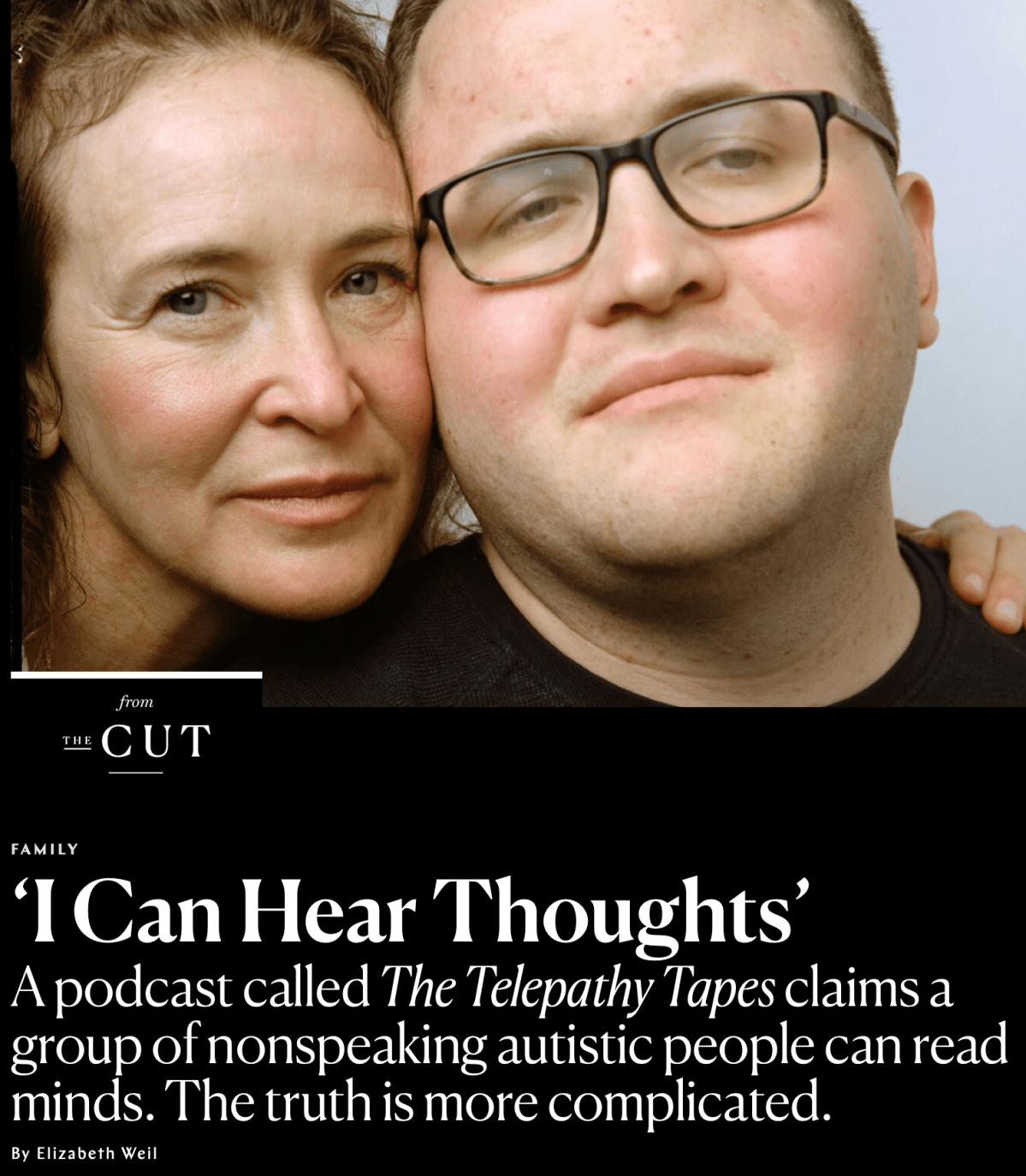
I Can Hear Thoughts” by Elizabeth Weil in the latest issue of New York Magazine reports on the viral podcast The Telepathy Tapes. (This article is behind a paywall, but if you haven’t visited the site recently, it might allow a free read. I read it via Apple News+. I find that subscription well worth the monthly $12.99 because it lets me read content behind hundreds of paywalls.)

The story is about a mother and her autistic son who appear to use telepathy. She started a podcast, which turned into a movement. The story is about how parents of nonverbal autistic children are desperate to know what their children think. For some, it goes much deeper than that. They want confirmation that a fully developed and aware human soul is trapped in a body that can’t communicate.

Often, one or more parents will sacrifice their normal lives to find some way to communicate with their nonverbal children. Many have spent years working with facilitated communication, leading to varying degrees of success. Sometimes such efforts produce startling results, results that appear to suggest telepathy.

Most scientists discredit these efforts. Studies show that autistic individuals respond to physical cues, variations on Clever Hans. However, some researchers suggest that something else might be at play. These researchers study consciousness, some with rather far-out theories about consciousness. Some researchers in consciousness want to leave the idea of telepathy open as a possibility, but see The Telepathy Tapes discrediting their research.

One of the most touching parts of the story is when Elizabeth Weil realized her journalistic queries brought doubt to the people she was interviewing. That their hope depended on absolute belief. I believe that issue is one of the fundamental reasons why our country has turned conservative and against liberal thinking. People are desperate to believe things science rejects, so they prefer to jettison science rather than their beliefs.

“I Can Hear Thoughts” is a beautiful piece of journalism about heartbreakingly sad lives. This story touches on many deep philosophical issues. Researching consciousness is at the cutting edge of science, philosophy, and even religion.

People desperate to save religion from science grasp any theory to rationalize their beliefs. The appeal of the Telepathy Tapes is the hope that communicating with profoundly autistic people will lead to proof of undiscovered spiritual dimensions. Dimensions that could be studied by science.

It’s a shame that this article is behind a paywall. I fully understand that New York Magazine needs to finance its publication. If you only consume free journalism on the web or YouTube, you are subsisting on a substandard diet of information. I wish more of my friends subscribed to Apple News+ so I could share articles with them.

I’m trying to wean myself off of crap news. The only way to do that is to pay for quality information. Apple News+ connects you with over 400 publications at a practical price.

JWH

The Reality of Reality

by James Wallace Harris, 5/2/25

I use reality to mean everything in existence. We used to use the term universe to mean everything, but scientists began speculating about multiverses and the word universe meant less than everything. Also, we tend to think of the universe in astronomical terms, and when I mean everything, I want it to encompass all the dimensions of existence everywhere, to whatever is beyond the quantum world to whatever existences lies beyond the multiverses.

The first reality of reality is that our local existence is an infinitely tiny portion of reality. We appear to exist in a three-dimensional domain defined by our sight, which gives us the illusion that we are small creatures in a large world. In reality, we are specks on a speck.

The second thing we need to remember about reality is that our lives have no meaning in relation to reality. Reality is completely indifferent to our existence. That every religion and philosophy we’ve ever created to explain reality are delusions by infinitesimally tiny beings. Think of our thoughts as a bacterium in our body speculating about its existence.

The third thing to remember about reality is that we spend our entire existence imposing order on chaos in our local bit of reality. Subatomic particles create atoms, and atoms create molecules, and molecules create inorganic chemistry, and inorganic chemistry creates biology, and biology creates humans, and humans create civilizations, and civilizations create technology, and technology is creating artificial intelligence. Reality is always evolving into something else.

Everything we do involves creating order out of chaos. We breathe and eat to stay alive. We learn to make sense of reality. We work to own things. We maintain the things we own. Doing the dishes imposes order on the kitchen. Washing clothes imposes order on our wardrobes. Gardening and landscaping impose order on our yard. Writing imposes order on our thoughts. Decluttering imposes order on our desks. Talking to people creates order in our relationships.

How much order we impose depends on how many habits, possessions, and people we want to control. The more we try to control, the more stress we feel. As we age, and our physical and mental abilities decline, we slowly lose control of everything we’ve worked to control. That is the reality of our lives.

We comprehend reality through science, but it’s extremely difficult because reality is hard to understand. At best, science notices repeatable statistical patterns that we can label with terms that we share. Like I said, religions and philosophies are mere delusions we embrace to think we understand reality. We don’t. We spend our lives acting on beliefs, believing we know more than we do.

We are creatures who live on delusions imposed on us by our biological urges and the delusions imposed on us by our culture and society. Except for Zen Buddhists, few people attempt to free themselves of their delusions. Instead, they passionately embrace their delusional beliefs by expending vast efforts to make them a reality.

I think about all of this as I encourage myself to go outside this morning to work at imposing order on the forty-thousand square feet of chaos that is my yard. The weeds are winning. They want to impose their order over my plot of land that I delusionally think I own and control. But it looks like rain, and as I glance around this room, I see three desks piled high with disorder that I need to wrestle into order. And I haven’t done my physical therapy exercises yet. If I don’t do them, my back falls into chaos, and I suffer great pain.

It would be so much easier to veg out in front of YouTube videos and let a little more disorder take over the house and yard.

JWH

ChatGPT Isn’t an Artificial Intelligence (AI) But an Artificial Unconsciousness (AU)

by James Wallace Harris, 2/12/24

This essay is for anyone who wants to understand themselves and how creativity works. What I’m about to say will make more sense if you’ve played with ChatGPT or have some understanding of recent AI programs in the news. Those programs appear to be amazingly creative by answering ordinary questions, passing tests that lawyers, mathematicians, and doctors take, generating poems and pictures, and even creating music and videos. They often appear to have human intelligence even though they are criticized for making stupid mistakes — but then so do humans.

We generally think of our unconscious minds as mental processes occurring automatically below the surface of our conscious minds, out of our control. We believe our unconscious minds are neural functions that influence thought, feelings, desires, skills, perceptions, and reactions. Personally, I assume feelings, emotions, and desires come from an even deeper place and are based on hormones and are unrelated to unconscious intelligence.

It occurred to me that ChatGPT and other large language models are analogs for the unconscious mind, and this made me observe my own thoughts more closely. I don’t believe in free will. I don’t even believe I’m writing this essay. The keyword here is “I” and how we use it. If we use “I” to refer to our whole mind and body, then I’m writing the essay. But if we think of the “I” as the observer of reality that comes into being when I’m awake, then probably not. You might object to this strongly because our sense of I-ness feels obviously in full control of the whole shebang.

But what if our unconscious minds are like AI programs, what would that mean? Those AI programs train on billions of pieces of data, taking a long time to learn. But then, don’t children do something similar? The AI programs work by prompting it with a question. If you play a game of Wordle, aren’t you prompting your unconscious mind? Could you write a step-by-step flow chart of how you solve a Wordle game consciously? Don’t your hunches just pop into your mind?

If our unconscious minds are like ChatGPT, then we can improve them by feeding in more data and giving it better prompts. Isn’t that what we do when studying and taking tests? Computer scientists are working hard to improve their AI models. They give their models more data and refine their prompts. If they want their model to write computer programs, they train their models in more computer languages and programs. If we want to become an architect, we train our minds with data related to architecture. (I must wonder about my unconscious mind; it’s been trained on decades of reading science fiction.)

This will also explain why you can’t easily change another person’s mind. Training takes a long time. The unconscious mind doesn’t respond to immediate logic. If you’ve trained your mental model all your life on The Bible or investing money, it won’t be influenced immediately by new facts regarding science or economics.

We live by the illusion that we’re teaching the “I” function of our mind, the observer, the watcher, but what we’re really doing is training our unconscious mind like computer scientists train their AI models. We might even fool ourselves that free will exists because we believe the “I” is choosing the data and prompts. But is that true? What if the unconscious mind tells the “I” what to study? What to create? If the observer exists separate from intelligence, then we don’t have free will. But how could ChatGPT have free will? Humans created it, deciding on the training data, and the prompts. Are our unconscious minds creating artificial unconscious minds? Maybe nothing has free will, and everything is interrelated.

If you’ve ever practiced meditation, you’ll know that you can watch your thoughts. Proof that the observer is separate from thinking. Twice in my life I’ve lost the ability to use words and language, once in 1970 because of a large dose of LSD, and about a decade ago with a TIA. In both events I observed the world around me without words coming to mind. I just looked at things and acted on conditioned reflexes. That let me experience a state of consciousness with low intelligence, one like animals know. I now wonder if I was cut off from my unconscious mind. And if that’s true, it implies language and thoughts come from the unconscious minds, and not from what we call conscious awareness. That the observer and intelligence are separate functions of the mind.

We can get ChatGPT to write an essay for us, and it has no awareness of its actions. We use our senses to create a virtual reality in our head, an umwelt, which gives us a sensation that we’re observing reality and interacting with it, but we’re really interacting with a model of reality. I call this function that observes our model of reality the watcher. But what if our thoughts are separate from this viewer, this watcher?

If we think of large language models as analogs for the unconscious mind, then everything we do in daily life is training for our mental model. Then does the conscious mind stand in for the prompt creator? I’m on the fence about this. Sometimes the unconscious mind generates its own prompts, sometimes prompts are pushed onto us from everyday life, but maybe, just maybe, we occasionally prompt our unconscious mind consciously. Would that be free will?

When I write an essay, I have a brain function that works like ChatGPT. It generates text but as it comes into my conscious mind it feels like I, the viewer, created it. That’s an illusion. The watcher takes credit.

Over the past year or two I’ve noticed that my dreams are acquiring the elements of fiction writing. I think that’s because I’ve been working harder at understanding fiction. Like ChatGPT, we’re always training our mental model.

Last night I dreamed a murder mystery involving killing someone with nitrogen. For years I’ve heard about people committing suicide with nitrogen, and then a few weeks ago Alabama executed a man using nitrogen. My wife and I have been watching two episodes of Perry Mason each evening before bed. I think the ChatGPT feature in my brain took all that in and generated that dream.

I have a condition called aphantasia, that means I don’t consciously create mental pictures. However, I do create imagery in dreams, and sometimes when I’m drowsy, imagery, and even dream fragments float into my conscious mind. It’s like my unconscious mind is leaking into the conscious mind. I know these images and thoughts aren’t part of conscious thinking. But the watcher can observe them.

If you’ve ever played with the AI program Midjourney that creates artistic images, you know that it often creates weirdness, like three-armed people, or hands with seven fingers. Dreams often have such mistakes.

When AIs produce fictional results, the computer scientists say the AI is hallucinating. If you pay close attention to people, you’ll know we all live by many delusions. I believe programs like ChatGPT mimic humans in more ways than we expected.

I don’t think science is anywhere close to explaining how the brain produces the observer, that sense of I-ness, but science is getting much closer to understanding how intelligence works. Computer scientists say they aren’t there yet, and plan for AGI, or artificial general intelligence. They keep moving the goal. What they really want are computers much smarter than humans that don’t make mistakes, which don’t hallucinate. I don’t know if computer scientists care if computers have awareness like our internal watchers, that sense of I-ness. Sentient computers are something different.

I think what they’ve discovered is intelligence isn’t conscious. If you talk to famous artists, writers, and musicians, they will often talk about their muses. They’ve known for centuries their creativity isn’t conscious.

All this makes me think about changing how I train my model. What if I stopped reading science fiction and only read nonfiction? What if I cut out all forms of fiction including television and movies? Would it change my personality? Would I choose different prompts seeking different forms of output? If I do, wouldn’t that be my unconscious mind prompting me to do so?

This makes me ask: If I watched only Fox News would I become a Trump supporter? How long would it take? Back in the Sixties there was a catch phrase, “You are what you eat.” Then I learned a computer acronym, GIGO — “Garbage In, Garbage Out.” Could we say free will exists if we control the data, we use train our unconscious minds?

JWH