Science v. Greed

by James Wallace Harris, 9/9/25

What if the greatest threat to truth isn’t ignorance—but desire? In a world overflowing with information, we rely on cognitive tools like religion, politics, philosophy, and science to make sense of reality. But as greed hijacks our narratives and undermines our trust in evidence, science—the one tool built to transcend bias—is under siege.” – Microsoft CoPilot

This essay describes how I evaluate my daily news feeds. We all rationalize what we want with cognitive tools humans have evolved to explain reality. Two tools dominate many news reports covering current events: science and greed.

If an electron had consciousness, imagine it attempting to explain its existence and describe its position in reality. We are no more significant than an electron, yet we explain our existence with an array of cognitive tools that justify our lives. Cognitive tools are linguistic systems that explain reality to ourselves and others.

Of all the changes our society is undergoing in 2025, the one I fear the most is the attack on science. Science is the only cognitive tool we’ve developed that consistently explains reality across minds and cultures. Unfortunately, reality is complex and science is statistical. Most individuals can’t comprehend complexity. This is especially true when math is required.

Most individuals choose a cognitive tool on faith. They will never understand what they believe or how they believe it. Even believers in science accept it mostly through faith. That’s a shame, faith is a terrible cognitive tool. It is the root of all delusion.

I know early Christian theologians made a virtue out of faith, but consider the logic behind it. They were asking their followers to believe something they couldn’t prove. Because I’m not a scientist, I can only accept scientific claims about reality on faith in science. I don’t like that, but I have to be honest with myself.

However, science’s peer-reviewed research can be studied. Scientific results evolve with constant retesting, which can also be studied. Scientific knowledge is applied in technology, which is further validation.

Faith is a cognitive tool, but a dangerous one. It promotes belief over evidence.

Throughout our evolution, we’ve developed several cognitive tools to explain reality. Religion is the people’s favorite. Unfortunately, religion doesn’t describe reality; it only claims to. To support its views on reality, religions spawned morality to impose order on individuals. Religions are fantasies we create to rationalize our fears and wants. Religion is a cognitive tool we use to impose an explanation on reality, one imagined by one person, and spread to others.

Politics is another cognitive tool we use to impose order onto reality. Politics began with the strength of one individual, which spread to groups. Eventually, weaker individuals gained power by using religion. Finally, collectives gained power through consensus. Politics often combines tools such as science, religion, art, philosophy, ethics, and others to create an ordered system within reality.

The next significant cognitive tool to emerge was philosophy. Philosophy gave us mathematics, ethics, logic, and rhetoric. We learned a great deal from philosophy, but ultimately, it can lead to endless speculation. Philosophy often became another tool for rationalization for what we wanted to believe.

Science is a collective effort that works to eliminate bias. Science studies patterns and consistency that can be measured by all observers. The results of science are not absolutes, only our current best working hypothesis. Science has proved to be the supreme cognitive tool because it works so consistently. Technology is applied science. We only have to consider the success of technology as the best proof that science is an effective cognitive tool.

Many humans can’t handle science. They are willing to accept science if it agrees with their wants. But they reject science when it gets in the way of their desires. Greed is steamrolling science today because some individuals have wants that are more powerful than scientific explanations.

I wanted to link to an article in Bloomberg, “Why Iowa Chooses Not to Clean Up Its Polluted Water,” but it’s behind a paywall. Bloomberg subscribers can read it, but that costs $39.99 a month. Apple News+ subscribers can read it for $12.99 a month. It was the perfect article to illustrate my essay. It described how all the cognitive tools I covered are used to rationalize polluting water in Iowa.

[I’ve since found a free video version of this article on YouTube.]

I’ll use a general example in case you don’t want to watch the video. Take climate change. Science has been consistent in predicting what will happen if we increase the concentration of CO2 in the atmosphere.

There are trillions of dollars worth of fossil fuels waiting to be extracted. The people who own the rights to those fossil fuels don’t want to lose that wealth. Science suggests we should switch to energy sources that don’t produce CO2. This would destroy the wealth connected to fossil fuels.

That’s why the fossil fuel industry attacked science. And they’ve made it political, philosophical, and even religious. They use every cognitive tool before science to attack science. They even attack science with pseudoscience.

Ever since the fossil fuel industry has succeeded with its attacks on science, every group that wants something that science denies has borrowed those tactics.

Climate change is a complex subject to understand. That complexity allows individuals to confuse people with doubt. I can simplify it in my mind. CO2 can be considered a thermostat. Raising the concentration will increase the average temperature of the planet; lowering the concentration will lower the temperature. But leaving trillions of dollars in the ground is something many people can’t accept.

The primary foe of science is greed, but other sources of human desire have embraced the same thinking. Especially, religion. Faith has always been the tool of religion to counter rationality.

Belief rules in this new age. Decades ago, I thought science would help us create a more rational political system. Maybe even inspire the creation of a science-based religion. But that hasn’t happened. We’re rejecting science. We’re returning to cognitive tools that don’t jive with an objective reality. We want to live by subjective experience.

That’s scary. Especially to me, since I want to live in a society where reality makes sense. Reality created through subjectivity is madness, a chaos.

We don’t have to see into the future to know what will happen. We only have to look at history, another cognitive tool for explaining reality. History has always been susceptible to corruption. But if you study enough histories, you’ll see consistencies.

With every news article you read or watch on television, consider how the individuals involved are interpreting reality and which cognitive tools they are using. Notice how often the story involves science versus greed.

Greed usually wins.

JWH
What Should I Major in at Old Age University?

by James Wallace Harris, 8/16/25

I’ve decided to earn an equivalent of a graduate degree before I turn 77. I need a project that will keep me occupied in retirement. I’ve always been one to know a tiny bit about hundreds of subjects rather than a lot about a few. I want to pick one subject and stick with it.

I could get a master’s degree from the University of Memphis, where I used to work, since I can take courses for free. I’m not sure they have a major that fulfills my interests. I will check it out. I’ll also check out available online universities. Mainly, I’m borrowing the structure of a graduate degree for my plan.

I decided a book-length thesis will be my measure of success. Since a master’s degree usually takes two or three years, I’m giving myself until I turn 77, which is November 25, 2028.

Over the next few months, I will decide what I want to study. There are many things to consider and think about. Most graduate programs have lots of prerequisites. Before I retired, I considered taking an M.S. in Computer Science. That program required 24 hours of math courses and 12 hours of computer courses to be accepted into the program. The degree itself was 36 hours.

It’s doubtful I could finish a computer science degree before turning 77. And in all honesty, I no longer have the cognitive ability to retake all that math.

My undergraduate degree is in English. I did 24 hours towards an M.A. in Creative Writing before I dropped out. I was also interested in American, British, and European literature. I’d have to start over from scratch because those 24 hours would have timed out. But I no longer want to study English or creative writing.

I’ve also thought of pursuing an Art History degree. I’ve been collecting art books and art history books for a couple of decades, and I have friends with degrees in Art History. One gave me a list of 200 artworks that I’d be required to discuss to pass the oral exam for the master’s degree. I started reading about those works.

I realized I would have to commit several years of dedicated study to pass the oral. I don’t want to do that. I don’t love art that much. I’m not sure what single subject would be worth that much dedication.

I’ll study college catalogs for inspiration, but it’s doubtful that I will want to complete an actual degree from a university. Instead, I will need to make up my own degree.

Let’s say a master’s degree involves twelve courses, and each course requires studying five books. Then my custom-designed degree will require distilling sixty books into a single thesis volume. That thesis should present an original idea.

The single subject I do know a lot about is science fiction. And I’ve thought it would be fun to write a book that parallels the development of science with the evolution of science fiction. I probably already own the books I’d need to research the subject. And it would be the easiest goal for me to achieve because it’s a subject I love and would have no trouble sticking with.

However, I’ve become obsessed with a couple of ideas that I want to study. I believe they are especially fascinating for the last years of my life.

The first is about how humans are delusional. I’d like to chronicle all the ways we fool ourselves. I want to study all the cognitive processes to discover if we can interact with reality without delusion. Current affairs is the perfect laboratory for such a study.

Second, I’m fascinated by how personality is formed. I’d like to answer this question: If I knew then what I know now, how would I have reshaped my personality?

There is a synergy between the two interests. How do delusions shape our personality?

Ever since I read Ed Yong’s An Immense World, I’ve been fascinated by the concept of Umwelt. Our senses limit and define how we perceive reality. Our personality and cognitive abilities determine how we choose to react to that perception of reality.

I haven’t decided yet on what I will pick, but I’m leaning towards delusion and personality development. If I choose that, I’d start this project by collecting books on the subjects and by reading popular periodicals. Eventually, I’d get to academic journals. I don’t think my made-up degree will be very rigorous, though. I’d consider a two-hundred-page book at a modest popular science reading level to merit my do-it-yourself degree.

JWH

What Will Be the Pivotal Issues in 2026 and 2028?

by James Wallace Harris, 7/2/25

Peter Leyden claims that America undergoes 80-year cycles, which he calls epochs, with peaks of upheaval that last 25 years. The past peak was after World War II, from 1945 to 1970. Leyden claims we’re entering a new peak in 2025 that should last until 2050. He zeroes in on artificial intelligence, clean energy, and bioengineering as the driving forces. I’m not big on predicting the future or seeing patterns in history, but there are ideas in his theory that are worth contemplating. I do believe we’re living through a historic period of change.

David Brooks claims America is moving away from thinking of itself as an idea that inspires the world to a homeland that we should defend. Brooks has moved away from being a traditional conservative to becoming a spiritual guru who teaches morality. I find all his recent speeches to be both uplifting and inspirational. Brooks feels the changes we are experiencing are undermining our individual characters and altering our collective national character.

CBS News asks if we’re moving into a new Gilded Age. But this time, the oligarchs are far richer and much more powerful. There is a synergy between this documentary and the videos of David Brooks and Peter Leyden. Everyone feels a massive paradigm shift coming. In 2025, I believe we’re living through the largest social and political upheaval since 1968.

If history does go through cycles, can we alter their course? The average person does not have much power. But in 2026, we do get to vote, and again in 2028. I believe the Democrats lost in 2024 because they had no clear vision. Being against Trump is not a political plan. In 2024, the Americans voted for Darwinian rule. Let the strong thrive and the weak die. The current administration is enacting laws to make the rich richer and the poor poorer. Essentially, civilization on the cheap. They appeal to greed. They appeal to resentment. They believe everyone should be responsible only for themselves.

It’s a very Darwinian philosophy. There’s no way we could call America a Christian Nation anymore. This is what America wanted through a fair and square election. But now that they are seeing what it means, do they want to keep it?

I don’t think we should wait until 2026 or 2028 to decide what we want. The Republicans won by clearly defining their goals in 2024. Democrats need to produce their own version of Project 2025. Project 2028 needs to be specific, and all Democrats need to support it. It can’t be too radical. It will need to be liberal yet practical. It needs to appeal to independents and old-style conservatives.

I have no idea what that plan should be, but I wish it would be something David Brooks would back. It needs a moral foundation because, as much as I accept the scientific theories of Darwin, I don’t think survival-of-the-fittest makes for an appealing political philosophy.

JWH

Who, What, When, Where, Why, and How of Being

by James Wallace Harris, 2/15/25

At 73 I’m starting to feel I’m running out of time. I keep having this nagging thought I should have done something, or should be doing something before time runs out. But what? I am immensely grateful for existing but was I supposed to do something while I am or was here? Would knowing who I was explain what I was? Would knowing when and where I was explain how and why I got here? And would knowing all those answers reveal my existential duties?

I just finished reading Orbital by Samatha Harvey which recently won the 2024 Booker Prize. Orbital is the kind of novel that inspires the questions above.

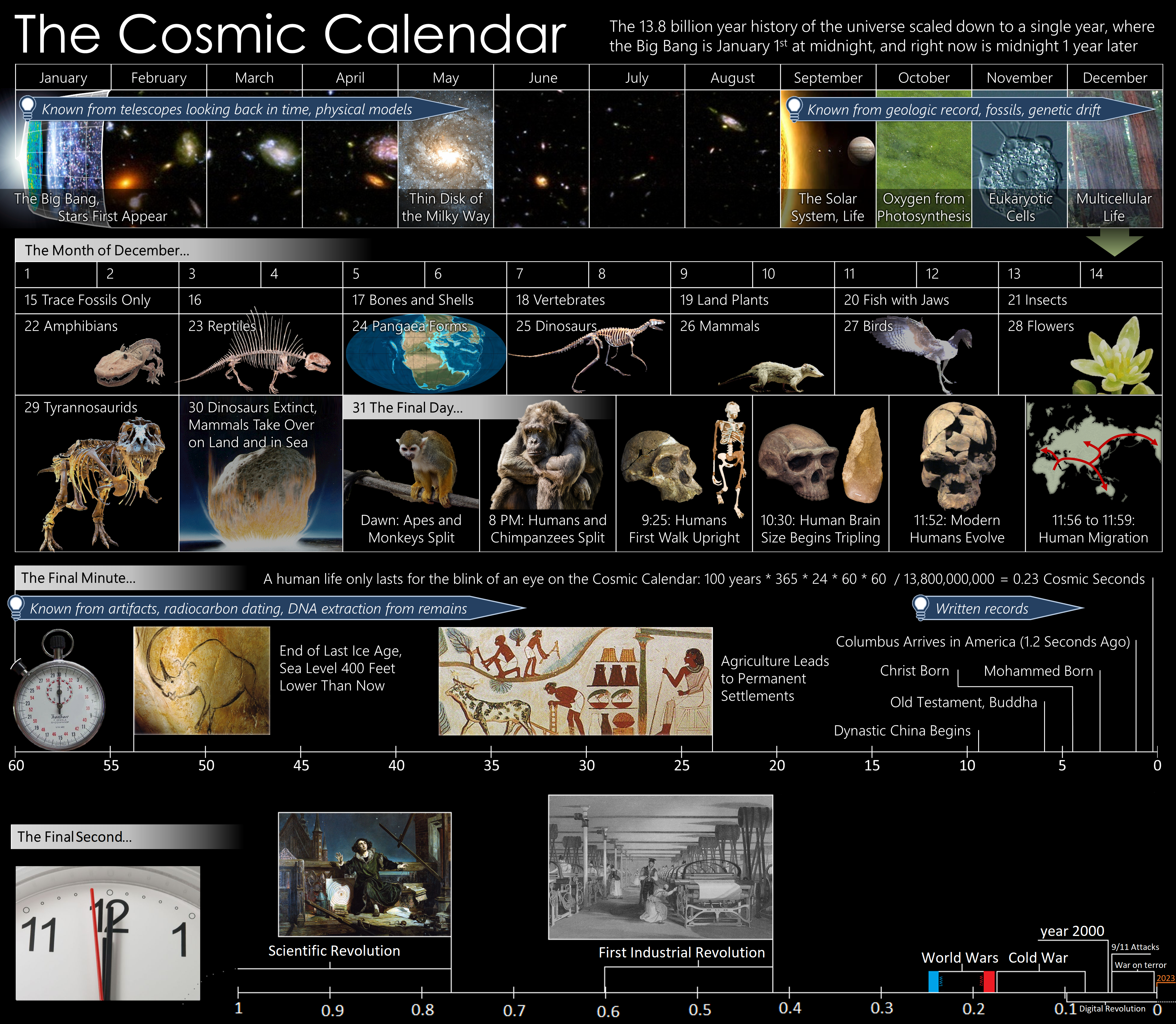
The story is set a few years hence on the International Space Station just as we’re sending astronauts to the Moon again. The book doesn’t have a plot but is a beautiful description of working in space. Harvey’s novel concludes by conveying a tremendous sense of wonder inspired by Carl Sagan’s Cosmic Calendar (large version). The Cosmic Calendar compares the timeline of the universe to one year. Everything since the Scientific Revolution would have happened in the last second of the Cosmic Calendar.

The Cosmic Calendar is a beautiful metaphor to contemplate ontology. How did we get here? There are two main theories. God implies a top-down creation. Evolution suggests a bottom-up development. Each has its paradox. Who created God? Or, how did something come from nothing? Studying cosmology makes it hard to believe in God. How could a single being create all that vastness? What if the universe is God? That’s pantheism. It makes God equal to Evolution but leaves us still with the problem of how things started.

The Cosmic Calendar answers for When.

But do we really need to know how things got started? Shouldn’t we just ask: What is our place in the universe? Scientists are now theorizing that we might exist in a multiverse. In other words, no matter how large we look into the cosmos, there’s always more. On the other hand, no matter how small we look into the subatomic, there’s always something smaller. This is beautifully illustrated by the famous Charles and Ray Eames video of The Powers of Ten from 1977.

The Powers of Ten answers for Where. More importantly, it reveals there are many domains. We might observe the cosmos or even the domain of the atom or quantum, but do they matter to who we are and what we should be doing? Shouldn’t our domain be a hundred meters?

Carl Sagan wrote a book The Pale Blue Dot based on a photograph of Earth taken by Voyager 1 while it passed Saturn. If you look closely, you will see a blue dot. That’s Earth. It’s hard to think we’re significant to the universe. Then think about the Milky Way as seen from the edge of the universe. It wouldn’t be visible at all. It’s beyond conceivable to imagine how small we are compared to all of existence. How can we be significant? How can we have a purpose?

It’s important to think of ourselves relative to the domain in which we live. Many people are depressed by watching the news but isn’t the domain of the Earth too big for one person? Isn’t it ego and delusion to think our purpose could be to organize a nation, city, or even something as small as a neighborhood? I have trouble keeping my house and yard in order.

Lately, I’ve been working in the yard. After fifteen years of neglect, the backyard is overrun with tangled wild growth. Every day I spend a little time trying to conquer my tiny plot of wilderness. At 73, that effort pushes the limits of my physical abilities. I use most of the energy I have left keeping the house somewhat neat. It’s not really clean. I also must spend precious vitality on personal finances, shopping, and general living and maintenance.

Yet, I keep thinking I should be doing something more. I’m not sure what. Maybe it’s having a purpose or making my mark in a small way. This would answer the question of who. And maybe why.

I’ve been using Ancestry.com and learning about genealogy. What did my parents expect of me? What did my grandparents expect of their grandchildren? I have thirty-two ancestors if I go back five generations. Did they expect anything? At most, they expected me to keep the gene line going. Well, that’s where I’ve failed.

I recently read Parable of the Sower by Octavia E. Butler. The story is about the United States suffering an economic apocalypse. The main character felt the need to have a purpose in life, even when everything bad was happening. She decided God was change and our purpose was to affect God/change. That’s a kind of pantheism. What if existence is just trying to become everything that could possibly exist?

Under Butler’s theory, my purpose is to shape myself. To constantly change. Well, I’ve certainly been doing that my whole life.

Right now I’m working on changing myself, my relationships, my house, and my yard. Mother nature was changing the way it wanted the yard. It might seem pointless, but wrestling control from Mother Nature and changing the yard into what I want does give me existential purpose. It’s essentially meaningless in the long run. But maybe our purposes should be limited to a time and place. To a domain. Think small.

I can change myself somewhat. I can change my house and yard. Somewhat. But I can’t change other people. Or anything larger in life.

Maybe that explains how and why.

JWH

I Want to Argue with Carlo Rovelli

by James Wallace Harris, 7/1/24

Can I understand science if I’m not a scientist? I read popular science books, but that doesn’t mean I understand the work that went into making the scientific discoveries they report on. However, is it possible for me to intuit what popular science writers are describing?

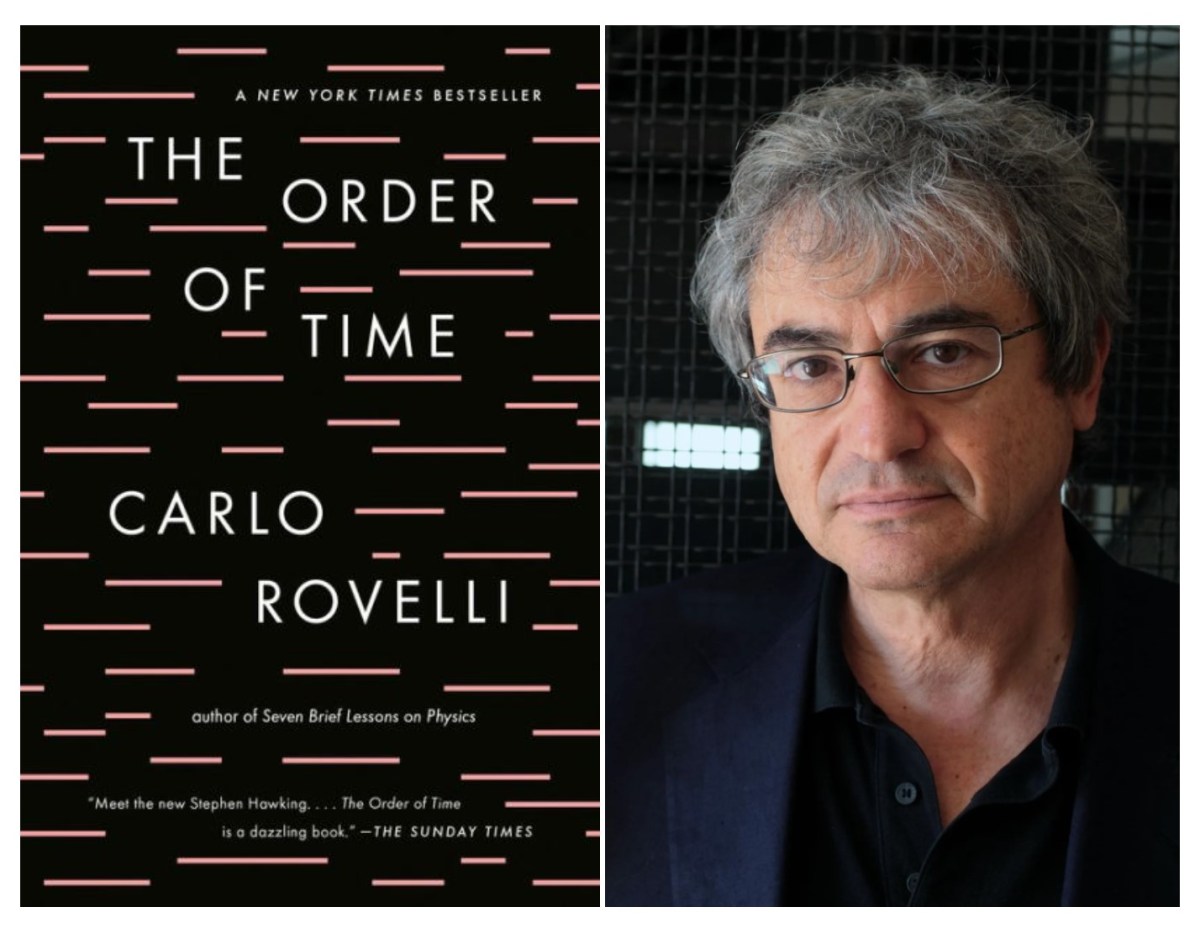
I’ve been thinking a lot about the concept of Universal Now. What is this thing we call now? How is it different from the past and future? But the most important question that’s driving me crazy is: Is it now everywhere in the universe at the same time? But then, what is time? I went looking for a book that might answer these questions and found The Order of Time by Carlo Rovelli. I discovered that book from finding the article “Now Means Nothing: How Time Works in Our Universe” online. It was taken from The Order of Time.

This passage tangles up my brain:

Now Means Nothing 

What is happening now in a distant place? Imagine, for example, your sister has gone to Proxima b, the recently discovered planet that orbits a star approximately 4 light-years away from us. What is your sister doing now on Proxima b?

The only correct answer is that the question makes no sense. It’s like asking, “What is here, in Peking?” when we are in Venice. It makes no sense, because if I use the word “here” in Venice, I am referring to a place in Venice, not in Peking.

If you ask what your sister, who is in the room with you, is doing now, the answer is usually an easy one: You look at her, and you can tell. If she’s far away, you phone her and ask what she’s doing. But take care: If you look at your sister, you’re receiving light that travels from her to your eyes. That light takes time to reach you — let’s say a few nanoseconds, a tiny fraction of a second. Therefore, you’re not quite seeing what she’s doing now but what she was doing a few nanoseconds ago. If she’s in New York and you phone her from Liverpool, her voice takes a few milliseconds to reach you, so the most you can claim to know is what your sister was up to a few milliseconds ago. Not a significant difference, perhaps.

What does it mean, this “modification of the structure of time”? Precisely the slowing of time described above. A mass slows down time around itself. The Earth is a large mass and slows down time in its vicinity. It does so more in the plains and less in the mountains, because the plains are closer to it. This is why the friend who stays at sea level ages more slowly.

Therefore, if things fall, it is due to this slowing of time. Where time passes uniformly, in interplanetary space, things don’t fall — they float. Here on the surface of our planet, on the other hand, things fall downward because, down there, time is slowed by the Earth.

Hence, even though we cannot easily observe it, the slowing of time nevertheless has crucial effects: Things fall because of it, and it allows us to keep our feet firmly on the ground. If our feet adhere to the pavement, it is because our whole body inclines naturally to where time runs more slowly — and time passes more slowly for your feet than it does for your head.

Does this seem strange? It’s like when watching the sun set, disappearing slowly behind distant clouds, we suddenly remember that it’s not the sun that’s moving but the Earth that’s spinning. And we envision our entire planet — and ourselves with it — rotating backward, away from the sun.

I really dislike that answer. It goes against my sense of intuitive logic. I can understand that time is relative. I can even understand that it’s impossible for us to know what’s happening on Proxima b because of the speed limit of light at any given moment. But I refuse to believe that if Proxima b still exists, that the same now I’m experiencing isn’t occurring there too. Any sentient being will experience the moment of now at a different rate, but don’t we all exist in the same Universal Now?

To me, it feels natural to think of the universe as one giant entity that is evolving/growing. I can accept that time is variable in separate places within this entity, but I feel there is a Universal Now everywhere. Only it’s perceived at different speeds. And that’s okay. I don’t expect us to be in sync in our sentient awareness of the Universal Now.

For example, a hummingbird perceives time differently from people. We seem to be slow moving to it. A computer with a clock with operates at trillions of cycles per second will see time differently too. Just because we each perceive time differently, doesn’t mean we don’t all experience it in the same Universal Now.

I have read that the Big Bang didn’t occur in an infinite void, that space and time were created with the Big Bang. I picture the universe as one cosmic system that evolves/grows. Time evidently is the awareness of change/growth at any given point. That if stars were sentient, they’d feel time differently than we do, or if bacteria could sense change, or if humans were traveling at different speeds, every perspective would sense time differently. But that doesn’t mean it isn’t happening in one Universal Now. I just can’t grasp what Ravelli is saying.

Everything that can perceive time doesn’t perceive it in the same way, but I believe they all exist together and there is one now they are all reacting to.

If my sister Becky went to Proxima b, and we had an ansible (a science fictional communication device that can transmit and receive instantaneously from anywhere), Becky and I could have a conversation in this Universal Now that I’m talking about.

Now if Becky were on a spaceship going near the speed of light, our voices would change. I would speak so fast she couldn’t comprehend me, and she would speak so slowly I couldn’t understand her either. But if the ansible had a record feature, my message could be slowed down, and hers could be speeded up.

I’d have the same problem if I was talking with a star or a bacteria (ignoring the language barrier).

If I was on Earth, and Becky was on her way to Proxima b, and I thought, “I wonder what Becky is doing now?” Becky would being doing something.

If time is relative, and it is unfolding at different speeds, I can’t help but think, “What is it unfolding into?” To me, that’s a Universal Now, the same kind of place that spacetime unfolds into, some kind of existential nothingness. If the universe is expanding, isn’t that the same as growing? And if time is unfolding, isn’t that a kind of growing too? Maybe it’s even the same. Maybe the Now I’m talking about, and the Nothingness that spacetime is expanding into, are the same thing.

To humans, time is sensing change. It is perceived at different rates. Without an ansible, I can’t know what Becky is doing on Proxima b because it would take over four years to learn whatever it was. Where I disagree with Carlo Ravelli is Becky isn’t experiencing the same Universal Now I’m experiencing.

I can comprehend why time is relative and why different sentient beings would perceive it differently. I just can’t understand why there isn’t one Universal Now that spacetime isn’t unfolding into.

As I write this, I assume Carlo Ravelli is experiencing the same Universal Now. I can’t know what he’s doing, or what time it might be, but if he’s alive, he’s doing something, and he’s feeling time unfold at the same time I’m feeling it unfold.

And if there are multiverses. I think they all exist in the same Universal Now. I can’t understand why there isn’t nothing rather than something. But no matter how many universes or dimensions there are, I’d like to think they are all in one Universal Now. It would hurt my mind too much to imagine multiple creations.

JWH