What Should I Major in at Old Age University?

by James Wallace Harris, 8/16/25

I’ve decided to earn an equivalent of a graduate degree before I turn 77. I need a project that will keep me occupied in retirement. I’ve always been one to know a tiny bit about hundreds of subjects rather than a lot about a few. I want to pick one subject and stick with it.

I could get a master’s degree from the University of Memphis, where I used to work, since I can take courses for free. I’m not sure they have a major that fulfills my interests. I will check it out. I’ll also check out available online universities. Mainly, I’m borrowing the structure of a graduate degree for my plan.

I decided a book-length thesis will be my measure of success. Since a master’s degree usually takes two or three years, I’m giving myself until I turn 77, which is November 25, 2028.

Over the next few months, I will decide what I want to study. There are many things to consider and think about. Most graduate programs have lots of prerequisites. Before I retired, I considered taking an M.S. in Computer Science. That program required 24 hours of math courses and 12 hours of computer courses to be accepted into the program. The degree itself was 36 hours.

It’s doubtful I could finish a computer science degree before turning 77. And in all honesty, I no longer have the cognitive ability to retake all that math.

My undergraduate degree is in English. I did 24 hours towards an M.A. in Creative Writing before I dropped out. I was also interested in American, British, and European literature. I’d have to start over from scratch because those 24 hours would have timed out. But I no longer want to study English or creative writing.

I’ve also thought of pursuing an Art History degree. I’ve been collecting art books and art history books for a couple of decades, and I have friends with degrees in Art History. One gave me a list of 200 artworks that I’d be required to discuss to pass the oral exam for the master’s degree. I started reading about those works.

I realized I would have to commit several years of dedicated study to pass the oral. I don’t want to do that. I don’t love art that much. I’m not sure what single subject would be worth that much dedication.

I’ll study college catalogs for inspiration, but it’s doubtful that I will want to complete an actual degree from a university. Instead, I will need to make up my own degree.

Let’s say a master’s degree involves twelve courses, and each course requires studying five books. Then my custom-designed degree will require distilling sixty books into a single thesis volume. That thesis should present an original idea.

The single subject I do know a lot about is science fiction. And I’ve thought it would be fun to write a book that parallels the development of science with the evolution of science fiction. I probably already own the books I’d need to research the subject. And it would be the easiest goal for me to achieve because it’s a subject I love and would have no trouble sticking with.

However, I’ve become obsessed with a couple of ideas that I want to study. I believe they are especially fascinating for the last years of my life.

The first is about how humans are delusional. I’d like to chronicle all the ways we fool ourselves. I want to study all the cognitive processes to discover if we can interact with reality without delusion. Current affairs is the perfect laboratory for such a study.

Second, I’m fascinated by how personality is formed. I’d like to answer this question: If I knew then what I know now, how would I have reshaped my personality?

There is a synergy between the two interests. How do delusions shape our personality?

Ever since I read Ed Yong’s An Immense World, I’ve been fascinated by the concept of Umwelt. Our senses limit and define how we perceive reality. Our personality and cognitive abilities determine how we choose to react to that perception of reality.

I haven’t decided yet on what I will pick, but I’m leaning towards delusion and personality development. If I choose that, I’d start this project by collecting books on the subjects and by reading popular periodicals. Eventually, I’d get to academic journals. I don’t think my made-up degree will be very rigorous, though. I’d consider a two-hundred-page book at a modest popular science reading level to merit my do-it-yourself degree.

JWH

What Will Be the Pivotal Issues in 2026 and 2028?

by James Wallace Harris, 7/2/25

Peter Leyden claims that America undergoes 80-year cycles, which he calls epochs, with peaks of upheaval that last 25 years. The past peak was after World War II, from 1945 to 1970. Leyden claims we’re entering a new peak in 2025 that should last until 2050. He zeroes in on artificial intelligence, clean energy, and bioengineering as the driving forces. I’m not big on predicting the future or seeing patterns in history, but there are ideas in his theory that are worth contemplating. I do believe we’re living through a historic period of change.

David Brooks claims America is moving away from thinking of itself as an idea that inspires the world to a homeland that we should defend. Brooks has moved away from being a traditional conservative to becoming a spiritual guru who teaches morality. I find all his recent speeches to be both uplifting and inspirational. Brooks feels the changes we are experiencing are undermining our individual characters and altering our collective national character.

CBS News asks if we’re moving into a new Gilded Age. But this time, the oligarchs are far richer and much more powerful. There is a synergy between this documentary and the videos of David Brooks and Peter Leyden. Everyone feels a massive paradigm shift coming. In 2025, I believe we’re living through the largest social and political upheaval since 1968.

If history does go through cycles, can we alter their course? The average person does not have much power. But in 2026, we do get to vote, and again in 2028. I believe the Democrats lost in 2024 because they had no clear vision. Being against Trump is not a political plan. In 2024, the Americans voted for Darwinian rule. Let the strong thrive and the weak die. The current administration is enacting laws to make the rich richer and the poor poorer. Essentially, civilization on the cheap. They appeal to greed. They appeal to resentment. They believe everyone should be responsible only for themselves.

It’s a very Darwinian philosophy. There’s no way we could call America a Christian Nation anymore. This is what America wanted through a fair and square election. But now that they are seeing what it means, do they want to keep it?

I don’t think we should wait until 2026 or 2028 to decide what we want. The Republicans won by clearly defining their goals in 2024. Democrats need to produce their own version of Project 2025. Project 2028 needs to be specific, and all Democrats need to support it. It can’t be too radical. It will need to be liberal yet practical. It needs to appeal to independents and old-style conservatives.

I have no idea what that plan should be, but I wish it would be something David Brooks would back. It needs a moral foundation because, as much as I accept the scientific theories of Darwin, I don’t think survival-of-the-fittest makes for an appealing political philosophy.

JWH

I’ve Been Craving the Kind of Great Science Fiction I Discovered When I Was Twelve and Thirteen

by James Wallace Harris, 3/17/25

When I get sick, or I’m bummed out over politics or economics, I get the urge to read a type of science fiction I discovered when I was twelve and thirteen (1964-1965). This isn’t nostalgia, but a proven method of stress reduction. We all have our own forms of escapism, mine is a kind of science fiction originally published in the 1950s. Old science fiction is my comfort reading.

When I was twelve, my main sources of science fiction were the twelve Heinlein juveniles and the Winston Science Fiction series of SF for juveniles. The term juvenile was the old way of saying Young Adult novel. At thirteen I discovered a treasure trove of old science fiction at the Homestead AFB Library. Those books were mainly published by Gnome, Fantasy Press, and Doubleday.

I loved stories about teens colonizing other worlds, which is what Heinlein did best. One of the first science fiction books I read was Red Planet by Robert A. Heinlein, about two boys living in rural Mars going off to college. When I was young I was convinced I wanted to go to Mars too, but after I got older, I realized Mars is no place for humans.

Reading science fiction at twelve made me feel important. I thought science fiction was preparing humanity for the future. At thirteen, I thought colonizing Mars was a way to back up our species. It was humanity’s manifest destiny to colonize the galaxy. When Elon Musk said he would colonize Mars I was all for it. But when the world’s richest man takes away the food and medicine from millions of the poorest, it only reminded me that Homo sapiens are a cancer that shouldn’t be allowed to spread across the universe.

Science fiction has always been about our hopes and fears of the future, but in the sixty years since 1965, I feel science fiction has lost touch with any possible realistic future that we would desire.

The urge to reread old science fiction from the 1950s comes from a deeper need to reconnect with my old hopes for the future. What’s strange, is when I do reread old science fiction, I often find pessimism where I once found hope.

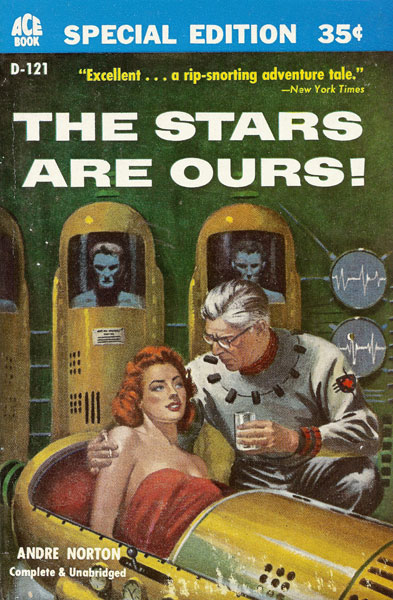
For example, The Stars Are Ours by Andre Norton. When I was young, I focused on the teen hero traveling on a spaceship to colonize a planet in another solar system. I didn’t focus on the reason why they left Earth. On rereading, I see they fled because the U.S. had been taken over by a totalitarian society that was repressing science.

On rereading my beloved Heinlein juveniles, I see Heinlein often portrayed Earth as being overpopulated, over-regulated, or having some kind of society that inspired the characters to leave.

When I was twelve and thirteen, I went to three different seventh grade schools, and two different eighth grade schools. Those were the years when I realized my parents were alcoholics. Those were the years they began to fight. And those were the years when my dad had his first heart attack. Is it any wonder that I identified with characters who left a bad world hoping to find a better one?

I loved stories like Ray Bradbury’s “The Million-Year Picnic.” I always remember the ending, where the father shows the three boys the Martians, and I always forget that the father had taken his family to Mars because Earth had destroyed itself in a nuclear war. But rereading Bradbury’s classic short story reveals that its power is a love of family and an appreciation basic human goodness.

Was science fiction back then really about escaping 1950s reality? And today, do I crave reading 1950s to escape from 2025? Is science fiction just another fantasy portal to leave here and now?

Science fiction grew up in the 1960s and 1970s. Stand on Zanzibar by John Brunner and Camp Concentration by Thomas Disch, both from 1968, were explicitly about how reality sucked. Reading them made me feel grown up. By then, even though I was still in high school, I was nostalgic for 1950s science fiction. But it wasn’t the 1950s themselves that I craved. It was the escapist fantasies of that decade.

I need to think deeper about that.

Could I be in a time loop?

JWH

The Limits of Memory

by James Wallace Harris, 3/3/25

It annoys me more and more that I can’t recall names and nouns. I don’t worry yet that it’s dementia because most of my friends have the same problem. But I’ve been thinking about my ability to remember and realized that I’ve never been good at remembering things.

I know I have aphantasia, which means I can’t visualize mental images in my head. I wonder if there’s a connection between not visualizing images and poor memory? People with astounding memory often use mental images as mnemonics.

The ability to remember is on a spectrum. On one end of this range, are rare individuals with photographic memories, while at the other end, are a tiny group with no short-term memories.

My new theory. One possible reason I have poor memory is my education. More precisely, how my personality approached learning as a kid. I considered K-12 a thirteen-year prison sentence. I paid just enough attention to pass tests. I mostly got Cs and Bs, with a rare A and D. I remembered things just long enough to pass a test.

I was never motivated to remember for the long haul.

I do like to learn. I’ve read thousands of books. Of course, most of them have been science fiction, but I also love nonfiction. However, information leaves me as fast as I consume it.

I’m starting to wonder if I would have a better memory if I had developed a different approach to school and learning. Primary and secondary education aim to give kids a well-rounded education. And in college, over half the courses are required.

The idea is we should learn as much as possible about the world. Is that a valid approach? After school and college, we specialize in whatever our work requires, and become selective about what we study for fun. Those subjects are what we remember best.

Reality is too big to know everything. What we need to learn is how to coexist with reality. We need the knowledge to fit in and survive. Would knowing more about fewer subjects help? Or would memorizing the deep dynamics of how things work better yet?

I do believe the more we know, the wiser we are. But there are limits to what we can understand and memorize.

I’m currently reading Nexus by Yuval Noah Harari. In chapter 2, Harari shows how fiction drives our societies, not truth. We live by stories we want to believe. It’s much easier to vaguely understand fiction than to learn the details of reality. For example, more people accept The Bible than biology. That suggests a natural tendency to minimize how much we know.

That would be okay if the Earth were sparsely populated. But we live in dense, complex societies racing at the speed of computer networks and artificial intelligence. Living by fiction is fine if the year is 500 BCE, but we live in 2025. CE.

Let me give one example of what I mean by learning less to know more. I’ve been reading American history books to understand how our society got to now. That gives me a certain level of wisdom about our problems. However, I’m also reading about French history, especially the French Revolution and 19th century history. Seeing the parallels ups my level of understanding. But do I need to read the history of every country now and then? What I see is common dynamics. Reading more histories will give me more examples of the same dynamics.

The same is true of religion. I like studying the history of the Bible. I’ve also studied Buddhism and Hinduism. As I do, I see common dynamics at work. Harari’s new book Nexus points out the common dynamics of society and history.

The educational philosophy I experienced growing up pushed me to memorize a million details. What I needed to understand and remember is the fewer dynamics of reality.

People like to live by fiction because it’s easier. Politics is currently overwhelmed by fiction. Read Nexus to understand why I say that. The question we have to answer is if we can reject fiction.

Real information is seeing patterns in reality. Wisdom is seeing patterns in the patterns. The only real cognitive tool we’ve ever developed to understand reality is science. However, it’s statistical, and hard to learn and understand. We live in a time of simplex thinking. People see or are told about one pattern and they accept that as a complete explanation of reality. All too often, that pattern is based on a cherished story.

We can’t live by memes alone. Nor can we live by infinite piles of memorized details. The only way to understand is to observe consistent patterns. But it has to be more than two or three. That can lead to delusions. Even anecdotal evidence of ten occurrences could still deceive. How can this lead to learning more from less? It’s a paradox.

Last year, I read a three-volume world history. It provided hundreds of examples of strong man rule over thousands. of years. But how many kids, or citizens can we get to read a three-volume world history? Would a listing of these leaders, including the wars they started, and the numbers of people who died because of their leadership be just as effective? Would all the common traits they shared help too? Such as wanting to acquire more territory, or appeals to nationalism?

Could we create a better educational system with infographics and statistics? I don’t know. I do know I tried to process too much information. I also know that I only vaguely remember things. Memory has limits. As does wisdom.

JWH

Age vs. Ability

by James Wallace Harris

We’re told that scientific studies show that we peak mentally and physically early in life but is that true for all our abilities. Where does wisdom come in? If I found a magic lamp and a genie offered me three wishes I might wish for the physical agility of Simone Biles, or the stamina of Beth Potter, or I might ask for the language ability of Amor Towles, or the political and economic savvy of Robert Reich, or even wish for the historical wisdom of Yuval Noah Harari, or the scientific brilliance of Sabine Hossenfelder. Unfortunately, there are no magic lamps with wish granting genies. I must live with who I am.

If I peaked mentally and physically in my late teens or twenties, whatever my best abilities were, they weren’t memorable. What’s weird is I don’t want to be young again, not if I must give up everything I learned. And I suppose whatever I’m afraid of losing might be called wisdom. Is wisdom the defining ability of being old? I don’t think so. I don’t think I’m particularly wise, nor do I know any older folks who seem all that wise. Wisdom might be undefinable, undetectable, and only perceived by the individual, and even that perception is relative.

If we consider the current U.S. presidential election, and the five people taking part in the televised debates are 40, 59, 60, 78, and 81 years old. Disregarding their political philosophy, it was obvious they had a range of cognitive abilities. The younger ones spoke more precisely, responded better to questions, were quicker to compose thought out responses, and overall expressed themselves better.

But what about wisdom. The two oldest candidates did promote what they believed from a lifetime of experience, but would we call wisdom? All the candidates show abilities needed to be politicians, which involve long scheduled days with tremendous amount of social interaction. That is impressive. I’m 72, and I couldn’t do what either the 78- or 81-year-olds do. Just a few days of political campaigning would kill me. However, I’ve got to assume, that the younger candidates have an easier time with those long days on the campaign trail.

But back to me and you. I was reading an article in the New York Times the other day about how memory loss isn’t the only sign of onset dementia. It said having trouble doing your finances, sleeping poorly, going through personality changes, having trouble driving, and losing the ability to smell are other signs that your brain isn’t firing on all cylinders.

This made me to ask myself: Is there anything I can do better now than when I was younger? Well, maybe writing essays. Okay, I’m having trouble thinking of other things. I feel I’m a better reader. And since I started playing the games on the New York Times games app every day I’ve gotten better at Wordle, Connections, Mini Crossword and Sudoku. I should admit I might have reached a plateau with all of those games.

My guess is over weeks and months I figured out how to apply all my existing abilities with those games and reached a certain level of proficiency. That felt like I was improving, which is a good feeling when you’re 72. However, I noticed that although I can finish every Sudoku game in a matter of minutes on the easy level, I have never been able to finish any game at the medium level.

When I discovered that, I’ve switched from playing the easy mode every day to the medium mode. I eventually sensed that my innate abilities let me discover several methods of solving the easy level Sudoku puzzles, but I never had the abilities that involve the more complex methods of solving the medium level puzzles. The challenge I gave myself was to studying Sudoku tutorials and learn those methods. I’ve tried for the past week, but so far, I’ve failed. I sense there are methods I could apply, and I almost grasp a couple of them when studying the tutorials, but when I try to apply in a daily game, I forget what they were.

So far, I don’t think I’m having problems with the five non-memory issues the New York Times identified that were early signs of dementia. But would I recognize a decline in those areas if I did?

I avoid driving at night or on freeways. I can do it, but it causes anxiety. One thing I do now that I’m older is avoid anxiety. So, should I check that box? I do fine with my finances, but I just do what’s required, I don’t try to improve my situation. I have weird sleeping habits because of problems with frequent peeing, but I feel like I’ve adapted and don’t feel sleep deprived. I think I still smell things simply fine. I can smell the cat shit several rooms away when a cat poops in their box. Does that give me a passing score? And I think I’ve gone through some personality changes, but I assume they were due to adapting to being retired.

I feel I’m pushing myself harder and I’m more disciplined than when I was younger. However, I know I can’t do what I used to do and have little stamina.

Overall, I’d say I have far less abilities than when I was younger, but I feel better adapted to being old than I did at being young. I still feel like I’m honing the abilities I care about, even though I’ve giving up on everything else.

Is getting old just streamlining our abilities to do more with less?

JWH