How To Calculate the Value of Your Monthly Subscriptions

by James Wallace Harris, 7/4/23

I feel like Susan and I have too many monthly subscriptions for watching television, listening to music and books, and reading the news. Everything is going digital, and everything requires a subscription. That increasing number of monthly subscriptions is bothering me, but is it really too many, or a problem?

I decided to create a way to measure their value. I looked at the monthly cost versus the total hours Susan and I use each service and then calculated the hourly cost of using each subscription. The results were surprising.

FYI, the hours were calculated by how much each of us used the service. For example, We both watch Acorn TV together for one hour a night, so the total usage was 60 hours for the month. For YouTube TV, Hulu, Peacock, and Netflix, the hours look very large, but it’s because I add both mine and Susan’s together and because Susan has the TV on in the background while she sews.

684 hours a month seems like a lot of digital content. But remember, most of Susan’s TV watching is while she’s working on her sewing. She’s being more productive than me. I only watch TV when the TV is on. There are 730 hours in a month, times two, which equals 1,460 hours. That means Susan and I spend over a third of our time using digital content.

$260.37 isn’t a huge monthly expense at all then when you think about how much we get out of it.

Even though that’s not that much for two people, I don’t want to waste money and I want to reduce our monthly bills. I consider anything under $1 an hour to be a good value. We are getting the most bang for the buck with TV. It’s news that’s more expensive.

It’s obvious I need to cancel my subscription to Apple News+. Having access to over 300 magazines seems like a fantastic bargain for $9.99 a month, but I never get around to reading many magazines — even though there are over a dozen I want to read. If I read magazines 30 minutes a day, that would be 15 hours for the month, or 66 cents an hour – in the value range. I need to either read more or cancel.

Apple News+ offers several newspapers. I could drop The New York Times and The Washington Post. I’d probably spend at least 30 minutes a day reading the news, which would bring the value under a dollar an hour. However, I want to support both the Times and Post as institutions. I need to think about this. Apple News+ is a bargain for news reading, but it’s terrible for supporting individual magazines and newspapers.

Calculating how much news I read each day should tell me just how many newspapers and magazines I should buy each month. If I was completely honest with myself, that would be one magazine and one newspaper. I’d probably settled on The Atlantic and The New York Times. But even then, most of their content would go unread. My eyes have always been bigger than my stomach when it comes to periodicals. I’m currently buying WAY MORE newspapers and magazines than anybody could ever read in a month, much less what I actually read.

I’m currently getting The New York Times for $6 a month because I quit to get an introductory rate, but when it goes back to $25 a month I don’t think it’s going to be a reasonable value.

We could probably slash that $260 bill for subscriptions. But seeing these expenses laid out like this is quite revealing. Susan and I hardly ever eat out anymore, and we stopped going to the movies, so this pretty much is our entire entertainment/education budget. It’s not that big, especially when you think it’s just $130 apiece.

JWH

Developing a Healthy News Diet

by James Wallace Harris, 5/21/23

Michael Pollan created a small book about eating healthy called Food Rules. As an analogy, I’d like to create a set of sensible rules about consuming the news. Pollan distilled his list of rules down to three simple sentences, “Eat food. Not too much. Mostly plants,” but it really takes reading his book to understand that mantra.

What I would like to do is develop a similar simple mantra about my daily news consumption but I’ll have to work out the details first. Pollan emphasized eating whole foods rather than processed foods. Is there such a thing as whole unprocessed news? “Not too much” is an obvious target since we obviously consume too much news. Finding an analogy for “mostly plants” will be interesting.

What would be the equivalent of nutritious news? Experience has taught me that some news is unhealthy, and I often get news indigestion. I also admit I’m bloated and overweight from too much news consumption.

Like whole food and junk food, we prefer junk news over whole news. I spend several hours a day nibbling on news from many sources. Most of which is forgotten immediately. I wonder if my first rule should be:

#1 – Ignore easily forgettable news

We’re used to clicking on anything that catches our fancy while idling away moments on our smartphones. Essentially, this kind of news is gossip and titillation. Basically, we’re bored or restless. We should use that time in better ways, especially if it exercises our minds. Read real news instead. Or, do something active. Playing games, listening to music, or audiobooks, is more nutritious than never-ending bites of clickbait.

Everyone bitches about information overload but who does anything about it? I’ve learned from intermittent fasting that my body appreciates having a good rest each day from eating. I believe I need to apply the same idea to news consumption.

#2 – Limit your hours consuming the news

I find 16:8 fasting works well for eating. I’m thinking of a 22:2 fast for news is what I’m going to aim for at the moment. Two hours of news consumption a day might sound like a lot, but if you add up all the forms of news I consume including television, magazines, online newspapers, YouTube, and news feeds, RSS feeds, I can easily go beyond two hours.

We should also separate news from learning and entertainment. Learning something new could be considered a form of news. I’m not going to count educational pursuits in my news time. And if you enjoy reading nonfiction books or watching documentaries on TV, that shouldn’t count as news either. However, shows like 60 Minutes, CBS Sunday Morning, and The Today Show can be considered informative entertainment news. Some people just prefer news shows for fun rather than watching fictional shows. I’m not sure if they should count or not.

What we really want is to stay informed about the world so that we interact with reality wisely. Humans have an extremely difficult time processing information. We think we’re far smarter than we are. We constantly delude ourselves. And we think our opinions matter when 99.999% of the time they don’t. Most people think they are experts on countless topics after having consumed just a few hours of news. They think they know better than real experts who have put tens of thousands of hours into studying their specialty.

#3 – Stop assuming you know anything

I believe the real key to understanding the news is being able to tell the difference between opinion and significant data. The real goal of news consumption should be finding the best data, and that means getting into statistics.

Unfortunately, the news industry is overwhelmed with talking heads. Everyone wants to be an expert, and all too often most news consumers tend to latch onto self-appointed experts they like. News has become more like a virus than information processing.

I read and watch a lot of columnists and programs about computers, stereo equipment, and other gadgets. Most are based on personal impressions of equipment individuals have bought or been loaned from manufacturers. These tech gurus are a good analogy for what I’m talking about. Most of the news we take in daily is from individuals processing limited amounts of information and giving us their opinion. What we really want is Consumer Reports, Rtings, or the Wirecutter, where large amounts of data are gathered from a variety of sources, and statistically analyzed.

This is just a start on designing my news diet. I want to keep current on a long list of topics, but that’s like learning about all the vitamins and nutrients my body needs. News nutrition will be a vastly more complicated topic. What are the essential vitamins I need every day? Is it politics, national and international affairs, economics, crime, immigration, ecology, etc?

Do I need to know about everything? Is that what an informed citizen needs to do? Take immigration. Is anything I think about immigration affects the situation at the border? Does voting liberal or conservative even affect anything at the border? I can barely maintain order in my house, why should I believe I can organize all of reality on Earth? Maybe my last two rules should be:

#4 – Know my limitations

#5 – Pursue the news I can actually use

Like nutrition, news is a complicated subject that’s hard to understand and can easily confuse.

JWH

What Books Do You Speak?

by James Wallace Harris, 8/8/22

Most of our ideas are borrowed since few people have original thoughts. The other day I was wondering why conservatives and liberals think so differently. I decided one reason is that they read different books. Of course, not everyone reads books. Ideas are also passed around from person to person, or by newspapers, magazines, journals, advertisements, political rallies, television shows, the internet, etc. We dwell in a sea of ideas.

Ideas do originate with original thinkers, and often they are first published in books. Journalism and other forms of mass media then propagate those ideas, which in turn are spread by word of mouth. So, for now, let’s think of the basic unit for storing and spreading ideas are books.

My theory is conservatives and liberals think differently because the foundation of their beliefs comes from different books. I’m not suggesting that all conservatives and liberals read the same set of books, but the ideas for their thoughts and speech originated in a subset of books.

I was thinking along these lines because I wondered if conservatives and liberals each had a core set of twenty books, what would happen if the conservatives read the liberal’s books, and the liberals read the conservative’s books? Would our polarized political opinions begin to homogenize?

Then I wondered about fundamentalist religious people who put their faith in one book. What would happen if all the fundamentalists around the world all read each other’s holy book?

Thinking about that brought up an obvious stumbling block. Most people’s beliefs are based on what they first learned as children. If you are raised Christian and conservative you’re most likely to stay Christian and conservative. That suggests ideas acquired in youth are stickier than ideas acquired later in life. For my test, we’d have to raise children with The Bible, The Quran, The Tanakh, The Talmud, The Vedas, The Upanishads, The Tipitaka, The Tao Te Ching, The Yasna, etc.

We know minds are open and plastic at birth. If you took a child from a Christian family and gave it to a Muslim family to raise, it will grow up Muslim. But for some reason, after a certain age, minds close and lose their plasticity.

On the other hand, fads arise and spread ideas/memes all the time. Adults will embrace new ideas. Fox News, the Internet, to Tik-Tok can spread new ideas like a California forest fire. This suggests that people can acquire new ideas that they put on top of the foundational ideas that were programmed in their youth.

And ideas don’t have to come from nonfiction books. If all you read are romance novels and watch romance TV shows and movies, your ideas about relationships will be different than if you only consumed mysteries.

I’m in a book club that was reading Developmental Politics by Steve McIntosh, a book about our polarized politics. McIntosh hoped his insights would help solve that problem but most of the readers in the book club doubted it. One of our members did believe in McIntosh’s ideas and thought they could work. I felt McIntosh’s ideas were insightful but figured for them to be persuasive, would require everyone to read many other books first. McIntosh’s book was complex enough to require reading dozens of other books to fully understand it.

That’s when I realized we speak in books. When we express ourselves, we pass on fragments of books, but we don’t pass on enough information to let other people fully understand the foundation of the original ideas. Generally, we pass on tiny fragments of the original idea that are barely impressions. And we seldom communicate ideas but express ourselves emotionally.

If you want to understand a person, you have to consume the same books they did, or at least the same secondary sources. If a friend is passionate about a belief you’ll never understand your friend until you understand the foundations of their beliefs.

Few people understand the sources of their beliefs. Few people can point to a set of books and say here’s where my ideas originated. The origin of a classical education came from the study of foundational books, but that idea broke down in modern times when we were overwhelmed with significant books.

Yet, even when there was only one book for most people, The Bible, Christianity spent centuries arguing over its meaning. If you study all the people who claim to be Christian today you’d find very little commonality. The Bible is too big and too diverse. If we took The U. S. Constitution instead, which is tiny in comparison, we still get endless disagreement.

Ideas are slippery and inexact. Even if we read the same books and speak about the same ideas we don’t interpret them in the same way. Humans aren’t computers. We filter ideas through our emotions. Books might sow ideas but they don’t plant them evenly, and they grow inconsistently.

It appears that humans latch onto vague concepts and use them for ammunition to get what they emotionally want. Even if we read the same books we’ll still be a long way from finding agreements.

What we have here is a failure to communicate. What we need is a better approach to understanding each other’s wants. It might start with reading the same books, but it would only be a start. We’d also need to start studying each other’s emotions, and emotions are even harder to communicate than ideas. That’s what McIntosh was getting into with Developmental Politics, building on developmental psychology.

JWH

Analog Reading in a Digital Age

by James Wallace Harris, Saturday, September 22, 2018

I used to be able to sit with my book for hours, lost in reading. Now I’m lucky if I can make myself sit in a chair and read a book for an hour or even thirty minutes. After years of digital reading, I’m craving old fashion books again.
reading in a digital age

How and what I read has changed in these digital times. I don’t know if it’s because I’m getting older or the digital technology is changing me. Other factors come into play too, like having more content and greater variety. Or different ways to read – the printed page, the digital screen, or the audiobook.

I actually spend many hours reading every day, but it’s mostly off my PC, iPhone, iPad or Kindle. And most of those words aren’t from books. When I was younger, I was never much of a newspaper reader. I loved books and magazines. I could read for hours. I still read books, but I often don’t finish them, and I rarely read a magazine anymore. My mind has developed an impatience that leaves me too fidgety for books. Newspapers have long ago disappeared from my life, and magazines have almost faded into nonexistence. I don’t want books to go too.

Every day I spend at least an hour, maybe more reading the New York Times and Flipbook from my iPhone. Flipbook does gather content from magazines, newspapers, and websites from all over the world, so I’m actually reading articles that used to be presented in paper newspapers and magazines. But the experience is different.

In pre-digital times, my days had a smaller selection of articles to read. I would find something that interested me and generally read the entire piece. For some of my favorite magazines, I’d spend hours reading the whole issue. Now I flip past dozens of articles, maybe even a hundred, skim read ten to twenty, and hardly ever finish one. I usually add a few to Instapaper every day telling myself I’m going to go back and study them, but I seldom do.

I’ve become a vacuum cleaner of words rather than a reader. At least not in the old sense of reading. I still finish three or four books a month, but mostly via audio. I’m currently listening to Doomsday Book by Connie Willis. It’s 26 hours and 20 minutes. The action is extremely slow paced, but I’m enjoying it very much. I’m not sure if I’d have the patience to read it. I did eyeball read Men Explain Things To Me by Rebecca Solnit on my Kindle this week, but it was a mere 130 pages.

I finished Solnit’s book aching both to hear it, and to read a paper copy. Psychologically, I felt I wasn’t getting all of what Solnit had to say from the Kindle. I need to hear someone read it with the proper pacing, cadence, and inflections, plus I wanted to see the words on actual paper. I wanted to squeeze every idea out of her book, make notes, and distill all the points into one concise outline. I doubt I’ll ever take the time to do so. I did highlight passages in my Kindle and printed those out so I could discuss them with my friend Linda during our two-person book club. We discussed Men Explain Things To Me twice, but that wasn’t enough. What Solnit had to say was something I wanted to memorize, but sadly, the modern way we read means rushing on to something new.

With audio listening, I can get through very long books, including nonfiction and classic novels I never had the patience to read before. Plus I enjoy them far more. If I read Doomsday Book with my eyes I’d miss so much of its richness, especially all her work with middle English (it’s a time travel story). However, I recently discovered I was missing other aspects of novels by not reading with my eyes.

PBS is running a series now called The Great American Read. Each weekly episode has readers explain why they love their favorite books. I’ve listened to Jane Eyre, a book I would never have read with my eyes. The audiobook had a lush dramatic reading, and I admired the writing and story but didn’t really care for the characters. But when its fans were interviewed on PBS, they read a segment from the book, highlighting the words, and I realized why those fans identified and loved Jane Eyre the character.

I also saw that other readers like to savor sentences in fiction, something I don’t take the time to do. I love audiobooks because they are slow. When I was young I’d speed read through books anxious to find out what happens. I missed a lot. The slowness of audiobooks allows me to get so much more. But seeing the words of Jane Eyre on TV highlighted as a reader read them, I understood to get deeper into a book I needed to read with my eyes and go even slower.

Our technology allows us to feel we’re reading more, giving us the illusion that we’re learning more, but are we? Part of my problem is I buy far more books than I can ever read, and find far more articles each day than I can ever finish. The pressure to consume them all makes me rush by their words. Reading off the computer screen, iPhone screen, iPad screen, the Kindle screen allows me to feel like I’m mass-consuming information, but I’m not sure I’d call that reading anymore.

I love computers and technology. I have no doubts that it has enhanced my life greatly. But I’m realizing my brain can only process so much data per day. Sometimes I feel my aging brain is slowing down, but I’m not so sure. I feel much wiser at 66 than I did at 26. I know I’ve always been a skimmer over knowledge, that I’m a dilettante of learning. Digital technology gives us the illusion we’re more productive, but I don’t think it’s true.

I’m struggling with the psychology of reading. I’m discovering I need to read with both my eyes and ears and on paper, screen and headphones. That there isn’t one way to read. I’m beginning to buy my favorite books on Kindle, Audible and paper and feel the need to process the best books three times. Most books only need one “reading” but some need two or three. I’m also learning that I probably shouldn’t waste my reading hours on those one-time books anyway.

For fiction, I feel the first reading should be audio. Audio has the greatest impact if it’s read by a skilled dramatic narrator. The second reading should be on the Kindle so I can highlight passages, especially if I want to write about the book or discuss it with friends. But for longterm enjoyment, I feel I need to bond with a printed copy of the book, one that I actually admire for its cover, design, fonts, and paper.

For nonfiction, I feel it’s best to start with the Kindle edition, and then go to audio. I like a physical book to flip through randomly. I’ve always loved hardbacks, but I’m starting to think smaller trade paperbacks are nicer for flipping.

I don’t like big heavy books or books with tiny print. So any book that’s hard to hold or requires squinty-eyes to read I leave to audio or Kindle. The other day I almost bought a beautiful hardback edition of Poe’s complete works. It looked new but was only $3 used. But I realized I wouldn’t like holding it. I still regret not buying it, but it was the right decision.

For years now I’ve been buying my favorite books on audio and Kindle, but now I’m also wanting a copy to hold. The hold-in-my-hands copy must have a kind of charm, either a beautiful cover or a unique character. I’m thinking of thinning out my library so the books I keep are ones I loved to hold and read with my eyes. (Thank you Marie Kondo.)

I don’t know why this craving to read books has returned to me now. I don’t feel anti-technology. I would never give up audiobooks or Kindle reading. I guess what I’m learning is no matter how carefully I read a book, with whatever technology, I never get all it has to offer.

JWH


Finding A Neighborly Middle Ground in Unbiased News

by James Wallace Harris, Wednesday, May 16, 2018

A couple who lives next door told me they watched OAN (One America News Network) because it was not biased. They knew I disliked Fox News because I’m a liberal. I took their recommendation of OAN as a gesture of compromise. Our country is crippled by political polarization so I’m willing to try to meet people half-way in some kind of political middle ground. The idea of a news service that promotes a unified America is a good idea. But sadly, One America News is definitely not it.

What is bias? One dictionary definition defines bias as, “prejudice in favor of or against one thing, person, or group compared with another, usually in a way considered to be unfair.” That would mean any news service that favors a liberal or conservative view, but it could also mean any news service that favors Christian over Muslim, or Hindu over Buddhism, or Atheist over Theist. Or it could mean a news service that favors capital over labor, or environmentalism over capitalism, pseudoscience over science, etc.

How can the news not be biased if it doesn’t give equal time to all issues? How can bias be measured? There are agencies that work to measure bias. Media Bias/Fact Check rates One America News Network as highly biased to the right. AllSides also rates it leaning to the right. RationalWiki describes OAN as far-right, ultra-conservative, and Pro-Trump.

And there are opinions from other news sources. Adweek says OAN is the ultimate pro-Trump network. The Washington Post says OAN takes pro-Trump to new heights. Salon even suggests that OAN is an alternative for those who think Fox News is too liberal.

I like the idea of finding a middle ground news source with my neighbor, but I’m afraid OAN is not it. I doubt they will support The New York Times, the only news I pay to read. I don’t subscribe to cable, and I’m watching less and less broadcast news. My main news sources are from Flipboard, which pulls stories from hundreds of different sites, including Fox News. I believe Flipboard provides a method for balancing bias, but it’s easily side-stepped if you are biased in the stories you select to read.

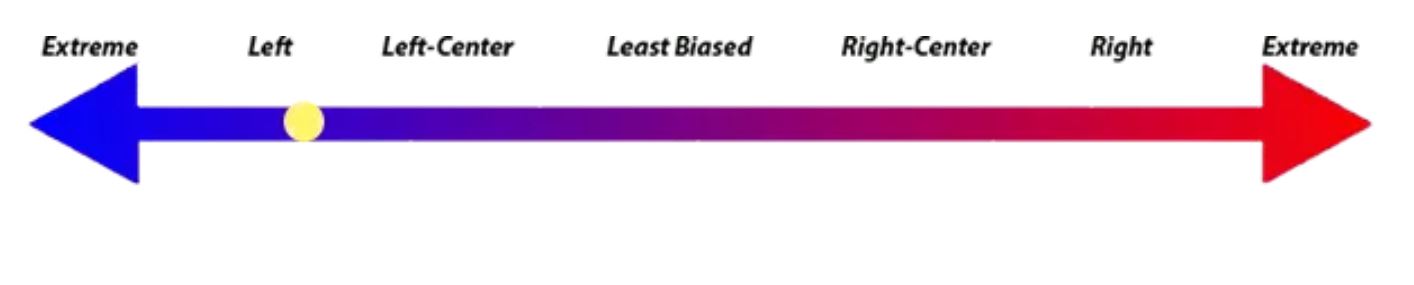
I disagree with my conservative friends who say that The New York Times is extremely biased to the left. Media Bias/Fact Check claims it’s left-center. They rate CNN and MSNBC as left. Their scale looks like this for CNN:

Media Bias Fact Check scales

Here is their list of least biased news sources. It’s an extremely long list, with mostly smaller sources, local papers, foreign news, but includes a few notable titles like The Christian Science Monitor and USA Today. I have to admit that most of my favorite news sources come from the Left-Center list. Although there are a few sources from Right-Center that I like, like Forbes Magazine. Fox News and One American News Network are in the Right-biased list. And I have to admit I do read several sources from the Left-biased list.

Media Bias/Fact Check is a great site to read to contemplate news bias. It also tracks Pro-Science and Pseudoscience lists.

I wonder if we can become less politically polarized and more neighborly if we change where we get our news? I doubt if all Americans will choose to read only from the Least Biased list, but maybe we could aim to stay within the Left-Center through Right-Center range.

JWH