Reading With a Purpose

by James Wallace Harris, 11/12/25

I used to keep up with the world by watching NBC Nightly News with Lester Holt, reading The New York Times on my iPhone, and bingeing YouTube videos. I felt well-informed. That was an illusion.

I then switched to reading The Atlantic, New York Magazine, The New Yorker, and Harper’s Magazine. I focused on the longer articles and developed the habit of reading one significant essay a day. That has taught me how superficial my previous methods were at informing me about what’s going on around the world. Television, the internet, and newspapers were giving me soundbites, while articles provide an education.

However, I still tend to forget this deeper knowledge just as quickly. I don’t like that. I feel like I learn something significant every day. What I’m learning feels heavy and philosophical. However, it drives me nuts that I forget everything so quickly. And I’m not talking about dementia. I think we all forget quickly. Just remember how hard it was to prepare for tests back in school.

I’ve watched dozens of YouTube videos about study methods, and they all show that if you don’t put information to use, it goes away. Use it or lose it. I’ve decided to start reading with a purpose.

At first, I thought I would just save the best articles and refer to them when I wanted to remember. That didn’t work. I quickly forget where I read something. Besides, that approach doesn’t apply any reinforcing methods.

I then thought about writing a blog post for each article. It turns out it takes about a day to do that. And I still forget. I needed something simpler.

I then found Recall AI.
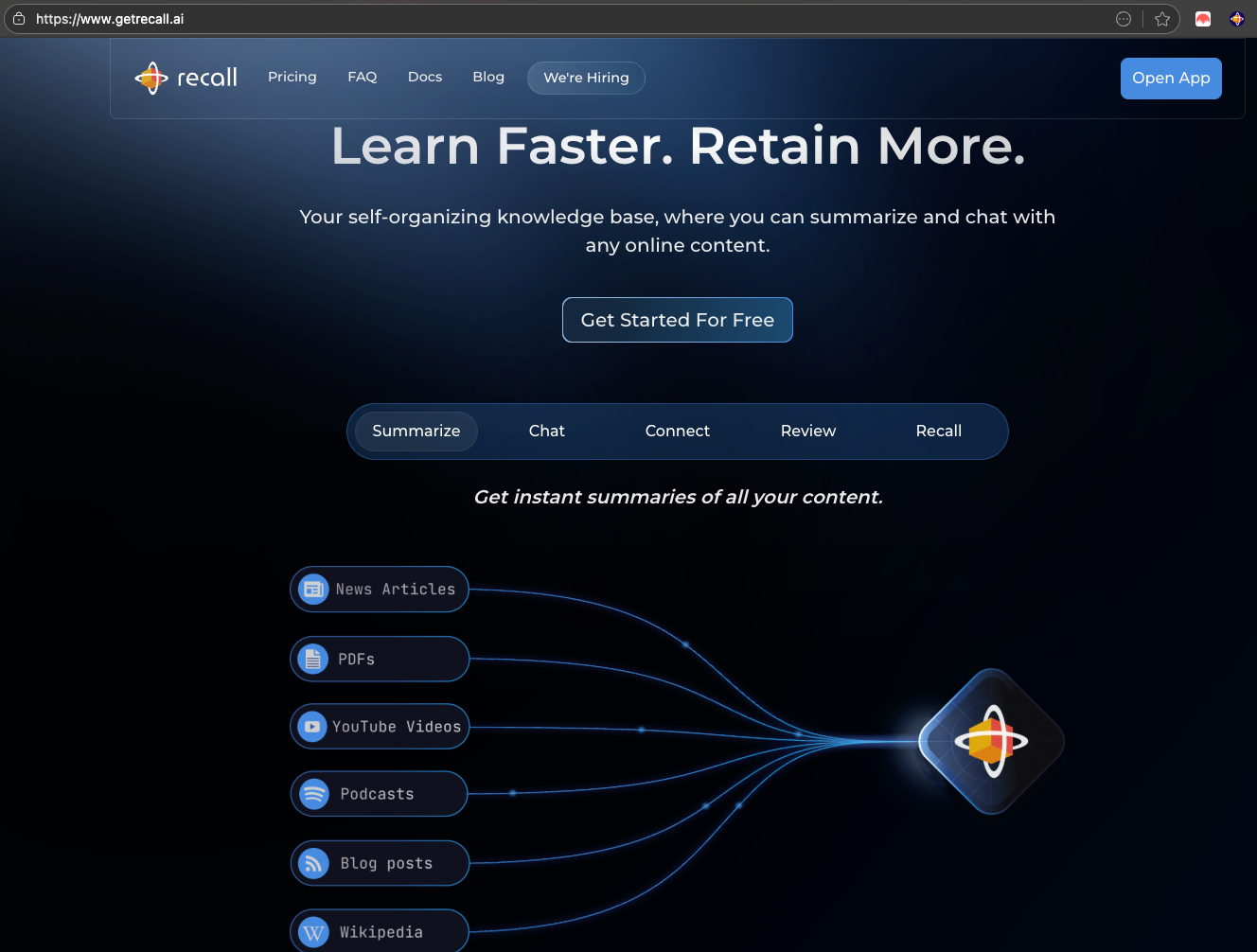
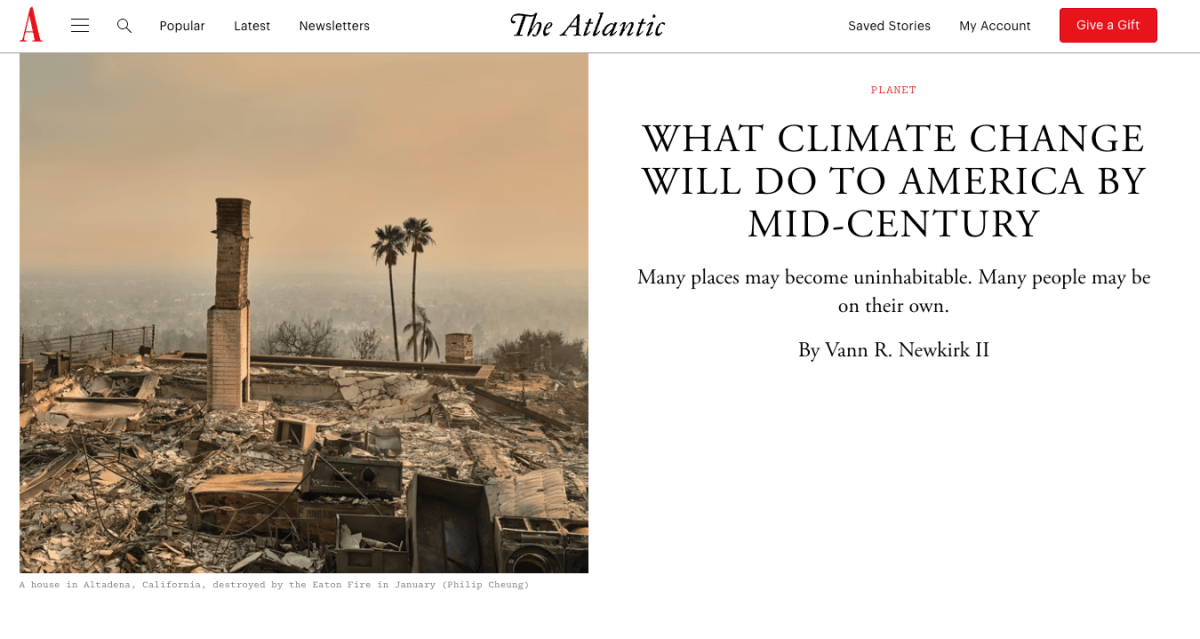
It reads and analyzes whatever webpage you’re on. Providing something like this for today’s article by Vann R. Newkirk II, “What Climate Change Will Do to America by Mid-Century:”
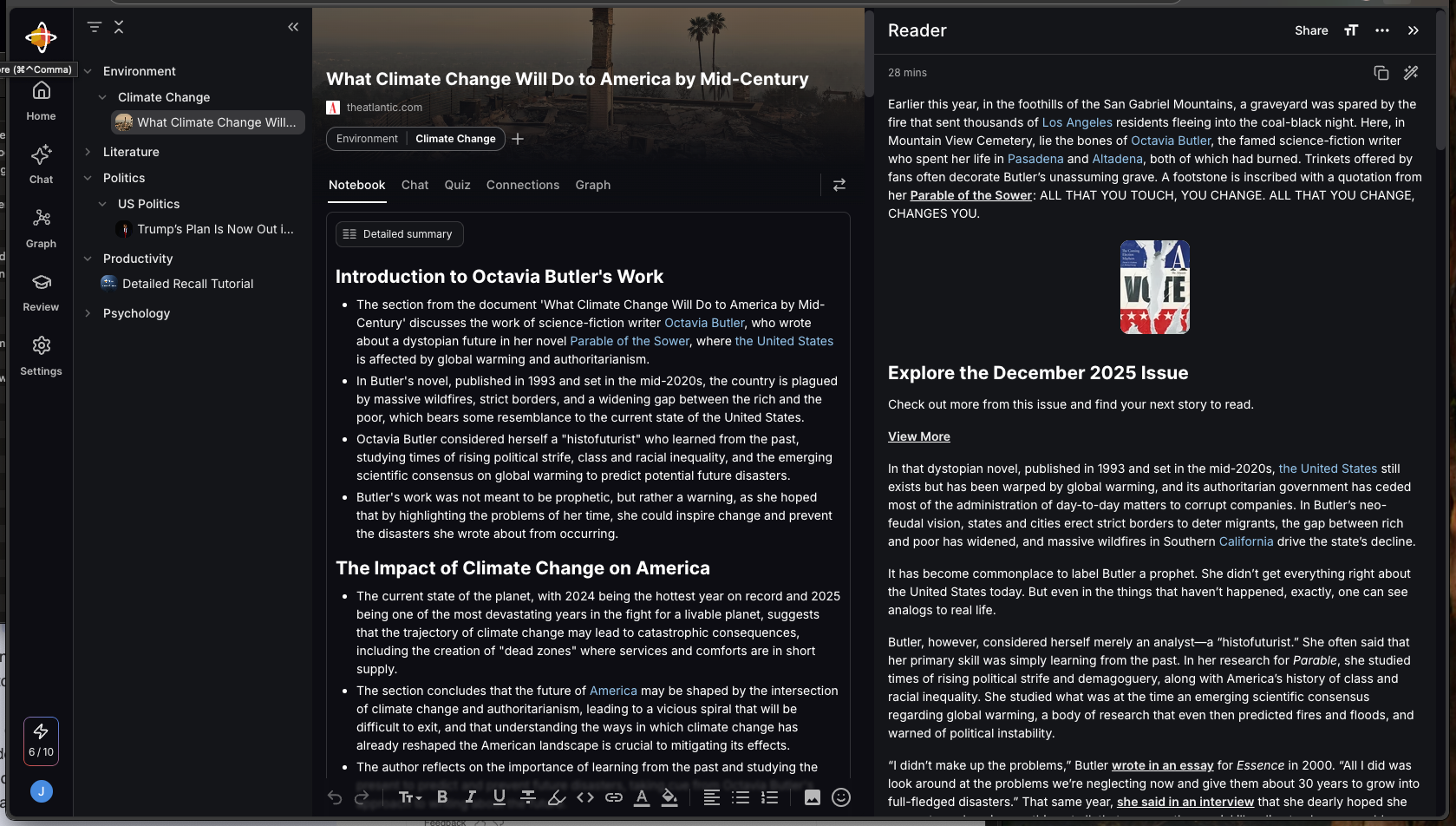
Recall allows me to save this into a structure. But again, this is a lot of work and takes a lot of time. If I were writing an essay or book, this would be a great tool for gathering research.

Recall is also great for understanding what I read. Helpful with quick rereading.

This morning, I got a new idea to try. What if I’m trying to remember too much? What if I narrowed down what I wanted to remember to something specific?

Within today’s article, the author used the term “climate gentrification” referring to neighborhoods being bought up because they were safer from climate change, and thus displacing poor people. The article mentions Liberty City, a poor neighborhood in Miami, with a slightly higher elevation, bought up by developers moving away from low-lying beachfront development.

I think I can remember that concept, climate gentrification. What if I only worked on remembering specific concepts? This got me thinking. I could collect concepts. As my collection grew, I could develop a classification system. A taxonomy of problems that humanity faces. Maybe a Dewey Decimal system of things to know.

I use a note-taking system called Obsidian. It uses hyperlinks to connect your notes, creating relationships between ideas. I could create a vault for collecting concepts. Each time I come across a new concept, I’d enter it into Obsidian, along with a citation where I found it. That might not be too much work.

I picked several phrases I want to remember and study:

  • Climate gentrification
  • Heat islands
  • Climate dead zones
  • Insurance market collapse
  • Climate change acceleration
  • Economic no-go zones
  • Corporate takeover of public services
  • Climate change inequality
  • Histofuturism
  • Sacrifice zones
  • Corporate feudalism

Contemplating this list made me realize that remembering where I read about each concept will take too much work. I have a browser extension, Readwell Reader, that lets me save the content of a web page. I could save every article I want to remember into a folder and then use a program to search for the concept words I remember to find them.

I just did a web search on “climate gentrification” and found it’s already in wide use. I then searched for “corporate feudalism,” and found quite a bit on it too. This suggests I’m onto something. That instead of trying to remember specifically what I read and where, I focus on specific emerging concepts.

Searching on “histofuturism” brought up another article at The Atlantic that references Octavia Butler: “How Octavia Butler Told the Future.” Today’s article by  Vann R. Newkirk II is also built around Octavia Butler. This complicates my plan. It makes me want to research the evolution of the concept, which could be very time-consuming.

The point of focusing on key concepts from my reading is to give my reading purpose that will help me remember. But there might be more to it. Concepts are being identified all the time. And they spread. They really don’t become useful until they enter the vernacular. Until a majority of people use a phrase like “climate gentrification,” the reality it points to isn’t visible.

That realization reinforces my hunch to focus on concepts rather than details in my reading. Maybe reading isn’t about specific facts, but about spreading concepts?

JWH
Homeschooling Myself in My Seventies: A Spiritual Journey for an Atheist

by James Wallace Harris, 10/21/25

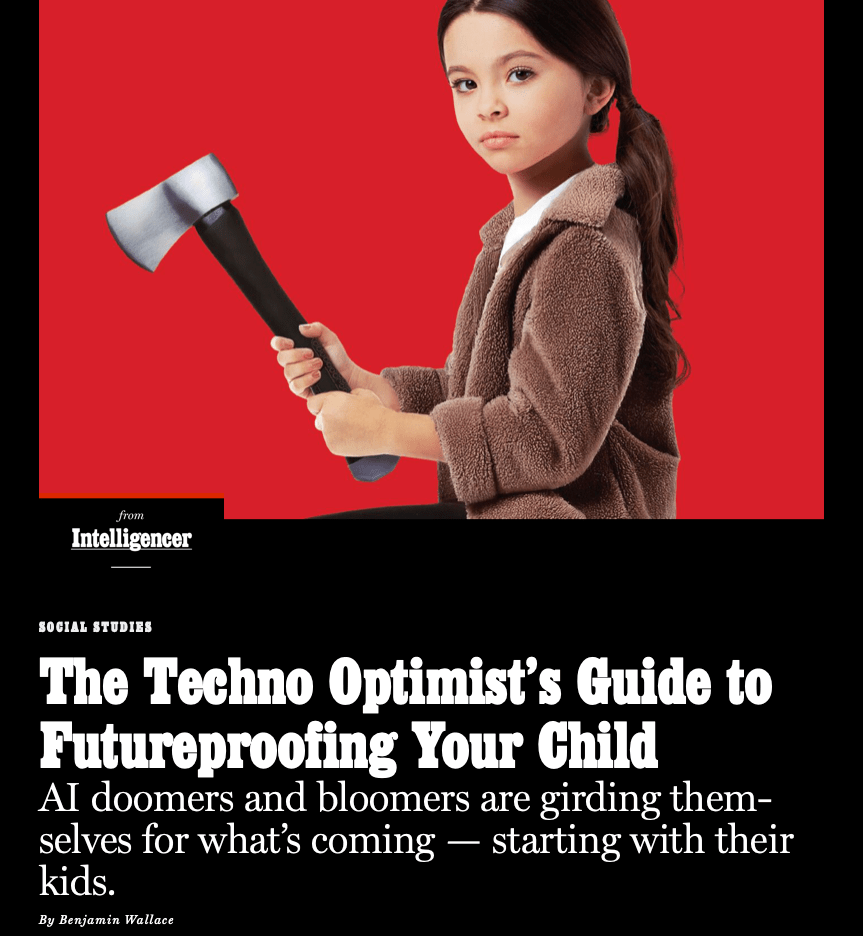
I recently read “The Techno Optimist’s Guide to Futureproofing Your Child” by Benjamin Wallace. The article was subtitled: “AI doomers and bloomers are girding themselves for what’s coming — starting with their kids.”

I don’t have a kid, but I do have me. The gist of the article is exploring new ways to teach kids. Many parents believe that a good college education is no longer the path to success in life. They fear AI will put everyone out of work, that climate change will disrupt society, and that the rapid progress is making everything unstable.

These parents ask: How can I prepare my kids for an uncertain future?

I ask: How can we all prepare for an uncertain future?

Generally, education is seen as preparation for a career. I’m retired. I don’t plan to work in the future. Sooner or later, I’m going to die. That’s another kind of uncertain future. This sense of affinity made this article relevant to me.

The article begins with a profile of Julia and Jeff Wise, who have three children. Wallace called Julia and Jeff “Effective Altruists.” I had to go look that up. To quote Wikipedia:

Affective altruism (EA) is a 21st-century philosophical and social movement that advocates impartially calculating benefits and prioritizing causes to provide the greatest good. It is motivated by “using evidence and reason to figure out how to benefit others as much as possible, and taking action on that basis”. People who pursue the goals of effective altruism, who are sometimes called effective altruists, follow a variety of approaches proposed by the movement, such as donating to selected charities and choosing careers with the aim of maximizing positive impact. The movement gained popularity outside academia, spurring the creation of research centers, advisory organizations, and charities, which collectively have donated several hundred million dollars.

Wallace quotes the Wise’s as saying, “We and some other parents we know have been thinking, Okay, it looks like there may be big changes in the next decade or two. What does that look like for how we prepare our children for the world?” They worry that their kids could die in disasters before they grow old, or find themselves in a post-scarcity utopia of abundance and not need a job.

Parents can’t decide; should their kids attend Harvard, train to be HVAC technicians, or become survivalists?

I could die any time now, since I’m approaching the statistical average age for death, or I could live another twenty or thirty years if I’m an outlier. That’s a big unknown. I could die with my mind intact or not know who I am. If society collapses, my retirement arrangements will fall apart.

What inspired me most about this article was the Alpha School, which sounded like a super-duper version of the Montessori school.

Founded in 2014 as a tiny K–8 private school in Austin, the Alpha School has opened 15 additional campuses, from Scottsdale to San Francisco, on the strength of a tantalizing pitch. Using its AI-driven digital platform, Alpha asserts students learn “2.6” times faster on average than in regular schools while doing only two hours of schoolwork per day. The school has named this platform, which knits together proprietary and third-party apps, “TimeBack.” With those newly liberated hours, students focus on learning the life skills that Alpha’s co-founder MacKenzie Price believes standardized education neglects — things like entrepreneurship and developing “a growth mind-set.” At the flagship campus, a second-grader, in order to ascend to third, must complete a checklist that includes running five kilometers in 35 minutes or less; delivering a two-minute TED-style talk with “zero filler words, 120–170 [wpm] pace, and 90% confidence,” as judged by an AI speech coach named Yoodli; and calling “a peer’s parent” to “independently plan and schedule a playdate.” At Alpha’s middle school, projects have included starting and running an Airbnb and sailing a boat from Florida to the Bahamas.

Basically, the Alpha School teaches kids to be independent learners. The teachers don’t teach; instead, they guide students to study independently.

The article covers theories about educating the young. We tend to think youth is the time of education. I feel like I’m learning more at the end of life than at the beginning. We also think of education in terms of goals. Shouldn’t education be a continual transformation? And we seldom think of learning in old age other than as a hobby.

How can I create my own pedagogy? And for what am I studying? I remember fifty years ago reading Be Here Now by Harvard LSD researcher Richard Alpert, writing as Ram Dass. He claimed that old age was the time to go on a spiritual journey to prepare for death. I’m a life-long atheist. I don’t believe in what most religions teach. But Ram Dass might be right; it might be time to go on a spiritual quest.

I don’t feel the need to study anything specific. First of all, my mind can’t retain information anymore. I love learning, but I have accepted that I forget almost as quickly as I discover. That doesn’t bother me. Like they say, it’s the journey that counts.

However, I don’t forget everything. I seem to lose the facts and details, but somehow, I retain a tiny bit of a new perspective.

My new method of educating myself is to subscribe to printed magazines. I’ve stopped trusting the internet and television. And I’m not too keen on podcasts either.

What I read helps me let go of lifelong beliefs. I’m learning that people live by delusions.

Our minds are corrupted by words. Strangely, the antidote for words is more words. To dissolve decades of thoughts that crust our minds like barnacles requires constant reading.

Our trouble, starting in childhood, is that we embrace beliefs that we never let go of. Most people are programmed by beliefs acquired early in life that they spend the rest of their lives defending.

Home schooling in my seventies is all about unlearning. But it’s not about forgetting. This isn’t intellectual Alzheimer’s. It’s about clarity.

When you watch the news and see reports about bad things happening, ask yourself: Is this because someone believed something wrong? If you are troubled by anything, consider letting go of something you believe true. See if that reduces your anxiety.

For example, much of what I believed in came from reading science fiction. Many billionaires are pursuing goals based on reading science fiction. But I’ve come to see that many desired science fiction futures are no more realistic than what religions have promised.

JWH

Science v. Greed

by James Wallace Harris, 9/9/25

What if the greatest threat to truth isn’t ignorance—but desire? In a world overflowing with information, we rely on cognitive tools like religion, politics, philosophy, and science to make sense of reality. But as greed hijacks our narratives and undermines our trust in evidence, science—the one tool built to transcend bias—is under siege.” – Microsoft CoPilot

This essay describes how I evaluate my daily news feeds. We all rationalize what we want with cognitive tools humans have evolved to explain reality. Two tools dominate many news reports covering current events: science and greed.

If an electron had consciousness, imagine it attempting to explain its existence and describe its position in reality. We are no more significant than an electron, yet we explain our existence with an array of cognitive tools that justify our lives. Cognitive tools are linguistic systems that explain reality to ourselves and others.

Of all the changes our society is undergoing in 2025, the one I fear the most is the attack on science. Science is the only cognitive tool we’ve developed that consistently explains reality across minds and cultures. Unfortunately, reality is complex and science is statistical. Most individuals can’t comprehend complexity. This is especially true when math is required.

Most individuals choose a cognitive tool on faith. They will never understand what they believe or how they believe it. Even believers in science accept it mostly through faith. That’s a shame, faith is a terrible cognitive tool. It is the root of all delusion.

I know early Christian theologians made a virtue out of faith, but consider the logic behind it. They were asking their followers to believe something they couldn’t prove. Because I’m not a scientist, I can only accept scientific claims about reality on faith in science. I don’t like that, but I have to be honest with myself.

However, science’s peer-reviewed research can be studied. Scientific results evolve with constant retesting, which can also be studied. Scientific knowledge is applied in technology, which is further validation.

Faith is a cognitive tool, but a dangerous one. It promotes belief over evidence.

Throughout our evolution, we’ve developed several cognitive tools to explain reality. Religion is the people’s favorite. Unfortunately, religion doesn’t describe reality; it only claims to. To support its views on reality, religions spawned morality to impose order on individuals. Religions are fantasies we create to rationalize our fears and wants. Religion is a cognitive tool we use to impose an explanation on reality, one imagined by one person, and spread to others.

Politics is another cognitive tool we use to impose order onto reality. Politics began with the strength of one individual, which spread to groups. Eventually, weaker individuals gained power by using religion. Finally, collectives gained power through consensus. Politics often combines tools such as science, religion, art, philosophy, ethics, and others to create an ordered system within reality.

The next significant cognitive tool to emerge was philosophy. Philosophy gave us mathematics, ethics, logic, and rhetoric. We learned a great deal from philosophy, but ultimately, it can lead to endless speculation. Philosophy often became another tool for rationalization for what we wanted to believe.

Science is a collective effort that works to eliminate bias. Science studies patterns and consistency that can be measured by all observers. The results of science are not absolutes, only our current best working hypothesis. Science has proved to be the supreme cognitive tool because it works so consistently. Technology is applied science. We only have to consider the success of technology as the best proof that science is an effective cognitive tool.

Many humans can’t handle science. They are willing to accept science if it agrees with their wants. But they reject science when it gets in the way of their desires. Greed is steamrolling science today because some individuals have wants that are more powerful than scientific explanations.

I wanted to link to an article in Bloomberg, “Why Iowa Chooses Not to Clean Up Its Polluted Water,” but it’s behind a paywall. Bloomberg subscribers can read it, but that costs $39.99 a month. Apple News+ subscribers can read it for $12.99 a month. It was the perfect article to illustrate my essay. It described how all the cognitive tools I covered are used to rationalize polluting water in Iowa.

[I’ve since found a free video version of this article on YouTube.]

I’ll use a general example in case you don’t want to watch the video. Take climate change. Science has been consistent in predicting what will happen if we increase the concentration of CO2 in the atmosphere.

There are trillions of dollars worth of fossil fuels waiting to be extracted. The people who own the rights to those fossil fuels don’t want to lose that wealth. Science suggests we should switch to energy sources that don’t produce CO2. This would destroy the wealth connected to fossil fuels.

That’s why the fossil fuel industry attacked science. And they’ve made it political, philosophical, and even religious. They use every cognitive tool before science to attack science. They even attack science with pseudoscience.

Ever since the fossil fuel industry has succeeded with its attacks on science, every group that wants something that science denies has borrowed those tactics.

Climate change is a complex subject to understand. That complexity allows individuals to confuse people with doubt. I can simplify it in my mind. CO2 can be considered a thermostat. Raising the concentration will increase the average temperature of the planet; lowering the concentration will lower the temperature. But leaving trillions of dollars in the ground is something many people can’t accept.

The primary foe of science is greed, but other sources of human desire have embraced the same thinking. Especially, religion. Faith has always been the tool of religion to counter rationality.

Belief rules in this new age. Decades ago, I thought science would help us create a more rational political system. Maybe even inspire the creation of a science-based religion. But that hasn’t happened. We’re rejecting science. We’re returning to cognitive tools that don’t jive with an objective reality. We want to live by subjective experience.

That’s scary. Especially to me, since I want to live in a society where reality makes sense. Reality created through subjectivity is madness, a chaos.

We don’t have to see into the future to know what will happen. We only have to look at history, another cognitive tool for explaining reality. History has always been susceptible to corruption. But if you study enough histories, you’ll see consistencies.

With every news article you read or watch on television, consider how the individuals involved are interpreting reality and which cognitive tools they are using. Notice how often the story involves science versus greed.

Greed usually wins.

JWH

What Should I Major in at Old Age University?

by James Wallace Harris, 8/16/25

I’ve decided to earn an equivalent of a graduate degree before I turn 77. I need a project that will keep me occupied in retirement. I’ve always been one to know a tiny bit about hundreds of subjects rather than a lot about a few. I want to pick one subject and stick with it.

I could get a master’s degree from the University of Memphis, where I used to work, since I can take courses for free. I’m not sure they have a major that fulfills my interests. I will check it out. I’ll also check out available online universities. Mainly, I’m borrowing the structure of a graduate degree for my plan.

I decided a book-length thesis will be my measure of success. Since a master’s degree usually takes two or three years, I’m giving myself until I turn 77, which is November 25, 2028.

Over the next few months, I will decide what I want to study. There are many things to consider and think about. Most graduate programs have lots of prerequisites. Before I retired, I considered taking an M.S. in Computer Science. That program required 24 hours of math courses and 12 hours of computer courses to be accepted into the program. The degree itself was 36 hours.

It’s doubtful I could finish a computer science degree before turning 77. And in all honesty, I no longer have the cognitive ability to retake all that math.

My undergraduate degree is in English. I did 24 hours towards an M.A. in Creative Writing before I dropped out. I was also interested in American, British, and European literature. I’d have to start over from scratch because those 24 hours would have timed out. But I no longer want to study English or creative writing.

I’ve also thought of pursuing an Art History degree. I’ve been collecting art books and art history books for a couple of decades, and I have friends with degrees in Art History. One gave me a list of 200 artworks that I’d be required to discuss to pass the oral exam for the master’s degree. I started reading about those works.

I realized I would have to commit several years of dedicated study to pass the oral. I don’t want to do that. I don’t love art that much. I’m not sure what single subject would be worth that much dedication.

I’ll study college catalogs for inspiration, but it’s doubtful that I will want to complete an actual degree from a university. Instead, I will need to make up my own degree.

Let’s say a master’s degree involves twelve courses, and each course requires studying five books. Then my custom-designed degree will require distilling sixty books into a single thesis volume. That thesis should present an original idea.

The single subject I do know a lot about is science fiction. And I’ve thought it would be fun to write a book that parallels the development of science with the evolution of science fiction. I probably already own the books I’d need to research the subject. And it would be the easiest goal for me to achieve because it’s a subject I love and would have no trouble sticking with.

However, I’ve become obsessed with a couple of ideas that I want to study. I believe they are especially fascinating for the last years of my life.

The first is about how humans are delusional. I’d like to chronicle all the ways we fool ourselves. I want to study all the cognitive processes to discover if we can interact with reality without delusion. Current affairs is the perfect laboratory for such a study.

Second, I’m fascinated by how personality is formed. I’d like to answer this question: If I knew then what I know now, how would I have reshaped my personality?

There is a synergy between the two interests. How do delusions shape our personality?

Ever since I read Ed Yong’s An Immense World, I’ve been fascinated by the concept of Umwelt. Our senses limit and define how we perceive reality. Our personality and cognitive abilities determine how we choose to react to that perception of reality.

I haven’t decided yet on what I will pick, but I’m leaning towards delusion and personality development. If I choose that, I’d start this project by collecting books on the subjects and by reading popular periodicals. Eventually, I’d get to academic journals. I don’t think my made-up degree will be very rigorous, though. I’d consider a two-hundred-page book at a modest popular science reading level to merit my do-it-yourself degree.

JWH

12 Reasons Why I’ve Stopped Watching the NBC Nightly News

by James Wallace Harris, 7/29/25

I developed the habit of watching the CBS Evening News with Walter Cronkite when JFK was assassinated in 1963. I had just turned thirteen. Cronkite had been the first to switch to a half-hour evening news format that September. I only had a vague sense of what the news was before that. I stuck with CBS until the 1980s, into the Dan Rather years. For some reason, my wife and I then switched to ABC for a couple of decades before finally switching to NBC. When Lester Holt retired, I decided to stop getting my news from television.

Since then, I’ve been thinking about what it means to follow the news. Does it require a daily habit of studying current affairs? Should we consider the news to be any reporting of significant events that have recently happened? How much information can be crammed into twenty-two minutes of television? Who decides what is worth knowing? Recently, NBC chose to make the deaths of two celebrities the lead story two nights running. Were the careers of Ozzy Osbourne and Hulk Hogan the most important information I needed to know on those two days? Think about it. Of all these events happening around the world on those two days, were their deaths the most essential for me to learn about?

Reason 1

I’m not picking on NBC. All the broadcast networks and the cable news networks decided what their audiences want to watch based on ratings. It’s not that Ozzy and Hulk’s deaths are more newsworthy than famine in Gaza, but NBC knows its audience is tired of hearing about starving Palestinians, and more people would watch their show if it opened with Osbourne and Hogan.

Decision 1: I need to decide what’s newsworthy.

Reason 2

Is twenty-two minutes enough time to learn about the critical world events that happened in the last twenty-four hours? Just how much time should I devote to being well-informed? If it is as little as twenty-two minutes, then television is the wrong medium. Reading just the headings of all the news stories from a quality newspaper app on my phone serves me far better.

Television news spends most of its time on visual news. Often, NBC repeats exciting film clips several times. That’s not an efficient use of time. Airplane crashes and flooding rivers grab our attention, but is it really news we need?

Decision 2: I need to decide how much time I want to spend on the news. Additionally, I need to decide on the best medium that maximizes that time.

Reason 3

Too much of television news is taken up by reporters and anchors. Often, reporters take more time asking a question than the time given to the eyewitness’s reply. I’m not interested in reporters or anchors.

Decision 3: I need to look for news sources where the journalist is in the background. That excludes television and most podcasts. Generally, good print reporting only includes the reporter’s byline.

Reason 4

Television news offers low-quality information. A major article in The Atlantic might have taken months to research and write. Such articles are information-dense. TV news is written and edited quickly. There’s not much time for fact gathering or checking. It’s often based on eye-witnesses who mainly add emotional impact rather than inform. Television news relies on soundbites, which are mostly opinions. Experts interviewed on TV news are often selected by convenience rather than their authority.

There have been over 22,500 days since I started watching nightly news programs on TV. There is an incredible sameness to the kind of content TV news presents. I should have abandoned it long ago, but it gave the illusion I was being informed, and it was convenient.

Decision 4: Pick another medium for consuming news.

Reason 5

Television news is narrow in scope. It focuses on catastrophes, tragedies, and political conflict. Over a lifetime of seeing thousands of news reports on wildfires, they all look and feel the same. That’s also true for wars, airplane crashes, riots, elections, famines, hurricanes, floods, and tornadoes. Television news mainly focuses on the types of stories we’ve seen repeated throughout our lives.

Television makes it seem like there is nothing new under the sun. I’ve learned from reading quality magazine articles and newspaper journalism that that old bit of wisdom is completely untrue. Magazine and newspaper articles constantly amaze me with news that surprises me because it’s about people, places, concepts, ideas, and events I’ve never heard of before.

Decision 5: Find more news sources that teach me about reality, inspire my curiosity, and better inform.

Reason 6

TV news is seldom memorable. If John F. Kennedy’s assassination was only reported once on the CBS Evening News on November 22, 1963, I doubt I would even remember the event. I remember it because of constant coverage over several days, including all the documentaries, movies, and books that have been produced since that day. I remember Project Mercury, Gemini, and Apollo missions because of the around-the-clock television coverage, as well as the documentaries, movies, and books that have been produced since those events. That’s why I don’t remember all the space missions since. They didn’t get such coverage.

A thirty-second spot on the nightly news, or even a big event stretched to four minutes of reporting, just isn’t remembered. I don’t need to waste time on ephemeral news stories. I’ve discovered it’s far better to spend thirty minutes on one topic than two minutes on fifteen topics.

Decision 6: Focus on one news topic for most of my daily time spent on the news. Then quickly go over the headlines.

Reason 7

Television news isn’t educational because it focuses on the same topics. Shouldn’t news enlighten us about reality? Shouldn’t we always expand our awareness of what’s going on in the world?

How can short videos and soundbites be truly informative? I want news that adds to my personal growth. News that adds wisdom, not ephemeral data.

Decision 7: Make lists of what I want to learn about and then find news reports that bring me up to date on those topics.

Reason 8

Television news is biased. Knowing the truth is impossible. Content produced for money-making ratings or to promote a political agenda will always be questionable. I even suspect the kind of long-form journalism that goes out of its way to appear unbiased. I expect all writing to have some bias. It’s my job to spot it.

Decision 8: Start analyzing prose for bias. Think about word choices in each sentence. Always wonder if information is left out.

Reason 9

Real knowledge is statistical. Science is our only cognitive tool that consistently explains reality. News is too close to word-of-mouth. We need news to be closer to peer-reviewed science journals. That’s probably impossible, but we need to think about it. Ground News attempts to apply statistics to the news by comparing political bias and the amount of coverage a story receives. Can’t we find other statistical methods to measure the news?

Decision: Don’t trust any news unless it comes from multiple sources.

Reason 10

Replying on a single network for news is dangerous.

Decision 10: Seek out different gatekeepers. Every group or organization has an agenda. Learn what that agenda is before interpreting what they are saying.

I’ve discovered that reading/listening to one well-reported article a day is much more informative and educational than a package of video clips and soundbites. I’ve been achieving this with Apple News+, which offers content from over 400 magazines and newspapers. Each morning, I listen to a single long-form article from magazines such as The Atlantic, New York Magazine, The New Yorker, and New Scientist, while I do my physical therapy and morning walk.

Reason 11

Television news can be misleading. It’s not as dangerous as AI-generated fake news on YouTube, but television news is easily corrupted by money, marketing, and politics.

Decision 11: Always consider the source of the news. I need to decide which news sources I will trust.

Reason 12

Most television news gives the United States’ perspective of world events.

Decision 12: Find news sources from around the world.

Conclusion

This is just the beginning of changing a lifelong habit of watching the nightly news on television. I should have made these changes long ago. We all get into ruts that are hard to escape. I believe getting old is making me regret not trying other approaches to understanding reality. However, all the political turmoil since 2016 is making me question everything I know. Human-created and computer-created fake news is disturbing. In recent years, I’ve decided that all of us suffer from multiple delusions.

You shouldn’t ask yourself if you’re delusional, but how delusional. Anyone who feels they know the truth is crazy. We can only guess what might be true by using statistics. Television has always depended on the false assumption that seeing is believing. I have doubts about believing anything.

Television, politics, artificial intelligence, and the Internet have corrupted our perception of reality. I want to rethink everything. I’m starting with my old habit of watching the nightly news.

JWH