Am I Too Old To Start A Second Brain?

by James Wallace Harris, 12/8/25

For years now, I’ve been reading about people who create a second brain to record what they want to remember. Most of these second brain systems use software, but not all. Many base their ideas on the Zettelkasten system, which was originally stored on note cards.

Over the years, I’ve tried different methods and software applications. I’m currently learning Obsidian. I’ve used note cards, notebooks, Google Docs, Evernote, OneNote, InstaPaper, Recall, and others. I love reading – taking information in – but I don’t like taking notes.

The trouble is, information goes through my brain like a sieve. When I want to tell someone about what I’ve learned, or think I’ve learned, I can’t cite my source, or, for that matter, clearly state what I think I know. And I seldom think about how I’ve come to believe what I believe.

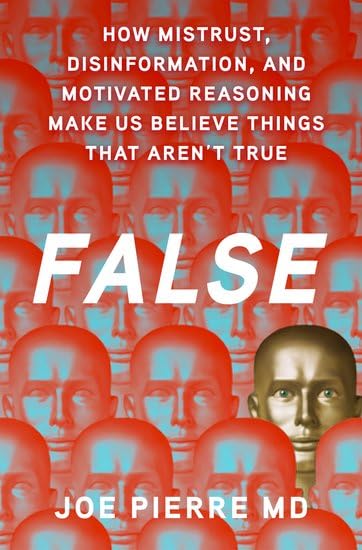
I’m currently reading False by Joe Pierre, MD, about how we all live with delusions. This book makes me want to rededicate myself to creating a second brain for two reasons. First, I want to take precise notes on this book because it offers dozens of insights about how we deceive ourselves, and about how other people are deceived and are deceiving. Second, the book inspires me to start tracking what I think I learn every day and study where that knowledge comes from.

One of the main ways we fool ourselves is with confirmation bias. Pierre says:

In real estate, it’s said that the most important guide to follow when buying a house and trying to understand home values is “location, location, location.” If I were asked about the most important guide to understand the psychology of believing strongly in things that aren’t true, I would similarly answer, “confirmation bias, confirmation bias, confirmation bias.”

Pierre explains how the Internet, Google, AIs, Social Media, and various algorithms reinforce our natural tendency toward confirmation bias.

Pierre claims there are almost 200 defined cognitive biases. Wikipedia has a nice listing of them. Wikipedia also has an equally nice, long list of fallacies. Look at those two lists; they are what Pierre is describing in his book.

Between these two lists, there are hundreds of ways we fool ourselves. They are part of our psychology. They explain how we interact with people and reality. However, everything is magnified by polarized politics, the Internet, Social Media, and now AI.

I’d like to create a second brain that would help me become aware of my own biases and fallacies. It would have been more useful if I had started this project when I was young. And I may be too old to overcome a lifetime of delusional thinking.

I do change the way I think sometimes. For example, most of my life, I’ve believed that it was important for humanity to go to Mars. Like Elon Musk, I thought it vital that we create a backup home for our species. I no longer believe either.

Why would I even think about Mars in the first place? I got those beliefs from reading dozens of nonfiction and fictional books about Mars. Why have I changed my mind? Because I have read dozens of articles that debunk those beliefs. In other words, my ideas came from other people.

I would like to create a second brain that tracks how my beliefs develop and change. Could maintaining a second brain help reveal my biases and thinking fallacies? I don’t know, but it might.

Doing the same thing and expecting different results is a common fallacy. Most of my friends are depressed and cynical about current events. Humanity seems to be in an immense Groundhog Day loop of history. Doesn’t it seem like liberals have always wanted to escape this loop, and conservatives wanted to embrace it?

If we have innate mental systems that are consistently faulty, how do we reprogram ourselves? I know my life has been one of repeatable behaviors. Like Phil Conners, I’m looking for a way out of the loop.

Stoicism seems to be the answer in old age. Is it delusional to think enlightenment might be possible?

JWH

Reading With a Purpose

by James Wallace Harris, 11/12/25

I used to keep up with the world by watching NBC Nightly News with Lester Holt, reading The New York Times on my iPhone, and bingeing YouTube videos. I felt well-informed. That was an illusion.

I then switched to reading The Atlantic, New York Magazine, The New Yorker, and Harper’s Magazine. I focused on the longer articles and developed the habit of reading one significant essay a day. That has taught me how superficial my previous methods were at informing me about what’s going on around the world. Television, the internet, and newspapers were giving me soundbites, while articles provide an education.

However, I still tend to forget this deeper knowledge just as quickly. I don’t like that. I feel like I learn something significant every day. What I’m learning feels heavy and philosophical. However, it drives me nuts that I forget everything so quickly. And I’m not talking about dementia. I think we all forget quickly. Just remember how hard it was to prepare for tests back in school.

I’ve watched dozens of YouTube videos about study methods, and they all show that if you don’t put information to use, it goes away. Use it or lose it. I’ve decided to start reading with a purpose.

At first, I thought I would just save the best articles and refer to them when I wanted to remember. That didn’t work. I quickly forget where I read something. Besides, that approach doesn’t apply any reinforcing methods.

I then thought about writing a blog post for each article. It turns out it takes about a day to do that. And I still forget. I needed something simpler.

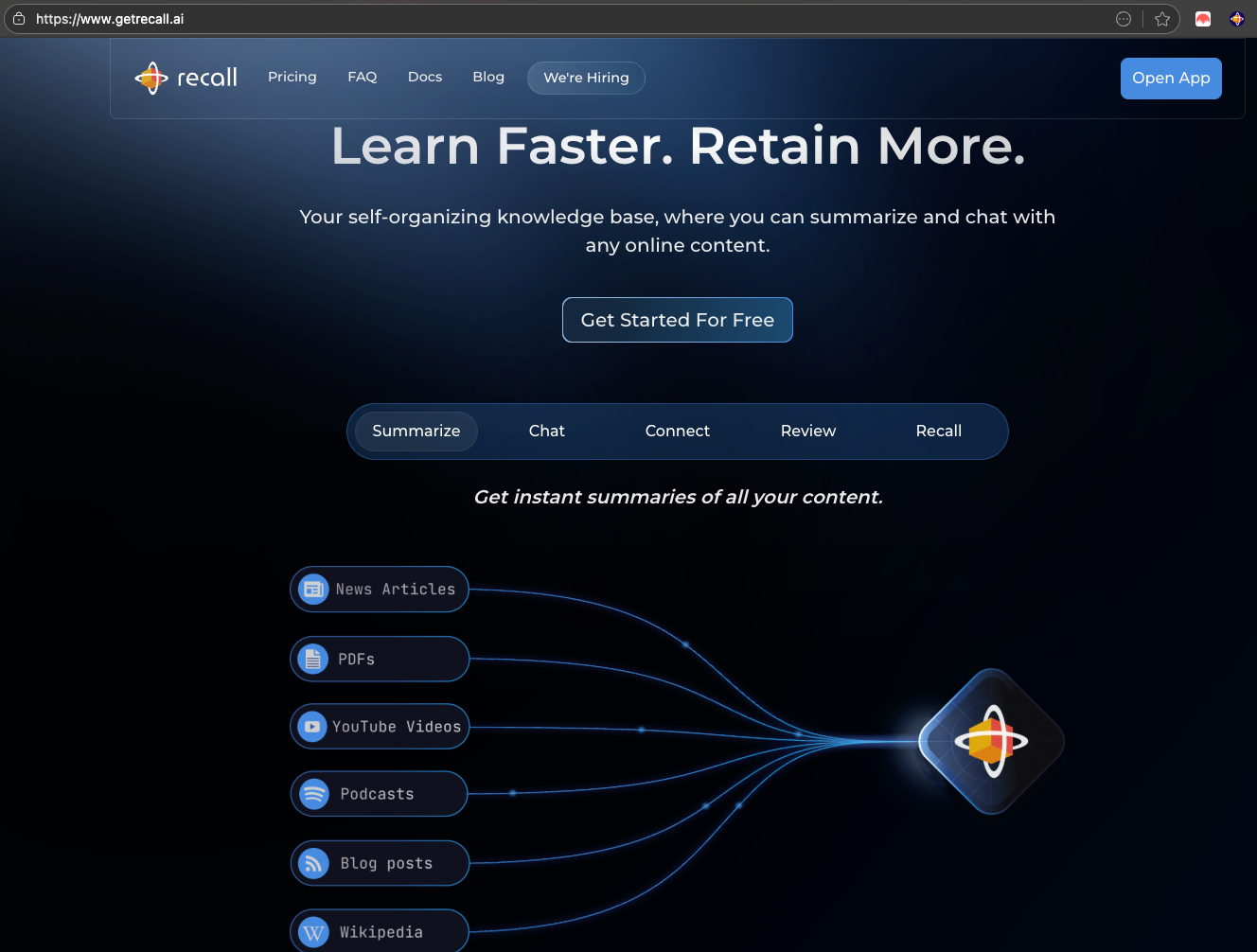
I then found Recall AI.

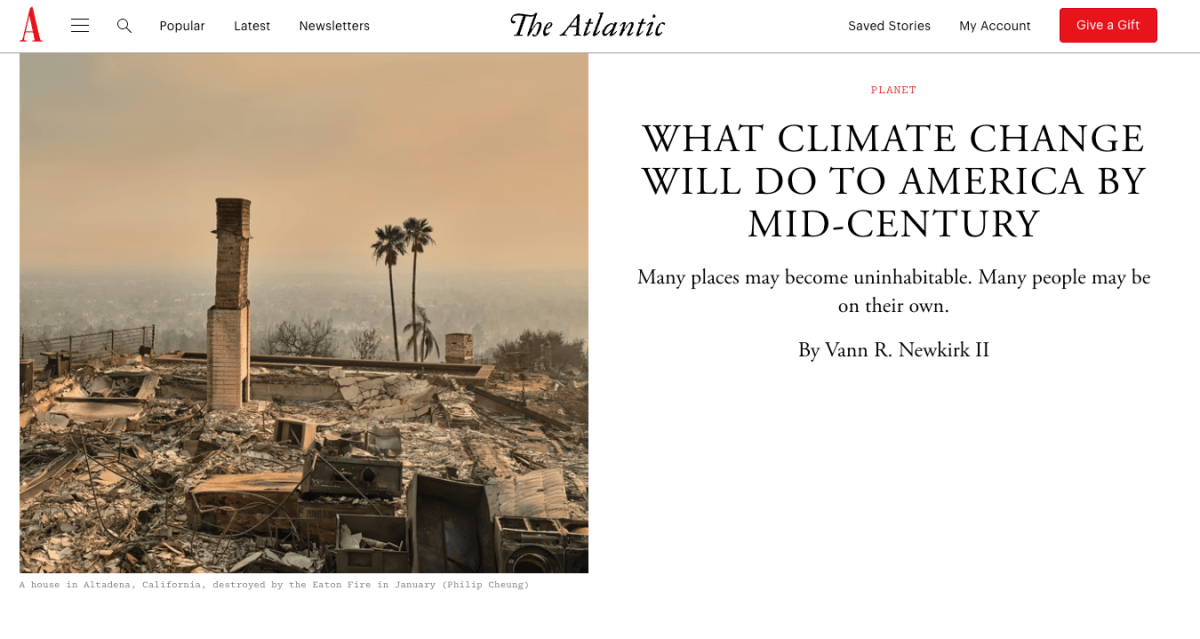
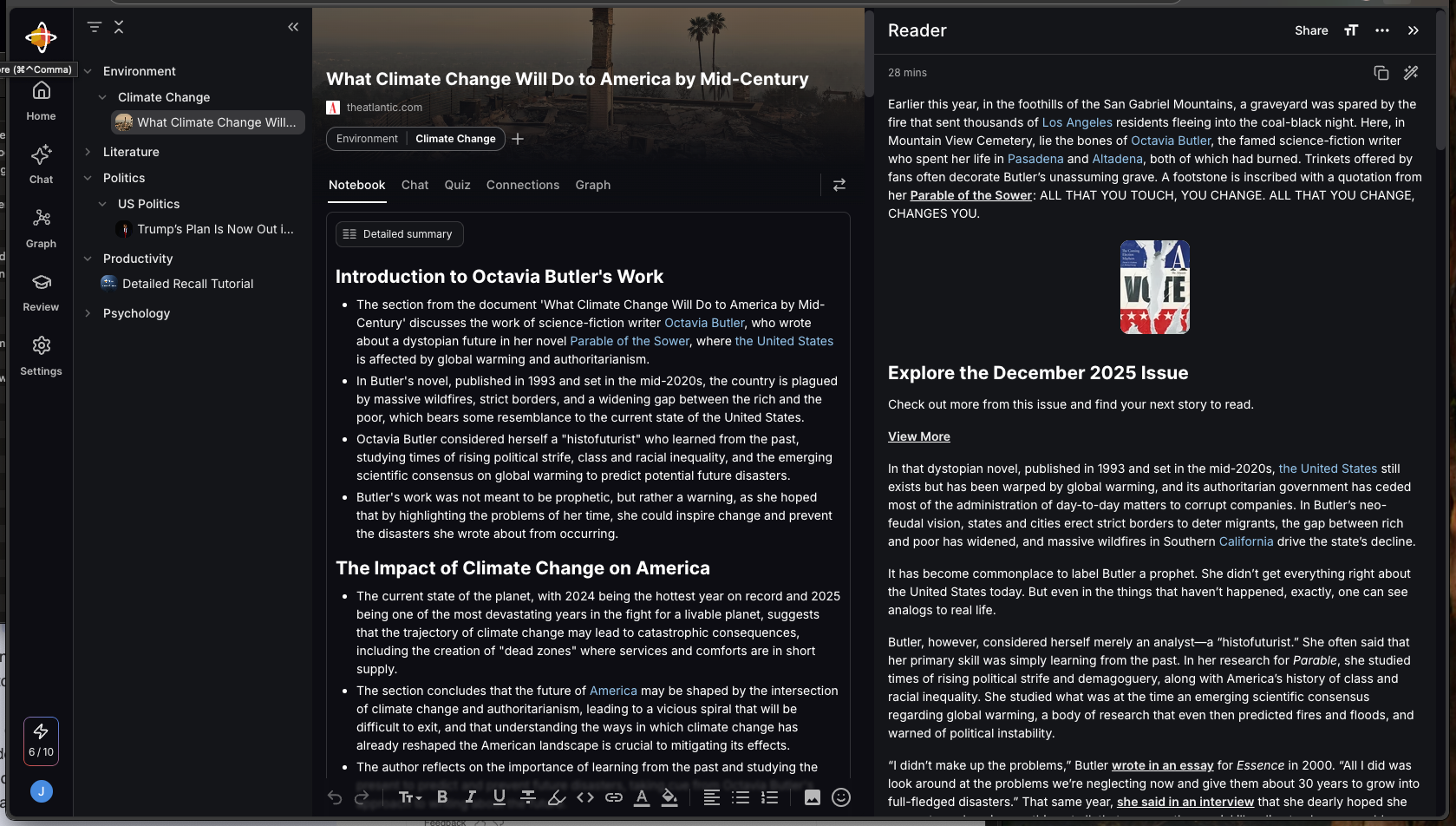
It reads and analyzes whatever webpage you’re on. Providing something like this for today’s article by Vann R. Newkirk II, “What Climate Change Will Do to America by Mid-Century:”

Recall allows me to save this into a structure. But again, this is a lot of work and takes a lot of time. If I were writing an essay or book, this would be a great tool for gathering research.

Recall is also great for understanding what I read. Helpful with quick rereading.

This morning, I got a new idea to try. What if I’m trying to remember too much? What if I narrowed down what I wanted to remember to something specific?

Within today’s article, the author used the term “climate gentrification” referring to neighborhoods being bought up because they were safer from climate change, and thus displacing poor people. The article mentions Liberty City, a poor neighborhood in Miami, with a slightly higher elevation, bought up by developers moving away from low-lying beachfront development.

I think I can remember that concept, climate gentrification. What if I only worked on remembering specific concepts? This got me thinking. I could collect concepts. As my collection grew, I could develop a classification system. A taxonomy of problems that humanity faces. Maybe a Dewey Decimal system of things to know.

I use a note-taking system called Obsidian. It uses hyperlinks to connect your notes, creating relationships between ideas. I could create a vault for collecting concepts. Each time I come across a new concept, I’d enter it into Obsidian, along with a citation where I found it. That might not be too much work.

I picked several phrases I want to remember and study:

  • Climate gentrification
  • Heat islands
  • Climate dead zones
  • Insurance market collapse
  • Climate change acceleration
  • Economic no-go zones
  • Corporate takeover of public services
  • Climate change inequality
  • Histofuturism
  • Sacrifice zones
  • Corporate feudalism

Contemplating this list made me realize that remembering where I read about each concept will take too much work. I have a browser extension, Readwell Reader, that lets me save the content of a web page. I could save every article I want to remember into a folder and then use a program to search for the concept words I remember to find them.

I just did a web search on “climate gentrification” and found it’s already in wide use. I then searched for “corporate feudalism,” and found quite a bit on it too. This suggests I’m onto something. That instead of trying to remember specifically what I read and where, I focus on specific emerging concepts.

Searching on “histofuturism” brought up another article at The Atlantic that references Octavia Butler: “How Octavia Butler Told the Future.” Today’s article by  Vann R. Newkirk II is also built around Octavia Butler. This complicates my plan. It makes me want to research the evolution of the concept, which could be very time-consuming.

The point of focusing on key concepts from my reading is to give my reading purpose that will help me remember. But there might be more to it. Concepts are being identified all the time. And they spread. They really don’t become useful until they enter the vernacular. Until a majority of people use a phrase like “climate gentrification,” the reality it points to isn’t visible.

That realization reinforces my hunch to focus on concepts rather than details in my reading. Maybe reading isn’t about specific facts, but about spreading concepts?

JWH

Homeschooling Myself in My Seventies: A Spiritual Journey for an Atheist

by James Wallace Harris, 10/21/25

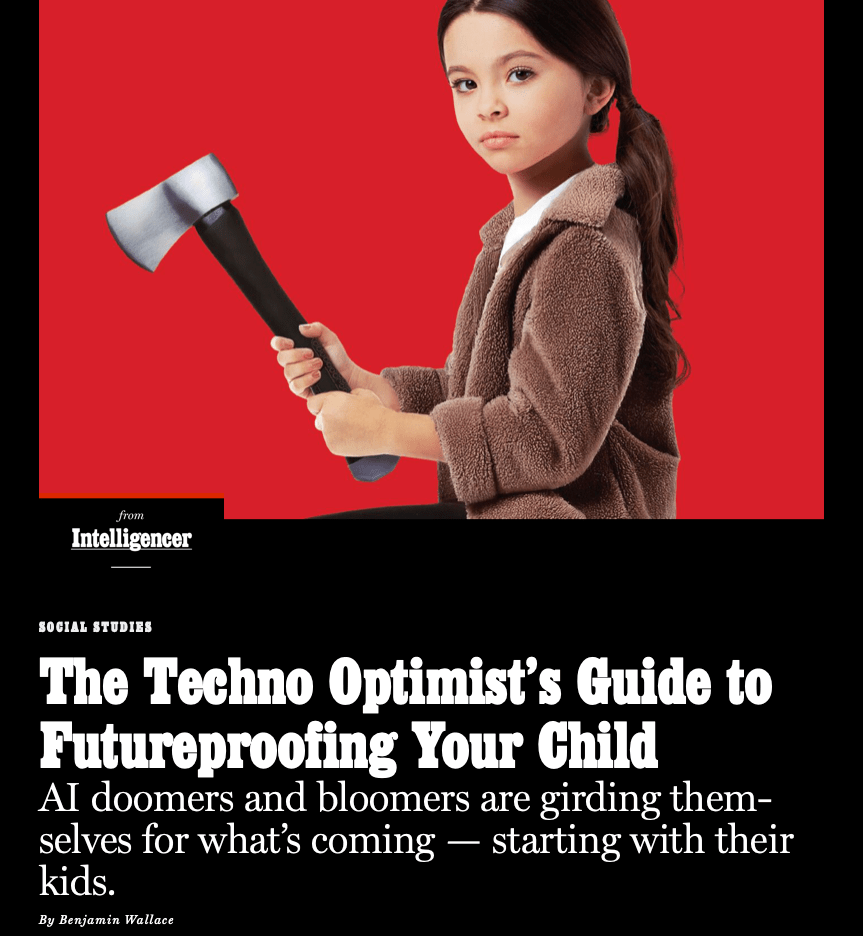
I recently read “The Techno Optimist’s Guide to Futureproofing Your Child” by Benjamin Wallace. The article was subtitled: “AI doomers and bloomers are girding themselves for what’s coming — starting with their kids.”

I don’t have a kid, but I do have me. The gist of the article is exploring new ways to teach kids. Many parents believe that a good college education is no longer the path to success in life. They fear AI will put everyone out of work, that climate change will disrupt society, and that the rapid progress is making everything unstable.

These parents ask: How can I prepare my kids for an uncertain future?

I ask: How can we all prepare for an uncertain future?

Generally, education is seen as preparation for a career. I’m retired. I don’t plan to work in the future. Sooner or later, I’m going to die. That’s another kind of uncertain future. This sense of affinity made this article relevant to me.

The article begins with a profile of Julia and Jeff Wise, who have three children. Wallace called Julia and Jeff “Effective Altruists.” I had to go look that up. To quote Wikipedia:

Affective altruism (EA) is a 21st-century philosophical and social movement that advocates impartially calculating benefits and prioritizing causes to provide the greatest good. It is motivated by “using evidence and reason to figure out how to benefit others as much as possible, and taking action on that basis”. People who pursue the goals of effective altruism, who are sometimes called effective altruists, follow a variety of approaches proposed by the movement, such as donating to selected charities and choosing careers with the aim of maximizing positive impact. The movement gained popularity outside academia, spurring the creation of research centers, advisory organizations, and charities, which collectively have donated several hundred million dollars.

Wallace quotes the Wise’s as saying, “We and some other parents we know have been thinking, Okay, it looks like there may be big changes in the next decade or two. What does that look like for how we prepare our children for the world?” They worry that their kids could die in disasters before they grow old, or find themselves in a post-scarcity utopia of abundance and not need a job.

Parents can’t decide; should their kids attend Harvard, train to be HVAC technicians, or become survivalists?

I could die any time now, since I’m approaching the statistical average age for death, or I could live another twenty or thirty years if I’m an outlier. That’s a big unknown. I could die with my mind intact or not know who I am. If society collapses, my retirement arrangements will fall apart.

What inspired me most about this article was the Alpha School, which sounded like a super-duper version of the Montessori school.

Founded in 2014 as a tiny K–8 private school in Austin, the Alpha School has opened 15 additional campuses, from Scottsdale to San Francisco, on the strength of a tantalizing pitch. Using its AI-driven digital platform, Alpha asserts students learn “2.6” times faster on average than in regular schools while doing only two hours of schoolwork per day. The school has named this platform, which knits together proprietary and third-party apps, “TimeBack.” With those newly liberated hours, students focus on learning the life skills that Alpha’s co-founder MacKenzie Price believes standardized education neglects — things like entrepreneurship and developing “a growth mind-set.” At the flagship campus, a second-grader, in order to ascend to third, must complete a checklist that includes running five kilometers in 35 minutes or less; delivering a two-minute TED-style talk with “zero filler words, 120–170 [wpm] pace, and 90% confidence,” as judged by an AI speech coach named Yoodli; and calling “a peer’s parent” to “independently plan and schedule a playdate.” At Alpha’s middle school, projects have included starting and running an Airbnb and sailing a boat from Florida to the Bahamas.

Basically, the Alpha School teaches kids to be independent learners. The teachers don’t teach; instead, they guide students to study independently.

The article covers theories about educating the young. We tend to think youth is the time of education. I feel like I’m learning more at the end of life than at the beginning. We also think of education in terms of goals. Shouldn’t education be a continual transformation? And we seldom think of learning in old age other than as a hobby.

How can I create my own pedagogy? And for what am I studying? I remember fifty years ago reading Be Here Now by Harvard LSD researcher Richard Alpert, writing as Ram Dass. He claimed that old age was the time to go on a spiritual journey to prepare for death. I’m a life-long atheist. I don’t believe in what most religions teach. But Ram Dass might be right; it might be time to go on a spiritual quest.

I don’t feel the need to study anything specific. First of all, my mind can’t retain information anymore. I love learning, but I have accepted that I forget almost as quickly as I discover. That doesn’t bother me. Like they say, it’s the journey that counts.

However, I don’t forget everything. I seem to lose the facts and details, but somehow, I retain a tiny bit of a new perspective.

My new method of educating myself is to subscribe to printed magazines. I’ve stopped trusting the internet and television. And I’m not too keen on podcasts either.

What I read helps me let go of lifelong beliefs. I’m learning that people live by delusions.

Our minds are corrupted by words. Strangely, the antidote for words is more words. To dissolve decades of thoughts that crust our minds like barnacles requires constant reading.

Our trouble, starting in childhood, is that we embrace beliefs that we never let go of. Most people are programmed by beliefs acquired early in life that they spend the rest of their lives defending.

Home schooling in my seventies is all about unlearning. But it’s not about forgetting. This isn’t intellectual Alzheimer’s. It’s about clarity.

When you watch the news and see reports about bad things happening, ask yourself: Is this because someone believed something wrong? If you are troubled by anything, consider letting go of something you believe true. See if that reduces your anxiety.

For example, much of what I believed in came from reading science fiction. Many billionaires are pursuing goals based on reading science fiction. But I’ve come to see that many desired science fiction futures are no more realistic than what religions have promised.

JWH

Science v. Greed

by James Wallace Harris, 9/9/25

What if the greatest threat to truth isn’t ignorance—but desire? In a world overflowing with information, we rely on cognitive tools like religion, politics, philosophy, and science to make sense of reality. But as greed hijacks our narratives and undermines our trust in evidence, science—the one tool built to transcend bias—is under siege.” – Microsoft CoPilot

This essay describes how I evaluate my daily news feeds. We all rationalize what we want with cognitive tools humans have evolved to explain reality. Two tools dominate many news reports covering current events: science and greed.

If an electron had consciousness, imagine it attempting to explain its existence and describe its position in reality. We are no more significant than an electron, yet we explain our existence with an array of cognitive tools that justify our lives. Cognitive tools are linguistic systems that explain reality to ourselves and others.

Of all the changes our society is undergoing in 2025, the one I fear the most is the attack on science. Science is the only cognitive tool we’ve developed that consistently explains reality across minds and cultures. Unfortunately, reality is complex and science is statistical. Most individuals can’t comprehend complexity. This is especially true when math is required.

Most individuals choose a cognitive tool on faith. They will never understand what they believe or how they believe it. Even believers in science accept it mostly through faith. That’s a shame, faith is a terrible cognitive tool. It is the root of all delusion.

I know early Christian theologians made a virtue out of faith, but consider the logic behind it. They were asking their followers to believe something they couldn’t prove. Because I’m not a scientist, I can only accept scientific claims about reality on faith in science. I don’t like that, but I have to be honest with myself.

However, science’s peer-reviewed research can be studied. Scientific results evolve with constant retesting, which can also be studied. Scientific knowledge is applied in technology, which is further validation.

Faith is a cognitive tool, but a dangerous one. It promotes belief over evidence.

Throughout our evolution, we’ve developed several cognitive tools to explain reality. Religion is the people’s favorite. Unfortunately, religion doesn’t describe reality; it only claims to. To support its views on reality, religions spawned morality to impose order on individuals. Religions are fantasies we create to rationalize our fears and wants. Religion is a cognitive tool we use to impose an explanation on reality, one imagined by one person, and spread to others.

Politics is another cognitive tool we use to impose order onto reality. Politics began with the strength of one individual, which spread to groups. Eventually, weaker individuals gained power by using religion. Finally, collectives gained power through consensus. Politics often combines tools such as science, religion, art, philosophy, ethics, and others to create an ordered system within reality.

The next significant cognitive tool to emerge was philosophy. Philosophy gave us mathematics, ethics, logic, and rhetoric. We learned a great deal from philosophy, but ultimately, it can lead to endless speculation. Philosophy often became another tool for rationalization for what we wanted to believe.

Science is a collective effort that works to eliminate bias. Science studies patterns and consistency that can be measured by all observers. The results of science are not absolutes, only our current best working hypothesis. Science has proved to be the supreme cognitive tool because it works so consistently. Technology is applied science. We only have to consider the success of technology as the best proof that science is an effective cognitive tool.

Many humans can’t handle science. They are willing to accept science if it agrees with their wants. But they reject science when it gets in the way of their desires. Greed is steamrolling science today because some individuals have wants that are more powerful than scientific explanations.

I wanted to link to an article in Bloomberg, “Why Iowa Chooses Not to Clean Up Its Polluted Water,” but it’s behind a paywall. Bloomberg subscribers can read it, but that costs $39.99 a month. Apple News+ subscribers can read it for $12.99 a month. It was the perfect article to illustrate my essay. It described how all the cognitive tools I covered are used to rationalize polluting water in Iowa.

[I’ve since found a free video version of this article on YouTube.]

I’ll use a general example in case you don’t want to watch the video. Take climate change. Science has been consistent in predicting what will happen if we increase the concentration of CO2 in the atmosphere.

There are trillions of dollars worth of fossil fuels waiting to be extracted. The people who own the rights to those fossil fuels don’t want to lose that wealth. Science suggests we should switch to energy sources that don’t produce CO2. This would destroy the wealth connected to fossil fuels.

That’s why the fossil fuel industry attacked science. And they’ve made it political, philosophical, and even religious. They use every cognitive tool before science to attack science. They even attack science with pseudoscience.

Ever since the fossil fuel industry has succeeded with its attacks on science, every group that wants something that science denies has borrowed those tactics.

Climate change is a complex subject to understand. That complexity allows individuals to confuse people with doubt. I can simplify it in my mind. CO2 can be considered a thermostat. Raising the concentration will increase the average temperature of the planet; lowering the concentration will lower the temperature. But leaving trillions of dollars in the ground is something many people can’t accept.

The primary foe of science is greed, but other sources of human desire have embraced the same thinking. Especially, religion. Faith has always been the tool of religion to counter rationality.

Belief rules in this new age. Decades ago, I thought science would help us create a more rational political system. Maybe even inspire the creation of a science-based religion. But that hasn’t happened. We’re rejecting science. We’re returning to cognitive tools that don’t jive with an objective reality. We want to live by subjective experience.

That’s scary. Especially to me, since I want to live in a society where reality makes sense. Reality created through subjectivity is madness, a chaos.

We don’t have to see into the future to know what will happen. We only have to look at history, another cognitive tool for explaining reality. History has always been susceptible to corruption. But if you study enough histories, you’ll see consistencies.

With every news article you read or watch on television, consider how the individuals involved are interpreting reality and which cognitive tools they are using. Notice how often the story involves science versus greed.

Greed usually wins.

JWH

Visiting the ER Makes Me Philosophical

by James Wallace Harris, 8/25/25

Friday night, I went to the ER. I arrived at 7:15 pm and left at 2:45 am. At 73, I’ve been to the ER more than a few times. It’s always a fascinating experience despite the pain that brought me there and the agony of waiting to be seen.

Rejuvenation

Last fall, I started working in the yard and began to feel stronger. It made me more active. By spring, I had lost twenty pounds. When it got warm, I switched to walking for exercising, something I hadn’t been able to do since Obama was President. In other words, I felt better than I had in years.

That was quite a dramatic transformation. I had been having various health problems since my forties and had undergone surgeries three years running, starting in 2020. I had accepted I was on a downward path and couldn’t imagine having my health on an upward trajectory again.

Mentally, this rejuvenation changed me. I was having more people over and going out more. I felt like I was turning back the clock. I felt younger. I started doing things I haven’t done in years and began hoping to do even more in the future. One of the fun things I had started doing was playing Mahjong. Susan and I had begun to visit games around town. It made me want to get out again, which probably surprised Susan. Mahjong is hard. I need to think faster to play it, and that felt challenging.

I even went to my doctor to have tests done on my heart to see how much I could push things. I wanted to do more physical things.

I wasn’t completely healthy. I still had aches and pains. But I was keeping them under control with physical therapy exercises. But the miracle was walking for exercise. I started out by walking around one small block once. Over weeks, I built up stamina. Eventually, I was walking three or four laps every morning. It felt great.

I was worried about my heart and the strange twinges of pain in my right side. I asked my doctor. We talked about some possibilities. We knew I had gallstones. We were going to run tests after doing the tests on my heart. Because I’ve had heart problems before, she was more concerned about that.

The ER

Two days before the ER, I felt more rejuvenated than I had in years, so it was a shock to need to go to the ER again. I didn’t feel bad mentally. I felt healthy and clear-headed, except that I had intense shooting pains in my side and back. At 6:30 pm Friday, I decided Susan should drive me to the ER to see if they meant something serious.

We got to the ER at 7:15 pm. They checked my vitals, set up an IV, and then told me to wait in chairs. The place was crowded. I knew it would take hours, so I told Susan to go home. She’s been having her own health problems, and she had left dinner half-prepared. I didn’t want to waste that food.

Being alone made me think about what it would be like if I didn’t have Susan. I imagined living on my own, doing everything by myself. I love working alone at home, but I hate being alone in life. Getting old makes you philosophical, and so does waiting in an ER for hours.

Looking around, I saw some people were by themselves, some were with spouses, and some were with their whole families. From listening in on conversations, I learned that many in the waiting room had been there for hours. Some of those people were waiting for a hospital room to free up. Many of those had wrapped themselves in white blankets and were trying to sleep. The ER had two racks of warm blankets. I love it when they put those warm blankets on you in surgery.

Most of the people in the waiting room were waiting in silence. Some were moaning, one guy was softly crying while his wife hugged him. One poor girl was loudly groaning in pain periodically. I wondered if she was in labor. I was glad that only one person was coughing.

I tried to be still because moving sent shooting pains through me. I wanted to be as stoic as possible. But sometimes pains just shot through me, and I had to jerk about a bit. I knew a few people were looking at me like I was looking at them and wondering what was wrong. I wished I knew.

Before midnight, they called me back. They put me in a small room divided by a cloth curtain. In the other half, they were examining a teenage boy while his mother watched. I heard all the details. They weren’t nice.

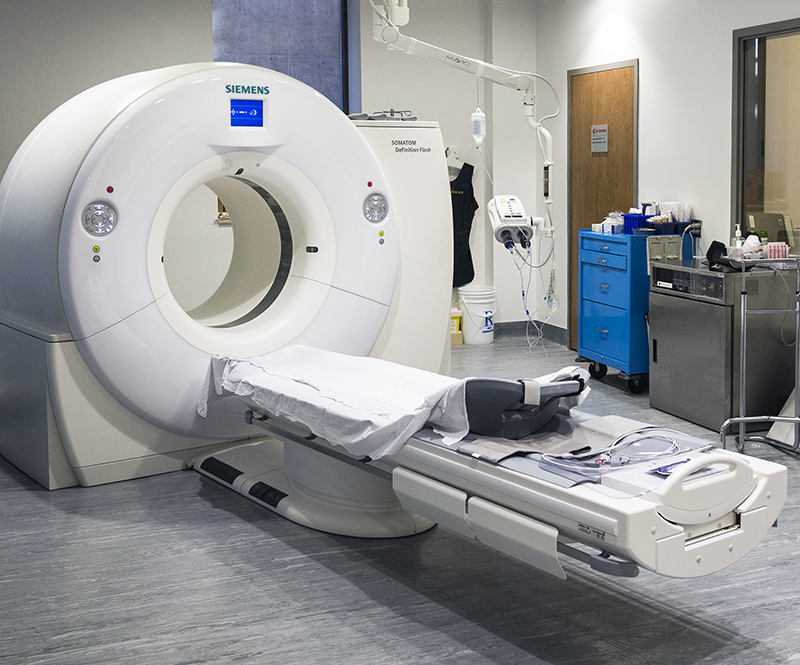
They took more vitals from me, and eventually, a tech took me to get a CT scan. I love the sound CT scanners make. It was quite painful to get into position and then back on my feet again. Everywhere I went, they asked if I wanted a wheelchair. I knew I looked bad, but I didn’t want to be bad enough to need a wheelchair. I’ve often seen old people refuse help; now I know why.

They took me back to the room. A sign on the wall said it took three hours to get a CT result. But the PA told the kid who also got a CT scan it would take about an hour.

Around 1:30 am Saturday morning the CT scan results came back. It was nothing I had imagined. I had two more hernias. I’ve already had three repaired surgically. And one hernia was interfering with the tube that goes from my kidney to my bladder. That might explain the weird pains in my side. And then the PA said, “And you have a stone in one of your kidneys.” She explained it wasn’t causing the pain now.

At least it wasn’t cancer, a ruptured gallbladder, or a blocked intestine, or any of the other scary conditions I fantasized about.

The kidney stone did scare me. It wasn’t descending so it shouldn’t be causing pain but they warned me it could try to pass. It might not happen, or happen years from now, or next week.

Evidently, the pain that made moving or standing so unpleasant was my old ordinary sciatica and muscle spasms caused by spinal stenosis. That was diagnosed almost twenty years ago. Sitting at the computer or standing or walking for any length of time aggravates it.

Because I was walking more, and writing more at the computer, I thought maybe my spinal stenosis was better because I had lost twenty pounds. I can’t explain why I was given a temporary reprieve.

The PA gave me 15mg of Toradol in my IV. It was magic. Thirty minutes later I would stand up. I still hurt, but I didn’t look like I needed a wheelchair.

The Future

I have to admit this episode put me in a tailspin. I was all geared up to feel younger and healthier again. I got a taste of being more active, and I liked it. I want that feeling back.

However, aging doesn’t work that way. It’s always a slow decline. Now I knew there could be some upswings in my health, too. I feel like I’m flying a plane I know is going to crash. For a few months, I forgot that. Going to the ER reminded me that it’s still going to crash. However, the past months taught me I could sometimes regain altitude.

Experiencing feeling younger for several months makes me wonder if I could get that feeling back again. I’m back where I can’t walk for exercise. And sitting at the computer makes my back hurt worse. I’m scheduled to see a urologist this coming Friday. I figure another surgery is in my future, and then there’s a time ticking bomb in my kidney. It took me months to recover from my last hernia surgery.

But what can I do to get that healthy feeling back? It might take months, or even years. I’m not giving up. Could losing another twenty pounds help? What diet or exercise to I need to pursue?

I’ve already returned to my adapted methods of coping. I’m back to using a laptop while reclined in a La-Z-Boy. I can walk long enough to do the dishes or go grocery shopping. But I really want to walk again for exercise. I wonder if that’s possible?

I only know one person my age that hasn’t had any health problems. It’s normal to break down in your seventies. I have to keep philosophical about that. But I also want to beat the system.

I’m reminded of a Vaugh Bode underground comic strip from the 1970s. In it two lizard like creatures are tied up. They’ve been blinded, and their legs have been cut off. One of them says to the other, “When it gets dark, I’z is gonna escape” That’s me at this moment.

When I left the ER, I took a Lyft home at 2:45 am. Several friends offered to come take me home. I appreciate that. But I like the feeling of still being able to take care of myself. I know that won’t always be true.

Riding through the dark, deserted streets was surreal. It was quite pleasant. I knew I would need another surgery, but I’ve been through them before. Passing a kidney stone sounded extremely unpleasant. I know just how unpleasant. I once watched a man in the urologist’s office passing a stone. But like the Stoics say, this too will pass. I’m lucky that it wasn’t something that couldn’t be fixed. Too many people I’ve known have already died, and almost everyone I know my age is suffering from something.

Many of my friends are worse off than I am. It’s funny, but I think everyone suffers what they know and wouldn’t trade it for someone else’s kind of suffering.

I remember how being healthier made me feel positive about the future. It was just for a few months. I want that feeling back.

The most unsettling aspect of all this is not knowing the answers. Doctors are more likely to know than I do, but I’m not sure they always know. I certainly can only speculate, and that’s often dangerous.

I just wish I could find some answers to simple questions. Does pain cause more pain? Do pain pills stop the cycle of pain? They stop pain, but what else do they do over the long run? I know they cause constipation. I had a kind of hangover from the Toradol. I know my mother got hooked on pain pills. She lived with chronic pain for over a decade.

Maybe I should have talked with the people in the ER waiting room. Some of them might know things I don’t. Susan and I have been binge-watching ER. We’re in the 14th season.

Real ERs aren’t like the TV program. The sets look similar, and the machines, but I wasn’t suffering anything dramatic, so I didn’t have a flock of doctors surrounding me. I wasn’t an interesting story. Most of the action was behind closed doors, so I couldn’t see it. I saw nurses, PAs, techs, and janitors going to and fro. I’m not sure I even saw a doctor in the hallways. Doctors were busy somewhere fixing people they could fix. I couldn’t be fixed, so I was sent home. The kid behind the curtain was waiting for surgery.

I have endless questions about my aging body. My regular doctor is very patient with me. She will answer many questions. But I don’t think I’ll ever know what I want to know. It’s not like in TV shows where things are explained so precisely.

JWH