Reading Comprehension: Books vs. Audiobooks

by James Wallace Harris, 1/3/24

At 72, I’m still learning how to read.

I recently finished the audiobook of The Simulacra by Philip K. Dick and started to write a review for my science fiction blog. That’s when I realized I needed to read the book with my eyes before I could write a proper review. The Simulacra was a complex novel involving several plot threads and dozens of named characters. (Read the plot summary at Wikipedia. Get the book at Amazon.)

From my audiobook experience I found the book compelling, fun, and I was always anxious to get back to listening to the story. I was never confused by what was going on, but when I tried to summarize the novel for my review, I discovered I couldn’t recall all the details I needed to make a coherent description of the story. There were just too many science-fictional concepts. Nor could I describe all the plot threads without researching them.

I won’t describe the book in detail, I’ll do that in my review, but for now, The Simulacra is about a post-apocalyptic world where China attacked America with atomic missiles in 1980, and the U.S. government and Germany combined to form a totalitarian regime called The United States of Europe and America (USEA). It appears to be run by a captivating 23-year-old first lady named Nicole Thibodeaux. However, she has been married to five presidents and always remains young. Since this book was written in the summer of 1963, I assume Dick was inspired by Jackie Kennedy because Nicole spends most of her time charming people, decorating the White House and gardens, and putting on nightly cultural events. But Nicole is also ruthless enough to have people summarily executed, evidently wielding unlimited power. She has access to time travel no less, and one subplot involves her negotiating with Nazis to change the course of WWII. Other subplots involve an insane psychic pianist Nicole wants to play at the White House, the outlawing of psychiatry pushed by the pharmaceutical industry, what happens to the last legal psychiatrist, a pair of ordinary guys who have a jug band that plays classical music who want to perform at the White House, a trio of sound engineers who are trying to chase down the psychic pianist to record, and a small company that hopes to get the contract to construct the next president. This long paragraph barely scratches the surface of the whole novel.

My failure of completely understanding the novel from listening to the audiobook was partly due to aging memory and partly due to the complexity of Dick’s prose. I could have hashed out several thousand words describing what I remembered, although it would have been a bundle of vague impressions. Summarizing what PKD was trying to do was evasive from just listening to the audiobook.

Audiobooks are bad for remembering exact details, which I knew, but was painfully revealed when I tried to read the novel and take notes. I called up The Simulacra on my PC in the Kindle app on the left side of the screen, and launched Obsidian, a note taking program on the left side of the screen. I started reading The Simulacra again, but with my eyes. After two days, getting to the 29% read position on the Kindle edition, I had twenty-eight names, twenty-six plot points, several lists of other details, and several quotes in my notes. I figure there are three to five main plot threads, each involving three or more characters.

More than that, I realized Philip K. Dick had riffed on hundreds of ideas. As I read them, I remembered them, but I realized that while listening, I had not put most of them within the context of the story. It wasn’t until my second reading that I saw all these hundreds of creative speculations as being part of one jigsaw puzzle picture. And I’m not talking about the characters and plots. I’m talking about worldbuilding.

Rereading with my eyes allowed me to stop and ponder. Rereading allowed me to remember the bigger picture. However, listening to the audiobook let me enjoy the story more. The narrator, Peter Berkrot, did voices for each of the characters, and acted out their personalities. Listening to the novel, it felt like I was listening to an old-time radio drama where many actors performed a story.

At one point I got too tired to read and went to bed. But before I fell asleep, I listened to the part I had just read. Berkrot expressed emotions I had not picked up while reading with my eyes, but recalling the scenes made me realize that Dick had put them there. In other words, Berkrot had found aspects of the text I missed and was pointing them out with sound.

Over the ten years since I’ve retired, I’ve been learning the value of rereading books. In fact, I now feel reading a story just once is unfair to the author. It takes two or more readings to see the author’s vision. Reading a work of fiction just once provides one layer of understanding. It’s when we see multiple layers within a work that we start to truly understand it.

Switching back and forth between reading with my eyes and reading with my ears reveals both methods have their advantages. If I read once with one sense organ and reread with another, the two combine to create reading synergy.

For most of my life, I’ve always been concerned with reading more books, but the wisdom I’m gaining from getting old is showing me that both speed reading and reading lots of books is a distraction from deep reading.

Right now, I’d recommend:

  1. Listen to an audiobook for the first reading to get the big picture.
  2. Reread with a physical book or ebook to get the details. Read slowly and stop often to ponder.
  3. Write a review to make deeper sense of a book. Putting things into words pushes us to make sense of things.
  4. Read reviews and scholarly articles to get other perspectives.
  5. Reread the book again to bring it all together.

This is what I’m working on with The Simulacra by Philip K. Dick. It’s not considered one of Dick’s better works, but I’m trying to discover if there is more to the novel than its current reputation.

JWH

Developing a Healthy News Diet

by James Wallace Harris, 5/21/23

Michael Pollan created a small book about eating healthy called Food Rules. As an analogy, I’d like to create a set of sensible rules about consuming the news. Pollan distilled his list of rules down to three simple sentences, “Eat food. Not too much. Mostly plants,” but it really takes reading his book to understand that mantra.

What I would like to do is develop a similar simple mantra about my daily news consumption but I’ll have to work out the details first. Pollan emphasized eating whole foods rather than processed foods. Is there such a thing as whole unprocessed news? “Not too much” is an obvious target since we obviously consume too much news. Finding an analogy for “mostly plants” will be interesting.

What would be the equivalent of nutritious news? Experience has taught me that some news is unhealthy, and I often get news indigestion. I also admit I’m bloated and overweight from too much news consumption.

Like whole food and junk food, we prefer junk news over whole news. I spend several hours a day nibbling on news from many sources. Most of which is forgotten immediately. I wonder if my first rule should be:

#1 – Ignore easily forgettable news

We’re used to clicking on anything that catches our fancy while idling away moments on our smartphones. Essentially, this kind of news is gossip and titillation. Basically, we’re bored or restless. We should use that time in better ways, especially if it exercises our minds. Read real news instead. Or, do something active. Playing games, listening to music, or audiobooks, is more nutritious than never-ending bites of clickbait.

Everyone bitches about information overload but who does anything about it? I’ve learned from intermittent fasting that my body appreciates having a good rest each day from eating. I believe I need to apply the same idea to news consumption.

#2 – Limit your hours consuming the news

I find 16:8 fasting works well for eating. I’m thinking of a 22:2 fast for news is what I’m going to aim for at the moment. Two hours of news consumption a day might sound like a lot, but if you add up all the forms of news I consume including television, magazines, online newspapers, YouTube, and news feeds, RSS feeds, I can easily go beyond two hours.

We should also separate news from learning and entertainment. Learning something new could be considered a form of news. I’m not going to count educational pursuits in my news time. And if you enjoy reading nonfiction books or watching documentaries on TV, that shouldn’t count as news either. However, shows like 60 Minutes, CBS Sunday Morning, and The Today Show can be considered informative entertainment news. Some people just prefer news shows for fun rather than watching fictional shows. I’m not sure if they should count or not.

What we really want is to stay informed about the world so that we interact with reality wisely. Humans have an extremely difficult time processing information. We think we’re far smarter than we are. We constantly delude ourselves. And we think our opinions matter when 99.999% of the time they don’t. Most people think they are experts on countless topics after having consumed just a few hours of news. They think they know better than real experts who have put tens of thousands of hours into studying their specialty.

#3 – Stop assuming you know anything

I believe the real key to understanding the news is being able to tell the difference between opinion and significant data. The real goal of news consumption should be finding the best data, and that means getting into statistics.

Unfortunately, the news industry is overwhelmed with talking heads. Everyone wants to be an expert, and all too often most news consumers tend to latch onto self-appointed experts they like. News has become more like a virus than information processing.

I read and watch a lot of columnists and programs about computers, stereo equipment, and other gadgets. Most are based on personal impressions of equipment individuals have bought or been loaned from manufacturers. These tech gurus are a good analogy for what I’m talking about. Most of the news we take in daily is from individuals processing limited amounts of information and giving us their opinion. What we really want is Consumer Reports, Rtings, or the Wirecutter, where large amounts of data are gathered from a variety of sources, and statistically analyzed.

This is just a start on designing my news diet. I want to keep current on a long list of topics, but that’s like learning about all the vitamins and nutrients my body needs. News nutrition will be a vastly more complicated topic. What are the essential vitamins I need every day? Is it politics, national and international affairs, economics, crime, immigration, ecology, etc?

Do I need to know about everything? Is that what an informed citizen needs to do? Take immigration. Is anything I think about immigration affects the situation at the border? Does voting liberal or conservative even affect anything at the border? I can barely maintain order in my house, why should I believe I can organize all of reality on Earth? Maybe my last two rules should be:

#4 – Know my limitations

#5 – Pursue the news I can actually use

Like nutrition, news is a complicated subject that’s hard to understand and can easily confuse.

JWH

Miss Buncle’s Book by D. E. Stevenson

by James Wallace Harris

Why do we love some books more than others? Why are some books so enchanting? Why is it so hard to always find the perfect book to read? Especially when we’re old and jaded and have read thousands of books.

I just finished Miss Buncle’s Book by D. E. Stevenson and I want to explain why I loved it so much. I mostly read science fiction, but lately, I’ve gotten tired of the genre. Well, not completely. I recently found a science fiction novel that completely enchanted me too, but it was an old science fiction book that came out in 1939, the setting was England in the thirties, and wasn’t sold as science fiction. See my review of The Hopkins Manuscript by R. C. Sherriff.

I just finished Miss Buncle’s Book by D. E. Stevenson and it pushed all the buttons that make me love books. Am I so burned out on science fiction that any decent story from any other genre would charm me to pieces? I don’t know.

Can I examine these two books and draw any conclusive conclusions that would help me always find a great book to read? And what is great? I might think Miss Buncle’s Book and The Hopkin’s Manuscript are great novels and other people might think they’re both snooze-fests.

Both books are set in England during the 1930s and I have to admit that I’ve been watching a lot of TV shows and reading other books about England before 1960. Maybe I’ve just found a new fictional setting that I like better than those offered by science fiction right now. But why England? And why older books? (I should admit that I still like older science fiction books. Maybe my reading problem is the 21st century.)

Is this a case of reading the right book at the right time? Would they have been so entertaining if I had read either of these books when I was in my teens, twenties, forties, or fifties? Is part of the equation for finding the right book include the age, gender, and philosophical outlook of the reader? I worry about recommending books because even when I love a book, I’m never sure someone reading my review will.

One reason why I’m sick of science fiction is I’ve read too much of it. But I’ve also got tired of the future, especially the far future. But the present isn’t very appealing either. I think I’m looking for comfort books. For cozy novels. And Miss Buncle’s Book fits the bill perfectly.

Normally, I wouldn’t pick a book aimed at women readers, but in the last year, I’ve read quite a number of books by women authors aimed at women readers. I had just finished reading a science fiction book by D. E. Stevenson, The Empty World and while researching her I found this video from The Comfort Book Club:

The enthusiasm of the YouTube host and her mother, as well as the testimonials from the show’s viewers, convinced me to give Miss Buncle’s Book a try. I’m so glad I did.

This 1934 novel is set in the small village of Silverstream. That might be in Yorkshire because we’re told Barbara Buncle has a Yorkshire accent. Barbara has a problem. The depression is on and her investments are no longer paying dividends. She needs money and decides to write a novel. Unfortunately, she has no imagination and writes a story about all the people in her village, just changing the names. She submits the book with the pen name of John Smith and it gets accepted. The publisher loves it, thinking that it’s either a very gentle satire or the work of a very simple mind. However, the publisher renames her novel, Disturber of the Peace.

Slowly the citizens of Silverstream discover the book. Even though it’s set in Copperfield and the characters’ names are different, they recognize themselves. Barbara Buncle has a knack for realistically painting portraits in words. Some of the village folk find it a pleasant read but others are outraged, especially Mrs. Featherstone Hogg, who is livid that the novel reveals she was once a chorus girl. She wants to find out how John Smith is and have him horsewhipped.

Miss Buncle is so mousy that no one suspects her. Several of the Silverstream citizens make it their business to ruin John Smith. But we’re also shown many villagers who are good people. The plot gets quite involved and it eventually becomes a book within a book within a book story when Miss Buncle writes a sequel.

Having this book within a book plot is rather clever. The humor is relatively dry since the story is told realistically even though the action gets rather far-fetched. Its humor is not like P. G. Wodehouse, but I imagine Wodehouse fans will love D. E. Stevenson too. If you like the TV series All Creatures Great and Small and the James Herriot books they were based on, you’ll probably like Miss Buncle’s Book. Miss Buncle’s Book is the first in a series of four. The blog Books and Chocolate thought Miss Buncle’s Book had the same appeal as Miss Pettigrew Lives for a Day by Winifred Watson.

But why did I prefer Miss Buncle’s Book now over my standard fare of science fiction? The writing in science fiction has gotten rather baroque in both prose and ideas. Miss Buncle’s Book is very straightforward and simple, yet very detailed. The characters are far more appealing and realistic compared to what I see in 21st science fiction.

However, I think the most important factor is the novelty of the setting. Science fiction and fantasy settings have gotten old and tiresome. Right now I’d much rather visit a small English village than Mars, or the future, or an interstellar spaceship. However, I wouldn’t mind if a Martian or a human from the future was visiting a 1930s English village.

If you’re a Scribd subscriber, they have the first three Miss Buncle books on audio. They are also available for the Kindle at Amazon and audio at Audible.com. There are nice paperback editions of the first three books from Persephone Books.

JWH

Why I Need To Side With Amazon/Audible

by James Wallace Harris, 1/1/23

Daniel Greene just posted The Audible Situation on his YouTube Channel. Greene is not attacking Amazon/Audible, but he is reporting on a controversy that began when author Brandon Sanderson posted “State of the Sanderson 2022” about why Sanderson wanted to publish his audiobooks first with Speechify rather than Audible. Amazon/Audible is moving towards becoming a monopoly for indie publishers and Sanderson wants to counter that and give other publishers a chance. Greene sides with that idea, and I sympathize completely. However, I need to explain why I and probably many other readers will stick with Amazon/Audible.

I’ve been buying audiobooks for maybe thirty years and buying them from Audible for twenty. I’ve been buying ebooks since the Rocket eBook came out, which was a little over twenty years ago. I have over a thousand Kindle books in my Amazon library and seventy-four pages of audiobooks (20 per page) in my Audible library. That’s a huge library of digital books I want to protect, and Amazon/Audible does a fantastic job of helping me. If my house burned down I’d lose all my physical books along with my iPad, iPhone, and Kindle. But I could buy a new iPhone, log in and have instant access to all my Amazon/Audible books.

Over the decades I have bought ebooks and audiobooks from companies not owned by Amazon/Audible. Nearly all of them have been lost as I moved from computer to computer, or forgotten the places and accounts I bought them from. I’ve bought books from Kickstarter, Apple, Barnes & Nobel, Recorded Books, Downpour, Humble Bundle, Phoenix Picks, O’Reilly Books, and many other publishers. I also bought audiobooks on cassettes and CDs, For example, we bought all the Harry Potter books on CD as they came out, but recently when my wife wanted to hear them again, she rebought them on Audible because it was convenient and because they will always be in her library.

Some of the ebooks I bought I sent to a Kindle device, but they don’t stay there as I’ve moved to new devices. And they don’t always look right in my Amazon library.

Years ago I realized that the only secure way of “owning” a digital book was to buy them from Amazon/Audible. I know they could change their policies or go out of business, but since Amazon is so big I’m betting they will be there until I die.

Amazon/Audible has become my trusted library to store digital books. They keep them fairly well organized and easy to find. They bought Goodreads and that helps me remember and review my books. That ecosystem makes for a very good digital library system. Even when Audible stops selling an audiobook I still have my copies. Of course, with thousands of books, some may have been deleted and I haven’t noticed.

There are times when I remember owning a book and going to Amazon/Audible and not finding it. When I search my mind I realize it’s missing because I bought it elsewhere. Sometimes I can still find them on my computer or remember the publisher and my account, but as time goes by, that’s becoming rarer.

If we thought of books like buying a movie ticket and watching a film, then buying books from any publisher wouldn’t matter. It would be a one-time experience. But if you buy books to build a library that doesn’t work.

I often see wonderful deals on Humble Bundle. I would buy them if they instantly became part of my Amazon library. And that’s true for deals from other publishers. But I’ve stopped getting those deals because I can’t easily keep up with their books for the long haul.

I do agree that it’s wrong that Amazon/Audible has gotten such a stranglehold on the industry. And I don’t see why Amazon/Audible must demand exclusive deals from authors. Amazon/Audible should stop that practice just to show goodwill to the book world.

I can think of some farfetched solutions to this problem. If there were an international registry of digital ownership that was separate from the publishers and sellers that would track what digital works a person owns, then that would break the monopoly. Booksellers would offer readers the best deal, and readers could pick from whichever seller they liked. But their purchase would be added to the registry. And they could then always download a copy of that book even if the bookseller or publisher went out of business. Such a system would even allow readers to leave their library to someone when they died.

Of course, Amazon/Audible has already created such a registry, and that’s why they are so successful.

JWH

Reading With My Eyes and Ears At The Same Time

by James Wallace Harris, 8/26/22

I’ve recently learned why it’s best to read with my eyes and ears concurrently.

When I joined Audible.com in 2002 it changed my reading life in several ways. First, it made me discover several things about my reading abilities. I always thought I was a great reader. I thought that because I was a bookworm. Listening showed me that was a delusion. I was really skimming books because I was reading too fast. Listening revealed that my inner reading voice was crappy at best. Listening made it all too obvious that there were nuances to fiction and nonfiction that I was completely missing.

When you listen to a professional narrator read a book you often get to experience the book at its best. Usually, the words are pronounced correctly, and the dialog comes across naturally, at a speed at which you’d hear it in real life. This enhances the dramatic effects of fiction, but it also has a cognitive impact on nonfiction.

I suppose good readers do all this in their heads, but I didn’t. I read to find out what happens. I did not savor the words or the writing. As a reader growing up I conditioned myself to read books with fast action prose. Either for fiction or nonfiction. I mainly stuck to science fiction and popular science books.

When I started listening I quickly learned I could handle other kinds of prose – especially longer, and denser books. For example, I listened to Moby Dick, not an easy novel. Listening opened up the 19th century to me. I never had the patience for old classics, but once I started listening I got into Dickens, Austen, Trollope, Elliot, and even Henry James. I also got into all kinds of nonfiction, including dry academic works, because hearing made them more interesting and accessible.

Over time listening helped me to read better with my eyes. Listening taught me to read slowly, and that made a big difference. I would switch back and forth depending on what format was the cheapest to buy.

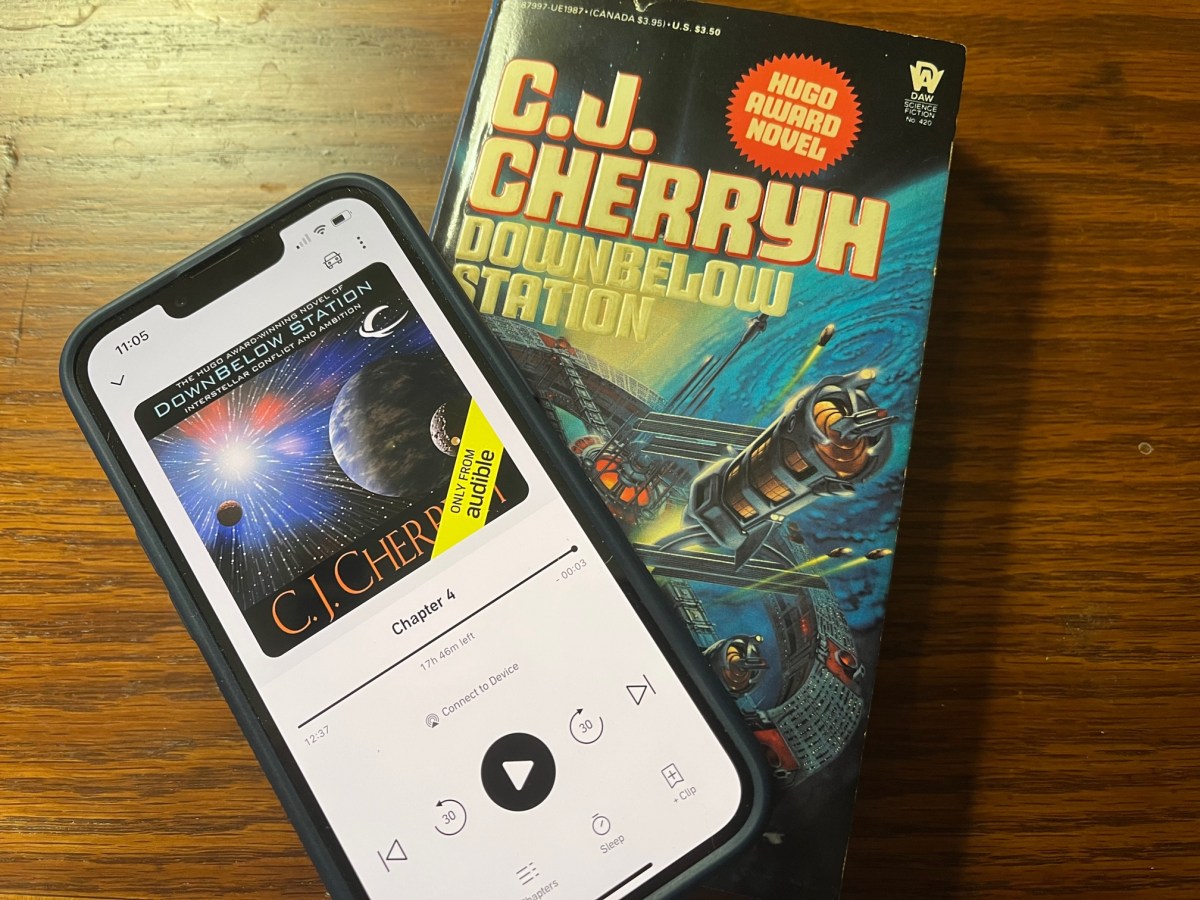
However, there are still books I couldn’t get into – like Downbelow Station by C. J. Cherry. Her dense prose makes my eyes glaze over when I try to read that novel, and my ears tune out when listening. Because it’s one of a handful of novels I haven’t read on the Classics of Science Fiction list, I’ve been pushing myself to finish it. And I’ve learned a trick that will help me.

I can only listen to books if I’m doing something else, like walking, doing the dishes, eating, exercising, etc. I had to give up walking, and because of my back problems, I’ve been exercising less. That’s cut into my listening time. If I try to listen while just sitting I fall asleep.

However, I’ve found a trick to beat that. I listen to an audiobook while reading the book with my eyes. Not only do I stay awake, but I retain what I read better. That’s always been one of the drawbacks of listening to books. I don’t retain them as well when I read with my ears. I don’t get into them as well when I read with my eyes.

When I read with my eyes and ears at the same time I get into the most and retain the most. And it turns out, it lets me read some books like Downbelow Station that I previously couldn’t read with just my eyes or just my ears.

Isn’t that weird?

The trick is to follow along with the words as I hear them – and don’t let myself get distracted.

I listened to Susan Wise Bauer’s The History of the Ancient World and The History of the Medieval World but started listening and reading The History of the Renaissance World. I’m getting so much more out of this dual-reading method, especially retention, that I’m thinking about rereading the first two volumes with the new method.

There is a major drawback to dual reading – cost. I do subscribe to Scribd.com and they sometimes have both the ebook and the audiobook. They had the recent biography on Buckminister Fuller that I listened to on audiobook so I just had to buy the Kindle edition. With Downbelow Station I had the paperback I’ve been meaning to read for years, and I’ve had the audiobook I’ve been meaning to listen to for years. And sometimes Amazon will give you a deal on the audiobook if you buy the Kindle edition first. Sometimes I get the Kindle on sale for $1.99 from Bookbub announcements and then buy the audiobook. Or I buy a used copy of the book or get it from the library.

I’m not going to read every book with my eyes and ears. But for books that I want to study, or total grok, or can’t get into, I will try the dual reading method.

JWH