
by James Wallace Harris, 12/8/25
For years now, I’ve been reading about people who create a second brain to record what they want to remember. Most of these second brain systems use software, but not all. Many base their ideas on the Zettelkasten system, which was originally stored on note cards.
Over the years, I’ve tried different methods and software applications. I’m currently learning Obsidian. I’ve used note cards, notebooks, Google Docs, Evernote, OneNote, InstaPaper, Recall, and others. I love reading – taking information in – but I don’t like taking notes.
The trouble is, information goes through my brain like a sieve. When I want to tell someone about what I’ve learned, or think I’ve learned, I can’t cite my source, or, for that matter, clearly state what I think I know. And I seldom think about how I’ve come to believe what I believe.
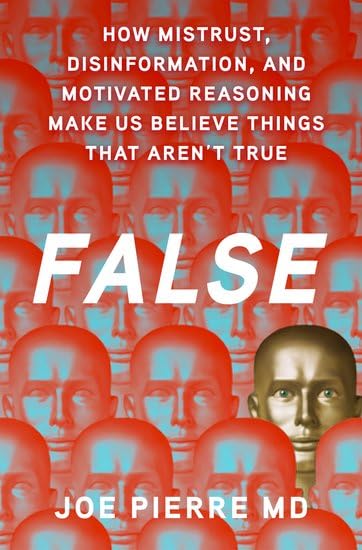
I’m currently reading False by Joe Pierre, MD, about how we all live with delusions. This book makes me want to rededicate myself to creating a second brain for two reasons. First, I want to take precise notes on this book because it offers dozens of insights about how we deceive ourselves, and about how other people are deceived and are deceiving. Second, the book inspires me to start tracking what I think I learn every day and study where that knowledge comes from.
One of the main ways we fool ourselves is with confirmation bias. Pierre says:
In real estate, it’s said that the most important guide to follow when buying a house and trying to understand home values is “location, location, location.” If I were asked about the most important guide to understand the psychology of believing strongly in things that aren’t true, I would similarly answer, “confirmation bias, confirmation bias, confirmation bias.”
Pierre explains how the Internet, Google, AIs, Social Media, and various algorithms reinforce our natural tendency toward confirmation bias.
Pierre claims there are almost 200 defined cognitive biases. Wikipedia has a nice listing of them. Wikipedia also has an equally nice, long list of fallacies. Look at those two lists; they are what Pierre is describing in his book.
Between these two lists, there are hundreds of ways we fool ourselves. They are part of our psychology. They explain how we interact with people and reality. However, everything is magnified by polarized politics, the Internet, Social Media, and now AI.
I’d like to create a second brain that would help me become aware of my own biases and fallacies. It would have been more useful if I had started this project when I was young. And I may be too old to overcome a lifetime of delusional thinking.
I do change the way I think sometimes. For example, most of my life, I’ve believed that it was important for humanity to go to Mars. Like Elon Musk, I thought it vital that we create a backup home for our species. I no longer believe either.
Why would I even think about Mars in the first place? I got those beliefs from reading dozens of nonfiction and fictional books about Mars. Why have I changed my mind? Because I have read dozens of articles that debunk those beliefs. In other words, my ideas came from other people.
I would like to create a second brain that tracks how my beliefs develop and change. Could maintaining a second brain help reveal my biases and thinking fallacies? I don’t know, but it might.
Doing the same thing and expecting different results is a common fallacy. Most of my friends are depressed and cynical about current events. Humanity seems to be in an immense Groundhog Day loop of history. Doesn’t it seem like liberals have always wanted to escape this loop, and conservatives wanted to embrace it?
If we have innate mental systems that are consistently faulty, how do we reprogram ourselves? I know my life has been one of repeatable behaviors. Like Phil Conners, I’m looking for a way out of the loop.
Stoicism seems to be the answer in old age. Is it delusional to think enlightenment might be possible?
JWH


 Auxiliary Memory