Do You Trust What You Read?

by James Wallace Harris, 8/4/25

Yesterday I tried to remember what I thought about as a young kid. I recall a few incidents when I was three, but I don’t start having many memories until I was around twelve or thirteen. The earliest age I can recall being philosophical is from that same period. Before twelve, I can’t remember thinking about things. I probably did. Very young kids are notorious for asking why.

But then I thought of something. It was around age eleven or twelve that I started reading books. The first books I chose were nonfiction about airplanes, space travel, dinosaurs, submarines, cars, and other things that boys like in the fourth and fifth grades. Fourth grade was 1960-1961. I turned ten in late 1961. In the fifth grade (1961-1962), I discovered fiction. Especially, the Oz books by L. Frank Baum and the Tom Swift, Jr. series. In the sixth grade (1962-1963), I got hooked on biographies and a few science fiction books.

It seems obvious that reading inspires thinking.

It was around the sixth grade, or the beginning of the seventh grade, that I can remember thinking about the world. During the seventh grade, and into the eighth, I became an atheist. I remember agonizing over that issue. What I heard in church and from my mother didn’t match what I was experiencing. Nor did it match what I was learning in school or what I was reading. I didn’t read any books on religion or against religion. All the ideas I consumed, especially from books, made me think.

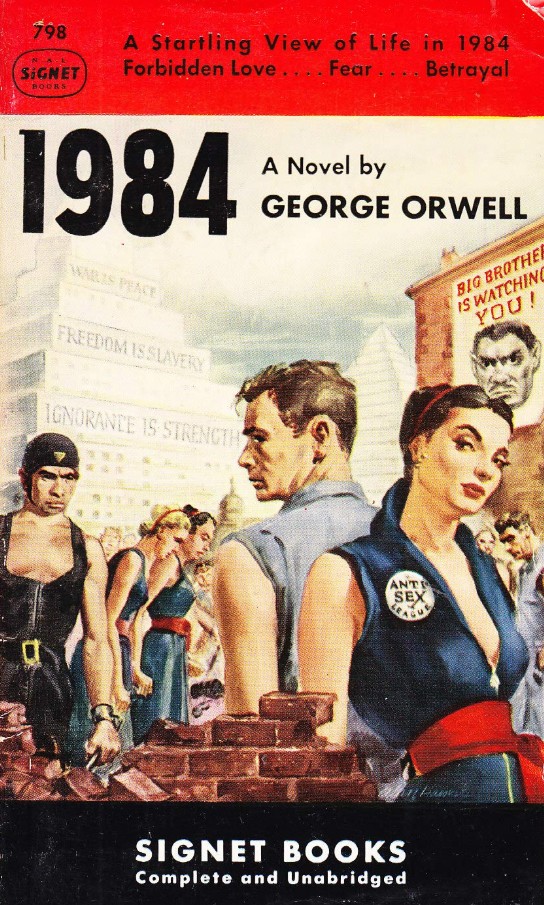
Here’s the kicker. I read a lot of crappy books with crappy ideas, and they infected me. Ideas about flying saucers, reincarnation, ESP, and remembering past lives, like in Bridie Murphy. Most of this came from my uncles, my father’s two brothers.

After rejecting religion, I eventually rejected the occult, spiritualism, and psychic abilities. I rejected them because I read more science books and science fiction. I was skeptical of what was in the science fiction books, but I wanted to believe many of SF’s stupid speculations about the future. The genre promised a more exciting reality that competed with religion.

I didn’t become truly skeptical until many years later. Maybe when I encountered the magazine, The Skeptical Inquirer.

The point I’m trying to make, with this long introduction, is to explain how I was overwhelmingly influenced by what I read. Even after a lifetime of skepticism, I’m easily swayed by concepts I got through books and magazines.

Of course, I’m also susceptible to ideas from my peers, television, and the Internet. Whenever I hear about a neat concept, one that sounds like it helps explain reality, I want to embrace it. I’m easily persuaded by intellectuals and studies that claim to be scientific.

Decades ago, I decided that science was the only cognitive tool humans had developed to explain reality in any consistent fashion. Science is statistical. It doesn’t offer conclusive answers. To truly understand science requires a great deal of science and mathematics. I don’t have those skills. I depend on popular science, and that isn’t the same thing. Accepting an idea based on popular science is similar to being religious and taking a theological concept on faith.

The only way to be scientifically minded without being a scientist is to look for the most consensus among scientific authorities. And this is true for understanding everything that doesn’t fit under the scientific microscope, such as politics, law, ethics, and creating a sustainable society.

Since 2016, I’ve decided that humans are all delusional, including myself. There are dozens, if not hundreds, of ways to be deluded. I decided I couldn’t trust the Internet or television. That I would only trust quality periodicals that had solid editorial policies. Unfortunately, such magazines and newspapers are going out of business.

People no longer want to pay for information. Television and the Internet have conditioned Americans to consume free information. And if you can’t see how that is destroying us, then that’s another delusion you are suffering from.

Humans eagerly embrace untrue concepts that support their desires. We even have labels for that delusion: confirmation bias, wishful thinking, motivated reasoning, and cognitive dissonance reduction.

I’m reminded of what the Jeff Goldblum character said in the movie, The Big Chill. “I don’t know anyone who could get through the day without two or three juicy rationalizations. They’re more important than sex.”

I want to separate myself from my rationalizations. The only way I can think to do that is by reading significant research. What I think depends on what I read. That means being extra careful with selecting my reading.

It also means I need to support the periodicals doing the best job of explaining reality.

JWH

The Young Adult Novels That Shaped My Childhood

by James Wallace Harris, 7/22/25

I’ve been amazed by how fanatical young people have become over their favorite pop cultural icons. My wife and I watch Jeopardy every day, and the clues are often based on successful pop culture franchises. Comics and young adult novels dominate, especially at the movie theater. Billions of dollars are spent by their fans, and children and young people often identify with certain characters.

At first, I thought all of this was new. The Beatles had worldwide fame, but I can’t think of any fictional characters that were as popular in the 1960s as those that have emerged in the 21st century. Star Trek and Star Wars fandoms began to evolve in the 1970s, but it wasn’t until the advent of the World Wide Web that they achieved pop culture universality.

Many consider science fiction fandom the first. It began in the late 1920s and by 1939 had its first World Convention. However, we’re only talking hundreds. I considered myself a science fiction fan in junior high, but it wasn’t until the 10th grade that I met another fan in person. That was 1967.

Looking back, I realize it was YA novels that made me a fan, too. At seventy-three, I wonder if I would have had a different life if I had discovered the works of another author first.

I realize now that reading books was my way of coping with the stress of growing up. Just after JFK’s assassination in November 1963, my family began to fall apart. In 1963-1964, I attended three different 7th-grade schools, and two 8th-grade schools, in two states, and lived in four different houses. My parents became obvious alcoholics, their marriage began to unravel, and my dad had his first heart attack. Somehow, I remained a happy kid.

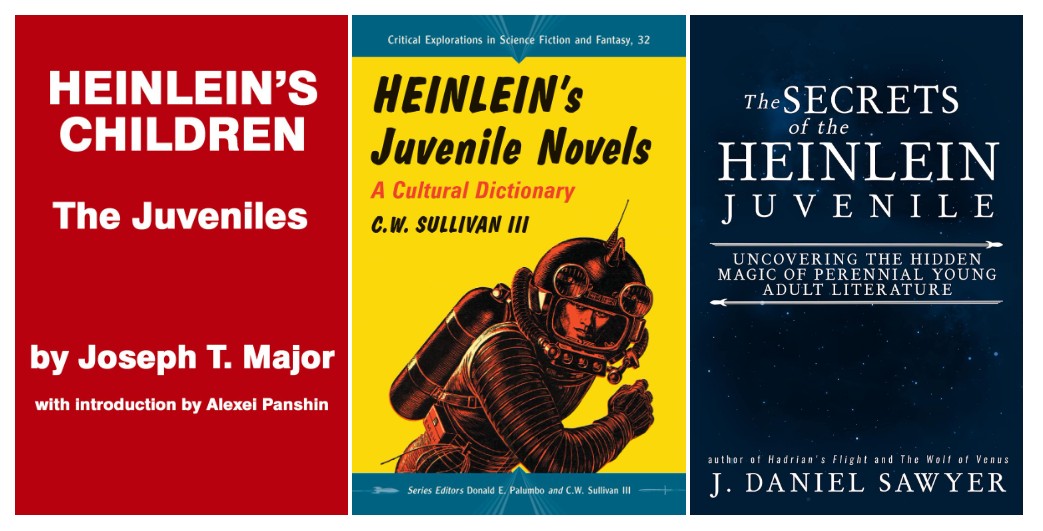
Just before I turned thirteen, when I began the 8th grade in September 1964, I discovered the young adult novels of Robert A. Heinlein. They didn’t use the term young adult back then, but called them books for juveniles. Juvenile delinquency was also a common phrase back then. Before that, they were called books for boys. There were also books for girls. Gender roles were specific back then. This was when newspapers divided job listings into “Men Wanted” and “Women Wanted.”

Discovering Robert A. Heinlein and science fiction gave me a positive outlook on life and my future. I especially identify with the Heinlein juveniles. I remember at the time believing Heinlein would have a literary reputation similar to Mark Twain by the time the 21st century rolled around. That hasn’t happened. Heinlein is often shunned by modern readers of science fiction. I accept much of the criticism regarding his adult novels published after 1960, but I still embrace his young adult novels and other work published before 1960.

Charles Scribner’s Sons, famous for publishing Hemingway, F. Scott Fitzgerald, and Thomas Wolfe, first published the twelve Heinlein juveniles between 1947 and 1958. The Heinlein juveniles were highly regarded by librarians and schools. I discovered them because my 8th-grade teacher put them on her approved reading list. She required our class to read three novels, three magazine articles, and three newspaper articles every six weeks. If we didn’t, she lowered our grade one letter. If we read five of each, she raised our letter grade by one letter. I always read the five of each because I’m terrible at diagramming sentences and understanding grammar. That upped my C to a B each report card.

For over sixty years now, I have been grateful to this teacher. Sadly, I can’t remember her name.

I keep hoping YouTube book reviewers will read Heinlein’s juveniles and reevaluate their judgment on Heinlein. Over the decades, I’ve read memoirs by scientists, writers, and astronauts about how they loved the Heinlein juveniles when they were young, and the impressions the books made on them.

I’ve been meaning to reread all the Heinlein juveniles again and judge them without the influence of nostalgia. Has sentiment clouded my perspective? I fear my love of these books is similar to how people embrace religion when young. Ideas often brainwash us in youth, and it’s almost impossible to deprogram ourselves. Our species suffers from delusions. No one is free of being fooled by beliefs. For every individual, it’s a matter of how delusional.

At seventy-three, I’m taking a hard look at what science fiction did to my mind and personality. I’m starting with the Heinlein juveniles because I believe they were at the Big Bang of my becoming self-aware.

Before I got into science fiction, I consumed the Oz books by L. Frank Baum. I read an article in my thirties about how some libraries pulled the Oz books off their shelves because the librarians worried they gave children unrealistic expectations about life. At the time, I thought that was silly. However, I realized I had grown up with many unrealistic beliefs about life. At the time, I believed the Heinlein juveniles had made me more realistic. Four decades later, I know that was wrong too.

When I took computer programming classes, they taught us the term GIGO – garbage in, garbage out. Have all the pop cultural fantasies we’ve consumed caused our delusional adult beliefs? Humans have always been susceptible to religious fantasies. Haven’t we just replaced those with pop cultural fantasies?

I love the Heinlein juveniles. Why? If I understood why, would I still love them?

JWH

Should I Overcome My Prejudice Against the Undead?

by James Wallace Harris, 6/24/25

I truly dislike vampires. Ditto for zombies. (Although I sometimes like ghosts.)

My short story reading group is discussing the stories from The Best Fantasy Stories from Fantasy and Science Fiction, edited by Edward L. Ferman. I must admit I also have a prejudice against fantasy in general. On the other hand, I want to participate in the group. I want to be positive in my comments. I don’t want to constantly whine about my annoyance with the common themes of the genre.

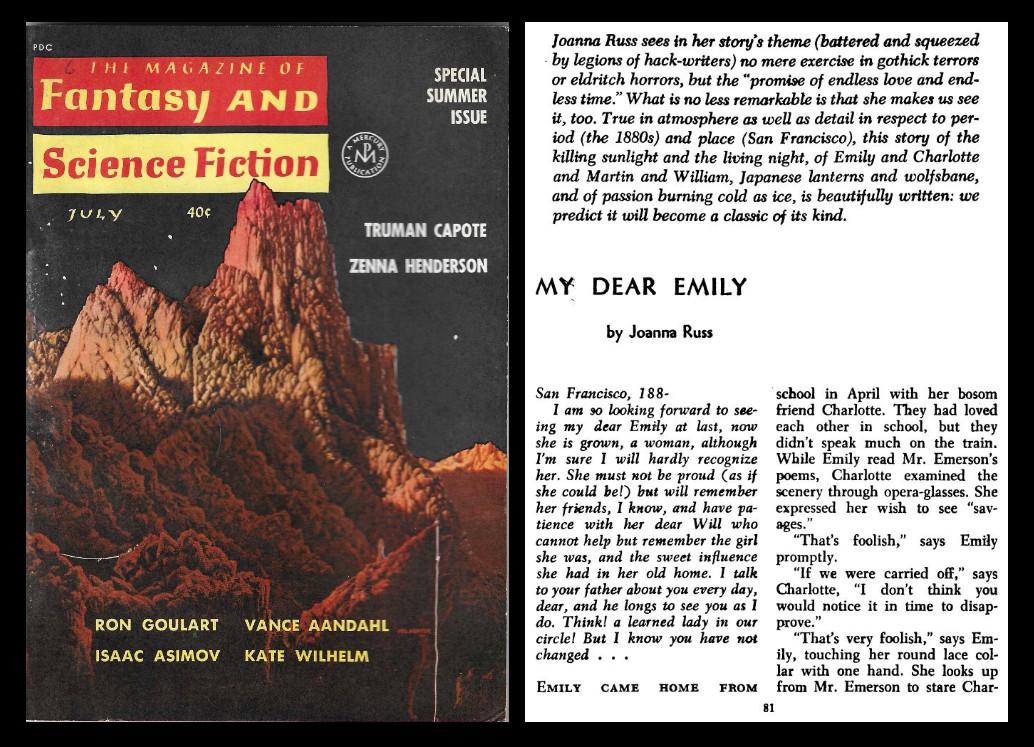
The second story up is “My Dear Emily” by Joanna Russ. It was first published in the July 1962 issue of The Magazine of Fantasy and Science Fiction. (You can read the story online.) F&SF provided my favorite genre magazine reading while growing up. I’m so fond of this periodical that I’ve collected an almost complete run of issues from 1949 to 1980. So, how can I be so prejudiced against fantasy?

I imprinted on science fiction when I first discovered reading. I consider science the only cognitive tool for understanding reality. Fantasy is based on magic and the love of the magical. Magic and science are polar opposites. I’ve never understood why people love fiction about beings that never existed. I will admit that science fiction is about beings that might exist, but are probably no more realistic than fantasy creatures.

My first impulse after reading “My Dear Emily” was to post this comment to the group: “Mediocre vampire story obscured by dense prose.” But would that be fair? Joanna Russ is a well-respected writer, even outside of science fiction. Within the genre, she is known for writing such classic feminist SF as The Female Man. Does “My Dear Emily” anticipate second-wave feminist themes in this 1962 story?

The story is set in 1880s San Francisco. Emily is returning from school in the east and bringing her friend Charlotte with her. Russ says, “They had loved each other in school.” Russ was a lesbian, but the story doesn’t appear to go in that direction at first, although in 1962, we might have been only expected to read between the lines. Emily and Charlotte do sleep in the same room.

Emily has returned to San Francisco to her father and Will, a man she is engaged to marry. Charlotte laughs at Emily’s endearing words about Will, and Emily wonders if God will strike her down for being a hypocrite.

However, Emily comes under the influence of Martin Guevara, a vampire. Why bring in the undead? We have the beginning of a good story with hints that Emily loves Charlotte but must marry Will in 19th-century America. My standard theory about why there are fantasy elements in literary stories is that it was easier to sell to genre magazines than get published in literary magazines. Literary magazines paid in free copies, but were usually a dead end for a story. “My Dear Emily” has been frequently reprinted in genre anthologies, earning additional payments and readers. In other words, would-be writers had a strong incentive to add fantasy or science-fictional elements to their stories.

Would I even be writing this essay, or have read “My Dear Emily,” if it hadn’t had a vampire in it? However, does Joanna Russ intend Martin Guevara to be meaningful in this story or just an in with the editor at F&SF?

Martin Guevara offers to get Emily out of her engagement to Will, but he exerts power over Emily, taking physical control of her. Emily already seems to know that Martin is a vampire. Did she know him before she left for school? And she leaves her house and finds me. How did she know where he lived?

On my second reading, this story seemed less murky, but it suggests things that aren’t explained. Emily tries to kill Martin with a silver cross, but he isn’t vulnerable to the power of that symbol. In fact, he isn’t affected by several of the classic defenses used against vampires. Martin tells Emily, “We’re a passion!” about his kind, and “Life is passion. Desire makes life.” He says desire lives when nothing else does.

The story becomes more about vampirism. But is it really? Russ’s prose is far from explicit. Is the story a vampire fantasy or one of lesbian liberation? Are Will and Martin two poles of masculine power?

This story did not need a vampire. But to get published in F&SF, it did. Fantasy obscured the real intent of this tale.

Why does pop culture love the undead? Do they really add anything valuable to fiction? Or, are they just popular stock characters? At best, they might be symbolic, but isn’t that symbolism usually ignored?

JWH

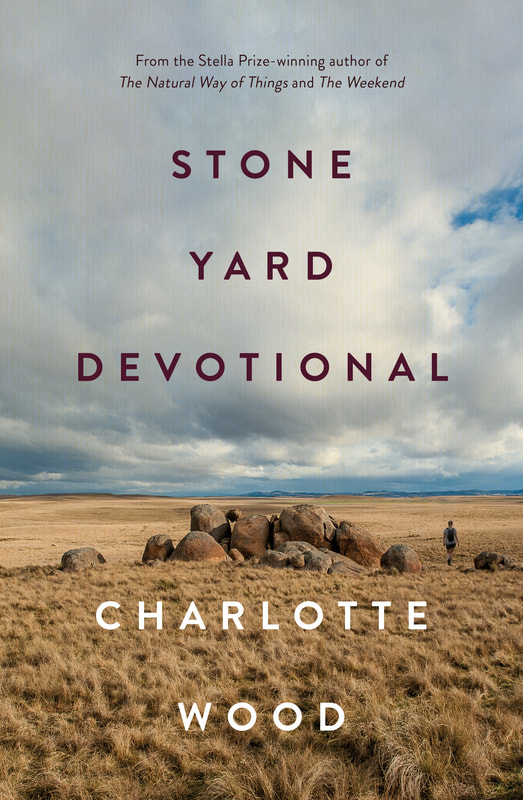
STONE YARD DEVOTIONAL by Charlotte Wood

by James Wallace Harris, 4/12/25

Stone Yard Devotional is about how reality puts the peddle to the metal when life gets all too real. Stone Yard Devotional reads like a memoir, a diary, but it’s classified as a novel. The book was nominated for several awards.

The entire time I was listening to this book I wondered if Charlotte Wood was the unnamed narrator, however after reading “‘The shock was so deep’: Novelist Charlotte Wood on the experience that changed everything” in the Syndney Herald, I realized the novel was only inspired by her own life. Wood and her two sisters were being treated for breast cancer, while she was contemplating mortality and drafting this book.

I have no memory of how I discovered Stone Yard Devotional by Charlotte Wood. The cover and title intrigued me for sure. Maybe it was because it was shortlisted for the 2024 Booker Prize. The audiobook was part of my Spotify subscription, so I gave it a try, and I’m glad I did. It’s not the kind of book I normally read, but it’s wonderful to read if you’re getting old.

The story begins with the Covid pandemic. The narrator separates from her husband, ghosts her friends, and hides out in a guest house of a religious order, even though she is nonreligious. She wants to be alone. But after her initial stay, she returns to the order to live with the nuns. I was never sure if she joined the order or not. I have often thought the monastic life has certain appeals.

The story is about the narrator’s observations while living a contemplative life. These include the death of her mother, the remembrance of childhood, studying the nuns, working in the garden and kitchen, and the guilt of living with a woman she and her classmates horribly bullied as a child. The narrative is simple, like meditation.

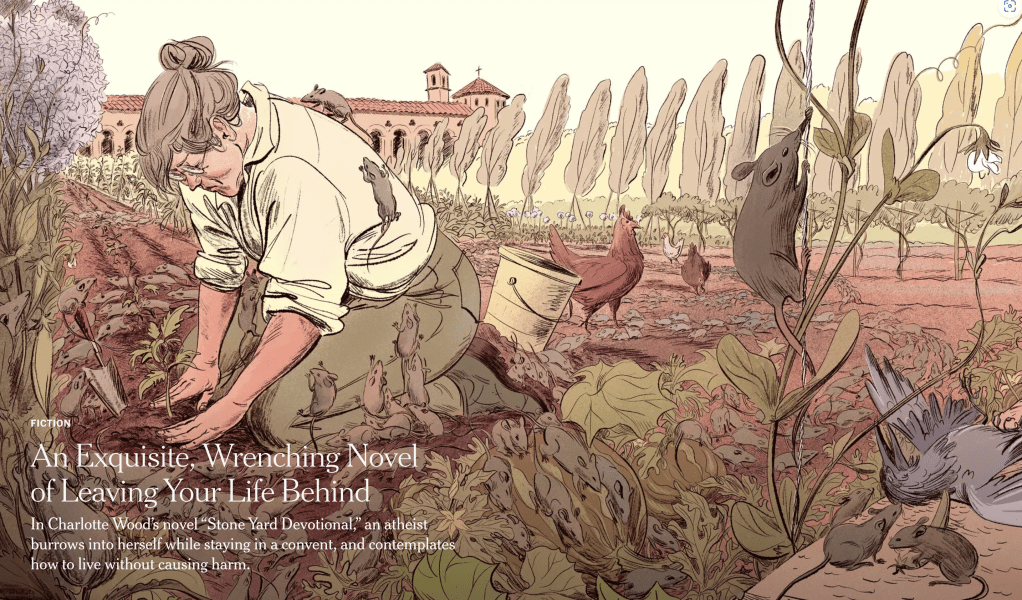
The setting is Australia, which is exotic to me. As a kid I wanted to live in Australia. Over the course of the novel, there is a plague of mice that invade the convent. The mice are so numerous that they cover the roads in gray fur. At first, I thought Wood added this element to give her tale some excitement, but I researched and found that her part of Australia they did have a mice plague of Biblical proportions in 2021.

That made life in the convent extremely inconvenient. The mice ate electrical insulation, throwing daily living in the convent back to the 19th century. The illustration for the book’s review at The New York Times might have been another reason I read this book.

Much of what the unnamed narrator contemplates throughout the novel is what everyone thinks about as they get older. The fear of declining health and death, the regrets, the desires for wanting to have done things different, the desires to connect with others while also wanting to pull away, the changes we see in ourselves and others, the appeal of nature and living simple. Wood’s story explores all of that and more, triggering the reader to think about their lives.

Charlotte Wood was born in 1965, so she’s fourteen years younger than me. However, her battle with cancer has likely aged her perception on life. At 73, I’ve been thinking about the things in this novel for years. But I don’t know if everyone who collects social security meditates on these issues. Stone Yard Devotional is a great title for this novel. Even though the narrator said she was an atheist at the beginning of this story, getting old and dealing with people who die, pushes you to be spiritual even without a belief in God.

JWH

The Limits of Memory

by James Wallace Harris, 3/3/25

It annoys me more and more that I can’t recall names and nouns. I don’t worry yet that it’s dementia because most of my friends have the same problem. But I’ve been thinking about my ability to remember and realized that I’ve never been good at remembering things.

I know I have aphantasia, which means I can’t visualize mental images in my head. I wonder if there’s a connection between not visualizing images and poor memory? People with astounding memory often use mental images as mnemonics.

The ability to remember is on a spectrum. On one end of this range, are rare individuals with photographic memories, while at the other end, are a tiny group with no short-term memories.

My new theory. One possible reason I have poor memory is my education. More precisely, how my personality approached learning as a kid. I considered K-12 a thirteen-year prison sentence. I paid just enough attention to pass tests. I mostly got Cs and Bs, with a rare A and D. I remembered things just long enough to pass a test.

I was never motivated to remember for the long haul.

I do like to learn. I’ve read thousands of books. Of course, most of them have been science fiction, but I also love nonfiction. However, information leaves me as fast as I consume it.

I’m starting to wonder if I would have a better memory if I had developed a different approach to school and learning. Primary and secondary education aim to give kids a well-rounded education. And in college, over half the courses are required.

The idea is we should learn as much as possible about the world. Is that a valid approach? After school and college, we specialize in whatever our work requires, and become selective about what we study for fun. Those subjects are what we remember best.

Reality is too big to know everything. What we need to learn is how to coexist with reality. We need the knowledge to fit in and survive. Would knowing more about fewer subjects help? Or would memorizing the deep dynamics of how things work better yet?

I do believe the more we know, the wiser we are. But there are limits to what we can understand and memorize.

I’m currently reading Nexus by Yuval Noah Harari. In chapter 2, Harari shows how fiction drives our societies, not truth. We live by stories we want to believe. It’s much easier to vaguely understand fiction than to learn the details of reality. For example, more people accept The Bible than biology. That suggests a natural tendency to minimize how much we know.

That would be okay if the Earth were sparsely populated. But we live in dense, complex societies racing at the speed of computer networks and artificial intelligence. Living by fiction is fine if the year is 500 BCE, but we live in 2025. CE.

Let me give one example of what I mean by learning less to know more. I’ve been reading American history books to understand how our society got to now. That gives me a certain level of wisdom about our problems. However, I’m also reading about French history, especially the French Revolution and 19th century history. Seeing the parallels ups my level of understanding. But do I need to read the history of every country now and then? What I see is common dynamics. Reading more histories will give me more examples of the same dynamics.

The same is true of religion. I like studying the history of the Bible. I’ve also studied Buddhism and Hinduism. As I do, I see common dynamics at work. Harari’s new book Nexus points out the common dynamics of society and history.

The educational philosophy I experienced growing up pushed me to memorize a million details. What I needed to understand and remember is the fewer dynamics of reality.

People like to live by fiction because it’s easier. Politics is currently overwhelmed by fiction. Read Nexus to understand why I say that. The question we have to answer is if we can reject fiction.

Real information is seeing patterns in reality. Wisdom is seeing patterns in the patterns. The only real cognitive tool we’ve ever developed to understand reality is science. However, it’s statistical, and hard to learn and understand. We live in a time of simplex thinking. People see or are told about one pattern and they accept that as a complete explanation of reality. All too often, that pattern is based on a cherished story.

We can’t live by memes alone. Nor can we live by infinite piles of memorized details. The only way to understand is to observe consistent patterns. But it has to be more than two or three. That can lead to delusions. Even anecdotal evidence of ten occurrences could still deceive. How can this lead to learning more from less? It’s a paradox.

Last year, I read a three-volume world history. It provided hundreds of examples of strong man rule over thousands. of years. But how many kids, or citizens can we get to read a three-volume world history? Would a listing of these leaders, including the wars they started, and the numbers of people who died because of their leadership be just as effective? Would all the common traits they shared help too? Such as wanting to acquire more territory, or appeals to nationalism?

Could we create a better educational system with infographics and statistics? I don’t know. I do know I tried to process too much information. I also know that I only vaguely remember things. Memory has limits. As does wisdom.

JWH