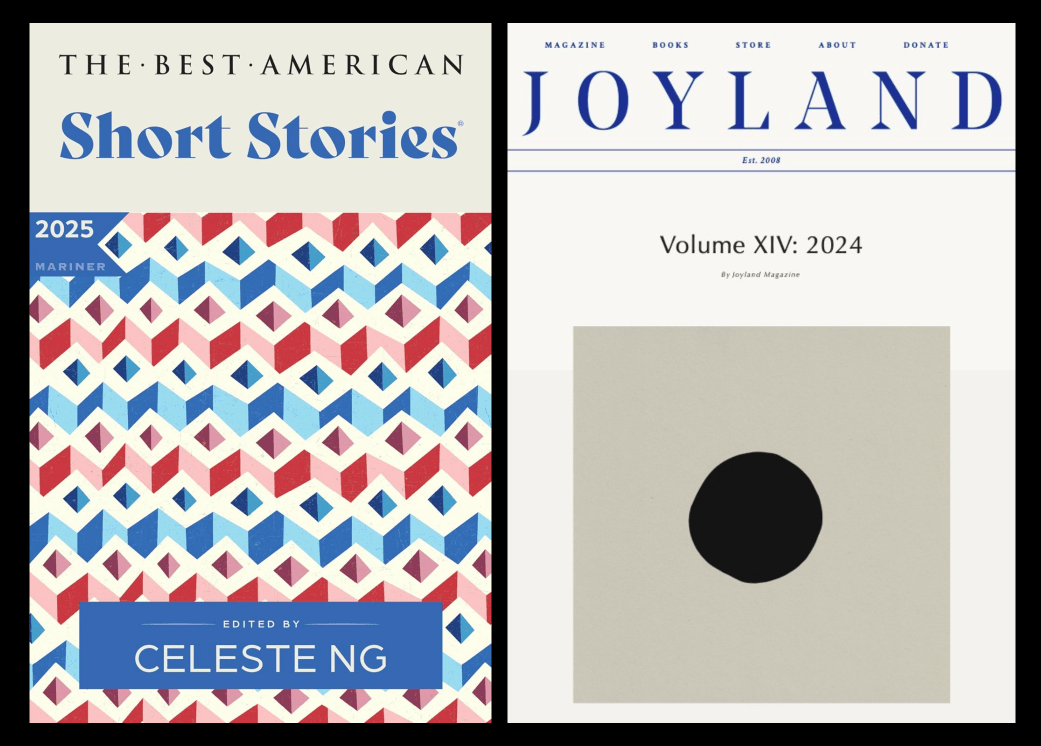
“What Would I Do for You, What Would You Do for Me?” by Emma Binder returns to the assertion that reading makes us more empathetic. The 2020s are difficult times for trans people, especially for those who live in the heartland. Emma Binder tells us about Cody Hartbrook, a trans man, whose father kicked him out of their Wisconsin home when he graduated high school. Cody found love, acceptance, purpose, even happiness in Massachusetts. Then his father got cancer, and Cody returned to Wisconsin to help his mother.
Unfortunately, you can’t read this story online. You’ll have to buy a copy of The Best American Short Stories 2025. I understand publishers need to make money, but I wish literary magazines would publish their stories online. Few people read little magazines, and not that many people even buy the annual Best American Short Stories.
Writing short stories is how new writers break in. They need the exposure. According to the Colburn Classroom, the Michigan Quarterly Review had a print run of 1,000 copies in 2020. I doubt most little magazines are for-profit concerns. Leaving their content offline is only hiding their light under a bushel. The world is giving up on reading short stories, and paywalls are only accelerating that decline.
But you should buy The Best American Short Stories every year. It makes you a patron of the arts by supporting budding writers. Most of the contributors will have names you don’t know. A few of them will publish a bestseller in years to come. Who knows, you might even buy their first novel when it comes out because you loved reading their short story.
Emma Binder said this in their contributor notes:
One of my obsessions, both artistically and in life, are the stories of queer and trans people who come from rural places and small towns, who may be omitted from the acknowledged social fabric of these communities but still shape them and are shaped by them. Queer and trans people are everywhere, so if their existence is not visible in a certain place, that erasure has been somehow designed. I also wanted to write a story about the feeling of freedom, and how some environments allow us to feel free while others are designed to constrain us—perhaps we experience that constraint through fear, shame, self-hatred, or an ambient hunch that we need to hush some vital part of ourselves in order to make our lives simpler. And maybe we love and miss those places regardless. So the emotional and thematic context was very clear to me, but the actual events of the story—Cody seeing a man falling through the ice, saving him, meeting him and his friends at the bar—took shape slowly and organically, during a warm winter when I was taking a lot of walks past ice fishermen.
I started this story in 2022, amid what I already thought was a harsh political climate for queer and trans people in the United States. Looking back on this story in the even darker and more oppressive landscape of 2025, I feel compelled to say that the ability to live in environments where we feel free, and where we can experience self-determination and authenticity, is literally lifesaving; it allows us to move past raw survival and access deeper, human, complex modes of living. It allows us, as Cody says in the story, to experience such essential things as “love, family, peace.” That is true for trans people and for every person on this Earth.
“What Would I Do for You, What Would You Do for Me?” really is a test for that common assertion that reading makes people more empathetic. I can’t believe anyone can read this story and not feel for Cody.
Like I’ve said before, literary stories are often like experiencing telepathy. Cody saves an ice fisherman, Greg Parham, when the ice breaks. Greg invites Cody out for a beer to say thanks. Cody doesn’t want to go because he’s afraid the locals will discover he’s trans and beat him up.
Cody does go to the bar, but is unnerved when Greg shows up with Kevin and Nick. Cody drinks and shoots pool with the guys while they ply him with friendly questions.
From that, we experience the anxiety Cody lives with. It becomes even more complicated when the guys discover Cody went to high school with them. The guys are baffled that they can’t place Cody. It makes them pry even more. Cody doesn’t lie, but he doesn’t tell them he was much different back then. He just says he was a loner.
Evidently, Cody wants to be one of the guys, but knows, or fears, being beaten up. I’m not sure I like Emma Binder’s ending. It works realistically, but not dramatically. She shows a gun in the first act, but it’s never used. What if Greg, Kevin, and Nick did learn that Cody was trans? How would Greg, a big, burly, bearded guy, feel about having his life saved by a trans guy?
Greg, Kevin, and Nick are ordinary guys, but they’ve probably never met a trans person. As readers, we feel tension from their masculinity. But aren’t we prejudging them too? Would they beat up Cody?
At 74, my youngest friend is 60. It’s been years since I’ve socialized with a young person. And when I think of young people, I recall the fellow baby boomers when they were young, or maybe Gen Xers I watched growing up. I’m totally out of touch with recent generations. So when I read a short story like “Take Me to Kirkland” by Sarah Anderson and view modern youth from inside their head, it’s kind of a shock.
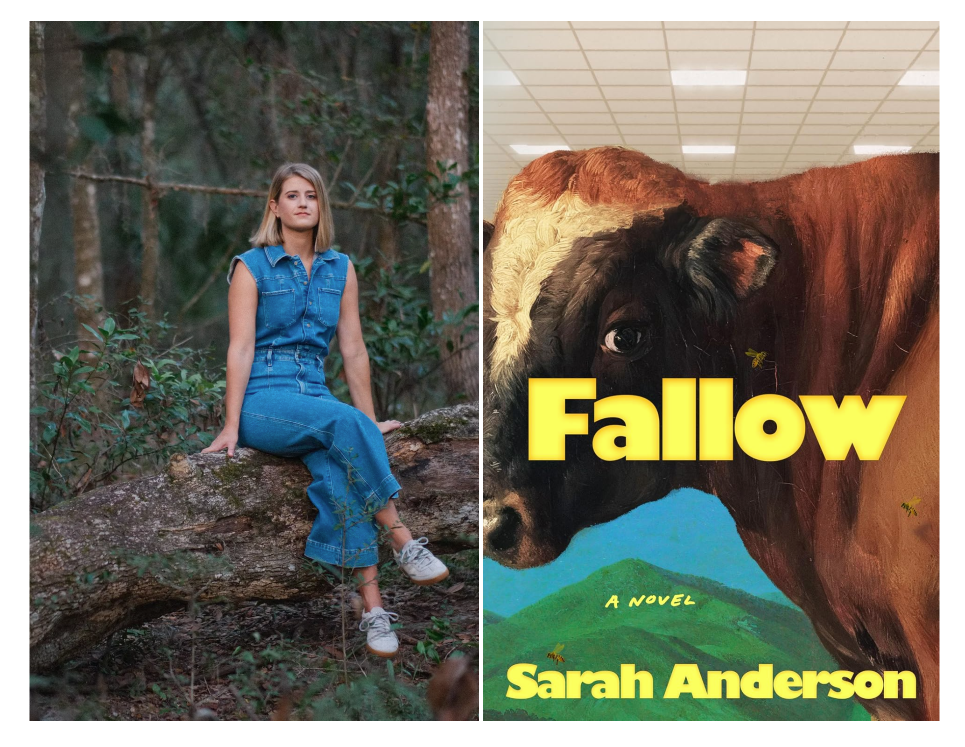
Anderson is a young woman from Gainesville, Florida, who is at the beginning of her writing career. Her first novel, Fallow, will be out in September.
Literary fiction is often a touch autobiographical, but you can never be sure. Is the unnamed narrator in “Take Me to Kirkland” made up, or does Anderson use herself or people she knows to paint her tale? Since I’ve sat through dozens of writing critiques in writing classes, I know some writers make things up, and some writers describe things they know. Generally, writers of genre fiction make things up, and literary writers use details from real life.
That’s why I like reading The Best American Short Story series. Reading each volume’s twenty stories feels like eavesdropping into people’s lives. And generally, they are unlike anyone I’ve known.
Luckily, the anthology includes notes from the contributors, so we get some clues about Anderson.
“Take Me to Kirkland” initially grew out of two main fragments.
The first piece to arrive was the scene of the narrator meeting Chloe and the intensity between them. My own breasts came in late, and one of my clearest memories from teenhood is the obsessive, desperate way I looked at other women’s bodies, like at any moment someone might jump from the bushes and announce a winner. That moment of sizing up by the mailbox was my way into the scene, and then the friendship came in a series of images: the cutting of the lemon, girl underwater, the trampoline.
The second piece was the section about childhood misunderstandings. I was a deeply anxious child, and that anxiety was made so much worse by all the things I didn’t understand about the world. I just had this vague sense of how much I didn’t know, and it terrified me. Perhaps because of this, and having made it to the other side, I take a particular joy in collecting other people’s stories of the misunderstandings they had well into adulthood. Like the narrator, I truly believed for a long, long time that Al Gore was only his last name.
It eventually became clear to me that the two fragments were connected, and I spent another year figuring out how to stitch together a narrative around them. Once it started to take shape, the story became a vehicle for a collection of other strangenesses, things that used to or still unsettle me in ways I struggle to articulate, all the ways the world never does actually make sense even after you grow up, and all the stories we tell each other and ourselves to try to understand it.
In other words, the story fictionalizes Anderson’s own anxieties. This is often true with literary short stories. It’s what I like. Unfortunately, I have a terrible time convincing my bookworm friends to read the annual Best American Short Stories. Most bookworms don’t like slice-of-life stories.
Partly, their dislike is with short stories in general. Most bookworms love novels. Writers like Ann Patchett and Elizabeth Strout write slice-of-life stories, but they are longer, and they have a plot. Genre short stories and 19th-century short stories have plots, but contemporary literary fiction short stories seldom do. Unless you’re a connoisseur of literary short stories, enjoying them is difficult.
The real pleasure of reading these kinds of stories is admiring a kind of pseudo-telepathy. In “Take Me to Kirkland,” readers will assume the unnamed narrator is either Anderson or a simulacrum of someone like her. We’re invited into her head. The best literary fiction is when writers reveal their innermost thoughts. Fans of this type of fiction particularly love when writers reveal things so private that we cringe at their honesty.
By the way, this same appeal is why memoirs are bestsellers.
There is a challenge to writing literary fiction. Book, TV, movie, and social media addicts now encounter the inner lives of thousands of people. It’s very difficult to make your thoughts naked in today’s world without appearing mundane. There’s a similarity between literary writers and OnlyFans hosts: you have to be willing to take it all off and show everything.
The narrator in “Take Me to Kirkland” is somewhat over 18, but spends most of the story remembering her friend Chloe from when they were children. At the beginning of the story, they were reunited after being out of touch.
I was surprised that Chloe was calling. We hadn’t spoken in almost two months, for a few reasons. The first was that she had new friends now, the girls she waitressed with three nights a week at the Longhorn Steakhouse. The one Chloe liked the most, Kayla, had a pierced nipple. Chloe showed me a picture after the first time they hung out. I didn’t know that an areola could be that big. I checked Chloe’s face out of the corner of my eye and could tell I was supposed to not make a big deal about it. “Nice,” I said. “Isn’t it so pretty?” she said. “Yeah,” I said. “I like that it’s silver.”
The second reason was that I had been spending more time with Damian, who Chloe said had too much body hair and a weird sense of humor. When I was honest with myself I kind of understood where she was coming from. Damian could be a real piece of shit sometimes and he was four years older than us which, at our current ages, many people found distasteful.
I’m sure this is all mundane to young people today, but for an old baby boomer, this is not how real people or characters talked fifty years ago.
The next part connects the reader to the story’s title. The narrator explains how, as a little kid, she thought Costco’s Kirkland was a magical place. This is a common MFA writing trick. Unfortunately, such childhood fantasies come off as cute rather than psychologically revealing. In fact, some of Anderson’s childhood stories are on the cute side. Especially the one about baby ducks. Such memoryscapes come off as writerly affectations.
Good writing is the accumulation of details. Great writing is the accumulation of significant details. I don’t think these early childhood details were significant. But then we jump forward in time.
Chloe and I met again when we were eleven, in July, when her family moved into the split-level one street over from mine. We had been in different classes every year since second grade and I hadn’t really thought about her. But that summer there she was, sitting on the curb across from our mailbox when I went outside to check if my mom’s Cosmopolitan magazine had been delivered so that I could read it first and then put it back in with the next day’s mail. “No mail on Sundays,” she said from behind me. I had forgotten what day it was.
I couldn’t decide if the girl in front of me, this new Chloe, was hotter than me or not. Her legs were shorter but her tits were bigger, and I had a bad feeling that her face was better than mine. I wanted her to whisper something in my ear. I wanted to cut her hair off. I wanted to watch her suck a slice of lemon and spit the little seeds into my hand one by one.
Chloe considered me too, pausing on my legs. “I live over there now,” she said finally, pointing. “Do you like trampolines?”
“Cool,” I said. “Yeah.”
“Come with me,” she said. Her ass cheeks peeked out from her jean shorts, two pimply little half moons. She took me to the pharmacy down the street to shoplift laxatives, and cough syrup as an afterthought. We passed the bottle back and forth the whole way home and then lay down on the trampoline in her backyard. The trampoline was covered in gravel and twigs and dead leaf fragments, so once we were high we took turns pulling out the pieces that were tangled up in each other’s hair. The syrup left gritty little particles of something on our tongues and made our breath thick and sweet, our thoughts scattering like fistfuls of pennies in a fountain.
These details seem more real and significant. But are they real? This is unknown territory to an old man like me, but is it mundane to someone Anderson’s age? Mundane isn’t always boring. Sometimes, it’s how people connect.
For the next several pages, the story takes a surreal detour for someone like me, but I worry: is this the average world of being a young woman today?
Then we reach the true shocking point of the story, when Chloe disappears. Was she killed or kidnapped? Did she run away? The narrator thinks she sees Chloe in a porn video, one about rough sex and teens. The narrator reveals she watches porn to combat insomnia. This is the narrator getting naked. Are there other things she can tell about herself that are even more disturbing?
To an old person, this is too private. One reason we old folks retreat from the world is that it gets too weird for us. Reading “Take Me to Kirkland” tells me how much the world has changed.
The narrator of this story tells us how she copes.
To try to make myself stop loving Chloe, I sifted through our moments, looking for a handful of them that could bend our narrative arc, or at least end it. The only thing I could come up with was the sight of that ugly black outline on her skin, glistening under the Saran Wrap, and the way she looked when I passed her silently in the hallway at school that last week, bony and distant. But other moments kept creeping in instead, things that made me love her more. Grape breath and her fingers working through my hair, the v of her legs and the o of her mouth when she jumped too high on the trampoline and scared herself, then did it again. The gasp when her hurricane body knocked me flat onto the nylon. “Sorry,” she said, when I pointed at the slick red rug burn on my elbow, and then she licked it.
For the first two weeks after we realized she was gone, people kept asking me if I was ok, and I didn’t really know but I thought I was, except that I was having a very hard time falling asleep. By the end of that first month, more and more I found myself on PornHub, which Damian introduced me to. I would start out watching really basic stuff but as the night wore on, things would escalate and eventually I would find myself watching a gangbang.
Our narrator has finally reached a state of Holden Caulfield-like mental illness. Does she recognize that? Is the world of 2026 that different from 1951 for young people? Or what about Esther Greenwood from The Bell Jar in 1963?
In my nonfiction book club group, we recently asked if fiction or nonfiction was the best way to convey what a moment in time and place is like.
If readers in the 2120s read “Take Me to Kirkland,” will they assume it’s how life was generally like in America in the 2020s? This story resonates with the nonfiction book Girls & Sex: Navigating the Complicated New Landscape by Peggy Orenstein that I read about a decade ago.
The problem with short stories is they are too short. Readers don’t spend the time to think about what they imply. Short stories are going the way of poetry. And if current pundits are correct, the novel will soon follow.
For many readers, reading an anthology like this one is like being pistol-whipped by reality.
There has been much discussion lately about how people are no longer reading for pleasure. Advocates for reading often claim that reading is important because it promotes empathy. Is that really true? I’ve decided to test that.
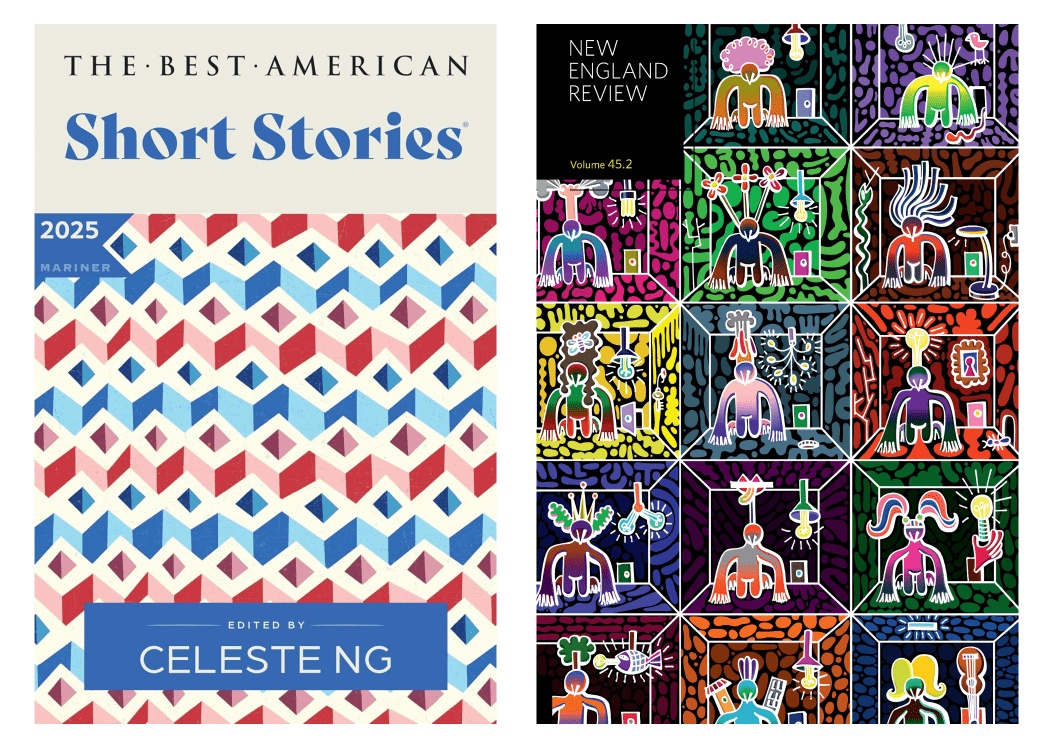
I read the short story “Dominion” by Lauren Acampora in The Best American Short Stories 2025, but it was originally published in New England Review. “Dominion” is reprinted in Acampora’s new collection The Animal Room. You can read more about Lauren Acampora here.
Roy Fox is a retired CEO of an oil company. “Dominion” is his story, and we follow Roy’s thoughts. Roy spends his retirement collecting exotic animals. He claims he runs a rescue preserve, but in reality, he owns a large private zoo and employs many people as caretakers.
The plot pivots on a girl who is clawed by a serval when Roy invites his granddaughter’s kindergarten class for a field trip.
Now I can’t say that Lauren Acampora’s goal in writing “Dominion” was to have readers empathize with Roy Fox, but if the virtue of reading is to understand people who are unlike us, then Roy is our subject. We live in politically polarized times where politics and wealth make us vilify our opposites.
Acampora doesn’t side with Roy. I believe she works hard to paint Roy Fox realistically and without judgment. However, many readers will see Fox as a narcissistic rich man who constantly rationalizes his wants while sneering down on the poor. But Acampora’s presentation is more nuanced than that.
The story begins when Roy reads through a couple dozen letters that mostly thank him for bringing Molly, the tiger, to Piper’s school. Piper is Roy’s granddaughter. However, one letter, written by a parent, riles Roy:
While we appreciate your good intention in visiting our child’s school with an animal ambassador as impressive as Molly, we’re concerned by the practice of keeping wild creatures captive—
Roy immediately wanted to defend himself by contacting the parent and telling them that Molly was rescued from a circus cage in Peru and now had three acres to herself. Then Roy thinks about how Shannon, his daughter, insisted on sending Piper to a public school when there was a “… panoply of private and Christian academies at her disposal.” He then thinks, “It was doubtful that his granddaughter would gain any special benefit from ‘diversity’ in this rawest sense of the word, this bestiary of scrappily dressed, minimally groomed children.”
Now, is Acampora using these details to criticize Roy? Or faithfully paint her character? Are liberal readers supposed to empathize with Roy? He is spending a great deal of money to “save” animals?
Roy’s favorite lines from The Book of Genesis: “Be fruitful and multiply and fill the earth and subdue it; and have dominion over the fish of the sea and over the birds of the air and over every living thing that moves upon the earth.” He had it engraved on a stone plaque and put it on the gate to his property.
Roy also recalls a time when his company spilled 10 million gallons of oil into the sea. He rationalized that it wasn’t the largest of spills. And that TV images of oil-covered birds were a PR nightmare for his company. Roy worked to minimize his company’s exposure to the affair, but that led to a fiasco. Marilyn, his wife, had tried to get him to immediately take responsibility because that would be the right thing to do. He refused, but in his mind he admitted she was right.
Are readers to assume that Roy is now spending a fortune on a personal zoo as atonement for the oil spill? Do we forgive him? Are we supposed to forgive him? Or is Acampora only asking us to walk a mile in Roy’s shoes?
The readers are next shown Roy’s love of his animals. Is it genuine love, or do caring for the animals only support Roy’s narcissism? Isn’t he getting off on playing God to them? That Bible quote is a clue. This long paragraph is quite telling.
Roy found himself laughing, too. The truth was that he enjoyed his property staff more than his peers in black tie. The people he hired to maintain the property and care for the animals were fine people, steered by other desires. The concept of ambition—of success for success’s sake—was foreign to them. Satisfied by the simple things the natural world provided, they were unaware of or indifferent to the higher calibers of human pleasures. Roy might have envied this plain contentment, but he understood he was designed differently. His enjoyment of these animals, this life, was necessarily contingent on all that had come before, the challenges he’d met with his own brain power. He enjoyed the animals because he’d worked to obtain them. But unequal as they were, he and his staff were happy together in this Eden. Roy was pleased to share the humor of watching a capybara waddle into the lagoon. Marilyn took delight in the animals, too—especially the camels, whose faces she loved, full of comedy and tragedy. She divined profound feeling in their soft, long-lashed eyes. She was, ironically, the keeper of the household ledger. In a funny swap, she was the manager now, and Roy the irresponsible one in need of reining in. When he’d wanted to build a dolphinarium, Marilyn had unequivocally told him no.
Roy wants to control his image. He decides to invite Piper’s class to the estate as a field trip. He’s sure they will see his side of things. Marilyn agrees with Roy and thinks it’s a good gesture. And the school agrees to come, but under conditions that irk Roy and spoil some of his plans.
Unfortunately, the field trip turns into another oil spill for Roy when a serval leaps at the fence, sending one of its very long legs through the links, clawing Layla, a young girl, on her chest.
After the ambulance and school bus leave, Roy goes inside and lies down. When Marilyn comes home, he tells her what happened; she’s horrified he didn’t follow the ambulance to the hospital and meet the parents.
Marilyn rushes them to the hospital. Marilyn goes right in and physically comforts the parents, while Roy holds back. Readers don’t know if Marilyn is a naturally good person or just good at appearing to do the right thing.
Roy is confronted by Layla’s teenage brother, Jordan. Jordan’s righteousness reminds Roy of his daughter, Shannon, when she was young. Roy feels Jordan spits on him, but the others don’t see it. Roy leaves the hospital room quickly to hide in the bathroom, where he starts getting hives that he scratches until they bleed.
As he and Marilyn near home, Roy calms down. He says he forgives Jordan because he is young. Marilyn informs him the parents aren’t going to sue. Roy tells her they should open up their zoo to the public so they can learn about animals.
The last paragraph is quite revealing.
At last, they pulled up to their gate, and Roy pressed the button that instructed the iron doors to swing inward. The row of elephant heads receded in orderly welcome. The car drove through, its tires purring over gravel, down the row of tamarind trees. The gnarled branches laced overhead, wrinkled pods dangling—and like that they left behind the barbaric world with all its howling demands. This was home, a sanctuary in the truest sense of the word. Roy’s heart eased back to a steady rhythm. All around them, miraculous creations. The flamingos in the distance like so many fresh brushstrokes. The camels, his grave dignitaries. The monkeys chirping merrily, scrambling through the branches, swinging down in bright numbers to greet him.
Has God returned to Eden after visiting Adam and Eve on the outside?
Like all stories, we could interpret this one in a zillion ways. But I wonder if Acampora is asking us to empathize with Roy Fox? If the value of reading fiction is to help us see inside other people, what should we do with this insight?
I believe one reason why Trump won the 2016 election is that conservative folks were tired of being bullied by liberals. For decades, comedians, late-night hosts, comedy news shows, and sarcastic intellectuals felt it was ethical to belittle the right. It’s rather ironic that we liberals have always defended the downtrodden and demanded that political correctness protect the weak from verbal persecution. Yet, the rich and strong were fair game to any kind of bullying. If kindness means protecting the mentally ill from verbal abuse, why don’t we extend such empathy to narcissists? It’s just another condition in the DSM.
I just wonder if Acampora was trying to make us feel bad for Roy. She paints him with all his sins, yet doesn’t her story ask us to forgive him? Am I taking my bleeding-heart liberalism too far? Am I expecting the woke to wake up even more?
Acampora also portrays Roy Fox in her novel The Hundred Waters. A blurb at Amazon quotes the Boston Globe calling Acampora “a brilliant anthropologist of the suburbs.” I’m tempted to read it.
Karen Carlson at A Just Recompense has a much different take than mine. But that’s to be expected. Everyone reads a story in their own unique way. Peter Kirwan at Come to the Pedlar is somewhat like Carlson in analyzing Roy. I agree with them that Roy is a goldmine for psychoanalyzing. I’m more curious what Acampora was aiming at in her storytelling.
The writer at Workshop Heretic feels Acampora is contemptuous of Roy. They certainly provide plenty of evidence to make their case. They also found the story dull. I didn’t at all. They called it a “bog-standard lit fic story.”
Since I have many hours of MFA writing courses (but without the degree), I know what they mean. Modern writers are so well trained in MFA programs that their work has a sameness to it. However, I consider that sameness to be high-quality writing.
And I’ll admit that reading The Best American Short Stories won’t appeal to many readers. But is that because its stories feel intellectual, often by elite writers from the literary establishment?
I have a different take. I refer to it as my “message in a bottle” theory of writing. We all live alone inside our heads, isolated from each other, like living on a deserted island. The best literary stories are distilled insights placed in a bottle and thrown into the ocean. The writers hope that bottle might be found and someone else might see what they see.
If you read this story, let me know what you think. I’ve told a good portion of the plot, but that leaves out the heart of the story. It’s a shame that it’s not online to read for free.
I highly recommend The Best American Short Stories series.
Susan and I just finished watching The Spoils of Poynton, a 1970 BBC production shown on Masterpiece Theater in 1971. It’s based on a 1897 novel by Henry James. Mrs. Adele Gereth has collected art objects, furniture, knick-knacks, lamps, glassware, and pottery for her entire life. Now that her son Owen is of age and will inherit the house and everything in it, she is distraught to learn that his fiancée, Mona Brigstock, lacks the taste and refinement to appreciate her treasure. So Adele connives to get Owen to marry someone else.
This is how things used to be. Families clung to generations of cherished things. Before my mother died, she wanted to know who wanted what of her things. She assumed that Becky, my sister, and I, as well as some of my cousins, would fight over her favorite things. After she died, I took the photo albums, my sister took some homemade quilts, and we gave away everything else.
I’m currently listening to Whistler, the new novel by Ann Patchett. At one point, Jonathan, the husband of the main character, Daphne Fuller, leaves her for several days to return home after his mother’s death to sort through her possessions with his siblings. Daphne begs Jonathan to hire an estate cleanout instead of putting himself through weeks of agony.
When Susan’s parents died, we bought their house because Susan and her brothers were too sentimental to let it go. So we lived with Robert and Mary’s stuff for a very long time. It was actually better than our stuff. And when my friend Janis moved to Mexico, we took in a bunch of her stuff. I think of these people by the things they owned.
All of this makes me think about the things I love to buy and own. Isn’t it weird how we love physical objects so intently? Susan and I are terrible at home decor. Our favorite kind of furniture is the La-Z-Boy. We have six single chairs and one double. We also love large screen TVs. My den has a 65″ TV, and her living room has a 75″ TV. We have hundreds of DVDs. And I have hundreds of CDs. I also have hundreds of books.
I don’t lust after cars, guns, or sports memorabilia like normal guys. I’m a bookworm, and books are what I get all sappy about. Susan says when I die, she’ll call Goodwill and Salvation Army and ask them to haul off everything I loved. Sometimes I think I should help her out by giving most of my books away before I die.
I especially love old science fiction magazines. I’d rather have them than diamonds. I would trade them for 19th-century artwork, but I’m realistic enough to know I’m no art collector. Besides, impressionist artworks really don’t go with La-Z-Boys.
The other day, I watched a YouTube video of the actor Paul Giamatti being interviewed about his book collecting. I felt a great affinity with these two guys. These are my people. I cherish crappy old paperbacks, too.
I always marvel when I visit friends and see how they’ve made their houses into museums of the things they admire. It makes me feel bad that I don’t love beautiful home furnishings. Our decor is functional for watching TV, listening to music, and reading.
After I’ve died, and someone is throwing out my science fiction magazine, I doubt they will see the beauty I saw. They won’t know that every issue of F&SF, Galaxy, or Astounding triggers memories. Most people remember the people they knew and the stories about them. I remember writers and the stories they wrote.
I wish I had a manor house and a lifetime of collected treasures like Adele Gereth, including my library of books and magazines. I love my house, even though it’s junky and cluttered. I do regret not having more refined tastes. But I never cared about dishes or doodads. My grandmother collected figurines of dogs. She had hundreds. That was cool. I wish I had gotten one to remember her by – a collie dog.
In Whistler, Jonathan’s first wife collected paintings of rabbits. I wish I had thought of something like that when I was young. Some kind of modest art that people throwing my stuff away could have identified me with. I’ve always admired 19th-century drawings by naturalists and scientists.
I visit the Friends of the Library bookstore once a week. People donate the kind of things I treasure. In fact, a lot of my treasure came from that bookstore. I think I’ll arrange to give my stuff to them when I die. I’ve already given them thousands of books, records, and CDs over the decades. It makes me sad when I see things I once loved left on the shelves for weeks. Hopefully, they will all find a new home with someone to love them. I guess I’m no different than Adele Gereth.
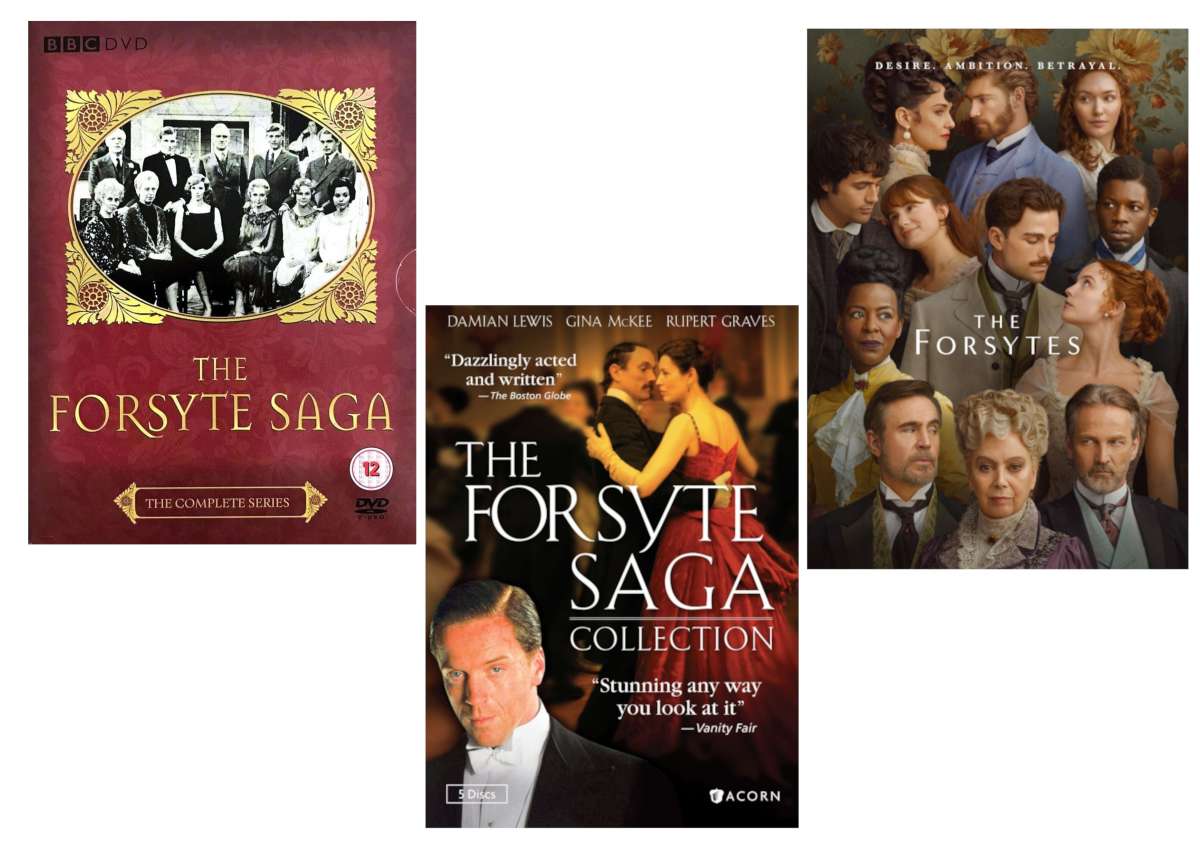
Would anyone still be reading John Galsworthy if British television didn’t keep producing new versions of The Forsyte Saga? Galsworthy did win the Nobel Prize for Literature in 1932, the year before he died, but that recognition seldom guarantees an enduring audience.
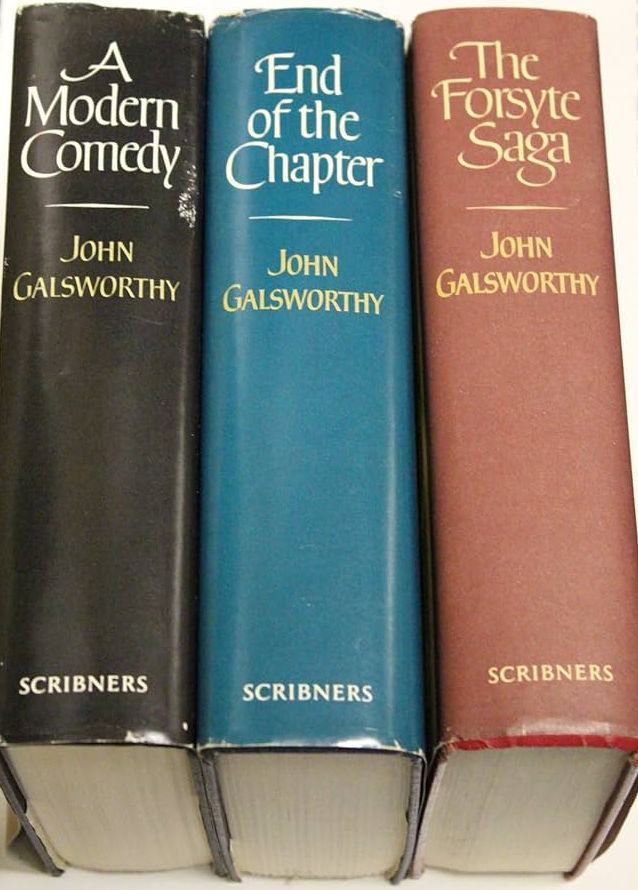
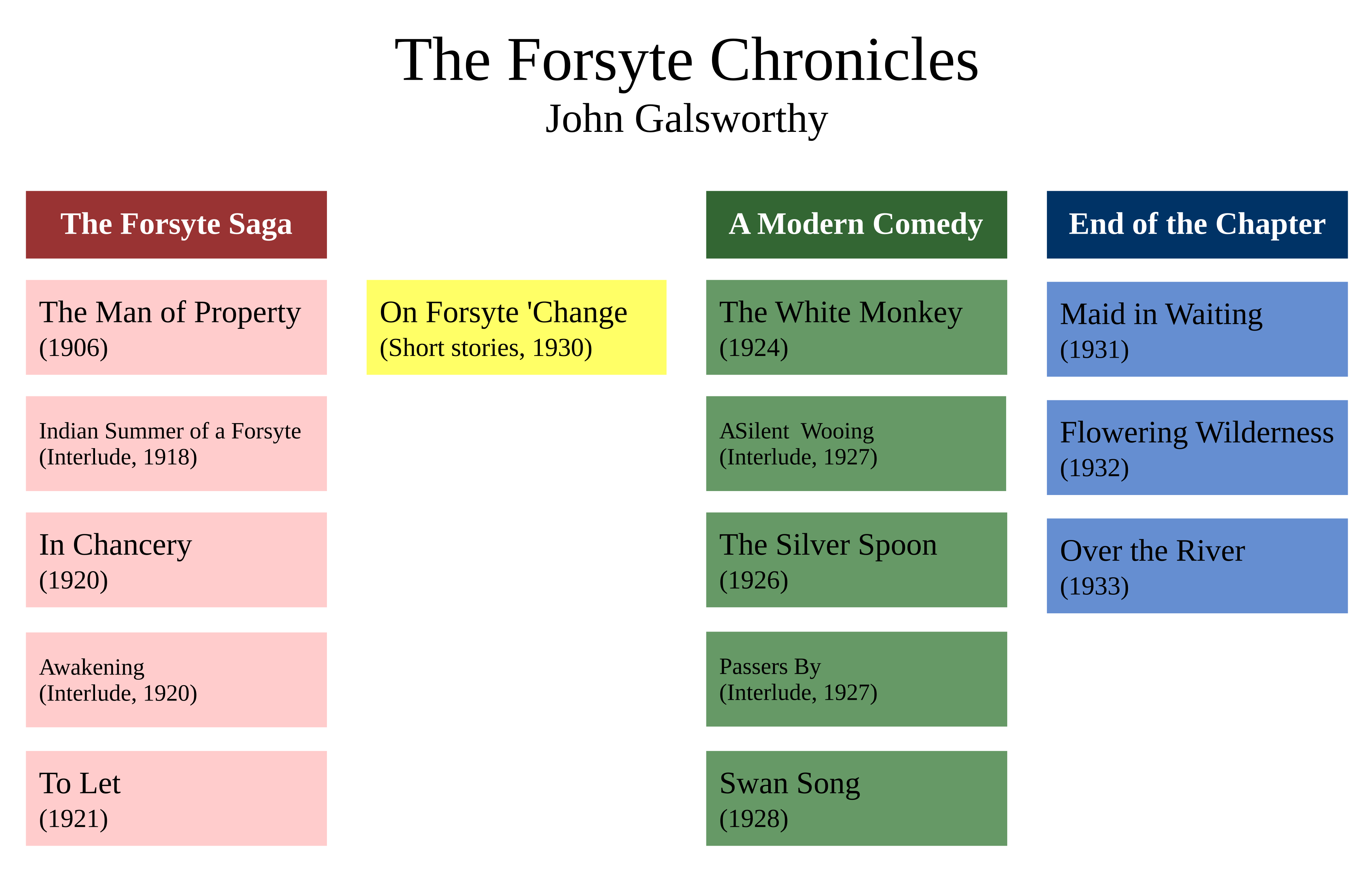
I must admit I wouldn’t be reading Galsworthy books today if I hadn’t been a fan of all three miniseries based on The Forsyte Saga. Technically, The Forsyte Saga is the title Galsworthy gave to the first trilogy of novels based on the Forsyte family. All nine novels are called The Forsyte Chronicles.
I know it sounds obsessive that I’m reading the books after watching 42 episodes of the three miniseries. However, the novels color in the main characters with greater detail. They also flesh out all the minor characters we see standing around the main characters on the screen.
The literary world has forgotten Galsworthy as a Victorian materialist who didn’t make the evolutionary step to modernism. Virginia Woolf was particularly hard on Galsworthy for failing to portray the inner lives of his characters. We don’t get deep, long stream-of-consciousness narratives, but I do feel Galsworthy describes the inner world of his characters, sometimes explicitly but often implied through dialogue and action.
Soames Foryste, who readers will hate as much as Irene Forsyte hates him, does get our sympathy. Soames is so well developed over six novels that he feels like one of the historical figures Lytton Strachey wrote about in Eminent Victorians.
Personally, I don’t know why Anthony Trollope and John Galsworthy aren’t as popular with readers as Jane Austen and Charles Dickens. They fill in a gap in English history for readers who study history through novels. Galsworthy is well-suited for those who love Downton Abbey, which explains why British television has produced it three times.
Amazon has the Forsyte Collection for 99 cents, which claims to contain everything in 3,355 pages. There are several audiobook editions, but I’m listening to the Naxos editions. Naxos packages the entire story of nine novels using their trilogy names: The Forsyte Saga, A Modern Comedy, and End of the Chapter.
Only the first six novels actually focus on the Forsytes; the last three deal with a distant cousin.
The Forsytes Saga (1967) miniseries has 26 parts, and covers the first six novels and interludes (short stories):
The Man of Property
In Chancery
To Let
The White Monkey
The Silver Spoon
Swan Song
The Forsyte Saga (2002) miniseries has 10 parts, and only covers the first three novels and interludes (short stories):
The Man of Property
In Chancery
To Let
The latest television version, The Forsytes (2025), had only six episodes in its first season and covered only part of The Man of Property. It had been renewed for seasons 2 and 3. For some reason, it changes the story from the books and the two other television series. I don’t recommend starting with this series, even though it has the most elaborate production.
I recommend watching the 1967 series, which is in black-and-white. The only place I could find it was on YouTube. Among the stars were two of my favorites, Kenneth More and Susan Hampshire.
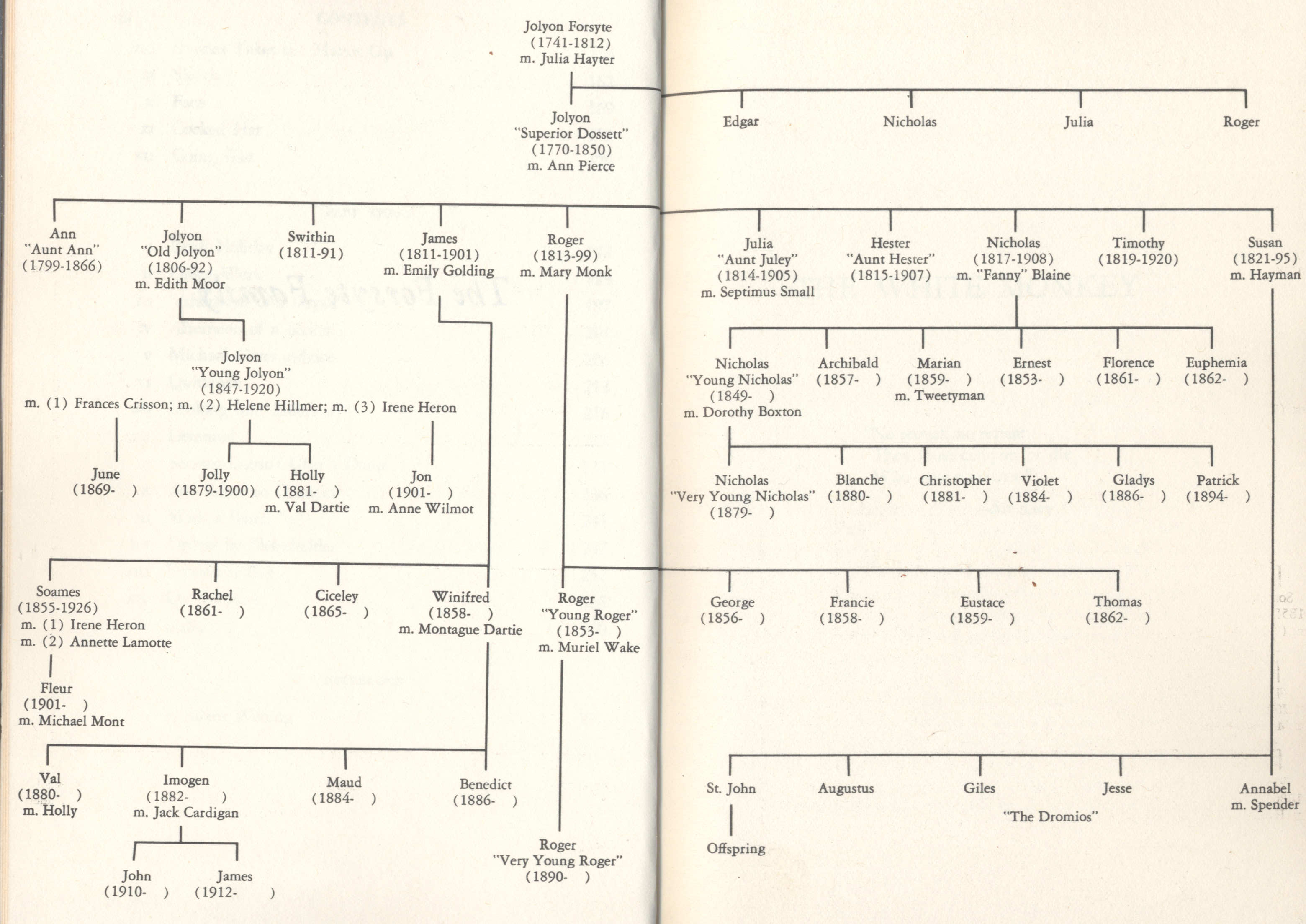
As far as I can remember, only Soames, Irene, and Winifred appear in all six of the first novels that focus on the Forsyte family from the 1880s until 1926. It involves at least ten love stories and eight marriages. It begins in Victorian times, spans the Edwardian, through World War I, and into the Jazz Age.
The 26 episodes of The Forsyte Saga reminded me a great deal of the 26 episodes of The Pallisers, which is based on six novels by Anthony Trollope. It made me wonder if Galsworthy was a fan of Trollope. But it also reminded me of the 12-volume novel series, Dance to the Music of Time by Anthony Powell, and the four-part TV series of the same name. These English writers like to span generations, combining character drama and British history.
Although there are plenty of reasons to hate Soames Forsyte, I found him a fascinating character. I was very sympathetic to Irene Forsyte, but I also wanted to condemn her. I both liked and disliked Jon and Fleur. In the 1967 version, Fleur was played by Susan Hampshire. It’s hard to judge the faults of a character played by such a beautiful actress.
I’ve already seen the 2002 version twice, and I’m looking forward to watching it again. According to WatchNow, it’s available on Netflix and PBS. Damian Lewis portrays Soames wonderfully. The character is so unlikable, yet over time, you develop great sympathy for the poor man.
Unfortunately, I haven’t taken to the new 2025 version, although I will give it another viewing. The actors all look too young and beautiful. The costumes, sets, and production are luscious. Visually, it reminds me of HBO’s The Gilded Age. The latest big historical dramas all seem to be revising the past, so everyone is young and beautiful. I really appreciated all the genuinely old-looking characters in the 1967 version.
The miniseries focuses on romantic relationships. The novels also explore many other kinds of relationships. Soames and his father. Soames and his uncles and aunts. Soames with his brothers and sisters. Soames is the patron of Philip the artist. But they are also romantic rivals for Irene. In the second trilogy, A Modern Comedy, the novels focus on Soames’ relationship with his daughter Fleur. In the second trilogy, we see Soames in several business and political relationships. And we see Soames’ relationship to art – he’s a collector of paintings.
And this is just the connections of Soames. There is an intense relationship between Old Jolyon, Young Jolyon, and his son Jolly. We encounter even more relationships with their wives and lovers. Young Jolyon is Soames’s first cousin, and the two families have several overlapping relationships.
The story focuses on marriage from Victorian times through the Jazz Age. To the first and second generations of Forystes, marriage was about improving the Forsyte holdings. Soames twice marries poor, beautiful women who come to despise him. Intense love fails other couples. In the first six novels, I can only recall one marriage where love succeeds.
I’ve read enough about Galsworthy to know that the complicated Forsytes were somewhat inspired by his own family. And Galsworthy stole his wife, Ada, from his cousin, and they lived unmarried for several years, hiding the scandal from his father. After his father died, his cousin divorced Ada, and Galsworthy married her. This is paralleled with Jolyon and Soames.
In other words, there is great depth in these novels that makes The Forsytes worth reproducing for television. And it should encourage fans to read the novels.