A Painful Challenge to My Ego

James Wallace Harris, 2/26/24

I’m hitting a new cognitive barrier that stops me cold. It’s making me doubt myself. I’ve been watching several YouTubers report on the latest news in artificial intelligence and I’ve been amazed by their ability to understand and summarize a great amount complex information. I want to understand the same information and summarize it too, but I can’t. Struggling to do so wounds my ego.

This experience is forcing me to contemplate my decaying cognitive abilities. I had a similar shock ten years ago when I retired. I was sixty-two and training a woman in her twenties to take over my job. She blew my mind by absorbing the information I gave her as fast as I could tell her. One reason I chose to retire early is because I couldn’t learn the new programming language, framework, and IDE that our IT department was making standard. That young woman was learning my servers and old programs in a language she didn’t know at a speed that shocked and awed me. My ego figured something was up, even then, when it was obvious this young woman could think several times faster than I could. I realized that’s what getting old meant.

I feel like a little aquarium fish that keeps bumping into an invisible barrier. My Zen realization is I’ve been put in a smaller tank. I need to map the territory and learn how to live with my new limitations. Of course, my ego still wants to maximize what I can do within those limits.

I remember as my mother got older, my sister and I had to decide when and where she could drive because she wouldn’t limit herself for her own safety. Eventually, my sister and I had to take her car away. I’m starting to realize that I can’t write about certain ideas because I can’t comprehend them. Will I always have the self-awareness to know what I can comprehend and what I can’t?

This makes me think of Joe Biden and Donald Trump. Both are older than I am. Does Biden realize what he’s forgotten? Does Trump even understand he can’t possibly know everything he thinks he knows? Neither guy wants to give up because of their egos.

So, what am I not seeing about myself? I’m reminded of Charlie Gordon in the story “Flowers for Algernon,” when Charlie was in his intellectual decline phase.

Are there tools we could use to measure our own decline? Well, that’s a topic for another essay, but I believe blogging might be one such tool.

JWH

I Finally Finished All 271 Episodes of Perry Mason

by James Wallace Harris, 2/18/24

Back in 2018 I wrote “Why Am I Binge Watching Perry Mason?” I started out watching the series on MeTV, but decided I wanted to watch the series from the first to the last episode. After printing a listing of all the episodes to act as a checklist, I then subscribed to CBS All Access to stream the episodes in order. I soon discovered they skipped some episodes. That annoyed me, so I got on eBay and found a bargain on a used copy of the complete series on DVD. I watched Perry Mason at a steady pace through the seventh season, when I completely burned out on the show. This year, I went back and with my wife’s help, finished the series.

Last night we watched season 9, episode 30, “The Case of the Final Fade-Out.” It was a fun way to end the series because that story was about a murder on the set of a television show. That episode used the Perry Mason crew as actors portraying a television crew, plus Erle Stanley Gardner played the judge. And there was one in-joke I particularly loved. We overhear an actress telling someone, “Who wants to be on a show that goes up against Bonanza.” Perry Mason was being canceled partly because it couldn’t compete with that popular western.

Even though I enjoyed watching episode after episode of Perry Mason, I can’t say it’s a great show. My love for the series was mainly due to nostalgia. My favorite aspect of each episode was seeing the guest stars, the sets, cars, and costumes. Perry Mason was filmed in black and white, except for one episode. I love black and white movies and television shows but seeing that one episode of Perry Mason in color made me wish the entire series had been filmed in color. The guest stars, old cars, and sets looked great in that one episode. It shows why color TVs became so popular. I can remember our family getting one in 1965.

I loved the characters Perry Mason (Raymond Burr), Della Street (Barbara Hale), Paul Drake (William Hopper) and Hamilton Burger (William Talman). However, they seldom ventured from their one-dimensional characterizations. In one episode Raymond Burr got to play an old English seadog who looked like Perry Mason. That revealed Burr’s missing acting potential. I’ve read that Burr got a big kick out of playing that crusty old sailor with an accent. It’s a shame that Burr played Perry Mason so woodenly so damn consistently.

We never got to see the private lives of Perry, Della, and Paul. The show followed a rigid formula. I’ve read that in the books that Perry and Della were a couple, but I can’t even say that’s even hinted at in the TV show. It would have been great having Della being involved with both Perry and Paul over the nine seasons. That would have added so many character dimensions and plots to the show.

Another missed potential the show should have added, was having Perry Mason lose a case now and then. Poor old Hamilton Burger must lose all his. Having Perry always win, always right, always infallible, made his character cardboard.

It sounds like I’m complaining, but I’m not. For television shows coming out from 1957 to 1966, Perry Mason‘s formula was on par. I wrote an essay, “Does Merry mason Follow the Rules for Detective Fiction?” that dealt with its mystery plots. When you watch 271 of them, it gets painful that every client of Perry Mason saw the victim just before they were killed. Sometimes, just minutes or seconds from the murder event. You’d think the writers would have been more creative in producing plots.

Yet, even with such a rigid formula, it was hard to guess whodunit. I seldom did. Often the plots were so confusing that even when we’re told what happened, it’s hard to understand what happened. I know HBO has a new Perry Mason that addresses my complaints, and I’ve seen the first season of that series. It’s excellent, but it’s not the same Perry Mason. The HBO series might be closer to the original books, and it’s set when the original books were written, making it more authentic to them, but still, I’d like a better Raymond Burr Perry Mason.

I know this is a bizarre and an impossible wish to grant, but I wish someone would remake the 1957-1966 television series set in the 1950s and 1960s, with actors much like Burr, Hale, Hopper, and Talman, but with 2024 television production values. Like Once Upon a Time in Hollywood (2019) recreates 1969.

The old Perry Mason sometimes plotted stories based on current news events. One episode was obviously inspired by the Kitty Genovese case. It’s a shame they bungled that episode. Having one of the bystanders who didn’t want to get involved be the murderer detracts from the moral lesson of the real-life murder.

Another episode was about computer dating. I assume that the 1965 episode was inspired by Operation Match, which was in the news in 1965. Wikipedia has an interesting history of computer dating, and the idea goes back further than I imagined. Again, I thought the writers mangled the inspiration. Because they shoehorned it into their formula, the implications of matching couples by computer was just a novel idea they threw out but didn’t explore.

I’d love to see a new Perry Mason series that explores the reality of Ameria from 1957 through 1966. We changed so much in those years. It’s a shame that an artistic artifact from that period reveals so little about the times, mostly giving a false impression of the past. We humans prefer consuming fantasy over reality.

I know all of this sounds like I’m complaining, but I did enjoy watching the series. It’s just knowing what’s happened to the world in the last sixty years, and knowing the potential of what television can be that makes me fantasize about watching a much better Perry Mason based on the old series. It had so much potential.

Given the times could Perry Mason have been better? I thought Route 66 (1960-1964) proved Perry Mason could have taken more chances and been truer to the times. I must assume that the writers and producers of Perry Mason calculated what American TV watchers wanted to see at the time, and that’s what they gave them.

Could 1950s America have accepted Perry Mason if he lost cases, made mistakes, had personal flaws, was screwing Della, was jealous that sometimes Della might have been screwing Paul, and had to deal with the real years of 1957 through 1966?

I love watching old TV shows, shows from the years I was growing up. That’s mostly because of nostalgia, but it’s also because I like analyzing the past. I can remember the real, edgier, darker, 1950s, even though I was a kid. I wonder why television was so unreal. I often think that back then, we wanted real life to be like television. Now that I’m older, I’m wishing that old television had been more like real life. What does that say about me?

Perry Mason witnessed at least 271 dead bodies, murdered in all kinds of ways. Why didn’t that have a cumulative effect on his psyche? You’d think Perry would have become cynical and bitter as the show progressed over nine years. I think that’s the substantial difference between old television and new. The characters grow and change.

America changed dramatically from 1957 to 1966, but we don’t see that in Perry Mason, except for cars. Watching Perry Mason is escaping into a fantasy we all had a lifetime ago.

But I’ve got to wonder, will people growing up now believe television accurately captures life during their adolescent years when they rewatch their old favorite shows in retirement while looking back over their life?

Even with these complaints, I’m already thinking about starting the series over.

JWH

ChatGPT Isn’t an Artificial Intelligence (AI) But an Artificial Unconsciousness (AU)

by James Wallace Harris, 2/12/24

This essay is for anyone who wants to understand themselves and how creativity works. What I’m about to say will make more sense if you’ve played with ChatGPT or have some understanding of recent AI programs in the news. Those programs appear to be amazingly creative by answering ordinary questions, passing tests that lawyers, mathematicians, and doctors take, generating poems and pictures, and even creating music and videos. They often appear to have human intelligence even though they are criticized for making stupid mistakes — but then so do humans.

We generally think of our unconscious minds as mental processes occurring automatically below the surface of our conscious minds, out of our control. We believe our unconscious minds are neural functions that influence thought, feelings, desires, skills, perceptions, and reactions. Personally, I assume feelings, emotions, and desires come from an even deeper place and are based on hormones and are unrelated to unconscious intelligence.

It occurred to me that ChatGPT and other large language models are analogs for the unconscious mind, and this made me observe my own thoughts more closely. I don’t believe in free will. I don’t even believe I’m writing this essay. The keyword here is “I” and how we use it. If we use “I” to refer to our whole mind and body, then I’m writing the essay. But if we think of the “I” as the observer of reality that comes into being when I’m awake, then probably not. You might object to this strongly because our sense of I-ness feels obviously in full control of the whole shebang.

But what if our unconscious minds are like AI programs, what would that mean? Those AI programs train on billions of pieces of data, taking a long time to learn. But then, don’t children do something similar? The AI programs work by prompting it with a question. If you play a game of Wordle, aren’t you prompting your unconscious mind? Could you write a step-by-step flow chart of how you solve a Wordle game consciously? Don’t your hunches just pop into your mind?

If our unconscious minds are like ChatGPT, then we can improve them by feeding in more data and giving it better prompts. Isn’t that what we do when studying and taking tests? Computer scientists are working hard to improve their AI models. They give their models more data and refine their prompts. If they want their model to write computer programs, they train their models in more computer languages and programs. If we want to become an architect, we train our minds with data related to architecture. (I must wonder about my unconscious mind; it’s been trained on decades of reading science fiction.)

This will also explain why you can’t easily change another person’s mind. Training takes a long time. The unconscious mind doesn’t respond to immediate logic. If you’ve trained your mental model all your life on The Bible or investing money, it won’t be influenced immediately by new facts regarding science or economics.

We live by the illusion that we’re teaching the “I” function of our mind, the observer, the watcher, but what we’re really doing is training our unconscious mind like computer scientists train their AI models. We might even fool ourselves that free will exists because we believe the “I” is choosing the data and prompts. But is that true? What if the unconscious mind tells the “I” what to study? What to create? If the observer exists separate from intelligence, then we don’t have free will. But how could ChatGPT have free will? Humans created it, deciding on the training data, and the prompts. Are our unconscious minds creating artificial unconscious minds? Maybe nothing has free will, and everything is interrelated.

If you’ve ever practiced meditation, you’ll know that you can watch your thoughts. Proof that the observer is separate from thinking. Twice in my life I’ve lost the ability to use words and language, once in 1970 because of a large dose of LSD, and about a decade ago with a TIA. In both events I observed the world around me without words coming to mind. I just looked at things and acted on conditioned reflexes. That let me experience a state of consciousness with low intelligence, one like animals know. I now wonder if I was cut off from my unconscious mind. And if that’s true, it implies language and thoughts come from the unconscious minds, and not from what we call conscious awareness. That the observer and intelligence are separate functions of the mind.

We can get ChatGPT to write an essay for us, and it has no awareness of its actions. We use our senses to create a virtual reality in our head, an umwelt, which gives us a sensation that we’re observing reality and interacting with it, but we’re really interacting with a model of reality. I call this function that observes our model of reality the watcher. But what if our thoughts are separate from this viewer, this watcher?

If we think of large language models as analogs for the unconscious mind, then everything we do in daily life is training for our mental model. Then does the conscious mind stand in for the prompt creator? I’m on the fence about this. Sometimes the unconscious mind generates its own prompts, sometimes prompts are pushed onto us from everyday life, but maybe, just maybe, we occasionally prompt our unconscious mind consciously. Would that be free will?

When I write an essay, I have a brain function that works like ChatGPT. It generates text but as it comes into my conscious mind it feels like I, the viewer, created it. That’s an illusion. The watcher takes credit.

Over the past year or two I’ve noticed that my dreams are acquiring the elements of fiction writing. I think that’s because I’ve been working harder at understanding fiction. Like ChatGPT, we’re always training our mental model.

Last night I dreamed a murder mystery involving killing someone with nitrogen. For years I’ve heard about people committing suicide with nitrogen, and then a few weeks ago Alabama executed a man using nitrogen. My wife and I have been watching two episodes of Perry Mason each evening before bed. I think the ChatGPT feature in my brain took all that in and generated that dream.

I have a condition called aphantasia, that means I don’t consciously create mental pictures. However, I do create imagery in dreams, and sometimes when I’m drowsy, imagery, and even dream fragments float into my conscious mind. It’s like my unconscious mind is leaking into the conscious mind. I know these images and thoughts aren’t part of conscious thinking. But the watcher can observe them.

If you’ve ever played with the AI program Midjourney that creates artistic images, you know that it often creates weirdness, like three-armed people, or hands with seven fingers. Dreams often have such mistakes.

When AIs produce fictional results, the computer scientists say the AI is hallucinating. If you pay close attention to people, you’ll know we all live by many delusions. I believe programs like ChatGPT mimic humans in more ways than we expected.

I don’t think science is anywhere close to explaining how the brain produces the observer, that sense of I-ness, but science is getting much closer to understanding how intelligence works. Computer scientists say they aren’t there yet, and plan for AGI, or artificial general intelligence. They keep moving the goal. What they really want are computers much smarter than humans that don’t make mistakes, which don’t hallucinate. I don’t know if computer scientists care if computers have awareness like our internal watchers, that sense of I-ness. Sentient computers are something different.

I think what they’ve discovered is intelligence isn’t conscious. If you talk to famous artists, writers, and musicians, they will often talk about their muses. They’ve known for centuries their creativity isn’t conscious.

All this makes me think about changing how I train my model. What if I stopped reading science fiction and only read nonfiction? What if I cut out all forms of fiction including television and movies? Would it change my personality? Would I choose different prompts seeking different forms of output? If I do, wouldn’t that be my unconscious mind prompting me to do so?

This makes me ask: If I watched only Fox News would I become a Trump supporter? How long would it take? Back in the Sixties there was a catch phrase, “You are what you eat.” Then I learned a computer acronym, GIGO — “Garbage In, Garbage Out.” Could we say free will exists if we control the data, we use train our unconscious minds?

JWH
Reading Vonnegut’s Slaughterhouse-Five at Ages 18, 55, and 72

by James Wallace Harris, 2/8/24

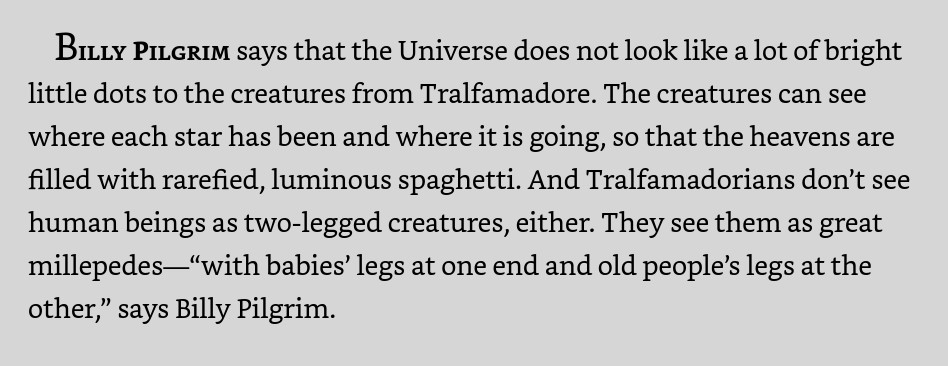
When I first read Slaughterhouse-Five by Kurt Vonnegut back in 1970 I thought of it as an antiwar novel. The Vietnam War overshadowed everything back then, and I was old enough to be drafted. 1970 was the year M.A.S.H. and Catch-22 came out in the movie theaters. I went to see Catch-22 and was so blown away that I bought the book, read it in a day, and then went to see the movie version again. I didn’t read the book version of M.A.S.H. for another year but saw the film in 1970 too. Ever since I’ve thought of Slaughterhouse-Five, Catch-22, and M.A.S.H. as the trilogy of anti-war novels of my generation. The books were all about hating war.

When I read Slaughterhouse-Five again, in 2006 when I was 55, I listened it on audio. That time it was a completely different novel. That time it was hilarious. It was over-the-top silly, slapstick, and viciously satirical. At that time I focused on the Tralfamadorians and Kilgore Trout, and Vonnegut’s commentary on science fiction. In 2006 I noticed the antiwar parts, but they didn’t seem to be the primary point of the novel. They were still horrifying, but I found it hard to take Slaughterhouse-Five as a serious novel about WWII. That happened to me last year when I tried to reread Catch-22.

Now in 2024, when I’m 72, I listened to the book again. This time the story was bittersweet, heavy on the bitter, gentle on the sweet, and deeply philosophical. This time Slaughterhouse-Five was a condemnation of humanity. It was dark, very dark, but strangely not depressing. Both Billy Pilgrim, the protagonist, and Vonnegut were accepting that humans do horrible things and there is nothing we could do about it. This time it was obvious that Vonnegut believes we have no free will, and the best we can do in life is enjoy those moments when life is pleasant. This time around Slaughterhouse-Five was incredibly stoic.

When I read Slaughterhouse-Five the first time I thought the main goal of the novel was to horrify readers that we bombed Dresden in 1945 and make them outraged. I thought Vonnegut was testifying to an Allied war crime. This time around I realized Vonnegut wasn’t doing that at all. He was completely accepting that we had to bomb Dresden.

I think both times before, I thought Billy Pilgrim was a stand-in for Vonnegut. However, this time it was quite explicit that Billy Pilgrim and Vonnegut were distinctly two different characters in the book. At the end of the audiobook, there was a ten-minute conversation between Vonnegut and another unnamed WWII vet. In that conversation Vonnegut even tells us the name of the man he based Billy Pilgrim on.

The vet Vonnegut was talking to kept trying to praise Vonnegut, and Vonnegut kept deflecting the compliments. But one thing the other guy said stood out. He said that all of Vonnegut’s books were in print because they have multigenerational appeal. Since I have read the book when I was young, middle aged, and old, I can attest to that.

When I read Slaughterhouse-Five back in 1970, I thought the book was a protest. It was Vonnegut telling his readers that we need to change. And back then I thought humans could change. When I read it in 2006, I still had hope that humanity could evolve into something better. But in 2024, I didn’t find Vonnegut protesting at all. Vonnegut advised acceptance. Why didn’t I see that at 18?

Slaughterhouse-Five is neither an antiwar novel, nor even a misanthropic novel. In 2024 it seems obvious that Vonnegut was saying we have no choice but to accept the life we’re given, both as an individual and as a species.

Vonnegut was around 42 when Slaughterhouse-Five was published in 1969. How is it he now seems like a wise old man when I read it at 72 in 2024? Every time I read Slaughterhouse-Five I thought of Kurt Vonnegut as a modern-day Mark Twain. I was very into Twain when I was young, but I pictured him as a bitter old man from his later fiction and autobiography.

I wonder now if Vonnegut eventually turned bitter like Twain. Even though for the 2024 reading many scenes felt bitter, now that I write this, I’m not even sure that’s what Vonnegut intended. Could he have intended a total beatific point of view? I need to rewatch the 2021 documentary about Vonnegut called Unstuck in Time. And I need to read And So It Goes: Kurt Vonnegut: A Life by Charles J. Shields.

This time around I’ve been thinking more about the Tralfamadorians, the alien race who kidnaps Billy Pilgrim in a flying saucer and takes him to their home world where they exhibit him in a zoo. The Tralfamadorians don’t see time like we do. Existence is all of one piece.

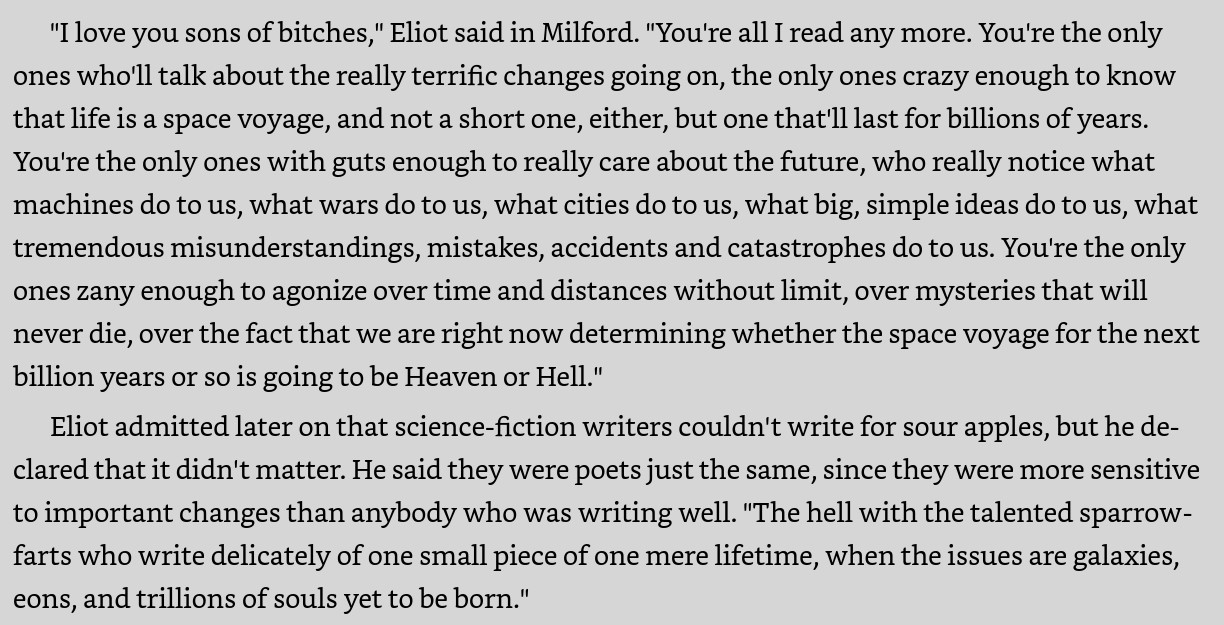
These aliens are like Zen Masters. Vonnegut uses them as enlightened teachers. But then, he gives a rather pitiful assessment of science fiction with his portrayal of Kilgore Trout. However, in a later novel, God Bless You, Mr. Rosewater, where Kilgore Trout is again featured, its hero, Elliot Rosewater attends a science fiction convention and gives this speech.

Science fiction didn’t come across so positively in Slaughterhouse-Five. Kilgore Trout wrote dozens of books that never sell. He’s a surly old man who makes his living by managing paperboys. Billy Pilgrim finds Kilgore Trout’s books only by accident. One time he finds four of them in a porn bookstore used as window dressing.

Wikipedia has an illuminating entry on Kilgore Trout. It says Vonnegut based Kilgore on Theodore Sturgeon. I’ve always wanted to know more about Theodore Sturgeon. Sturgeon’s fiction suggests he’s both eccentric and beat.

There are certain writers that haunt me. I think Vonnegut is becoming one of the ghosts that I need to get to know a whole lot better. And I might need to give Catch-22 and M.A.S.H. another read too.

JWH

How Anne Got Phished and What We Should Learn from Her Experience

by James Wallace Harris, 2/2/24

My friend Anne called me the other day terribly upset. Her bank had just called her to say her account had been hacked. She was worried that her computer was the tool of the hackers and wanted me to look at it. Anne was freaked out and called me because I’m her computer guy.

The first thing I asked her was, “How do you know it was the bank who called you?” She said the bank’s name and phone number came up on her phone. I told her she needed to call her bank and confirm that. I told her the bad guys can pretend to be anyone. Anne said she would do that immediately.

When I didn’t hear from her for a couple of hours, I called her. A man answered. I didn’t think it was her husband but asked for Anne. A woman got on the line I didn’t know. I again asked for Anne. She said she was Anne. I was suspicious, so I asked this time giving Anne’s full name. She said, “Yes, that’s me.” I said, “No, you’re not.” and hung up.

I couldn’t call Anne, but I thought a text might get through. I texted “Call me right now.” The real Anne called me. I told her what happened. She said she’d been on the phone with her bank for hours and she had been phished. They stole $3500. I told her she needed to call her phone company immediately. “Tell them your calls are being redirected.” A couple of hours later, she called back to say her forwarding had been set to another number and the phone company had turned that off. Anne said the phone company couldn’t help her anymore and would notify their security people, but it would take a few days.

My guess is the phishers had gotten ahold of hacked data from Anne’s bank, so they knew a lot about her, enough to convince them they were the bank. The phishers then conned Anne into giving them more information. Then they rigged her phone so they would get her calls. That would allow them to confirm any transfer requests. That’s very clever.

Anne knew she had been duped, and it made her feel stupid. Anne is no dummy. She has two undergraduate and two master’s degrees. But we want to trust people, especially banks. We trust banks with our money, so we want to believe they’re dependable.

Anne brought over her laptop for me to check. It didn’t seem to have any malware or viruses, but Google would not work using Chrome. I couldn’t change anything on the computer because an IT department had it locked down. I don’t know if that was a coincidence that Google stopped working, or if the phishers had somehow jammed Chrome and Google without needing administrative rights. They wouldn’t have needed to hack her computer to steal the money, but it might have helped them by keeping Anne from searching for help.

Anne was still upset, frequently crying, and embarrassed by this event. Her bank had immediately replaced the money, but Anne was still afraid something else was going to happen. She’s so afraid that she’s changed banks and doing everything she can to protect herself. She cried off and on for days. At first, she didn’t want me to tell anyone because she was embarrassed about being conned. But I said she should tell everyone she knew to help other people avoid getting phished too. That’s when she said I could blog about her.

Now I’m worried. I’m thinking about all the things people should do to protect their identity and money. Once I started thinking about it, I realized the problem is immense. What should I do to be more proactive? We generally think of “identity thief” in terms of people, but phishers also steal the identity of banks. Solving phishing would require perfect identification of people and corporations. But since nearly everything happens online today, it’s easy to spoof both kinds of identity.

An antivirus program won’t protect you from this kind of theft, although the best ones try. Norton has a nice tips page, “How to protect against phishing: 18 tips for spotting a scam.” Its focus is on phishing emails because that’s what their software can deal with, but you also need to consider phone calls or even people coming to your door.

There are also all kinds of anti-fraud services for credit cards, but I don’t know enough about them yet. AARP has a whole website devoted to “Scams & Fraud.” It even has an article, “Bank Impersonation Is the Most Common Text Scam.” It makes me want to join AARP, but I wonder about trusting a company that has so many ads and popups.

Remember the old days when you had to go to the bank in person? And the bank was a big, impressive building? The digital world is both insubstantial and so damn shady. Since I read a lot of science fiction, I think of what the future might bring to solve phishing and identity theft.

The core problem is verification of identity. Right now, thieves can be you with a username and password. Hell, my iPhone needs facial identification before it will talk to me, so why don’t banks want better verification? You’d think banks would want two or three kinds of biometric proof of your identity before they transfer any of your money. But then, how do you verify your bank is your bank?

Another thing that worries me is the number of companies that have my credit card on file, or my bank account routing number. I hear about big companies getting hacked all the time. Maybe there should be a law against storing such financial information, or even personal information. It would be a pain in the ass if I had to fill out all my information every time I ordered an ebook from Amazon, but it might be worth it. PayPal is one solution to hide credit card information.

Just a bit of searching the internet on how to protect myself from fraud reveals it could be a subject worthy of a college major. Right now, banks and stores cover digital theft, but will that always be true? Insurance companies that insure homes are going out of business in some states because of too many natural disasters. Some retail chains are closing stores in areas where there’s too much “shrinkage” in their inventories. So, I can imagine banks going bankrupt or refusing some types of customers.

Right now, banks are making more money by laying off human tellers and using online systems. They probably save enough money downsizing buildings to web servers even with the cost of covering phishing theft. But at some point, they will decide that the cost is too high. I think the reason many people want to elect Donald Trump again is because they secretly want more of a police state. They’re tired of all the crime and cons. One way to solve it is to use computers and the internet. Americans never wanted national identity cards, but what will they think of being chipped like a dog? Things could get very weird in the future. If we really knew the absolute identity of every person and their location, it would solve a lot of crimes, but what would it mean to personal freedom?

Anne just called me. She’s learning. She got a phishing attempt in her email. She called to see if I thought it was the bank phishers. I didn’t think so. I told her that The International Guild of Phishers kept a dummies list on the Dark Web to share with each other.

At least she laughed at that.

JWH