Is Ethical Capitalism Even Possible?

by James Wallace Harris, 10/20/23

This month, several of my friends have separately expressed doubt about the future. I don’t hold much hope either. Our current world civilization seems to be falling apart. Capitalism is consuming the planet, but capitalism is the only economic system that creates enough jobs to end poverty. The only alternative to free market capitalism I can imagine is if we adapt capitalism to an ethical system. So, I’ve been keeping my eye open for signs of emerging ethical capitalism.

Here’s one: “The Workers Behind AI Rarely See Its Rewards. This Indian Startup Wants to Fix That” from Time Magazine (8/14/23). The article describes how AI startups need vast amounts of sample data from other languages for their large language models. In India, many data companies are exploiting poor people for their unique language data and keeping the profit, but one company, Karya, is giving the poor people they employ a larger share of the profits. This helps lift them out of poverty.

Capitalism has two dangerous side effects. It destroys the environment and creates inequality. For capitalism to become ethical it will need to be environmentally friendly, or at least neutral, and it will need to be more equitable. If we want to have hope for the future, we need to see more signs of that happening.

Right now, profits drive capitalism. Profits are used to expand a corporation’s ability to grow profits, and to make management and investors rich. Labor and environmental controls are seen as expenses that reduce profits. For a corporation to be ethical it will have to have a neutral or positive impact on the environment, and it will need to share more of its profits with labor.

Since the pandemic hourly wages have been going up, and so has inflation. If capitalism becomes more ethical, costs for environmentalism and labor will go up, thus ethical capitalism will be inflationary. Some people have gotten extraordinarily rich by making things cheap, but it’s also shifted labor and environmental costs away from corporations onto the government and the public. The price at the store does not reflect the actual cost of making what you buy. You pay the difference in taxes.

For ethical capitalism to come about things will need to be sold for what they cost to make. That will involve getting rid of governmental and corporate corruption. It will involve political change. And it will be inflationary until the new system stabilizes.

My guess is ethical capitalism will never come about. If I were writing a science fiction novel that envisioned life in the 2060s it would be very bleak. Life in America will be like what we see in failed states today. Back in the 1960s we often heard of the domino theory regarding communism. Failed states are falling like dominoes now. Environmental catastrophes, political unrest, dwindling natural resources, and viral inequality will homogenize our current world civilization. Either we work together to make it something good, or we’ll all just tear everything apart.

Civilization is something we should all shape by conscious design and not a byproduct of capitalistic greed.

We have all the knowledge we need to fix our problems, but we lack the self-control to apply it. I have some friends who think I’m a dope for even holding out a smidgen of hope. Maybe my belief that we could theoretically solve our problems is Pollyannish.

I have two theories that support that sliver of hope. One theory says humans have always been the same psychological for two hundred thousand years. In other words, our habits and passions don’t change. The other theory says we create cultures, languages, technologies, systems that can organize us into diverse kinds of social systems that control our behavior.

We could choose better systems to manage ourselves. However, we always vote by greed and self-interest. We need to vote for preserving all.

In other words, we don’t change on the inside, but we do change how we live on the outside. My sliver of hope is we’ll make laws and invent technology that will create a society based on ethical capitalism and we’ll adapt our personalities to it.

I know that’s a long shot, but it’s the only one I have.

I’m working to develop a new habit of reading one substantial article a day and breaking my bad habit of consuming dozens of useless tidbits of data that catch my eye as clickbait. In other words, one healthy meal of wisdom versus snacking all day on junk ideas. Wisdom doesn’t come packaged like cookies or chips.

JWH

What Gives Me A Sense of Accomplishment at Age 71

by James Wallace Harris

When we were little kids grownups would ask: “What do you want to be when you grow up?” That plants a seed in us that we should have a goal for the future, to plan to do something and accomplish things. When we were little, we’d tell the grownups we wanted to be astronauts or rock stars, because those were the exciting glamourous occupations we knew about.

As we got older, we learned that becoming an astronaut requires getting advanced science degrees, and becoming a rock star means learning how to play the guitar and sing which takes ten thousand hours of practice, neither of which we really want to do.

As we got older we learned that just finishing doing anything had its own rewards. The trouble was learning what we like to do. I had to work at many shit jobs before I was 25 to learn what I actually liked doing, which was working in a nice office, messing with computers, and having coworkers who would become friends. Helping someone else accomplish their goals by programming a computer was what I eventually discovered I like doing. I found working at a university that helped other people to become what they wanted to be fulfilling to me.

Before we retire we think about all kinds of big things we want to do after we quit work. I thought about moving to New York City or living in England, or moving to a retirement community with a lot of social activities. But those things were like dreaming of becoming an astronaut when I was a kid. The reality of retirement was quite different. Susan and I decided to stay in the home we had. And my health problems made me not want to travel.

However, the urge to do something is still there. And even as I get older and can do less physically, I still have this desire that I should have a goal for the future, and to accomplish something. What’s rather fascinating is where and how I get my sense of accomplishment every day.

Nowadays, the future isn’t so far off. It’s either, “What am I going to do tomorrow,” or “What will I do today.”

My goals have become smaller and smaller too. A big one recently was cleaning out the attic. Our friends Anne and Tony came over and helped us get everything down, and now Susan and I are going through all the boxes and suitcases stacked up in the dining room to get rid of that stuff. When that task is done it will give me a reasonably big sense of accomplishment.

But I don’t need big things to accomplish to find satisfaction. Even going to the grocery store provides a satisfying sense of getting something done. It involves Susan and I planning our meals for the week, making a list, going shopping, and putting things away. All of that might take just a couple hours, but it wears me out and leaves me feeling I did do something worthwhile. Me and my old friends joke about how doing one thing like going to the grocery store makes us feel like we’ve gotten something done for the day. And the common joke is, “How did we ever have time for a job?”

If I look at my ToDoist app on my phone, I see a list of things to do that will make me feel good when I get to remove them from my To Do list. And most of those little goals are rather mundane: clean out the file drawers, find a new dermatologist, hire an electrician to install the new Blink security camera and light, cull out DVDs I’ll never watch again, get my eyes checked, and so on.

This is a long way from becoming an astronaut. We never hear people ask: “What do you want to do when you get old?” Theoretically, my retirement years could be longer than my work years. At one time I had big ambitions about what I would do with them, but like a kid growing up and discovering the reality of the work years, the reality of the retirement years is very different too.

A lot of what you can accomplish in retirement depends on money and health, and health really becomes the defining factor. I no longer have a bucket list of things I want to do because at some point the scope of life changes. My sister Becky once told me, “You start out life by living mostly in one room with someone changing your diaper and end up living mostly in one room with someone changing your diaper.” At the time that was funny, scary, and depressing. But as you get older, it becomes, “I can see that.”

I could still have a decade or two, or even three. That’s a lot of time. Unfortunately, it’s time when I’ll have dwindling energy and health. But I don’t think I’ll lose a sense of wanting to accomplish things.

I’m reminded of a short story by R. A. Lafferty called “Nine Hundred Grandmothers.” In it, a space explorer visits another planet and learns the beings there are immortal. However, they get smaller and smaller as they age. He is taken to a cave where the ancestors live on shelves in the wall. The further back he goes the tinier they get. That’s what life is like getting older. The scope of every day slowly gets smaller and smaller. You live with it.

Right now I measure accomplishments by how many books I read or essays I write. I like waking up in the morning and thinking of a goal and then achieving it during the course of the day. At 5:55am this morning I imagine writing this essay. It’s now 7:53am and I’ve almost got a first draft. I hope to finish it soon and eat breakfast. It’s great to start the day having completed a goal early.

Before I got up I also pictured cleaning up the house so our friend Leigh Ann could come over and Susan, Leigh Ann and I can spend the afternoon playing Rummikub. It’s not much of a goal, but it is satisfying.

And I look forward to tonight when Suan and I will watch another episode of Call the Midwife and A Place to Call Home. This might be silly, but I find watching complete series from pilot to finale gives me a sense of accomplishment. So each night I feel like we’ve done something by watching another episode from those two series.

Sometimes I even give myself big goals, ones that are daunting to me now. Ones that I have to push myself to finish. Like cleaning out and organizing my email and computer files on my hard drive. You might laugh, but I have thousands of emails and tens of thousands of computer files waiting to be examined.

Finally, there’s a weird symmetry to getting old. Susan and I have collected a lot of stuff in 45 years of marriage, and now we’re getting rid of all that stuff a little bit at a time. I have thousands of books that I still haven’t read. Ones I bought thinking that one day I’ll get to read. Well, that one day is here and I’ve got to get busy reading them. Finishing each one gives me a sense of accomplishment.

JWH (another thing done – 8:35am)

Developing a Healthy News Diet

by James Wallace Harris, 5/21/23

Michael Pollan created a small book about eating healthy called Food Rules. As an analogy, I’d like to create a set of sensible rules about consuming the news. Pollan distilled his list of rules down to three simple sentences, “Eat food. Not too much. Mostly plants,” but it really takes reading his book to understand that mantra.

What I would like to do is develop a similar simple mantra about my daily news consumption but I’ll have to work out the details first. Pollan emphasized eating whole foods rather than processed foods. Is there such a thing as whole unprocessed news? “Not too much” is an obvious target since we obviously consume too much news. Finding an analogy for “mostly plants” will be interesting.

What would be the equivalent of nutritious news? Experience has taught me that some news is unhealthy, and I often get news indigestion. I also admit I’m bloated and overweight from too much news consumption.

Like whole food and junk food, we prefer junk news over whole news. I spend several hours a day nibbling on news from many sources. Most of which is forgotten immediately. I wonder if my first rule should be:

#1 – Ignore easily forgettable news

We’re used to clicking on anything that catches our fancy while idling away moments on our smartphones. Essentially, this kind of news is gossip and titillation. Basically, we’re bored or restless. We should use that time in better ways, especially if it exercises our minds. Read real news instead. Or, do something active. Playing games, listening to music, or audiobooks, is more nutritious than never-ending bites of clickbait.

Everyone bitches about information overload but who does anything about it? I’ve learned from intermittent fasting that my body appreciates having a good rest each day from eating. I believe I need to apply the same idea to news consumption.

#2 – Limit your hours consuming the news

I find 16:8 fasting works well for eating. I’m thinking of a 22:2 fast for news is what I’m going to aim for at the moment. Two hours of news consumption a day might sound like a lot, but if you add up all the forms of news I consume including television, magazines, online newspapers, YouTube, and news feeds, RSS feeds, I can easily go beyond two hours.

We should also separate news from learning and entertainment. Learning something new could be considered a form of news. I’m not going to count educational pursuits in my news time. And if you enjoy reading nonfiction books or watching documentaries on TV, that shouldn’t count as news either. However, shows like 60 Minutes, CBS Sunday Morning, and The Today Show can be considered informative entertainment news. Some people just prefer news shows for fun rather than watching fictional shows. I’m not sure if they should count or not.

What we really want is to stay informed about the world so that we interact with reality wisely. Humans have an extremely difficult time processing information. We think we’re far smarter than we are. We constantly delude ourselves. And we think our opinions matter when 99.999% of the time they don’t. Most people think they are experts on countless topics after having consumed just a few hours of news. They think they know better than real experts who have put tens of thousands of hours into studying their specialty.

#3 – Stop assuming you know anything

I believe the real key to understanding the news is being able to tell the difference between opinion and significant data. The real goal of news consumption should be finding the best data, and that means getting into statistics.

Unfortunately, the news industry is overwhelmed with talking heads. Everyone wants to be an expert, and all too often most news consumers tend to latch onto self-appointed experts they like. News has become more like a virus than information processing.

I read and watch a lot of columnists and programs about computers, stereo equipment, and other gadgets. Most are based on personal impressions of equipment individuals have bought or been loaned from manufacturers. These tech gurus are a good analogy for what I’m talking about. Most of the news we take in daily is from individuals processing limited amounts of information and giving us their opinion. What we really want is Consumer Reports, Rtings, or the Wirecutter, where large amounts of data are gathered from a variety of sources, and statistically analyzed.

This is just a start on designing my news diet. I want to keep current on a long list of topics, but that’s like learning about all the vitamins and nutrients my body needs. News nutrition will be a vastly more complicated topic. What are the essential vitamins I need every day? Is it politics, national and international affairs, economics, crime, immigration, ecology, etc?

Do I need to know about everything? Is that what an informed citizen needs to do? Take immigration. Is anything I think about immigration affects the situation at the border? Does voting liberal or conservative even affect anything at the border? I can barely maintain order in my house, why should I believe I can organize all of reality on Earth? Maybe my last two rules should be:

#4 – Know my limitations

#5 – Pursue the news I can actually use

Like nutrition, news is a complicated subject that’s hard to understand and can easily confuse.

JWH

“Created by Humans” vs. “Created by AI”

by James Wallace Harris, 4/22/23

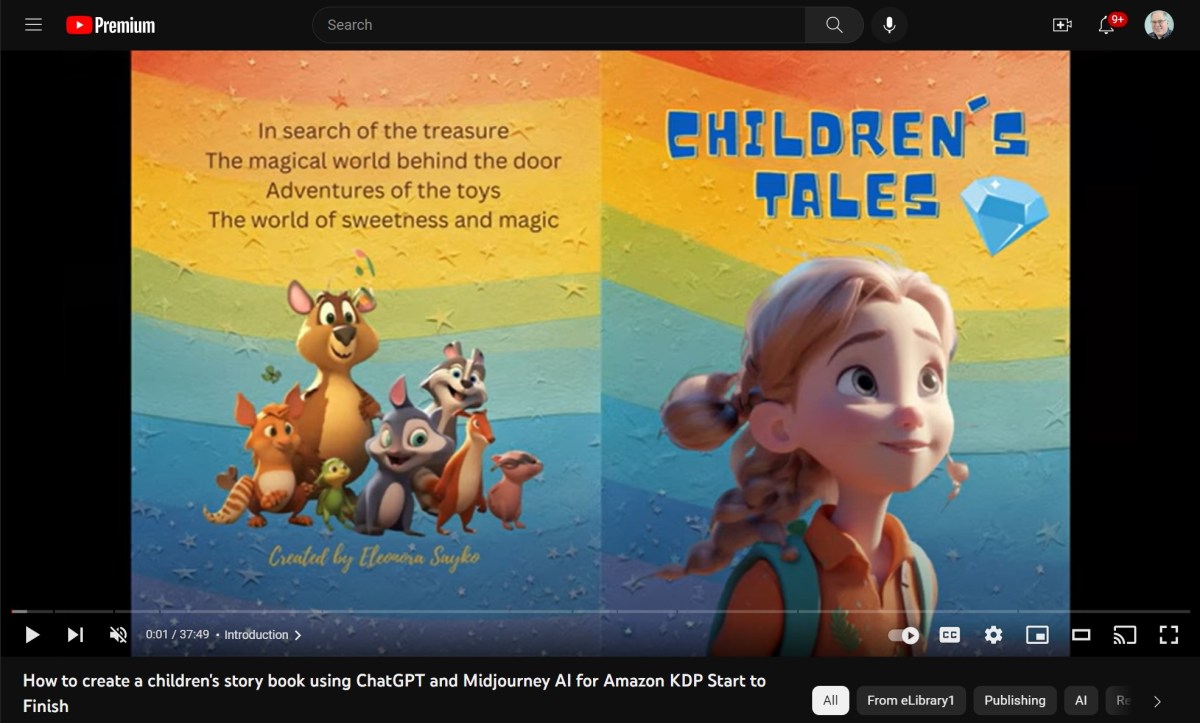
The first video I watched on YouTube this morning was “How to create a children’s storybook using ChatGPT and Midjourney AI for Amazon KDP Start to Finish.” eLibrary1 explains how she creates children’s books using AI tools.

It’s actually quite fascinating. She gets ChatGPT to suggest a series of ideas and then asks ChatGPT to write up 500-word versions of the ideas she likes. Then she tests those stories against an AI checker to show how they can be easily detected as AI-created. Then she runs the stories through another program that rewrites her stories. After that, she checks again and shows how the AI detector shows they are now human-written. Then she runs them through a plagiarizer detector to make sure they won’t be rejected for that reason. After she’s sure she’s got something good to work with she submits the stories scene by scene to Midjourney to have it create the artwork.

As I watched this video I thought about how so many people are concerned with seeing “Made in America” tags on the products they buy. I wondered if people in the future will look for “Made by Humans” or “Created by Humans” tags?

My initial reaction was I wouldn’t want to read a book that eLibrary1 created. I would feel cheated. I expect art and fiction to be produced by artists that suffered for their art. But then I thought, what if the story and pictures were better than what people produce? I’m already seeing artwork produced by AI that blows me away.

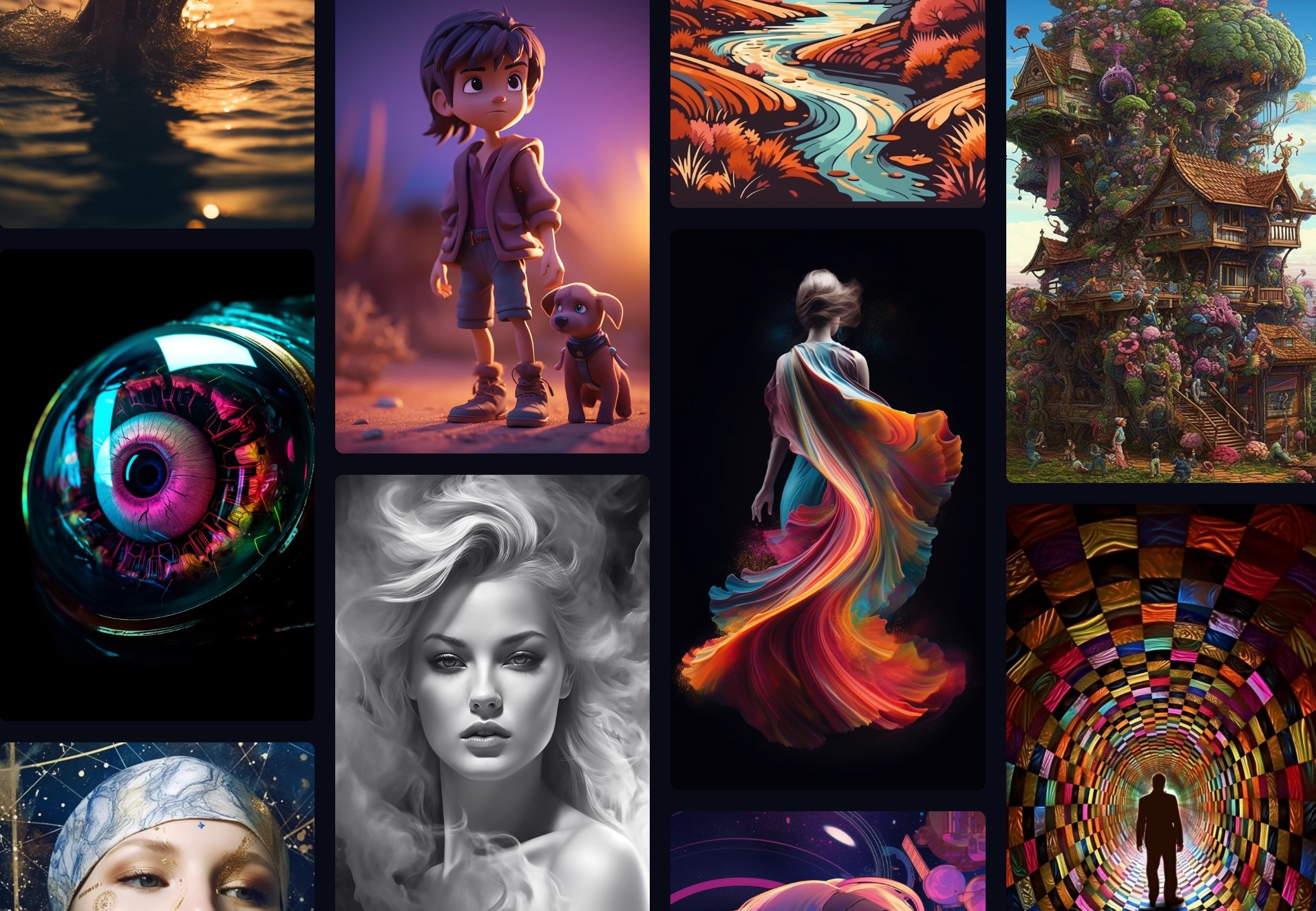
Just scroll down for a while in Midjourney’s Community Showcase.

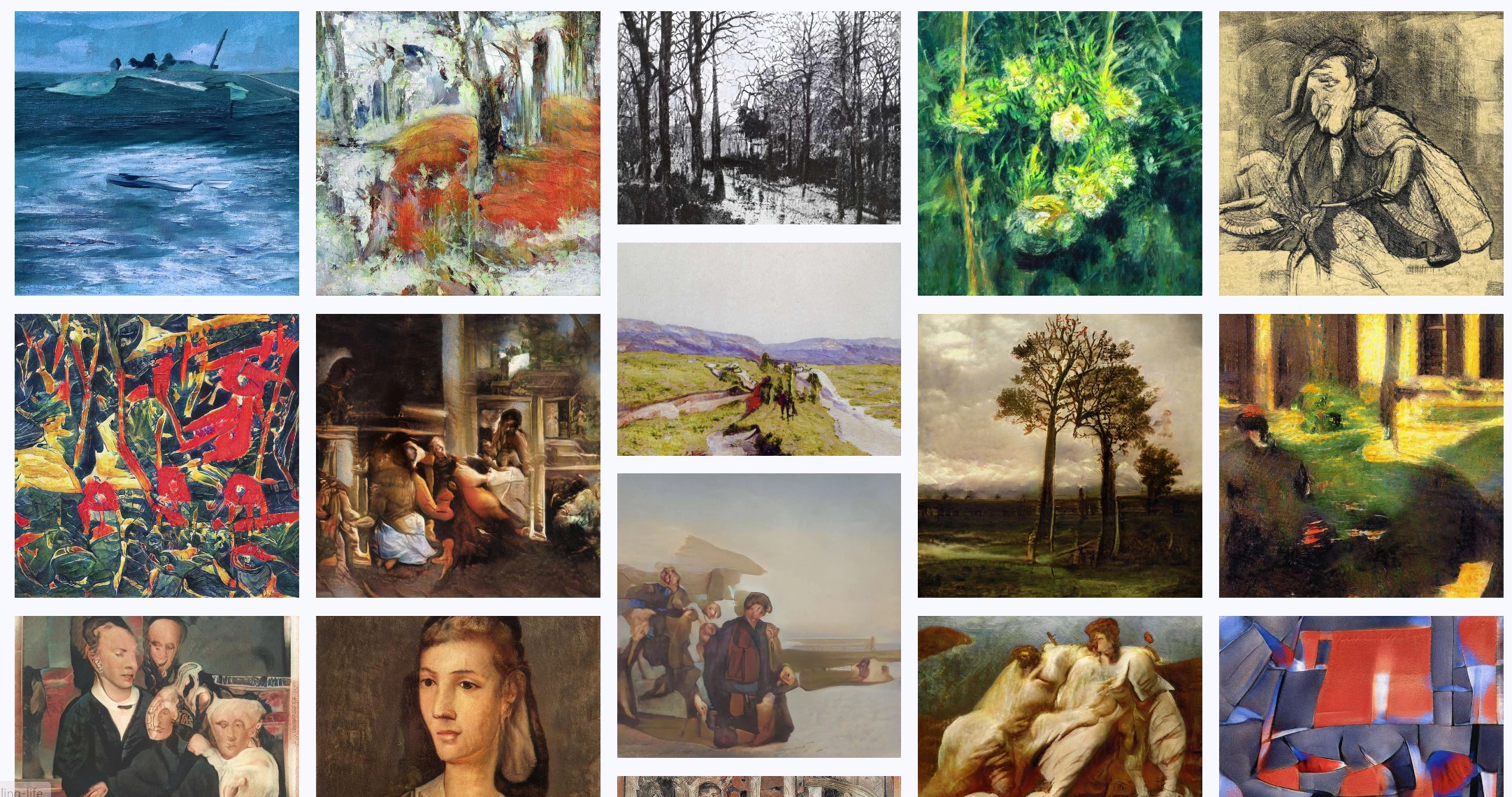
Or look at Latest Works at Art AI Gallery.

The range of what’s possible is tremendous. But then, it’s all been inspired by art created by humans. Is AI art actually creative work? Well, humans don’t create artwork out of nothing either. They have a lifetime of being inspired by other artists.

Let’s ignore this philosophical question for a moment. Let’s go back to the old idea of people “liking what they see” as a test of quality. I love visiting art galleries. I love looking at graphic art in magazines. I love looking at art books. I often buy books for their covers. And I have collected thousands of science fiction magazines, both in physical format and digital scans (but mostly digital). The reason I love them so much is because of their covers.

I’ve got to admit that AI-generated art presses the same exact buttons as art produced by humans. I have not read fiction written by AI writers, but what if I love their stories as much as I like AI art? To be honest, I believe I have a stronger psychological desire for fiction to be human-generated. What happens to that feeling if I read an AI-written novel that I like more than all my favorite human-written novels?

What I’m feeling right now is the desire to tune out the AI world. To retreat into the past, and savor the art and fiction created before the 21st century. That I want to become a modern Luddite that rejects AI machinery. But what will I be missing out on?

What if machines can take our imaginations further? Isn’t that why I’ve been a lifelong science fiction reader? Isn’t that why I took psychedelic drugs in the 1960s? Isn’t that why we admire the greatest of human thinkers?

Maybe I want to run away because I’m old and tired. One of the main enjoyments of getting old and putting up with the pains of aging is seeing how events unfold. So, why turn away now?

JWH

Are You in Future Shock Yet?

by James Wallace Harris, 3/24/23

Back in 1970, a nonfiction bestseller, Future Shock by Alvin Toffler, was widely talked about but it’s little remembered today. With atomic bombs in the 1940s, ICBMs, and computers in the 1950s, manned space flight and landing on the Moon in the 1960s, LSD, hippies, the Age of Aquarius, civil rights, gay rights, feminism, as well as a yearly unfolding of new technologies, it was easy to understand why Toffler suggested the pace of change could lead society into a collective state of shock.

But if we could time travel back to 1970 we could quote Al Jolson to Alvin, “You ain’t seen nothing yet.” Couldn’t we? Toffler never came close to imagining the years we’ve been living since 1970. And his book was forgotten, but I think his ideas are still valid.

Future shock finally hit me yesterday when I watched the video “‘Sparks of AGI’ – Bombshell GPT-4 Paper: Fully Read w/ 15 Revelations.”

I’ve been playing around with ChatGPT for weeks, and I knew GPT 4 was coming, but I was surprised as hell when it hit so soon. Over the past few weeks, people have been writing and reporting about using ChatGPT and the general consensus was it was impressive but because it made so many mistakes we shouldn’t get too worried. GPT 4 makes far fewer mistakes. Far fewer. But it’s fixing them fast.

Watch the video! Read the report. I’ve been waiting years for general artificial intelligence, and this isn’t it. But it’s so damn close that it doesn’t matter. Starting back in the 1950s when computer scientists first started talking about AI, they kept trying to set the bar that would prove a computer could be called intelligent. An early example was playing chess. But when a computer was built to perform one of these measures and passed, computer scientists would say that test really wasn’t a true measure of intelligence and we should try X instead. Well, we’re running out of things to equate with human-level intelligence.

Most people have expected a human-level intelligent computer would be sentient. I think GPT 4 shows that’s not true. I’m not sure anymore if any feat of human intelligence needs to be tied to sentience. All the fantastic skills we admire about our species are turning out to be skills a computer can perform.

We thought we’d trump computers with our mental skills, but it might be our physical skills that are harder to give machines. Like I said, watch the video. Computers can now write books, compose music, do mathematics, paint pictures, create movies, analyze medical mysteries, understand legal issues, ponder ethics, etc. Right now AI computers configured as robots have difficulty playing basketball, knitting, changing a diaper, and things like that. But that could change just as fast as things have been changing with cognitive creativity.

I believe most people imagined a world of intelligent machines being robots that look like us — like those we see in the movies. Well, the future never unfolds like we imagine. GPT and its kind are invisible to us, but we can easily interact with them. I don’t think science or science fiction imagined how easily that interaction would be, or how quickly it would be rolled out. Because it’s here now.

I don’t think we ever imagined how distributed AI would become. Almost anything you can think of doing, you can aid your efforts right now by getting advice and help from a GPT-type AI. Sure, there are still problems, but watch the video. There are far fewer problems than last week, and who knows how many fewer there will be next week.

Future shock is all about adapting to change. If you can’t handle the change, you’re suffering from future shock. And that’s the thing about the 1970 Toffler book. Most of us kept adapting to change no matter how fast it came. But AI is going to bring about a big change. Much bigger than the internet or computers or even the industrial revolution.

You can easily tell the difference between the people who will handle this change and those who can’t. Those that do are already using AI. They embraced it immediately. We’ve been embracing pieces of AI for years. A spelling and grammar checker is a form of AI. But this new stuff is a quantum leap over everything that’s come before. Put it to use or get left behind.

Do you know about cargo cults? Whenever an advanced society met a primitive society it doesn’t go well for primitive societies. The old cultural divide was between the educated and the uneducated. Expect new divisions. And remember Clarke’s Third Law: “Any sufficiently advanced technology is indistinguishable from magic.” For many people, AI will be magic.

Right now AI can help scholars write books. Soon AI will be able to write better scholarly books than scholars. Will that mean academics giving up writing papers and books? I don’t think so. AIs, as of now, have no desires. Humans will guide them. In the near future, humans will ride jockey on AI horses.

A couple weeks ago Clarkesworld Magazine, a science fiction magazine, shut down submissions because they were being flooded with Chat-GPT-developed stories. The problem was the level of submissions was overwhelming them, but the initial shock I think for most people would be the stories would be crap. That the submitted science fiction wouldn’t be creative in a human sense. That those AI-written stories would be a cheat. But what if humans using GPT start producing science fiction stories that are better than stories only written by humans?

Are you starting to get why I’m asking you if you feel future shock yet? Be sure and watch the video.

Finally, isn’t AI just another example of human intelligence? Maybe when AIs create artificial AIs, we can call them intelligent.

JWH