Bomber by Len Deighton

by James Wallace Harris, 9/5/23

I thought Bomber, a 1970 novel by Len Deighton to be an exceptional work about WWII. But saying so will not convince you to read it. How can I describe it best to help you decide? First, if you love books and movies about bomber missions during WWII then you don’t need to read this essay but just go buy the book (if you haven’t already read it). If you love Catch-22 by Joseph Heller and Slaughterhouse Five by Kurt Vonnegut, then you’ll probably want to read Bomber. If you love well-researched historical novels particularly about WWII, or well-written novels in general, then you should keep reading this essay.

Grove Press released a new edition of Bomber on 8/22/23 with an introduction by Malcolm Gladwell. Bomber has been reprinted many times over the last 53 years which says a lot about a book. I listened to the 21 hours and 25 minutes audiobook edition narrated pitch-perfectly by Richard Burnip which includes an afterward narrated by Len Deighton. I loved how Burnip did accents for different characters.

Bomber is about one fictional day, June 31, 1943, that that is so realistic that you keep thinking it’s based on true events. It’s not, but it’s so well-researched and detailed that it could compete with history. Deighton creates over a hundred characters including several Avro Lancaster bomber crews, their German interceptors and controllers, the ground crews and command in England, and the citizens of an imaginary German town that gets bombed to hell by a flying armada of over seven-hundred planes.

Two of my favorite movies growing up were Twelve O’Clock High (1949) and The War Lover (1962), along with the Quinn Martin TV show 12 O’Clock High (1964-1967). And I’ve read nonfiction books and novels about the Blitz and B-17 campaigns over Germany. Bomber gave me a much better sense of what it was like to be in a bombing raid, both in the air and on the ground. Of course, no fiction or nonfiction book could convey the actual experience and horror but this one gave me far more details to consider. It was multiplex and multidimensional.

But Bomber reminds me most of all of Catch-22 (1961) and Slaughterhouse Five (1969), two classic anti-war novels from the 1960s. Those two novels had comic aspects, and Bomber does not. However, all three novels depict the horror of war on innocent individuals. Wars are born out of the egomania of a few, who inflame the passions of true believers who then force millions of helpless bystanders into their deadly squabbles. These books are about ordinary people who want to live ordinary lives but are forced to play parts in the conflicts created by these evil egos.

In the afterward of the new edition Len Deighton talks about how he produced the idea for Bomber. He was studying WWII and thought one way of looking at the war was to visualize it as our machines against their machines. He said he liked machines, but to tell the story he had to talk about the people behind the machines. He didn’t want it to be science fiction. (By the way, he talked about using an IBM MT word processing machine, one of the earliest dedicated word processors, and said he thought Bomber might be the first novel to be written with word processing. I worked three years on an IBM MT/ST machine.)

In Malcolm Gladwell’s introduction to the book, he suggests that Bomber is about the evil and guilt the British felt specifically targeting German citizens during their nighttime bombing raids. Here’s what Gladwell said in a version of the intro at The Washington Post:

“We British are not an imaginative people,” the activist Vera Brittain wrote, in the opening sentence of her 1944 book “Seed of Chaos.” “Throughout our history wrongs have been committed, or evils gone too long unremedied, simply because we did not perceive the real meaning of the suffering which we had caused or failed to mitigate.”

Brittain was referring to the decision during the Second World War by Arthur Harris, head of the Royal Air Force’s Bomber Command, to send hundreds of planes, night after night, to bomb the residential neighborhoods of German cities. Harris was resolutely unsentimental about his decision. He once wrote that it “should be unambiguously stated” that the RAF’s goal was “the destruction of German cities, the killing of German workers, and the disruption of civilized life throughout Germany … the destruction of houses, public utilities, transport and lives, the creation of a refugee problem on an unprecedented scale.” His nickname was “Butcher” Harris, a sobriquet employed with a certain grudging respect, on the understanding that butchers can be useful in times of war. Harris was a psychopath. Twenty-five thousand people in Cologne once burned to death, in one night, on his orders. And Vera Brittain’s point was that the people of England acquiesced to his decision because they did not have the imagination to appreciate what those deadly bombing campaigns meant to those on the ground.

I didn’t get that reading Bomber. It’s there if you read between the lines, but Deighton doesn’t preach or philosophize in the novel. Bomber is a perfect example of show don’t tell writing. Nor does Deighton make his characters into heroes or anti-heroes.

Even though Bomber is told through a couple dozen main characters, with several dozen walk-on parts, the story focuses on Sam Lambert who is a Flight Sargeant and Captain of the Creaking Door, an Avro Lancaster, a 4-engine British bomber. Lambert is the Yossarian or Billy Pilgrim of this story. Lambert isn’t always on center stage though because Deighton considered it especially important to tell the story of the people he bombs, the people who try to kill him, as well as the other airmen who fly with Lambert, both in the Creaking Door and other planes.

I was particularly taken by this Solzhenitsyn quote “to do evil a human being must first of all believe that what he’s doing is good” taken from this review (which I recommend reading). Deighton doesn’t preach or sermonize in Bomber, but there is much to meditate on in his story. In recent years I’ve been reading more history books, and history is really one long succession of wars. My take is evil is caused by a few individuals who need to feed their monstrous egos, as well as the people who worship and follow those psychopathic egos.

There is one scene in Bomber that was very minor but very telling where a commanding officer tried to coerce Ruth into getting her husband, Sam Lambert, to play on the company’s cricket team. It showed how that officer’s ego manipulated reality for doing what he thought was good. If you read Bomber, notice how often that happens.

JWH

Do You Remember the Childhood of Famous Americans Series of Biographies Written for Children?

by James Wallace Harris, 6/12/23

Over the years, my friend Linda and I have nostalgically recalled a series of books we both read in elementary school. They were biographies aimed at kids, but that’s all we could remember. We both wondered why we never saw them in used bookstores, or libraries, or met other people who fondly recalled them?

These books came up again on Sunday, and I did a Google search and discovered they were books published by Bobbs-Merrill starting in the 1930s. The series was called Childhood of Famous Americans. Linda and I remembered them being blue, but in my search, I found many people remember them as the “orange books.”

Well, this site solved that mystery, claiming there were 220 in the series, and showed photos of how they looked different over the decades. Some of them were orange and others were blue. They also had uniform dust jackets with numbers. Those numbers appealed to me. They made me want to read them all. However, I doubt I read more than 10-12 of them. Linda claims to have read far more, but then she was a much bigger bookworm in elementary school than I was. Linda and I both remember the yellow decoration about the blue book below.

Evidently, this series was intended to provide patriotic reading for young readers. I was already a patriotic little kid when I discovered them. My father was in the Air Force, and we were living on Homestead Air Force Base, and I discovered them in 1962 in the Air Base Elementary. I was in the 5th grade. My teacher was Mr. Granger. He was a WWII vet, who had been in a Japanese prisoner-of-war camp. Mr. Granger had lost a leg in the war and had a wooden one which the class found fascinating. Sometimes Mr. Granger would step on our feet not knowing it, and we all would never let him know. Mr. Granger told the class lots of interesting stories. It would have been interesting to have a biography of Mr. Granger.

I became a bookworm that year. Linda says she became a bookworm in the first grade, but I didn’t discover books until summer school between the third and fourth grades. I was sent there because they thought I couldn’t read. On the first day, the teacher said to pick out a book from a twirling wire rack and I found a kid’s version of Up Periscope. It turns out I could read. They just had never given me anything worth reading before.

In the fourth grade, I slowly started getting into books. I liked nonfiction books about war, planes, dogs, and nature. We moved to Homestead for the 5th grade and I had access to two libraries: the base library and the school library. I loved Homestead Air Force Base Library, and have written about it before. It was while I regularly used these two libraries that I became a bookworm.

The Childhood of Famous Americans was the first book series I got hooked on. They may have caused my lifelong love of biographies, or my biography-loving genes first discovered biographies there.

I remember reading bios of Ben Franklin, John F. Kennedy, Jim Thorpe, George Washington Carver, and I think Betsy Ross that are in the series. I’m pretty sure I read several others but don’t recall specific memories. I also remember reading a biography of Blackjack Pershing then but he doesn’t seem to be in the series, so maybe there were other biography series for kids.

This page at LibraryThing lists 208 books in the series, with links about them, and gives the totals for people owning them in their collection. Few people owned them, but some titles have huge numbers of likes. That suggests there are plenty of people like me and Linda who remember them.

The series ran for a long time, and have been reprinted in paperback, and inspired other series. Some publishers have even tried to restart the series.

I can’t remember any exact details from the books, but reading about them while researching this piece, it seems they were a mixture of fiction and nonfiction. Some writers have called them problematic for both conservatives and liberals. All this book banning is making people overly sensitive about books.

I’ll keep an eye out for Childhood of Famous Americans books at the library bookstore and see if I can find some to read. I wonder if I can document any instances of them that were the seeds of my current philosophy?

Did you read any of the Childhood of Famous Americans books? Leave a memory in the comments.

JWH

Developing a Healthy News Diet

by James Wallace Harris, 5/21/23

Michael Pollan created a small book about eating healthy called Food Rules. As an analogy, I’d like to create a set of sensible rules about consuming the news. Pollan distilled his list of rules down to three simple sentences, “Eat food. Not too much. Mostly plants,” but it really takes reading his book to understand that mantra.

What I would like to do is develop a similar simple mantra about my daily news consumption but I’ll have to work out the details first. Pollan emphasized eating whole foods rather than processed foods. Is there such a thing as whole unprocessed news? “Not too much” is an obvious target since we obviously consume too much news. Finding an analogy for “mostly plants” will be interesting.

What would be the equivalent of nutritious news? Experience has taught me that some news is unhealthy, and I often get news indigestion. I also admit I’m bloated and overweight from too much news consumption.

Like whole food and junk food, we prefer junk news over whole news. I spend several hours a day nibbling on news from many sources. Most of which is forgotten immediately. I wonder if my first rule should be:

#1 – Ignore easily forgettable news

We’re used to clicking on anything that catches our fancy while idling away moments on our smartphones. Essentially, this kind of news is gossip and titillation. Basically, we’re bored or restless. We should use that time in better ways, especially if it exercises our minds. Read real news instead. Or, do something active. Playing games, listening to music, or audiobooks, is more nutritious than never-ending bites of clickbait.

Everyone bitches about information overload but who does anything about it? I’ve learned from intermittent fasting that my body appreciates having a good rest each day from eating. I believe I need to apply the same idea to news consumption.

#2 – Limit your hours consuming the news

I find 16:8 fasting works well for eating. I’m thinking of a 22:2 fast for news is what I’m going to aim for at the moment. Two hours of news consumption a day might sound like a lot, but if you add up all the forms of news I consume including television, magazines, online newspapers, YouTube, and news feeds, RSS feeds, I can easily go beyond two hours.

We should also separate news from learning and entertainment. Learning something new could be considered a form of news. I’m not going to count educational pursuits in my news time. And if you enjoy reading nonfiction books or watching documentaries on TV, that shouldn’t count as news either. However, shows like 60 Minutes, CBS Sunday Morning, and The Today Show can be considered informative entertainment news. Some people just prefer news shows for fun rather than watching fictional shows. I’m not sure if they should count or not.

What we really want is to stay informed about the world so that we interact with reality wisely. Humans have an extremely difficult time processing information. We think we’re far smarter than we are. We constantly delude ourselves. And we think our opinions matter when 99.999% of the time they don’t. Most people think they are experts on countless topics after having consumed just a few hours of news. They think they know better than real experts who have put tens of thousands of hours into studying their specialty.

#3 – Stop assuming you know anything

I believe the real key to understanding the news is being able to tell the difference between opinion and significant data. The real goal of news consumption should be finding the best data, and that means getting into statistics.

Unfortunately, the news industry is overwhelmed with talking heads. Everyone wants to be an expert, and all too often most news consumers tend to latch onto self-appointed experts they like. News has become more like a virus than information processing.

I read and watch a lot of columnists and programs about computers, stereo equipment, and other gadgets. Most are based on personal impressions of equipment individuals have bought or been loaned from manufacturers. These tech gurus are a good analogy for what I’m talking about. Most of the news we take in daily is from individuals processing limited amounts of information and giving us their opinion. What we really want is Consumer Reports, Rtings, or the Wirecutter, where large amounts of data are gathered from a variety of sources, and statistically analyzed.

This is just a start on designing my news diet. I want to keep current on a long list of topics, but that’s like learning about all the vitamins and nutrients my body needs. News nutrition will be a vastly more complicated topic. What are the essential vitamins I need every day? Is it politics, national and international affairs, economics, crime, immigration, ecology, etc?

Do I need to know about everything? Is that what an informed citizen needs to do? Take immigration. Is anything I think about immigration affects the situation at the border? Does voting liberal or conservative even affect anything at the border? I can barely maintain order in my house, why should I believe I can organize all of reality on Earth? Maybe my last two rules should be:

#4 – Know my limitations

#5 – Pursue the news I can actually use

Like nutrition, news is a complicated subject that’s hard to understand and can easily confuse.

JWH

What I Learned Cataloging My Books, Ebooks, and Audiobooks on Goodreads

by James Wallace Harris, 3/21/23

I learned several things this week while entering over fifteen hundred books into my Goodreads database. The books I added were mainly acquired since I retired in 2013. One insight that impressed me the most was I was specializing in a limited number of topics. On one hand, I was disappointed by my narrow range of interests, but on the other hand, I was annoyed at myself for being scattered in my intellectual pursuits. You can’t get good at something if you try to get good at too many things.

If I judged my reading as a leisure activity it wouldn’t matter what I read. However, if I judged my reading as an education, then I was majoring in too many subjects. But here’s the kicker to this revelation. Before I started cataloging my books I assumed I was reading for fun and randomly exploring any subject that caught my fancy. It was only as I entered all the titles into the database did I realize that I have been specializing in several areas. And my immediate impulse was to read deeper into those topics and to go out and buy more books on those subjects.

Why was I chasing so many subjects when I’ve always wanted to be a master of one? Why would I want to do that? Yet, focusing on one would mean ignoring many things I want to know more about. That thought has started me to do a lot of naval gazing this week.

My original goal was to put all my books into my Goodreads database so I’ll know what I own to keep from buying duplicates when I’m at the used bookstore. So far I’ve found a shopping bag of duplicates which I gave to my buddy Mike. I entered all my books into Goodreads many years ago but didn’t update the database when I bought books or gave them away, so my Goodreads database was badly out of date. I had been putting this task off for years because I couldn’t figure out which books to add or delete from the system to catch up again.

My solution was to create a “shelf” called “2023 inventory” and reenter all my books linking them to that shelf. Then delete all the books in the system that wasn’t in the 2023 inventory.

After entering 1,506 books, which were all the physical books in the house, I had 3,159 total books in the database. That implied I could have given away 1,653 books, but then I realized that some of those might be Kindle or Audible books I own. Now I must go down the list of 3,159 books, and if they aren’t in the 2023 inventory, see if they are in my Kindle or Audible libraries. If they aren’t, I can delete them.

Doing all this librarian work has been rewarding in several ways. The work is revealing how my reading has shifted away from physical books to ebooks and audiobooks. This process has also revealed other insights about myself. For certain titles, and subjects I tend to buy both the audiobook and the ebook edition because that’s how I like to study them. And for some titles, I have the ebook, audiobook, and physical book. If I really like the book and subject, or if it’s fiction, and I really enjoy the story, I like getting into the book through all three formats.

I can spot my favorite authors because with some writers I’ve collected their books in all three formats. That also reflects a consolidation of interests, focus, and specialization.

When I used to go to parties I noticed that people tend to talk about things they loved most. The most interesting people were the ones who could expound deeply on a subject. Like most people, I just chatted about what little I knew about a zillion subjects.

I eventually observed that some people like to specialize and that some people even feel they are experts on their favorite subjects. It’s even fun to see two fans of the same subject argue over who knows more. I see from my data entry the subjects I’ve unintentionally tried to master. What’s funny is I seldom meet people interested in the subjects I’m interested in. Which is why I seldom talked much at parties. (This blog is my way of nattering about what I like.)

Thinking about people who know a lot about a little has led me to ask why I’d want to specialize in certain topics anyway? It’s not like I’m at a university trying to pass courses and get a major. I never go to parties anymore. I think it’s like my urge to catalog my books, which is a kind of anal pursuit, I also want to organize what I know.

There is a certain satisfaction in getting the biggest picture on the tiniest of topics. There is also satisfaction in collecting everything of a certain type. For example, I like westerns, so I collected my favorite western movies on DVDs. Then I started buying books about movie westerns. But after that, I started buying books about the history of the American West. I’ve done the same thing for classic rock and jazz music. While cataloging my books I realize I was gathering novels written in England between the wars, and books about their authors. That interest is also reflected in the TV shows I’m watching. Susan and I have recently watched all of Downton Abbey, Upstairs, Downstairs, and we’re currently going through the seven seasons of the first television version of All Creatures Great and Small.

The upshot of all these cataloging revelations is I want to focus more on my best subjects. And abandon some lesser interests to put more time into my majors. After I finish this project I could write my tombstone epitaph – “Here lies Jim Harris, this is what he liked to read:” I mean, isn’t what we focus on one of the best descriptions of our personality?

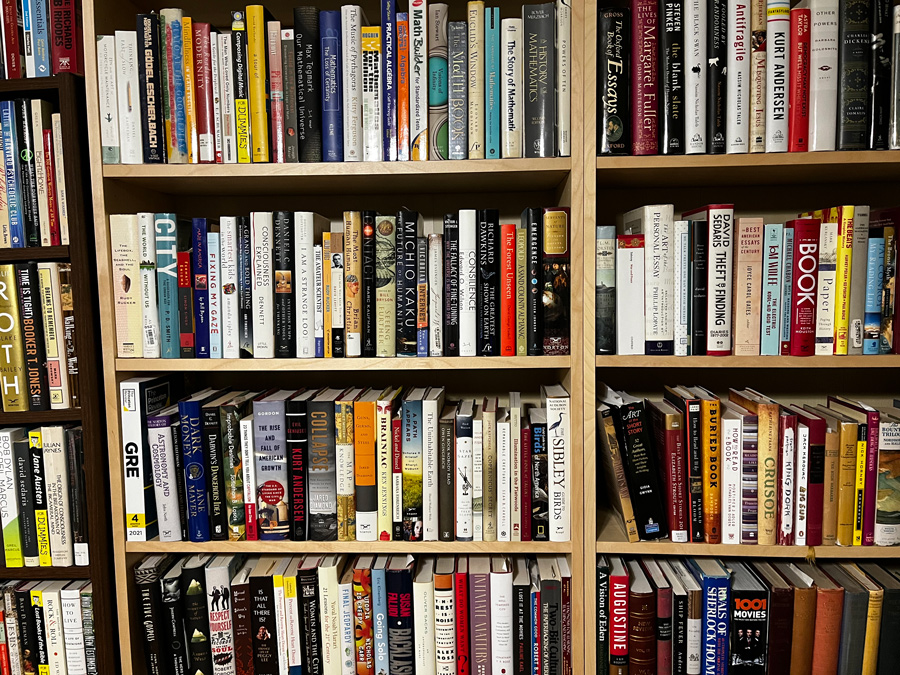
I only have nine bookcases. And they are all full. I don’t want to buy more bookcases. Nine’s my limit. I feel that’s also an analogy for my brain. It can only hold so much, so if I want to get better at one subject I have to forget about another.

If I want to buy more books I have to get rid of existing books to make room for the new ones on the shelves. This tends to distill my collection even further into specialized subjects. It also means I cull crappy books for better books.

But there is something else to consider. I’m getting older. I’m running out of time. My mental abilities are declining, which limits how much information I can process. And my physical abilities are declining, which also influences my book collecting. I can imagine a future where I can only handle six bookcases, or even three, and maybe down to just one.

I put every book I own onto a Rubbermaid rolling cart one shelf at a time to take them to my computer to enter their data. That physically wore me out. I’m thinking of getting rid of the heavy coffee table books in my collection just because in the near future I won’t be able to handle their weight. And there’s another reason I need to start shrinking my collection. If I should die I don’t want to burden my wife with having to get rid of a couple of tons of books. And if I ever need to move to a retirement apartment or assisted living I wouldn’t want to deal with all of them either.

This week of cataloging my books has reminded me of which subjects I’ve studied over the last forty years, which subjects are my favorite topics, and that I want to thin out my collection.

Currently, Goodreads says I have a total of 3,150 books but I haven’t finished entering all my Kindle and Audible books. Amazon says I have 1,608 Kindle books and 1,544 Audible titles, however, many are already in Goodreads. I’ve just got to figure out which ones aren’t. Luckily, Kindle and Audible books don’t weigh much, or take up much space.

I’ve always wanted to make a list of everything I own because I assume it would tell me a lot about myself. This Goodreads list is a good start toward that.

JWH

I Wish I Had Been A Librarian

by James Wallace Harris, 12/8/22

I almost became a librarian. This was a long time ago. What kept me from that career was having to move to another city to get an MLS degree. Susan and I had been married for a few years, and we didn’t want to move. I worked in the Periodicals Department at Memphis State University (now the University of Memphis). I was a Periodicals clerk, which was an hourly position. I was working on my English degree and taking some undergraduate courses in library science in a program designed to produce librarians for K-12 schools. I didn’t want to work in a school, but at a university, and most universities require a Master’s of Library Science. In fact, my university required an MLS to get the job, but a second master’s in a useful subject to aid in working in a library to keep the job. This was also true of the public library at the time. And even with two master’s degrees, the pay would never be much, but I’d work in the environment I loved best.

Instead, I took a job at the College of Education setting up their network and creating a student database system to track student teaching experience. I worked there for the rest of my life, but I’ve always wished I had gotten that MLS degree and spent my 9-to-5 life in a library. When I was young I worked at the Memphis Public Library for a few months, and later at the university library for six years. I love periodicals. And I love how magazines have become available on the internet as digital scans. I have quite a collection of them. I believe my compulsive acquisition of books and magazines is caused by a gene for librarianship.

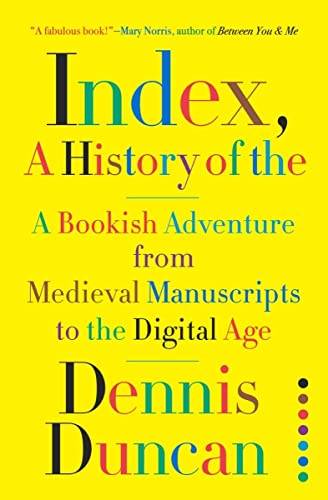
Reading Index, A History of the: A Bookish Adventure From Medieval Manuscripts to the Digital Age by Dennis Duncan has brought back my desire to work in a library. I’m not sure I can recommend this book to everyone, but if you love books and libraries it might be for you. Its subject is somewhat esoteric. Did you know that the idea of alphabetizing had to be invented? That made me wonder who came up with the idea that letters of the alphabet should have an order? Duncan didn’t cover that.

Books haven’t always been like the books we read today. When books were scrolls they didn’t have covers or even titles. A book might be written over several scrolls of paper, so if you had a bunch of scrolls, finding the one you wanted, and the part you wanted to read, could be very difficult. So early librarians started tying the scrolls together and putting them in bins. Then they learned to glue little tags of paper to the end of scrolls to identify what was in the scroll. That’s the beginning of the index. As I said, this book won’t be for everyone, but if you have the library gene it might.

What most people think of as an index, that section of the book at the back with a list of keywords and page numbers wasn’t invented right away either. When books began to be printed people got the idea of helping people find specific places in them, and the index as we know it was born. At first, the index was published separately. Then when they started being published with the book they were put in the front. It took centuries before they standardized on placing the index in the back of the book.

David Duncan’s book is mostly an amusing look at all this. He was especially delighted by discovering what I call index wars. For example, Richard Bently satirized a 1695 book by Charles Boyle by publishing an index that ridiculed Boyle’s book by how he indexed the keywords. This led to all kinds of indexing shenanigans including dirty politics. Duncan found quite of bit of indexing history in the line, “Let no damned Tory index my History!” by Whig historian Laurence Echard whose three-volume History of England was indexed by Tory sympathizer John Oldmixon.

Another bit of off-the-road history Duncan discovered was that very scholarly accused the lesser scholarly that their poor thoughts were due to reading just the index rather than the whole book when composing their writing. That’s because indexers use to put more information into their indexes.

Duncan shows many photographs of the fine art of indexing satire but it’s hard to read them because they were being written at a time before standardized spelling. Luckily he translates historical English into modern English. And the historical humor has become very dry. You’ve got to enjoy a good three-hundred-year-old in-joke to really appreciate this book, but Duncan is good at explaining them. Sometimes the humor was as crude as the silliest of Saturday Night Live skits.

Duncan eventually works his history through the centuries up until the age of Google and online indexes. This is where I wished I had worked, using computers to organize information, periodicals, and libraries. In a way, our website Classics of Science Fiction is a kind of index. We index the popularity of science fiction short stories and novels. I’m all the time thinking of things I’d like to put into databases that deal with books and magazines. Reading Duncan’s book showed me there have been bookworms with the same kind of bibliographic urges for thousands of years.

But Index, A History of the also inspired two very specific librarian-type desires. The first was triggered by Duncan’s coverage of The Spectator, a very influential publication.

Many of the journals of the eighteenth century fall into this intermediary zone, and none more so than the Spectator. Founded in 1711 – and no direct relation of modern magazine of the same name – the Spectator was a cheap, daily, single-sheet paper that featured brief essays on literature, philosophy or whatever took its writers’ fancies. Its editors were Richard Steele and Joseph Addison (whom we met in the last chapter having his Italian travelogue mauled by ironic indexers), and, although it ran only for a couple of years, it was immensely popular. The Spectator started off in a print run of 555 copies; by its tenth issue, this had ballooned to 3,000. This, however, was only a fraction of the true readership. The editors claimed that there were twenty readers to every copy, and deemed that even this was a ‘modest Computation’. The Spectator was a paper designed for the emerging public sphere, a conversation piece to be read at ‘Clubs and Assemblies, at Tea-tables, and in Coffee-Houses’.2 A paper to be read and passed on. 

What’s more, the Spectator was only the best known in a long list of similar sheets. The Tatler, the Free-Thinker, the Examiner, the Guardian, the Plain Dealer, the Flying Post – papers like these were able to capitalize on a perfect storm of rising literacy rates, the emergence of coffee-house culture, the relaxation of formerly strict printing laws, and a growing middle-class with enough leisure time to read. The eighteenth century was gearing up to be what scholars now call the age of print saturation.3 That term saturation has some interesting suggestions. Certainly, it implies excess – too much to read – but also something else: too much to keep hold of, a new disposability of printed matter. Our poor, abused quire of paper was born at the wrong time. Flicking through original copies of the Spectator preserved in the British Library, one certainly sees the signs of coffee-house use. You won’t find stains like this in a Gutenberg Bible. And yet the essays are among the finest in English: wryly elegant, impeccably learned. If you had bought the paper for self-improvement you might well want to come back to it. 

And so it was that the news-sheets found themselves being republished, almost immediately, in book form. These editions, appearing within months of their broadsheet originals, anticipated how the kind of reader who would want the full run of the Spectator would want to use it: not simply as a single sheet – a single thought – for a few minutes’ entertainment with one’s coffee, but as an archive of ideas that one might return to. Benjamin Franklin, for example, describes coming across a collected edition of the Spectator as a boy and reading it ‘over and over’, jotting down notes from it and trying to imitate its style in his own writing.4 The movement from coffee-table to bookshelf implies a different mode of reading, one of reference, reuse, of finding the thought, the phrase, the image, and bringing it into the light again. If the Spectator was to be a book it would need an index. 

The indexes to the early volumes of the Spectator, along with those of its older sister the Tatler, are a joy in themselves, full of the same ranging, generous wit as the essays they serve. Rifling through them, a century later, Leigh Hunt would compare them to ‘jolly fellows bringing burgundy out of a cellar’, giving us ‘a taste of the quintessence of [the papers’] humour’.5 Who, indeed, would not want to sample more after reading a tantalizing entry like ‘Gigglers in Church, reproved, 158’ or ‘Grinning: A Grinning Prize, 137’ or ‘Wine, not proper to be drunk by everyone that can swallow, 140’. The Tatler, meanwhile, offers us ‘Evergreen, Anthony, his collection of fig-leaves for the ladies, 100’, or ‘Love of enemies, not constitutional, 20’, or ‘Machines, modern free thinkers are such, 130’. Elsewhere, two entries run on together, oblivious to the strictures of alphabetical order: 

     Dull Fellows, who, 43 
     Naturally turn their Heads to Politics or Poetry, ibid. 

There is something at once both useless and compelling about these indexes. Is ‘Dull Fellows’, listed under the ds, really a helpful headword? Of course not. But it catches our attention, makes us want to find out more. This is as much about performance as about quick reference. Each entry is a little advertisement for the essay it points to, a sample of the wit we will find there. The Tatler and Spectator indexes belong to the same moment as the satirical indexes we saw in the last chapter, but unlike William King’s work there is nothing cruel or pointed about them. Instead, they are zany, absurd, light. ‘Let anyone read [them],’ declares Leigh Hunt, ‘and then call an index a dry thing if he can.’ The index has made itself at home in the journals of the early eighteenth century, adapting to suit their manners, their tone. Moreover, it signals the elevation of these essays produced at a gallop for the daily coffee-house sheet to something more durable, to a format that connotes value, perhaps even status. At the midpoint of the second decade of the eighteenth century, the index is primed to offer the same sheen to other genres, to epic poetry, to drama, to the emerging form of the novel. And yet, we know how this story ends. In the twenty-first century novels do not have indexes. Nor do plays. Poetry books are indexed by first line, not by subject. Why, then, was the index to fiction a short-lived phenomenon? Why did it not take? To shed some light on this question, let us turn briefly to two literary figures from the late nineteenth century, both still indexing novels long after the embers had died down on that particular experiment. What can these latecomers tell us about the problems of indexing when it comes to works of the imagination?

Duncan, Dennis. Index, A History of the: A Bookish Adventure from Medieval Manuscripts to the Digital Age (pp. 173-177). W. W. Norton & Company. Kindle Edition. 

Reading about The Spectator makes me wish I was sitting in a library compiling information from old magazines. Of course, this is partially what Duncan has done by writing his book. By the way, The Spectator can be read online at Project Gutenberg.

Another example of how Index, A History of inspires my bookish ways is when Duncan wrote about Sherlock Holmes, and how Holmes built a massive index to help him be a detective. Did Doyle/Holmes know about the zettlekasten method? Just reading this bit of Sherlock Holmes history makes me want to do an annotation of a Sherlock Holmes story to find all the hidden clues — not to solve the crime, but to see how Arthur Conan Doyle created his characters and stories. I don’t remember ever getting excited about Holmes keeping an index when I read some of the Sherlock Holmes short stories. I need to go reread them.

Some people define themselves by exotic travel, others by the gourmet meals they consume, but I find purpose in connecting words in books to words in other books. Just note the interesting details quoted from the story and what Duncan made of them.

‘Kindly look her up in my index, Doctor,’ murmured Holmes, without opening his eyes. For many years he had adopted a system of docketing all paragraphs concerning men and things, so that it was difficult to name a subject or a person on which he could not at once furnish information. In this case I found her biography sandwiched between that of a Hebrew Rabbi and a staff commander who had written a monograph upon the deep sea fishes. 

The year is 1891, the story ‘A Scandal in Bohemia’, and the person Holmes is searching for, sandwiched between the rabbi and the amateur marine biologist, is Irene Adler, opera singer, adventuress and lover of the man now standing in Holmes’ drawing room, one Wilhelm Gottsreich Sigismond von Ormstein, Grand Duke of Cassel-Felstein and hereditary King of Bohemia. The tale will find Holmes outsmarted and chastened by Adler. ‘Beaten by a woman’s wit,’ as Watson puts it. It begins, however, with Holmes coolly in control, seated in his armchair and not deigning to open his eyes, not even for a grand duke. 

It is probably no surprise that Sherlock Holmes should be an indexer. His schtick, after all, his superpower, is his encyclopedic learning, the world’s arcana: a human Google, or a walking Notes and Queries. But that would be preposterous. Besides, from the very first adventure, A Study in Scarlet, we have been informed that, in Watson’s appraisal, Holmes’ general knowledge is severely limited: ‘Knowledge of literature – nil; Philosophy – nil; Astronomy – nil; Politics – feeble . . .’ So occasionally Conan Doyle offers us a glimpse behind the curtain, a look at the system which allows Holmes his universal recall. Every now and again we see him pruning and tending his index, ‘arranging and indexing some of his recent materials’, or ‘sat moodily at one side of the fire, cross-indexing his records of crime’. It is, naturally, an alphabetical system, with a ‘great index volume’ for each letter of the alphabet. When he wants to check something on, say, vampires, he is, characteristically, too lazy to get up himself: ‘Make a long arm, Watson, and see what V has to say.’ As a line of dialogue, incidentally, isn’t this a minor masterpiece of characterization? The asymmetry of the pair’s relationship is smoothed over with chummy slang: make a long arm. Watson, the gopher, will take the book down from the shelf, but he will not be the one to see what V has to say; Holmes, of course, will do the reading, balancing the book on his knee and gazing ‘slowly and lovingly over the record of old cases, mixed with the accumulated information of a lifetime’: 

‘Voyage of the Gloria Scott’, he read. ‘That was a bad business. I have some recollection that you made a record of it, Watson, though I was unable to congratulate you upon the result. Victor Lynch, the forger. Venomous lizard or gila. Remarkable case, that! Vittoria, the circus belle. Vanderbilt and the Yeggman. Vipers. Vigor, the Hammersmith wonder.’ 

‘Good old index,’ he purrs. ‘You can’t beat it.’ The index – his index, with its smattering of everything – is the source of his mastery. 

Holmes’ alphabetical volumes represent the index unbound, not confined to a single work but looking outwards, docketing anything that might be noteworthy. It is by no means a new idea; Robert Grosseteste was practising something similar six-and-a-half centuries previously. In the Victorian period, however, it is taken up with a new intensity. Co-ordinated, resource heavy: the universal index is becoming industrialized. Looking closely at Holmes’ index, there is something charmingly, inescapably homespun about it. Victor Lynch, venomous lizard, Vittoria the circus belle: this is a rattlebag of headers: patchy, piecemeal. Like Grosseteste’s Tabula, Holmes’ index brings together the collected readings and experiences of a single, albeit extraordinary, figure – the index as personal history. But Holmes, in his way, represents the last of a kind. Not long after ‘A Scandal in Bohemia’ first appeared in the Strand Magazine, Holmes would come to be indexed himself, a recurring entry in the annual Index to Periodicals, which trawled the year’s papers, magazines and journals, keeping a record of every article. The efforts of even a Holmes or a Grosseteste appear paltry alongside a venture of this scale, available to anyone with access to a subscribing library. But how to bring such a thing into existence? That will be a three-pipe problem.

Duncan, Dennis. Index, A History of the: A Bookish Adventure from Medieval Manuscripts to the Digital Age (pp. 203-205). W. W. Norton & Company. Kindle Edition. 

JWH