The Limits of Memory

by James Wallace Harris, 3/3/25

It annoys me more and more that I can’t recall names and nouns. I don’t worry yet that it’s dementia because most of my friends have the same problem. But I’ve been thinking about my ability to remember and realized that I’ve never been good at remembering things.

I know I have aphantasia, which means I can’t visualize mental images in my head. I wonder if there’s a connection between not visualizing images and poor memory? People with astounding memory often use mental images as mnemonics.

The ability to remember is on a spectrum. On one end of this range, are rare individuals with photographic memories, while at the other end, are a tiny group with no short-term memories.

My new theory. One possible reason I have poor memory is my education. More precisely, how my personality approached learning as a kid. I considered K-12 a thirteen-year prison sentence. I paid just enough attention to pass tests. I mostly got Cs and Bs, with a rare A and D. I remembered things just long enough to pass a test.

I was never motivated to remember for the long haul.

I do like to learn. I’ve read thousands of books. Of course, most of them have been science fiction, but I also love nonfiction. However, information leaves me as fast as I consume it.

I’m starting to wonder if I would have a better memory if I had developed a different approach to school and learning. Primary and secondary education aim to give kids a well-rounded education. And in college, over half the courses are required.

The idea is we should learn as much as possible about the world. Is that a valid approach? After school and college, we specialize in whatever our work requires, and become selective about what we study for fun. Those subjects are what we remember best.

Reality is too big to know everything. What we need to learn is how to coexist with reality. We need the knowledge to fit in and survive. Would knowing more about fewer subjects help? Or would memorizing the deep dynamics of how things work better yet?

I do believe the more we know, the wiser we are. But there are limits to what we can understand and memorize.

I’m currently reading Nexus by Yuval Noah Harari. In chapter 2, Harari shows how fiction drives our societies, not truth. We live by stories we want to believe. It’s much easier to vaguely understand fiction than to learn the details of reality. For example, more people accept The Bible than biology. That suggests a natural tendency to minimize how much we know.

That would be okay if the Earth were sparsely populated. But we live in dense, complex societies racing at the speed of computer networks and artificial intelligence. Living by fiction is fine if the year is 500 BCE, but we live in 2025. CE.

Let me give one example of what I mean by learning less to know more. I’ve been reading American history books to understand how our society got to now. That gives me a certain level of wisdom about our problems. However, I’m also reading about French history, especially the French Revolution and 19th century history. Seeing the parallels ups my level of understanding. But do I need to read the history of every country now and then? What I see is common dynamics. Reading more histories will give me more examples of the same dynamics.

The same is true of religion. I like studying the history of the Bible. I’ve also studied Buddhism and Hinduism. As I do, I see common dynamics at work. Harari’s new book Nexus points out the common dynamics of society and history.

The educational philosophy I experienced growing up pushed me to memorize a million details. What I needed to understand and remember is the fewer dynamics of reality.

People like to live by fiction because it’s easier. Politics is currently overwhelmed by fiction. Read Nexus to understand why I say that. The question we have to answer is if we can reject fiction.

Real information is seeing patterns in reality. Wisdom is seeing patterns in the patterns. The only real cognitive tool we’ve ever developed to understand reality is science. However, it’s statistical, and hard to learn and understand. We live in a time of simplex thinking. People see or are told about one pattern and they accept that as a complete explanation of reality. All too often, that pattern is based on a cherished story.

We can’t live by memes alone. Nor can we live by infinite piles of memorized details. The only way to understand is to observe consistent patterns. But it has to be more than two or three. That can lead to delusions. Even anecdotal evidence of ten occurrences could still deceive. How can this lead to learning more from less? It’s a paradox.

Last year, I read a three-volume world history. It provided hundreds of examples of strong man rule over thousands. of years. But how many kids, or citizens can we get to read a three-volume world history? Would a listing of these leaders, including the wars they started, and the numbers of people who died because of their leadership be just as effective? Would all the common traits they shared help too? Such as wanting to acquire more territory, or appeals to nationalism?

Could we create a better educational system with infographics and statistics? I don’t know. I do know I tried to process too much information. I also know that I only vaguely remember things. Memory has limits. As does wisdom.

JWH

Could You Give a One Hour Lecture On One of Your Favorite Subjects?

by James Wallace Harris, 2/19/25

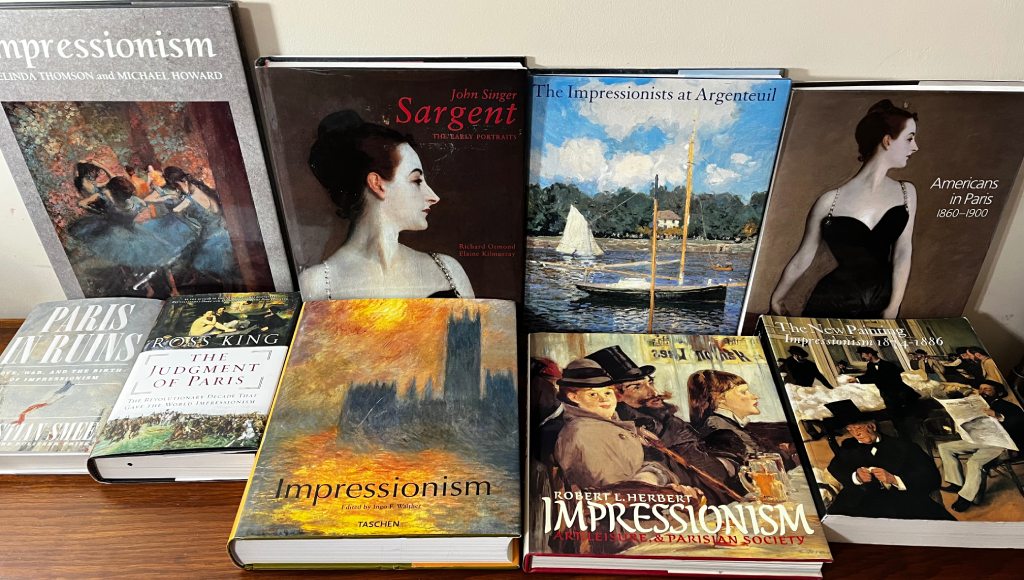
I’ve read several books on Impressionism. I’ve completed a 24-lecture series on The Great Courses on the topic. I’ve seen several exhibits of paintings by Impressionists. Yet, if someone asked me about Impressionism at a party, all I could say was “Oh, I love their paintings.” I vaguely remember their struggles to be accepted into the annual Salon in Paris in the 1860s and 1870s. I can’t tell Manet from Monat, or Gauguin from Van Gogh. If I saw pictures of water lilies I’d guess Monat, and if I saw ballet dancers I’d guess Degas. I have a stack of books on Impressionism that I want to read, but I doubt if I’ll retain much from reading them.

I’m a lifelong bookworm who loves reading nonfiction, but the information in those books seldom sticks. That’s always been disappointing to me.

I could give a pretty good lecture on the history of science fiction. I could give a decent talk on Robert A. Heinlein, the man and his work. I could get up and give a half-ass talk on Philip K. Dick. But that’s about all.

But there are so many other subjects that fascinate me. Ones I regularly read about. I worked with computers for decades and had a serious computer book/magazine addiction, but I couldn’t teach anyone anything reliable about programming anymore.

Most of us believe we know far more than we do, but isn’t that a delusion? News and information are usually how we divert ourselves. We don’t learn, we consume.

I’ve been thinking about how I could remember more. One method would be to research a subject, condense the facts, and then write and memorize a lecture. Certain people can talk at length at parties on their favorite subjects. My guess is they’ve memorized their routines like memorizing jokes. I’m not sure you could extensively grill them on the depths of their subject. I might be wrong though.

Other people are trivia buffs. They’ve memorized a lot of details. I’ve wondered if I could store enough facts about the Impressionists to have a good conversation with another fan of that art movement?

Have you ever thought about all the information they stuffed into you while attending K-12 and college? And then consider how much you’ve forgotten? A good education has always been based on exposure to a wide range of knowledge. And then we specialized in learning what’s needed to make a living.

I’ve been thinking about another kind of education. Call it the know-it-all approach to learning. Most know-it-alls are usually full of bullshit. Often they are mansplainers who annoy women. However, there is nothing wrong with loving to know a lot about little. We need an accreditation body for every subject and a way to test and rank people who want to be know-it-alls in their favorite subjects. Something like chess rankings.

I’ve wondered if I would retain more knowledge of Impressionism if I took regular tests and quizzes on the subject. Let’s imagine that scholars at universities teaching about Impressionism designed a database system that covered everything they’ve ever learned about the topic. They could create an international body that ranked knowledge of Impressionism by giving standardized tests.

I picture them putting the exams online allowing anyone to take them as often as they liked for practice. But to get an official ranking score, you’d have to take a paid supervised test. People who wanted to be ranked in this subject would attend lectures, join study groups, read books, subscribe to online study programs, etc. Learning would be any way you like to learn. That’s the problem with schools, it’s one size fits all.

I believe that the act of competing for a ranking would inspire people to remember their subject. Right now, I have no incentive to remember what I read. Of course, this is just a theory. I do know when I realized I’d forgotten all my math knowledge, studying at the Khan Academy encouraged me to keep going. Even though I had Calculus in college, I had to start over with second-grade math. I worked my way back to the 5th grade. That felt good. I’ve been meaning to keep going.

JWH

Ancestry.com Isn’t What I Expected

by James Wallace Harris, 1/6/25

I joined Ancestry.com so I could upload old family photos. I thought they should be saved somewhere because all my family photos will be thrown away after I die. Many of my photographs have already been converted into digital files, so I figured it would only require looking up the person and uploading the files for that person.

Because the government knows so much about us, I assumed that kinship relationships for the last three or four generations would already be in the Ancestry.com system. That was a big false assumption.

Ancestry.com claims to have over 60 billion records. I don’t know if that’s 60 billion different pieces of paper or 60 billion references to individuals. The trick using Ancestry.com is to start with a name and then use all its records to verify the identity of each person. It’s not easy. You can’t trust any one record. You need to find several records with connecting information that’s already been previously validated.

My assumption was recent family members would be known and family from the past would be harder to identify. It turned out that parents, siblings, cousins, and grandparents are hard to verify but once I did, Ancestry.com offered a lot of hints about my great-grandparents, and their ancestors. However, the hints need to be verified. Those hints are probably based on distant relatives in the past, working up family trees, and those trees might not be accurate.

I was shocked by how many people have similar names, with similar dates of birth and death, coming from the same part of the country. I could very easily add photos of people who were not the people photographed.

Before I joined Ancestry.com and used it, I thought family trees were already well established, and I could quickly upload all my family photos. That won’t be the case.

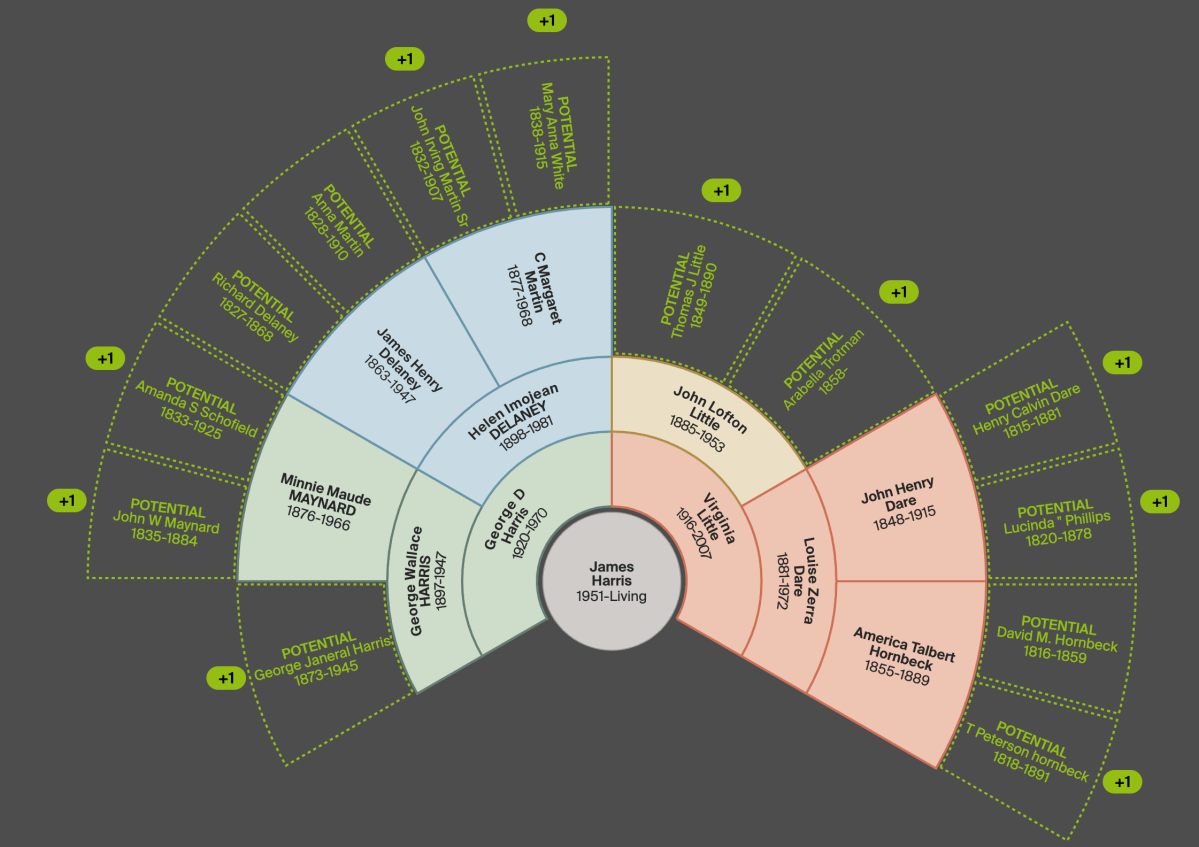
Just to cover my parents, grandparents, great-grandparents, and great-great-grandparents, I’ll need to research and identify 30 people. I only knew four of them. If I go back to another generation, that would add 32 more people. This completely ignores aunts, uncles, and cousins from each generation. Adding them to my family three would mean researching another hundred people, maybe two hundred.

Another assumption I had before working with Ancestry.com was the belief that building a family tree would help me get to know my ancestors. It hasn’t worked out that way. Finding names and dates to add to my tree reveals nothing about those people.

Genealogy is interesting and even educational. It’s revealing in unexpected ways. It shows that blood is not thicker than water. Kinship is meaningless. Actual interactions with each other are everything.

I’m not sure if saving my photographs will be of any real value. I’ll save them anyway, but I’m uncertain if anyone will care. Now I understand why so many people I’ve talked to about this project said they had zero interest in genealogy. They instinctively knew that people they never met were just meaningless names and dates on a chart

However, learning genealogy offers other rewards. It teaches research skills. It reveals how society knows and remembers people. Pursuing genealogy shows the limits of identity and identification. Unless a person is worthy of a biography, history only knows us by our names, marriages, addresses, birthdates, and death dates. And don’t those details say absolutely nothing about true selves?

Maybe I’m wrong. As I dig into the past, maybe I’ll find revelations I never expected.

By the way, genealogy should benefit greatly from AI.

JWH

Pop Culture vs. Social Media

by James Wallace Harris, 1/1/25

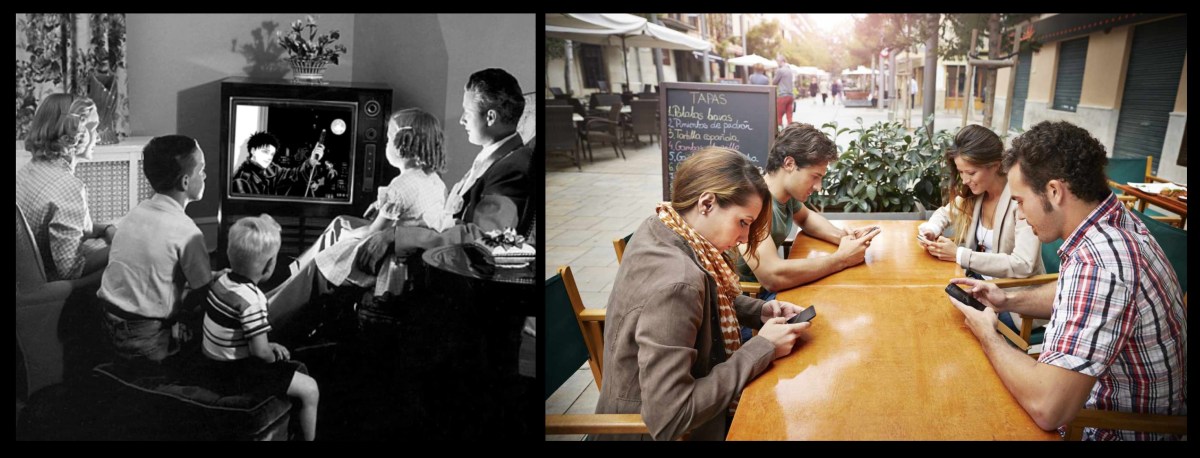
I began pondering the differences between generations that grew up with pop culture versus generations that grew up with social media when playing Trivia Pursuit. I then noticed the same differences while watching Jeopardy. Pop culture is about what most people know, while social media is about knowing the details of subcultures.

I’m often surprised by how much young contestants on Jeopardy know about the 1960s and older pop culture, but old and young players are very selective in their knowledge of 21st-century trivia. For years, I thought people my age just couldn’t keep up with popular music after 1990 because of changing mental conditions. But now I wonder if it’s because popular music shattered into countless genres appealing to various subcultures. In other words, there became too many art forms to remember their trivia.

I was born in 1951 and my personality was shaped by the pop culture of the 1950s and 1960s. Pop culture was primarily television, AM radio, movies, books, newspapers, magazines, and comics. People watched the same three television networks, CBS, NBC, and ABC. They often saw the same hit films and listened to the same Top 40 songs. They usually read a single daily paper. Some people read books, usually, paperbacks bought off twirling racks which sold in the hundreds of thousands, if not millions. The most common magazines seen in people’s homes were National Geographic, Reader’s Digest, Saturday Evening Post, Life, and Time.

The by-product of that limited array of pop culture was people within a generation shared a common awareness of what each other liked. You might not watch Leave It to Beaver or Perry Mason, but you knew what those shows were about.

People growing up since the Internet, especially since the explosion of social media, didn’t have popular culture, they had social media that focused on subcultures. Social media might be all about sharing, but people’s shared interests have broken down into thousands of special interests. People on the internet crave contact with others who share their interests, but no one group, not even Swifties, makes up a popular culture.

There are songs on Spotify with billions of plays that are completely unknown to the average American. The Academy Awards now nominate ten pictures for the Best Picture category, but most Americans have seldom seen them before they were announced. Hundreds of scripted TV shows are produced yearly yet it’s quite easy for all your friends and family to have a different favorite. My wife and I struggle to find shows we’re willing to watch together.

Mass media has broken down into specialized media devoted to subcultures.

Pop culture was a product of mass media. It inspired group identity through common knowledge. I’m not sure it exists anymore.

Social media is a byproduct of individuals trying to find others sharing similar interests. It isolates people into smaller groups. It promotes individual interests that limit people’s ability to overlap with other people’s interests. It makes people specialize. You become obsessed with one subculture.

I wonder if the MAGA movement is unconsciously countering that trend. They think they want to return to the past, but what they want is to be part of a large group. Their delusion is believing that if everyone looked alike and thought alike, it would create a happier society. I’m not sure that’s the case. The 1950s were not Happy Days, and the 1960s wasn’t The Age of Aquarius.

I’m not sure that happiness comes from the size of the group you join. Some happiness does come from interacting with others and sharing a common interest. I also think people might be happier knowing less about subcultures, and more about pop culture. But that’s just a theory.

Could people withdraw some from the internet to become more physically social? I don’t think we can give up on the internet, but do we need to use it as much as we do?

I liked it when my friends watched the same TV shows or movies. I also loved that my friends knew about the same albums, and would play them together, or go to the same concerts. Pop culture was popular culture. Will we ever see that again? And is that a delusion on my part. Am I only remembering a more social time from youth that naturally disappears after we marry?

JWH

What To Do With Family Photos That No One Wants?

by James Wallace Harris, 12/30/24

I have a box of old photos and photo albums that contain pictures of people from six generations. I inherited the family photos from my father’s and mother’s side of the family. My wife and I have no children, and my sister recently informed me that her son and granddaughters have no interest in the past. When I die, I’m sure that box of history will be thrown away.

It seems wrong to destroy such historical artifacts. Online research recommends trying to donate old photos to historical or genealogy organizations. I was horrified by one site’s recommendation: to burn them. But then, wouldn’t that be like cremation? I guess that’s more dignified than letting them rot in the landfill?

Sadly, no one wants to remember these people. I always thought one of the main reasons people believed in heaven was their desire to see family and friends again. Maybe that’s not true. I’m also reminded of the sentiment, that as long as you remember a person, they will not die. I never met many of the folks in my family photos, but I have wondered about them.

I have digitized most of my family photos. Sometimes I even set my computer background to use random pictures from that folder to remind me of all the people who are gone. Every ten minutes I see another moment from the past where people I share DNA pose to be remembered.

I have used scans of these photos for this blog in the past. I wrote “The Burden and Responsibilities of Family Photos,” “My Father Would Have Been 100 Today,” and “My Mother Would Have Been 100 Today.” I had hoped that some of their friends I never knew would have discovered those pages and left a comment, but that didn’t happen.

I joined Ancestry.com which allows uploading photos. It’s a slow process because I have to verify details and family connections, and I try to add as much information as possible to each image. My initial subscription is for three months, so I’ll try to scan, document, organize, and upload all the photos I can within that period. It’s kind of expensive.

Once the work is completed at Ancestry.com I might join other genealogical sites to upload the photos at each.

After that, I’ll box them all up carefully, and leave a note for whoever goes through my stuff to ask my sister’s descendants if they want them one last time.

You’d think there would be a national archive that collected old photos and certain kinds of documents for future historians.

If you don’t have anyone to leave your family photos, what will you do with them?

JWH