A Painful Challenge to My Ego

James Wallace Harris, 2/26/24

I’m hitting a new cognitive barrier that stops me cold. It’s making me doubt myself. I’ve been watching several YouTubers report on the latest news in artificial intelligence and I’ve been amazed by their ability to understand and summarize a great amount complex information. I want to understand the same information and summarize it too, but I can’t. Struggling to do so wounds my ego.

This experience is forcing me to contemplate my decaying cognitive abilities. I had a similar shock ten years ago when I retired. I was sixty-two and training a woman in her twenties to take over my job. She blew my mind by absorbing the information I gave her as fast as I could tell her. One reason I chose to retire early is because I couldn’t learn the new programming language, framework, and IDE that our IT department was making standard. That young woman was learning my servers and old programs in a language she didn’t know at a speed that shocked and awed me. My ego figured something was up, even then, when it was obvious this young woman could think several times faster than I could. I realized that’s what getting old meant.

I feel like a little aquarium fish that keeps bumping into an invisible barrier. My Zen realization is I’ve been put in a smaller tank. I need to map the territory and learn how to live with my new limitations. Of course, my ego still wants to maximize what I can do within those limits.

I remember as my mother got older, my sister and I had to decide when and where she could drive because she wouldn’t limit herself for her own safety. Eventually, my sister and I had to take her car away. I’m starting to realize that I can’t write about certain ideas because I can’t comprehend them. Will I always have the self-awareness to know what I can comprehend and what I can’t?

This makes me think of Joe Biden and Donald Trump. Both are older than I am. Does Biden realize what he’s forgotten? Does Trump even understand he can’t possibly know everything he thinks he knows? Neither guy wants to give up because of their egos.

So, what am I not seeing about myself? I’m reminded of Charlie Gordon in the story “Flowers for Algernon,” when Charlie was in his intellectual decline phase.

Are there tools we could use to measure our own decline? Well, that’s a topic for another essay, but I believe blogging might be one such tool.

JWH

Do You Plan to Bequeath Any of Your Computer Files in Your Will?

by James Wallace Harris, 11/20/23

I currently have 71,882 files in Dropbox. Will anyone want any of those digital documents after I die?

Let’s say I go on a Döstädning rampage (Swedish death cleaning) of my digital possessions, would there be anything left that I’d want anyone to have?

Most people consider their photographs to be among their most cherished digital possessions. I have 5,368 of those — some of those photos go back to four generations in our families. Susan and I have no children. We made copies of those photos for our relatives one Christmas, although I’m not sure if any of those relatives wanted them. I imagine them groaning at their pile of digital junk growing larger.

Would a genealogical database want old photographs? I know people interested in their ancestry spend a lot of time looking for old documents online. I wonder if I have any photos, letters, or documents that would be of interest to people in the future researching their past?

I have 28,811 digital scans of old science fiction and pulp magazines that took me years to collect. Most of them are easily found online, so I doubt they will be wanted. But what if the Internet Archive servers were shut down for lack of funding? Will there be kids in the future wishing they had a complete run of Astounding Science Fiction? Or will that desire die with the generation that grew up reading the stories that were first published in that magazine?

There are certain documents relating to money that my wife will want, but she will prefer printed copies. When my mother died, and Susan’s folks died, I scanned a bunch of family documents. I haven’t looked at them in years, and Susan has never asked about them. Still, would they be of value to anyone? What will future historians want to know about ordinary people?

I wonder how long my blogs will exist after I die. I’ve known bloggers who have died, and I can still read their blog posts, but some of writers were published at online companies that went under. I know I used a couple of those sites, and I can’t even remember the names of the companies.

I have over a thousand Kindle books, and over a thousand Audible audiobooks in Amazon’s cloud. Is there any way for me to leave those libraries to other people?

And if no one in the future will want my digital files, do I need to hang onto them now? Why do I keep them? Why do I give Dropbox $119 a year? When I retired, I made copies of all the computer programs I wrote. I put them on several drives just to be sure. I put those drives in the closet. Several years later I went to check on them and every one of those hard drives was dead. I have a friend whose computer hard drive died recently. She had always backed everything up with Apple’s Time Machine. However, when she restored her files, many were corrupted. It’s hard to preserve digital files for a long time. Backup programs and online backup services aren’t 100% reliable.

When humanity stored our past on paper, some of it got saved. Not much, but some. I get the feeling that since we switched to storing stuff digitally, even less will survive. I have a handful of paper photographs that my great grandparents, grandparents, and parents took. So does Susan. I wonder who we should give them to?

Every day I spend a few minutes going around the house looking for things to throw away or give away. I need to start doing that with my computer files. I spent a lifetime gathering stuff, both physical stuff, and digital stuff. It’s funny now that I’m trying to reverse that progression of acquisitions.

I wonder when I was young if I had somehow known for sure that my older self would be getting rid of all the stuff I was buying back then, would I have bought so much stuff in the first place? How much stuff have I bought or saved because of FOMO (fear of missing out)? And how much did I really miss out?

JWH

Hitting a Cognitive Barrier

by James W. Harris, 9/24/23

I crashed into a cognitive barrier trying to write my reactions to The Trouble with Harry and To Catch a Thief, two Alfred Hitchcock movies from 1955. After two drafts I realized I wasn’t getting where I wanted to go. I know I don’t want to write movie reviews — the perfect place to find them is Rotten Tomatoes. Nor did I want to describe a film — just go to Wikipedia or IMDB. I wanted to write an essay that captured what I got out of watching those films at age 71.

Time is running out, so I need to make the most of every experience. That involves understanding myself at a deeper cognitive level. One I’m finding harder to reach as I age. On the other hand, aging is giving me more wisdom. The cognitive barrier is being able to express what I’m learning by getting older. But aging is also wearing down my brain. What one hand giveth, another takes away.

Writing is thinking outside of the head. Thoughts are generated inside the head from emotional reactions. Thoughts are fleeting. Thoughts are like cream stirred into coffee, creating little patterns that quickly dissipate. Writing is about capturing that initial pattern and making sense of it by showing how it relates to the memories of millions of past patterns.

Very few people can describe exactly how they feel, and few of those people can explain why they feel the way they do. There are rare individuals that can compose their thoughts inside their heads and eloquently convey the results in speech. Most of us need to think outside our minds via writing and editing.

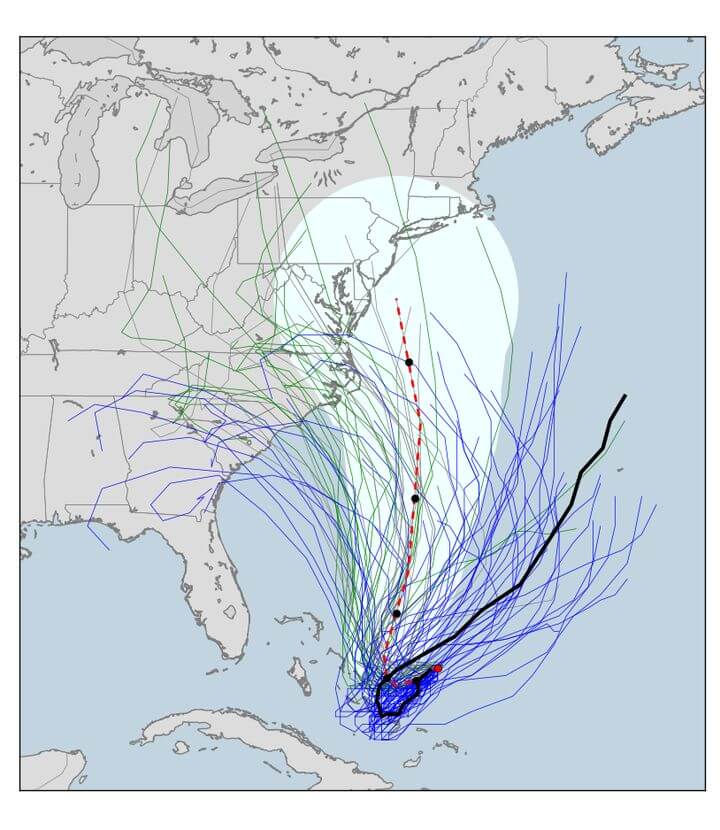
Even when we feel our written words are clear, readers seldom find clarity. Communicating with words is difficult at best and often impossible. What we think we’re expressing can often take a different path to each reader like those spaghetti strings we see in hurricane reports. I might believe I’m writing about Jacksonville, while some readers think I’m writing about Bermuda while others Miami and Charleston.

I enjoyed The Trouble with Harry better than all the other Hitchcock films we’ve watched this month, including Rebecca, Notorious, To Catch a Thief, and Strangers on a Train, films most critics admire a great deal more. However, I thought The Trouble with Harry had many flaws, but then Hitchcock is a flawed filmmaker.

How can I admire a movie that doesn’t measure well against the best movies I’ve seen over a lifetime? This gets into complexity and even multiplexity. I need to relate several reactions that contradict each other. The three films I admired and enjoyed the most this month have been The Trouble with Harry, Twelve O’Clock High, and Mr. Belvedere Rings the Bell. All three were feel-good movies to me, but they each made me feel good in a unique way. Is the word “feel-good” even useful? Many moviegoers might interpret the term “feel-good” so differently that these three movies would not fit their definition.

Should I even use the term? Shouldn’t I just describe exactly what I felt? Will that be clearer?

In my second draft I had a breakthrough. I realized to understand how I react to films I’d need to understand what I expected from them. But my expectations have changed widely over the years. And will my readers have the same expectations? It was then I realized that what I’m expecting from movies at 71 is different from my younger self. Even describing my own emotional experiences is a moving target. But explaining why that’s so hits another cognitive barrier.

I need to think about that.

Putting everything into words precisely is so difficult. Should I even try? I believe most people don’t because all they value is personal experience. Why tell anyone about our perceptions when they have their own?

Do you see why writing that essay became such a black hole?

JWH

Thinking Outside of Our Heads

by James Wallace Harris

I believe recent developments in artificial intelligence prove that many of the creative processes we thought came from conscious actions come from unconscious mechanisms in our minds. What we are learning is computer techniques used to generate prose or images are like unconscious processes in the human brain.

The older I get, the more I believe that most of my thinking comes from my subconscious. The more I pay attention to both dreams and my waking thoughts, the more I realize that I’m very rarely making conscious decisions.

I might think “I am going to walk across the street and visit Paul,” but I have no idea how to make my body walk anywhere. But then, I’ve always assumed muscle actions were automatic. It was mental actions I believed were conscious actions. I used to believe “I am writing this essay,” but I no longer believe that. This has led me to ask:

Just what activities do we perform with our conscious minds?

Before the advent of writing, we did all our thinking inside our heads. Homer had to memorize the Iliad to recite it. Prehistory was oral. How much of thought then was conscious or unconscious? Have you ever read The Origins of Consciousness in the Breakdown of the Bicameral Mind by Julian Jaynes? I know his theories have lots of problems, but they do imagine what I’m thinking about.

How often have you worried over a problem, say a math problem, or a programming problem, and gave up, but then later, usually after a nap or sleep, the solution came to you? That’s the classic view of unconscious thinking. But even when we’re thinking we’re solving a calculus problem is it really being done at a conscious level? Are you consciously recalling all your math lessons over a lifetime to solve the problem?

How often when working on a Wordle or Crossword does the word magically come to you? But sometimes, we are aware of the steps involved.

In recent years I’ve developed a theory that when we work with pen and paper, or word processor or spreadsheet, or any tool outside our body, we’re closer to thinking consciously. Sure, our unconscious minds are helping us, but making a list is more willful than just trying to remember what we need at the store.

Writing an essay is more willful than woolgathering in the La-Z-Boy. Authoring a book is far more willful still. Engineering a submarine by a vast team of people is an even more conscious effort. Sure, it involves a collective of unconscious activity too, but a vast amount documentation must be worked out consciously.

I’ve written before about this idea. See “Thinking Outside Your Head.” That’s where I reviewed different techniques and applications we use to think outside of our heads.

Many people want to deny the recent successes with AI because they want to believe machines can’t do what we do. That humans are special. If you scroll through the images at Midjourney Showcase, it’s almost impossible to deny that some of the images are stunningly beautiful. Some people will claim they are just stolen from human creativity. I don’t think that’s true.

I think AI developers have found ways to train computer programs to act like the human mind. That these programs have stumbled upon the same tricks that the brain evolved. Many great writers and artists often talk about their Muse. I think that’s just a recognition of their unconscious minds at work. What those creative people have learned is how to work consciously with the unconscious.

What some creative people are doing now is consciously working with two unconscious minds – their own and an AI. There is still a conscious component, the act of working with tools outside of our head. Where the action is, is that vague territory between the unconscious mind and the conscious one.

JWH

What Gives Me A Sense of Accomplishment at Age 71

by James Wallace Harris

When we were little kids grownups would ask: “What do you want to be when you grow up?” That plants a seed in us that we should have a goal for the future, to plan to do something and accomplish things. When we were little, we’d tell the grownups we wanted to be astronauts or rock stars, because those were the exciting glamourous occupations we knew about.

As we got older, we learned that becoming an astronaut requires getting advanced science degrees, and becoming a rock star means learning how to play the guitar and sing which takes ten thousand hours of practice, neither of which we really want to do.

As we got older we learned that just finishing doing anything had its own rewards. The trouble was learning what we like to do. I had to work at many shit jobs before I was 25 to learn what I actually liked doing, which was working in a nice office, messing with computers, and having coworkers who would become friends. Helping someone else accomplish their goals by programming a computer was what I eventually discovered I like doing. I found working at a university that helped other people to become what they wanted to be fulfilling to me.

Before we retire we think about all kinds of big things we want to do after we quit work. I thought about moving to New York City or living in England, or moving to a retirement community with a lot of social activities. But those things were like dreaming of becoming an astronaut when I was a kid. The reality of retirement was quite different. Susan and I decided to stay in the home we had. And my health problems made me not want to travel.

However, the urge to do something is still there. And even as I get older and can do less physically, I still have this desire that I should have a goal for the future, and to accomplish something. What’s rather fascinating is where and how I get my sense of accomplishment every day.

Nowadays, the future isn’t so far off. It’s either, “What am I going to do tomorrow,” or “What will I do today.”

My goals have become smaller and smaller too. A big one recently was cleaning out the attic. Our friends Anne and Tony came over and helped us get everything down, and now Susan and I are going through all the boxes and suitcases stacked up in the dining room to get rid of that stuff. When that task is done it will give me a reasonably big sense of accomplishment.

But I don’t need big things to accomplish to find satisfaction. Even going to the grocery store provides a satisfying sense of getting something done. It involves Susan and I planning our meals for the week, making a list, going shopping, and putting things away. All of that might take just a couple hours, but it wears me out and leaves me feeling I did do something worthwhile. Me and my old friends joke about how doing one thing like going to the grocery store makes us feel like we’ve gotten something done for the day. And the common joke is, “How did we ever have time for a job?”

If I look at my ToDoist app on my phone, I see a list of things to do that will make me feel good when I get to remove them from my To Do list. And most of those little goals are rather mundane: clean out the file drawers, find a new dermatologist, hire an electrician to install the new Blink security camera and light, cull out DVDs I’ll never watch again, get my eyes checked, and so on.

This is a long way from becoming an astronaut. We never hear people ask: “What do you want to do when you get old?” Theoretically, my retirement years could be longer than my work years. At one time I had big ambitions about what I would do with them, but like a kid growing up and discovering the reality of the work years, the reality of the retirement years is very different too.

A lot of what you can accomplish in retirement depends on money and health, and health really becomes the defining factor. I no longer have a bucket list of things I want to do because at some point the scope of life changes. My sister Becky once told me, “You start out life by living mostly in one room with someone changing your diaper and end up living mostly in one room with someone changing your diaper.” At the time that was funny, scary, and depressing. But as you get older, it becomes, “I can see that.”

I could still have a decade or two, or even three. That’s a lot of time. Unfortunately, it’s time when I’ll have dwindling energy and health. But I don’t think I’ll lose a sense of wanting to accomplish things.

I’m reminded of a short story by R. A. Lafferty called “Nine Hundred Grandmothers.” In it, a space explorer visits another planet and learns the beings there are immortal. However, they get smaller and smaller as they age. He is taken to a cave where the ancestors live on shelves in the wall. The further back he goes the tinier they get. That’s what life is like getting older. The scope of every day slowly gets smaller and smaller. You live with it.

Right now I measure accomplishments by how many books I read or essays I write. I like waking up in the morning and thinking of a goal and then achieving it during the course of the day. At 5:55am this morning I imagine writing this essay. It’s now 7:53am and I’ve almost got a first draft. I hope to finish it soon and eat breakfast. It’s great to start the day having completed a goal early.

Before I got up I also pictured cleaning up the house so our friend Leigh Ann could come over and Susan, Leigh Ann and I can spend the afternoon playing Rummikub. It’s not much of a goal, but it is satisfying.

And I look forward to tonight when Suan and I will watch another episode of Call the Midwife and A Place to Call Home. This might be silly, but I find watching complete series from pilot to finale gives me a sense of accomplishment. So each night I feel like we’ve done something by watching another episode from those two series.

Sometimes I even give myself big goals, ones that are daunting to me now. Ones that I have to push myself to finish. Like cleaning out and organizing my email and computer files on my hard drive. You might laugh, but I have thousands of emails and tens of thousands of computer files waiting to be examined.

Finally, there’s a weird symmetry to getting old. Susan and I have collected a lot of stuff in 45 years of marriage, and now we’re getting rid of all that stuff a little bit at a time. I have thousands of books that I still haven’t read. Ones I bought thinking that one day I’ll get to read. Well, that one day is here and I’ve got to get busy reading them. Finishing each one gives me a sense of accomplishment.

JWH (another thing done – 8:35am)