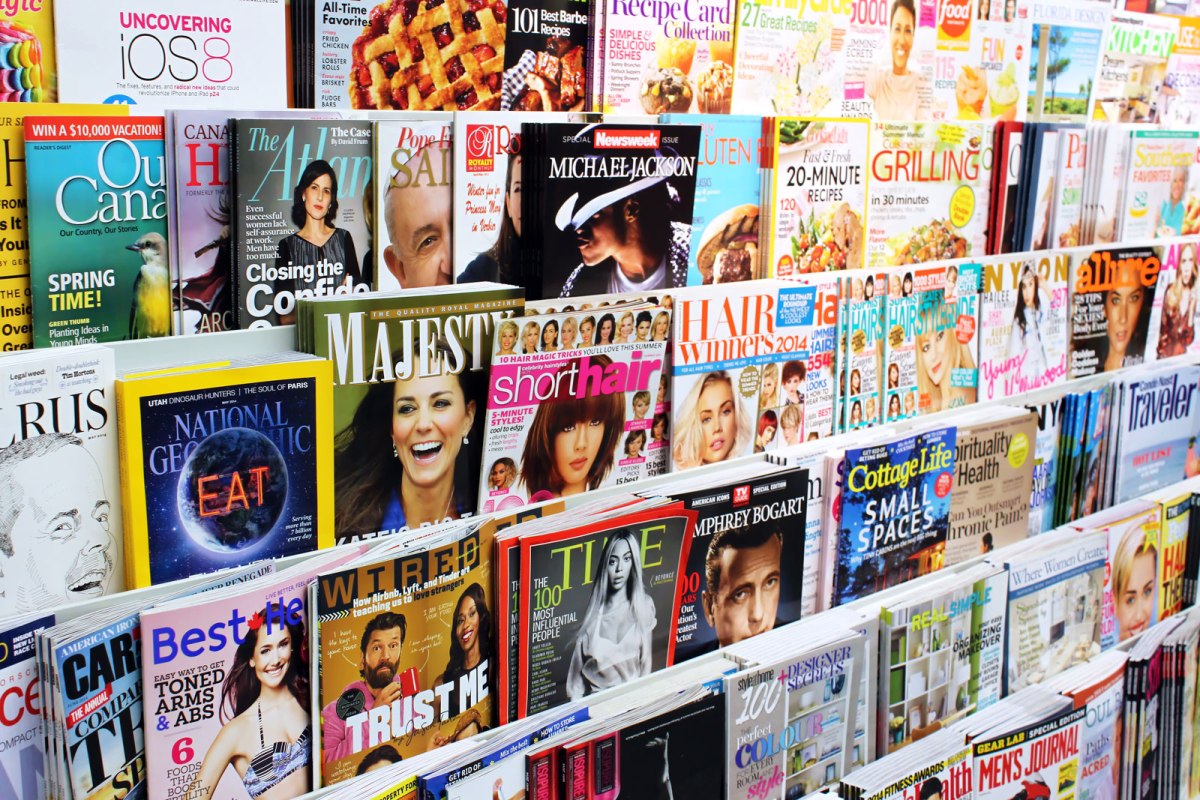

12 Reasons Why I’ve Stopped Watching the NBC Nightly News

by James Wallace Harris, 7/29/25

I developed the habit of watching the CBS Evening News with Walter Cronkite when JFK was assassinated in 1963. I had just turned thirteen. Cronkite had been the first to switch to a half-hour evening news format that September. I only had a vague sense of what the news was before that. I stuck with CBS until the 1980s, into the Dan Rather years. For some reason, my wife and I then switched to ABC for a couple of decades before finally switching to NBC. When Lester Holt retired, I decided to stop getting my news from television.

Since then, I’ve been thinking about what it means to follow the news. Does it require a daily habit of studying current affairs? Should we consider the news to be any reporting of significant events that have recently happened? How much information can be crammed into twenty-two minutes of television? Who decides what is worth knowing? Recently, NBC chose to make the deaths of two celebrities the lead story two nights running. Were the careers of Ozzy Osbourne and Hulk Hogan the most important information I needed to know on those two days? Think about it. Of all these events happening around the world on those two days, were their deaths the most essential for me to learn about?

Reason 1

I’m not picking on NBC. All the broadcast networks and the cable news networks decided what their audiences want to watch based on ratings. It’s not that Ozzy and Hulk’s deaths are more newsworthy than famine in Gaza, but NBC knows its audience is tired of hearing about starving Palestinians, and more people would watch their show if it opened with Osbourne and Hogan.

Decision 1: I need to decide what’s newsworthy.

Reason 2

Is twenty-two minutes enough time to learn about the critical world events that happened in the last twenty-four hours? Just how much time should I devote to being well-informed? If it is as little as twenty-two minutes, then television is the wrong medium. Reading just the headings of all the news stories from a quality newspaper app on my phone serves me far better.

Television news spends most of its time on visual news. Often, NBC repeats exciting film clips several times. That’s not an efficient use of time. Airplane crashes and flooding rivers grab our attention, but is it really news we need?

Decision 2: I need to decide how much time I want to spend on the news. Additionally, I need to decide on the best medium that maximizes that time.

Reason 3

Too much of television news is taken up by reporters and anchors. Often, reporters take more time asking a question than the time given to the eyewitness’s reply. I’m not interested in reporters or anchors.

Decision 3: I need to look for news sources where the journalist is in the background. That excludes television and most podcasts. Generally, good print reporting only includes the reporter’s byline.

Reason 4

Television news offers low-quality information. A major article in The Atlantic might have taken months to research and write. Such articles are information-dense. TV news is written and edited quickly. There’s not much time for fact gathering or checking. It’s often based on eye-witnesses who mainly add emotional impact rather than inform. Television news relies on soundbites, which are mostly opinions. Experts interviewed on TV news are often selected by convenience rather than their authority.

There have been over 22,500 days since I started watching nightly news programs on TV. There is an incredible sameness to the kind of content TV news presents. I should have abandoned it long ago, but it gave the illusion I was being informed, and it was convenient.

Decision 4: Pick another medium for consuming news.

Reason 5

Television news is narrow in scope. It focuses on catastrophes, tragedies, and political conflict. Over a lifetime of seeing thousands of news reports on wildfires, they all look and feel the same. That’s also true for wars, airplane crashes, riots, elections, famines, hurricanes, floods, and tornadoes. Television news mainly focuses on the types of stories we’ve seen repeated throughout our lives.

Television makes it seem like there is nothing new under the sun. I’ve learned from reading quality magazine articles and newspaper journalism that that old bit of wisdom is completely untrue. Magazine and newspaper articles constantly amaze me with news that surprises me because it’s about people, places, concepts, ideas, and events I’ve never heard of before.

Decision 5: Find more news sources that teach me about reality, inspire my curiosity, and better inform.

Reason 6

TV news is seldom memorable. If John F. Kennedy’s assassination was only reported once on the CBS Evening News on November 22, 1963, I doubt I would even remember the event. I remember it because of constant coverage over several days, including all the documentaries, movies, and books that have been produced since that day. I remember Project Mercury, Gemini, and Apollo missions because of the around-the-clock television coverage, as well as the documentaries, movies, and books that have been produced since those events. That’s why I don’t remember all the space missions since. They didn’t get such coverage.

A thirty-second spot on the nightly news, or even a big event stretched to four minutes of reporting, just isn’t remembered. I don’t need to waste time on ephemeral news stories. I’ve discovered it’s far better to spend thirty minutes on one topic than two minutes on fifteen topics.

Decision 6: Focus on one news topic for most of my daily time spent on the news. Then quickly go over the headlines.

Reason 7

Television news isn’t educational because it focuses on the same topics. Shouldn’t news enlighten us about reality? Shouldn’t we always expand our awareness of what’s going on in the world?

How can short videos and soundbites be truly informative? I want news that adds to my personal growth. News that adds wisdom, not ephemeral data.

Decision 7: Make lists of what I want to learn about and then find news reports that bring me up to date on those topics.

Reason 8

Television news is biased. Knowing the truth is impossible. Content produced for money-making ratings or to promote a political agenda will always be questionable. I even suspect the kind of long-form journalism that goes out of its way to appear unbiased. I expect all writing to have some bias. It’s my job to spot it.

Decision 8: Start analyzing prose for bias. Think about word choices in each sentence. Always wonder if information is left out.

Reason 9

Real knowledge is statistical. Science is our only cognitive tool that consistently explains reality. News is too close to word-of-mouth. We need news to be closer to peer-reviewed science journals. That’s probably impossible, but we need to think about it. Ground News attempts to apply statistics to the news by comparing political bias and the amount of coverage a story receives. Can’t we find other statistical methods to measure the news?

Decision: Don’t trust any news unless it comes from multiple sources.

Reason 10

Replying on a single network for news is dangerous.

Decision 10: Seek out different gatekeepers. Every group or organization has an agenda. Learn what that agenda is before interpreting what they are saying.

I’ve discovered that reading/listening to one well-reported article a day is much more informative and educational than a package of video clips and soundbites. I’ve been achieving this with Apple News+, which offers content from over 400 magazines and newspapers. Each morning, I listen to a single long-form article from magazines such as The Atlantic, New York Magazine, The New Yorker, and New Scientist, while I do my physical therapy and morning walk.

Reason 11

Television news can be misleading. It’s not as dangerous as AI-generated fake news on YouTube, but television news is easily corrupted by money, marketing, and politics.

Decision 11: Always consider the source of the news. I need to decide which news sources I will trust.

Reason 12

Most television news gives the United States’ perspective of world events.

Decision 12: Find news sources from around the world.

Conclusion

This is just the beginning of changing a lifelong habit of watching the nightly news on television. I should have made these changes long ago. We all get into ruts that are hard to escape. I believe getting old is making me regret not trying other approaches to understanding reality. However, all the political turmoil since 2016 is making me question everything I know. Human-created and computer-created fake news is disturbing. In recent years, I’ve decided that all of us suffer from multiple delusions.

You shouldn’t ask yourself if you’re delusional, but how delusional. Anyone who feels they know the truth is crazy. We can only guess what might be true by using statistics. Television has always depended on the false assumption that seeing is believing. I have doubts about believing anything.

Television, politics, artificial intelligence, and the Internet have corrupted our perception of reality. I want to rethink everything. I’m starting with my old habit of watching the nightly news.

JWH
What Will Be the Pivotal Issues in 2026 and 2028?

by James Wallace Harris, 7/2/25

Peter Leyden claims that America undergoes 80-year cycles, which he calls epochs, with peaks of upheaval that last 25 years. The past peak was after World War II, from 1945 to 1970. Leyden claims we’re entering a new peak in 2025 that should last until 2050. He zeroes in on artificial intelligence, clean energy, and bioengineering as the driving forces. I’m not big on predicting the future or seeing patterns in history, but there are ideas in his theory that are worth contemplating. I do believe we’re living through a historic period of change.

David Brooks claims America is moving away from thinking of itself as an idea that inspires the world to a homeland that we should defend. Brooks has moved away from being a traditional conservative to becoming a spiritual guru who teaches morality. I find all his recent speeches to be both uplifting and inspirational. Brooks feels the changes we are experiencing are undermining our individual characters and altering our collective national character.

CBS News asks if we’re moving into a new Gilded Age. But this time, the oligarchs are far richer and much more powerful. There is a synergy between this documentary and the videos of David Brooks and Peter Leyden. Everyone feels a massive paradigm shift coming. In 2025, I believe we’re living through the largest social and political upheaval since 1968.

If history does go through cycles, can we alter their course? The average person does not have much power. But in 2026, we do get to vote, and again in 2028. I believe the Democrats lost in 2024 because they had no clear vision. Being against Trump is not a political plan. In 2024, the Americans voted for Darwinian rule. Let the strong thrive and the weak die. The current administration is enacting laws to make the rich richer and the poor poorer. Essentially, civilization on the cheap. They appeal to greed. They appeal to resentment. They believe everyone should be responsible only for themselves.

It’s a very Darwinian philosophy. There’s no way we could call America a Christian Nation anymore. This is what America wanted through a fair and square election. But now that they are seeing what it means, do they want to keep it?

I don’t think we should wait until 2026 or 2028 to decide what we want. The Republicans won by clearly defining their goals in 2024. Democrats need to produce their own version of Project 2025. Project 2028 needs to be specific, and all Democrats need to support it. It can’t be too radical. It will need to be liberal yet practical. It needs to appeal to independents and old-style conservatives.

I have no idea what that plan should be, but I wish it would be something David Brooks would back. It needs a moral foundation because, as much as I accept the scientific theories of Darwin, I don’t think survival-of-the-fittest makes for an appealing political philosophy.

JWH

The Price of High-Quality Information

by James Wallace Harris, 6/30/25

We all know the internet is full of crappy information. The creators of the Internet intended it to be an information utopia. They wanted information to be free and instantly available. It turns out free information is only worth what you paid for it.

The Internet destroyed the local paper and investigative journalism. Quality magazine journalism is circling the drain. Television news is more abundant than ever, but it’s so predigested and targeted to specific audiences that it’s worthless.

Most of the high-quality sources of information are behind paywalls. Every morning, I get up and listen to Apple News+ narrators reading articles from quality magazines as I do my physical therapy exercises. Usually, that’s one thirty-minute article. Unlike podcasts, magazine journalism features a greater percentage of useful information per minute. I truly despise the kind of podcasts that spend more time on the host’s personality than the topic promised in the thumbnail.

Apple News+ gives me access to over 400 magazines and newspapers. This is the bargain of the century for $12.99 a month. However, it’s doubtful these magazines earn enough money from this service to keep them going. The real way to support them is to subscribe to each periodical. Apple News+ is like Spotify, good for the consumer, bad for the creator. The ethical way to use Spotify is to locate albums you want to buy. And the ethical way to use Apple News+ is to find the journals you should subscribe to.

I know these periodicals have become expensive. The Atlantic is $79.99 for a digital subscription. The New Yorker is $130 for a digital subscription. Why pay those prices when I already get the content in Apple News+? Especially when I will consume the content via Apple News+.

The answer is support. Think of quality journalism as an important charity. However, there is another reason. When I read a great article, I want to share it with my friends. Apple News+ is so locked down that it’s not possible. You can only share with other Apple News+ subscribers. You can’t even cut and paste from the screen.

Many periodicals that publish on the web can be copied to an email or printed as a PDF and shared. However, even those methods of getting around the paywall might disappear.

I often read articles that I know friends would also want to read. Some paywalled publications do allow for limited sharing. It should be a standard feature.

We need to move away from the shitty free content. Sharing is prevalent on the Internet, but consider the type of content people share. It’s mostly mindless entertainment or opinions. We need to learn to distinguish between well-researched articles and endless unfounded opinions.

The easiest way for me to share content is if my friends subscribe to Apple News+. And if more people subscribed, the publications would get more money.

We live in an age where authority is suspect. Everyone wants their views to dominate, and will rationalize their beliefs with any content that supports those views. We have lost the ability to evaluate what is real.

The trouble is reality can’t be understood with sound bites. Any topic worth considering requires significant study and research. TV and podcasts create content too quickly. Their information is presented too soon after events and produced too fast. Long-form journalism explores ideas in depth, and that takes time.

It also takes time to read such content. We’ve trained our minds to consume content quickly that was created quickly. Start paying attention to the information you consume and think about how it was produced. If you’re listening to a podcast that lasts an hour, note how much actual useful information you gleaned from that hour. If you get your news from television, pay attention to how long each news segment lasts. Think about how that news was gathered and why. And pay particular attention to the personalities presenting the news on TV and podcasts. Is it more about them or the content?

The highest quality content is nonfiction books written by well-educated researchers. However, it’s not possible to read enough nonfiction books to keep up with everything we need to know. I believe the best compromise for consuming high-quality information is long-form journalism.

You will be far better educated if you spend one hour a day on one subject than one hour a day on twenty different five-minute topics. This is where a service like Apple News+ succeeds. And it does have competitors, such as Zinio. My library offers a selection of free digital magazines and newspapers through Libby.

JWH

Can We Avoid a Population Collapse Without Throwing Women Under the Bus?

by James Wallace Harris

Most countries around the world are worried about a population collapse that will destroy their economies and social systems. I’ve been worried about overpopulation since the 1960s, but now economists are warning us that capitalism is doomed if we don’t have more babies. Every country’s economic wellbeing depends on GDP growth. That might be impossible if birthrates continue to shrink.

The replacement birthrate to keep the population the same is around 2.1 children per woman, or 2,100 children per 1,000 women. In the U.S., we had 1,626 births per 1,000 women in 2024. At that rate, if we exclude immigration, the United States will fade away. Here are the U.S. population number by decade for the next 400 years.

YearPopulation (in millions)
2025341.7
2035330.5
2045319.8
2055309.5
2065299.6
2075290.0
2085280.8
2095271.9
2105263.3
2115255.0
2125247.0
2135239.3
2145231.8
2155224.6
2165217.6
2175210.9
2185204.4
2195198.1
2205192.0
2215186.0
2225180.2
2235174.6
2245169.1
2255163.8
2265158.6
2275153.5
2285148.6
2295143.8
2305139.1
2315134.5
2325130.0
2335125.6
2345121.3
2355117.1
2365113.0
2375109.0
2385105.1
2395101.3
240597.5

If we follow the trends of other countries that have even lower replacement birthrates, we’d shrink even faster. If we became like South Korea, we’d shrink to half our population by 2100.

At some point, we’d reach zero population. From an ecological point of view, I’d think the Earth would be better off without so many people. However, capitalism, and our support systems like Social Security depend on growth.

To solve this problem requires women having more babies. Because some women can’t have children, most women would need to have three children. That’s quite burden to put on women. Countries around the world with declining birthrates are trying various incentives to get women to have more children, but so far, those incentives aren’t working.

Can We Have Capitalism Without Growth?

What if it’s time to think about shrinking the population? What would be a sustainable population regarding the environment? Let’s just say the world would be much better without only one billion people. Could we come up with an economic system that didn’t depend on growth?

Humanoid robots are enterting the workforce. Could they take up the GDP slack for fewer people? Are there other methods to generate economic growth without people? The U.S. economy depends on consumerism. Can we create an environmental steady-state economic system that creates abundance?

How Many People Do We Need?

If we allowed ourselves to shrink the population to one billion humans, to keep from continuing to shrink, we’d be back to needing women having 2,100 children per 1,000 women. That means every woman needs to have two children, and one in ten needs to have three.

Since the second wave of feminism and the creation of the birth control pill, women have chosen to have fewer children. We have to assume that’s what they want as individuals. Then is it fair to put the burden of reproduction on one gender? What if we had a society where every individual is responsible for raising their replacement? How would we force males into having kids?

Conservatives and some women are now proposing that women go back to being full-time mothers. What if most women don’t want to become mothers? Could we create a Brave New World type society where children are grown in test tubes and vats? That would allow males to have children.

This is a great idea for science fiction, but I’m not sure if it will ever happen.

What If Some Women Were Willing to Have Lots of Children?

Some women do like having children. If half of women were willing to have four or five children, and maybe a quarter of them have one child, that would allow one quarter of women to have no children.

Curently, in the U.S. 57% of all adults under 50 choose not to have children. That means we wouldn’t have enough women wanting children. Current incentive programs for woman to have more children are failing. Is there anything governments could do to convince women to have more children?

Universal guaranteed incomes are often discussed nowadays because of growing automation. What if women were guaranteed a significant income for having children? Say $75,000 a year for each child.

There is a meme going around where pretty women claim they are too beautiful to work. I don’t know how big this movement is, but it seems some women have decided that careers are not fun and they’d rather be stay-at-home moms. But as critics have pointed out, this plan only works with Mr. Right who makes a lot of money. How many women would choose a career of raising babies if they made $225,000 a year by raising three children, or $450,000 a year for raising six?

Think about how this would change our society? I have no idea if this is a good idea, but it sounds like it could make a fun science fiction story. How would this change society for males? It might make marriage more appealing. However, it would shift the power to women, and males might not like that.

However, with robots taking over everyone’s jobs, raising babies might become a new growth industry.

I’m just speculating here. If population collapse is a real problem, then we need to think of solutions. Conservatives are hell bent to bring back the large traditional family, but I doubt that will fly anymore. I think it’s obvious that many women don’t want to be moms to large broods.

How far are conservatives willing to go to recreate large families? Would they back $75,000 per child incentive? How many men would be willing to stay at home and raise children and let their wives have careers? How many people of either gender want careers? Would such an incentive balance out the responsibility of child raising if the incentive is paid to females and males? Do child raisers need to be married?

I suppose there could be new kinds of marriages, like limited partnerships. Conservatives would probably propose the incentives be payable only to married couples. Would they allow gay couples? What about two older people who are just friends and need to make some money? Maybe we need to redefine marriage as a legal bond to raise children.

Because robots and AIs are taking over everyone’s jobs, raising babies is one job they can’t have. Or could they? I suppose we could create robotic mothers and fathers to raise human babies that have been conceived in test tubes and gestated in vats.

There’s lots to think about.

I’ve thought of one other thing. What if humans are choosing not to have babies but raise robots instead? What if robots are our evolutionary replacements? If that’s the case, then population decline is right on time.

JWH

Which Came First: Political Personality or News?

by James Wallace Harris, Monday, December 19, 2016

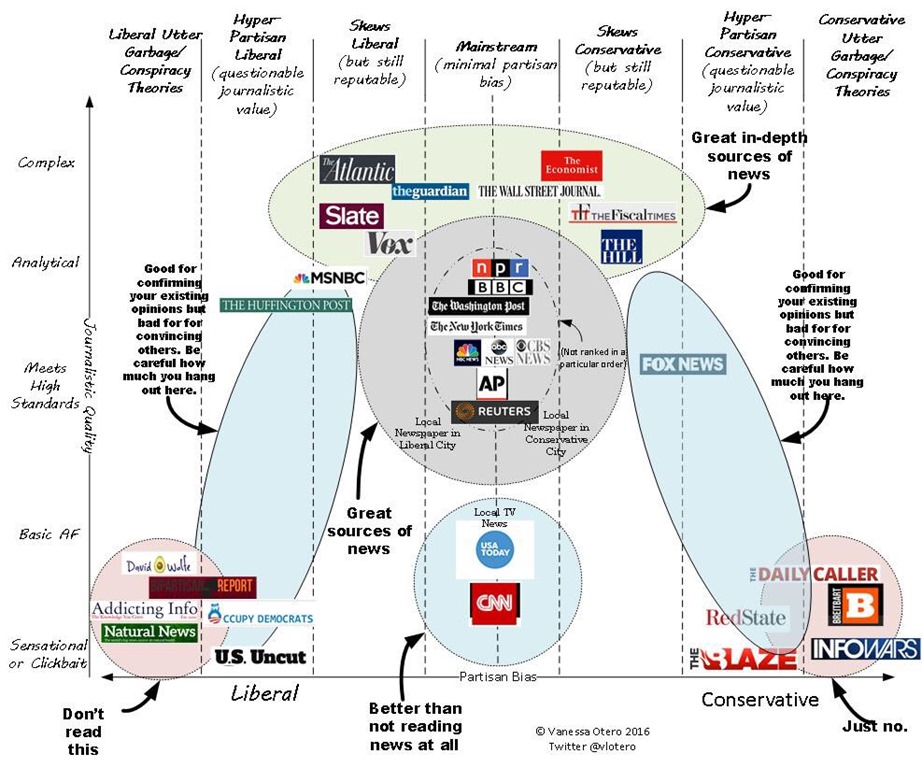
My wife Susan found this infographic on Facebook. It was created by Vanessa Otero and distributed on her Twitter feed. You can click on the image to see a larger version.

Vanessa Otero News Graph 2016

My news sources are NBC, CBS, PBS, The New York Times, NPR, The Washington Post, The Guardian, The Atlantic, Slate, Vox, and sometimes The Economist and The Wall Street Journal when I get free links. In other words, I stay close to the center of things, and by Otero’s reckoning, use sources of high standards, that can be analytical and complex.

Do I have the kind of personality that is drawn to those news sources, or did those news sources create my political personality? If you grow up reading news from sources on the lower left or right of the graphic, do you program your personality by them? In recent years I’ve met a number of people who watch Fox News all day long. These people have different personal personalities, but they often feel like they have the same political personality. They are usually paranoid about the government, believe in various kinds of conspiracies, are passionately anti-taxes, and hate when people get money from the government without working.

Do people in childhood develop particular beliefs and then migrate to news outlets that promote those beliefs, or do they get hooked on various news sources and adopt the beliefs of the news programs they watch?

Would people who watch Fox News morph into new political personalities if they switched to watching PBS news programs? If I started watch Fox News all the time, would I become conservative? I remember favoring JFK back in 1960, when I was in the third grade, and that was well before I watched the news. I’ve never liked any Republican candidate – is that because of my innate programming, or because of how I acquired my news?

When I did start watching the news, it was the CBS Evening News with Walter Cronkite, probably around 1962-63. In 1960 when we moved from New Jersey to Mississippi, I learned I didn’t like racists. As a shy kid, I was always afraid of people with strong emotions, and the racists scared the crap out of me with their raging anger. I had no idea what they were talking about. They were for Nixon. Maybe that influenced my political development. I remember getting into a playground fight with a kid who was pro-Nixon. Did that experience lean me towards the left?

When I went to tech school for computers in 1971, they taught us a phrase, GIGO (Garbage In, Garbage Out). That implies the news we consume does change us. But then, I’ve read books like The Blank Slate by Steven Pinker that counter that philosophy. I’ve also read books like Thinking Fast and Slow by Daniel Kahneman that explain how our consciousness minds aren’t too swift when it comes to making decisions. I’m almost finished with The Undoing Project: A Friendship That Changed Our Minds by Michael Lewis that profiles Daniel Kahneman, and his colleague Amos Tversky. They were two Israeli psychologists that made careers studying how we make poor choices and misunderstand reality because our gut reactions are usually wrong.

JWH