
Can We Avoid a Population Collapse Without Throwing Women Under the Bus?

by James Wallace Harris

Most countries around the world are worried about a population collapse that will destroy their economies and social systems. I’ve been worried about overpopulation since the 1960s, but now economists are warning us that capitalism is doomed if we don’t have more babies. Every country’s economic wellbeing depends on GDP growth. That might be impossible if birthrates continue to shrink.

The replacement birthrate to keep the population the same is around 2.1 children per woman, or 2,100 children per 1,000 women. In the U.S., we had 1,626 births per 1,000 women in 2024. At that rate, if we exclude immigration, the United States will fade away. Here are the U.S. population number by decade for the next 400 years.

YearPopulation (in millions)
2025341.7
2035330.5
2045319.8
2055309.5
2065299.6
2075290.0
2085280.8
2095271.9
2105263.3
2115255.0
2125247.0
2135239.3
2145231.8
2155224.6
2165217.6
2175210.9
2185204.4
2195198.1
2205192.0
2215186.0
2225180.2
2235174.6
2245169.1
2255163.8
2265158.6
2275153.5
2285148.6
2295143.8
2305139.1
2315134.5
2325130.0
2335125.6
2345121.3
2355117.1
2365113.0
2375109.0
2385105.1
2395101.3
240597.5

If we follow the trends of other countries that have even lower replacement birthrates, we’d shrink even faster. If we became like South Korea, we’d shrink to half our population by 2100.

At some point, we’d reach zero population. From an ecological point of view, I’d think the Earth would be better off without so many people. However, capitalism, and our support systems like Social Security depend on growth.

To solve this problem requires women having more babies. Because some women can’t have children, most women would need to have three children. That’s quite burden to put on women. Countries around the world with declining birthrates are trying various incentives to get women to have more children, but so far, those incentives aren’t working.

Can We Have Capitalism Without Growth?

What if it’s time to think about shrinking the population? What would be a sustainable population regarding the environment? Let’s just say the world would be much better without only one billion people. Could we come up with an economic system that didn’t depend on growth?

Humanoid robots are enterting the workforce. Could they take up the GDP slack for fewer people? Are there other methods to generate economic growth without people? The U.S. economy depends on consumerism. Can we create an environmental steady-state economic system that creates abundance?

How Many People Do We Need?

If we allowed ourselves to shrink the population to one billion humans, to keep from continuing to shrink, we’d be back to needing women having 2,100 children per 1,000 women. That means every woman needs to have two children, and one in ten needs to have three.

Since the second wave of feminism and the creation of the birth control pill, women have chosen to have fewer children. We have to assume that’s what they want as individuals. Then is it fair to put the burden of reproduction on one gender? What if we had a society where every individual is responsible for raising their replacement? How would we force males into having kids?

Conservatives and some women are now proposing that women go back to being full-time mothers. What if most women don’t want to become mothers? Could we create a Brave New World type society where children are grown in test tubes and vats? That would allow males to have children.

This is a great idea for science fiction, but I’m not sure if it will ever happen.

What If Some Women Were Willing to Have Lots of Children?

Some women do like having children. If half of women were willing to have four or five children, and maybe a quarter of them have one child, that would allow one quarter of women to have no children.

Curently, in the U.S. 57% of all adults under 50 choose not to have children. That means we wouldn’t have enough women wanting children. Current incentive programs for woman to have more children are failing. Is there anything governments could do to convince women to have more children?

Universal guaranteed incomes are often discussed nowadays because of growing automation. What if women were guaranteed a significant income for having children? Say $75,000 a year for each child.

There is a meme going around where pretty women claim they are too beautiful to work. I don’t know how big this movement is, but it seems some women have decided that careers are not fun and they’d rather be stay-at-home moms. But as critics have pointed out, this plan only works with Mr. Right who makes a lot of money. How many women would choose a career of raising babies if they made $225,000 a year by raising three children, or $450,000 a year for raising six?

Think about how this would change our society? I have no idea if this is a good idea, but it sounds like it could make a fun science fiction story. How would this change society for males? It might make marriage more appealing. However, it would shift the power to women, and males might not like that.

However, with robots taking over everyone’s jobs, raising babies might become a new growth industry.

I’m just speculating here. If population collapse is a real problem, then we need to think of solutions. Conservatives are hell bent to bring back the large traditional family, but I doubt that will fly anymore. I think it’s obvious that many women don’t want to be moms to large broods.

How far are conservatives willing to go to recreate large families? Would they back $75,000 per child incentive? How many men would be willing to stay at home and raise children and let their wives have careers? How many people of either gender want careers? Would such an incentive balance out the responsibility of child raising if the incentive is paid to females and males? Do child raisers need to be married?

I suppose there could be new kinds of marriages, like limited partnerships. Conservatives would probably propose the incentives be payable only to married couples. Would they allow gay couples? What about two older people who are just friends and need to make some money? Maybe we need to redefine marriage as a legal bond to raise children.

Because robots and AIs are taking over everyone’s jobs, raising babies is one job they can’t have. Or could they? I suppose we could create robotic mothers and fathers to raise human babies that have been conceived in test tubes and gestated in vats.

There’s lots to think about.

I’ve thought of one other thing. What if humans are choosing not to have babies but raise robots instead? What if robots are our evolutionary replacements? If that’s the case, then population decline is right on time.

JWH
Which Came First: Political Personality or News?

by James Wallace Harris, Monday, December 19, 2016

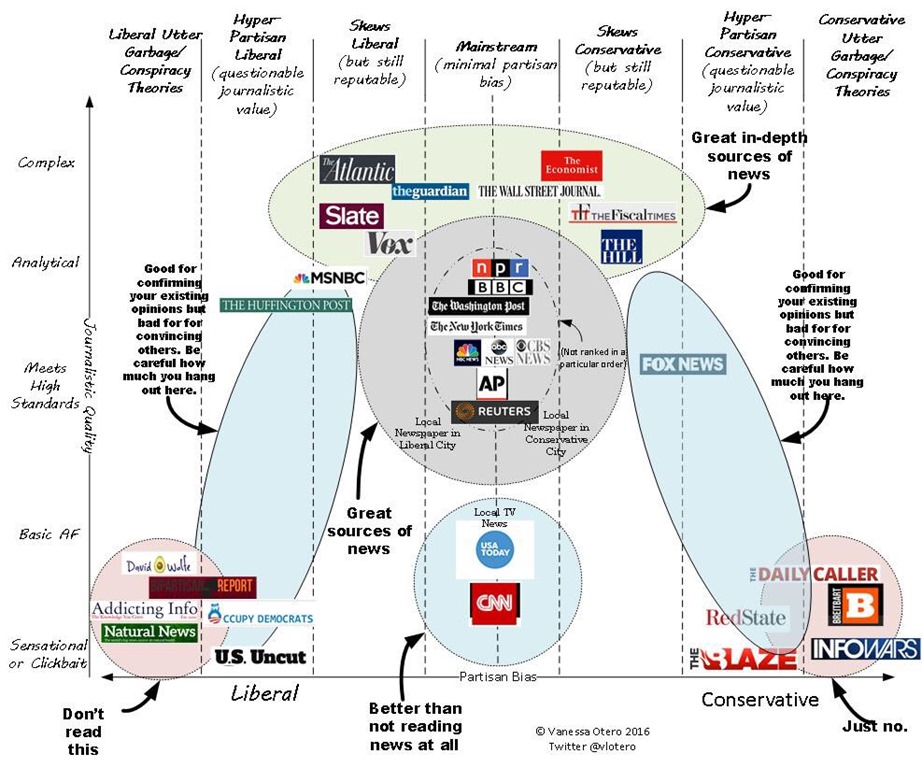
My wife Susan found this infographic on Facebook. It was created by Vanessa Otero and distributed on her Twitter feed. You can click on the image to see a larger version.

Vanessa Otero News Graph 2016

My news sources are NBC, CBS, PBS, The New York Times, NPR, The Washington Post, The Guardian, The Atlantic, Slate, Vox, and sometimes The Economist and The Wall Street Journal when I get free links. In other words, I stay close to the center of things, and by Otero’s reckoning, use sources of high standards, that can be analytical and complex.

Do I have the kind of personality that is drawn to those news sources, or did those news sources create my political personality? If you grow up reading news from sources on the lower left or right of the graphic, do you program your personality by them? In recent years I’ve met a number of people who watch Fox News all day long. These people have different personal personalities, but they often feel like they have the same political personality. They are usually paranoid about the government, believe in various kinds of conspiracies, are passionately anti-taxes, and hate when people get money from the government without working.

Do people in childhood develop particular beliefs and then migrate to news outlets that promote those beliefs, or do they get hooked on various news sources and adopt the beliefs of the news programs they watch?

Would people who watch Fox News morph into new political personalities if they switched to watching PBS news programs? If I started watch Fox News all the time, would I become conservative? I remember favoring JFK back in 1960, when I was in the third grade, and that was well before I watched the news. I’ve never liked any Republican candidate – is that because of my innate programming, or because of how I acquired my news?

When I did start watching the news, it was the CBS Evening News with Walter Cronkite, probably around 1962-63. In 1960 when we moved from New Jersey to Mississippi, I learned I didn’t like racists. As a shy kid, I was always afraid of people with strong emotions, and the racists scared the crap out of me with their raging anger. I had no idea what they were talking about. They were for Nixon. Maybe that influenced my political development. I remember getting into a playground fight with a kid who was pro-Nixon. Did that experience lean me towards the left?

When I went to tech school for computers in 1971, they taught us a phrase, GIGO (Garbage In, Garbage Out). That implies the news we consume does change us. But then, I’ve read books like The Blank Slate by Steven Pinker that counter that philosophy. I’ve also read books like Thinking Fast and Slow by Daniel Kahneman that explain how our consciousness minds aren’t too swift when it comes to making decisions. I’m almost finished with The Undoing Project: A Friendship That Changed Our Minds by Michael Lewis that profiles Daniel Kahneman, and his colleague Amos Tversky. They were two Israeli psychologists that made careers studying how we make poor choices and misunderstand reality because our gut reactions are usually wrong.

JWH

I’m Switching From NBC Nightly News To PBS NewsHour

James Wallace Harris, Thursday, December 3, 2015

I’ve been a faithful follower of NBC Nightly News for decades now. But last night’s report, with the entire show covering the mass shooting in San Bernardino, convinced me I’m not being well informed by my news source. Mass shootings are horrible, but they can’t be the only news. Neither can storms, fires, earthquakes, floods and other natural catastrophes. Nor can crime, war and politics dominate our awareness of what’s going on around the world. The NBC Nightly News has become so obsessed by sensational stories that I feel they are the only news events happening in the world each day.

NBC Nightly News

I learned far more about the San Bernardino shootings this morning by five minutes of reading The New York Times, than the 30 minutes spent watching The NBC Nightly News. Last night’s time was wasted on speculation, or watching police carefully inspect a SUV, shown from a camera above the scene. Sometimes we get the news too fast. Watching it as it happens might be exciting, but it’s often deceptive, and full of incorrect information. Network news gives us a 20 minute summary of world events, but are those stories the best ones to spend my 20 minutes of news watching? I could cover more stories by reading.

I’ve routinely watched The NBC Nightly News because it was slickly produced and I like Lester Holt and the NBC reporters. Last night I was particularly disappointed by not hearing about the climate change summit in Paris. It should be big news if more world leaders met there than anytime ever before in history. What happened in San Bernardino was horrible, and an important news story, but the climate conference deals with the fate of the world. Does NBC assume we’re not interested, or think it’s too subtle for us to understand? Or that mass shooters scare us more than a worldwide universal threat?

For now I’ve deleted The NBC Nightly News from my TiVo and added The PBS NewsHour. In the past I’ve tried to switch to just getting my news online, but for some reason I enjoy how television conveniently packages the news. So I’ll try PBS for a while. In the long run, I might need to give up on television. I’ve always avoided local news because I find it so damn depressing, but I’m wondering if I wouldn’t be better citizen if I took more interest in my own city. Then just read about the rest of the world on the Internet.

This brings up two interesting questions. First, how much time should we spend each day on the news? We all need to be well informed citizens, so how much daily time does staying informed take? Second, which topics are the most important to follow? A surprising amount of reporting are on topics that are forgettable. For example, what do we learn about the world from film clips of forest fires? Quite often NBC spends a nightly ten minutes on forest fires, floods, tornadoes, earthquakes, and other natural disasters, but they are so common that all forest fire reports look the same. And why are all the stories about fighting fires. Why not stories about managing forests to prevent fires, or how people rebuild after fires, or where do all the wild animals go in a fire? Political reporting is becoming monotonous too, usually just telling us what stupid thing Donald Trump said today.

When I think about it, I wonder if the news is packaged to pander to a specific psychological addiction in us. It’s become entertainment, not education. I’ve watched PBS NewsHour off and on, but it takes more time to consume. Let’s see if I feel better informed.

Essay #985 – Table of Contents

If We Don’t Need Newspapers, Do We Need the Network Nightly News?

To stay informed I watch NBC Nightly News, catch a documentary now and then, read several magazine articles each week, and surf the web daily.  This is fairly time consuming, but I like to keep up on what’s going down.  Some of my friends use other sources, like radio, newspapers and podcasts, which I don’t.  None of us want to be considered ignorant, ill-informed or out-of-the-loop.  With so many news sources, what’s the best method to track reality, and become well informed citizens?

nightly_news

For months I’ve been hearing reports on NBC Nightly News about the Ebola outbreak in Africa.  NBC gave me a few minutes here and there.  The other night PBS Frontline presented “Ebola Outbreak” that in 27 minutes was many times more informative than anything NBC had presented all summer.  Then I read this piece in Vanity Fair, “Hell in the Hot Zone” that  concisely summed up the history of the recent outbreak in about 15 minutes of reading.  NBC spent most of its Ebola reporting time in the last few weeks on the plight of American doctors who had been infected with Ebola, which actually told me little about Ebola and the outbreak.

In terms of massive impact on my brain, the PBS Frontline piece made the deepest emotional impression, and probably a lasting impression.  However, the Vanity Fair piece was more informative and educational.  Why were these two sources better than the NBC Nightly News?

The network  nightly news – ABC, CBS, NBC – has always been a convenient way to stay inform in thirty minutes.  If you remove the commercials, that’s really 20 minutes of content.  Most stories are just sound bites, and often viewers spend more time looking at the reporters than we do at film clips.  If you watch the film clip I linked above, and read the article link, you’ll notice no commercials or reporters.  By far, the Vanity Fair piece is the most information dense of each kind of reporting, but the documentary, with its shocking video is more impactful.  We tend to be addicted to nightly news because we love to see things happening.  The real appeal of TV news are the visuals.  These shows are good for rubbernecking at reality.  It’s fun, but is it educational?

In the course of a month I might see 300 news stories by watching the nightly news, and I might remember some of them to talk about with friends in the next twenty-four hours.  After a day I tend to forget what I’ve seen.  Generally, I only remember stuff long term when I’ve seen a longer news story, for example, like something on 60 Minutes or Frontline.  When is news empty calories, and when is news something that’s mentally nutritious and healthy?  I believe the real goal of staying informed is to become better educated about the world at large.  A diet of mesmerizing videos and sound bites might be informative but not educational.  News needs to be more than talking heads and film clips.  As an older person I’ve stuck with television news, but I think younger people have already moved on.

I’m not advocating giving up watching network news shows, or even predicting their extinction.  What I’m asking is if there’s a more efficient ways to stay informed?  I’m also asking why those ways might be more effective and educational.  One theory I have is network news stories are too short.  That we don’t get enough data about any one subject to make it memorable.  I’m wondering if we read or watch more focused and longer pieces if we’re actually learn and remember more?

I think my habit of watching television news, and a similar habit of grazing the web for news, is wasting my time.  By exploring the same news through different news sources I’m discovering a difference in how I learn and remember.

longform

Reading long essays versus short news items is showing me something important.  There is a movement called long form journalism.  Does spending twenty minutes reading one essay make you more informed than spending the same time on 10-20 smaller pieces?  I read Zite and News360 every day, and most links take me to very short news items.  Like watching the network news, I forget 99.9% of everything I read by the next day or two.  I don’t think I’ll be able to recall the exact facts from the Vanity Fair piece on Ebola, but I think I’ll know a year from now how it started, spread, and is usually contained. (It might not this time.)

There are several web sites devoted to promoting long form journalism.  These curated sites link to the best long form essays on the web and I’m wondering if they might be a replacement for the network news show.  On the other hand, there are many who attack the concept.  I think you’ll have to create your own tests to see which kind of news is the most valuable to you.  Personally, my tests favor long form.  I believe we’re addicted to short news stories because it takes less work and we’re lazy.  Read an annual volume of Best American Essays or Best American Science and Nature Writing and tell me you don’t feel more enlightened than watching a whole year of television news.

It’s interesting that long form reading seems to have coincided with the development of the tablet computer.  Fans like to create their own customize magazines with Twitter and RSS feeds.  Mobile devices allow users to read anywhere, and more comfortably, and that might explain why more people are willing to read longer essays. 

Some people will claim today’s citizens don’t have the attention span for longer articles, or that our fast pace world demands quick reading, or that the busy productive person needs to get to the facts fast.  But I’m asking:  Is quickly gobbled down data worth much?  I’m considering switching from reading Zite and News360 and just browsing several of the long form curated sites.  Will reading longer articles actually tell me about everything that was in the shorter pieces?

I wished that Google would tell us how many words are in the articles they cite in a search result.  I waste a lot of time going to articles that have little value, and all too often the pages seem full of click-bait traps.  But will I miss all the glitz, gossip and sexiness of news grazing?  Reading only long articles ignores all the filler.  Maybe filler has it’s own value, and I’ll learn that too? 

Long Form Curated Sites:

Essays about Long Form Content:

JWH – 9/12/14

Is The Daily Newspaper Dying?

I often find myself lamenting the passing of institutions I assumed would always be permanent fixtures in my life.

My parents, who grew up during the heyday of radio, long before television, lived in a world of two daily newspapers, The Miami Herald in the morning, and The Miami News in the evening.  I was even a paperboy for the News back in 1965, but it died a long time ago.  During my life I saw many cities close their afternoon papers.  Now, all over the country, morning papers are hurting, and some are even disappearing.  I’m wondering if morning papers are going the way of the buggy whip.

Newspaper sections 

My wife and I quit getting the newspaper years ago.  We kept subscribing for years because it was a lifelong habit, but seldom read it.  But we finally realized that most often our daily issues went directly to the recycle bin, and so we stopped taking The Commercial Appeal.  I see fewer people bringing the paper to work, and I assume there are college kids at the university where I worked that never got into the habit of reading the paper with breakfast.

This is sad.  Months ago I bought an issue of The New York Times to read the old fashion way, but I couldn’t. I love reading The New York Times online, but I no longer had the patience to read a printed paper, which involves a lot of flipping, folding, jumping from section to section, and getting ink on my fingers.  My old eyes find it painful to read the paper’s small print.  Susan and I aren’t alone in giving up on our hometown paper, there’s even a web site, Newspaper Death Watch, devoted to the passing of this very old tradition.  Should we all go back to subscribing to save this fading technology?  Are there things newspaper publishers could do to revitalize their product?

I read books and listen to music on electronic devices, so why don’t I read my local paper on my iPad?  On the new miniseries Under the Dome, a newspaper reporter talks to an older woman who tells her she doesn’t take the paper, but gets her news from the Internet like everyone else.  Ouch. 

We have to think about why people were so devoted to newspapers in the past.  For many pre-Internet citizens, reading the paper was the only form of reading they did.  The paper offered news, gossip, social media, advertisements, job want ads, for sale listings, sports scores, stock and bond quotes, cartoons, horoscopes, movies times, recipes, letters to the editor, wedding announcements, photos, etc.  Newspapers packed a lot of entertainment value.  And from this list we can see the answer to why papers are losing subscribers.  The Internet provides the same content, but faster, better, cheaper, and it’s highly customized.  In fact, smartphones, pulling content from the Internet, provides people exactly what they got from newspapers and more, but in a much handier delivery and reading system.  Progress marches on.  It’s cruel, but so it goes.

Newspapers were a delivery system for communication and content – pretty much a printed internet.  I feel sad that all those reporters, editors, linotype operators, pressmen, truckers, delivery people have lost their jobs, but I hope they got jobs at new Internet businesses.  I’d hate to think that local people lost their jobs to out-of-town companies. 

Long before the Internet, many reporters had moved to TV, and we have far more TV stations with news programs than we ever had papers.  So what I’m lamenting isn’t a lack of reporting, but the system in which the news was reported.   If you’re interested, you might find the Newspaper Death Watch interesting to read, it’s subtitle is “Chronicling the Decline of Newspapers and the Rebirth of Journalism.”

To be honest, I’ve never been happy with television journalism, so I wonder if there isn’t something potentially better than the printed newspaper and local TV news show?  More and more papers are working with paywalls to create online newspapers, that include print, photos, sound and video.  The New York Times is excellent, except for their pricing, but if everyone subscribed to it, where would we get local, state and regional news?  Can local news sites make a go of providing news that can compete with TV and national web sites?  Is it possible to make hometown news site?

Anyone can collect their favorite links to a bunch of sites and recreate much of the content people used to get from their local newspaper.  Can a newspaper publisher, with their editors, reporters, and staff create a central site that essentially recreates the old features of a newspaper?  How many people would give up their favorite news, weather, TV listing, movie listing, Craigslist apps to use a centralized service?  Has the App-ization of the world killed off a general purpose tool like the newspaper?  Probably.

I shouldn’t mourn the victims of progress, but I do, even though my buying habits are killing what I miss.  I recently bought my local paper for nostalgia’s sake.  I didn’t like it.  I was like that baby on the YouTube video trying to use a magazine after playing with an iPad.  It just didn’t feel right.  I guess I’m dumb.  I keep buying vinyl records, even though they’re a pain in-the-ass to play.  And I still buy books even though my eyes love my Kindle.  And I keep writing crying-in-my-beer blog posts about the old ways disappearing.  When will I learn?

JWH – 6/30/13