The Limits of Memory

by James Wallace Harris, 3/3/25

It annoys me more and more that I can’t recall names and nouns. I don’t worry yet that it’s dementia because most of my friends have the same problem. But I’ve been thinking about my ability to remember and realized that I’ve never been good at remembering things.

I know I have aphantasia, which means I can’t visualize mental images in my head. I wonder if there’s a connection between not visualizing images and poor memory? People with astounding memory often use mental images as mnemonics.

The ability to remember is on a spectrum. On one end of this range, are rare individuals with photographic memories, while at the other end, are a tiny group with no short-term memories.

My new theory. One possible reason I have poor memory is my education. More precisely, how my personality approached learning as a kid. I considered K-12 a thirteen-year prison sentence. I paid just enough attention to pass tests. I mostly got Cs and Bs, with a rare A and D. I remembered things just long enough to pass a test.

I was never motivated to remember for the long haul.

I do like to learn. I’ve read thousands of books. Of course, most of them have been science fiction, but I also love nonfiction. However, information leaves me as fast as I consume it.

I’m starting to wonder if I would have a better memory if I had developed a different approach to school and learning. Primary and secondary education aim to give kids a well-rounded education. And in college, over half the courses are required.

The idea is we should learn as much as possible about the world. Is that a valid approach? After school and college, we specialize in whatever our work requires, and become selective about what we study for fun. Those subjects are what we remember best.

Reality is too big to know everything. What we need to learn is how to coexist with reality. We need the knowledge to fit in and survive. Would knowing more about fewer subjects help? Or would memorizing the deep dynamics of how things work better yet?

I do believe the more we know, the wiser we are. But there are limits to what we can understand and memorize.

I’m currently reading Nexus by Yuval Noah Harari. In chapter 2, Harari shows how fiction drives our societies, not truth. We live by stories we want to believe. It’s much easier to vaguely understand fiction than to learn the details of reality. For example, more people accept The Bible than biology. That suggests a natural tendency to minimize how much we know.

That would be okay if the Earth were sparsely populated. But we live in dense, complex societies racing at the speed of computer networks and artificial intelligence. Living by fiction is fine if the year is 500 BCE, but we live in 2025. CE.

Let me give one example of what I mean by learning less to know more. I’ve been reading American history books to understand how our society got to now. That gives me a certain level of wisdom about our problems. However, I’m also reading about French history, especially the French Revolution and 19th century history. Seeing the parallels ups my level of understanding. But do I need to read the history of every country now and then? What I see is common dynamics. Reading more histories will give me more examples of the same dynamics.

The same is true of religion. I like studying the history of the Bible. I’ve also studied Buddhism and Hinduism. As I do, I see common dynamics at work. Harari’s new book Nexus points out the common dynamics of society and history.

The educational philosophy I experienced growing up pushed me to memorize a million details. What I needed to understand and remember is the fewer dynamics of reality.

People like to live by fiction because it’s easier. Politics is currently overwhelmed by fiction. Read Nexus to understand why I say that. The question we have to answer is if we can reject fiction.

Real information is seeing patterns in reality. Wisdom is seeing patterns in the patterns. The only real cognitive tool we’ve ever developed to understand reality is science. However, it’s statistical, and hard to learn and understand. We live in a time of simplex thinking. People see or are told about one pattern and they accept that as a complete explanation of reality. All too often, that pattern is based on a cherished story.

We can’t live by memes alone. Nor can we live by infinite piles of memorized details. The only way to understand is to observe consistent patterns. But it has to be more than two or three. That can lead to delusions. Even anecdotal evidence of ten occurrences could still deceive. How can this lead to learning more from less? It’s a paradox.

Last year, I read a three-volume world history. It provided hundreds of examples of strong man rule over thousands. of years. But how many kids, or citizens can we get to read a three-volume world history? Would a listing of these leaders, including the wars they started, and the numbers of people who died because of their leadership be just as effective? Would all the common traits they shared help too? Such as wanting to acquire more territory, or appeals to nationalism?

Could we create a better educational system with infographics and statistics? I don’t know. I do know I tried to process too much information. I also know that I only vaguely remember things. Memory has limits. As does wisdom.

JWH

How Well Can You Read, Comprehend, Analyze, and Summarize an Essay?

by James Wallace Harris, 12/11/24

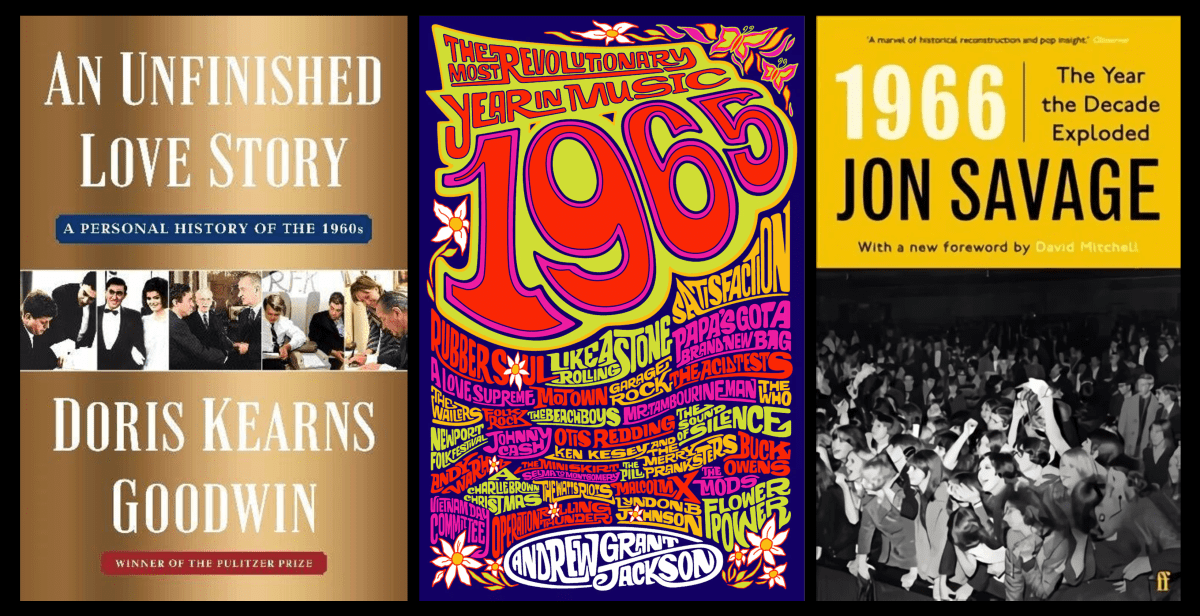
I recently read An Unfinished Love Story by Doris Kearns Goodwin. It’s about how Doris and her husband Richard went through dozens of boxes containing papers that Richard saved from his time as a speechwriter for John F. Kennedy, Lyndon Baines Johnson, Eugene McCarthy, and Robert Kennedy. Richard was in his eighties and wanted to write a memoir about those times. Doris agreed to help him.

The book is subtitled “A Personal History of the 1960s.” An Unfinished Love Story resonates with me because I lived through that decade too. I’m now rereading their book closely. I want to comprehend what happened in the 1960s and reconcile it with my memories. I do that by looking up original sources mentioned and studying them.

However, I’ve hit a cognitive barrier. I’ve never been a great student, much less a scholar. I have trouble focusing. I can’t stick to any subject long enough to comprehend it. These failings are getting worse as I age.

I’ve discovered a tool that helps me understand my limitations. Maybe it will help me overcome them. That tool is Google NotebookLM. It’s an AI tool that digests information. You link to web pages or upload your documents, and it will analyze that content and then create several kinds of summaries.

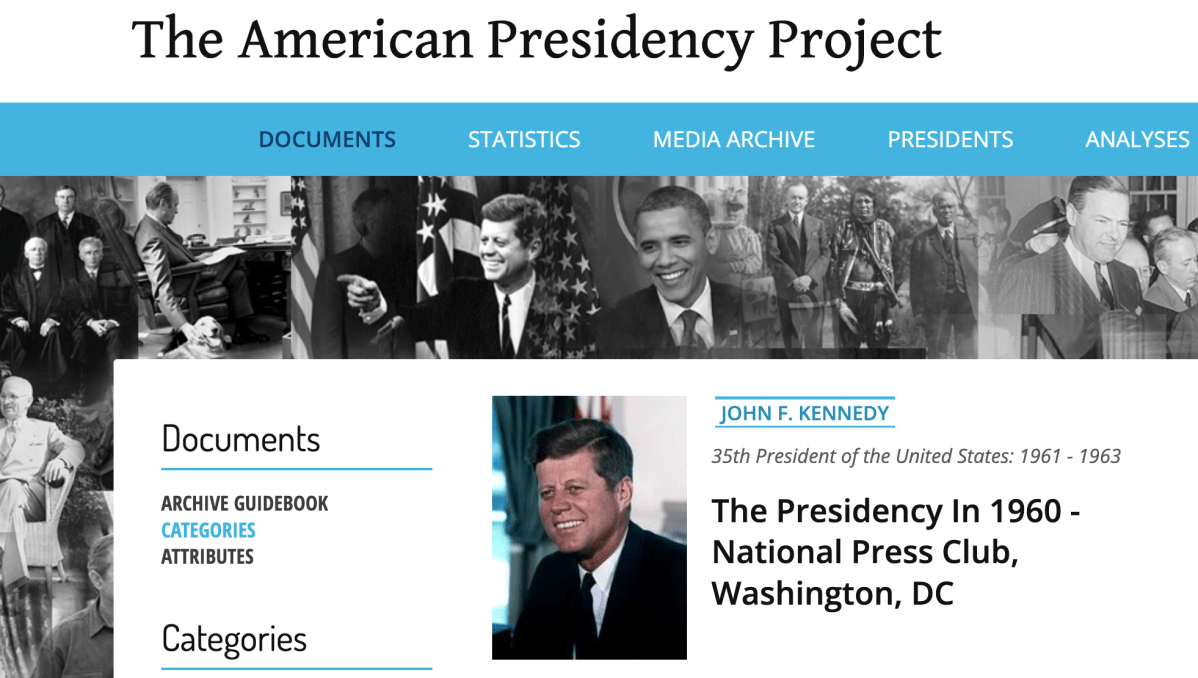
I tested Google NotebookLM with a speech that Richard Goodwin helped write for John F. Kennedy when he was campaigning for president in 1960. It was given at the National Press Club on January 14, 1960. You can read it here. I also gave it this article about that speech. NotebookLM then generated several files that summarized the content of those two documents. The most startling was an AI-generated podcast. You can listen to it here. (You’ll need a free Google account, but anyone using Google email should already be logged in.)

That podcast sounds like an NPR segment. It’s spooky how real the two people sound. But the technology to produce this artificial conversation isn’t what I want to showcase. It’s how NotebookLM understood the speech. It’s a level of reading comprehension that I envy. If I spent a week studying that speech I don’t think I could reach that level of understanding.

Damn, damn, damn!

First of all, Kennedy’s speech was a distillation of extensive knowledge of American political history by Kennedy, Richard Goodwin, and Ted Sorensen. Kennedy expected his audience to decode that knowledge, and to understand his plan for the coming decade. I doubt few did, especially at the level that NotebookLM did.

From reading An Unfinished Love Story, I believe Richard Goodwin could process knowledge like NotebookLM, which is why he was such a brilliant speechwriter. I can’t do anything like that. From this experience, I want to study the results produced by NotebookLM to see if I can learn from it.

Even when I think I understand what I read, I doubt I comprehend even ten percent. I’m quite sure a scholar could write a five-hundred-page book just about that one speech.

NotebookLM created several results. I want to study what it does and see if I can learn to use its techniques.

Here is the summary version.

Briefing Doc: John F. Kennedy's Vision of the Presidency
Sources:

"All notes 12/11/2024" (Study Guide and FAQ on Kennedy's Speech)
"Pasted Text" (Full Text of Kennedy's Speech at the National Press Club, January 14, 1960)
Excerpts from "The Presidency in 1960 (Remarks at the National Press Club) | Teaching American History"
Main Themes:

Active and Engaged Presidency: Kennedy argues for a strong, proactive president who actively shapes policy and drives the national agenda. He rejects a "detached, limited concept of the Presidency" in favor of a leader willing to "place himself in the very thick of the fight."
Legislative Leadership: The president must be an active participant in the legislative process, not simply a "casual bystander." This includes initiating legislation, collaborating with Congress, and using his influence to ensure passage of vital bills.
Party Leadership: Kennedy believes the president must be an active leader of his political party, utilizing its resources and working closely with party leadership to advance his agenda and strengthen the democratic process.
Moral Leadership: The president must not only represent prevailing sentiment but also inspire the nation, set a high ethical standard, and mobilize the public to address challenges and seize opportunities.
Key Ideas and Facts:

Critique of Eisenhower: Kennedy contrasts his vision with Eisenhower's perceived passivity, arguing that the nation needs a more engaged leader for the challenges of the 1960s. He criticizes Eisenhower's preference to remain above politics, stating, "no President, it seems to me, can escape politics."
Historical Examples: Kennedy invokes presidents like Lincoln, Theodore Roosevelt, and Wilson as exemplars of his ideal. He highlights their willingness to use presidential power, exert legislative leadership, and champion moral causes.
Constitutional Vision: While acknowledging the importance of Congress and cautioning against executive overreach, Kennedy views the presidency as the driving force in the American system. He stresses the president's unique role in foreign policy and domestic policy initiation.
Four Key Roles: Kennedy outlines four essential roles for the modern president: Chief Executive, Legislative Leader, Party Leader, and Moral Leader. Each role requires active engagement and a willingness to utilize the full resources of the office.
The Lincoln Anecdote: Kennedy uses the story of Lincoln signing the Emancipation Proclamation to illustrate the kind of decisive and resolute leadership he believes is essential for the presidency. "Lincoln's hand did not tremble. He did not hesitate. He did not equivocate. For he was the President of the United States."
Important Quotes:

On the need for an active president: "The American Presidency will demand more than ringing manifestoes issued from the rear of the battle. It will demand that the President place himself in the very thick of the fight."
On the president's role as Chief Executive: "He must be prepared to exercise the fullest powers of his office – all that are specified and some that are not."
On the importance of legislative leadership: "The President must initiate policies and devise laws to meet the needs of the nation. And he must be prepared to use all the resources of his office to ensure the enactment of that legislation – even when conflict is the result."
On the president's responsibility as party leader: "If he neglects the party machinery and avoids his party's leadership – then he has not only weakened the political party as an instrument of the democratic process – he has dealt a blow to the democratic process itself."
On the importance of moral leadership: "We will need in the sixties a President who is willing and able to summon his national constituency to its finest hour."
Discussion Points:

To what extent does Kennedy's vision of the presidency align with the principles of a constitutional republic?
Does Kennedy sufficiently address the potential risks of an overly powerful executive branch?
How does Kennedy's vision compare to the presidencies that followed him?
This briefing document summarizes the main themes and key ideas of John F. Kennedy's vision for the presidency. It is important to note that this is just one interpretation of his speech, and further analysis and discussion are encouraged.

Here is a FAQ it generated:

FAQ: John F. Kennedy's Vision of the Presidency
1. What is the central theme of John F. Kennedy's speech at the National Press Club?
This speech, delivered in January 1960 during his presidential campaign, focuses on Kennedy's vision for the modern presidency. He argues that the American people deserve to understand a candidate's philosophy regarding the presidency because it shapes their approach to all other issues.

2. How does Kennedy differentiate his view of the presidency from President Eisenhower's?
Kennedy critiques the "detached, limited concept of the Presidency" he observed during the Eisenhower administration. He advocates for a more active and engaged president who proactively addresses pressing issues and drives the national agenda. He contrasts this with Eisenhower's perceived passivity and delegation of responsibilities.

3. What historical examples does Kennedy use to illustrate his preferred presidential model?
Kennedy invokes figures like Abraham Lincoln, Theodore Roosevelt, and Woodrow Wilson as exemplars of strong, effective presidents. He highlights their willingness to utilize the full extent of presidential power, exert legislative leadership, and champion moral causes, even at the risk of political unpopularity.

4. According to Kennedy, what are the essential roles of a modern president?
Kennedy outlines several key roles:

Chief Executive: A hands-on leader who actively manages government departments, resolves conflicts, and makes crucial decisions, particularly in foreign policy.
Legislative Leader: A president who proactively shapes legislation, collaborates with Congress, and uses their influence to ensure the passage of vital bills.
Party Leader: A president who actively engages with their political party, utilizing its machinery and leadership to advance their agenda and strengthen the democratic process.
Moral Leader: A president who inspires the nation, sets a high ethical standard, and mobilizes the public to address critical challenges and seize opportunities.
5. How does Kennedy view the relationship between the president and Congress?
While acknowledging the importance of Congress's legislative role and cautioning against executive overreach, Kennedy believes the president should actively lead and collaborate with Congress. He emphasizes that the president must be prepared to use all available resources to secure the enactment of crucial legislation.

6. What is Kennedy's stance on the president's role as a party leader?
Kennedy rejects the notion that a president should remain aloof from politics. He believes the president must embrace their role as party leader, engaging with the party machinery and working closely with party leadership to advance their agenda and strengthen the democratic process.

7. What is the significance of the Abraham Lincoln anecdote in Kennedy's speech?
Kennedy concludes by recounting Lincoln's unwavering commitment to the Emancipation Proclamation, even when facing internal opposition. He uses this story to illustrate the decisive and resolute leadership he aspires to embody as president.

8. What message does Kennedy aim to convey to the American people through this speech?
Kennedy seeks to persuade the public that the nation needs a strong, proactive president who will actively engage in solving national and international problems. He aims to differentiate himself from Eisenhower's approach and assure voters that he is the leader the times demand.

Here is a quiz it created:

The Presidency in 1960: A Study Guide
Quiz

Instructions: Answer the following questions in 2-3 sentences each.

According to John F. Kennedy, what is the central issue that should be addressed in the 1960 presidential campaign?
Why does Kennedy argue that good intentions are not enough to make a successful president?
What is the "restricted concept of the Presidency" that Kennedy critiques?
What does Kennedy mean when he says that the next president must be the "Chief Executive in every sense of the word"?
Why does Kennedy believe that the president must be an active legislative leader?
How does Kennedy contrast the legislative leadership styles of Theodore Roosevelt and Calvin Coolidge?
What criticism does Kennedy offer of President Eisenhower's approach to party leadership?
Why does Kennedy believe that Abraham Lincoln is a good example of party leadership?
How does Kennedy define the president's role as a moral leader?
What specific historical example does Kennedy use to illustrate the kind of decisive leadership he advocates for?
Answer Key

Kennedy argues that the central issue of the 1960 campaign is the Presidency itself. He believes the public needs to understand how a candidate views the role, powers, and limitations of the office.
Kennedy uses the examples of Woodrow Wilson and Warren G. Harding, both considered good men, to illustrate that good intentions alone are insufficient for presidential success. Different conceptions of the Presidency can lead to vastly different outcomes.
The "restricted concept of the Presidency" refers to a passive approach where the President primarily reacts to events rather than actively shaping them. Kennedy argues this approach is inadequate to address the challenges of the 1960s.
Kennedy believes that being "Chief Executive in every sense of the word" means actively engaging with complex problems, initiating action, and taking responsibility for the outcomes of his administration.
Kennedy argues that the President must be an active legislative leader to ensure the enactment of policies that meet the nation's needs. He contends that Congress should not dominate the executive branch nor should the President shy away from conflict with Congress.
Kennedy contrasts Theodore Roosevelt, who actively fought for his legislative agenda even at the cost of Congressional popularity, with Calvin Coolidge, who took a more passive approach and ultimately failed to advance key initiatives.
Kennedy criticizes Eisenhower's preference to remain above politics, arguing that a president cannot avoid politics and must actively engage with his party to advance his agenda and the democratic process itself.
Kennedy cites Lincoln's passionate engagement in politics, even closely following the results of state elections, as a model for how a president should actively lead his party.
Kennedy defines the president's role as a moral leader as one who goes beyond representing current sentiment and instead inspires the nation to meet challenges and achieve great ideals.
Kennedy uses the example of Lincoln signing the Emancipation Proclamation, despite potential backlash, to highlight the kind of resolute and decisive leadership he believes is essential for the presidency.
Essay Questions

Analyze Kennedy's vision of the modern presidency. What are its key characteristics? How does it differ from the "restricted concept of the Presidency" he criticizes?
Evaluate Kennedy's assessment of the presidencies of Theodore Roosevelt and Calvin Coolidge. How do their approaches to legislative leadership exemplify his broader arguments about the office?
To what extent does Kennedy's call for a "moral leader" in the White House align with the principles of a constitutional republic? Discuss the potential benefits and risks of such leadership.
Kennedy claims that "legislative leadership is not possible without party leadership." Analyze this statement, considering the relationship between the president, Congress, and political parties.
Compare and contrast Kennedy's conception of the presidency with another president or political thinker of your choice. How do their views converge and diverge? What might account for these differences?
Glossary of Key Terms

Chief Executive: The role of the President as head of the executive branch of government, responsible for enforcing laws and overseeing the administration of government agencies.
Legislative Leadership: The President's role in influencing the legislative process, proposing legislation, working with members of Congress, and advocating for the passage of bills.
Party Leadership: The President's role as leader of his political party, setting the agenda, mobilizing support, and working to elect party members to office.
Moral Leadership: The President's role as a national figurehead who sets a moral tone for the country, inspires citizens, and advocates for ethical principles.
Restricted Concept of the Presidency: A passive approach to the presidency where the president primarily reacts to events and defers to Congress or other actors.
Bully Pulpit: A term coined by Theodore Roosevelt to describe the presidency as a platform from which to advocate for policies and ideas.
Grand Alliance: A reference to the alliance of nations that fought against the Axis powers in World War II, emphasizing the president's role as a global leader.
Divided Government: A situation in which the presidency and Congress are controlled by different political parties.
Emancipation Proclamation: A presidential proclamation issued by Abraham Lincoln in 1863 that declared the freedom of slaves in Confederate-held territory.

Here is an outline of sources:

John F. Kennedy's Vision of the Presidency: A Table of Contents
Source 1: Excerpts from "All notes 12/11/2024"

The Presidency in 1960: A Study Guide
Quiz: A series of 10 short-answer questions designed to test comprehension of John F. Kennedy's vision of the presidency as articulated in his 1960 National Press Club speech.
Answer Key: Provides concise answers to the quiz questions, summarizing Kennedy's arguments regarding the importance of presidential leadership, the limitations of a passive approach, and the need for active engagement in legislative, party, and moral matters.
Essay Questions: Poses 5 in-depth essay prompts that encourage critical analysis of Kennedy's vision of the presidency, his assessment of historical presidencies, the role of moral leadership, and the relationship between the president, Congress, and political parties.
Glossary of Key Terms: Defines 10 essential terms related to presidential powers and roles, including "Chief Executive," "Legislative Leadership," "Party Leadership," "Moral Leadership," and "Restricted Concept of the Presidency," providing a conceptual framework for understanding Kennedy's arguments.
FAQ: John F. Kennedy's Vision of the Presidency
8 Frequently Asked Questions and Answers: Addresses key aspects of Kennedy's National Press Club speech, including his central theme, critiques of Eisenhower's approach, historical examples used, essential roles of a modern president, and the relationship between the president and Congress. This section provides a concise overview of Kennedy's arguments.
Source 2: Excerpts from "January 14, 1960 - Senator John F. Kennedy speaks at National Press Club, Washington, DC."

Fragment 1: This excerpt captures Kennedy's criticism of the Eisenhower administration's "restricted concept of the Presidency," highlighting the need for a more active and engaged approach to address the challenges of the 1960s.
Fragment 2: This segment emphasizes the need for a president who actively engages in the legislative process, contrasting this with a "casual bystander" approach that Kennedy deems insufficient.
Source 3: Excerpts from "Pasted Text"

Introduction: Sets the stage for Kennedy's argument by highlighting the importance of understanding a candidate's vision of the presidency and framing it as the central issue of the 1960 campaign.
Critique of the Eisenhower Administration: Kennedy critiques the "detached, limited concept of the Presidency" he observed during the Eisenhower years, arguing for a more active and engaged presidential role.
The Demands of the Times: Kennedy outlines the challenges facing the nation, both domestic and foreign, and argues that they require a strong, proactive president.
The President as Chief Executive: This section emphasizes the president's role as a hands-on leader who actively manages government, resolves conflicts, and makes crucial decisions, particularly in foreign policy.
The President as Legislative Leader: Kennedy argues for a president who actively shapes legislation, collaborates with Congress, and uses their influence to ensure the passage of vital bills.
The President as Party Leader: Kennedy rejects the notion of a president staying above politics and stresses the importance of engaging with the party machinery to advance an agenda and strengthen the democratic process.
The President as a Moral Leader: This section highlights the president's role as a national figurehead who sets a moral tone for the country, inspires citizens, and mobilizes the public to address critical challenges.
The Example of Abraham Lincoln: Kennedy concludes with a powerful anecdote about Lincoln's unwavering commitment to the Emancipation Proclamation, emphasizing the decisive and resolute leadership he aspires to embody as president.
Source 4: Excerpts from "The Presidency in 1960 (Remarks at the National Press Club) | Teaching American History"

Context and Introduction: Provides historical background and sets the context for Kennedy's speech, emphasizing the significance of his remarks within the broader history of the American presidency.
Kennedy's Speech Excerpts: Features key excerpts from Kennedy's National Press Club address, focusing on his critique of Eisenhower's approach, his vision for the modern presidency, and the importance of active leadership in various roles.
Discussion Questions: Poses thought-provoking questions that encourage readers to analyze Kennedy's conception of the presidency, his use of historical examples, and the relationship between the president and Congress.
Footnotes: Provides explanatory notes on historical figures and events mentioned in Kennedy's speech, enhancing understanding and facilitating further research.
This table of contents provides a detailed overview of John F. Kennedy's vision of the presidency as articulated in his 1960 National Press Club speech and related sources, offering insights into his beliefs about presidential leadership, the role of the president within the constitutional order, and the challenges facing the nation at the dawn of the 1960s.

But the truly dazzling product was the podcast.

Many people will use NotebookLM to help them write, or even let NotebookLM create their content. I watched one YouTuber use NotebookLM to produce a blog and podcast. I don’t want AI doing my work. I want to learn how to work at an AI level.

JWH

Reading History Books About Events I Originally Watched on Television

by James Wallace Harris, 12/8/24

The 1960 U.S. presidential election is the first one I remember, but just barely. I was eight years old. My father was for Nixon and my mother for Kennedy. I decided I liked Kennedy because he was younger, more dynamic and had a good-looking wife. Even at eight, good looking women were often a deciding factor. I remember getting in a fight in the school playground because I was for Kennedy and the other kid was for Nixon. Neither of us got to decide the issue because a teacher pulled us apart.

During the Kennedy years I didn’t watch TV news. I would sometimes stay home from school to watch the Mercury space launches. Back then the TV news departments of each network would take over all broadcasting. In the first half of the 1960s, the space program was about the only real-world activity I paid any attention to.

I did pay some attention during the Cuban Missile Crisis in 1962, mainly because I lived on Homestead Air Force Base, and everyone talked about it constantly. I remember having duck and cover drills at Homestead Air Force Base Elementary, but I was disappointed when there were no real A-bombs dropped. (I was very immature for my age.)

I didn’t become a news watcher until Kennedy’s death. I remember that weekend, my family watched the news constantly, and the following week too. That’s when I started following Walter Cronkite. I turned twelve three days after Kennedy was shot.

The news also became exciting in February of 1964 when The Beatles came to America. It was during 1965 that older boys I knew began worrying about being drafted, and I started paying attention to news about Vietnam.

The CBS Evening News was my main source of information about life beyond my own little world during the 1960s. I sometimes got to see The Today Show on NBC because my mother watched it while making breakfast. I liked that show because I found Barbara Walters hot. (Okay, I’ve already said I was a weird kid.) Sometimes I would watch news specials or documentaries. While in the ninth grade (1965-66) I had a civics course. But for the most part I just wasn’t that aware of what was going on in the world except for Top 40 AM music.

I don’t remember reading the paper, The Miami Herald, until 1968. I did start to read magazines in 1965, but that was haphazard. People would give my parents copies of Life, Time, Newsweek, Look, Saturday Evening Post, and National Geographic from time to time, and I found them fascinating. On my own, after 1965, I would buy Popular Science, Popular Mechanics, and MAD Magazine. During twelfth grade (1968-69) my English teacher got me interested in literary fiction, and I subscribed to Saturday Review with money I made from working in a grocery store. I really didn’t understand it though. In late 1968 or early 1969, I got hooked on Rolling Stone magazine and sometimes bought Creem when it started publishing.

A whole lot of what I knew about the counterculture came from Life Magazine.

If you think about it one way, television and magazines offered a fairly diverse view on what was happening in the world, but squinted at it another way, it was a rather limited view.

In December 2024, I’ve been reading three books about the 1960s that explore events I encountered in two minute stories on TV, or read about in a few pages in a magazine when they first happened. Some of those short snippets of current events made huge impressions on me as a kid. They shaped who I thought I was. The history books makes me realize I was mostly uninformed.

The reality of the 1960s is I was a kid going to school every day except for long summer vacations. I started 1960 in New Jersey but moved to Mississippi then to Florida then to South Carolina back to Florida, then Mississippi again, and back to Florida. I went to thirteen different schools during the 1960s. The only newsworthy event I saw live was the launch of Apollo 8. I had a chance to see Kennedy in 1962 when he came to Homestead Air Force Base. They let us out of school to see him, but me and my friends went fishing instead. My sister was at Dinner Key Auditorium when Jim Morrison flashed the crowd. I got to meet an astronaut in 1968, but I’ve forgotten which one. And this is hardly newsworthy. I got to see Cream play during their farewell tour in 1968. Oh, and I attended one SDS rally.

In other words, I experienced the legendary Sixties mostly via AM radio, television, and magazines. I did have long hair sometimes, and I sometimes messed around with drugs, but I was hardly a hippie or a radical. I did get into the counterculture more in the 1970s, but that’s another story.

The point of this long-winded essay is I’m now reading history books about years I lived through. I can contrast my memories to behind the scenes accounts of things I got from soundbites. That’s quite enlightening.

We live with the illusion that we think we understand what is real and true. We delude ourselves that we make decisions on relevant information. But we don’t. If I could have read the history books about the sixties I’m reading in old age when I was young, I could have gotten closer to seeing reality.

Timothy Leary and Aldous Huxley, two heroes of my youth, claimed that LSD opened the doors of perception, and that might be true on a nonverbal level, but a deep reading of history books is far greater at revealing reality that we can comprehend on a verbal level.

Lately, I’ve been reading that reading is going out of fashion with young people. That’s a shame. Even back when I was a teen, and only got superficial understandings about the events around me from superficial news sources, it did make me more aware.

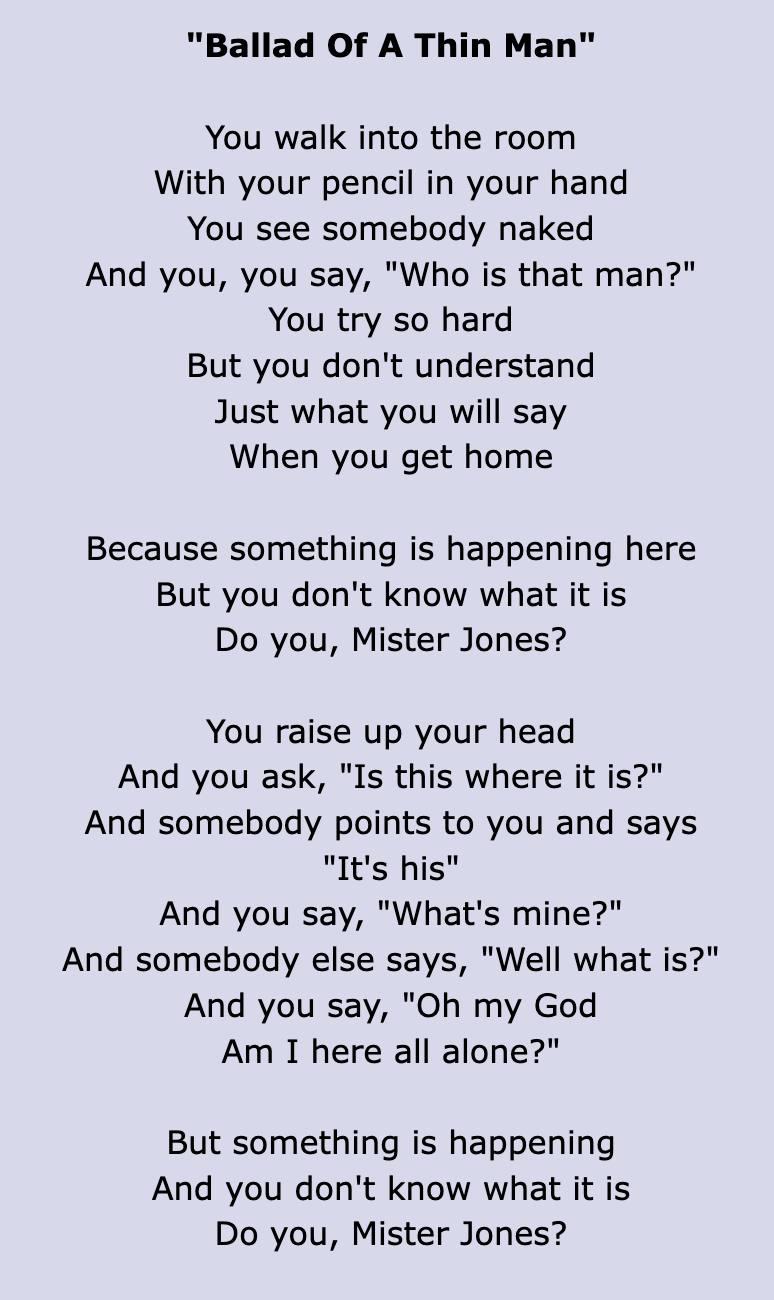
The three books above are filling in details on things happening around me as I was growing up. I’m reminded of Bob Dylan’s “Ballad of the Thin Man.”

I realize I’ve been Mr. Jones my whole life, and I’m still trying to figure out what happened.

JWH

Meditating on a Meme

by James Wallace Harris, 11/28/24

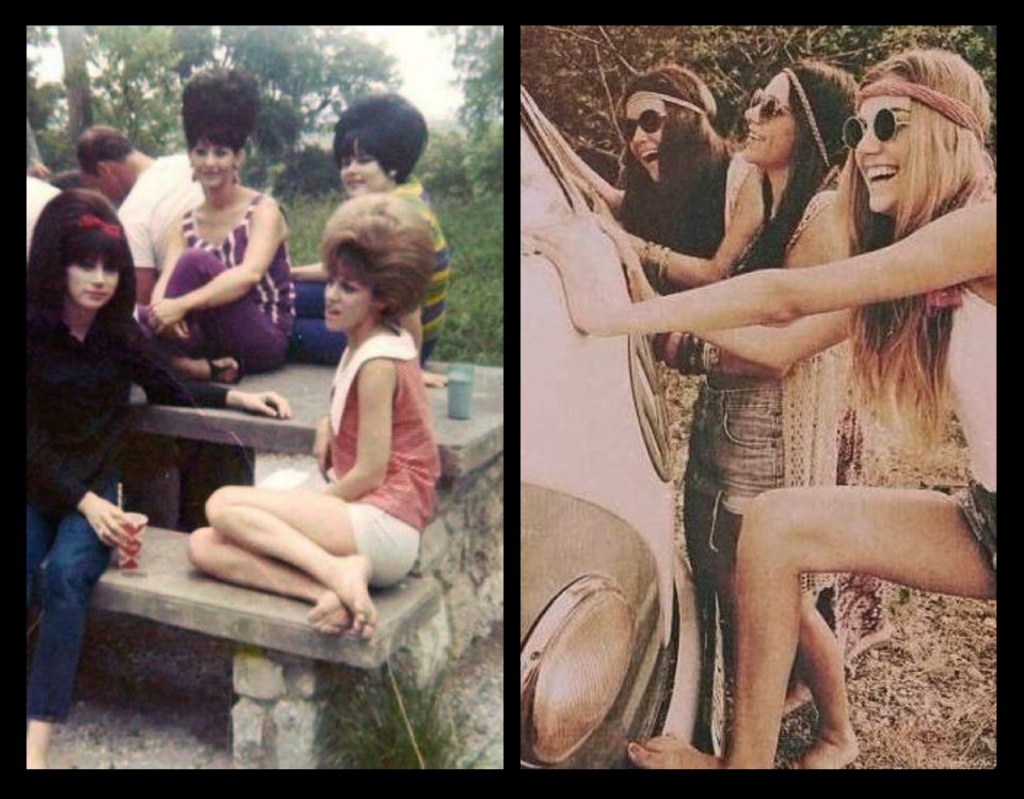
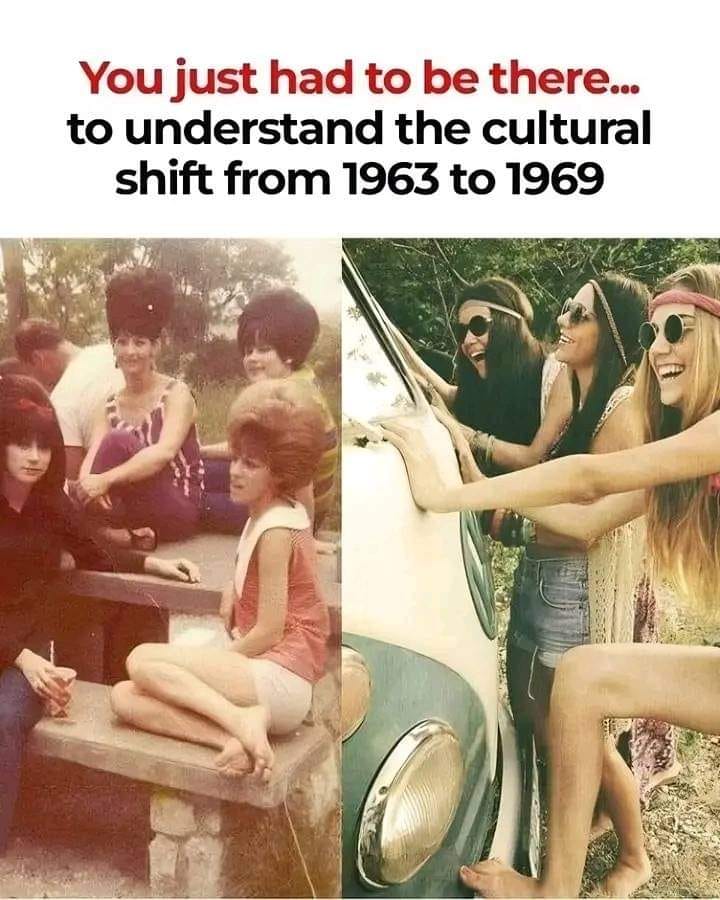
Seeing the above photos as a meme on Facebook made me think about how much people, society, and pop culture changed in the 1960s.

If a picture is worth 1,000 words, then are two pictures only worth 2,000 words? I don’t think so, I think it’s 1,000 words times 1,000 words, or 1,000,000 words. I could easily write that many from all the ideas my mind has generated since I began meditating on those photos.

Here’s the original meme from Facebook:

I was eight on 1/1/60 and eighteen on 12/31/69. I have always thought the longest years of my life were from 1963 to 1969 because so much happened to me and the world I lived in during that time. For folks who didn’t grow up in the sixties, it was much more than what you can learn from watching Grease or American Graffiti and contrasting it with Hair or Woodstock.

When I first saw the meme above I instantly thought about how rock and roll music of the 1950s ended up becoming the rock music of Woodstock. I’ve tried several times just to write an essay about that, but after typing over 5,000 words, I realize I’ve barely hinted at what I could say. That’s too long for a blog post.

I recommend that you find two photos that bracket your adolescent years or the decade you identify with the most and meditate on them. Start with remembering every place you lived and what you did each year. Remember your family and friends, your pets, your homes, your schools and workplaces, the clothes you wore, all the activities you pursued, everything you wanted to buy. Then write the shortest essay that makes it all coherent. You will then feel the mental anguish I am feeling right now.

Then branch out in your meditations. The easy and fun things to contemplate are the changes in pop culture — how music, movies, books, TV shows, games, and technology evolved over ten years. But then move on to the political and social changes. That’s when things get heavy. Can you connect your firsthand experiences with all those external events? Have you ever compared the life you lived to what you saw on the TV news every night?

Every one of us has the life experience to write a Proust-size novel and has lived through enough social change to write a series of history books about the formative decade of our lives. If you don’t think so, meditate more on the two photos you have selected.

I turned seventy-three on Monday, and getting old has made me more susceptible to memes about the past. My memories are fading away so I desperately want to cling to them. Emotions gnaw at me to make sense of everything I’ve experienced. The urge is to put it all down in words, but I don’t have what it takes to do the job and do it precisely.

There is an undefinable mental barrier that keeps me from organizing my thoughts into coherent histories. And I’m not talking about writing something worthy of publication for others to read, but just producing a narrative that makes sense of things for myself about myself and what I’ve learned. The older I get, the more I want to understand.

This essay started out about when rock and roll music became rock music. After several drafts and much contemplation, I narrowed it down to the summer of 1965 when I first heard Bob Dylan’s “Like a Rolling Stone” on the radio. As I kept trying to document my theory, I realized I could write a whole book on it.

Then as I was researching the subject, I found that Andrew Grant Jackson had already published the book I wish I had written, 1965: The Most Revolutionary Year in Music. His book is what I wanted to write in this essay when I first saw the meme above.

The Kindle edition is currently $2.99, and it’s a perfect example of what I’m talking about when I suggest we should chronicle our lives. Even if you don’t buy the book, read the sample at Amazon. I feel the format of organizing the narrative around a month-by-month description of what was happening is a great template to use for writing about memories.

JWH

MY BRILLIANT FRIEND by Elena Ferrante

by James Wallace Harris, 10/19/24

Technically, My Brilliant Friend by Elena Ferrante is the first novel in a four-volume sequence that is collectively referred to as the Neapolitan Novels. Now that I’ve read all four books, I dislike that tagline for the whole story. The four books are really one whole novel, and even though Naples, Italy is very important to the story, it doesn’t properly describe the complete novel. Each volume picks up exactly where the last one stops. If they were published in one volume with no subdivisions, you wouldn’t notice any transitions.

For this review, I’m going to refer to the whole as My Brilliant Friend, and when needed, I’ll point to the individual titles as part of the story. The structure below uses the dates for the English translation. The books were originally published in Italian one year earlier.

  1. My Brilliant Friend (2012)
    • Prologue: Eliminating All the Traces
    • Childhood: The Story of Don Achille
    • Adolescence: The Story of the Shoes
  2. The Story of a New Name (2013)
  3. Those Who Leave and Those Who Stay (2014)
    • Middle Time
  4. The Story of the Lost Child (2015)
    • Maturity
    • Old Age: The Story of Bad Blood
    • Epilogue: Restitution

Circular Plot and Recursion

The complete story begins where it ends. And throughout this long story, it constantly refers to itself. It’s so recursive that it feels like two mirrors aimed at each other. It’s also cyclical because it’s about daughters and their mothers, who eventually become mothers of daughters. In so many ways, this story mirrors its parts.

The novel is about two women, Elena Greco and Raffaella Cerullo, who call each other Lenù and Lila. The story feels like an autobiography, and we have to remember that the author’s name is Elena too. Elena Ferrante hides behind a pseudonym, but this novel feels very autobiographical. Lenù and Lila react and respond to each other so intensely that it’s hard to tell who originates what traits. I even imagined that Elena Greco is writing about two versions of her own identity, the one who writes books, and her ordinary self. And it’s interesting that Ferrante hides behind her pseudonym, claiming she wants to remain anonymous while Lila also wants to remain anonymous throughout the story. So many reflections.

Literary Novels

I’ve always thought the greatest of literary novels feel biographical or autobiographical. They don’t need to be about real people, but they do need to feel like they are, and this novel offers two realistic portraits. Another trait of great literary novel is setting. We often think of London when we think of Dickens, or Russia when we think of Tolstoy, or Ireland when we think of Joyce. Ferrante has made her book about Naples and Italy.

If you’ve only read the first volume, My Brilliant Friend, you should tell yourself that you never finished the novel. The Neapolitan Novels boxed set runs 1,965 pages. On audio the four books run 78 hours and 52 minutes. To give perspective, War and Peace by Leo Tolstoy averages about 60 hours in the various audio editions. Different translations of The Bible run 82-102 hours. The seven volumes of Proust’s Remembrance of Things Past runs 154 hours and 14 minutes. In other words, the whole My Brilliant Friend is a literary heavyweight.

Most novels that come out in a series are never artistically heavier than a single volume. That’s why when I finished reading the single volume entitled My Brilliant Friend, I couldn’t understand why the writers polled by The New York Times considered it the top book of the 21st century so far. It was good, but not that good. That’s because it’s only one-fourth of a whole. Now that I’ve read all four volumes, I can easily see why it was voted the top novel of this century.

Will it Become a Classic?

Whenever I read a highly respective modern novel I’ve wondered if it will someday be considered a classic. I’ve never felt sure about any modern novel to predict one before. However, for the whole of My Brilliant Friend I felt like it was at least an equal to Anna Karenina by Leo Tolstoy. That novel only runs 36-40 hours in audio, so it’s about half the size of the full version of My Brillian Friend. The Ferrante novel is far more ambitious, at least in being a biography of two women, so maybe it needs twice the space that Tolstoy used to tell us about Anna Karenina. However, Anna is never developed in such detail like Lenù and Lila.

We follow Lenù and Lila from being little girls to old women, and that makes a huge difference in storytelling ambition. This novel is primarily about friendship, even though it says almost as much about kinship. Men do not come across well in this story. This novel is feminist at a visceral level. I’d also say this book is an anti-chemistry book in the sexual sense. Time and time again, hormones overwhelm Lenù and Lila into making bad life-changing decisions. The great loves of their lives are the same evil Mr. Right. Nino Sarratore is no Mr. Darcy. Ferrante makes Nino one of the detestable bad guys of literary history. I can’t believe that Lenù and Lila didn’t immediately recognize that he was a clone of his father, Donato, the slimy seducer they knew from childhood.

The Prose

It’s hard to judge the writing of a translated novel. I do know that Ann Goldstein’s translation of Ferrante’s Italian prose is clear and precise, and the writing comes across as vivid and impactful, but the style is plain and unadorned. It lacks the colorful authorial voice of two recent novels where the prose enchanted me, A Gentleman in Moscow by Amor Towles and Lessons in Chemistry by Bonnie Garmus. Nor does it have any the wonderful authorial commentary like old literary writers Dickens or Tolstoy since Ferrante’s story is told in the first person.

A lot of modern bestsellers have the highly refined writing style taught by MFA programs. Readability and clarity are valued over wordy digressions and colorations. This is one reason why I have a hard time predicting if a novel will become a classic a century from now. The classics we’ve crowned from the 19th century all have distinctive writer’s voices. Ferrante’s voice comes across through the characterizations of Lenù and Lila, and it’s confusing to distinguish Elena the author’s voice from Elena the character.

Final Judgment

I liked this story tremendously. It may have ruined me for reading lesser novels, especially for reading science fiction, which seldom achieves any kind of deep character development. The whole story of My Brilliant Friend reminds me of two other multi-novel sequences about characters as they age.

The first is A Dance to the Music of Time, a twelve-volume series by Anthony Powell which he wrote from 1951 to 1975 using his own life and friends for inspiration. I reviewed them here, here, and here.

And the other are books by Elizabeth Strout. Collectively, they follow the growth of two women too, Lucy Barton and Olive Kitteridge. I’ve reviewed them here.

This first reading of the entire My Brilliant Friend story will not be enough to truly appreciate this novel. Even though it’s told in a straightforward manner, it is quite complex in what it has to say. I listened to the books this time. Next time I’ll read them with my eyes. Luckily, I have a one-volume Kindle edition that includes all four books.

Ferrante made me think about my life as a whole. She also makes me think about aging. And she has quite a lot to say about the relationship between men and women. Her novel might be the perfect illustration as to why we don’t have free will. Whether or not it becomes a classic in future centuries, it is worth reading and contemplating now. It gives us lot to meditate on.

JWH