I watched two YouTube videos yesterday that disturbed me. Both were about the impact of AI. The first was “How What I Do Is Threatened by AI” by Leo Notenboom. Leo has a website where he answers technical questions. He also makes videos about each problem. His traffic is down because many people are turning to AI to answer their technical questions. Leo eloquently discusses what this means to his business in this video. Asking AIs for help will impact many online companies, including Google. I already prefer to ask CoPilot to look something up for me rather than Googling it.
The next video was even more depressing. Julia McCoy reports “AI Just Killed Video Production: The 60-Second Revolution Nobody Saw Coming.” New tools allow anyone to produce videos featuring computer-generated people or cartoon characters who talk with computer-generated lip-synced voices. I’m already seeing tons of these, and I hate them. McCoy points out that old methods of video production required the skills of many different people, taking days, weeks, or months to produce. Those jobs are lost.
I love seeing little short videos on the web. I’ve always admired how ordinary people can be so creative. I saw YouTube and other sites giving millions of people opportunities to create a money-making business.
I’m often dazzled by computer-generated content. It is creative. But I don’t care about giving computers jobs. I admire people for their creative efforts.
Technology allowed millions of people to produce creative content. That was already overwhelming. I’m not sure if the world needs hundreds of millions of people with minimal ability producing zillions of creative works.
For example, I admire a handful of guys who review audiophile equipment. That handful does high-quality work. Then dozens of audiophiles produce so-so videos. I sometimes watch them, but usually not. Now, YouTube is flooded with videos reviewing audiophile equipment by computer-generated hosts with computer-generated voices, scraping information off the web, and using stock video for visuals. It sucks. It’s a perfect example of enshitafication and AI slop.
I’m not completely against AI. I ask AIs for help. I’m glad when AI does significant work. For example, just watch this video for 15 mind-blowing examples of AI successes:
However, we need to set limits. I love funny cat videos. But I don’t want to see funny cat videos generated by AI. I want to see real cats. If I watch a video of a pretty woman or a beautiful nature scene, I want to believe I’m seeing something that exists in reality. If I’m watching a funny cartoon, I want to know a human thought up the words and drew the pictures. Prompt engineering is creative, maybe even an emerging art form, but computers can generate infinities. Real art is often defined by limitations.
I admire people. I admire nature. Sure, I also admire stuff computers create, but when I do, I want to know that it was a work of a computer. Don’t fool with my sense of reality.
Sometimes, I do love doomscrolling. And I love watching YouTube videos for hours at a time. And I love wasting time on Facebook before going to bed. But all the AI sloop is spoiling it for me. What I really loved about all that content was admiring human creativity and natural beauty. I want to see the best, even if it’s produced by a computer. What spoils it is all the AI slop, poorly produced human-created content, and too much computer-produced content.
That’s why I’m returning to magazines. A magazine is limited in scope. Editors must curate what is put into the limited number of pages. Facebook, YouTube, etc., would be much better if they had editors.
I enjoyed TV the most in my life when there were only three channels. The best time in my life for music was when there were only two Top 40 AM channels. I liked reading science fiction far better when I just subscribed to The Magazine of Fantasy & Science Fiction, Galaxy, and Analog.
I’m not against AI. I’m just against too much of it.
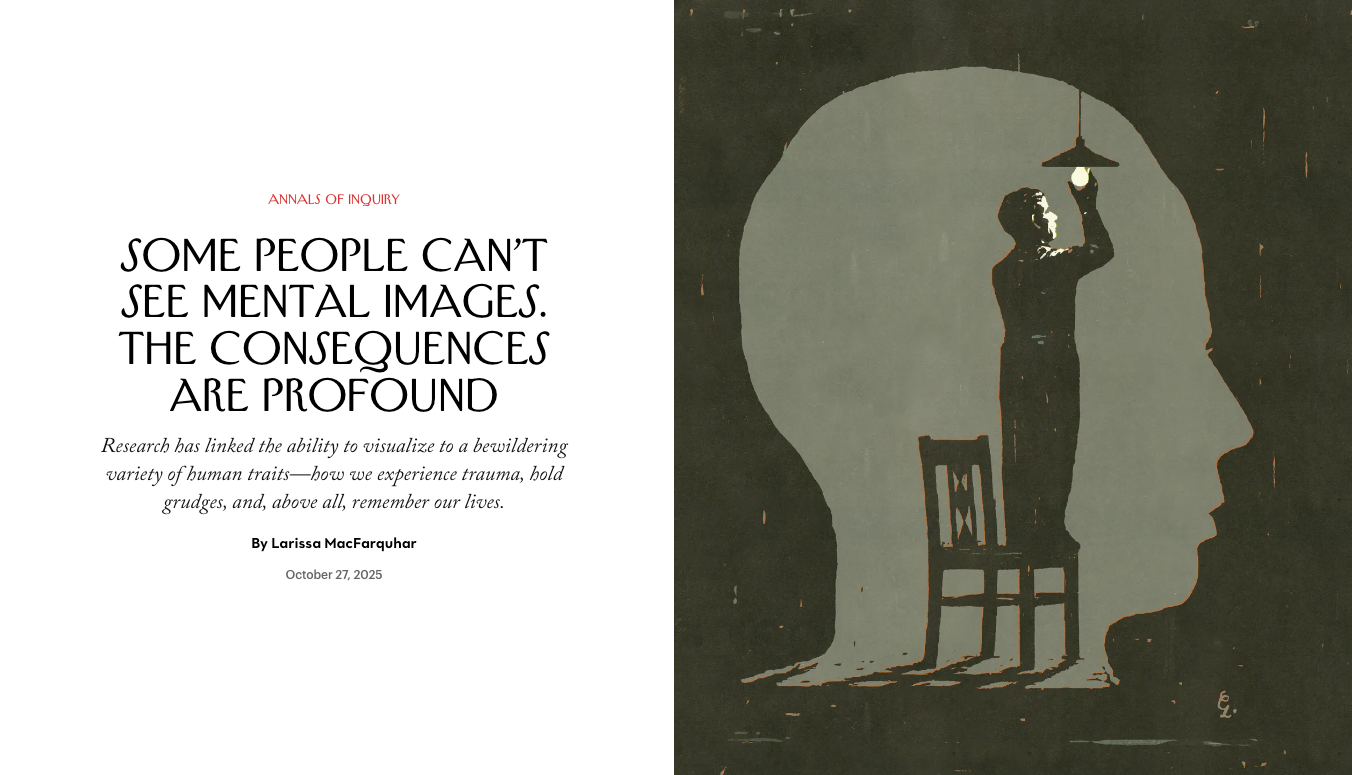
If you don’t know what aphantasia or hyperphantasia then you should read “Some People Can’t See Mental Images. The Consequences Are Profound.” by Larissa MacFarquhar in The New Yorker. Unfortunately, it’s behind a paywall, so I’m going to reiterate the high points to encourage you to find a copy. I highly recommend subscribing to the magazine or Apple News+.
The article is about a condition called aphantasia, one that I have. I wrote about that when I first discovered it in 2016. This new article by MacFarquhar describes the condition and its discovery in much greater depth than I have previously read. It also describes the opposite of this condition, hyperphantasia.
If you don’t know what aphantasia and hyperphantasia are, then you need to read this article if you have a certain kind of mindset such as artist or scientist, have trouble remembering the past, have difficulty recognizing faces, feel disconnected from your self, think you might be autistic, and many other personality traits that make you wonder if you’re different.
Aphantasia is the inability to remember mental images. Most people can close their eyes and recall a scene from their life. The face of a loved one, their desktop at work, the home they lived in as a child. About 2-3 percent of people can’t. But it turns out there all many degrees of not being able to see mental images, including some people who are overwhelmed with mental imagery. That condition is called hyperphantasia.
This article taught me a great deal about this condition I didn’t know. From my previous readings, I simplistically thought aphantasia meant one thing, but it’s not. For many people with the condition, they can’t remember their own past. I can. In fact, I’m obsessed with my past. I was particularly impressed what aphantasia did to artists and scientists.
I’m not like the extreme members of The Aphantasia Network or the people interviewed in the book Aphantasia: Experiences, Perceptions, and Insights by Alan Kendle. That’s comforting, but I still miss mental memories. Yet, I’m lucky. Some people have aphantasia so severe they can’t remember anything about their past, and they feel like living corpses.
For most of my life, I assumed everyone perceived reality pretty much the same if all their sense organs were healthy. Of course, I knew some people had better sight or hearing than others, but I assumed what we perceive was the same reality. That’s because I naively thought we observed reality directly.
I now know we don’t. Our senses are used to construct a model of reality inside our heads. And we all model reality differently. This is called our Umwelt. I highly recommend reading An Immense World by Ed Yong if you want to learn more about that.
MacFarquhar’s article explores how the ability to recall mental images affects our personality, memory, sense of self, and our Umwelt. When I first learned that I lacked the common ability to consciously recall mental images, I felt deprived. Some call it mental blindness. MacFarquhar suggests I would be a different person if I had what I missed. More than that, aphantasia affects people in various ways, and I could have been very different in other ways.
MacFarquhar begins her article by profiling Nick Wakins. He thought he was normal, but couldn’t understand why other people could remember their past and he couldn’t. He abstractly knew about his earlier life from what people told him and photographs. He started researching his condition and discovered that some 19th century scientists had discovered people like him. Then in the 1970s, psychologists again explored visual memory, but it didn’t go far.
In 2010 Adam Zeman and colleagues published research in Neuropsychologie about “blind imagination.” The journalist Carl Zimmer wrote an article for Discover magazine. That caused dozens of people recognizing the condition in themselves to contact Zeman. Zeman coined the term aphantasia with the help of a friend, and published “Lives without imagery–Cogential aphantasia” in Cortex in 2015.
That inspired an article in The New York Times and Zeman got around seventeen thousand emails. It was around this time that I heard about it and wrote my blog piece.
Zeman was now hearing about many related conditions that people claiming to have aphantasia experience. Since 2015 a tremendous wealth of research has gone into this topic, information I didn’t know about. Larissa MacFarquhar does a fantastic job of catching me up.
This article is as exciting as anything Oliver Sacks wrote about. He also had aphantasia. And it’s more than just visual memories. It also relates to being remember sound, smells, tastes, and touches.
We all peceive the world tremendously different.
Nick Wakins thought he was absolutely normal until he uncovered this research. Nick has a PhD. He didn’t know what he was missing until he researched how other people peceived. We seldom compare notes like that.
Melinda Utal had an extreme case of no past memory that is very sad:
One of Kendle’s interviewees was Melinda Utal, a hypnotherapist and a freelance writer from California. She had trouble recognizing people, including people she knew pretty well, so she tended to avoid social situations where she might hurt someone’s feelings. When she first discovered that she was aphantasic, she called her father, who was in the early stages of Alzheimer’s disease and living in a nursing home in Oregon. He had been a musician in big bands—he had toured with Bob Hope and played with Les Brown and his Band of Renown. She asked him whether he could imagine a scene in his head, and he said, Of course. I can imagine going into a concert hall. I see the wood on the walls, I see the seats, I know I’m going to sit at the back, because that’s where you get the best sound. I can see the orchestra playing a symphony, I can hear all the different instruments, and I can stop it and go backward to wherever I want it to start up and hear it again. She explained to her father what aphantasia was, how she couldn’t see images in her mind, or hear music, either. On the phone, her father started to cry. He said, But, Melinda, that’s what makes us human.
Melinda had an extremely bad memory for her life, even for an aphantasic. She once had herself checked for dementia, but the doctor found nothing wrong. She had become aware when she was in second grade that she had a bad memory, after a friend pointed it out. In an effort to hold on to her memories, she started keeping a journal in elementary school, recording what she did almost every single day, and continued this practice for decades. When, in her sixties, she got divorced and moved into an apartment by herself, she thought it would be a good time to look through her journals and revisit her younger days. She opened one and began to sob because, to her horror, the words she had written meant nothing to her. The journals were useless. She read about things she had done and it was as though they had happened to someone else.
MacFarquhar profiles many people for her long article, but I was particularly taken by two artists she interviewed. Sheri Paisley had aphantasia:
Among the e-mails that Zeman received, there were, to his surprise, several from aphantasic professional artists. One of these was Sheri Paisley (at the time, Sheri Bakes), a painter in her forties who lived in Vancouver. When Sheri was young, she’d had imagery so vivid that she sometimes had difficulty distinguishing it from what was real. She painted intricate likenesses of people and animals; portraiture attracted her because she was interested in psychology. Then, when she was twenty-nine, she had a stroke, and lost her imagery altogether.
To her, the loss of imagery was a catastrophe. She felt as though her mind were a library that had burned down. She no longer saw herself as a person. Gradually, as she recovered from her stroke, she made her way back to painting, working very slowly. She switched from acrylic paints to oils because acrylics dried too fast. She found that her art had drastically changed. She no longer wanted to paint figuratively; she painted abstractions that looked like galaxies seen through a space telescope. She lost interest in psychology—she wanted to connect to the foundations of the universe.
On the other hand, Clare Dudeney had hyperphantasia.
In talking to a friend of hers, an aphantasic painter who was one of Zeman’s research subjects, Clare had realized that she was the opposite—hyperphantasic. Her imagery was extraordinarily vivid. There was always so much going on inside her head, her mind skittering and careening about, that it was difficult to focus on what or who was actually in front of her. There were so many pictures and flashes of memory, and glimpses of things she thought were memory but wasn’t sure, and scenarios real and imaginary, and schemes and speculations and notions and plans, a relentless flood of images and ideas continuously coursing through her mind. It was hard to get to sleep.
At one point, in an effort to slow the flood, she tried meditation. She went on a ten-day silent retreat, but she disliked it so much—too many rules, getting up far too early—that she rebelled. While sitting in a room with no pictures or stimulation of any kind, supposedly meditating, she decided to watch the first Harry Potter movie in her head. She wasn’t able to recall all two hours of it, but watching what she remembered lasted for forty-five minutes. Then she did the same with the other seven films.
An interesting aspect of new research is showing that some people have aphantasia since birth, but others acquire it later in life, often due to a physical injury. Other reseach suggests that visual memory is better in children and women, and that many children might have hyperphantasia. I believe I did see mental images when I was young. And other studies suggest that taking drugs brings back the ability to create mental imagery. I can testify to that. I used to get great flashes of imagery when I got high. Other studies show that people repress the ability to create mental imagery because of psychological trauma. All of this makes me wonder if I could retrain myself to create mental pictures in my head.
It is quite common for people with aphantasia to dream with vivid imagery, although others claim their dreams are thin and dark. As I’ve gotten older, my dreams have become dark and shadowy. However, the other night I had a dream that was intensely vivid, bright, and colorful. I was even aware in the dream to a slight degree. I said to myself that I was in a dream and I couldn’t believe it was so damn real. It felt so real that I was afraid I couldn’t get back to my old life. I was on a street looking at buildings I didn’t know, and was worried that if I became stuck in the dream I wouldn’t know where to go. I was quite relieved to wake up.
Scientists who are very good at thinking abstractly often forget how to create mental imagery. And some even theorize that spending so much time reading and staring at words have ruined our capacity to create mental pictures.
At first I envied people with hyperphantasia until I read this:
Hyperphantasia often seemed to function as an emotional amplifier in mental illness—heightening hypomania, worsening depression, causing intrusive traumatic imagery in P.T.S.D. to be more realistic and disturbing. Reshanne Reeder, a neuroscientist at the University of Liverpool, began interviewing hyperphantasics in 2021 and found that many of them had a fantasy world that they could enter at will. But they were also prone to what she called maladaptive daydreaming. They might become so absorbed while on a walk that they would wander, not noticing their surroundings, and get lost. It was difficult for them to control their imaginations: once they pictured something, it was hard to get rid of it. It was so easy for hyperphantasics to imagine scenes as lifelike as reality that they could later become unsure what had actually happened and what had not.
I believe I’ve copied as much of this article as I ethically should.
I’m using this blog to encourage you to go read the article. I’m also encourage people to subscribe to magazines. If you want good information it costs. We need to get away from always assume information should be free. Free information on the web is corrupting our society. Subscribing to magazines supports the spread of better information.
My new effort at home schooling myself is to read one great article a day from magazines with solid editors. I look for articles that expand my mental map of the world. This one certainly has.
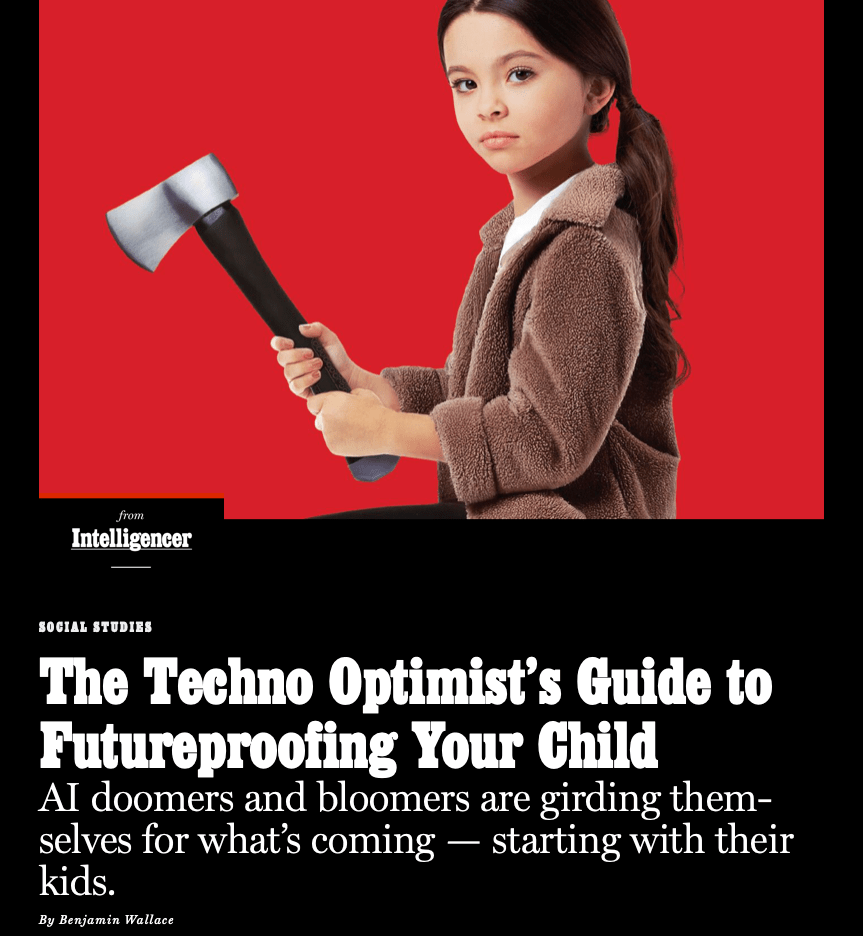
I don’t have a kid, but I do have me. The gist of the article is exploring new ways to teach kids. Many parents believe that a good college education is no longer the path to success in life. They fear AI will put everyone out of work, that climate change will disrupt society, and that the rapid progress is making everything unstable.
These parents ask: How can I prepare my kids for an uncertain future?
I ask: How can we all prepare for an uncertain future?
Generally, education is seen as preparation for a career. I’m retired. I don’t plan to work in the future. Sooner or later, I’m going to die. That’s another kind of uncertain future. This sense of affinity made this article relevant to me.
The article begins with a profile of Julia and Jeff Wise, who have three children. Wallace called Julia and Jeff “Effective Altruists.” I had to go look that up. To quote Wikipedia:
Affective altruism (EA) is a 21st-century philosophical and social movement that advocates impartially calculating benefits and prioritizing causes to provide the greatest good. It is motivated by “using evidence and reason to figure out how to benefit others as much as possible, and taking action on that basis”. People who pursue the goals of effective altruism, who are sometimes called effective altruists, follow a variety of approaches proposed by the movement, such as donating to selected charities and choosing careers with the aim of maximizing positive impact. The movement gained popularity outside academia, spurring the creation of research centers, advisory organizations, and charities, which collectively have donated several hundred million dollars.
Wallace quotes the Wise’s as saying, “We and some other parents we know have been thinking, Okay, it looks like there may be big changes in the next decade or two. What does that look like for how we prepare our children for the world?” They worry that their kids could die in disasters before they grow old, or find themselves in a post-scarcity utopia of abundance and not need a job.
Parents can’t decide; should their kids attend Harvard, train to be HVAC technicians, or become survivalists?
I could die any time now, since I’m approaching the statistical average age for death, or I could live another twenty or thirty years if I’m an outlier. That’s a big unknown. I could die with my mind intact or not know who I am. If society collapses, my retirement arrangements will fall apart.
What inspired me most about this article was the Alpha School, which sounded like a super-duper version of the Montessori school.
Founded in 2014 as a tiny K–8 private school in Austin, the Alpha School has opened 15 additional campuses, from Scottsdale to San Francisco, on the strength of a tantalizing pitch. Using its AI-driven digital platform, Alpha asserts students learn “2.6” times faster on average than in regular schools while doing only two hours of schoolwork per day. The school has named this platform, which knits together proprietary and third-party apps, “TimeBack.” With those newly liberated hours, students focus on learning the life skills that Alpha’s co-founder MacKenzie Price believes standardized education neglects — things like entrepreneurship and developing “a growth mind-set.” At the flagship campus, a second-grader, in order to ascend to third, must complete a checklist that includes running five kilometers in 35 minutes or less; delivering a two-minute TED-style talk with “zero filler words, 120–170 [wpm] pace, and 90% confidence,” as judged by an AI speech coach named Yoodli; and calling “a peer’s parent” to “independently plan and schedule a playdate.” At Alpha’s middle school, projects have included starting and running an Airbnb and sailing a boat from Florida to the Bahamas.
Basically, the Alpha School teaches kids to be independent learners. The teachers don’t teach; instead, they guide students to study independently.
The article covers theories about educating the young. We tend to think youth is the time of education. I feel like I’m learning more at the end of life than at the beginning. We also think of education in terms of goals. Shouldn’t education be a continual transformation? And we seldom think of learning in old age other than as a hobby.
How can I create my own pedagogy? And for what am I studying? I remember fifty years ago reading Be Here Now by Harvard LSD researcher Richard Alpert, writing as Ram Dass. He claimed that old age was the time to go on a spiritual journey to prepare for death. I’m a life-long atheist. I don’t believe in what most religions teach. But Ram Dass might be right; it might be time to go on a spiritual quest.
I don’t feel the need to study anything specific. First of all, my mind can’t retain information anymore. I love learning, but I have accepted that I forget almost as quickly as I discover. That doesn’t bother me. Like they say, it’s the journey that counts.
However, I don’t forget everything. I seem to lose the facts and details, but somehow, I retain a tiny bit of a new perspective.
My new method of educating myself is to subscribe to printed magazines. I’ve stopped trusting the internet and television. And I’m not too keen on podcasts either.
What I read helps me let go of lifelong beliefs. I’m learning that people live by delusions.
Our minds are corrupted by words. Strangely, the antidote for words is more words. To dissolve decades of thoughts that crust our minds like barnacles requires constant reading.
Our trouble, starting in childhood, is that we embrace beliefs that we never let go of. Most people are programmed by beliefs acquired early in life that they spend the rest of their lives defending.
Home schooling in my seventies is all about unlearning. But it’s not about forgetting. This isn’t intellectual Alzheimer’s. It’s about clarity.
When you watch the news and see reports about bad things happening, ask yourself: Is this because someone believed something wrong? If you are troubled by anything, consider letting go of something you believe true. See if that reduces your anxiety.
For example, much of what I believed in came from reading science fiction. Many billionaires are pursuing goals based on reading science fiction. But I’ve come to see that many desired science fiction futures are no more realistic than what religions have promised.
At thirteen, I read books entirely differently than I do now at seventy-three. I think everyone does, but it’s not apparent why. Our memory gives us the illusion that we’ve always been the same person. But if we think about it, there is plenty of evidence that we couldn’t have been.
I’ve been thinking about the difference between my younger reading self and my older reading self while writing a review of The Foundation Trilogy by Isaac Asimov for my other blog. Every so often, I reread a book I read as a teenager. For some books, it’s a nostalgic return to a familiar, comfortable place. For most books, it’s just vague recollections.
My first realization from trying to reconstruct my reading mind at age 13 was to remember that I read very fast. I consumed books like potato chips. Reading was like casually watching TV. Words just flowed past my eyes, and I didn’t always pay attention to every word. I just read to find out what happened.
I have a fond memory of reading The Foundation Trilogy, but a limited one. I liked the idea of a galactic empire in decline. However, the only chapter I can remember is the first one, “The Psychohistorians.” It wasn’t until decades later that I learned that the trilogy was a fix-up novel based on nine stories running from short stories to novellas.
Thinking about it now, I realize that most of the ideas in the book didn’t mean much to me at 13. I had not studied or read about the Roman Empire, Asimov’s inspiration. Actually, I probably didn’t know what an empire was either. Nor did I understand all the references to nobility, aristocracy, and politics.
As a teenager, I mostly read science fiction books. I did read some popular science books too. My awareness of the world and my vocabulary were limited. However, I didn’t know that. And I wasn’t the kind of person who looked up words I didn’t know. What’s weird is that I was a kind of know-it-all.
One way to judge my teenage brilliance was that my favorite TV show at the time was Gilligan’s Island. When I catch that show today, I can only assume I was brain-dead back then.
I’ve tried to reread The Foundation Trilogy twice now. The first time was in 2015, and now in 2025. In both cases, I could only finish the first book of the trilogy. I loved the first story, but with each additional story, I detested them more.
At first, I thought that Asimov’s most famous books were just bad. But I’ve known people smarter than me, and just as old, who say they still loved the Foundation series. One woman in our reading group said the Foundation stories were a great comfort to reread. And I recently heard that twenty million copies of the series have been sold.
Not only was my current reading self different from my younger reading self, but I’m out of step with millions of readers. This got me thinking about the different modes of reading.
I think the most basic mode is just to let fiction flow over you. You read whatever pleases you. And you don’t think about why.
Then, as we age, we become more judgmental. We learn more about life and reading. We develop a process of natural selection by rejecting what we don’t like. We don’t think much about why we don’t like what we don’t like. We just evolve into a reading machine that knows what it likes.
Two other reading modes are: English teachers or literary critics. These are very critical modes, and often they take the fun out of reading. I think as I’ve gotten older, my reading habits have taken on a bit of these two modes. While in them, it’s all too easy to shoot Asimov down.
However, I’ve discovered another mode recently when I read “Foundation” for the fourth time. “Foundation” was the first story published in the series in 1942. While reading this story yet again, I kept admiring Asimov for where he succeeded and not where he failed.
In my rereadings, I’ve always come to the series wanting to love it. And I’ve always been disappointed by how much I didn’t. But with this reading, I worked to think like Asimov. What was he trying to do, and how did he go about doing it?
I’m in the process of documenting this for my other blog, Classics of Science Fiction. I’m writing this now because the other post is going to take a long while to complete.
I never would have put this much effort into reading a story when I was a teen. Or any time before I was 73.
One reason I dislike this story in recent years is my skepticism. I don’t believe humans will ever travel to the stars, much less form a galactic empire. Another reading mode I’m trying to develop is to read with the mind of a person from when the story was first published.
Trying to read like Asimov thought and how science fiction fans felt in 1942 is difficult. I’m reminded of Samuel R. Delany’s concepts of simplex, complex, and multiplex that he described in his story Empire Star. I started out as a simplex reader and eventually evolved into a complex one. Now I’m moving into a multiplex reader.
Multiplex thinking often involves holding contradictory viewpoints. I really dislike the Foundation stories. But if I work at it and look at them in just the right way, I can like them too. It’s hard. It’s a Sisyphean struggle learning to admire something that triggers so many annoyances, but I’m working on it.
Last night’s dream was epic. It was one of those dreams that was so intense that when I woke up, I was immensely thankful to be back in reality. The dream started out pleasant. Susan and I were with our friends Mike and Betsy. Maybe we were on vacation together. We kept seeing marvelous sights. I wish I could remember them. All I can remember is that the four of us went from scene to scene together. And then at some point, I realized I was in a “Can’t Find My Way Home Dream,” which I’ve written about before.
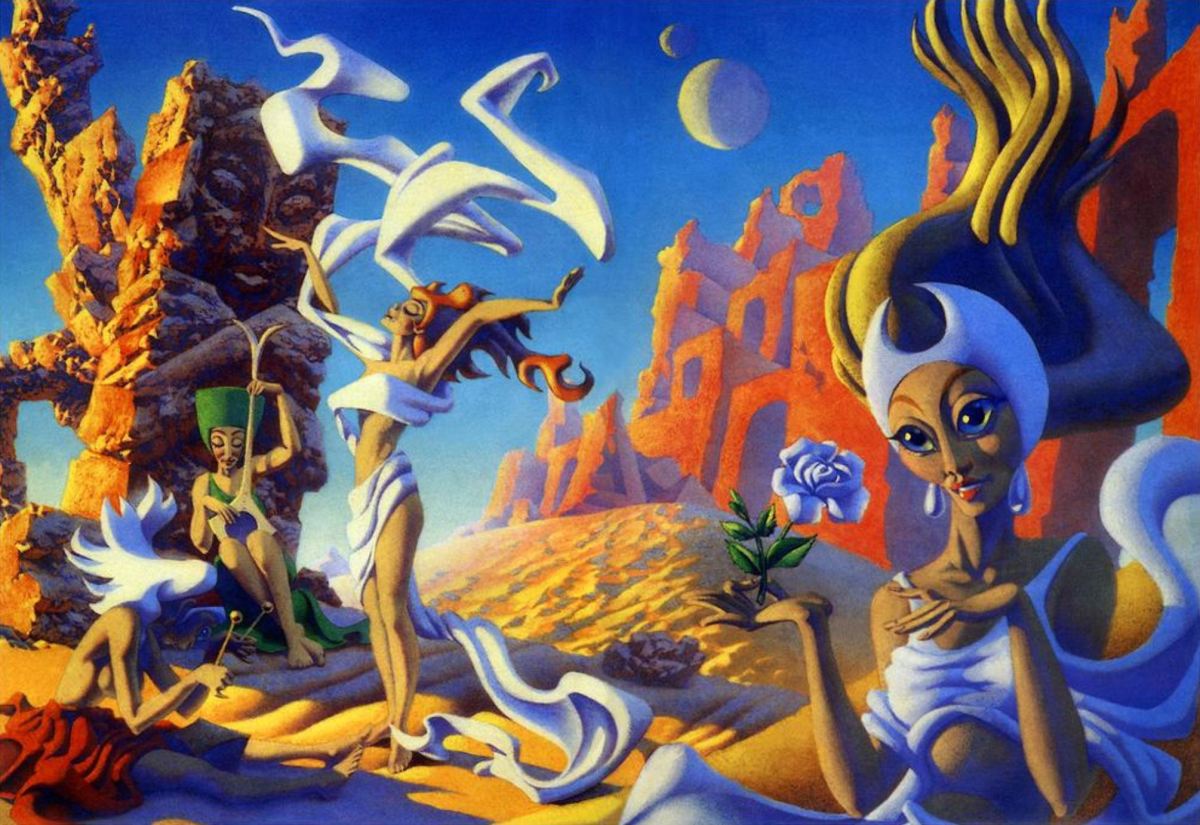
In recent years, my dreams have tended to be dark and murky, sometimes even black and white. But last night’s dream was in vivid technicolor. At times, the four of us found ourselves in dark places, outdoors, but mostly we strolled through touristy areas in broad daylight. However, some scenes were even more vivid. They were psychedelic, bright, and looked like something from Cirque du Soleil. We were having a good time. Then something changed.
I remembered we were in a dream and I tried to tell Susan, Mike, and Betsy, but they wouldn’t believe me. I knew it was a can’t find my way home dream. I’ve always been by myself in those dreams. They are very frustrating because I get lost and can no longer find my way home.
I tell Susan, Mike, and Betsy to stick close. I try to get us to all hold hands. I figure as long as we’re all together, I’d be okay. At one point, we’re in a store and Betsy wants to shop. I try to stop her, but she steps away. We lose sight of her. Then we think we see her, but we realize it’s not her, but someone who only looks like Betsy.
Then we lose Susan. I plead with Mike that we must stay together. He isn’t worried. My anxiety grows. I feel like I’m Kevin McCarthy in The Invasion of the Body Snatchers. I know Mike will disappear, too. And he does.
Now the dream shifts to the standard routine of the can’t find my way home dream. I run down streets hoping to find one I know. Things shift, and I’m in a mall again. I can’t find the exit. I enter a store and go to the back wall, hoping to find a door that leads outside. I find a door, but it’s into a back room. I look for another door. I find one, but it takes me to a smaller room. I discover there are no doors or windows. There are workmen in the room.
I tell them I need to tear a hole in the wall. They try to stop me. I start ripping away sheetrock and then wooden panels. Finally, I find the outside. I run out and see a vast, strange world. It’s bright and colorful, but nothing like this one.
That’s when I wake up. That’s when I always wake up.
My friend Mike has been having health issues, and that worries me. I lost my oldest friend Connell this year. I’ve known Mike and Betsy for forty-five years. I’ve known Susan for forty-eight years. So many people I’ve known have died. And nearly all my peers have been in and out of hospitals.
I assume the dream was generated from my anxiety over losing people. But it was so damn intense, so damn vivid, so damn emotionally overwhelming. It’s like my brain has a copy of Sora 2 built into it. Why did it put me in all those scenes? Who wrote the prompt?
I can’t remember the details now. They are just a blur in my memory. But in the dream, I felt like I was somewhere else. I’m an atheist. I don’t believe in an afterlife, but that dream made me wonder.
However, if that dream was anything like an afterlife, it would be overwhelming. Buddhists believe that when we die, our personality disappears, and our soul returns to an ocean of souls. I don’t think a human mind could handle that dreamworld for long.
The dream felt like I was in a giant pool of possibilities. That our brains are like ChatGPT and Sora 2 and can generate anything. That’s only words to you.
Whenever I wake up from these dreams, reality feels solid and real. I like that. It’s comforting. Aging is making me worry. Reality is starting to feel less solid. Like an acid trip, all we can do is ride it out.



 Auxiliary Memory