Reading History Books About Events I Originally Watched on Television

by James Wallace Harris, 12/8/24

The 1960 U.S. presidential election is the first one I remember, but just barely. I was eight years old. My father was for Nixon and my mother for Kennedy. I decided I liked Kennedy because he was younger, more dynamic and had a good-looking wife. Even at eight, good looking women were often a deciding factor. I remember getting in a fight in the school playground because I was for Kennedy and the other kid was for Nixon. Neither of us got to decide the issue because a teacher pulled us apart.

During the Kennedy years I didn’t watch TV news. I would sometimes stay home from school to watch the Mercury space launches. Back then the TV news departments of each network would take over all broadcasting. In the first half of the 1960s, the space program was about the only real-world activity I paid any attention to.

I did pay some attention during the Cuban Missile Crisis in 1962, mainly because I lived on Homestead Air Force Base, and everyone talked about it constantly. I remember having duck and cover drills at Homestead Air Force Base Elementary, but I was disappointed when there were no real A-bombs dropped. (I was very immature for my age.)

I didn’t become a news watcher until Kennedy’s death. I remember that weekend, my family watched the news constantly, and the following week too. That’s when I started following Walter Cronkite. I turned twelve three days after Kennedy was shot.

The news also became exciting in February of 1964 when The Beatles came to America. It was during 1965 that older boys I knew began worrying about being drafted, and I started paying attention to news about Vietnam.

The CBS Evening News was my main source of information about life beyond my own little world during the 1960s. I sometimes got to see The Today Show on NBC because my mother watched it while making breakfast. I liked that show because I found Barbara Walters hot. (Okay, I’ve already said I was a weird kid.) Sometimes I would watch news specials or documentaries. While in the ninth grade (1965-66) I had a civics course. But for the most part I just wasn’t that aware of what was going on in the world except for Top 40 AM music.

I don’t remember reading the paper, The Miami Herald, until 1968. I did start to read magazines in 1965, but that was haphazard. People would give my parents copies of Life, Time, Newsweek, Look, Saturday Evening Post, and National Geographic from time to time, and I found them fascinating. On my own, after 1965, I would buy Popular Science, Popular Mechanics, and MAD Magazine. During twelfth grade (1968-69) my English teacher got me interested in literary fiction, and I subscribed to Saturday Review with money I made from working in a grocery store. I really didn’t understand it though. In late 1968 or early 1969, I got hooked on Rolling Stone magazine and sometimes bought Creem when it started publishing.

A whole lot of what I knew about the counterculture came from Life Magazine.

If you think about it one way, television and magazines offered a fairly diverse view on what was happening in the world, but squinted at it another way, it was a rather limited view.

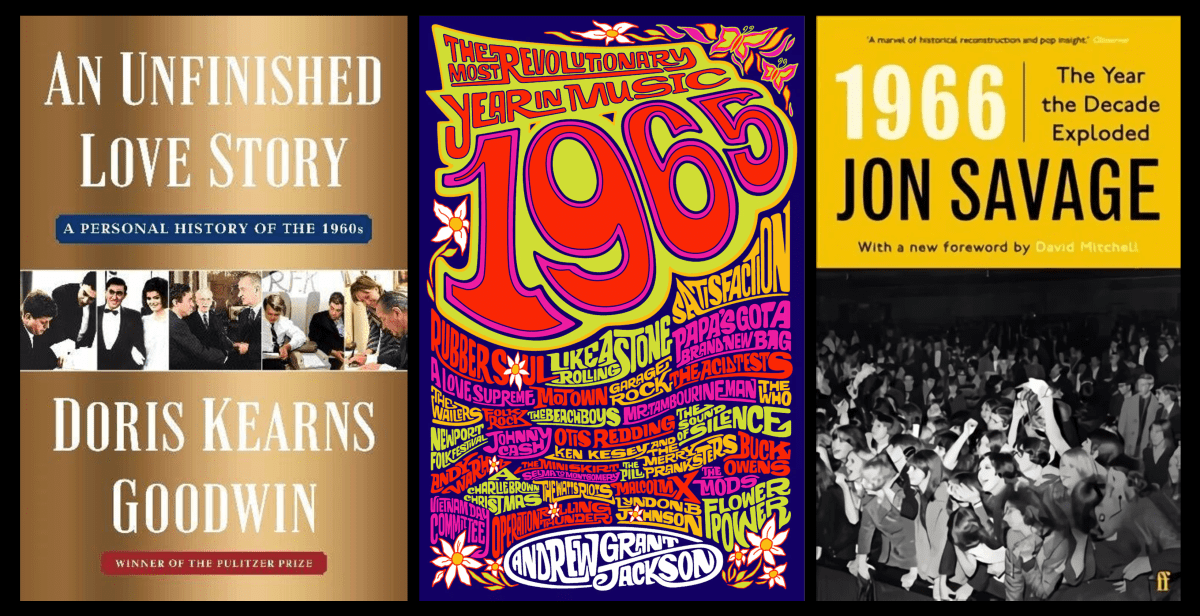
In December 2024, I’ve been reading three books about the 1960s that explore events I encountered in two minute stories on TV, or read about in a few pages in a magazine when they first happened. Some of those short snippets of current events made huge impressions on me as a kid. They shaped who I thought I was. The history books makes me realize I was mostly uninformed.

The reality of the 1960s is I was a kid going to school every day except for long summer vacations. I started 1960 in New Jersey but moved to Mississippi then to Florida then to South Carolina back to Florida, then Mississippi again, and back to Florida. I went to thirteen different schools during the 1960s. The only newsworthy event I saw live was the launch of Apollo 8. I had a chance to see Kennedy in 1962 when he came to Homestead Air Force Base. They let us out of school to see him, but me and my friends went fishing instead. My sister was at Dinner Key Auditorium when Jim Morrison flashed the crowd. I got to meet an astronaut in 1968, but I’ve forgotten which one. And this is hardly newsworthy. I got to see Cream play during their farewell tour in 1968. Oh, and I attended one SDS rally.

In other words, I experienced the legendary Sixties mostly via AM radio, television, and magazines. I did have long hair sometimes, and I sometimes messed around with drugs, but I was hardly a hippie or a radical. I did get into the counterculture more in the 1970s, but that’s another story.

The point of this long-winded essay is I’m now reading history books about years I lived through. I can contrast my memories to behind the scenes accounts of things I got from soundbites. That’s quite enlightening.

We live with the illusion that we think we understand what is real and true. We delude ourselves that we make decisions on relevant information. But we don’t. If I could have read the history books about the sixties I’m reading in old age when I was young, I could have gotten closer to seeing reality.

Timothy Leary and Aldous Huxley, two heroes of my youth, claimed that LSD opened the doors of perception, and that might be true on a nonverbal level, but a deep reading of history books is far greater at revealing reality that we can comprehend on a verbal level.

Lately, I’ve been reading that reading is going out of fashion with young people. That’s a shame. Even back when I was a teen, and only got superficial understandings about the events around me from superficial news sources, it did make me more aware.

The three books above are filling in details on things happening around me as I was growing up. I’m reminded of Bob Dylan’s “Ballad of the Thin Man.”
I realize I’ve been Mr. Jones my whole life, and I’m still trying to figure out what happened.

JWH

Leave It to Beaver (1957-1963)

by James Wallace Harris, 7/17/24

Susan and I are watching the entire run of Leave It to Beaver. We’re currently in the sixth and final season, about to finish all 234 episodes. We watch two episodes a night, so that means we’ll complete six years of the original broadcast in 117 days. Back then they had thirty-nine episodes per season.

We’ve watched Jerry Mathers (Beaver) and Tony Dow (Wally) grow up. When the series begun in 1957, Beaver was seven and in second grade. Wally was thirteen in the eighth grade. Six years apart, but six years later, Beaver was in the eighth, but Wally was in the twelfth, four years apart. Evidently, the producers didn’t want Wally going off to college. Mathers and Dow were only three years apart in age in real life. Dow was born in 1945, and Mathers in 1948.

Leave It to Beaver premiered on October 4, 1957, the same day that Sputnik I went into orbit. I had just entered first grade and was five. I don’t remember seeing Leave It to Beaver as a kid in the 1950s. It wasn’t until sometime in the 1960s that I saw an episode, and I didn’t see it often. Susan didn’t watch it as a kid either.

In other words, we’re not watching Leave It to Beaver for nostalgic reasons. I’m not sure why we got hooked on it. We were just looking around for something to watch, and I suggested the show as something pleasant we both might like. Susan doesn’t like shows with violence (although I’ve got her to watch the Fargo series recently). I think I picked Beaver because Susan loved watching Andy Griffith so much.

I do have nostalgic memories of family shows like Make Room for Daddy, Father Knows Best, The Donna Reed Show, The Adventures of Ozzie and Harriet, and My Three Sons from the late 1950s and early 1960s, so it’s odd we picked Leave It to Beaver. We even signed up for Peacock with no ads so we could watch it without ads.

I can’t promise that Leave It to Beaver is one of the greatest TV shows ever. It’s pleasant. We like the actors and characters. The stories are quite simple, very pro-family, very didactic. The stories are also repetitive. For example, there are several episodes about Beaver getting a pet he can’t keep, including an alligator, rat, donkey, and a very ugly monkey. There were many shows where Beaver friends convince him they should all go to school wearing something weird, like a sweatshirt with a horrible monster on it, or show up for a special event not wearing a coat and tie, and Beaver shows up as the gang planned but the others don’t, making him look stupid. Another common plot was for Beaver’s friends to talk him into doing something he shouldn’t.

Most of the episodes had a message. Often it was: When your parents tell you something it is for your own good. But fairly frequently, there were shows about how parents should listen to their kids sometimes, because sometimes their kids knew better.

I remember Leave It to Beaver being about only the kids, sort of like Peanuts. But half the show is about Ward and June. I guess as a kid I just didn’t pay attention to adults, either in real life or on TV.

One of my favorite episodes has Beaver getting in an argument with a bigger kid and uses a cuss word. Of course, the school bell rings when Beaver says the word, but his teacher, Miss Landers, heard what he said. Miss Landers is shocked and sternly informs Beaver he’s in big trouble. Miss Landers tells Beaver to bring a guardian to school to meet with her. Ward is off on a business trip, and Beaver can’t bring himself to tell June what he said, so he convinces Wally to come to school as his guardian. Miss Landers accepts Wally because she doesn’t want Beaver to tell June what he said either.

Even though we time travel back to the 1950s and early 1960s when we watch Leave It to Beaver, it doesn’t feel nostalgic. It feels more archeological. The show just reminds me of how things were so different back then.

I thought I’d find episodes I would remember but I haven’t. The closest any episode felt like I had seen it before was the one when Beaver and Wally play the stock market. I do remember as a kid watching a TV show where the kids learn about the stock market, but I can’t swear it was on Leave It to Beaver. Maybe it was, maybe it wasn’t.

Quite often while watching other old TV shows I’ll tell Susan, “Oh, I’ve seen this one.” But that’s never happened with Beaver. But the intros and closing credit scenes to all six seasons seem burned into my memory, but not the stories themselves. I guess I remember the visuals and not the plots.

It’s weird to watch a show from the first to the last episode. I’ve done that several times now. It’s also kind of painful. Older TV shows depended on every episode being entirely self-contained. This approach leant itself to formulaic scripts, which was true with Leave It to Beaver. I’ve read that Beaver was the first show to have a finale, which was a unique episode. But for the most part, there was a commonality to every other episode.

As far as I can remember every episode featured the staircase. Most featured front or back door meetings, breakfast table meetings, dinner table meetings, doing the dishes together, sitting around the bedroom, living room, or den. For most seasons we saw Ward and June kiss in each episode. That seemed to fall off in the last couple of seasons. All four of the main actors had standard facial expressions and used specific body language in every show.

One thing I remembered wrong was the Eddie Haskell (Ken Osmond) character. I remember him as a juvenile delinquent, the bad boy. But the show portrays him as a sympathetic loser, on the pathetic side, one who tries too hard, has too much ego, and probably has bad parents.

Beaver had very few guest stars, which was what I enjoyed when watching the entire nine years of Perry Mason. However, a few of the actors, like Miss Landers (Sue Randall) I’ve seen on other shows. I saw her on Perry Mason. Of course, Fred Rutherford (Richard Deacon) went on to be Mel on The Dick Van Dyke Show.

Watching old TV shows from the 1950s and 1960s reveals an alternate reality that we all observed back then. The Beaver often mentioned the TV shows that were on when Leave It to Beaver was on the air, even making inside jokes about the competition. And to a degree it makes fun of other pop culture of the 1950s and 1960s. But it was very gentle. I even saw a science fiction magazine a couple of times. I’ve often wondered when science fiction was first mentioned in pop culture.

The show covered the phases of childhood and adolescence that kids were going through back in the 1950s and early 1960s. Leave It to Beaver went off the air in 1963, before the famous Sixties began. This photo meme on Facebook conveys that stark change perfectly.

Watching Leave It to Beaver explores the times before that cultural shift.

JWH

I Want to Argue with Carlo Rovelli

by James Wallace Harris, 7/1/24

Can I understand science if I’m not a scientist? I read popular science books, but that doesn’t mean I understand the work that went into making the scientific discoveries they report on. However, is it possible for me to intuit what popular science writers are describing?

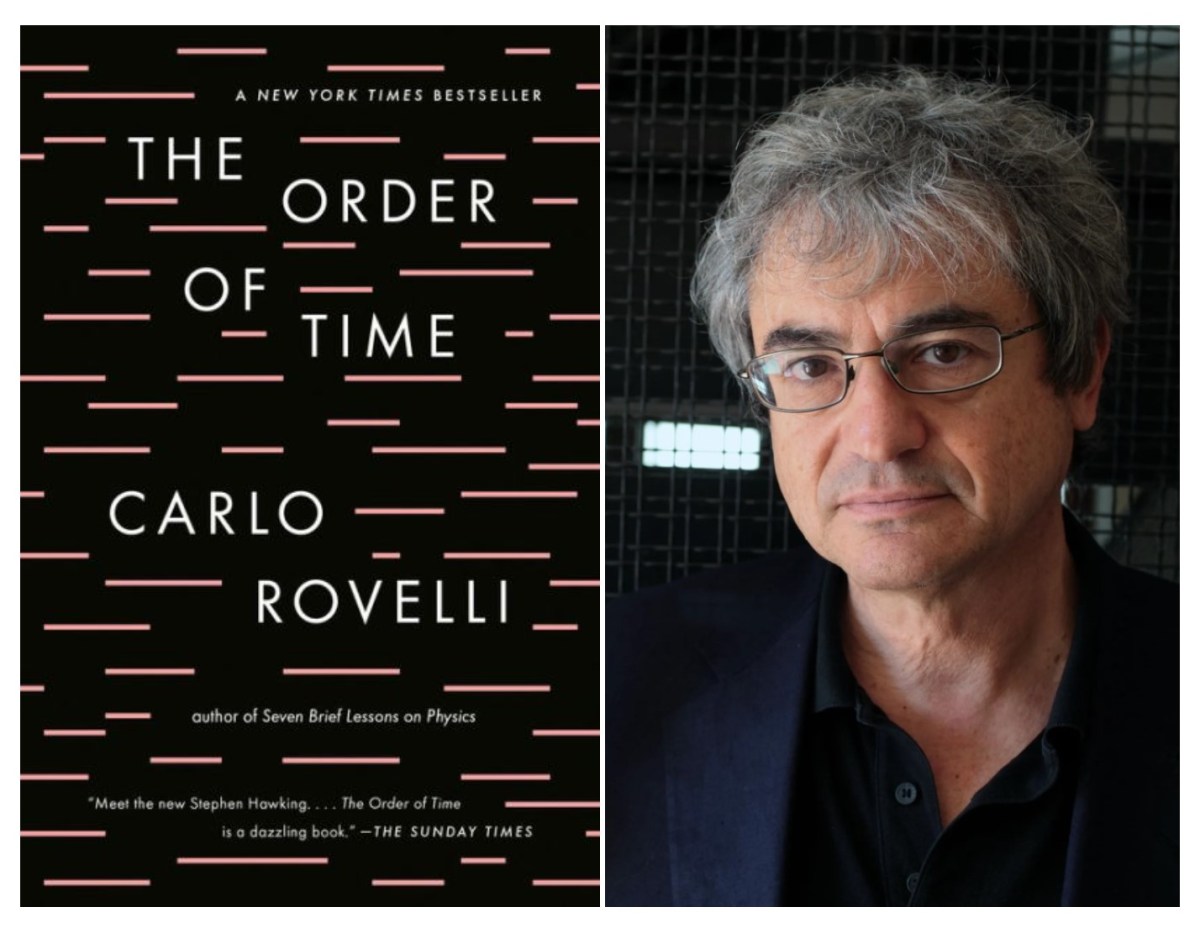
I’ve been thinking a lot about the concept of Universal Now. What is this thing we call now? How is it different from the past and future? But the most important question that’s driving me crazy is: Is it now everywhere in the universe at the same time? But then, what is time? I went looking for a book that might answer these questions and found The Order of Time by Carlo Rovelli. I discovered that book from finding the article “Now Means Nothing: How Time Works in Our Universe” online. It was taken from The Order of Time.

This passage tangles up my brain:

Now Means Nothing 

What is happening now in a distant place? Imagine, for example, your sister has gone to Proxima b, the recently discovered planet that orbits a star approximately 4 light-years away from us. What is your sister doing now on Proxima b?

The only correct answer is that the question makes no sense. It’s like asking, “What is here, in Peking?” when we are in Venice. It makes no sense, because if I use the word “here” in Venice, I am referring to a place in Venice, not in Peking.

If you ask what your sister, who is in the room with you, is doing now, the answer is usually an easy one: You look at her, and you can tell. If she’s far away, you phone her and ask what she’s doing. But take care: If you look at your sister, you’re receiving light that travels from her to your eyes. That light takes time to reach you — let’s say a few nanoseconds, a tiny fraction of a second. Therefore, you’re not quite seeing what she’s doing now but what she was doing a few nanoseconds ago. If she’s in New York and you phone her from Liverpool, her voice takes a few milliseconds to reach you, so the most you can claim to know is what your sister was up to a few milliseconds ago. Not a significant difference, perhaps.

What does it mean, this “modification of the structure of time”? Precisely the slowing of time described above. A mass slows down time around itself. The Earth is a large mass and slows down time in its vicinity. It does so more in the plains and less in the mountains, because the plains are closer to it. This is why the friend who stays at sea level ages more slowly.

Therefore, if things fall, it is due to this slowing of time. Where time passes uniformly, in interplanetary space, things don’t fall — they float. Here on the surface of our planet, on the other hand, things fall downward because, down there, time is slowed by the Earth.

Hence, even though we cannot easily observe it, the slowing of time nevertheless has crucial effects: Things fall because of it, and it allows us to keep our feet firmly on the ground. If our feet adhere to the pavement, it is because our whole body inclines naturally to where time runs more slowly — and time passes more slowly for your feet than it does for your head.

Does this seem strange? It’s like when watching the sun set, disappearing slowly behind distant clouds, we suddenly remember that it’s not the sun that’s moving but the Earth that’s spinning. And we envision our entire planet — and ourselves with it — rotating backward, away from the sun.

I really dislike that answer. It goes against my sense of intuitive logic. I can understand that time is relative. I can even understand that it’s impossible for us to know what’s happening on Proxima b because of the speed limit of light at any given moment. But I refuse to believe that if Proxima b still exists, that the same now I’m experiencing isn’t occurring there too. Any sentient being will experience the moment of now at a different rate, but don’t we all exist in the same Universal Now?

To me, it feels natural to think of the universe as one giant entity that is evolving/growing. I can accept that time is variable in separate places within this entity, but I feel there is a Universal Now everywhere. Only it’s perceived at different speeds. And that’s okay. I don’t expect us to be in sync in our sentient awareness of the Universal Now.

For example, a hummingbird perceives time differently from people. We seem to be slow moving to it. A computer with a clock with operates at trillions of cycles per second will see time differently too. Just because we each perceive time differently, doesn’t mean we don’t all experience it in the same Universal Now.

I have read that the Big Bang didn’t occur in an infinite void, that space and time were created with the Big Bang. I picture the universe as one cosmic system that evolves/grows. Time evidently is the awareness of change/growth at any given point. That if stars were sentient, they’d feel time differently than we do, or if bacteria could sense change, or if humans were traveling at different speeds, every perspective would sense time differently. But that doesn’t mean it isn’t happening in one Universal Now. I just can’t grasp what Ravelli is saying.

Everything that can perceive time doesn’t perceive it in the same way, but I believe they all exist together and there is one now they are all reacting to.

If my sister Becky went to Proxima b, and we had an ansible (a science fictional communication device that can transmit and receive instantaneously from anywhere), Becky and I could have a conversation in this Universal Now that I’m talking about.

Now if Becky were on a spaceship going near the speed of light, our voices would change. I would speak so fast she couldn’t comprehend me, and she would speak so slowly I couldn’t understand her either. But if the ansible had a record feature, my message could be slowed down, and hers could be speeded up.

I’d have the same problem if I was talking with a star or a bacteria (ignoring the language barrier).

If I was on Earth, and Becky was on her way to Proxima b, and I thought, “I wonder what Becky is doing now?” Becky would being doing something.

If time is relative, and it is unfolding at different speeds, I can’t help but think, “What is it unfolding into?” To me, that’s a Universal Now, the same kind of place that spacetime unfolds into, some kind of existential nothingness. If the universe is expanding, isn’t that the same as growing? And if time is unfolding, isn’t that a kind of growing too? Maybe it’s even the same. Maybe the Now I’m talking about, and the Nothingness that spacetime is expanding into, are the same thing.

To humans, time is sensing change. It is perceived at different rates. Without an ansible, I can’t know what Becky is doing on Proxima b because it would take over four years to learn whatever it was. Where I disagree with Carlo Ravelli is Becky isn’t experiencing the same Universal Now I’m experiencing.

I can comprehend why time is relative and why different sentient beings would perceive it differently. I just can’t understand why there isn’t one Universal Now that spacetime isn’t unfolding into.

As I write this, I assume Carlo Ravelli is experiencing the same Universal Now. I can’t know what he’s doing, or what time it might be, but if he’s alive, he’s doing something, and he’s feeling time unfold at the same time I’m feeling it unfold.

And if there are multiverses. I think they all exist in the same Universal Now. I can’t understand why there isn’t nothing rather than something. But no matter how many universes or dimensions there are, I’d like to think they are all in one Universal Now. It would hurt my mind too much to imagine multiple creations.

JWH

What Gives Me A Sense of Accomplishment at Age 71

by James Wallace Harris

When we were little kids grownups would ask: “What do you want to be when you grow up?” That plants a seed in us that we should have a goal for the future, to plan to do something and accomplish things. When we were little, we’d tell the grownups we wanted to be astronauts or rock stars, because those were the exciting glamourous occupations we knew about.

As we got older, we learned that becoming an astronaut requires getting advanced science degrees, and becoming a rock star means learning how to play the guitar and sing which takes ten thousand hours of practice, neither of which we really want to do.

As we got older we learned that just finishing doing anything had its own rewards. The trouble was learning what we like to do. I had to work at many shit jobs before I was 25 to learn what I actually liked doing, which was working in a nice office, messing with computers, and having coworkers who would become friends. Helping someone else accomplish their goals by programming a computer was what I eventually discovered I like doing. I found working at a university that helped other people to become what they wanted to be fulfilling to me.

Before we retire we think about all kinds of big things we want to do after we quit work. I thought about moving to New York City or living in England, or moving to a retirement community with a lot of social activities. But those things were like dreaming of becoming an astronaut when I was a kid. The reality of retirement was quite different. Susan and I decided to stay in the home we had. And my health problems made me not want to travel.

However, the urge to do something is still there. And even as I get older and can do less physically, I still have this desire that I should have a goal for the future, and to accomplish something. What’s rather fascinating is where and how I get my sense of accomplishment every day.

Nowadays, the future isn’t so far off. It’s either, “What am I going to do tomorrow,” or “What will I do today.”

My goals have become smaller and smaller too. A big one recently was cleaning out the attic. Our friends Anne and Tony came over and helped us get everything down, and now Susan and I are going through all the boxes and suitcases stacked up in the dining room to get rid of that stuff. When that task is done it will give me a reasonably big sense of accomplishment.

But I don’t need big things to accomplish to find satisfaction. Even going to the grocery store provides a satisfying sense of getting something done. It involves Susan and I planning our meals for the week, making a list, going shopping, and putting things away. All of that might take just a couple hours, but it wears me out and leaves me feeling I did do something worthwhile. Me and my old friends joke about how doing one thing like going to the grocery store makes us feel like we’ve gotten something done for the day. And the common joke is, “How did we ever have time for a job?”

If I look at my ToDoist app on my phone, I see a list of things to do that will make me feel good when I get to remove them from my To Do list. And most of those little goals are rather mundane: clean out the file drawers, find a new dermatologist, hire an electrician to install the new Blink security camera and light, cull out DVDs I’ll never watch again, get my eyes checked, and so on.

This is a long way from becoming an astronaut. We never hear people ask: “What do you want to do when you get old?” Theoretically, my retirement years could be longer than my work years. At one time I had big ambitions about what I would do with them, but like a kid growing up and discovering the reality of the work years, the reality of the retirement years is very different too.

A lot of what you can accomplish in retirement depends on money and health, and health really becomes the defining factor. I no longer have a bucket list of things I want to do because at some point the scope of life changes. My sister Becky once told me, “You start out life by living mostly in one room with someone changing your diaper and end up living mostly in one room with someone changing your diaper.” At the time that was funny, scary, and depressing. But as you get older, it becomes, “I can see that.”

I could still have a decade or two, or even three. That’s a lot of time. Unfortunately, it’s time when I’ll have dwindling energy and health. But I don’t think I’ll lose a sense of wanting to accomplish things.

I’m reminded of a short story by R. A. Lafferty called “Nine Hundred Grandmothers.” In it, a space explorer visits another planet and learns the beings there are immortal. However, they get smaller and smaller as they age. He is taken to a cave where the ancestors live on shelves in the wall. The further back he goes the tinier they get. That’s what life is like getting older. The scope of every day slowly gets smaller and smaller. You live with it.

Right now I measure accomplishments by how many books I read or essays I write. I like waking up in the morning and thinking of a goal and then achieving it during the course of the day. At 5:55am this morning I imagine writing this essay. It’s now 7:53am and I’ve almost got a first draft. I hope to finish it soon and eat breakfast. It’s great to start the day having completed a goal early.

Before I got up I also pictured cleaning up the house so our friend Leigh Ann could come over and Susan, Leigh Ann and I can spend the afternoon playing Rummikub. It’s not much of a goal, but it is satisfying.

And I look forward to tonight when Suan and I will watch another episode of Call the Midwife and A Place to Call Home. This might be silly, but I find watching complete series from pilot to finale gives me a sense of accomplishment. So each night I feel like we’ve done something by watching another episode from those two series.

Sometimes I even give myself big goals, ones that are daunting to me now. Ones that I have to push myself to finish. Like cleaning out and organizing my email and computer files on my hard drive. You might laugh, but I have thousands of emails and tens of thousands of computer files waiting to be examined.

Finally, there’s a weird symmetry to getting old. Susan and I have collected a lot of stuff in 45 years of marriage, and now we’re getting rid of all that stuff a little bit at a time. I have thousands of books that I still haven’t read. Ones I bought thinking that one day I’ll get to read. Well, that one day is here and I’ve got to get busy reading them. Finishing each one gives me a sense of accomplishment.

JWH (another thing done – 8:35am)

I Wish All My Family and Friends Blogged, I Wish Everyone Blogged

by James Wallace Harris, 7/16/23

What if everyone who ever lived kept an indestructible diary. Imagine reading what all our ancestors thought throughout their lifetimes. I don’t believe in an afterlife, but this could be the form of one. I’ve often wondered what my parents thought as they were growing up and got older. I’ve also wondered about my grandparents and what they thought about their lives. If they had written down their thoughts and were saved in some way, I could read them now. I wish I had a magic lamp and three wishes. This is how I’d use one of them.

I’ve always been somewhat interested in genealogy. However, just seeing names with dates of birth and death isn’t good enough. Whenever I see a genealogy chart I ask: Who were they, what did they think, what did they do?

The past is gone, so we can’t worry about that now. Although I have read accounts of people wanting to program an AI based on everything they could find out about someone they loved who died. The theory is if we programmed everything we know about a person, say Mark Twain or Ernest Hemingway into an AI, it might act like those men. That sounds creepy. On the other hand, one of my favorite science fiction stories, “Appearance of Life” by Brian W. Aldiss involved the protagonist finding memory cubes by two people who had been married and died years apart and putting them on a shelf so they talked to each other. It was both moving, tragic, and pathetic all at once.

Reading books by famous writers and biographies about them does convey a sense of who they were and how they reacted to their times. And biographies about famous people who left no writings of their own lack something. Look at the four Gospels — if only Jesus had written something himself.

Blogging offers the potential to do what I’m talking about. What if the Library of Congress archived all blogs. Would people in the 22nd century find our blogs interesting? What about the 43rd century?

If you pay attention to serious fiction and films, much of the trouble conveyed about the characters and interactions with other characters is due to a lack of communication. A good example is Celeste Ng’s first novel, Everything I Never Told You. Think about every person you ever loved, hated, or worked with, and what it would mean if you read their inner thoughts? Or at least the thoughts they wanted to share?

Also, it’s important to know that our thoughts are not coherent. Writing is the way we learn this. You’ll never know yourself only by thinking. Writing is a way to sculpt thoughts into something recognizable. Writing is the way to learn about yourself, and reading is the way to learn about other people.

Remember being back in school and all the emotional turmoil and conflicts caused by relationships, perceived relationships, and lack of relationships? Would we have been better people, kinder people, more self-aware people, if we had all blogged back then and read each others’ thoughts? Weren’t a lot of our problems as kids because we hid inside of ourselves and only speculated about our classmates? Would there be more or less school shootings if all the kids knew each other better?

Not only would growing up blogging help with self-expression, and communication, but it would have made us better learners and scholars. I’ve already written about “Blogging in the Classroom.”

I also wrote, “77 Things I Learned From Writing 1000 Blog Essays” which was mostly about how blogging is a great self-improvement tool. One of the main reasons I blog is it helps keep my mind together.

But I mostly wish everyone I knew blogged so I could learn more about them. Lately, I’ve been noticing how little we really communicate with one another. We have our public persona, and we hide the rest. I’ve noticed how many people as they grow older withdraw into themselves. We tend to just chat. Is that because we have given up on relationships? Or because we have more worries about ourselves and don’t want to worry about other people?

For some reason, we consume fiction hours a day. And it’s not the kind of fiction where we learn about people. It’s the kind that helps us forget and hide. Wouldn’t our lives be better if we learned more about real people and not imaginary people?

On the other hand, we are bombarded with personal problems and information overload every day. Maybe we watch television because we had enough of reality and real people? Even extroverts who crave constant social activity often stay at a shallow level of communication. Could the fact that we don’t all blog, or communicate deeply imply that’s what we prefer?

JWH