What Will Be the Pivotal Issues in 2026 and 2028?

by James Wallace Harris, 7/2/25

Peter Leyden claims that America undergoes 80-year cycles, which he calls epochs, with peaks of upheaval that last 25 years. The past peak was after World War II, from 1945 to 1970. Leyden claims we’re entering a new peak in 2025 that should last until 2050. He zeroes in on artificial intelligence, clean energy, and bioengineering as the driving forces. I’m not big on predicting the future or seeing patterns in history, but there are ideas in his theory that are worth contemplating. I do believe we’re living through a historic period of change.

David Brooks claims America is moving away from thinking of itself as an idea that inspires the world to a homeland that we should defend. Brooks has moved away from being a traditional conservative to becoming a spiritual guru who teaches morality. I find all his recent speeches to be both uplifting and inspirational. Brooks feels the changes we are experiencing are undermining our individual characters and altering our collective national character.

CBS News asks if we’re moving into a new Gilded Age. But this time, the oligarchs are far richer and much more powerful. There is a synergy between this documentary and the videos of David Brooks and Peter Leyden. Everyone feels a massive paradigm shift coming. In 2025, I believe we’re living through the largest social and political upheaval since 1968.

If history does go through cycles, can we alter their course? The average person does not have much power. But in 2026, we do get to vote, and again in 2028. I believe the Democrats lost in 2024 because they had no clear vision. Being against Trump is not a political plan. In 2024, the Americans voted for Darwinian rule. Let the strong thrive and the weak die. The current administration is enacting laws to make the rich richer and the poor poorer. Essentially, civilization on the cheap. They appeal to greed. They appeal to resentment. They believe everyone should be responsible only for themselves.

It’s a very Darwinian philosophy. There’s no way we could call America a Christian Nation anymore. This is what America wanted through a fair and square election. But now that they are seeing what it means, do they want to keep it?

I don’t think we should wait until 2026 or 2028 to decide what we want. The Republicans won by clearly defining their goals in 2024. Democrats need to produce their own version of Project 2025. Project 2028 needs to be specific, and all Democrats need to support it. It can’t be too radical. It will need to be liberal yet practical. It needs to appeal to independents and old-style conservatives.

I have no idea what that plan should be, but I wish it would be something David Brooks would back. It needs a moral foundation because, as much as I accept the scientific theories of Darwin, I don’t think survival-of-the-fittest makes for an appealing political philosophy.

JWH

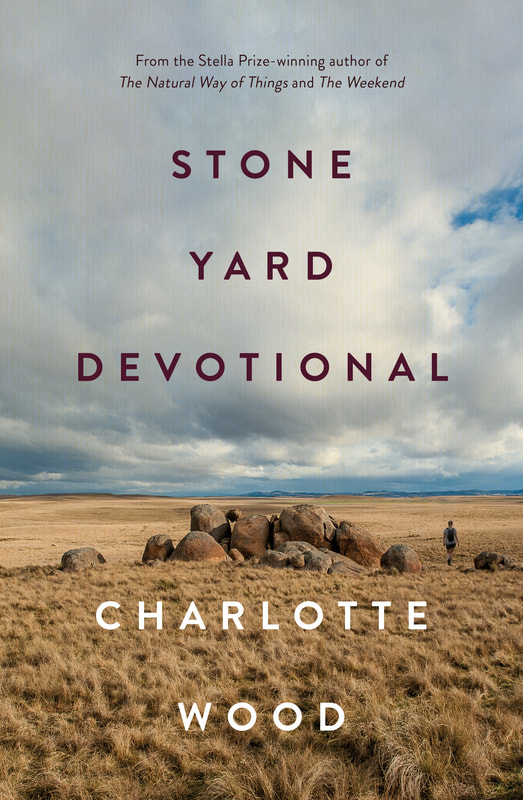
STONE YARD DEVOTIONAL by Charlotte Wood

by James Wallace Harris, 4/12/25

Stone Yard Devotional is about how reality puts the peddle to the metal when life gets all too real. Stone Yard Devotional reads like a memoir, a diary, but it’s classified as a novel. The book was nominated for several awards.

The entire time I was listening to this book I wondered if Charlotte Wood was the unnamed narrator, however after reading “‘The shock was so deep’: Novelist Charlotte Wood on the experience that changed everything” in the Syndney Herald, I realized the novel was only inspired by her own life. Wood and her two sisters were being treated for breast cancer, while she was contemplating mortality and drafting this book.

I have no memory of how I discovered Stone Yard Devotional by Charlotte Wood. The cover and title intrigued me for sure. Maybe it was because it was shortlisted for the 2024 Booker Prize. The audiobook was part of my Spotify subscription, so I gave it a try, and I’m glad I did. It’s not the kind of book I normally read, but it’s wonderful to read if you’re getting old.

The story begins with the Covid pandemic. The narrator separates from her husband, ghosts her friends, and hides out in a guest house of a religious order, even though she is nonreligious. She wants to be alone. But after her initial stay, she returns to the order to live with the nuns. I was never sure if she joined the order or not. I have often thought the monastic life has certain appeals.

The story is about the narrator’s observations while living a contemplative life. These include the death of her mother, the remembrance of childhood, studying the nuns, working in the garden and kitchen, and the guilt of living with a woman she and her classmates horribly bullied as a child. The narrative is simple, like meditation.

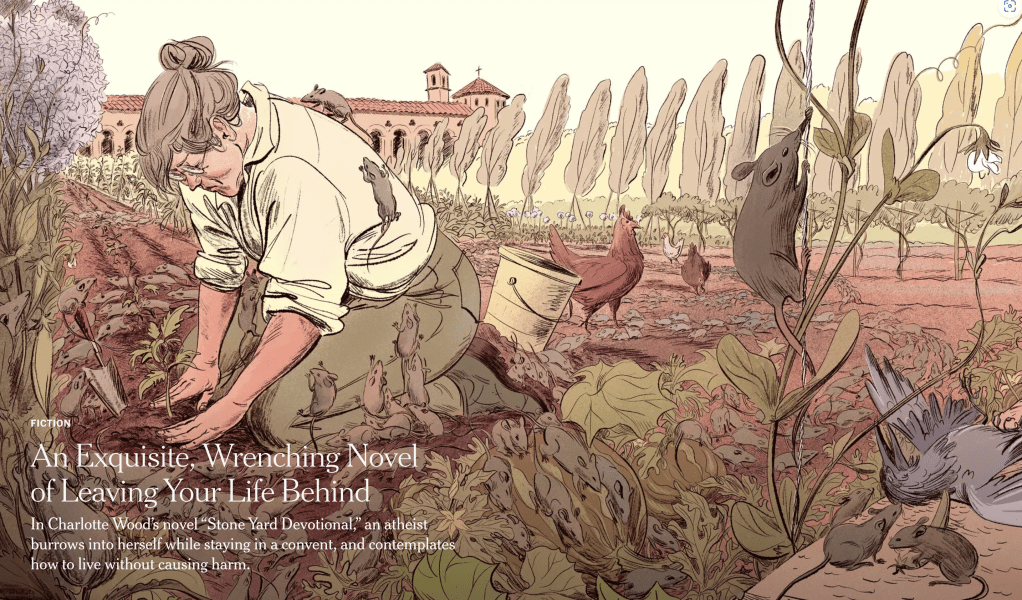
The setting is Australia, which is exotic to me. As a kid I wanted to live in Australia. Over the course of the novel, there is a plague of mice that invade the convent. The mice are so numerous that they cover the roads in gray fur. At first, I thought Wood added this element to give her tale some excitement, but I researched and found that her part of Australia they did have a mice plague of Biblical proportions in 2021.

That made life in the convent extremely inconvenient. The mice ate electrical insulation, throwing daily living in the convent back to the 19th century. The illustration for the book’s review at The New York Times might have been another reason I read this book.

Much of what the unnamed narrator contemplates throughout the novel is what everyone thinks about as they get older. The fear of declining health and death, the regrets, the desires for wanting to have done things different, the desires to connect with others while also wanting to pull away, the changes we see in ourselves and others, the appeal of nature and living simple. Wood’s story explores all of that and more, triggering the reader to think about their lives.

Charlotte Wood was born in 1965, so she’s fourteen years younger than me. However, her battle with cancer has likely aged her perception on life. At 73, I’ve been thinking about the things in this novel for years. But I don’t know if everyone who collects social security meditates on these issues. Stone Yard Devotional is a great title for this novel. Even though the narrator said she was an atheist at the beginning of this story, getting old and dealing with people who die, pushes you to be spiritual even without a belief in God.

JWH

Who, What, When, Where, Why, and How of Being

by James Wallace Harris, 2/15/25

At 73 I’m starting to feel I’m running out of time. I keep having this nagging thought I should have done something, or should be doing something before time runs out. But what? I am immensely grateful for existing but was I supposed to do something while I am or was here? Would knowing who I was explain what I was? Would knowing when and where I was explain how and why I got here? And would knowing all those answers reveal my existential duties?

I just finished reading Orbital by Samatha Harvey which recently won the 2024 Booker Prize. Orbital is the kind of novel that inspires the questions above.

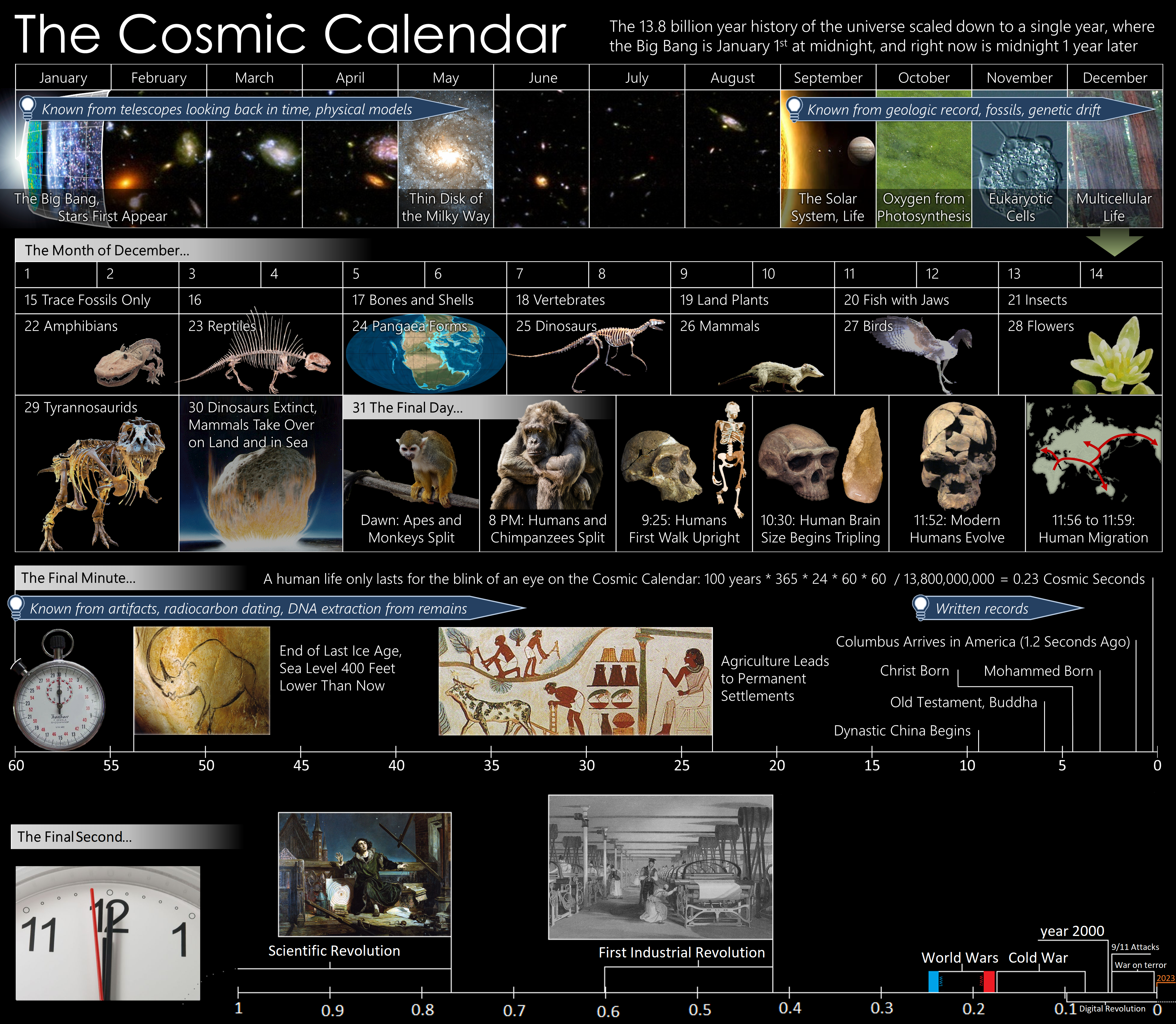
The story is set a few years hence on the International Space Station just as we’re sending astronauts to the Moon again. The book doesn’t have a plot but is a beautiful description of working in space. Harvey’s novel concludes by conveying a tremendous sense of wonder inspired by Carl Sagan’s Cosmic Calendar (large version). The Cosmic Calendar compares the timeline of the universe to one year. Everything since the Scientific Revolution would have happened in the last second of the Cosmic Calendar.

The Cosmic Calendar is a beautiful metaphor to contemplate ontology. How did we get here? There are two main theories. God implies a top-down creation. Evolution suggests a bottom-up development. Each has its paradox. Who created God? Or, how did something come from nothing? Studying cosmology makes it hard to believe in God. How could a single being create all that vastness? What if the universe is God? That’s pantheism. It makes God equal to Evolution but leaves us still with the problem of how things started.

The Cosmic Calendar answers for When.

But do we really need to know how things got started? Shouldn’t we just ask: What is our place in the universe? Scientists are now theorizing that we might exist in a multiverse. In other words, no matter how large we look into the cosmos, there’s always more. On the other hand, no matter how small we look into the subatomic, there’s always something smaller. This is beautifully illustrated by the famous Charles and Ray Eames video of The Powers of Ten from 1977.

The Powers of Ten answers for Where. More importantly, it reveals there are many domains. We might observe the cosmos or even the domain of the atom or quantum, but do they matter to who we are and what we should be doing? Shouldn’t our domain be a hundred meters?

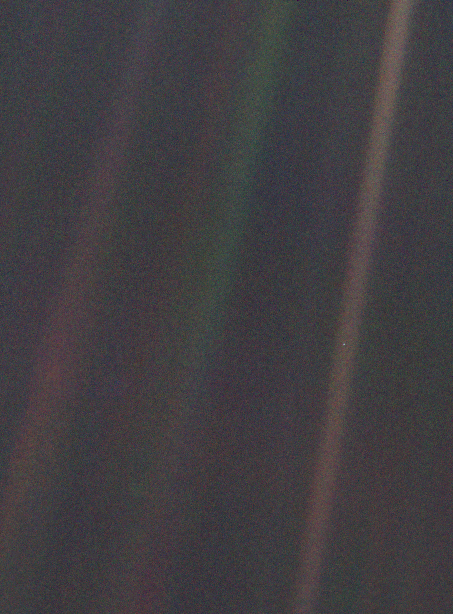
Carl Sagan wrote a book The Pale Blue Dot based on a photograph of Earth taken by Voyager 1 while it passed Saturn. If you look closely, you will see a blue dot. That’s Earth. It’s hard to think we’re significant to the universe. Then think about the Milky Way as seen from the edge of the universe. It wouldn’t be visible at all. It’s beyond conceivable to imagine how small we are compared to all of existence. How can we be significant? How can we have a purpose?

It’s important to think of ourselves relative to the domain in which we live. Many people are depressed by watching the news but isn’t the domain of the Earth too big for one person? Isn’t it ego and delusion to think our purpose could be to organize a nation, city, or even something as small as a neighborhood? I have trouble keeping my house and yard in order.

Lately, I’ve been working in the yard. After fifteen years of neglect, the backyard is overrun with tangled wild growth. Every day I spend a little time trying to conquer my tiny plot of wilderness. At 73, that effort pushes the limits of my physical abilities. I use most of the energy I have left keeping the house somewhat neat. It’s not really clean. I also must spend precious vitality on personal finances, shopping, and general living and maintenance.

Yet, I keep thinking I should be doing something more. I’m not sure what. Maybe it’s having a purpose or making my mark in a small way. This would answer the question of who. And maybe why.

I’ve been using Ancestry.com and learning about genealogy. What did my parents expect of me? What did my grandparents expect of their grandchildren? I have thirty-two ancestors if I go back five generations. Did they expect anything? At most, they expected me to keep the gene line going. Well, that’s where I’ve failed.

I recently read Parable of the Sower by Octavia E. Butler. The story is about the United States suffering an economic apocalypse. The main character felt the need to have a purpose in life, even when everything bad was happening. She decided God was change and our purpose was to affect God/change. That’s a kind of pantheism. What if existence is just trying to become everything that could possibly exist?

Under Butler’s theory, my purpose is to shape myself. To constantly change. Well, I’ve certainly been doing that my whole life.

Right now I’m working on changing myself, my relationships, my house, and my yard. Mother nature was changing the way it wanted the yard. It might seem pointless, but wrestling control from Mother Nature and changing the yard into what I want does give me existential purpose. It’s essentially meaningless in the long run. But maybe our purposes should be limited to a time and place. To a domain. Think small.

I can change myself somewhat. I can change my house and yard. Somewhat. But I can’t change other people. Or anything larger in life.

Maybe that explains how and why.

JWH

Will We Ever Be Able to Know Why There is Something and Not Nothing?

by James Wallace Harris, 6/29/24

Is there one question you’d love to know the answer to before you die? For me, it’s always been “Why is there something rather than nothing?” Religious people want to believe God created everything, but there’s always that one smart kid who asks: What created God? We get into the problem of infinite regression. Of course, there’s the famous story by a scientist where the punchline is: “Turtles all the way down.”

Science has been trying to answer this question forever. At the small end, we have elementary particles in the Standard Model, with scientists and mathematicians speculating they came about because of strings or other concepts. At the large scale, cosmologists think the universe might be part of a multiverse. But don’t we have the same problem? What creates strings and multiverses? It’s something tinier or larger all the way down or up.

I must assume I will never know the answer to the question that gives me the most existential angst. I used to think as a kid, when we die, we’re finally told the answer to all our questions. But if I find myself in another dimension after death, I’m just going to ask: “What created this place?”

Maybe the answer that leads to happiness is to ask questions that can be answered. To focus on a smaller domain of existence. If I reduce the domain to planet Earth, I’d ask: “What happens to humans after runaway climate change?” It’s possible to speculate with some possibilities of getting the answer close to what might happen. But is such speculation useful?

If I reduce the domain to the United States. I guess the question right now that most people are asking: “Who will be elected president in November?” Until the debate Thursday night, we assumed it would be one of two possibilities. But have things changed? Don’t things always change?

I think I need to reduce the domain again. On a very personal level I’d like to know: “What is time.” And I don’t mean where in the Earth’s rotation, or orbit about the sun. No, I want to know: “What makes reality grow from one moment to the next?” Nothing stays the same. So, what is the smallest degree of change perceptible? Is it the vibration of subatomic particles? Is it the fields and forces that make up those particles? What is one tick of reality’s clock?

This is why I’m currently reading books like The Order of Time by Carlo Ravelli and On the Origin of Time by Thomas Hertog. I struggle to understand what these books are telling me. Is it possible to understand physics without understanding mathematics and science at the graduate level? I can vaguely sense what I think they’re talking about, but I might be deluding myself.

I do think time might be the key to why there’s something and not nothing, but I’m not sure we can ever grasp the reality of spacetime. I’m certainly no Einstein or Hawking. I don’t even understand science at an eighth-grade general science teaching level. To me, comprehending time is closer to being a meditating Buddhist.

What question would you love to know the answer to?

JWH

If Ignorance is Bliss, is Knowing Suffering?

by James Wallace Harris, 6/27/24

This essay is about how keeping up with current events is hard on our mental health. Is there a point in becoming informed that turns self-destructive? Happiness seems to be a balance between knowing and not knowing, between learning and ignoring.

I’ve always been amazed by the amount of fiction we consume in our lives — the books, movies, television shows, plays, video games, role playing, comics, fantasizing, bullshitting, and so on. Is fiction our way of regulating our awareness of reality?

I’m trying to decide in this essay just how much news I should consume. I believe I have three basic choices:

  1. Ignorance really is bliss.
  2. Learn enough to maximize my own survival.
  3. Learn everything I can to answer why and maybe know what can be changed.

I also consider the first three lines of the Serenity Prayer practical advice:

God grant me the Serenity to accept the things I cannot change,
Courage to change the things I can, and
Wisdom to know the difference.

Mental health depends on knowing what can be changed and what cannot. I believe the old saying, “ignorance is bliss” is merely advising people not to try to change things. Eastern religion and philosophy are all about acceptance, and that might be one path to happiness, or at least contentment. Western religion and philosophy have always been about control, which often leads to frustration and unhappiness. However, Western religion and politics have always been delusional because they don’t know enough to wisely make changes. Too many people think they know, but don’t. And too many people pursuing ignorance follow the people who don’t know. In other words, even if you learn everything you probably won’t be able to do anything.

For most of my life I hoped humanity would evolve into a global humanistic society that was ecologically sustainable, maximizing freedom, and minimizing inequality. That’s obviously not going to happen. Instead, we’re returning to nationalism, xenophobia, and fascism. The growing consensus advocates: get all you can, protect what you have, and let the losers lose. Even Christians have become Darwinians.

The main message in the movies and television shows we consume is the good life is eating, screwing, buying, and travel. But hasn’t that made us the most invasive and destructive species on the planet?

I believe the fiction we consume, and the fantasies we chase, is our way of self-medicating a deep depression caused by seeing too much of reality. If I read or watch too many news programs, documentaries, or nonfiction books about what’s happening around the world I get bummed out and need to retreat. Is that the best thing to do? Or the only thing to do?

How much of learning about reality is educational, soul strengthening, and enlightening? Billions of people are suffering. How important is it to know that the majority of people on this planet spend a good deal of their lives in misery?

If you only watch NBC Nightly News, Fox News, MSNBC, or CNN, you’ll only end up worrying about problems in the United States. And that’s enough to depress most people. But if you take in news from around the world, it can deeply threaten your mental health.

I watch a lot of news from all over, and I’m convinced that our civilization is in decline. The number of failed nations grows every year. The number of weather catastrophes increases every year. Wars and famines are increasing. Life expectancies are declining. Economies are breaking down, and people are dying, becoming homeless or refugees, and suffering in ever-growing numbers. We’re lucky in the United States that we don’t suffer as much, but that’s why millions want to come here.

Decades ago, I stopped watching local news so I wouldn’t be depressed about crime. Even though I live in a high crime city, I seldom hear about it, and thus seldom worry. I could do the same thing with national and international news. That would be good for my mental wellbeing, but shouldn’t I do something?

Liberals believe society should alleviate suffering through laws. Conservatives want to solve the same problems by convincing everyone to pull themselves up by their bootstraps. The reality is liberals want to solve society’s problems by spending the conservative’s money, and the conservatives just want to ignore the problems and keep their money. And it seems the only problem politicians really want to solve is how to get reelected and feed their egos.

Civilization is coming undone. That’s all too obvious if you watch a lot of news and study local, state, federal, international, and world events. However, knowing, and even understanding the problems we face doesn’t empower us to solve them. We either solve them together, or not at all, and if you’re an ardent news watcher, you’ll know we’re living in an age where we don’t work together.

Here’s where I’d love to list and catalog all our problems and assess their chances of being solved. But that would take a book length bit of writing. I’m sure you see enough of the news to know about all the problems we face — or do you? Would knowing more help or hurt you?

I could construct a detailed taxonomy of all the problems we face. I could stop reading novels and watching television and study the heck out of current events. But other than finding enlightenment about why civilization is collapsing, are there any mental, spiritual, or psychological benefits to learning how and why we’re self-destructing?

The real question is: Can we do anything to stop our self-destruction if we all agreed to work together and knew the right solutions? Even if we banned all airplane travel, reduced car travel to a minimum, rebuilt the energy grid that maximized renewable energy, and we all became vegetarians, we’ve already put enough CO2 in the atmosphere to radically change the climate. We may have already destabilized the climate so it can’t be reversed.

And we don’t have to wait until the seas rise above New York and London before climate change will do us in. We’re about to see the collapse of the home insurance industry which will completely destabilize the economy around home ownership. Just that might bring about economic chaos.

I could go on. Aren’t we like cattle in a stockyard? Would knowing about the captive bolt pistol offer any personal benefit in our lives? Or is there a kind enlightenment to be achieved by figuring out how the system works?

JWH