Reading Comprehension: Books vs. Audiobooks

by James Wallace Harris, 1/3/24

At 72, I’m still learning how to read.

I recently finished the audiobook of The Simulacra by Philip K. Dick and started to write a review for my science fiction blog. That’s when I realized I needed to read the book with my eyes before I could write a proper review. The Simulacra was a complex novel involving several plot threads and dozens of named characters. (Read the plot summary at Wikipedia. Get the book at Amazon.)

From my audiobook experience I found the book compelling, fun, and I was always anxious to get back to listening to the story. I was never confused by what was going on, but when I tried to summarize the novel for my review, I discovered I couldn’t recall all the details I needed to make a coherent description of the story. There were just too many science-fictional concepts. Nor could I describe all the plot threads without researching them.

I won’t describe the book in detail, I’ll do that in my review, but for now, The Simulacra is about a post-apocalyptic world where China attacked America with atomic missiles in 1980, and the U.S. government and Germany combined to form a totalitarian regime called The United States of Europe and America (USEA). It appears to be run by a captivating 23-year-old first lady named Nicole Thibodeaux. However, she has been married to five presidents and always remains young. Since this book was written in the summer of 1963, I assume Dick was inspired by Jackie Kennedy because Nicole spends most of her time charming people, decorating the White House and gardens, and putting on nightly cultural events. But Nicole is also ruthless enough to have people summarily executed, evidently wielding unlimited power. She has access to time travel no less, and one subplot involves her negotiating with Nazis to change the course of WWII. Other subplots involve an insane psychic pianist Nicole wants to play at the White House, the outlawing of psychiatry pushed by the pharmaceutical industry, what happens to the last legal psychiatrist, a pair of ordinary guys who have a jug band that plays classical music who want to perform at the White House, a trio of sound engineers who are trying to chase down the psychic pianist to record, and a small company that hopes to get the contract to construct the next president. This long paragraph barely scratches the surface of the whole novel.

My failure of completely understanding the novel from listening to the audiobook was partly due to aging memory and partly due to the complexity of Dick’s prose. I could have hashed out several thousand words describing what I remembered, although it would have been a bundle of vague impressions. Summarizing what PKD was trying to do was evasive from just listening to the audiobook.

Audiobooks are bad for remembering exact details, which I knew, but was painfully revealed when I tried to read the novel and take notes. I called up The Simulacra on my PC in the Kindle app on the left side of the screen, and launched Obsidian, a note taking program on the left side of the screen. I started reading The Simulacra again, but with my eyes. After two days, getting to the 29% read position on the Kindle edition, I had twenty-eight names, twenty-six plot points, several lists of other details, and several quotes in my notes. I figure there are three to five main plot threads, each involving three or more characters.

More than that, I realized Philip K. Dick had riffed on hundreds of ideas. As I read them, I remembered them, but I realized that while listening, I had not put most of them within the context of the story. It wasn’t until my second reading that I saw all these hundreds of creative speculations as being part of one jigsaw puzzle picture. And I’m not talking about the characters and plots. I’m talking about worldbuilding.

Rereading with my eyes allowed me to stop and ponder. Rereading allowed me to remember the bigger picture. However, listening to the audiobook let me enjoy the story more. The narrator, Peter Berkrot, did voices for each of the characters, and acted out their personalities. Listening to the novel, it felt like I was listening to an old-time radio drama where many actors performed a story.

At one point I got too tired to read and went to bed. But before I fell asleep, I listened to the part I had just read. Berkrot expressed emotions I had not picked up while reading with my eyes, but recalling the scenes made me realize that Dick had put them there. In other words, Berkrot had found aspects of the text I missed and was pointing them out with sound.

Over the ten years since I’ve retired, I’ve been learning the value of rereading books. In fact, I now feel reading a story just once is unfair to the author. It takes two or more readings to see the author’s vision. Reading a work of fiction just once provides one layer of understanding. It’s when we see multiple layers within a work that we start to truly understand it.

Switching back and forth between reading with my eyes and reading with my ears reveals both methods have their advantages. If I read once with one sense organ and reread with another, the two combine to create reading synergy.

For most of my life, I’ve always been concerned with reading more books, but the wisdom I’m gaining from getting old is showing me that both speed reading and reading lots of books is a distraction from deep reading.

Right now, I’d recommend:

  1. Listen to an audiobook for the first reading to get the big picture.
  2. Reread with a physical book or ebook to get the details. Read slowly and stop often to ponder.
  3. Write a review to make deeper sense of a book. Putting things into words pushes us to make sense of things.
  4. Read reviews and scholarly articles to get other perspectives.
  5. Reread the book again to bring it all together.

This is what I’m working on with The Simulacra by Philip K. Dick. It’s not considered one of Dick’s better works, but I’m trying to discover if there is more to the novel than its current reputation.

JWH
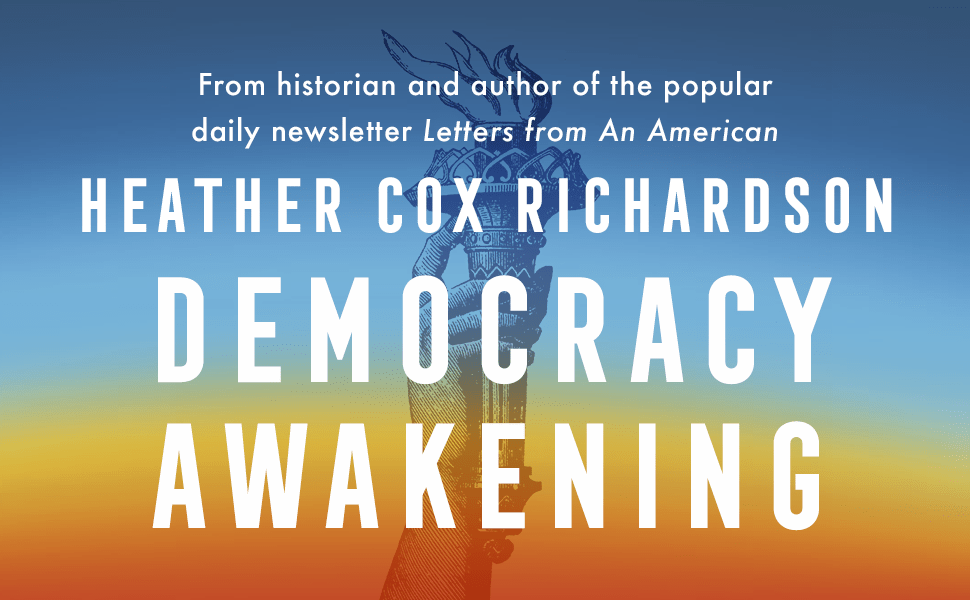
Democracy Awakening by Heather Cox Richardson – Review Part One

by James Wallace Harris

Americans have general thought of America as a democracy, although it’s never been a true democracy. When the United States of America was first created a limited number of white males could vote. As time progressed more white males were allowed to vote. As liberals and radicals influenced politics, they advocated for wider suffrage state by state. See this timeline for details, but the Fifteenth Amendment in 1870 gave black men the vote, and in 1920 the Nineteenth amendment was passed that gave women the vote in all states. Whites have always suppressed black voters, and even some men still resent women voting. And political parties have always tried to control who could vote and how, and even suppressing voting.

A true democracy would allow every citizen over a certain age to vote, or universal suffrage. Before the 21st century most Americans didn’t see that as a problem, but as ethnic demographics have changed it has turned some Americans against democracy.

America is supposed to have a representative democracy, but it inspired the formation of political parties supported by various special interest groups fighting for power. In America Awakening Heather Cox Richardson describes how we’ve reached the current state where liberals advocate more democracy and conservatives push for less, apparently wanting authoritarian rule instead. Authoritarians general promote some ideal in the past as the authority of how things should be govern. Most modern American authoritarians look to either the Founding Fathers and the Constitution or to God and The Bible, or a combination of both. Modern American authoritarian leaders tend to be white and paternalistic, and their followers tend to want a strong man, or strong father figure, although more women are wanting to be Republican leaders too.

Richardson says it’s important to understand that many terms like conservative, liberal, radical, Republican, and Democrat have changed over the centuries. In the 19th century Republicans were for African Americans voting, and for gun laws, and in the early 20th century, for regulations on corporations. In the 19th century and through the first half of the 20th century, Democrats tried to keep African Americans from having the vote. The Republican and Democratic parties went through a polarity change in the 1960s. Richardson says its important understand how words have changed meaning because authoritarians often abuse them and justify their abuse by claiming history supports their new definitions. In other words, history gets distorted and abused.

I’m reviewing Democracy Awakening because I think it’s an important book everyone should read for the 2024 U.S. presidential election, but also to push my ability to remember. I love reading nonfiction books, but their information often feels like it goes in one ear and out the other. I can only retain what I learn in the vaguest way. Since I’m also reading about memory and aging, I’ve decided to read Democracy Awakening differently. I’m going to distill what Richardson is saying into my own words but in some concise form that I hope I can remember. I’ll do that in a series of blog posts, outlines, tables, etc.

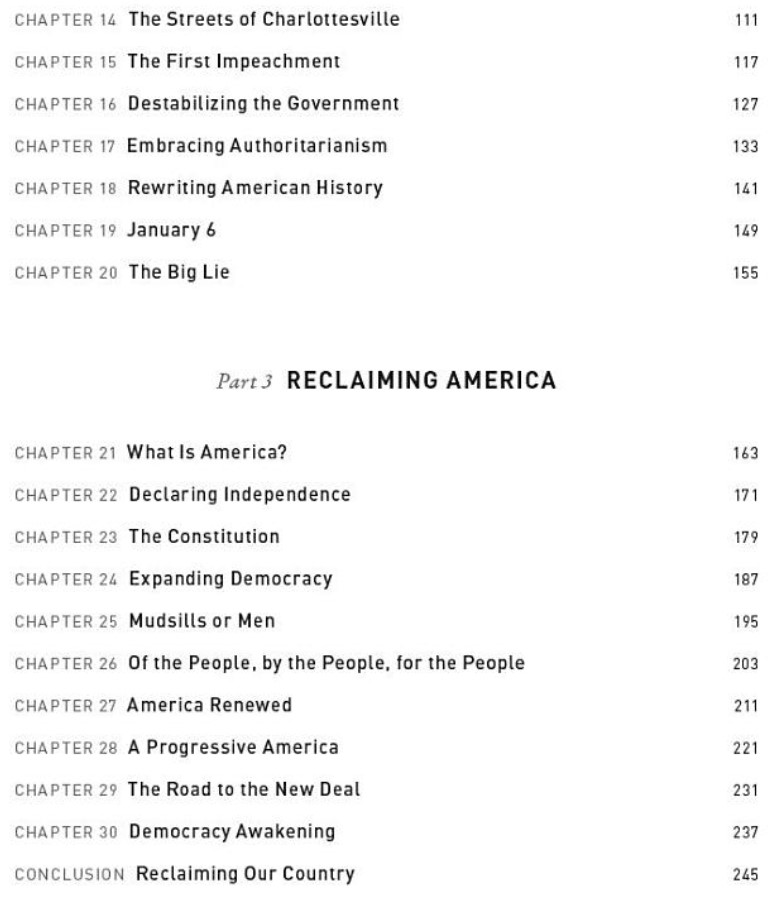
My friend Linda and I are reading Democracy Awakening together and for our first discussion we are covering Part 1, Chapters 1-10, which I hope to cover today. Here is the Table of Contents.

Because I’ve also read other books on this subject already, including watching related documentaries and YouTube videos, I’m going to reference them in this series to show how there’s a synergy in my reading.

Heather Cox Richardson is a history professor who has specialized on the history of the Republican Party through a series of books. I have not read these books, but I have read some about each and it gives me confidence that Richardson is an expert on this subject. On the internet there are zillions of people claiming to be knowledgable on specific subjects but when you check into their creditials, you find little to back their claim of authority.

Richardson makes her points by citing historical events. I wish I could remember all the cited dates and important changes in history because they show an evolution of how we got to today. The first ten chapters progress mostly in a linear fashion, so I hope to eventually create a timeline.

Richardson also quotes significant papers, speeches, books, and other sources to reveal how concepts emerged that cause people to seek political change. Just the history of African Americans seeking Civil Rights reveals many connections to how conservatives and liberals changed their parties and political goals. I’d like to make a list of the most significant quotes to remember. And I’d like to read the books Richardson references, including books by conservative writers. But this will take a lot of time.

And there’s another problem, both conservatives and liberals use the Founding Fathers as historical authority even though members of both political parties distort history for their cause. Republicans like to cite the past, both the Founding Fathers, and The Bible, as how to create or interpret laws. This is rediculous. 2023 isn’t 1776, or 800 BCE. Yet, reading Richardson’s book Democracy Awakening shows the democracy we have today is constantly changing, and how those changes comes from actions in the past.

It is well documented that Republicans feel the United States took a wrong turn in the 1930s when FDR’s administration created the New Deal. They’ve been trying to undo it ever since. And their methods and philosophy of why and how have evolved over the decades. Part of that evolution is moving away from democracy, which is what Richardson’s book is about.

Richardson believes we didn’t fall into fascism in the 1930s because the United States has a long history of various groups fighting for suffrage. That the history of United States is one of a ruling class struggling to keep power from various groups of people wanting to vote. This includes poor whites, African Americans, women, and immigrants. The current Republicans know they cannot win with universal suffrage and fair elections and so they have to do an end run around democracy.

Republicans formed coalitions with special interest groups that the leaders of the party have no interest in supporting. What has changed is the special interest groups have taken over the power from the old Republican elites. Neither the Republicans nor Democrats have a clear majority with voters, and depend on Independents who swing their votes.

The main problem revealed in the first part of Democracy Awakening is the country is dividing itself into two camps. Those who want an authoritarian government based on their version of the Founding Fathers and their version of Christianity, and those people who want universal suffrage and a true democracy.

The authoritarians cannot get what they want by existing voting laws and population demographics. That’s why they are undermining the election process. Since majority rule is 50%, these two groups are polarized. Neither Republicans or Democrats have a majority. They depend on swing votes from Independents.

What I’m hoping to see in the next two parts is whether or not Richardson thinks democracy can survive. I was recently terrified by a New York Times essay, “Trump Has a Master Plan for Destroying the ‘Deep State’” by Donald P. Moynihan. In it Moynihan says Trump has three goals which I’ll take out of context and quote here:

The first is to put Trump loyalists into appointment positions. Mr. Trump believed that “the resistance” to his presidency included his own appointees. Unlike in 2016, he now has a deep bench of loyalists. The Heritage Foundation and dozens of other Trump-aligned organizations are screening candidates to create 20,000 potential MAGA appointees. They will be placed in every agency across government, including the agencies responsible for protecting the environment, regulating workplace safety, collecting taxes, determining immigration policy, maintaining safety net programs, representing American interests overseas and ensuring the impartial rule of law.

...

The second part of the Trump plan is to terrify career civil servants into submission. To do so, he would reimpose an executive order that he signed but never implemented at the end of his first administration. The Schedule F order would allow him to convert many of these officials into political appointees.

Schedule F would be the most profound change to the civil service system since its creation in 1883. Presidents can currently fill about 4,000 political appointment positions at the federal level. This already makes the United States an outlier among similar democracies, in terms of the degree of politicization of the government. The authors of Schedule F have suggested it would be used to turn another 50,000 officials — with deep experience of how to run every major federal program we rely on — into appointees. Other Republican presidential candidates have also pledged to use Schedule F aggressively. Ron DeSantis, for example, promised that as president he would “start slitting throats on Day 1.”

...

The third part of Mr. Trump’s authoritarian blueprint is to create a legal framework that would allow him to use government resources to protect himself, attack his political enemies and force through his policy goals without congressional approval. Internal government lawyers can block illegal or unconstitutional actions. Reporters for The New York Times have uncovered a plan to place Trump loyalists in those key positions.

This is not about conservatism. Mr. Trump grew disillusioned with conservative Federalist Society lawyers, despite drawing on them to stock his judicial nominations. It is about finding lawyers willing to create a legal rationale for his authoritarian impulses. Examples from Mr. Trump’s time in office include Mark Paoletta, the former general counsel of the Office of Management and Budget, who approved Mr. Trump’s illegal withholding of aid to Ukraine. Or Jeffrey Clark, who almost became Mr. Trump’s acting attorney general when his superiors refused to advance Mr. Trump’s false claims of election fraud.

This is why I believe everyone should be reading Democracy Awakening. I believe Richardson’s book is defining what the 2024 election will truly mean at the deepest level.

JWH

Is Ethical Capitalism Even Possible?

by James Wallace Harris, 10/20/23

This month, several of my friends have separately expressed doubt about the future. I don’t hold much hope either. Our current world civilization seems to be falling apart. Capitalism is consuming the planet, but capitalism is the only economic system that creates enough jobs to end poverty. The only alternative to free market capitalism I can imagine is if we adapt capitalism to an ethical system. So, I’ve been keeping my eye open for signs of emerging ethical capitalism.

Here’s one: “The Workers Behind AI Rarely See Its Rewards. This Indian Startup Wants to Fix That” from Time Magazine (8/14/23). The article describes how AI startups need vast amounts of sample data from other languages for their large language models. In India, many data companies are exploiting poor people for their unique language data and keeping the profit, but one company, Karya, is giving the poor people they employ a larger share of the profits. This helps lift them out of poverty.

Capitalism has two dangerous side effects. It destroys the environment and creates inequality. For capitalism to become ethical it will need to be environmentally friendly, or at least neutral, and it will need to be more equitable. If we want to have hope for the future, we need to see more signs of that happening.

Right now, profits drive capitalism. Profits are used to expand a corporation’s ability to grow profits, and to make management and investors rich. Labor and environmental controls are seen as expenses that reduce profits. For a corporation to be ethical it will have to have a neutral or positive impact on the environment, and it will need to share more of its profits with labor.

Since the pandemic hourly wages have been going up, and so has inflation. If capitalism becomes more ethical, costs for environmentalism and labor will go up, thus ethical capitalism will be inflationary. Some people have gotten extraordinarily rich by making things cheap, but it’s also shifted labor and environmental costs away from corporations onto the government and the public. The price at the store does not reflect the actual cost of making what you buy. You pay the difference in taxes.

For ethical capitalism to come about things will need to be sold for what they cost to make. That will involve getting rid of governmental and corporate corruption. It will involve political change. And it will be inflationary until the new system stabilizes.

My guess is ethical capitalism will never come about. If I were writing a science fiction novel that envisioned life in the 2060s it would be very bleak. Life in America will be like what we see in failed states today. Back in the 1960s we often heard of the domino theory regarding communism. Failed states are falling like dominoes now. Environmental catastrophes, political unrest, dwindling natural resources, and viral inequality will homogenize our current world civilization. Either we work together to make it something good, or we’ll all just tear everything apart.

Civilization is something we should all shape by conscious design and not a byproduct of capitalistic greed.

We have all the knowledge we need to fix our problems, but we lack the self-control to apply it. I have some friends who think I’m a dope for even holding out a smidgen of hope. Maybe my belief that we could theoretically solve our problems is Pollyannish.

I have two theories that support that sliver of hope. One theory says humans have always been the same psychological for two hundred thousand years. In other words, our habits and passions don’t change. The other theory says we create cultures, languages, technologies, systems that can organize us into diverse kinds of social systems that control our behavior.

We could choose better systems to manage ourselves. However, we always vote by greed and self-interest. We need to vote for preserving all.

In other words, we don’t change on the inside, but we do change how we live on the outside. My sliver of hope is we’ll make laws and invent technology that will create a society based on ethical capitalism and we’ll adapt our personalities to it.

I know that’s a long shot, but it’s the only one I have.

I’m working to develop a new habit of reading one substantial article a day and breaking my bad habit of consuming dozens of useless tidbits of data that catch my eye as clickbait. In other words, one healthy meal of wisdom versus snacking all day on junk ideas. Wisdom doesn’t come packaged like cookies or chips.

JWH

Thinking Outside of Our Heads

by James Wallace Harris

I believe recent developments in artificial intelligence prove that many of the creative processes we thought came from conscious actions come from unconscious mechanisms in our minds. What we are learning is computer techniques used to generate prose or images are like unconscious processes in the human brain.

The older I get, the more I believe that most of my thinking comes from my subconscious. The more I pay attention to both dreams and my waking thoughts, the more I realize that I’m very rarely making conscious decisions.

I might think “I am going to walk across the street and visit Paul,” but I have no idea how to make my body walk anywhere. But then, I’ve always assumed muscle actions were automatic. It was mental actions I believed were conscious actions. I used to believe “I am writing this essay,” but I no longer believe that. This has led me to ask:

Just what activities do we perform with our conscious minds?

Before the advent of writing, we did all our thinking inside our heads. Homer had to memorize the Iliad to recite it. Prehistory was oral. How much of thought then was conscious or unconscious? Have you ever read The Origins of Consciousness in the Breakdown of the Bicameral Mind by Julian Jaynes? I know his theories have lots of problems, but they do imagine what I’m thinking about.

How often have you worried over a problem, say a math problem, or a programming problem, and gave up, but then later, usually after a nap or sleep, the solution came to you? That’s the classic view of unconscious thinking. But even when we’re thinking we’re solving a calculus problem is it really being done at a conscious level? Are you consciously recalling all your math lessons over a lifetime to solve the problem?

How often when working on a Wordle or Crossword does the word magically come to you? But sometimes, we are aware of the steps involved.

In recent years I’ve developed a theory that when we work with pen and paper, or word processor or spreadsheet, or any tool outside our body, we’re closer to thinking consciously. Sure, our unconscious minds are helping us, but making a list is more willful than just trying to remember what we need at the store.

Writing an essay is more willful than woolgathering in the La-Z-Boy. Authoring a book is far more willful still. Engineering a submarine by a vast team of people is an even more conscious effort. Sure, it involves a collective of unconscious activity too, but a vast amount documentation must be worked out consciously.

I’ve written before about this idea. See “Thinking Outside Your Head.” That’s where I reviewed different techniques and applications we use to think outside of our heads.

Many people want to deny the recent successes with AI because they want to believe machines can’t do what we do. That humans are special. If you scroll through the images at Midjourney Showcase, it’s almost impossible to deny that some of the images are stunningly beautiful. Some people will claim they are just stolen from human creativity. I don’t think that’s true.

I think AI developers have found ways to train computer programs to act like the human mind. That these programs have stumbled upon the same tricks that the brain evolved. Many great writers and artists often talk about their Muse. I think that’s just a recognition of their unconscious minds at work. What those creative people have learned is how to work consciously with the unconscious.

What some creative people are doing now is consciously working with two unconscious minds – their own and an AI. There is still a conscious component, the act of working with tools outside of our head. Where the action is, is that vague territory between the unconscious mind and the conscious one.

JWH

I Wish All My Family and Friends Blogged, I Wish Everyone Blogged

by James Wallace Harris, 7/16/23

What if everyone who ever lived kept an indestructible diary. Imagine reading what all our ancestors thought throughout their lifetimes. I don’t believe in an afterlife, but this could be the form of one. I’ve often wondered what my parents thought as they were growing up and got older. I’ve also wondered about my grandparents and what they thought about their lives. If they had written down their thoughts and were saved in some way, I could read them now. I wish I had a magic lamp and three wishes. This is how I’d use one of them.

I’ve always been somewhat interested in genealogy. However, just seeing names with dates of birth and death isn’t good enough. Whenever I see a genealogy chart I ask: Who were they, what did they think, what did they do?

The past is gone, so we can’t worry about that now. Although I have read accounts of people wanting to program an AI based on everything they could find out about someone they loved who died. The theory is if we programmed everything we know about a person, say Mark Twain or Ernest Hemingway into an AI, it might act like those men. That sounds creepy. On the other hand, one of my favorite science fiction stories, “Appearance of Life” by Brian W. Aldiss involved the protagonist finding memory cubes by two people who had been married and died years apart and putting them on a shelf so they talked to each other. It was both moving, tragic, and pathetic all at once.

Reading books by famous writers and biographies about them does convey a sense of who they were and how they reacted to their times. And biographies about famous people who left no writings of their own lack something. Look at the four Gospels — if only Jesus had written something himself.

Blogging offers the potential to do what I’m talking about. What if the Library of Congress archived all blogs. Would people in the 22nd century find our blogs interesting? What about the 43rd century?

If you pay attention to serious fiction and films, much of the trouble conveyed about the characters and interactions with other characters is due to a lack of communication. A good example is Celeste Ng’s first novel, Everything I Never Told You. Think about every person you ever loved, hated, or worked with, and what it would mean if you read their inner thoughts? Or at least the thoughts they wanted to share?

Also, it’s important to know that our thoughts are not coherent. Writing is the way we learn this. You’ll never know yourself only by thinking. Writing is a way to sculpt thoughts into something recognizable. Writing is the way to learn about yourself, and reading is the way to learn about other people.

Remember being back in school and all the emotional turmoil and conflicts caused by relationships, perceived relationships, and lack of relationships? Would we have been better people, kinder people, more self-aware people, if we had all blogged back then and read each others’ thoughts? Weren’t a lot of our problems as kids because we hid inside of ourselves and only speculated about our classmates? Would there be more or less school shootings if all the kids knew each other better?

Not only would growing up blogging help with self-expression, and communication, but it would have made us better learners and scholars. I’ve already written about “Blogging in the Classroom.”

I also wrote, “77 Things I Learned From Writing 1000 Blog Essays” which was mostly about how blogging is a great self-improvement tool. One of the main reasons I blog is it helps keep my mind together.

But I mostly wish everyone I knew blogged so I could learn more about them. Lately, I’ve been noticing how little we really communicate with one another. We have our public persona, and we hide the rest. I’ve noticed how many people as they grow older withdraw into themselves. We tend to just chat. Is that because we have given up on relationships? Or because we have more worries about ourselves and don’t want to worry about other people?

For some reason, we consume fiction hours a day. And it’s not the kind of fiction where we learn about people. It’s the kind that helps us forget and hide. Wouldn’t our lives be better if we learned more about real people and not imaginary people?

On the other hand, we are bombarded with personal problems and information overload every day. Maybe we watch television because we had enough of reality and real people? Even extroverts who crave constant social activity often stay at a shallow level of communication. Could the fact that we don’t all blog, or communicate deeply imply that’s what we prefer?

JWH