Past-Present-Future As It Relates to Fiction-Nonfiction-Fantasy-SF

by James Wallace Harris, 12/12/25

I’ve been contemplating how robot minds could succeed at explaining reality if they didn’t suffer the errors and hallucinations that current AIs do. Current AI minds evolve from training on massive amounts of words and images created by humans stored as digital files. Computer programs can’t tell fiction from fact based on our language. It’s no wonder they hallucinate. And like humans, they feel they must always have an answer, even if it’s wrong.

What if robots were trained on what they see with their own senses without using human language? Would robots develop their own language that described reality with greater accuracy than humans do with our languages?

Animals interact successfully with reality without language. But we doubt they are sentient in the way we are. But just how good is our awareness of reality if we constantly distort it with hallucinations and delusions? What if robots could develop consciousness that is more accurately self-aware of reality?

Even though we feel like a being inside a body, peering out at reality with five senses, we know that’s not true. Our senses recreate a model of reality that we experience. We enhance that experience with language. However, language is the source of all our delusions and hallucinations.

The primary illusion we all experience is time. We think there is a past, present, and future. There is only now. We remember what was, and imagine what will be, but we do that with language. Unfortunately, language is limited, misleading, and confusing.

Take, for instance, events in the New Testament. Thousands, if not millions, of books have been written on specific events that happened over two thousand years ago. It’s endless speculation trying to describe what happened in a now that no longer exists. Even describing an event that occurred just one year ago is impossible to recreate in words. Yet, we never stop trying.

To compound our delusions is fiction. We love fiction. Most of us spend hours a day consuming fiction—novels, television shows, movies, video games, plays, comics, songs, poetry, manga, fake news, lies, etc. Often, fiction is about recreating past events. Because we can’t accurately describe the past, we constantly create new hallucinations about it.

Then there is fantasy and science fiction. More and more, we love to create stories based on imagination and speculation. Fantasy exists outside of time and space, while science fiction attempts to imagine what the future might be like based on extrapolation and speculation.

My guess is that any robot (or being) that perceives reality without delusions will not use language and have a very different concept of time. Is that even possible? We know animals succeed at this, but we doubt how conscious they are of reality.

Because robots will have senses that take in digital data, they could use playback to replace language. Instead of one robot communicating to another robot, “I saw a rabbit,” they could just transmit a recording of what they saw. Like humans, robots will have to model reality in their heads. Their umwelt will create a sensorium they interact with. Their perception of now, like ours, will be slightly delayed.

However, they could recreate the past by playing a recording that filled their sensorium with old data recordings. The conscious experience would be indistinguishable from using current data. And if they wanted, they could generate data that speculated on the future.

Evidently, all beings, biological or cybernetic, must experience reality as a recreation in their minds. In other words, no entity sees reality directly. We all interact with it in a recreation.

Looking at things this way makes me wonder about consuming fiction. We’re already two layers deep in artificial reality. The first is our sensorium/umwelt, which we feel is reality. And the second is language, which we think explains reality, but doesn’t. Fiction just adds another layer of delusion. Mimetic fiction tries to describe reality, but fantasy and science fiction add yet another layer of delusion.

Humans who practice Zen Buddhism try to tune out all the illusions. However, they talk about a higher state of consciousness called enlightenment. Is that just looking at reality without delusion, or is it a new way of perceiving reality?

Humans claim we are the crown of creation because our minds elevate us over the animals, but is intelligence or consciousness really superior?

We apparently exist in a reality that is constantly evolving. Will consciousness be something reality tries and then abandons? Will robots with artificial intelligence become the next stage in this evolutionary process?

If we’re a failure, why copy us? Shouldn’t we build robots that are superior to us? Right now, AI is created by modeling the processes of our brains. Maybe we should rethink that. But if we build robots that have a higher state of consciousness, couldn’t we also reengineer our brains and create Human Mind 2.0?

What would that involve? We’d have to overcome the limitations of language. We’d also have to find ways to eliminate delusions and hallucinations. Can we consciously choose to do those things?

JWH
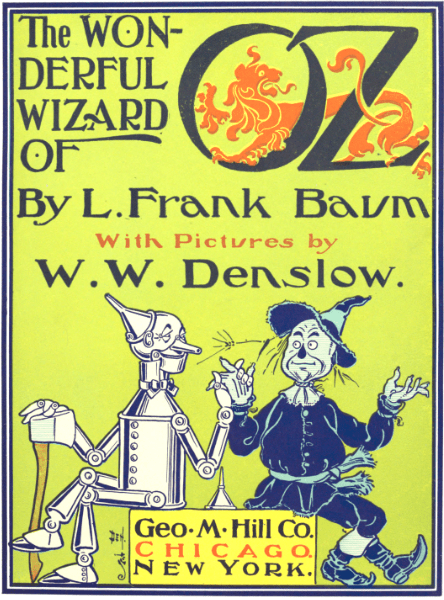
Can Rereading THE WONDERFUL WIZARD OF OZ Help Me Remember What It Was Like to Be Ten Years Old?

by James Wallace Harris, 12/5/25

While watching Wicked, I struggled to recall the excitement I felt when I first read the Oz books at age 10 back in the summer of 1962. I wanted to know whether the fantasy world Wicked created matched the one L. Frank Baum created in his fourteen Oz novels.

The barrier to making this comparison is memory. Memories are highly unreliable. Plus, we overwrite our memories every time we recall them, so am I really remembering 1962, or just the last time I thought about reading the Oz books as a kid?

Like most of my brain excavations, I have to rely on logic and deduction instead. I also look for corroborating evidence. I spent many days on this problem, and here are my results.

The Oz books were the first novels I discovered on my own. For various reasons, I concluded this was the summer between the 5th and 6th grades. My family lived on base at Homestead Air Force Base, and I found the Oz books in the children’s wing of the base library. They were old and worn.

The first novel I remember is Treasure Island by Robert Louis Stevenson, which my mother read to me in the third grade. I started using libraries in the fourth grade, but read nonfiction books about airplanes, space travel, cars, and animals.

I remember roaming up and down the fiction section at the base library and discovering the Oz books. I had no idea who L. Frank Baum was, nor did I have any idea when they were written. I didn’t know about copyright pages or genres. I saw “Oz” on the spines and connected those books to the 1939 film, The Wizard of Oz, which I had seen on television every year since the 1950s.

I did not know the word fantasy. I doubt I understood the concept of fiction. In other words, these books were an exciting discovery. To compound that excitement, they were all set in the same fictional universe. They were my Harry Potter books. L. Frank Baum had tremendous world-building skills.

Analytically, I know that at ten, I didn’t know much about the world. My vocabulary was limited. And I was unaware of most concepts and abstractions. My previous beliefs in fantasy – Santa Claus, the Easter Bunny, and the Tooth Fairy had caused me great embarrassment in first grade when a girl called me a baby for mentioning them. I was five, she was six.

In other words, I knew Oz did not exist, even though Baum created so many wonderful details to make it believable. I remember wanting Oz to exist, but I knew it didn’t. I don’t think I grasped the idea of fantasy at that time. All I knew was that the books created an artificial reality in my mind that was mesmerizing.

Watching Wicked and then rereading The Wonderful Wizard of Oz this week let me compare the two versions of Oz, but I couldn’t compare my initial reactions. Wicked is quite colorful, creative, and contains many elements of the original stories, but it no longer worked on me as the Oz books had in 1962. And that’s to be expected, since I’m 74, long past the age for fairytales.

My quest changed. I now wanted to know how my ten-year-old self saw the world. Rereading The Wonderful Wizard of Oz gave me very few clues.

My contemplations led me to some ideas, though. I have damn few memories of life before age five. I have zillions of memories dating from age five to twelve. I started thinking about them, and a revelation came to me.

Before age five, I theorize our minds are like LLMs (large language models). Those AIs can take in information and react to it, but they are unaware of the world. After five, but before puberty, we develop some self-awareness, but it’s very limiting. It isn’t until around twelve or thirteen that we start thinking for ourselves.

Here’s my main bit of evidence. As a child, my mother told me about God and took my sister and me to Sunday School and church. I just accepted what I was told. But when I was twelve, I started thinking about what they were telling me about religion. I didn’t buy it. I considered myself an atheist by 1964, when I was thirteen, maybe fourteen.

In my thirties, when I was working in a library, I came across an article that said that some librarians in the 1950s felt the Oz books gave children unrealistic expectations about life, and pulled the books from their shelves.

When I read that, I knew it had been true for me. The Oz books led me to science fiction, a genre that also inspired unrealistic expectations regarding the future that have proven to be unrealistic.

Here’s the thing: I was being told two fantasies at age ten. The first was from The Bible, and the second from the Oz books. Looking back, I see that my young self began to reject religion at age ten because I preferred the stories from L. Frank Baum. I wasn’t aware that I was comparing two fantasies; I just preferred one over the other.

Then I discovered science fiction. Concurrently, I was also discovering science. That gave me the illusion that science fiction was reality-based. When I consciously rejected religion, I thought I was choosing science. However, in recent decades, I’ve realized I had substituted science-fictional fantasies for religious fantasies.

I realize now that the Oz books had the power of Bible stories on me at age ten. The reason why so many people are true believers as adults is that they were programmed as children. Wicked doesn’t have that kind of power over me today. I can’t remember what that power felt like, but I do remember that for a few weeks in 1962, the ideas in the Oz books set my mind on fire. Rereading The Wonderful Wizard of Oz did not reignite that fire because I’m no longer a believer in anything.

I’ve often wondered if I hadn’t been lied to about Santa Claus, the Easter Bunny, and the Tooth Fairy, and thus had not experienced humiliation at discovering they were lies, and if I also hadn’t discovered Oz books, would I have accepted the Bible stories as truth as a kid and believed them now?

JWH

Should I Overcome My Prejudice Against the Undead?

by James Wallace Harris, 6/24/25

I truly dislike vampires. Ditto for zombies. (Although I sometimes like ghosts.)

My short story reading group is discussing the stories from The Best Fantasy Stories from Fantasy and Science Fiction, edited by Edward L. Ferman. I must admit I also have a prejudice against fantasy in general. On the other hand, I want to participate in the group. I want to be positive in my comments. I don’t want to constantly whine about my annoyance with the common themes of the genre.

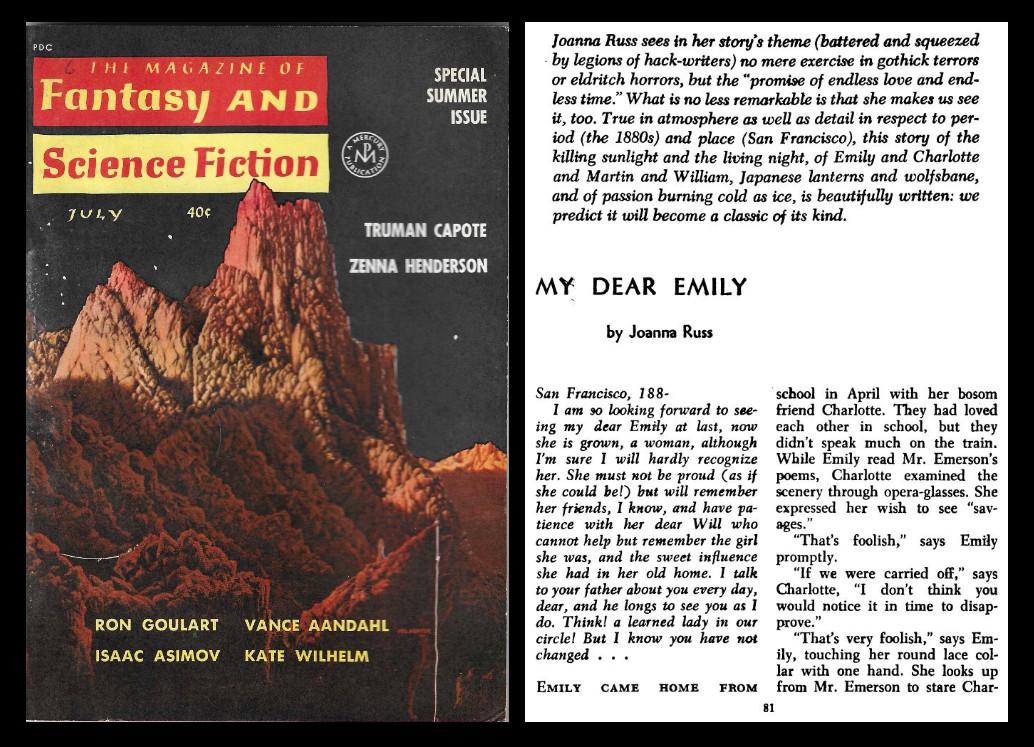
The second story up is “My Dear Emily” by Joanna Russ. It was first published in the July 1962 issue of The Magazine of Fantasy and Science Fiction. (You can read the story online.) F&SF provided my favorite genre magazine reading while growing up. I’m so fond of this periodical that I’ve collected an almost complete run of issues from 1949 to 1980. So, how can I be so prejudiced against fantasy?

I imprinted on science fiction when I first discovered reading. I consider science the only cognitive tool for understanding reality. Fantasy is based on magic and the love of the magical. Magic and science are polar opposites. I’ve never understood why people love fiction about beings that never existed. I will admit that science fiction is about beings that might exist, but are probably no more realistic than fantasy creatures.

My first impulse after reading “My Dear Emily” was to post this comment to the group: “Mediocre vampire story obscured by dense prose.” But would that be fair? Joanna Russ is a well-respected writer, even outside of science fiction. Within the genre, she is known for writing such classic feminist SF as The Female Man. Does “My Dear Emily” anticipate second-wave feminist themes in this 1962 story?

The story is set in 1880s San Francisco. Emily is returning from school in the east and bringing her friend Charlotte with her. Russ says, “They had loved each other in school.” Russ was a lesbian, but the story doesn’t appear to go in that direction at first, although in 1962, we might have been only expected to read between the lines. Emily and Charlotte do sleep in the same room.

Emily has returned to San Francisco to her father and Will, a man she is engaged to marry. Charlotte laughs at Emily’s endearing words about Will, and Emily wonders if God will strike her down for being a hypocrite.

However, Emily comes under the influence of Martin Guevara, a vampire. Why bring in the undead? We have the beginning of a good story with hints that Emily loves Charlotte but must marry Will in 19th-century America. My standard theory about why there are fantasy elements in literary stories is that it was easier to sell to genre magazines than get published in literary magazines. Literary magazines paid in free copies, but were usually a dead end for a story. “My Dear Emily” has been frequently reprinted in genre anthologies, earning additional payments and readers. In other words, would-be writers had a strong incentive to add fantasy or science-fictional elements to their stories.

Would I even be writing this essay, or have read “My Dear Emily,” if it hadn’t had a vampire in it? However, does Joanna Russ intend Martin Guevara to be meaningful in this story or just an in with the editor at F&SF?

Martin Guevara offers to get Emily out of her engagement to Will, but he exerts power over Emily, taking physical control of her. Emily already seems to know that Martin is a vampire. Did she know him before she left for school? And she leaves her house and finds me. How did she know where he lived?

On my second reading, this story seemed less murky, but it suggests things that aren’t explained. Emily tries to kill Martin with a silver cross, but he isn’t vulnerable to the power of that symbol. In fact, he isn’t affected by several of the classic defenses used against vampires. Martin tells Emily, “We’re a passion!” about his kind, and “Life is passion. Desire makes life.” He says desire lives when nothing else does.

The story becomes more about vampirism. But is it really? Russ’s prose is far from explicit. Is the story a vampire fantasy or one of lesbian liberation? Are Will and Martin two poles of masculine power?

This story did not need a vampire. But to get published in F&SF, it did. Fantasy obscured the real intent of this tale.

Why does pop culture love the undead? Do they really add anything valuable to fiction? Or, are they just popular stock characters? At best, they might be symbolic, but isn’t that symbolism usually ignored?

JWH

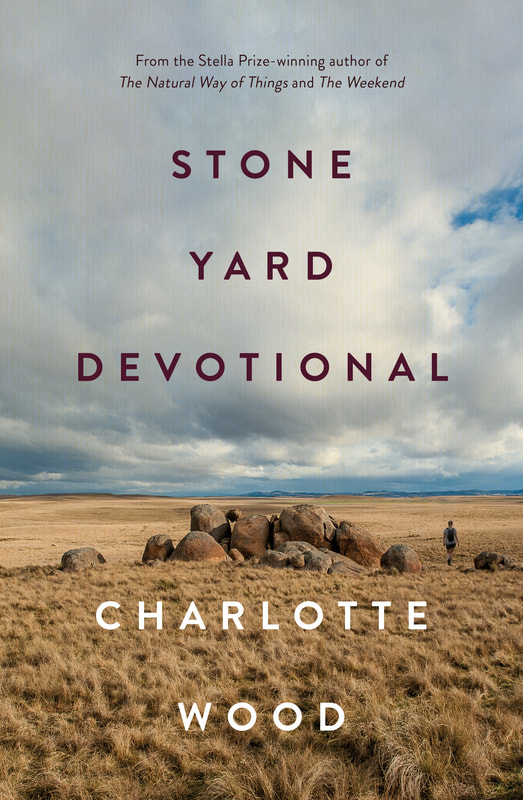
STONE YARD DEVOTIONAL by Charlotte Wood

by James Wallace Harris, 4/12/25

Stone Yard Devotional is about how reality puts the peddle to the metal when life gets all too real. Stone Yard Devotional reads like a memoir, a diary, but it’s classified as a novel. The book was nominated for several awards.

The entire time I was listening to this book I wondered if Charlotte Wood was the unnamed narrator, however after reading “‘The shock was so deep’: Novelist Charlotte Wood on the experience that changed everything” in the Syndney Herald, I realized the novel was only inspired by her own life. Wood and her two sisters were being treated for breast cancer, while she was contemplating mortality and drafting this book.

I have no memory of how I discovered Stone Yard Devotional by Charlotte Wood. The cover and title intrigued me for sure. Maybe it was because it was shortlisted for the 2024 Booker Prize. The audiobook was part of my Spotify subscription, so I gave it a try, and I’m glad I did. It’s not the kind of book I normally read, but it’s wonderful to read if you’re getting old.

The story begins with the Covid pandemic. The narrator separates from her husband, ghosts her friends, and hides out in a guest house of a religious order, even though she is nonreligious. She wants to be alone. But after her initial stay, she returns to the order to live with the nuns. I was never sure if she joined the order or not. I have often thought the monastic life has certain appeals.

The story is about the narrator’s observations while living a contemplative life. These include the death of her mother, the remembrance of childhood, studying the nuns, working in the garden and kitchen, and the guilt of living with a woman she and her classmates horribly bullied as a child. The narrative is simple, like meditation.

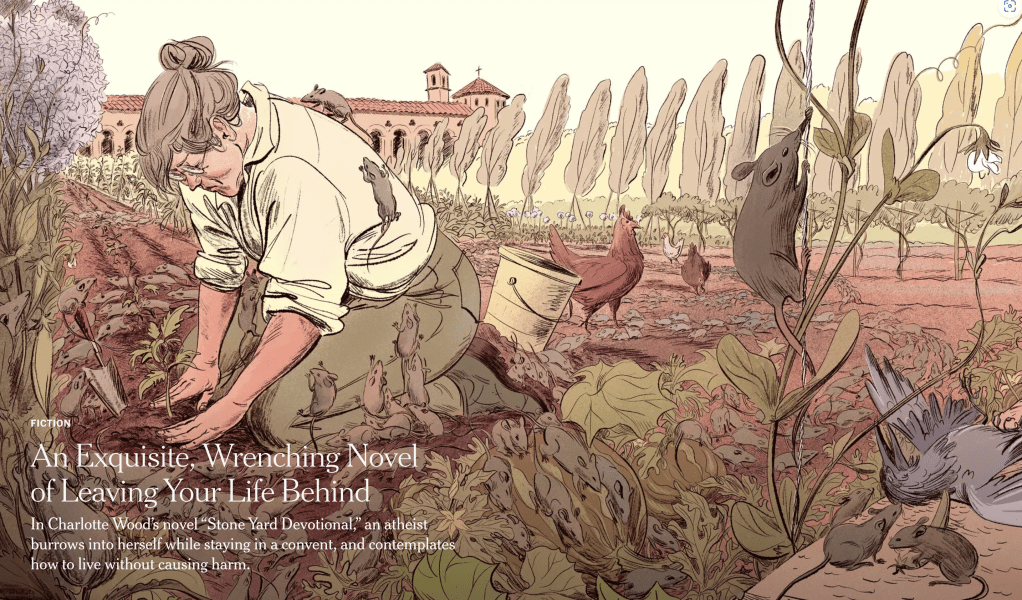
The setting is Australia, which is exotic to me. As a kid I wanted to live in Australia. Over the course of the novel, there is a plague of mice that invade the convent. The mice are so numerous that they cover the roads in gray fur. At first, I thought Wood added this element to give her tale some excitement, but I researched and found that her part of Australia they did have a mice plague of Biblical proportions in 2021.

That made life in the convent extremely inconvenient. The mice ate electrical insulation, throwing daily living in the convent back to the 19th century. The illustration for the book’s review at The New York Times might have been another reason I read this book.

Much of what the unnamed narrator contemplates throughout the novel is what everyone thinks about as they get older. The fear of declining health and death, the regrets, the desires for wanting to have done things different, the desires to connect with others while also wanting to pull away, the changes we see in ourselves and others, the appeal of nature and living simple. Wood’s story explores all of that and more, triggering the reader to think about their lives.

Charlotte Wood was born in 1965, so she’s fourteen years younger than me. However, her battle with cancer has likely aged her perception on life. At 73, I’ve been thinking about the things in this novel for years. But I don’t know if everyone who collects social security meditates on these issues. Stone Yard Devotional is a great title for this novel. Even though the narrator said she was an atheist at the beginning of this story, getting old and dealing with people who die, pushes you to be spiritual even without a belief in God.

JWH

I’ve Been Craving the Kind of Great Science Fiction I Discovered When I Was Twelve and Thirteen

by James Wallace Harris, 3/17/25

When I get sick, or I’m bummed out over politics or economics, I get the urge to read a type of science fiction I discovered when I was twelve and thirteen (1964-1965). This isn’t nostalgia, but a proven method of stress reduction. We all have our own forms of escapism, mine is a kind of science fiction originally published in the 1950s. Old science fiction is my comfort reading.

When I was twelve, my main sources of science fiction were the twelve Heinlein juveniles and the Winston Science Fiction series of SF for juveniles. The term juvenile was the old way of saying Young Adult novel. At thirteen I discovered a treasure trove of old science fiction at the Homestead AFB Library. Those books were mainly published by Gnome, Fantasy Press, and Doubleday.

I loved stories about teens colonizing other worlds, which is what Heinlein did best. One of the first science fiction books I read was Red Planet by Robert A. Heinlein, about two boys living in rural Mars going off to college. When I was young I was convinced I wanted to go to Mars too, but after I got older, I realized Mars is no place for humans.

Reading science fiction at twelve made me feel important. I thought science fiction was preparing humanity for the future. At thirteen, I thought colonizing Mars was a way to back up our species. It was humanity’s manifest destiny to colonize the galaxy. When Elon Musk said he would colonize Mars I was all for it. But when the world’s richest man takes away the food and medicine from millions of the poorest, it only reminded me that Homo sapiens are a cancer that shouldn’t be allowed to spread across the universe.

Science fiction has always been about our hopes and fears of the future, but in the sixty years since 1965, I feel science fiction has lost touch with any possible realistic future that we would desire.

The urge to reread old science fiction from the 1950s comes from a deeper need to reconnect with my old hopes for the future. What’s strange, is when I do reread old science fiction, I often find pessimism where I once found hope.

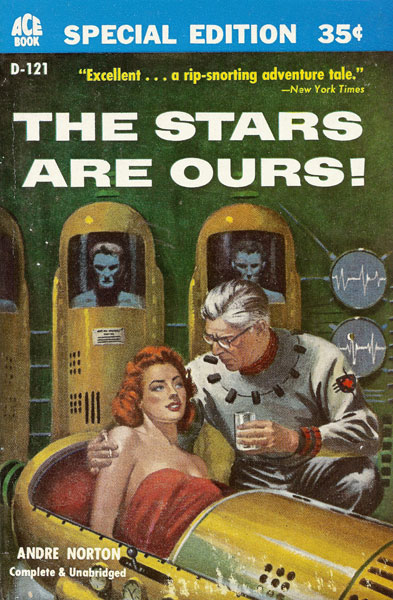
For example, The Stars Are Ours by Andre Norton. When I was young, I focused on the teen hero traveling on a spaceship to colonize a planet in another solar system. I didn’t focus on the reason why they left Earth. On rereading, I see they fled because the U.S. had been taken over by a totalitarian society that was repressing science.

On rereading my beloved Heinlein juveniles, I see Heinlein often portrayed Earth as being overpopulated, over-regulated, or having some kind of society that inspired the characters to leave.

When I was twelve and thirteen, I went to three different seventh grade schools, and two different eighth grade schools. Those were the years when I realized my parents were alcoholics. Those were the years they began to fight. And those were the years when my dad had his first heart attack. Is it any wonder that I identified with characters who left a bad world hoping to find a better one?

I loved stories like Ray Bradbury’s “The Million-Year Picnic.” I always remember the ending, where the father shows the three boys the Martians, and I always forget that the father had taken his family to Mars because Earth had destroyed itself in a nuclear war. But rereading Bradbury’s classic short story reveals that its power is a love of family and an appreciation basic human goodness.

Was science fiction back then really about escaping 1950s reality? And today, do I crave reading 1950s to escape from 2025? Is science fiction just another fantasy portal to leave here and now?

Science fiction grew up in the 1960s and 1970s. Stand on Zanzibar by John Brunner and Camp Concentration by Thomas Disch, both from 1968, were explicitly about how reality sucked. Reading them made me feel grown up. By then, even though I was still in high school, I was nostalgic for 1950s science fiction. But it wasn’t the 1950s themselves that I craved. It was the escapist fantasies of that decade.

I need to think deeper about that.

Could I be in a time loop?

JWH