Switched From PC To Mac After Buying a Mac Mini M4

by James Wallace Harris, 12/12/24

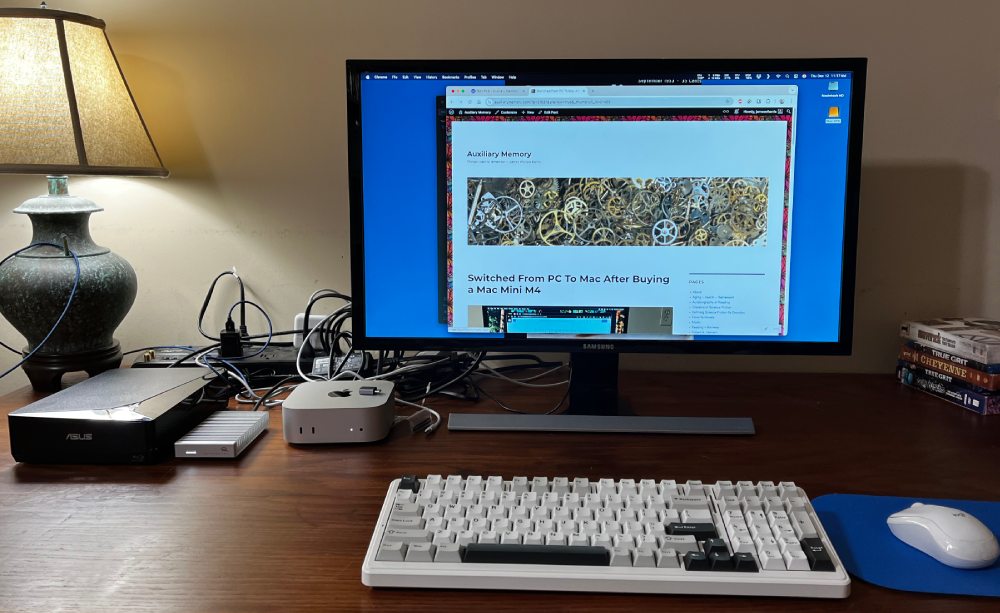
I’ve wanted to own a Mac since 1984, but they were always too expensive. When Apple announced the Mac Mini M4 had 16GB of memory as the base memory for $599, I preordered one from Amazon. They had it for $579.

I love Windows. But my Intel NUC has been annoying the crap out of me with its fan noise. I even went into the BIOS and set the processor to its lowest performance level so it should overheat less, but the fan still whined, but not as much. And it got less hot to touch. I don’t know why, but even when I didn’t use it background processes were always running something. I checked for viruses and malware but didn’t find any. I opened the NUC and vacuumed the dust, making sure that wasn’t a problem. I don’t know why, but that fan whine just got to me.

I never hear the Mac Mini M4. Nor does it get warm. I added a 4TB external hard drive to handle my 2TB Dropbox drive and a folder of Plex movies and TV shows. The heavy-duty OWC enclosure with metal fins gets warm sometimes, but it’s quiet.

I love the quietness of the Mac Mini, but I’m worried about the OWC external drive. The light comes on when I’m not using the machine, and it’s sometimes warm when I haven’t used the Mac for hours. I’m worried that something is running in the background that I might not like.

Modern computers run dozens of processes in the background, and this is starting to annoy me. I was hoping the Mac ran fewer. It’s a major reason why I considered switching to Linux. I never know if those processes are essential, corporate spying, or malware activity.

The trick to switching to the Mac was finding software that served the same functions as all my Windows programs. Office 365 runs on both platforms. No problem there. I use Microsoft Edge browser on Windows, Linux, iOS, Android, and Mac. Obsidian runs on PC, Mac, and Linux.

I was quite happy with Office 365 on the Mac. It even installs Microsoft Defender, which includes more than just anti-virus tools. However, I’ve taken all the Microsoft programs off the Mac Mini because Activity Monitor shows that Microsoft runs too many processes.

I’m testing to see if I want to standardize on pure Apple apps or pure Open Source programs. I mention this because switching to the Mac is like switching to Linux. You can try to make everything work like it did on Windows, or you can go native.

My first big hurdle was Adobe Photoshop Elements 2021. My copy came with a Mac version but wouldn’t load on the Mac Mini. I thought I’d switch to Gimp because it runs on PC, Mac, and Linux. But I just don’t like Gimp. I solved the problem by using the online app, Photopea. It works great on all three platforms. Photopea works like Photoshop Elements and Photoshop, so no learning curve.

Ripping disks with MKV works even better on the Mac. Plex works fine from the Mac. I took down the Intel NUC I used as a Plex server. Since I have so much space on the Mac Mini’s external drive, and because it is quiet and power-efficient enough to run all the time, I made it my Plex server. Even my favorite CBR reader, YACReader ran on the Mac (as well as Windows and Linux).

The Mac doesn’t work with my Plustek OptiBook flatbed scanner or my favorite program for scanning and mass manipulating images, IrfanView. I just can’t find a driver for the Plustek for either the Mac or Linux and no other program I’ve ever used even comes close to the utility of IrFanView.

Also, I can’t find a screenshot program that functions as well as Windows Snipping Tool, or ShareX.

I own a copy of Abbyy Fine Reader for Windows 15, but they’ve moved to a subscription program. I don’t know if I’m ready to subscribe to the Mac version, especially since I can’t use my scanner. I used to scan old science fiction magazines and fanzines to convert to CBR files and needed the Plustek, IrfanView, Abbyy Fine Reader, and Scan Tailor for the job. That task might have to stay on my Windows machine. But it might just retire from that hobby.

I’m not keen on how Mac OS does many things, but that might be because I’m used to doing it differently on Windows for decades. I’m adapting. I can go days without turning on my Windows machine.

One thing that has made migration easier is I keep all my files on Dropbox. I’ve always been annoyed when using one machine and remembering a file I created is stored locally on another machine. It’s so much easier to keep things on Dropbox and I can access the files from Windows, Linux, Mac OS, iOS, and Android.

There’s a lot I have left to learn about using a Mac, but it doesn’t seem to be too much trouble to do the Mac way of doing things. I am disappointed my PlusTek scanner doesn’t work.

I’ve wanted to switch to Linux for years, but never could because it didn’t have the programs I use to scan magazines or drivers for my scanner. So the Mac and Linux are equal in that.

Now that I’ve been using the Mac Mini M4 for a couple weeks, I love the hardware, but I still don’t like Apple’s operating system. It works, but it’s not what I’ve been using for decades. Using MacOS reveals just how much I love Windows 11. I wish Windows 11 ran on the Mac Mini M4.

I don’t like having an external SSD. The OWC housing and 4TB Crucial SSD work fine, but there’s something else on the desk. That bugs me. Knowing what I know now, I wouldn’t try switching to a Mac. I’m going to stick with it, at least for several months.

I write this in case you’re seduced by the Mac Mini M4 mania and haven’t bought one yet.

I love the high-tech of the M4 chip. I love having such a powerful machine. However, all I really needed was a new mini PC that was quiet.

JWH
Why I Deleted Facebook and Twenty Other Apps from My iPhone

by James Wallace Harris, 4/21/24

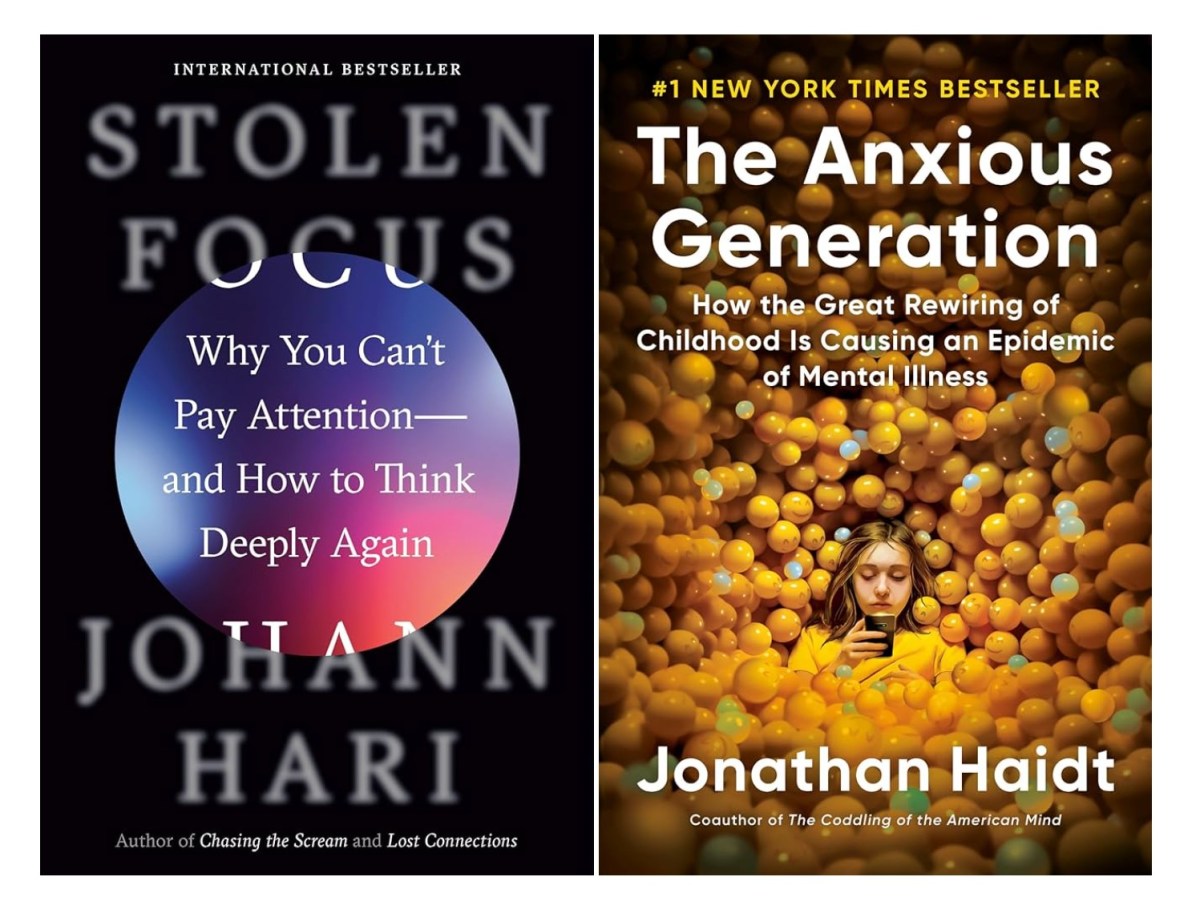
Lately, I’ve been encountering numerous warnings on the dangers of the internet and smartphones. Jonathan Haidt is promoting his new book The Anxious Generation. Even though it’s about how there’s increase mental illness in young girls using smartphones, I think it might tangentially apply to an old guy like me too.

Haidt was inspired to write his book because of reports about the sharp rise in mental illness in young people since 2010. That was just after the invention of the iPhone and the beginnings of social media apps. Recent studies show a correlation between the use of social media on smartphones and the increase reports of mental illness in young girls. I’m not part of Haidt’s anxious generation, but I do wonder if the internet, social media, and smartphones are affecting us old folks too.

Johann Hari’s book, Stolen Focus, is about losing our ability to pay attention, which does affect me. I know I have a focusing problem. I can’t apply myself like I used to. For years, I’ve been thinking it was because I was getting old. Now I wonder if it’s not the internet and smartphones. Give me an iPhone and a La-Z-Boy and I’m a happy geezer but not a productive one.

So, I’ve decided to test myself. I deleted Facebook and about twenty other apps from my iPhone. All the ones that keep me playing on my phone rather than doing something else. I didn’t quit Facebook, or other social media accounts, just deleted the apps off my phone. I figure if I need to use them, I’ll have to get my fat ass out of my La-Z-Boy and go sit upright at my desktop computer.

This little experiment has had an immediate impact — withdrawal symptoms. Without Facebook, YouTube, and all the other apps I kept playing with all day long, I sit in my La-Z-Boy thinking, “What can I do?” I rationalized that reading the news is good, but then I realized that I had way too many news apps. With some trepidation, I deleted The Washington Post, Ground News, Feedly, Reddit, Instapaper, and other apps, except for The New York Times and Apple News+.

I had already deleted Flipboard because it was one huge clickbait trap, but couldn’t that also be true of other news apps? They all demand our attention. When does keeping current turn into a news addiction? What is the minimum daily requirement of news to stay healthy and informed? What amount constitutes news obesity?

I keep picking up my iPhone wanting to do something with it, but there’s less and less to do. I kept The New York Times games app. I play Mini Crossword, Wordle, Connections, and Sudoku every morning. For now, I’m rationalizing that playing those games is exercise for my brain. They only take about 20-30 minutes total. And I can’t think of any non-computer alternatives.

I still use my iPhone for texting, phoning, music streaming, audiobooks, checking the weather, looking up facts, reading Kindle books, etc. The iPhone has become the greatest Swiss Army knife of useful tools ever invented. I don’t think I could ever give it up. Whenever the power goes out, Susan and I go through withdrawal anxiety. Sure, we miss electricity, heating, and cooling, but what we miss the most is streaming TV and the internet. We’ve experienced several three-day outages, and it bugs us more than I think it should.

One of the insights Jonathan Haidt provides is his story about asking groups of parents two questions?

  1. At what age were you allowed to go off alone unsupervised as a child?
  2. At what age did you let your children go off unsupervised?

The parents would generally say 5-7 for themselves, for 10-12 for their children. Kids today are overprotected, and smartphones let them retreat from the world even further. Which makes me ask: Am I retreating from the world when I use my smartphone or computer? Has the iPhone become like a helicopter parent that keeps me tied to its apron strings?

That’s a hard question to answer. Isn’t retiring a kind of retreat from the world? Doesn’t getting old make us pull back too? My sister offered a funny observation about life years ago, “We start off life in a bed in a room by ourselves with someone taking care of us, and we end up in bed in a room by ourselves with someone taking care of us.” Isn’t screen addiction only hurrying us towards that end? And will we die with our smartphones clutched tightly in our gnarled old fingers?

Is reading a hardback book any less real than reading the same book on my iPhone screen, or listening to it with earbuds and an iPhone? With the earbuds I can walk, work in the yard, or wash dishes while reading. Is reading The Atlantic from a printed magazine a superior experience than reading it on my iPhone with Apple News+?

Is looking at funny videos less of a life experience than playing with my cat or walking in the botanic gardens?

Haidt ends up advising parents to only allow children under sixteen to own a flip phone. He would prefer kids wait even longer to get a smartphone till they complete normal adolescent development, but he doesn’t think that will happen. I don’t think kids will ever go back to flip phones. The other day I noticed that one of the apps I had was recommended for age 4+ the App Store.

Are retired folks missing any kind of elder years of psychological development because we use smartphones? As a bookworm with a lifelong addiction to television and recorded music, how can I even know what a normal life would be like? I’m obviously not a hunter and gatherer human, or an agrarian human, or even a human adapted to industrialization. Is white collar work the new natural? Didn’t we live in nature too long ago for it to be natural anymore?

Aren’t we quickly adapting to a new hivemind way of living? Are the warnings pundits give about smartphones just identifying the side effects of evolving into a new human social structure? Is cyberization the new phase of humanity?

There were people who protested industrialization, but we didn’t reject it. Should we have? Now that there are people rejecting the hivemind, should we reject it too? Or jump in faster?

For days now I’ve been restless without my apps. I have been more active. I seeded my front lawn with mini clover and have been watering and watching it come in. I contracted to have our old bathtub replaced with a shower so it will be safer for Susan. I’ve been working with a bookseller to sell my old science fiction magazines. And I’ve been trying to walk more. However, I’ve yet to do the things I hoped to do when I decided to give up my apps.

It’s hard to tell the cause of doing less later in life. Is it aging? Is it endless distractions? Is it losing the discipline of work after retiring? Before giving up all my apps, I would recline in my La-Z-Boy and play on my iPhone regretting I wasn’t doing anything constructive. Now I sit in my La-Z-Boy doing nothing and wonder why I’m not doing anything constructive. I guess it’s taken a long time to get this lazy, so it might take just as long to overcome that laziness.

JWH

A Painful Challenge to My Ego

James Wallace Harris, 2/26/24

I’m hitting a new cognitive barrier that stops me cold. It’s making me doubt myself. I’ve been watching several YouTubers report on the latest news in artificial intelligence and I’ve been amazed by their ability to understand and summarize a great amount complex information. I want to understand the same information and summarize it too, but I can’t. Struggling to do so wounds my ego.

This experience is forcing me to contemplate my decaying cognitive abilities. I had a similar shock ten years ago when I retired. I was sixty-two and training a woman in her twenties to take over my job. She blew my mind by absorbing the information I gave her as fast as I could tell her. One reason I chose to retire early is because I couldn’t learn the new programming language, framework, and IDE that our IT department was making standard. That young woman was learning my servers and old programs in a language she didn’t know at a speed that shocked and awed me. My ego figured something was up, even then, when it was obvious this young woman could think several times faster than I could. I realized that’s what getting old meant.

I feel like a little aquarium fish that keeps bumping into an invisible barrier. My Zen realization is I’ve been put in a smaller tank. I need to map the territory and learn how to live with my new limitations. Of course, my ego still wants to maximize what I can do within those limits.

I remember as my mother got older, my sister and I had to decide when and where she could drive because she wouldn’t limit herself for her own safety. Eventually, my sister and I had to take her car away. I’m starting to realize that I can’t write about certain ideas because I can’t comprehend them. Will I always have the self-awareness to know what I can comprehend and what I can’t?

This makes me think of Joe Biden and Donald Trump. Both are older than I am. Does Biden realize what he’s forgotten? Does Trump even understand he can’t possibly know everything he thinks he knows? Neither guy wants to give up because of their egos.

So, what am I not seeing about myself? I’m reminded of Charlie Gordon in the story “Flowers for Algernon,” when Charlie was in his intellectual decline phase.

Are there tools we could use to measure our own decline? Well, that’s a topic for another essay, but I believe blogging might be one such tool.

JWH

ChatGPT Isn’t an Artificial Intelligence (AI) But an Artificial Unconsciousness (AU)

by James Wallace Harris, 2/12/24

This essay is for anyone who wants to understand themselves and how creativity works. What I’m about to say will make more sense if you’ve played with ChatGPT or have some understanding of recent AI programs in the news. Those programs appear to be amazingly creative by answering ordinary questions, passing tests that lawyers, mathematicians, and doctors take, generating poems and pictures, and even creating music and videos. They often appear to have human intelligence even though they are criticized for making stupid mistakes — but then so do humans.

We generally think of our unconscious minds as mental processes occurring automatically below the surface of our conscious minds, out of our control. We believe our unconscious minds are neural functions that influence thought, feelings, desires, skills, perceptions, and reactions. Personally, I assume feelings, emotions, and desires come from an even deeper place and are based on hormones and are unrelated to unconscious intelligence.

It occurred to me that ChatGPT and other large language models are analogs for the unconscious mind, and this made me observe my own thoughts more closely. I don’t believe in free will. I don’t even believe I’m writing this essay. The keyword here is “I” and how we use it. If we use “I” to refer to our whole mind and body, then I’m writing the essay. But if we think of the “I” as the observer of reality that comes into being when I’m awake, then probably not. You might object to this strongly because our sense of I-ness feels obviously in full control of the whole shebang.

But what if our unconscious minds are like AI programs, what would that mean? Those AI programs train on billions of pieces of data, taking a long time to learn. But then, don’t children do something similar? The AI programs work by prompting it with a question. If you play a game of Wordle, aren’t you prompting your unconscious mind? Could you write a step-by-step flow chart of how you solve a Wordle game consciously? Don’t your hunches just pop into your mind?

If our unconscious minds are like ChatGPT, then we can improve them by feeding in more data and giving it better prompts. Isn’t that what we do when studying and taking tests? Computer scientists are working hard to improve their AI models. They give their models more data and refine their prompts. If they want their model to write computer programs, they train their models in more computer languages and programs. If we want to become an architect, we train our minds with data related to architecture. (I must wonder about my unconscious mind; it’s been trained on decades of reading science fiction.)

This will also explain why you can’t easily change another person’s mind. Training takes a long time. The unconscious mind doesn’t respond to immediate logic. If you’ve trained your mental model all your life on The Bible or investing money, it won’t be influenced immediately by new facts regarding science or economics.

We live by the illusion that we’re teaching the “I” function of our mind, the observer, the watcher, but what we’re really doing is training our unconscious mind like computer scientists train their AI models. We might even fool ourselves that free will exists because we believe the “I” is choosing the data and prompts. But is that true? What if the unconscious mind tells the “I” what to study? What to create? If the observer exists separate from intelligence, then we don’t have free will. But how could ChatGPT have free will? Humans created it, deciding on the training data, and the prompts. Are our unconscious minds creating artificial unconscious minds? Maybe nothing has free will, and everything is interrelated.

If you’ve ever practiced meditation, you’ll know that you can watch your thoughts. Proof that the observer is separate from thinking. Twice in my life I’ve lost the ability to use words and language, once in 1970 because of a large dose of LSD, and about a decade ago with a TIA. In both events I observed the world around me without words coming to mind. I just looked at things and acted on conditioned reflexes. That let me experience a state of consciousness with low intelligence, one like animals know. I now wonder if I was cut off from my unconscious mind. And if that’s true, it implies language and thoughts come from the unconscious minds, and not from what we call conscious awareness. That the observer and intelligence are separate functions of the mind.

We can get ChatGPT to write an essay for us, and it has no awareness of its actions. We use our senses to create a virtual reality in our head, an umwelt, which gives us a sensation that we’re observing reality and interacting with it, but we’re really interacting with a model of reality. I call this function that observes our model of reality the watcher. But what if our thoughts are separate from this viewer, this watcher?

If we think of large language models as analogs for the unconscious mind, then everything we do in daily life is training for our mental model. Then does the conscious mind stand in for the prompt creator? I’m on the fence about this. Sometimes the unconscious mind generates its own prompts, sometimes prompts are pushed onto us from everyday life, but maybe, just maybe, we occasionally prompt our unconscious mind consciously. Would that be free will?

When I write an essay, I have a brain function that works like ChatGPT. It generates text but as it comes into my conscious mind it feels like I, the viewer, created it. That’s an illusion. The watcher takes credit.

Over the past year or two I’ve noticed that my dreams are acquiring the elements of fiction writing. I think that’s because I’ve been working harder at understanding fiction. Like ChatGPT, we’re always training our mental model.

Last night I dreamed a murder mystery involving killing someone with nitrogen. For years I’ve heard about people committing suicide with nitrogen, and then a few weeks ago Alabama executed a man using nitrogen. My wife and I have been watching two episodes of Perry Mason each evening before bed. I think the ChatGPT feature in my brain took all that in and generated that dream.

I have a condition called aphantasia, that means I don’t consciously create mental pictures. However, I do create imagery in dreams, and sometimes when I’m drowsy, imagery, and even dream fragments float into my conscious mind. It’s like my unconscious mind is leaking into the conscious mind. I know these images and thoughts aren’t part of conscious thinking. But the watcher can observe them.

If you’ve ever played with the AI program Midjourney that creates artistic images, you know that it often creates weirdness, like three-armed people, or hands with seven fingers. Dreams often have such mistakes.

When AIs produce fictional results, the computer scientists say the AI is hallucinating. If you pay close attention to people, you’ll know we all live by many delusions. I believe programs like ChatGPT mimic humans in more ways than we expected.

I don’t think science is anywhere close to explaining how the brain produces the observer, that sense of I-ness, but science is getting much closer to understanding how intelligence works. Computer scientists say they aren’t there yet, and plan for AGI, or artificial general intelligence. They keep moving the goal. What they really want are computers much smarter than humans that don’t make mistakes, which don’t hallucinate. I don’t know if computer scientists care if computers have awareness like our internal watchers, that sense of I-ness. Sentient computers are something different.

I think what they’ve discovered is intelligence isn’t conscious. If you talk to famous artists, writers, and musicians, they will often talk about their muses. They’ve known for centuries their creativity isn’t conscious.

All this makes me think about changing how I train my model. What if I stopped reading science fiction and only read nonfiction? What if I cut out all forms of fiction including television and movies? Would it change my personality? Would I choose different prompts seeking different forms of output? If I do, wouldn’t that be my unconscious mind prompting me to do so?

This makes me ask: If I watched only Fox News would I become a Trump supporter? How long would it take? Back in the Sixties there was a catch phrase, “You are what you eat.” Then I learned a computer acronym, GIGO — “Garbage In, Garbage Out.” Could we say free will exists if we control the data, we use train our unconscious minds?

JWH

I’m Too Dumb to Use Artificial Intelligence

by James Wallace Harris, 1/19/24

I haven’t done any programming since I retired. Before I retired, I assumed I’d do programming for fun, but I never found a reason to write a program over the last ten years. Then, this week, I saw a YouTube video about PrivateGPT that would allow me to train an AI to read my own documents (.pdf, docx, txt, epub). At the time I was researching Philip K. Dick, and I was overwhelmed by the amount of content I was finding about the writer. So, this light bulb went off in my head. Why not use AI to help me read and research Philip K. Dick. I really wanted to feed the six volumes of collected letters of PKD to the AI so I could query it.

PrivateGPT is free. All I had to do was install it. I’ve spent days trying to install the dang program. The common wisdom is Python is the easiest programming language to learn right now. That might be true. But installing a Python program with all its libraries and dependencies is a nightmare. What I quickly learned is distributing and installing a Python program is an endless dumpster fire. I have Anaconda, Python 3.11, Visual Studio Code, Git, Docker, Pip, installed on three computers, Windows, Mac, and Linux, and I’ve yet to get anything to work consistently. I haven’t even gotten to part where I’d need the Poetry tool. I can run Python code under plain Python and Anaconda and set up virtual environments on each. But I can’t get VS Code to recognize those virtual environments no matter what I do.

Now I don’t need VS Code at all, but it’s so nice and universal that I felt I must get it going. VS Code is so cool looking, and it feels like it could control a jumbo jet. I’ve spent hours trying to get it working with the custom environments Conda created. There’s just some conceptual configuration I’m missing. I’ve tried it on Windows, Mac, and Linux just in case it’s a messed-up configuration on a particular machine. But they all fail in the same way.

I decided I needed to give up on using VS Code with Conda commands. If I continue, I’ll just use the Anaconda prompt terminal on Windows, or the terminal on Mac or Linux.

However, after days of banging my head against a wall so I could use AI might have taught me something. Whenever I think of creating a program, I think of something that will help me organize my thoughts and research what I read. I might end up spending a year just to get PrivateGPT trained on reading and understanding articles and dissertations on Philip K. Dick. Maybe it would be easier if I just read and processed the documents myself. I thought an AI would save me time, but it requires learning a whole new specialization. And if I did that, I might just end up becoming a programmer again, rather than an essayist.

This got me thinking about a minimalistic programming paradigm. This was partly inspired by seeing the video “The Unreasonable Effectiveness of Plain Text.”

Basically, this video advocates doing everything in plain text, and using the Markdown format. That’s the default format of Obsidian, a note taking program.

It might save me lot of time if I just read the six volumes of PKD’s letters and take notes over trying to teach a computer how to read those volumes and understand my queries. I’m not even sure I could train PrivateGPT to become a literary researcher.

Visual Studio Code is loved because it does so much for the programmer. It’s full of artificial intelligence. And more AI is being added every day. Plus, it’s supposed to work with other brilliant programming tools. But using those tools and getting them to cooperate with each other is befuddling my brain.

This frustrating week has shown me I’m not smart enough to use smart tools. This reminds me of a classic science fiction short story by Poul Anderson, “The Man Who Came Early.” It’s about a 20th century man who thrown back in time to the Vikings, around the year 1000 AD. He thinks he will be useful to the people of that time because he can invent all kinds of marvels. What he learns is he doesn’t even know how to make the tools, in which to make the tools, that made the tools he was used to in the 20th century.

I can use a basic text editor and compiler, but my aging brain just can’t handle more advance modern programming tools, especially if they’re full of AI.

I need to solve my data processing needs with basic tools. But I also realized something else. My real goal was to process information about Philip K. Dick and write a summarizing essay. Even if I took a year and wrote an AI essay writing program, it would only teach me a whole lot about programming, and not about Philip K. Dick or writing essays.

What I really want is for me to be more intelligent, not my computer.

JWH