What Susan and I Are Watching

by James Wallace Harris, 6/16/23

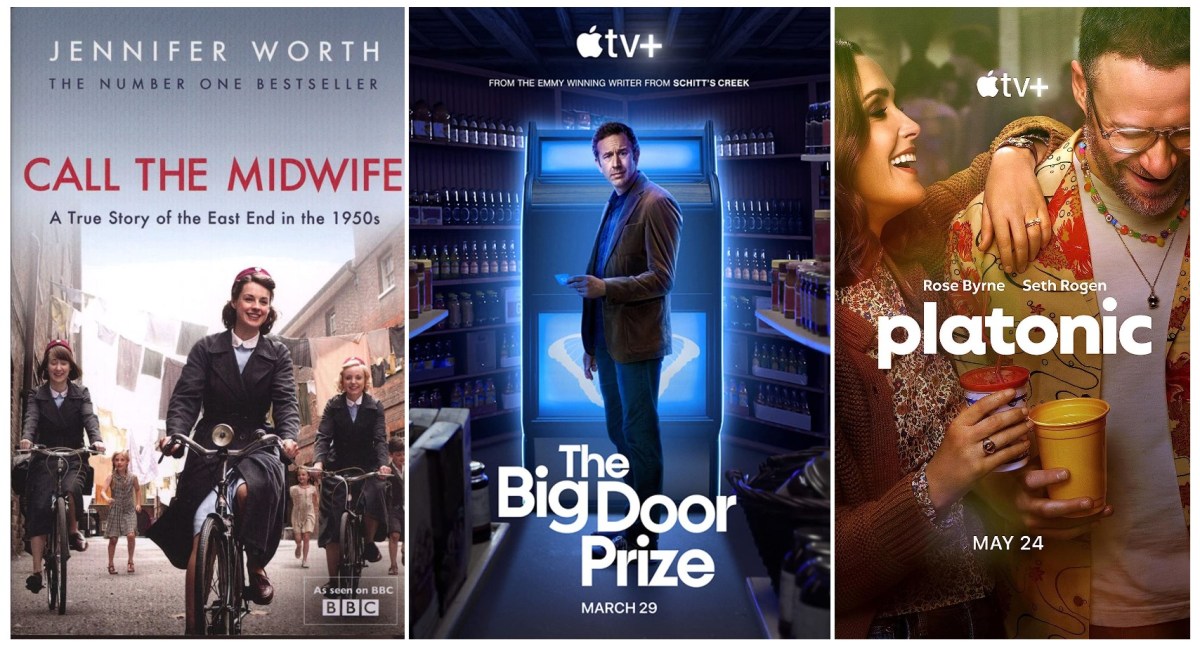
Unless I have someone to watch TV with, I end up watching YouTube videos, and maybe an old movie once a month. So I’m grateful when Susan is willing to watch TV with me. As we’ve gotten older our taste in television has diverged significantly, so it’s hard to find shows we’ll both watch. Currently, we’re watching Call the Midwife (Netflix), The Big Door Prize (AppleTV), and Platonic (AppleTV). And, about once a month, we have three friends over to binge-watch four episodes of Ted Lasso (AppleTV).

Susan and I seem to share a love for British TV, or at least a certain type of British TV. Last year we started our 9 pm TV watching with Downton Abbey, then went to Upstairs, Downstairs (old and new), All Creatures Great and Small (old and new), and The Marvelous Mrs. Maisel. We’re continuing with Call the Midwife. Most of the British PBS shows have a certain feel to them. Especially since Call the Midwife and All Creatures Great and Small are TV shows based on memoirs about English life in the mid-20th century. And Downton Abbey and Upstairs, Downstairs have a definite historical feel. The Marvelous Mrs. Maisel was about mid-20th century American life. So we might like shows with a sense of history.

While my sister was here for a week, she got us hooked on Platonic, and that caused us to try The Big Door Prize.

It’s interesting to contrast the two British TV shows, Call the Midwife and All Creatures Great and Small, set in the past, with the two American shows, Platonic and The Big Door Prize, set in the present. The British shows are heartwarming and focus on people who help other people, while the American shows are focused on people who are focused on themselves. The Marvelous Mrs. Maisel is set in the mid-20th century but is very different from those other shows. I’m not using it in the comparisons below.

The British shows are about people who work long hours at very hard jobs and do a lot of sacrificing for others, while the American shows are about frivolous life after work where the characters spend a lot of time in self-doubt, worrying about their relationships, while trying to find something meaningful in their lives.

The British shows, focus on the grittier aspects of life, while the American shows lean towards the fantastic and fanciful. In The Big Door Prize, a small-town community wakes up to discover a magical machine in their local grocery that tells them their potential. While Platonic is about a man and woman rekindling their friendship after many years. In both shows, the setup leads to quirky characters dealing with quirky new situations. Is it me, or does that suggest Americans are bored?

By the way, Susan and I both enjoy Platonic and The Big Door Prize, but we’re not wild about either. While I fill idle hours with YouTube videos, Susan fills her time sewing and watching old favorite sitcoms (M.A.S.H., Andy Griffith, Friends) and feel-good dramas (The Gilmore Girls, Grey’s Anatomy). The shows we loved most while watching together have been the British shows that originally appeared on PBS and The Marvelous Mrs. Maisel.

We’re only in the 4th season of Call the Midwife, and it currently has twelve in total, so we’ll have plenty of TV for several weeks. But after that, we’ll be searching for something new to watch. We’re open to suggestions — but consider our track record. I’m not sure how many TV shows exist about hard-working self-sacrificing people based on memoirs.

I think Susan and I are burned out on television so it’s very hard to find something new to watch. Neither one of us care about mysteries, thrillers, or police procedurals. And I’m tired of my old favorite themes of Westerns and science fiction. We both loved Downton Abbey and The Marvelous Mrs. Maisel but shows like those are rare.

JWH

Do You Remember the Childhood of Famous Americans Series of Biographies Written for Children?

by James Wallace Harris, 6/12/23

Over the years, my friend Linda and I have nostalgically recalled a series of books we both read in elementary school. They were biographies aimed at kids, but that’s all we could remember. We both wondered why we never saw them in used bookstores, or libraries, or met other people who fondly recalled them?

These books came up again on Sunday, and I did a Google search and discovered they were books published by Bobbs-Merrill starting in the 1930s. The series was called Childhood of Famous Americans. Linda and I remembered them being blue, but in my search, I found many people remember them as the “orange books.”

Well, this site solved that mystery, claiming there were 220 in the series, and showed photos of how they looked different over the decades. Some of them were orange and others were blue. They also had uniform dust jackets with numbers. Those numbers appealed to me. They made me want to read them all. However, I doubt I read more than 10-12 of them. Linda claims to have read far more, but then she was a much bigger bookworm in elementary school than I was. Linda and I both remember the yellow decoration about the blue book below.

Evidently, this series was intended to provide patriotic reading for young readers. I was already a patriotic little kid when I discovered them. My father was in the Air Force, and we were living on Homestead Air Force Base, and I discovered them in 1962 in the Air Base Elementary. I was in the 5th grade. My teacher was Mr. Granger. He was a WWII vet, who had been in a Japanese prisoner-of-war camp. Mr. Granger had lost a leg in the war and had a wooden one which the class found fascinating. Sometimes Mr. Granger would step on our feet not knowing it, and we all would never let him know. Mr. Granger told the class lots of interesting stories. It would have been interesting to have a biography of Mr. Granger.

I became a bookworm that year. Linda says she became a bookworm in the first grade, but I didn’t discover books until summer school between the third and fourth grades. I was sent there because they thought I couldn’t read. On the first day, the teacher said to pick out a book from a twirling wire rack and I found a kid’s version of Up Periscope. It turns out I could read. They just had never given me anything worth reading before.

In the fourth grade, I slowly started getting into books. I liked nonfiction books about war, planes, dogs, and nature. We moved to Homestead for the 5th grade and I had access to two libraries: the base library and the school library. I loved Homestead Air Force Base Library, and have written about it before. It was while I regularly used these two libraries that I became a bookworm.

The Childhood of Famous Americans was the first book series I got hooked on. They may have caused my lifelong love of biographies, or my biography-loving genes first discovered biographies there.

I remember reading bios of Ben Franklin, John F. Kennedy, Jim Thorpe, George Washington Carver, and I think Betsy Ross that are in the series. I’m pretty sure I read several others but don’t recall specific memories. I also remember reading a biography of Blackjack Pershing then but he doesn’t seem to be in the series, so maybe there were other biography series for kids.

This page at LibraryThing lists 208 books in the series, with links about them, and gives the totals for people owning them in their collection. Few people owned them, but some titles have huge numbers of likes. That suggests there are plenty of people like me and Linda who remember them.

The series ran for a long time, and have been reprinted in paperback, and inspired other series. Some publishers have even tried to restart the series.

I can’t remember any exact details from the books, but reading about them while researching this piece, it seems they were a mixture of fiction and nonfiction. Some writers have called them problematic for both conservatives and liberals. All this book banning is making people overly sensitive about books.

I’ll keep an eye out for Childhood of Famous Americans books at the library bookstore and see if I can find some to read. I wonder if I can document any instances of them that were the seeds of my current philosophy?

Did you read any of the Childhood of Famous Americans books? Leave a memory in the comments.

JWH

Beatlemania in 2023

by James Wallace Harris

Yesterday, when our friend Leigh Ann came over to play our weekly game of Rummikub with Susan and me, and they started telling each other what they’d done this week, I felt rather mute. I feel I don’t talk as much as I used to, and that getting old has left me with less to say. But aging might not be the cause because some of my friends talk even more than they did when they were younger.

I thought I had a very exciting week but I couldn’t put it into words. I guess that’s why I blog, to find ways to put things into words. All I was able to say was I was going through a phase of Beatlemania. But that didn’t come close to meaning what I wanted to say. For someone observing me, I would look like I wasn’t doing much the last few weeks, sitting around doing nothing but thinking, watching TV, reading, or listening to music. But inside my head, things are hopping, at least to me, but here’s what I was thinking.

Why do we love the things we love? Why do we devote time to the activities we do and not other activities? Why do we remember some things and forget other things? For the past few weeks, I’ve been exclusively listening to albums by The Beatles every day and finding great enjoyment in their music. I was a fan of The Beatles back in the 1960s but never a fanatic. I can go decades without playing their albums, but three weeks ago I signed up for Apple Music and started streaming Beatles albums again, playing, two or three a day.

After I got hooked on Beatles music again I also started listening to a 44-hour biography of The Beatles, Tune In by Mark Lewisohn. That led me to ask: What are the best books on The Beatles? I found The Beatles and The Historians by Torkelson Weber. Finally, I also got hooked on watching documentaries about The Beatles too — YouTube is full of them. Beatlemania thrives online.

Why am I undergoing a Beatlemania phase in 2023? How can songs from five and six decades ago give me so much pleasure now? I’ve been thinking about that while I listening, and a number of reasons have come to mind.

#1 – Forgetting Our Hateful Times

Buddhists and Hindus teach that we should be here now. Now for me is retirement in an older middle-class suburb. I don’t have much to do other than maintain my declining health, coexist with my wife and two cats, and take care of an aging house and yard that needs more and more upkeep. I suppose I could find a kind of Eastern beatific bliss in just doing that, but my Western mind wants more. If I take in news about the larger world via television and the Internet, my reality is troubled by endless worries about things I have no control over but I can’t help but wish I could change. The most disturbing of these worries is how hate is taking over the world.

When I listen to The Beatles I escape all thoughts of that hate for a couple of hours. That’s quite pleasurable. This is also true when I watch The Marvelous Mrs. Maisel, All Creatures Great and Small, Downton Abbey, and other shows that let me forget the hate in the world. Reading old science fiction also works. These artistic works bring various kinds of beauty into my world.

One friend said that listening to music just triggers endorphins — that I’m just a dopamine junky. That might be where the rubber meets the road but it doesn’t explain where I’m going and why. This reminds me of “Fixing a Hole” by The Beatles, especially the lines:

I’m painting the room in a colorful way
And when my mind is wandering
There I will go

When I contemplate this I realize I’ve used these kinds of escapes my whole life to avoid aspects of reality I didn’t like. Knowing that made me realize that I can map events in my past along a timeline created by pop culture that is well documented by date and time.

#2 – I Love Reconstructing Memories

Looking back over a lifetime of avoiding reality is quite revealing. Wise people from history tell us the unexamined life isn’t worth living. Recreating what happened in my past through reconstructing memories is a form of examination.

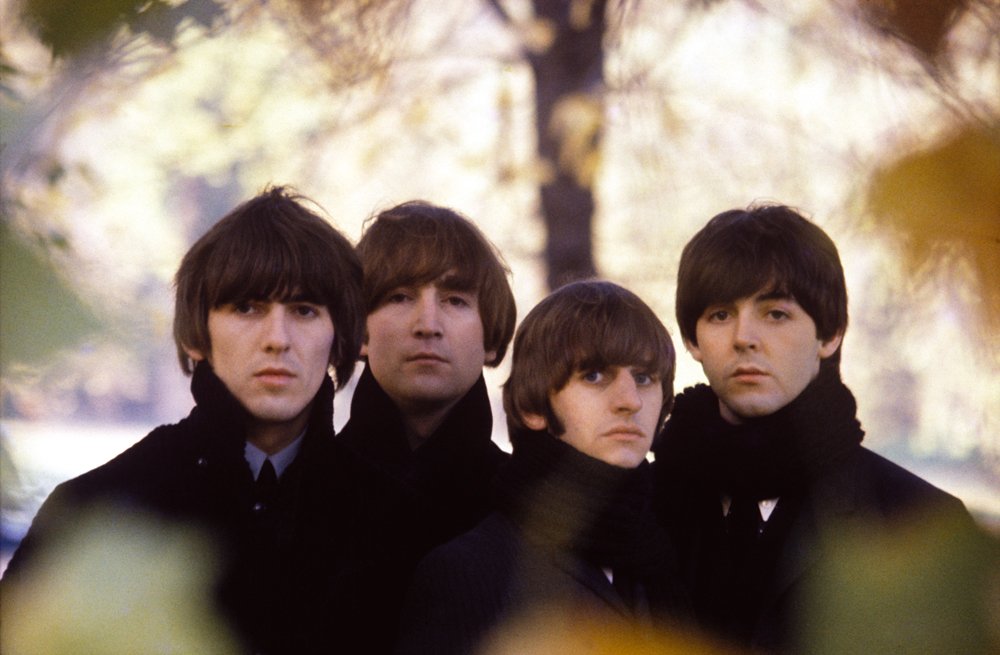
The second reason why I’m remembering The Beatles is that I can use their career as an external timescale for measuring events in my own past. They are like tree rings or carbon dating. For example, I know what I was doing on the evenings of the 9th, 16th, and 23rd of February 1964, because that’s when The Beatles first appeared on the Ed Sullivan Show. And those memories release other memories of that month to float up from my unconsciousness to my conscious mind. Because The Beatles were so often in the news I can use memories of those news events to recall what I was doing in my life between 1964 and 1970.

In this case, playing The Beatles albums over and over these past weeks reminded me of 1964. I now see something different that I didn’t realize then. I moved to South Carolina just days after the assassination of JFK. I was starting my third 7th-grade school in the Fall of 1963, moving into my 3rd house, I hadn’t yet made any friends, and my alcoholic parents had begun fighting. We were all mourning the president, and the beginning of 1964 was a very weird time nationally with the funeral and as LBJ took over.

Beatlemania hit in February of 1964 and it seemed like magic. My mood, and maybe even the mood of the country changed. At least it did for many of us kids. Even though South Carolina was the worst time for my parents I started having a good time, and living there became one of my favorite memories. If I think hard and dredge up other memories, I can dredge up other bad memories, but my sister Becky and I made friends, and we had a lot of fun that year. We played outside a lot. I hadn’t gotten addicted to science fiction yet, and I don’t remember watching much TV that year. What I remember is The Beatles and all the other music that came out in 1964. During the 1960s, AM radio, science fiction, and television produced most of my endorphins.

Looking back I remember the Sixties very fondly, but if I go to Wikipedia and read the history of the decade it was horrible. There were just as many hateful people back then as there are now. I realized that The Beatles were constantly in my awareness, releasing new singles and albums, and doing things that got them on TV and in the news. Listening to their music these weeks I realized that I hadn’t paid much attention to the lyrics back then, but I found their music upbeat and uplifting and knew that’s what they did for us back in the Sixties too.

#3 – Growing Up in the 1960s

While listening to all of The Beatles albums from Please Please Me to Abbey Road this week, I observed the Fab Four maturing as creative artists and I recalled parallels in my own growing maturity. The kid who rocked out to “I Want To Hold Your Hand” was also watching My Favorite Martian. I wasn’t very mature, and neither were The Beatles’ songs. Most of their early tunes were about teen love, but then most of the songs on AM Top 40 in 1964 were also about teen love. I turned 13 in late 1964, so that was a preoccupation of my own mind.

The Beatles were never protest singers like early Dylan and a lot of American rock and roll bands. Although, John Lennon did go heavily in that direction after leaving The Beatles. Their song “Revolution” was a kind of protest song put down. This week I was surprised by how quickly their songs changed to topics other than love, and when they were about love, they left teenage life behind and were about work and relationships of people in their twenties.

Young people often enjoy works of fiction where the protagonists are slightly older than themselves. The Beatles and Bob Dylan were about a decade older than I was. They were not Baby Boomers. They were digesting experiences ahead of me and their music was a kind of guide to aging for my teenage self.

As I play the music from 1962 to 1969 now, I can recall how I grew and the music grew. The Beatles were only #1 with me in 1964 and part of 1965, because in July 1965 Bob Dylan’s “Like a Rolling Stone” hit the charts, and he took over the #1 spot. Eventually, The Byrds pushed The Beatles down to #3, and then Simon and Garfunkel pushed them to #4, and then Jefferson Airplane and a zillion other bands vied to be my favorites. Each artist had their own philosophical insight into the decade.

The third reason why I’m remembering The Beatles is to recall the growth of my maturity as a person. It’s understandable that my 12-year-old self would respond to “I Want To Hold Your Hand” in early 1964 but my 13-year-old self would much prefer “I’m A Loser” in 1965 or my 16-year-old self would resonate with “While My Guitar Gently Weeps” in 1968. But this is harder to understand and requires remembering the other music I loved during those years. The Beatles evolved as creative artists from year to year, and so did all other creators of popular music, as did all of their fans.

What’s interesting now is when I watch TV shows I loved back in 1964-65, like Gilligan’s Island or The Beverly Hillbillies, I internally cringe to think I was once so simple-minded to enjoy them. But I don’t cringe at hearing the early simple songs of The Beatles. I should cringe when I hear “I Want To Hold Your Hand,” but I don’t. Why?

#4 – What If Things Had Been Different?

The fourth reason why I’m remembering The Beatles is that I’m trying to reconstruct possible alternative personal histories of the 1960s. Our formative years are always shaped by the times in which we grow up. Nearly everyone is programmed for life by external influences when they are young. How would I have been different if I had imprinted on Bob Dylan in 1964 rather than The Beatles? Or Miles Davis? Or Beethoven? Pop culture does a number on us, in essence, it’s a kind of brainwashing. Think about how the political right is up in arms over the Woke culture of today and how they don’t want it to shape their children. If you remember the generation gap, you’ll remember how there was some generational resistance against the pop culture of the 1960s too.

The fourth reason why I’m remembering The Beatles is harder to explain, but I’ll give you a thought experiment. What if I could reincarnate in my 12-year-old body but with my present mind, how would I relive 1964-1969? Sure, I still love listening to The Beatles today, but isn’t that conditioning and nostalgia? If I was back in 1964 with my 71-year-old mind, I’m not sure a song titled “I Want To Hold Your Hand” would be that appealing. Even if I was in a 12-year-old body, I wouldn’t want to live through being a teenager again. Then why am I doing it now? Reviewing the past now gives me a chance to think about what else might have been interesting about the Sixties. This makes me wonder why I wasn’t more mature back then.

And the truth is I was interested in all kinds of other things but I’ve mostly forgotten them. Remembering The Beatles is a way to try and remember those other things. We can call this the fifth reason. Of course, there were other songs and musicians, but there was so much more. We remember the past through the highlights that have stayed with us or our collective history. But what were the mundane things I was doing just before or just after playing The Beatles?

I can vividly remember a time I was listening to “Hey Jude.” I had just gotten off work at the Kwik Chek in Coconut Grove, Florida, where I was a stocker. I was sixteen and had worked my way up from bagboy to stocker. I had just spent six hours after school shelving the canned foods on the vegetable aisle. I was driving home from work in an old 1958 Mercury at ten o’clock at night. I had the windows down. I was hot and dirty, drinking a 16-ounce bottle of ice-cold Coke and it tasted great. “Hey Jude” came on, and it sounded better than any time I had heard it before or probably since. It was my favorite song on the radio at that time. I was driving along Old Cutler Road, which wasn’t lit with lampposts, and the dark was eerie and surreal driving under old mangrove trees near Matheson Hammock while listening to “Hey Jude” turned all the way up.

#5 – History

I guess the fifth reason why I’m remembering The Beatles is their history is so fascinating that I just want to know more about them. There are certain subjects that fascinate me that make me want to become an amateur historian or biographer. I never stick to these subjects long, but I always come back to them. These topics are like million-piece jigsaw puzzles I work on from time to time.

I love reading books and watching documentaries about my favorite subjects. I love going deeper and deeper into a topic. It’s both psychologically and philosophically rewarding. The depth of detail and research in Tune In is remarkable. But also reading The Beatles and the Historians is teaching me a tremendous amount about understanding memory and analysis of the past. It teaches me a bit about being a historian. If you want to know more about this book I highly recommend watching this YouTube review.

We all delude ourselves. We all have faulty memories. We should never trust our own opinions. Studying how historians evaluate the data they collect is applicable to studying how we perceive the world. And reading an in-depth biography like Tune In helps me mentally construct my own biography in more greater detail.

#6 – It’s Not Nostalgia

I’ve always looked backward. And sometimes I do have a longing to return to the past. But I also know that the past had more bad things that I’ve forgotten than good things that I remember. One thing I’ve noticed while playing these Beatles albums over and over is how little I recall them. I’ve been able to recall enough memories about how I reacted to The Beatles in the 1960s to remember that I didn’t play their albums that much, and I mostly heard their tunes on the radio. I bought the albums, and some of the singles, but I didn’t play them over and over again like I did Bob Dylan or The Byrds.

And I have gone through smaller bouts of Beatlemania over the decades. The first time was when their albums came out on CDs and I bought them again. Then bought them a third time when those CDs were remastered. During those periods I also read about The Beatles and watched documentaries that summed up their career. Each time playing their music from the past meant more to what I was doing in the now. I wasn’t just reliving the past. Their music has a weird kind of lasting power.

#7 – Self Revelation

I don’t believe in an afterlife. Until I’m proven wrong I assume this life is all we get. And it troubles me that we forget so much about our one life. We forget due to inattention. Nor do we pay attention to what makes us who we are. Quite often we chase illusions rather than face up to reality. We exist by reacting impulsively to a never-ending parade of random events. I’ve become obsessed with figuring out who I am by remembering what I did in the past and why. I use the lessons of memory to trigger revelations about myself with the final goal of knowing who I am today.

Strangely enough, I’m finding such revelations in The Beatles. Why am I playing them now after ignoring them for years, or even decades? Lately, I can play Beatles albums for one to two hours and find a kind of bliss.

While I’m strung out on the endorphins The Beatles music pumps into me, my mind is racing with thoughts. Memories and connections burble up out of my unconscious mind. I might look like I’m doing nothing, but it feels like I’m more active than when I’m running around doing something very physical.

JWH
Why Didn’t I Hear The Beatles in 1963?

by James Wallace Harris, 5/25/23

I’ve been playing The Beatles all this week and I noticed something that has me thinking about it a lot. The first two Beatles albums Please Please Me and With the Beatles came out in 1963 in the United Kingdom but I didn’t hear them until after February 9, 1964, when The Beatles appeared on the Ed Sullivan Show. Obviously, some Americans heard Fab Four songs before then because there were mobs at the airport and 73 million people watched Ed’s show that night.

When do you remember first hearing the Beatles? I got interested in those dates because I was going to write an essay about what I remembered about The Beatles from 1964, but it bothered me I was recalling my 1964 but the tunes were from 1962 and 1963. America and England were out of sync by over a year.

Why hadn’t I heard the Beatles on the radio in 1963? Starting in 1962, I listened to Top 40 music several hours a day on WQAM and WFUN AM radio stations in Miami, so I should have heard The Beatles’ songs if they were released. I just don’t remember hearing them at all in 1963.

Love Me Do/P.S. I Love You” was released in England on October 5, 1962, but not until April 24, 1964, in the U.S., when it reached #1 on the Billboard Hot 100 chart. Beatlemania could have started in late 1962, or early 1963 — why didn’t it?

“Please Please Me/From Me To You” was the Beatles’ 2nd single in England, released on January 11, 1963. It reached #1 on the New Music Express and Melody Maker charts. “Please Please Me/Ask Me Why” was the first Beatles single released in the United States on February 25, 1963, but failed to chart. Some radio stations around the country played this single but it got no screaming fans and was forgotten. “Please Please Me” reached #35 in Chicago on March 8 on their local charts, and again on March 15, but disappeared after that.

“Please Please Me/From Me To You” was re-released in the U.S. on January 3, 1964, and made it to #3 on Billboard. Again, it was obvious that Americans loved the Beatles, but why did we wait until 1964 to love them? This makes me want to write an alternate history science fiction story about Beatlemania hitting America during Christmas of 1962. And it can’t be all Capitol’s fault.

Three more singles by the Beatles were released in the U.K. in 1963: “From Me To You/Thank You Girl” on 4/11/63, “She Loves You/I’ll Get You” on 8/23/63, and “I Want To Hold Your Hand/This” on 11/29/63. Did Americans visiting England bring back these singles and albums? Weren’t there any word-of-mouth from the jet setters?

According to Wikipedia, 34 songs were recorded by the Beatles in 1962 and 1963. Capitol turned down the opportunity to put them out, and a little label, Vee-Jay snapped up the rights. Vee-Jay planned to release Introducing… The Beatles, a repackaged of the UK album Please Please Me in July of 1963, but Vee-Jay didn’t get it out until January 10, 1964. Then Beatlemania hit and Capitol took back the rights.

Theoretically, I could have heard some of the Beatles songs in 1963 on WQAM or WFUN in Miami, but I don’t think so. What if Beatlemania had arrived a year earlier? Would that have launched The Sixties sooner? The 1960s up until the assassination of John F. Kennedy on November 22, 1963, never felt like the legendary times we call The Sixties. 1960 to 1963 felt like the 1950s.

The Sixties, at least to me, began when The Beatles appeared on Ed Sullivan. Seeing them that night felt like Dorothy opening the door in The Wizard of Oz when the film went from black and white to Technicolor. The magic of the Sixties ended for me with Charles Manson and Altamont. In 1970, The Beatles broke up, my father died, and I moved from Miami to Memphis. That’s when I felt The Seventies began.

I was going to write an essay comparing The Beatles’ first two albums against their competition. In America, our first two Beatles albums in 1964 were a mixture of songs from the UK 1963 albums and 1962-1963 singles plus some cuts from the third and fourth British Beatles albums recorded in 1964. It’s all rather confusing if I wanted to understand music as a product of its times.

Here’s an overview of what The Beatles were doing in 1963. As they were writing those songs, or doing covers of American songs, it was 1963. But they made a social and psychological impact on us in 1964. That delay fascinates me.

This week I played all the Beatles albums from Please Please Me (UK 1963) to The Beatles (White Album) (UK/US 1968). I can play all the albums through Sgt. Pepper’s Lonely Hearts Club Band (1967) over and over and did this week. All the songs appeal to me. Each album was a unique masterpiece. Things completely fell apart with The Beatles (White Album). (George Martin and others thought it should have been a single album. I agree completely. The White album feels like a single album with a bunch of outtakes and demos.)

Even though I loved all those Beatles albums through 1967, I’ve only put a few of their songs on my Top 1000 playlist on Spotify. I’ve been wondering why for a long time. I want to compare The Beatles’ songs to the hits that came out at the same time that I love better. But when I saw the dates when the first two albums came out were from 1963, I wondered if should I compare those songs to songs coming out in 1964 when I first heard those Beatles songs, or to songs that were coming out in 1963 when The Beatles recorded their songs?

As I listened to the Beatles’ albums this week it was obvious with each album John, Paul, George, and Ringo progressed in creative sophistication. But then so did pop hits each year. In America, those 1964 Beatles releases stomped the 1964 American releases. But shouldn’t they be compared to 1963 songs?

Finally, could I have heard some Beatles songs in 1963 and they just made no impact on me? Did it take Beatlesmania to get us to love The Beatles? And could the reason I put so few of their songs on my Top 1000 playlist is because Beatlesmania and The Sixties ended in 1969?

JWH

Developing a Healthy News Diet

by James Wallace Harris, 5/21/23

Michael Pollan created a small book about eating healthy called Food Rules. As an analogy, I’d like to create a set of sensible rules about consuming the news. Pollan distilled his list of rules down to three simple sentences, “Eat food. Not too much. Mostly plants,” but it really takes reading his book to understand that mantra.

What I would like to do is develop a similar simple mantra about my daily news consumption but I’ll have to work out the details first. Pollan emphasized eating whole foods rather than processed foods. Is there such a thing as whole unprocessed news? “Not too much” is an obvious target since we obviously consume too much news. Finding an analogy for “mostly plants” will be interesting.

What would be the equivalent of nutritious news? Experience has taught me that some news is unhealthy, and I often get news indigestion. I also admit I’m bloated and overweight from too much news consumption.

Like whole food and junk food, we prefer junk news over whole news. I spend several hours a day nibbling on news from many sources. Most of which is forgotten immediately. I wonder if my first rule should be:

#1 – Ignore easily forgettable news

We’re used to clicking on anything that catches our fancy while idling away moments on our smartphones. Essentially, this kind of news is gossip and titillation. Basically, we’re bored or restless. We should use that time in better ways, especially if it exercises our minds. Read real news instead. Or, do something active. Playing games, listening to music, or audiobooks, is more nutritious than never-ending bites of clickbait.

Everyone bitches about information overload but who does anything about it? I’ve learned from intermittent fasting that my body appreciates having a good rest each day from eating. I believe I need to apply the same idea to news consumption.

#2 – Limit your hours consuming the news

I find 16:8 fasting works well for eating. I’m thinking of a 22:2 fast for news is what I’m going to aim for at the moment. Two hours of news consumption a day might sound like a lot, but if you add up all the forms of news I consume including television, magazines, online newspapers, YouTube, and news feeds, RSS feeds, I can easily go beyond two hours.

We should also separate news from learning and entertainment. Learning something new could be considered a form of news. I’m not going to count educational pursuits in my news time. And if you enjoy reading nonfiction books or watching documentaries on TV, that shouldn’t count as news either. However, shows like 60 Minutes, CBS Sunday Morning, and The Today Show can be considered informative entertainment news. Some people just prefer news shows for fun rather than watching fictional shows. I’m not sure if they should count or not.

What we really want is to stay informed about the world so that we interact with reality wisely. Humans have an extremely difficult time processing information. We think we’re far smarter than we are. We constantly delude ourselves. And we think our opinions matter when 99.999% of the time they don’t. Most people think they are experts on countless topics after having consumed just a few hours of news. They think they know better than real experts who have put tens of thousands of hours into studying their specialty.

#3 – Stop assuming you know anything

I believe the real key to understanding the news is being able to tell the difference between opinion and significant data. The real goal of news consumption should be finding the best data, and that means getting into statistics.

Unfortunately, the news industry is overwhelmed with talking heads. Everyone wants to be an expert, and all too often most news consumers tend to latch onto self-appointed experts they like. News has become more like a virus than information processing.

I read and watch a lot of columnists and programs about computers, stereo equipment, and other gadgets. Most are based on personal impressions of equipment individuals have bought or been loaned from manufacturers. These tech gurus are a good analogy for what I’m talking about. Most of the news we take in daily is from individuals processing limited amounts of information and giving us their opinion. What we really want is Consumer Reports, Rtings, or the Wirecutter, where large amounts of data are gathered from a variety of sources, and statistically analyzed.

This is just a start on designing my news diet. I want to keep current on a long list of topics, but that’s like learning about all the vitamins and nutrients my body needs. News nutrition will be a vastly more complicated topic. What are the essential vitamins I need every day? Is it politics, national and international affairs, economics, crime, immigration, ecology, etc?

Do I need to know about everything? Is that what an informed citizen needs to do? Take immigration. Is anything I think about immigration affects the situation at the border? Does voting liberal or conservative even affect anything at the border? I can barely maintain order in my house, why should I believe I can organize all of reality on Earth? Maybe my last two rules should be:

#4 – Know my limitations

#5 – Pursue the news I can actually use

Like nutrition, news is a complicated subject that’s hard to understand and can easily confuse.

JWH